Category: Opera

  • HANSEL & GRETEL at The Met

    KLsideshot

    Wednesday December 21, 2011 – The presence of a number of intriguing names in the cast (led by Kate Lindsey, above, as Hansel) drew me back to the Met’s dark and not very pleasing production of HANSEL & GRETEL which is playing during the holiday season. It’s a far cry from the Met’s older production with its fanciful gingerbread house and jolly, green-tongued witch, Rosina Daintymouth. In the current incarnation the characterizations of both the witch and the parents are based on infamous British serial killers. There’s little magic to be found visually…

    Met_Opera_Hansel_Gretel_31_medium

    …though a couple of nice images crop up here and there, like the phalanx of chefs (above) who serve a feast to the starving children. But for the most part the production is earthbound and lacking in fantasy.

    What drew us to see it again – in addition to the singers – was the music itself (Humperdinck greatly admired Wagner), as well as a conductor new to the Met podium: Robin Tacciati . He provided appealing orchestral textures all evening and his interpretation brimmed over with emotionally satisfying colours. Unfortunately, his first act seemed rushed and he often let the large orchestra overwhelm the voices.

    HanselGretel1112.06

    As the two children, Alexandra Kurzak and Kate Lindsey (above) entered fully into the demanding staging of the work which calls for lots of physicality, dancing and mime…and getting plastered from head to toe with foodstuffs from the witch’s kitchen. Kate was virtually slathered in pudding and jam, then plentifully dusted with cocoa and powdered sugar. Alexandra staggered around the set with a huge platter of melting chocolate cookies and a bowl of custard. She continues to sing while stuffing various sweets into her mouth. Sticky fingers? Who needs Mick Jagger? 

    Despite all the things they are called on to do and eat, both Alexandra and Kate managed to sing very well into the bargain. Alexandra’s voice has girlish, lyrical appeal and even though the orchestral volume forced her to push the voice in a couple of spots, her Gretel was very prettily sung, especially in her exquisite vocalizing of the famous prayer. Kate has one of the truly distinctive voices in the opera business these days and her singing is impeccably tailored, warm and clear. As hansel, she is a truly convincing boy onstage, expanding her repertory of trouser roles: her Cherubino and Nicklausse were perfect, her Siebel’s coming up, and I’m longing for her Octavian. But she shouldn’t spend her whole life in pants, she’s far too pretty: so I hope we will have her Rosina and Dorabella soon, and I’d love to see her as Berlioz’s Beatrice.

    HanselGretel1112.09

    Robert Brubaker, a teriffic Mime in SIEGFRIED at the Met a couple of seasons back, was a huge-voiced and creepy Witch. It’s so eerie to hear his voluminous character-tenor sound emanating from the frumpy old biddy in a fat-suit. Robert was superb and, like Kate and Alexandra, simply threw himself into the production’s food fantasy. Photo above: Robert Brubaker and Alexandra Kurzak.

    HanselGretel1112.02

    As the parents Peter and Gertrude, Dwayne Croft and Michaela Martens (above) excelled. They have authentic Met-size voices and took the waves of sound coming up from the pit in their stride. I’ve always loved Dwayne Croft’s voice since I first heard him as Puccini’s Marcello at Glimmerglass many moons ago. He sounded fabulous tonight. Dmitry and I are very fond of Ms. Martens and she sang with power and attractive tone as the desperate mother. If the Met management had any imagination, Michaela would be doing roles like Fricka, Venus, Brangaene and the Berlioz Cassandra here. I could even imagine her as a very fine Sieglinde.

    HanselGretel1112.07

    Ashley Emerson (above) was a delicious Dew Fairy, a petite elfin maiden with tiny Sylphide wings. Her singing was bright and light-filled, a perfect wake-up call. She carries on a tradition – both in-house and on recordings – of casting wonderful singers in the opera’s two cameo solo roles. Her evening counter-part was the Sandman of Jennifer Johnson Cano who sang very nicely indeed.

    The musical pleasures of the evening were offset by the overall drabness of the production. There were lots of empty seats throughout The Met so word must have gotten out that this is not a festive holiday treat with an underlying moral message but rather a grotesque take on a story and score which should be heart-warming but instead leaves us slightly nauseous.

    A major failure of stagecraft comes hear the end when the many children who had been under the witch’s spell are set free. The director apparently couldn’t think of any better way to handle this than to lower the curtain on an empty set and then bring it up again 30 seconds later on a stage filled with two dozen urchins. Then the uplifting melodic benediction launched by Peter as the work comes to an end failed to resonate because there was no context of religiosity anywhere else in the production.

    Act I takes place in a desolate kitchen where Hansel and Gretel seem like manic-depressives and where Gertrude is on the verge of committing suicide. The scene in the forest is instead set in a large empty hall with green-leaf wallpaper. It’s too dim, and nothing seems to be happening til the old Sandman and  – later – the chefs arrive. The witch’s kitchen is drably industrial and she is played like an over-the-top drag version of Julia Child, flingling flour and powdered chocolate all over the place. Candy, pudding and strawberry preserves are smeared on Hansel and Gretel, and Hansel is trussed up for roasting. The scene is vulgar and not funny in the least though it is broadly played. 

    The English translation is very Brit-oriented and, thanks largely to the over-enthusiastic conducting, much of it didn’t register. I’d like to see the Met dump this production and give us a more attractive, kid-friendly look at this opera. It should cast a Christmastime spell of hope and familial love; instead it only reminds us of the American knack for wasting food while children right here in Gotham don’t have enough to eat.

    Production photos: Mary Sohl/Metropolitan Opera.

    Metropolitan Opera House
    December 21, 2011
    In English

    HANSEL UND GRETEL
    Humperdinck

    Hansel..................Kate Lindsey
    Gretel..................Aleksandra Kurzak
    Gertrud.................Michaela Martens
    Peter...................Dwayne Croft
    Witch...................Robert Brubaker
    Sandman.................Jennifer Johnson Cano
    Dew Fairy...............Ashley Emerson

    Conductor...............Robin Ticciati

    The evening ended on a sweet note when I went backstage to see Kate and Ashley; I met both of them when they were in the Lindemann Young Artists Development Program at the Met and I’m very pleased to be following their successful careers. It was also nice to wish happy holidays to Michaela Martens and Dwayne Croft.

  • Alto Rhapsody: Mildred Miller

    MillerNozze

    Above: Mezzo-soprano Mildred Miller as Cherubino in LE NOZZE DI FIGARO. Photo: Sedge LeBlanc.

    Every year ar Christmas approaches I find myself wanting to hear the Alto Rhapsody of Johannes Brahms. I am not quite sure what it is about this unusual and unique vocal/choral work that suggests Christmas to me because the text has nothing to do with Christ’s birth. But it is about a Winter journey, and about hope and spiritual refreshment; maybe those are thoughts that should come to mind this time of year.

    Brahms wrote this work – I suppose we could call it a cantata – in 1869 as a wedding gift for Julie Schumann, daughter of Robert and Clara Schumann. Brahms is thought to have been in love with Julie. It was first performed privately but in 1870 it was heard by the public for the first time in a concert at Jena where the soloist was Pauline Viardot. (Viardot looms large in my musical imagination; hers is the one voice from out of the past that I most dearly wish I could hear; and how I would love to have met her…her, and Lillian Nordica!).

    The Alto Rhapsody begins with a sort of narrative for solo voice in a minor key; it seems a bit bleak, well-suiting the poetic image of a lost soul wandering in the desolation of a lonely landscape. The mood lifts as the chorus joins in, hymnlike and now in major-key mode. The music is tranquil, luminous, joyful in a calm way. The solo voice intones the melody against the choral harmonies – gorgeous – and the piece ends with a sort of benediction that has the effect of an amen.

    The Alto Rhapsody is not often performed in concerts these days. For symphony orchestras it means hiring a chorus in addition to the soloist, and for choral societies it’s a little difficult to program as it is a bit too short to be half of the bill, and you need to think of something else for your guest soloist to sing during the evening. I’ve only experienced it once in a concert hall.

    Many great singers have recorded the Alto Rhapsody: Kathleen Ferrier, Marian Anderson, Dame Janet Baker, Christa Ludwig, Marilyn Horne. I have Ludwig’s lovely rendition, and up til a couple years ago I would often break out Sigrid Onegin’s recording. But that magisterial performance is somewhat dampened by the singer’s tendency to be ever-so-slighly off-pitch at times. This year I decided I wanted a different recording and so I went to Amazon to peruse the listings and very quickly settled on the SONY recording with mezzo-soprano Mildred Miller, conducted by Bruno Walter. I got it for a bargain price, paired with the same composer’s Deutches Requiem.

    When I had a bit of free time the other day, I slipped the disc in and found the recording to be just perfect in every regard. The sound is warm, full and plush, Maestro Walter is perfectly in his element, the chorus sounds heavenly and Mildred Miller is a complete delight. She doesn’t falsely weight her lower range; her timbre is feminine and not overly-maternal, and she avoids overdoing the angst of the opening passages. 

    Mildred Miller sang at The Met for 23 years, making more than 300 appearances. She made her debut as Cherubino in 1951 and went on to sing Suzuki, Nicklausse, Octavian, and the Composer in ARIADNE AUF NAXOS. By the time I encountered her in the 1960s she had settled into a repertoire of ‘major-secondary’ roles; I loved her as Annina in ROSENKAVALIER and the Second Lady in the Chagall ZAUBERFLOETE. She was my first ‘Lene in MEISTERSINGER in 1968, when she signed the cast page of my program:

    6a00d8341c4e3853ef014e88cbff12970d-800wi

  • Met’s 1961 TROVATORE on SONY

    886979100626

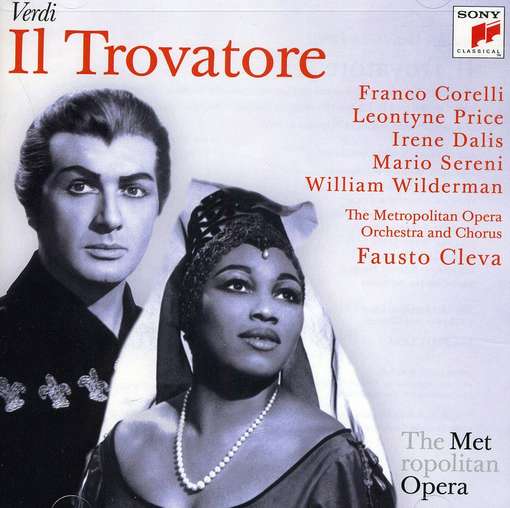
    The Metropolitan Opera on SONY series recently issued the famous February 4, 1961 TROVATORE broadcast with Leontyne Price and Franco Corelli which followed by a week their wildly acclaimed joint Met debut in the Verdi opera. The 1960-61 Met broadcast season was happening without my knowledge, otherwise I would certainly have been glued to my radio. But I did not discover the Met broadcasts until the following season when the fabled Sutherland ‘debut’ LUCIA was the first time I tuned in. From then until just a couple of years ago, I hardly ever missed a broadcast.

    I heard Price and Corelli many times at The Met – Leontyne I actually heard at the Old Met as Fiordiligi in COSI FAN TUTTE (in English) and Franco sang in the first performance I saw at the New Met (as Calaf in TURANDOT). I loved them both in those golden years though I knew Franco could be sloppy at times and Leontyne, over the years, developed some annoying idiosyncrasies. I’d never heard the 1961 TROVATORE so I set aside time to concentrate on it; I must say, it is a very erratic performance.

    Fausto Cleva, a favorite conductor of Renata Tebaldi, takes much of TROVATORE at a breathless clip. For the most part the singers manage to keep up though there’s some scrambling here and there. Aside from Leontyne Price, who strives throughout for thoughtful musicality, the principal quartet of singers tend to sing TROVATORE in verismo style rather than treating it like a god-child of the bel canto era. I suppose there’s a temptation to snarl and bluster in the opera’s dramatic utterances and in a live performance there is no recourse other than to let the singers do what they will in declaiming the text. But it becomes a bit tiresome after a while.

    Corelli is the most lachrymose Manrico I ever heard; he gives the same impression on his commercial recording of the role for EMI, though that is more artfully sung. Of course there is a lot of very powerful and exciting vocalism in his interpretation, but this is somewhat compromised by his melodramatic excesses. Upon receiving news that Leonora is to take the veil, Corelli has a little mad scene which wanders right off the musical map. But despite some slight variability of pitch at times, the utterly distinctive Corelli timbre and his sheer generosity of voice make him a Manrico on the grand scale. Interestingly, Corelli only sang this opera at the Met eleven times, retiring it from his repertory at the House in 1964. A new production in 1969 was reportedly planned for Corelli but in the event Placido Domingo was the Manrico.

    Leontyne Price on the other hand kept Leonora in her repertoire for over twenty years; the great aria “D’amor sull’ali rosee” might be considered the soprano’s theme song and she sang it superbly at the gala that closed the Old Met in 1966. The warmth and shimmering beauty of her timbre provide the vocal high points of this 1961 broadcast where she manages to maintain the Verdian line while her colleagues wander into melodramatic over-accenting of certain passages. For my money, Price was not a soprano with a first-rate forte top; she was best in the floating upper phrases of a role. Corelli drowns her out on the final D-flat of Act I, and her high-C at the climax of the Act IV duet with di Luna doesn’t have any zing to it. But overall it’s wonderful to hear the soprano in all her freshness in this music. Over the ensuing years Price developed a vocal ‘style’ that could be off-putting: growling in the lower register and introducing some bluesy mannerisms that could spoil her performances for me. You don’t hear these on her commercial recordings so much, but in the House she could be very self-indulgent. Nevertheless her singing could still thrill, right to her farewell operatic performance.

    I always loved the sound of Mario Sereni’s voice, so warm and attractive. For me he was at his best in verismo: his Marcello, Carlo Gerard and Tonio (PAGLIACCI) were all very fine; he did leave behind some wonderful studio recordings too, notably his Germont with de los Angeles and his Enrico on the RCA/Moffo LUCIA. But in this TROVATORE he seems way off form. I wonder in fact if he was actually originally scheduled for this  broadcast since Robert Merrill had sung di Luna in the Price/Corelli debut performance and sang it again in the next performance following the broadcast. Whatever the case, Sereni seems unprepared. He sings the wrong entry line in the first scene of Act III and gets lost in the recitative on his entry in Act IV. Some handsome singing along the way is offset by serious pitch problems in the great aria “Il balen”. It’s sad that this particular broadcast should be chosen as a document of Sereni’s live Met performances; I know I can never listen to it again.

    Irene Dalis was a great favorite of mine. She was a powerful stage presence and a singer who could be both passionate and subtle. Her performance is exciting but I feel of all the singers she may have been most put-off by Cleva’s fast tempi. In the Act III, Scene 1 finale Irene is pushed to the limits by the conductor’s absurdly rapid pace and it seems to me that she simply stops singing during the final bars of music. Her final scene is very impressive, though, with the quiet calm of her “Ai nostri monti” and a sustained high B-flat in her last triumphant, vindictive phrase. Ten years after this broadcast, I saw Irene’s Azucena at the Met during a June Festival performance. Despite the intervening decade of singing some of opera’s most demanding roles, she was in fact far more thrilling and vocally secure than on this 1961 broadcast.

    It’s good to have a document of William Wilderman’s performance of Ferrando; his ample and darkishly dramatic singing gets the opera off to a strong start. Teresa Stratas sings the brief role of Inez and there is no mistaking her voice. She strives to make something lovely of her phrase bidding farewell to Leonora at the convent, but Price trumps her by coming in a shade early and stepping on the younger soprano’s tapering piano.

    For all its flaws, listening to this recording reminded me of how much I love this opera. Despite its improbable plot, the vast treasury of Verdi melody makes TROVATORE essential.

  • Gertrude Grob-Prandl

    Gertrude grob-prandl

    While I was working at Tower, I got into a discussion one day with my boss and a couple of the other ‘opera people’ who worked there. We were naming favorite singers and in one breath I mentioned Nilsson, Rysanek, Behrens and Dame Gwyneth Jones. “Oh, so you’re a size queen!”, Bryan laughed. Well, not really…since I also loved people like Reri Grist, Patricia Brooks, Lucia Popp and Kathleen Battle. But if you want to stereotype me, go right ahead: because I do love big voices.

    The four ‘loud ladies’ I mentioned above were among the largest voices I ever heard live. I guess Dame Gwyneth’s was the biggest of all though I’d also have to mention Angeles Gulin who, in a concert performance of LES HUGUENOTS at Carnegie Hall (1969) unleashed an enormous voice in Valentine’s music. But there was one voice, often described as the largest of all operatic voices in living memory, that for some reason I had never heard: that of the soprano Gertrude Grob-Prandl.

    Of course I’d heard people talking about her, and I read the article about her in Lanfranco Rasponi’s excellent book The Last Prima Donnas. But I’d never heard her sing a note until about a week ago when I was sampling different versions of Ortrud’s Invocation from LOHENGRIN on YouTube. Grob-Prandl’s rendition blew me away both in terms of the dimensions of the voice and the easy top.

    So I ordered a Myto recital disc by the soprano on which she sings music of Weber, Halevy, Meyerbeer, Wagner and Strauss and it’s all pretty glorious. Now I’m trying to locate her complete recording of TURANDOT. The voice does tend to go off-pitch slightly here and there, and a few notes take a split second to tonalize after she hits them – an endearing quality she shared with Leonie Rysanek.

    Grob-Prandl sings Isolde’s Narrative and Curse here.

  • Giorgio Tozzi Has Passed Away

    Tozzi_pic2
    I’m very sorry to learn of the death of Giorgio Tozzi, the basso whose voice was among the first that I became familiar with when I started listening to opera at a very early age.

    My parents had presented me with a prophetic birthday gift: a two-LP set of Verdi and Puccini arias culled from various RCA Victor recordings. Tozzi was the featured basso (the other singers were Milanov, Albanese, Peters, Bjoerling, Peerce, Merrill and Warren…what a collection of voices to cut one’s operatic teeth on!) and I literally wore out the tracks of his performances of arias from NABUCCO and SIMON BOCCANEGRA. Once my voice changed I would try to sing along with Tozzi in these arias, and also with his rendition of “Some Enchanted Evening” which my mother loved so.

    IMG_0002
    Giorgio Tozzi sang Don Giovanni in the very first performance I ever attended at the (Old) Met…

    IMG_0001
    …and he was my very first Hans Sachs (at the ‘new’ Met). I saw him so many times over the years: as Daland, as Philip II, as Fiesco, as Colline, Mozart’s Figaro, Ramfis and and as Count Rodolfo in LA SONNAMBULA. He sang more than 500 performances with the Metropolitan Opera (in-House and on tour) between 1955 and 1975. He created the role of the Old Doctor in Samuel Barber’s VANESSA and sings in the classic recording of that opera. Tozzi sang in the final trio from LA FORZA DEL DESTINO during the gala concert that marked the end-of-an-era closing of the Old Met in 1966.

    In 1978, a few years after he had left The Met, I saw Giorgio Tozzi onstage for the last time. He sang (an acted) grandly as Oroveso in Bellini’s NORMA in a performance at Hartford CT opposite the thrilling Cristina Deutekom as Norma.

    Giorgio Tozzi’s voice became widely known outside the world’s opera houses when he sang the music of Emil de Becque for the soundtrack of the film SOUTH PACIFIC (Rossano Brazzi portrayed de Becque on-screen). Tozzi later appeared in stage productions of the musical and on Broadway in MOST HAPPY FELLA.

    Giorgio Tozzi sings the Old Doctor’s aria from VANESSA here: “For every love there is a last farewell; for each remembered day an empty room.”

  • Checking In with John-Mark Owen

    P1220291

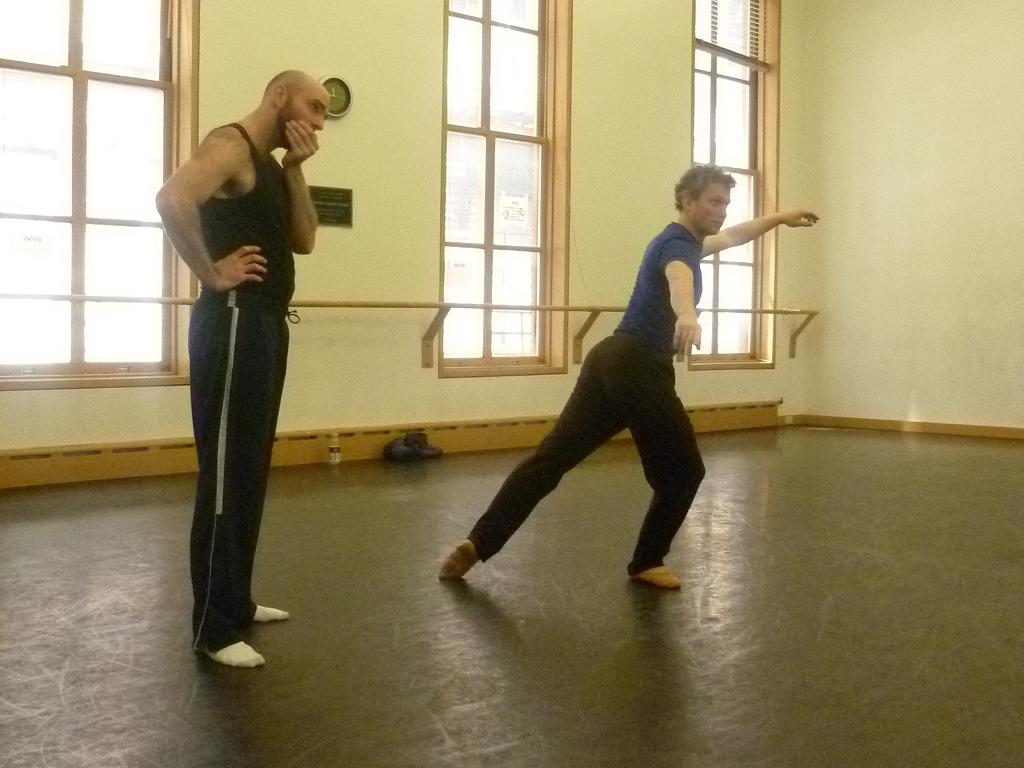
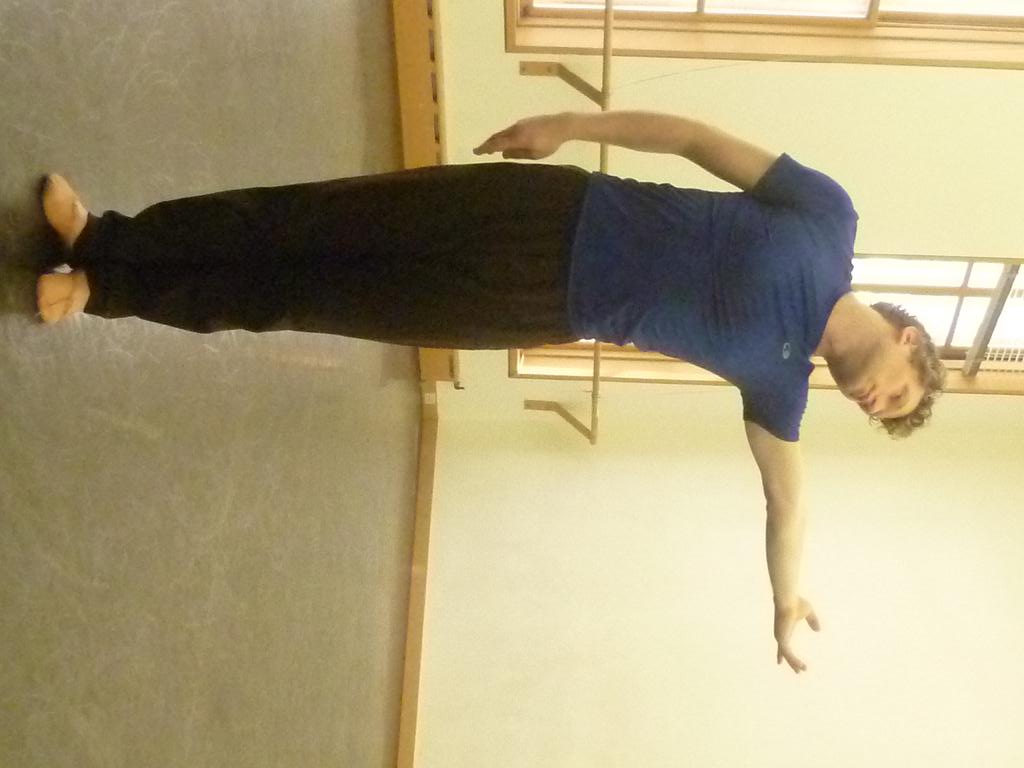
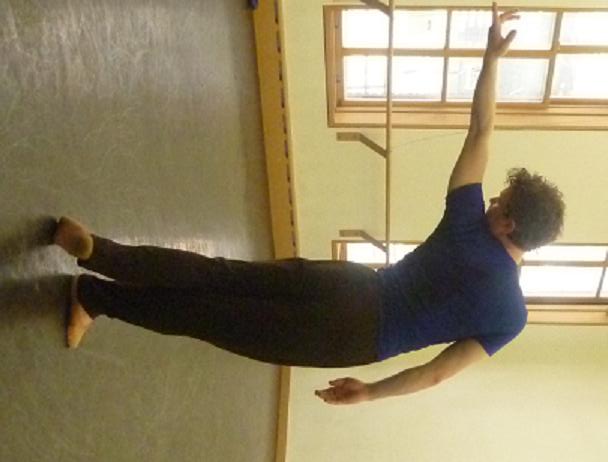
    Friday April 29, 2011 – Down to SoHo this morning to watch choreographer John-Mark Owen putting the finishing touches on a new solo performed by Jesse Marks, a soloist with Colorado Ballet. Kokyat and I met Jesse last year when he appeared with Lydia Johnson Dance here in New York City.

    P1220300

    The solo, entitled Sonatae, is set to music of Heinrich Ingaz Franz Biber. It begins with the dancer in a contemplative Narcissus-like pose and then flows into space-covering movement. John-Mark, a choreographer after my own heart for our shared love of Baroque music, shows Jesse off to beaufitul advantage. I really enjoyed seeing Jesse again.

    P1220359

    P1220362

    P1220319

    P1220297

    Sonatae will premiere at Manhattan Movement and Arts Center in performances on May 6th and 7th when John-Mark’s work shares a triple bill with Island Moving Co (from Newport, RI) and Cherylyn Lavagnino. Details here.

    Both Jesse Marks and John-Mark Owen will be appearing in Dances Patrelle‘s GILBERT & SULLIVAN: A Ballet! at Dicapo Opera Theatre May 12th – 15th. Information here. Read about it here.

  • DANCE AGAINST CANCER: Gallery

    DAC110425-392

    Photographer Erin Baiano shares a portfolio of her images from the April 25th DANCE AGAINST CANCER benefit performance at Manhattan Movement and Arts Center. Above: New York City Ballet principal dancer Daniel Ulbricht in a solo of his own devising entitled Tatum Pole Boogie. Daniel, along with MMAC‘s Erin Fogarty, organized the gala event.

    Since I was going to be at The Met on the evening of the benefit, Erin and Daniel very generously arranged for me to watch the technical rehearsal for the programme which began at noon. In the darkened theater, Daniel took a break from his directorial duties to run thru his solo with devastating agility and effortless airborne facility. Then he immediately bounced back into director mode.

    DAC110425-279

    Another dancing dynamo, Alex Wong (above) performed the solo 747 chroregraphed by Rachael Poirier. At the tech rehearsal, Alex sort of marked the piece though there was enough full-out dancing to see that he was going to knock ’em dead at the actual performance. Which by all reports is exactly what he did.

    DAC110425-287

    A programme change left time for a solo danced by a colleague of Alex’s, Tara Jean Popowich (above).

    DAC110425-137

    From Carolina Ballet, Lara O’Brien and Attila Bongar (above) danced a lirico-romantic duet choreographed by Mr. Bongar. They looked beautiful together and fitted comfortably into the programme’s stellar lineup.

    DAC110425-049

    I had to leave the tech rehearsal before Aaron Carr and Kristina Hanna (above) from Keigwin & Co ran their duet, Love Songs. Having recently seen these dancers in Larry Keigwin’s EXIT at The Joyce, I imagine they were pretty exciting and that Larry’s choreography would grab the crowd.

    DAC110425-260

    Attila Joey Csiki from the Lar Lubovitch Dance Company performed the four-part solo Little Rhapsodies which Lar excerpted from his 2007 work of the same title as a concert piece for Attila. Kathy Tagg was at the keyboard to play the Schumann pieces and Attila – even in rehearsal – showed the fluid Lubovitch style with grace and commitment. On the previous weekend, Attila had danced these solos for another worthy cause, the DANCE FOR JAPAN benefit in Brooklyn. This afternoon at MMAC I snuck a peek at Atti warming up in the same studio with NYCB’s Janie Taylor and developed the idea of seeing them dance together sometime.

    DAC110425-029

    Janie was one of four NYC Ballet principal ballerinas to appear on the gala programme. She danced a duet with Tyler Angle choreographed by Benjamin Millepied entitled On The Other Side. This duet was made during a summer on Nantucket a a few years ago. Janie and Tyler have a great rapport and during the tech I had the added secret excitement of seeing Janie’s hair slip out of its pin-up and become a part of her performance. Tyler and Janie, above.

    DAC110425-070

    You can’t imagine how exciting it was for me to watch my beloved NYCB dancers in this intimate rehearsal setting. Maria Kowroski (above) danced the Preghiera from MOZARTIANA at the tech in a tee-shirt, leg warmers over black tights, and no makeup. She was able to create the celestial atmosphere of this famous Balanchine solo with her expressive port de bras and serene emotional connection to the music.

    DAC110425-419

    In a complete change of pace, Maria was later joined by Martin Harvey (above) to dance a sultry pas de deux from Christopher Wheeldon’s setting of the dances from the opera CARMEN which he created for the Metropolitan Opera‘s production where Maria and Martin have performed it several times. This particular duet is set to the prelude of the opera’s third act; for me, it’s the most poignant music in that super-familiar opera. Maria and Martin were really into this passionate love duet, understandly so: they plan to wed this Summer. What a gorgeous couple!

    DAC110425-199

    Deborah Wingert, former NYCB dancer and a top-class ballet teacher and coach, sat next to me as we watched Amar Ramasar and Sterling Hyltin (above) in a dazzling rendition of The Man I Love from Balanchine’s WHO CARES? Yes, it was only a rehearsal but these two dancers got right to the heart of the matter. Deborah remarked how superbly they were able to fill the space while never seeming constrained by it.

    DAC110425-469

    I’ve seen hundreds of mesmerizing dance performances over the years but nothing hits me in the heart quite like the now-classic duet from Christopher Wheeldon’s AFTER THE RAIN. Arturo Delmoni and Cameron Grant played the Arvo Part score live for Wendy Whelan and Craig Hall (above). Even in a rehearsal with the dancers occasionally speaking to one another and once even cracking up over a small faux pas, this work generates a breath-taking atmosphere. Matt Murphy, who photographed the performance from the wings, spoke of how moved he was by Wendy and Craig’s dancing.

    DAC110425-305

    Matthew Rushing (above) of Alvin Ailey gave me a remarkable experience as I watched him rehearse a solo crafted for him by Earl Mosley. Matthew is one of those dancers for whom the sheer quiet joy of dance radiates thru every centimeter of his being. I could watch this man dance for hours and in this solo there was a pure rush of Rushing. I felt yet again my extraordinary good fortune at being in the same space with such a genius of movement.

    DAC110425-038

    The presenters: Daniel Ulbricht and Erin Fogarty. My thanks to them and to publicist Michell Brandon Tabnick for letting me eavesdrop on the process of putting a gala together, and to all the dancers and musicians who are so generous with their time and talent and so welcoming to a starstruck viewer. Special thanks to Erin Baiano for her photographic souvenirs of a grand night of dancing.

  • Monodramas @ NYC Opera

    Monodramas0055

    Tuesday March 29, 2011 – Tonight was my first visit to New York City Opera as a member of the press. I’ve been going to NYCO since 1966; my first evening with them at Lincoln Center was the opening of GIULIO CESARE when Beverly Sills made her sensational splash as Cleopatra. But even before that I had seen the Company on tour up in Syracuse and Oswego NY – I even saw Beverly before she was Beverly, singing Rosalinda in FLEDERMAUS.

    Throughout the 1970s, 80s and 90s I went to NYCO as often as to the Met; I experienced several operas at the State Theater for the first time: CAPRICCIO, MEFISTOFELE, BALLAD OF BABY DOE, PRINCE IGOR, THE MAKROPOULOS CASE, the Donizetti/Tudor operas and many more. Singers from the Company became top favorites of mine: Maralin Niska, Patricia Brooks, Phyllis Curtin, Johanna Meier, Gilda Cruz-Romo, Beverly Sills, Susanne Marsee, Frances Bible, Beverly Wolff, Placido Domingo, Enrico di Giuseppe, Dominic Cossa, William Chapman, Richard Fredricks, Robert Hale, Norman Treigle.

    In recent seasons I have gone less and less to NYCO; of couse the Company have been thru exasperating times of late,  but let’s hope now that their future will be a bright one. Tonight’s triple bill of 20th/21st century works for solo female voice looked fascinating on paper, and I asked my longtime opera-companion Paul to join me.

    Aside from the three principal singers and an ensemble of dancers in MONODRAMAS, the key elements of this unusual evening were the direction of Michael Counts, the choreography of Ken Roht, and the conducting of NYCO’s stalwart maestro George Manahan. The visual aspects of the evening were the work of video artist Jennifer Steinkamp, motionographer Ada Whitney, and as an homage to laser artist Hiro Yamagata.

    There was one aspect of the production that I felt should be re-thought. About ten minutes before the curtain rose, a young man and woman dressed in tuxedos walked onstage before the curtain to pose and gaze about the house with in a somewhat bored manner. When the curtain rose on the Zorn the music didn’t start til these two had sauntered around the stage a while, removing the bhurkas of a couple members of the ensemble and then of the soprano. They continued rather pointlessly to participate in the action during the opening work.

    After the Zorn there was an interlude in which a digitized film of flowering tree branches (quite lovely) was shown as insects buzzed and chirped quietly. While this alluded to The Woman’s lines in the Schoenberg about the garden at evening and the sounds of crickets, it went on a bit too long and then The Couple returned and removed more bhurkas to expose the women of ERWARTUNG in white dresses. All this business seemed stagey and self-consciuous and too drawn out; yet it might have worked had the orchestra then gone directly into the Schoenberg. But instead when the pit lights came up, they took a tuning break. Whatever dramatic connection was being sought between the Zorn and Schoenberg was thus lost. The Couple appeared later in NEITHER but simply as members of the ensemble, thus diluting their (pointless) presence as a link between the three works. In general, the movement group added a shifting visual dynamic to the staging; it would have been more potent in my opinion to maintain this ‘choral’ effect rather than trying to interject them as individuals into the ‘plot’.

    Beyond this each work was uniquely and impessively staged, the orchestra dealt persuasively with all the demands placed on them, and the three sopranos did their utmost to assure the success of the evening. The audience were extremely attentive and focused; why can’t NYCB audiences behave like this? 

    Monodramas0026

    The evening opened with John Zorn’s LA MACHINE DE L’ETRE, having its staged premiere in these performances. In this rather brief wordless piece, the Finnish soprano Anu Komsi gave a truly impressive rendering of the demanding vocal line. Jagged coloratura roulades occupy the vocalist for most of the work’s duration; she also whispers, speaks and screams. There is no plot, no meaning, no message other than the music itself – colorfully orchestrated with piano, celesta and a variety of percussion effects. 

    Monodramas0021

    Backed by a ‘chorus’ of bhurka-clad dancers, Ms Komsi not only sang compellingly but moved with statuesque grace. I’d love see her again in a more familiar piece, the better to judge her capabilities.  

    Monodramas0032

    Above: Kara Shay Thompson as The Woman in Schoenberg’s ERWARTUNG, the only one of tonight’s three works with which I am somewhat familiar, having seen a peformance of it at the Met in 1989 with Jessye Norman, James Levine conducting. That production remains vividly in the mind – the stage setting consisted of a grand piano and hundreds of white candles – as does Ms. Norman’s powerful singing. Tonight at NYCO, The Woman was portrayed by Kara Shay Thompson whose voice at first seemed more lyrical in quality than one might expect to hear in this music. She proved however to be an accomplished vocalist, taking the demands of the piece in stride.

    Red rose petals fell gorgeously against the deep blue sky throughout this piece in which a deranged woman wanders thru the woods in the depths of night, seeking her lover. She stumbles upon him…literally; his corpse has been abandoned on the forest path. The Woman speaks of another Woman, a rival. Which of them is the murderer? Or are they one and the same?
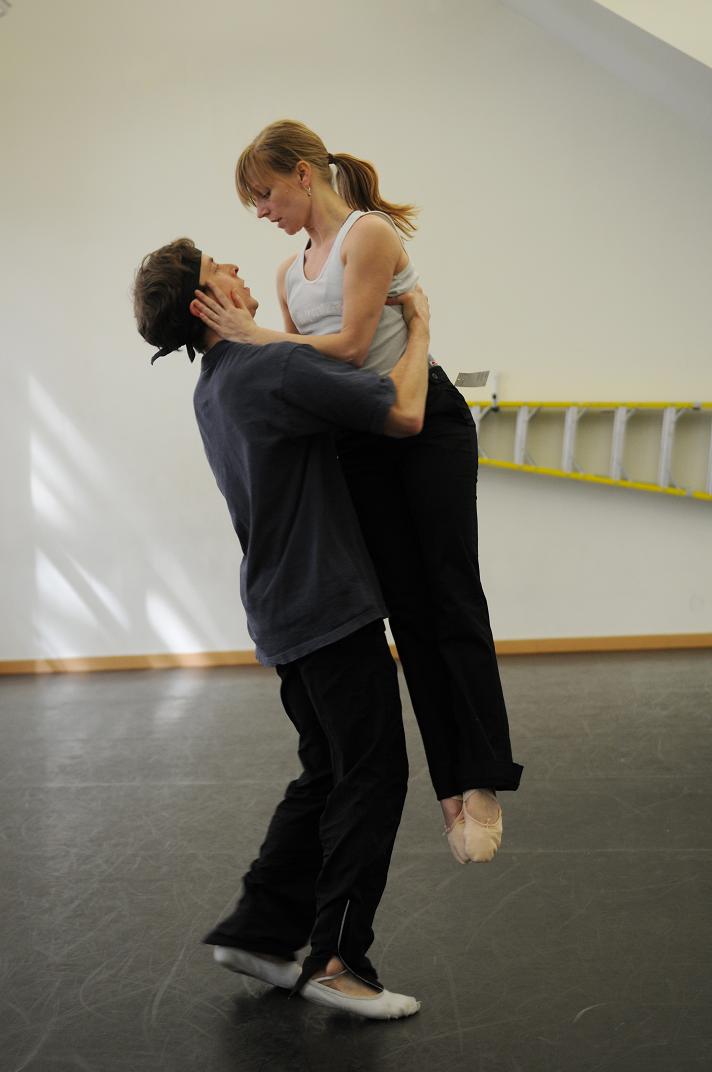
    Schoenberg wrote of his work: “In Erwartung the aim is to represent in slow motion everything that occurs during a single second of maximum spiritual excitement, stretching it out to half an hour.” Based on a case study of Freud, The Woman’s multiple personalities are here evoked by six identically dressed woman who cunningly slip down a trap door as the opera draws to a close.
     Monodramas0052

    When I worked at Tower, Morton Feldman’s NEITHER was a much-sought-after item; the one existing recording at the time came and went from the distributor with maddening uncertainty. If a definitive recording were to be made today, it should most surely feature Cyndia Sieden who tonight turned the fiendish vocal writing of the work into a personal tour de force. The libretto of NEITHER is actually a poem by Samuel Beckett:

    “to and fro in shadow from inner to outer shadow

    from impenetrable self to impenetrable unself by way of neither

    as between two lit refuges whose doors once neared gently close, once away turned from gently part again

    beckoned back and forth and turned away

    heedless of the way, intent on the one gleam or the other

    unheard footfalls only sound

    till at last halt for good, absent for good from self and other

    then no sound

    then gently light unfading on that unheeded neither

    unspeakable home”

    Feldman met Beckett in Berlin in 1976 and asked the writer to provide a text for a vocal work commissioned by the Rome Opera. After replying that he didn’t like having his words set to music, Beckett finally agreed to style a brief libretto based on “the theme of my life”. He mailed Feldman the poem a few weeks later; the composer meanwhile had already started to write the music. The result, nearly an hour-long, is a unique and challenging work – challenging both the singer and the listener.   

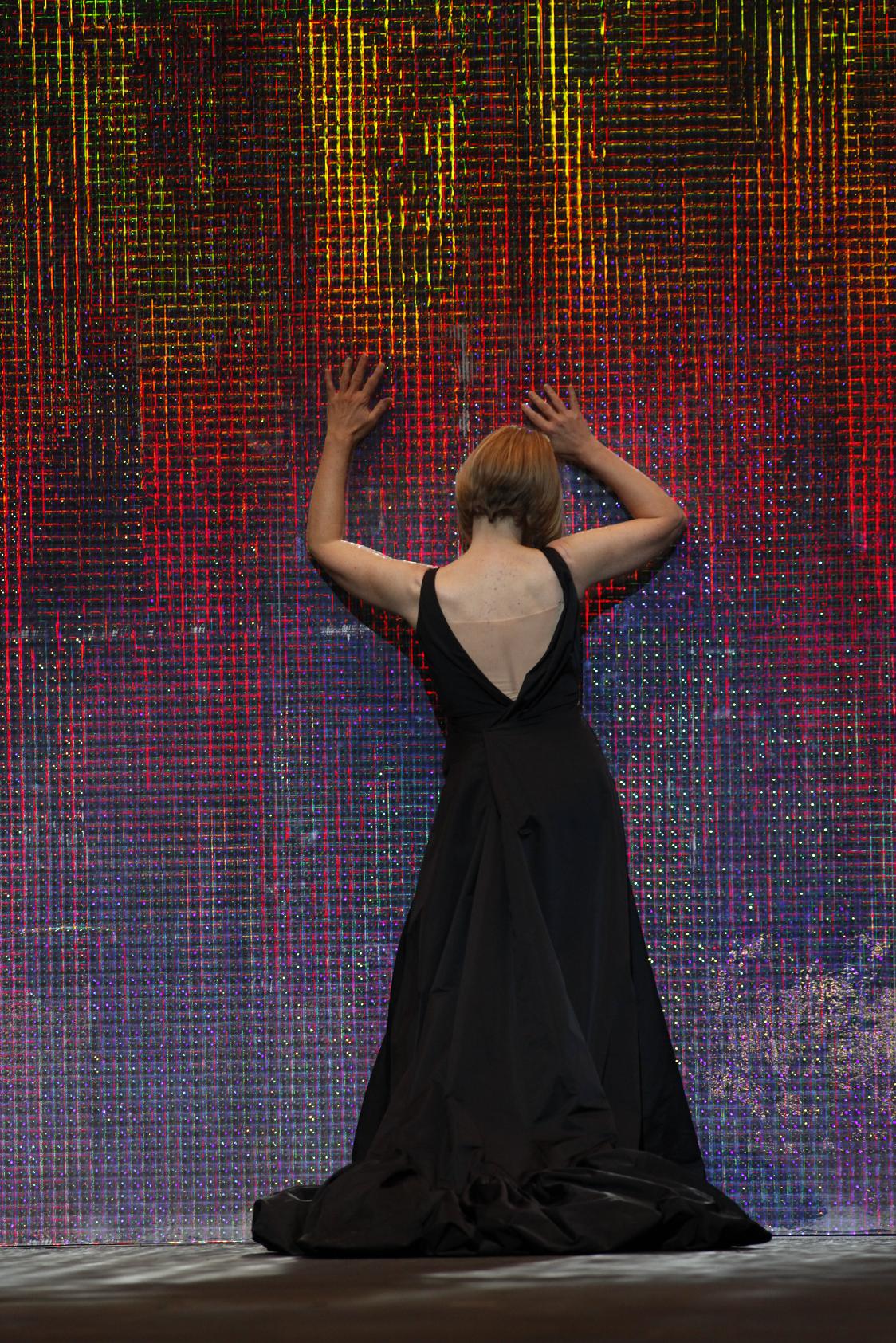
    New York City Opera‘s visually rich production sets the protagonist and ‘chorus’ surrounded by high walls of textured reflective material above which are suspended mirrored cubes which fall and rise above the action. The cubes reflect dazzling light into the auditorium while the walls are illuminated in rich hues: green, mauve, yellow, red, purple by turn. In this dreamlike space the tuxedoed choristers move with stylized gestures as Ms. Sieden, in a striking black gown with train, takes on the aspect of a priestess.

    Monodramas0016

    I first heard Ms. Sieden singing Mozart in the film ANDRE’S MOTHER; later she was a Met Lulu and Queen of Night. It was exciting to re-connect with her tonight and find her on such thrilling form. The vocal writing lingers in a very high tessitura – clarity of diction cannot thus be expected, and the super-titles here compensated – and Ms. Sieden proved not only a mistress of the heights but also produced tone of unusual beauty, almost sweetness, with some lovely taperings of dynamic.

    Watch a video featuring the three protagonists of the MONODRAMAS here. Three performances remain to catch this unusually powerful and rewarding triple-bill of music and theatre: March 31, April 2 matinee and April 8.

    Production photos by Carol Rosegg, courtesy of New York City Opera.

  • John Mark Owen’s Sonatae II

    Copy of 1

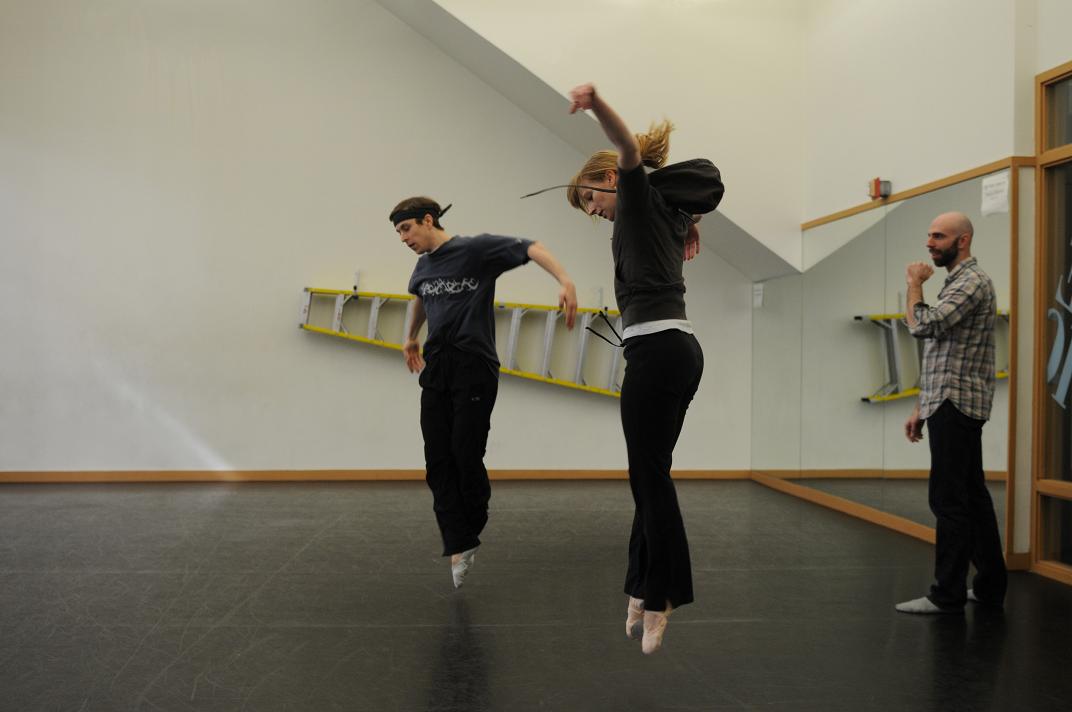
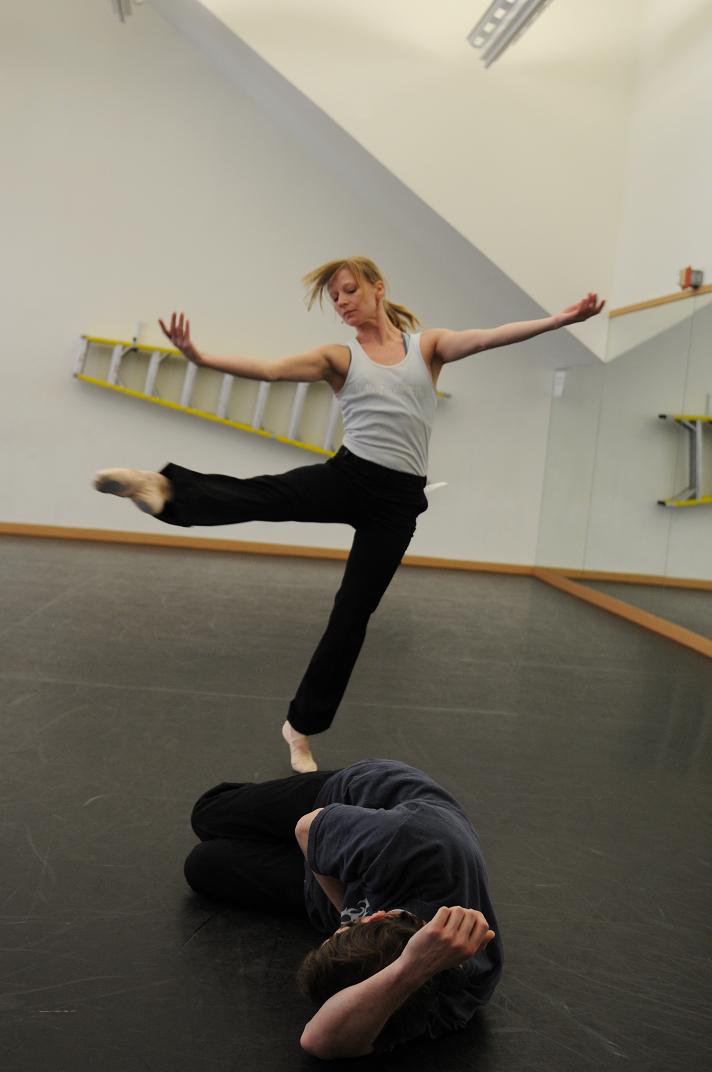
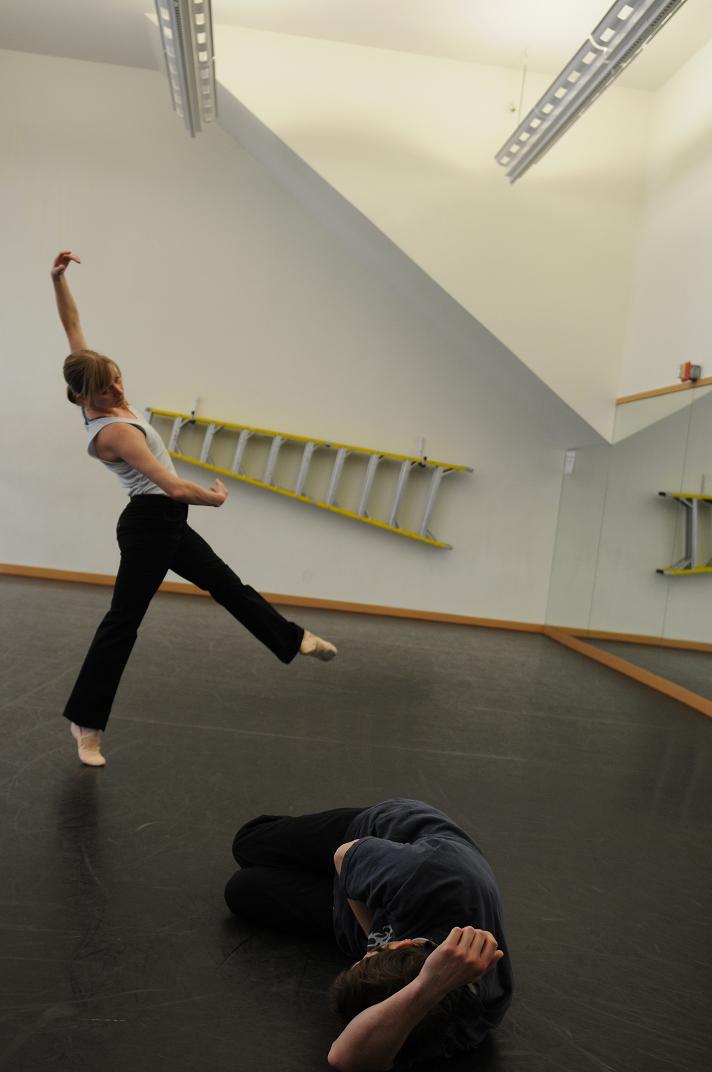
    Saturday March 26, 2011 – Choreographer John-Mark Owen invited us to watch a rehearsal of his newest work, Sonatae II, set to music of Alexander Balanescu. The duet will be shown at the 92nd Street Y on Sunday March 27th at 3:00 PM. The dancers are Jennifer Goodman and Josh Christopher, above in Kokyat’s photo.

    Copy of 2

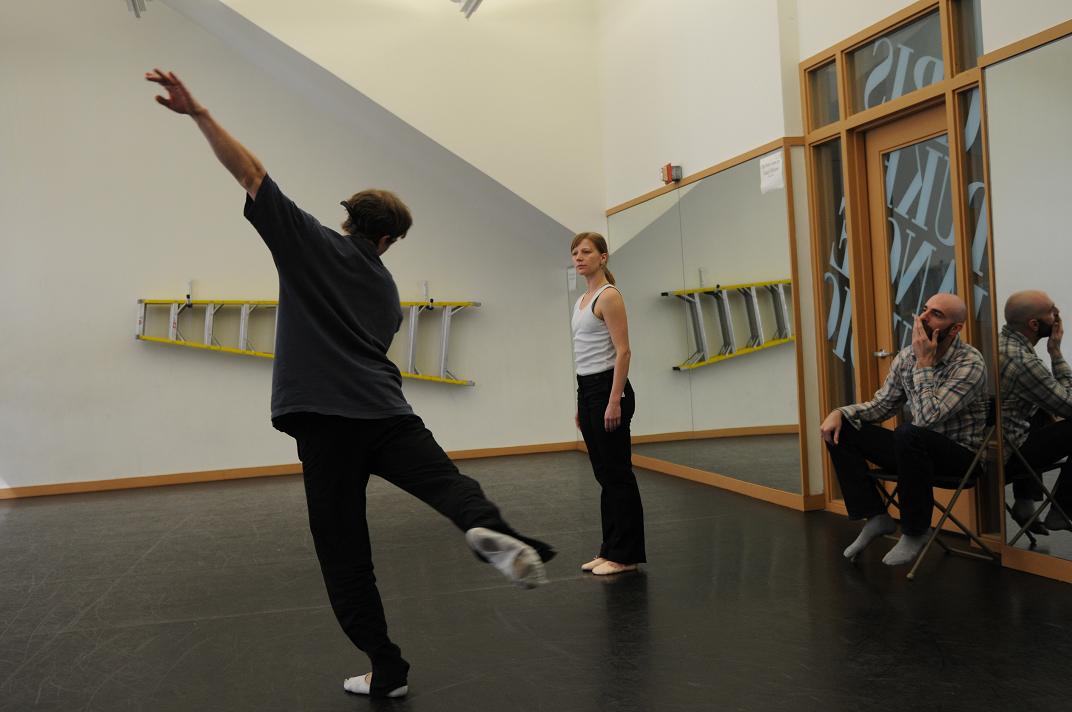
    When Kokyat and I arrived at the studio, Jennifer and Josh were putting the finishing touches on the duet.

    Copy of 13

    They worked in silence with John-Mark and all the movement seemed so expressive. With a performance scheduled for the following afternoon one might have expected an atmosphere of urgency or even panic in the studio but instead there was an air of calm with the dancers taking their time to perfect the small nuances of gesture and expression that John-Mark was looking for.

    Copy of 24

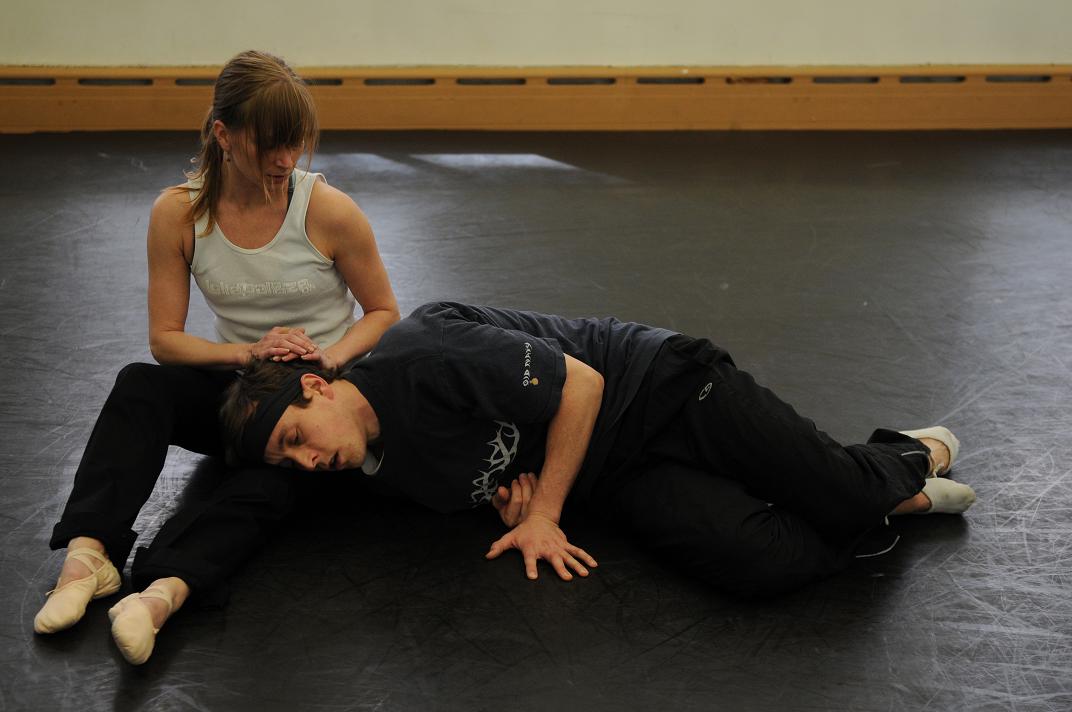
    With the studio time running out, John-Mark played the Balanescu music and what had been an attractive series of danced passages took on a deeper and more intense feeling altogether.

    Copy of 19

    The music is just so poetic, and the dancing took wing on it. 

    Copy of 17

    Copy of 26

    Copy of 20

    As soon as the run-thru finished the dancers quickly bundled up and packed off to the Y for further rehearsing. All photos: Kokyat.

    Jennifer Goodman is currently dancing a featured role in performances of Strauss’ CAPRICCIO at the Metropolitan Opera.

    On May 6th and 7th, John-Mark Owen’s Sonatae I will be performed by Jesse Marks at Manhattan Movement and Arts Center on a programme shared with the Island Moving Company of Newport, RI.

  • Balanchine/Martins/Robbins @ NYCB

    36419_10150223708355529_112319735528_13368955_7285888_n

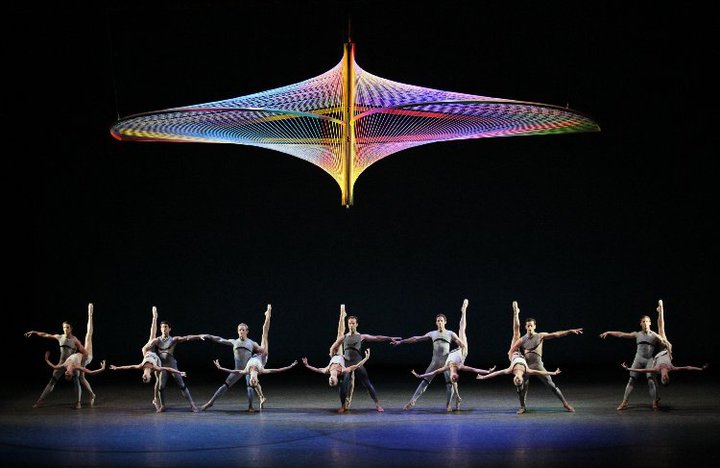
    Sunday February 27, 2011 matinee – Today’s programme at the New York City Ballet featured a Balanchine/baroque masterpiece, a visually striking Martins ballet (photo above) set to a fascinating contemporary score, and the festive Robbins/Verdi FOUR SEASONS as a finale. The Company now leave for a week of performances in Hong Kong, and will be back at Lincoln Center for their Spring season opening on May 3rd.

    SQUARE DANCE: M Fairchild, Huxley

     MIRAGE: Somogyi, J. Angle, Laracey, Finlay, Pereira, Huxley  (solo violin: Lydia Hong)

    THE FOUR SEASONS: JANUS: J. Peck; WINTER: Janzen, Pereira, Alberda, Tworzyanski; SPRING: Muller, Mearns, T. Angle; SUMMER: Anderson, Reichlen, R. Fairchild; FALL: Seth, Bouder, Veyette, Carmena 

    The opening SQUARE DANCE again featured Megan Fairchild and Anthony Huxley in the leading roles. This is ideal casting of the ballerina role; it could have been created just for Ms. Fairchild as it shows off her polished technique and lovely presence to perfection. Anthony Huxley was again very impressive both in his allegro work and in the slow, expressive solo with its deep backbends and silky port de bras. He and Megan showed a more intense connection with one another than at the earlier performance, and both separately and as a partnership they offer a highly enjoyable vision of this vivid and demanding Balanchine ballet. Excellent corps work.

    9616_171328055832_157578620832_4098448_2400586_n

    Ashley Laracey (Joe Anderson photo from the NY EXPORT: OPUS JAZZ project) is a dancer who always stands out among the bevy of City Ballet’s corps ballerinas and I am always so happy to see her in a featured role. In MIRAGE she danced with Chase Finlay, the Company’s rising young cavalier; they looked great together and Ashley showed off her beautiful extension, swift pirouettes and a lyrical style that is uniquely her own. Chase was excellent here, confirming his ascendent trajectory.

    Jennie Somogyi’s innate dramatic quality instills a sense of urgency into her duets with Jared Angle, always the perfect partner. It’s been great to see Jennie so often this season, and Jared shows her off superbly in this ballet. Erica Pereira’s technical clarity works wonders in a contemporary setting and Anthony Huxley followed up his beautiful SQUARE DANCE with a fine performance in the Martins, notably his airy opening solo. The four corps couples deserve special mantion, both for their fine dancing here and for their uniform excellence all season: Callie Bachman, Brittany Pollack, Kristen Segin and Mary Elizabeth Sell with Ralph Ippolito, Troy Schumacher, Andrew Scordato and Christian Tworzyanski.

    At its premiere, the composer Esa-Pekka Salonen had conducted his own score for MIRAGE; tonight Andrews Sill had the complexities of this dense, colorful work well in hand and Lydia Hong played the demanding violin part – a real physical workout – with complete command.

    In THE FOUR SEASONS, set by Robbins to neglected ballet music from Verdi operas, Justin Peck summoned the seasonal deities – Russell Janzen, Gwyneth Muller, Marika Anderson and Henry Seth – who in turn escorted their respective courts onto the stage. Erica Pereira made a very pretty impression as the shivering maiden in Winter, with Christian Tworzyanski and Devin Alberda as her cavaliers. Sara Mearns swirled serenly thru the many pirouettes of Spring and looked luscious while her partner Tyler Angle gave an excellent performance with some majestic grand jetes. Their four back-up boys – Giovanni Villalobos, Allen Peiffer, Austin Laurent and Ralph Ippolito – looked handsome and danced handsomely. The tall and radiant Teresa Reichlen was provocative in Summer and Robert Fairchild was ideally cast as her cavalier, a new role for him this season.

    Ashley Bouder and Andrew Veyette tossed off the spectacular technical fireworks of Autumn with boundless supplies of energy and pirouettes, and Antonio Carmena’s sexy and ingratiating Faun followed Bouder’s lead and tucked in some Plisetskaya kicks in addition to his other virtuoso feats.

    A very sizeable audience today and nice to see so many of the faithful on the Promenade at intermssion.