Category: Reviews

  • New Bayreuth

    Scanned Section 4-1

    Penelope Turing (above) was an Englishwoman who attended the second post-war Bayreuth Festival in 1952, returning to the Green Hill for many seasons thereafter. She continued to attend performances thru the Summer of 2009, and she passed away in 2010.

    Turing’s book, New Bayreuth, was first published in 1969. It is full of detailed writing about both the scenic and the musical aspects of the productions she saw there over her first seventeen years of attending the Festival, commencing – in 1952 – with DAS RHEINGOLD, in Wieland Wagner’s ground-breaking production which had premiered the Summer before.

    Turing’s writing about the voices and characterizations of the eminent singers who appeared in those first post-war festivals is fascinating to read.  

    Her descriptions are so evocative. Of curtain-rise for the Wieland Wagner PARSIFAL, which had been introduced in 1951, Turing writes: “According to the score, the scene is a glade in a solemn, shady forest in the domain of the Grail. In what we saw, however, there was no forest definable, nor even a tree. We felt the forest rather than saw it: a legendary forest that was of no time and no place, and one, moreover, over which mystery and sorrow and pain seemed to have brooded long.”

    After reading that, on page 6, I was hooked on Turing’s book, and have been barely able to put it down. Turing’s writing is free of ‘intellectual’ blather, theories, and nit-picking. She writes about what she saw and what she heard, and how she felt about it all. 

    Md30327760771

    The book contains many black-and-white photos from those years: of the iconic productions, and of the fabled singers who appeared in them; of the Festspielhaus, and of the town of Bayreuth. These produce a feeling of nostalgia for a place I’ve – unfortunately – never been.

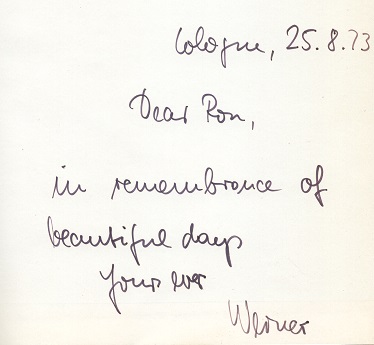
    But there’s another reason I’m so captivated by the book. As I so often do, I bought New Bayreuth in a used, hardcover edition via Alibris. Used books invariably have a life of their own, and, opening it for the first time, I found this inscription:

    Scanned Section 2-1

    Who were Ron and Werner? Were they lovers? Had they gone to Bayreuth together, or did they perhaps meet one another there? Are they still alive? My guess would be: probably not.

    But now their book has come down to me, and it is intriguing in so many ways.

    ~ Oberon

  • Ingrid Bjoner as Turandot

    Scanned Section 3-1

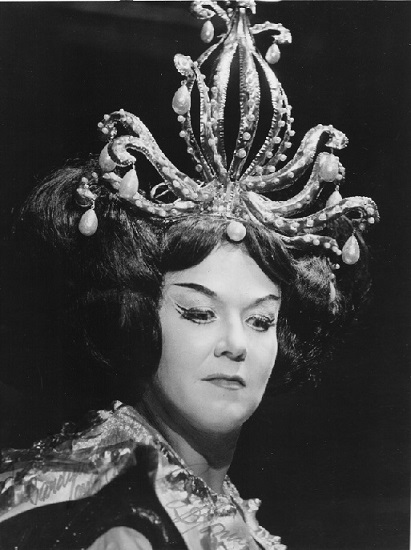
    Ingrid Bjoner sent me the above photo of herself as Turandot after I sent her a letter of praise letter after seeing her in this role at The Met in 1974.

    On the back of the photo, Ms. Bjoner wrote:

    Scanned Section 11-1

    Turandot is a fascinating role, and I have seen many sopranos undertake it over the years since Mary Curtis-Verna was my first icy princess at The Old Met in 1965.

    Birgit Nilsson was, of course, the Turandot of her day. But Ingrid Bjoner made a striking impression with her powerful, silvery sound, and – in truth – her characterization was more complex and interesting than Nilsson’s. I wrote about my impressions of the Bjoner Turandot here.

    And here she is, in a German-language performance:

    Ingrid Bjoner – TURANDOT ~ In questa reggia (in German) with Ludovic Spiess

    ~ Oberon

  • The Young Troyanos

    Troyanos

    Tatiana Troyanos made her Met debut as Octavian in DER ROSENKAVALIER in 1977. But I had had the incredible opportunity to see her on the Met stage ten years earlier, when she sang Baba the Turk in a remarkable performance of Stravinsky’s THE RAKE’S PROGRESS given by the visiting Hamburg State Opera for the Lincoln Center Festival in 1967. I was 19 years old and obsessed with opera.

    RAKE

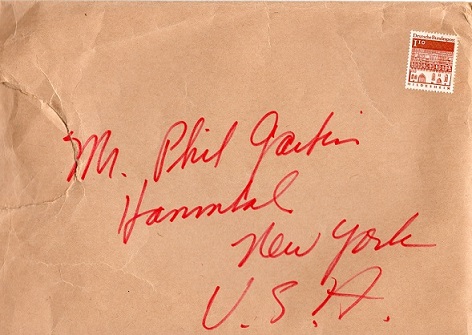
    A few days after the performance, I sent Tatiana Troyanos a fan letter in care of the Hamburg State Opera. Soon after, an envelope arrived in our family mailbox in Hannibal, New York:

    Troyanos envelope

    This was in the pre-zip code era; there was no return address, but the German postage stamp (with no cancellation) provided a clue. Inside was the signed photo from Troyanos that appears at the top of this article. Scanning these beautiful souvenirs was genuinely moving to me: these were things Tatiana held in her hands, and undoubtedly she signed, sealed, and delivered this to the post office herself. (So cute that she ran out of space when signing her name!)

    Troyanos had sung in the chorus of nuns in THE SOUND OF MUSIC on Broadway before spending two seasons with New York City Opera.  Then, in 1965, she traveled to Europe, auditioned successfully for three companies, and chose to join the Hamburg State Opera, where she remained (first as an ensemble member, later as a guest artist) for ten years, singing a variety of roles and honing her stagecraft.

    Then came the debut at The Met, where she was to become a beloved star, giving over 275 performances there and making an indelible mark on such roles as Octavian, the Composer in ARIADNE AUF NAXOS, Mozart’s Tito, Princess Eboli, and Wagner’s Venus and Kundry. I saw Troyanos many times, in these roles and others, and she always thrilled me as few other singers consistently did. Yet whenever her name comes up, it’s that first experience of her Baba that immediately springs to mind.

    Tatiana Troyanos passed away after a long battle with cancer. She continued to sing to the end of her life, including – reportedly – for fellow patients at Lenox Hill Hospital on the day she died: August 21, 1993.

    Here, from her Hamburg years, is Troyanos singing the Composer’s great aria in praise of music from a 1968 performance:

    Tatiana Troyanos – ARIADNE AUF NAXOS ~ finale of the Prologue – Hamburg 1968

    ~ Oberon

  • Liane Synek as Brünnhilde

    Synek

    Liane Synek (above) was an Austrian dramatic operatic soprano. She based her career in Germany, at such opera centers as Wiesbaden, Cologne, and the Staatsoper Berlin and the Cologne Opera, She appeared at international major opera houses and festivals, including Covent Garden, La Scala, and as the Bayreuth Festival.

    A somewhat erratic singer, Synek took on opera’s most demanding roles – including Turandot, Elektra, Isolde, and the Brünnhildes – and threw herself into the music with abandon: her top notes could thrill.

    Over time, collectors have taken an interest in Synek’s “live” recordings; quite a few have surfaced, and can be found at Opera Depot.

    Here is Liane Synek in the great scene from Act III of DIE WALKURE wherein Brünnhilde attempts to explain to her father Wotan why she disobeyed his expressed command that Hunding should prevail in his fight against Siegmund. The performance, in surprisingly good sound, is from Montevideo 1959; Wilhelm Schirp sings Wotan.

    Liane Synek – War es so schmählich ~ WALKURE – with Wilhelm Schirp – Montevideo 1959

  • Vilda Frang @ Mostly Mozart

    Thumbnail_vilde-frang-2012

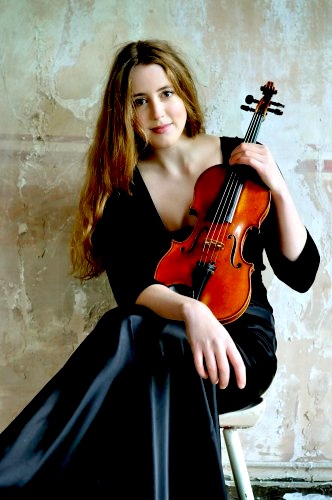
    Above: violinist Vilda Frang/photo from EMI Classics

    ~ Author: Ben Weaver

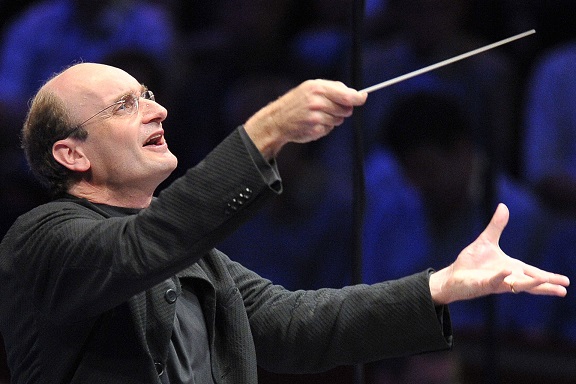
    Wednesday July 24th, 2019 – Beethoven’s two warhorses were on the program of the Mostly Mozart Festival tonight: the Violin Concerto and the Eroica Symphony, with Andrew Manze presiding over the proceedings.

    For the Mostly Mozart Festival, the main auditorium of David Geffen Hall has been transformed into a night-club-like atmosphere (for a couple of years now), with the stage moved up and seating created on the sides and behind the orchestra. Amphitheater-like concert halls have been all the rage in Europe (and to a lesser extent in the US) since the Berlin Philharmonie was built; seemingly every new concert hall replicates that structure. (In the US, Walt Disney Hall, home of the LA Philharmonic, is built the same way). I’ve never been to one of these concert halls, so maybe the acoustics really are ideal 360° around the orchestra in these halls.


    I am, however, not convinced that the arrangement being used for the Mostly Mozart concerts improves the sound for anyone inside David Geffen, where the acoustics have been notoriously bad since the theater’s construction in the 1960s and no amount of fiddling has changed that. (It seems that plans to gut the theater and rebuild with a superior interior are permanently shelved again. Apparently NYC and NY Philharmonic do not deserve a world-class concert hall…) Generally, when a large orchestra plays in David Geffen Hall, the sound in the orchestra section is fine, if a bit dense. However, the further up you go, the more the sound disappears. In the highest sections I find that the sound seems to be coming from across the plaza.


    I bring up my issues with the acoustics of David Geffen Hall because in these Mostly Mozart Festival performances the size of the orchestra is cut drastically; Andrew Manze, a famed violinist and conductor specializing in early music and period instrument practices, has a unique take on the sound of the orchestra. Even tough the chamber-sized ensemble plays on modern instruments, Maestro Manze’s orchestral balance brought to mind a small period-instrument ensemble. This would have been wonderful if the hall’s acoustics were not mediocre to begin with and as I mentioned above, I’m not convinced the rearrangement of seating in the hall enhances the sound in any way.


    It so happens that for Beethoven’s Violin Concerto the light sound of the orchestra was mostly very effective: that’s because Norwegian violinist Vilde Frang, making her MMF debut, delivered a truly unique performance. Beethoven’s demands on the violinist are intense; the concerto shocked the public upon its 1806 premiere. They were not prepared for a long and serious concerto like this: the revolutionary side of Beethoven was definitely part of this work. Ms. Frang, however, did the almost unthinkable: she played one of the most popular works of music in a way I’ve never heard anyone attempt: while abdicating nothing of Beethoven’s power, she delivered a gentle, dreamy performance. If most violinists compete with the orchestra for volume and heft, Frang and Manze joined forces to make the audience lean in: Frang’s frequent pianissimi – quieter than this concerto is used to – floated through the hall like gentle breezes. She never forced the instrument to fight or compete for attention, and Manze never forced the MMF Orchestra either. This was a perfect union of minds and musicians delivering a deeply felt and carefully thought out and fascinating performance. I hope Ms. Frang returns to NYC soon; she is a violinist to watch.


    Andrew-Manze-1920x1280


    Above: conductor Andrew Manze


    Things felt more familiar with the performance of Beethoven’s 3rd Symphony, the famed Eroica. The 1803 work changed the course of music and what a symphony was thought to be; there are now only 2 steps from Beethoven to, say, Mahler (No. 3 to No. 9 to everything that followed.) The opening chords of the Allegro con brio were bright and forceful. The movement unfolded with energy and verve. Marcia funebre was dark and brooding, but seemed closer in spirit to the earlier Violin Concerto than “Beethoven the revolutionary.”  To me, the Scherzo is always the most difficult movement to pull off: it seems to not belong to this symphony. Its jollity and energy are closer to Beethoven’s previous two symphonies, not the granitic Eroica. I’m afraid tonight that feeling remained, though the movement was played well. And the final Allegro molto was a perfectly executed march from darkness to triumph. 


    Except…back to the cursed acoustics of the hall. What was missing was the sound surrounding you, going behind you and coming back to hit the back of your head. The fact that Maestro Manze was using greatly reduced forces isn’t the reason for that; I’ve heard soloists and chamber ensembles at Carnegie Hall deliver ear-shattering sounds. At David Geffen Hall and in MMF’s seating configuration, no matter how much they tried, the sound simply gets lost.


    An orchestra like the NY Philharmonic can make the rafters shake through sheer will and size of the ensemble. It truly is a disgrace that a city like New York is incapable of building a hall for its home band and Festival. Maybe MMF should consider moving some of their performances to Carnegie Hall, which seems to be vacant during the summer. Tonight’s wonderful concert by Andrew Manze, Vilde Frang, and Mostly Mozart Festival Orchestra deserved to be heard.


    ~ Ben Weaver

  • Aase Nordmo-Løvberg & Kolbjørn Høiseth

    Aase-nordmo-lvberg-6d8aba9d-d166-4244-b6c9-58dc451cbbf-resize-750

    Above: soprano Aase Nordmo-Løvberg

    Ms. Nordmo-Løvberg spent most of her career at Oslo and Stockholm. She was a highly-regarded soprano who worked with top conductors (such as Karajan and Solti). She sang at the Vienna State Opera, and gave a dozen performances at The Met in 1959-1960 singing Elsa, Eva, Sieglinde, and Beethoven’s Leonore.

    HOISETH Kolbjorn

    Above: the Norwegian tenor Kolbjørn Høiseth

    Mr. Høiseth’s career took him to London, Berlin, Stockholm, Lyon, and Bordeaux as well as numerous German houses. He specialized in Wagner and Verdi, also appearing in WOZZECK, FIDELIO, and ELEKTRA.

    In 1975, the tenor sang Froh in RHEINGOLD (in which role I saw him twice) at The Metropolitan Opera, where he also appeared as Siegmund in a single performance of WALKURE. His voice had a lyric quality, but also ample power when needed.

    Aase Nordmo Løvberg & Kolbjørn Høiseth – WALKURE – ACT I scene – Stockholm 1963

  • Teatro Nuovo ~ LA STRANIERA

    P01br19s

    Above: composer Vincenzo Bellini

    ~ Author: Oberon

    Wednesday July 17th, 2019 – Will Crutchfield’s Teatro Nuovo presenting Bellini’s rarely-performed opera LA STRANIERA at Rose Hall in the Jazz at Lincoln Center home-space. The semi-staged performance featured the following cast:

    Alaide (La Straniera) – Christine Lyons, soprano
    Isoletta – Alina Tamborini, soprano
    Arturo – Derrek Stark, tenor
    Valdeburgo – Steven LaBrie, baritone
    Il Priore – Vincent Grana, bass
    Montolino – Dorian McCall, bass-baritone
    Osburgo – Isaac Frishman, tenor

    Chorus and Orchestra of Teatro Nuovo
    Will Crutchfield, maestro al cembalo
    Jakob Lehmann, primo violino e capo d’orchestra

    Written in 1829, LA STRANIERA was Bellini’s fourth opera. It has, in the last 50 years, been briefly associated with such bel canto paragons as Renata Scotto and Montserrat Caballe. One of the Scotto performances, from Palermo 1968, was in my reel-to-reel collection for years; hearing the opera live tonight brought back memories of enjoying her persuasive styling of this music. 

    In terms of plot, the opera borders on the risible: a queen (Alaide, known as La Straniera – the “Foreign Woman”) has been living incognito in a hut by a lake. She has inspired the love of the local Count Arturo, who murders a supposed rival who is in fact Alaide’s brother. Somehow, it’s Alaide who is accused of having committed the murder; but at her trial, the dead man suddenly shows up, saying he had fallen into the lake. Things muddle on until the king’s messenger appears to tell Alaide (turns out she’s the Queen of France) that she must resume the throne as the ‘other’ queen has died. At this news, the still-smitten Count Arturo kills himself, and Alaide has the obligatory mad scene. As with so many operas written in this time period, the story line is merely an excuse for a lot of singing. 

    Musically, LA STRANIERA has its moments but they are rather few and far between. There’s an awful lot of filler, most of it pleasant enough…but it’s music that rarely grips the imagination. There is no feeling of a musico-dramatic arc in the opera, but rather a series of disjointed scenes in which the story’s convoluted twists and turns make minimal sense. Above all, if these old operas are to be revived, the singing must be spectacular.  

    Vocally, the opening scene for Valdeburgo and Isoletta was really impressive and augured well for the rest of the evening. Baritone Steven LaBrie has a handsome voice, sizeable and expressive, with a gift for dramatic nuance. As Isoletta, a hapless bride-to-be, Alina Tamborini displayed a most interesting timbre, with a trace of flicker-vibrato that was very appealing. She has the wide range demanded by the composer – clear high notes and plush low ones – and a lovely trill.

    Tenor Derrek Stark’s sustained opening note of his long introductory recitative assured us that his would be a pleasing voice to hear in Arturo’s plentiful music. Later, in uncomprehending anger, Mr. Stark unleashed a brilliant top note that sent wave of murmuring approval thru the hall. The tenor’s flashy jacket was something of a visual distraction, though.

    Just as the onstage harp solo announcing the appearance of La Straniera (Alaide) sounded, the man sitting behind us began rummaging thru his belongings; he continued, undeterred by dirty looks and shushing. I think he was looking for a sandwich. This interruption was the beginning of ongoing deterrents to my concentration.

    Soprano Christine Lyons’s offstage opening lines did not intrigue; her voice had a throaty quality which – luckily – would soon become less evident. As the first act unfolded, the soprano produced many fine passages, with a good feel for dynamics and for the text. In her scenes with Mr. LaBrie and Mr. Stark, Ms. Lyons offered expressive singing, with an appealing sense of the character’s vulnerability.

    Having been accused of murdering Valdeburgo, Alaide has a ‘mad scene’ in which she incoherently tries to explain to the angered townspeople why she is holding a bloody sword. The vocal demands here, which come in fits and starts, brought out a weighted chest voice from the soprano that seemed better suited to verismo than bel canto.

    While all this was happening, the hall had become freezing due to air conditioning overkill. A woman in the front row kept checking her phone, the screen flashing brightly. In front of us were a whispering couple. Across the aisle, a squeaky chair added an unwanted obbligato to the music. And the young primo violino e capo d’orchestra, seated at audience level, was animated to the point of distraction. 

    Midway thru the intermission, we decided that Bellini had delighted us long enough.

    ~ Oberon
  • Paolo Washington

    A-1726033-1532529259-1673.jpeg

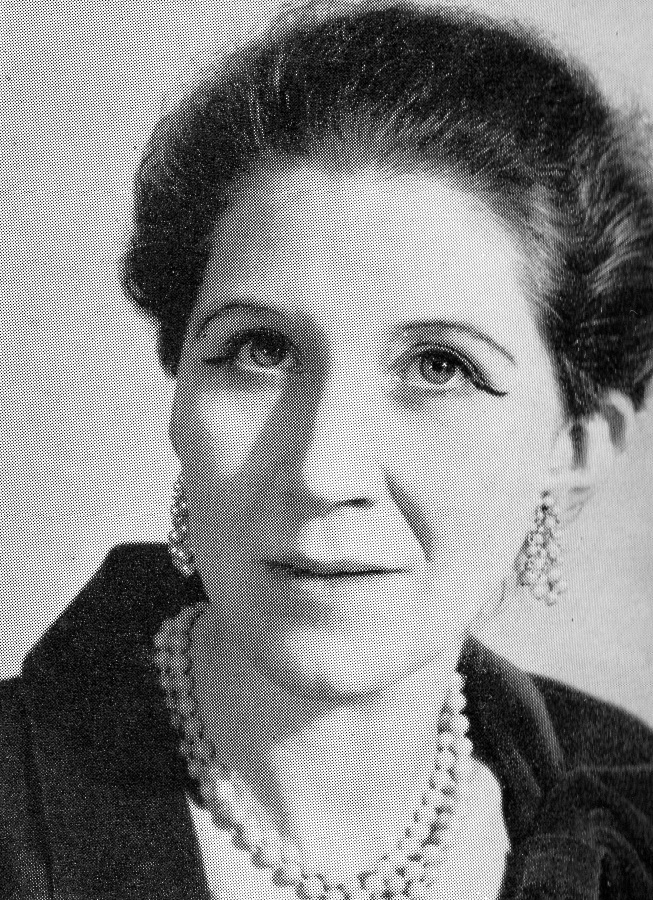
    Basso Paolo Washington (above) was a featured artist at the major opera houses of Italy, beginning with his professional debut at the Teatro Comunale, Florence, in 1958. He subsequently appeared at La Scala, Rome, and Naples, and participated in broadcasts by the RAI.

    Chicago Lyric Opera was Washington’s home base in the United States. From 1968 thru 1997, he appeared in 14 roles for a total of 101 performances with the Company He sang in operas by Donizetti and Bellini, as well as in Stravinsky’s LE ROSSIGNOL and OEDIPUS REX. He was particularly admired for his moving portrayals of Colline in LA BOHEME and Timur in TURANDOT.

    Washington was heard throughout Spain, and also at Geneva, Marseille, Nice, Toulouse, and Lisbon, and at the Salzburg and Bregenz festivals. His wide repertory extended from Handel to the 20th century works by Prokofiev and Hans Werner Henze. He appeared only twice at the Metropolitan Opera, in the title role of DON PASQUALE in 1979.

    He passed away in 2008 at the age of 75.

    Paolo Washington – Nabucco ~ Tu sul labbro

  • Blanche Thebom

    51J27V3W9WL

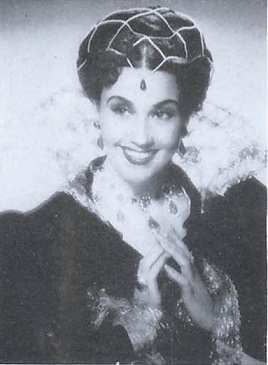
    Blanche Thebom (above), the glamorous mezzo-soprano whose career at The Met lasted over 30 years, was as well-known for her magnetic stage presence and her sensationally long hair as for her singing.

    She made her debut with the Metropolitan Opera Company in 1944 as Brangaene in TRISTAN UND ISOLDE in a performance at Philadelphia, Pennsylvania; two weeks later, she sang Fricka in DIE WALKURE at The Met. These performances drew rave reviews for Ms. Thebom, both for her singing and for her distinctive beauty and dramatic flair.

    Ms. Thebom went on to sing more that 360 performances with the Metropolitan Opera Company, in New York and on tour. She was a much-admired Carmen and Dalila, and in Verdi she made a regal impression as Amneris and Princess Eboli. She seemed capable of singing anything, from Adalgisa in NORMA to Venus in TANNHAUSER, while – in a lighter vein – she appeared as Prince Orlofsky and as Dorbella in COSI FAN TUTTE.

    Thebom Eboli

    Above: Blanche Thebom as Princess Eboli

    Blanche Thebom – O don fatale ~ DON CARLO

    Ms. Thebom appeared in the US premieres of two important works at The Met: as Baba the Turk in Stravinsky’s RAKE’S PROGRESS in 1953, and as Adelaide in Strauss’s ARABELLA in 1955. In the 1960s, she undertook what might be called “principal character” roles such as Genevieve in PELLEAS ET MELISANDE, Magdalene in MEISTERSINGER, and the Old Baroness in VANESSA. Her last role was that of the Countess in Tchaikovsky’s QUEEN OF SPADES – performed in English, at the New Met – in which she appeared opposite Teresa Stratas and Jon Vickers.

    After retiring from the Met, Blanche Thebom taught singing and also served on the Metropolitan Opera’s Board of Directors until 2008. She passed away in 2010, at the age of 94.

    AR-311309810

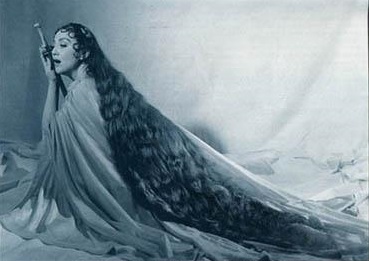
    In my earliest days of opera-loving, Blanche Thebom was already spoken of in our house. My father, who had seen her on TV, referred to her as ‘Blanche the Bomb’ due to her physical allure. And my grandmother told me about Thebom’s legendary hair, which had been used as a dramatic device when she sang Berlioz’s Dido at Covent Garden in 1957 (photo above).

    I finally heard Thebom’s voice on the radio in 1962:

    Metropolitan Opera House
    December 29th, 1962 Matinee/Broadcast

    PELLÉAS ET MÉLISANDE

    Pelléas.................Nicolai Gedda
    Mélisande...............Anna Moffo
    Golaud..................George London
    Arkel...................Jerome Hines
    Geneviève...............Blanche Thebom
    Yniold..................Teresa Stratas
    Physician...............Clifford Harvuot
    Shepherd................William Walker

    Conductor...............Ernest Ansermet

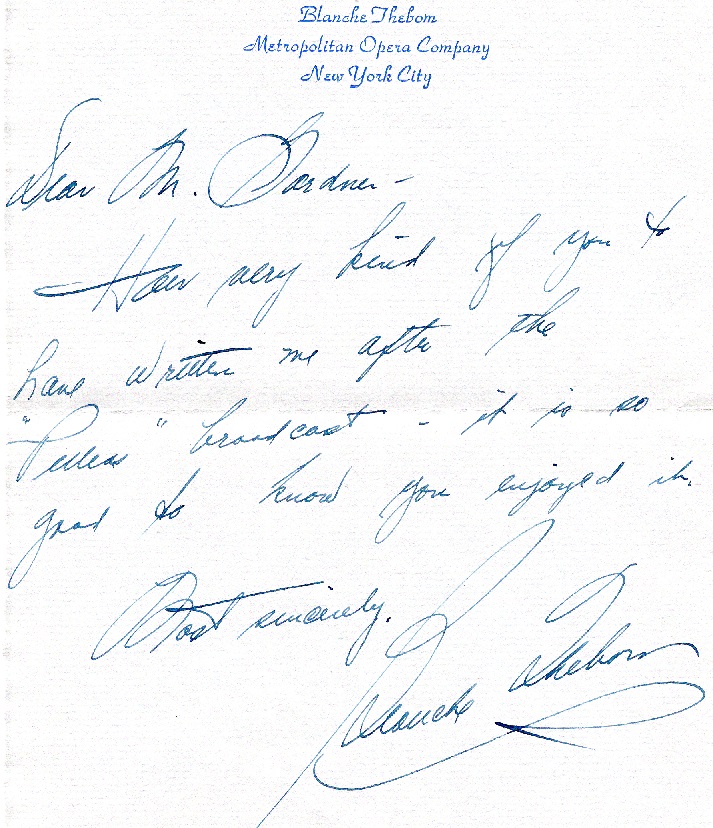
    Listening to her sing Debussy’s  Genevieve on a Texaco broadcast of PELLEAS ET MELISANDE, I was well-prepared to like her. And like her I did, so much so that I wrote her a letter; soon after, I received this elegant reply:

    Scanned Section 14-1

    More samplings of Blanche Thebom’s singing below. In RHEINGOLD, her usual role was Fricka, but I’m partial to her recording of Erda’s Warning:

    Blanche Thebom – Weiche Wotan weiche! ~ RHEINGOLD

    Blanche Thebom – Mon coeur s´ouvre a ta vois ~ SAMSON & DALILA

    Blanche Thebom – Wolf ~ Um Mitternacht

    ~ Oberon

  • Cardiff Singer of the World ~ 2019

    Andrei-Kymach-c.Alexander-Andryushchenko-8

    Ukranian baritone Andrei Kymach (above, photo by Alexander Andryuschenko) is the 2019 Cardiff Singer of The World. En route to winning the title, Mr. Kymach gave this vibrant performance of Count Tomsky’s narrative from Tchaikovsky’s PIQUE DAME.

    Mr. Kymach joins a list of illustrious singers who have claimed the Cardiff prize since the competition was founded in 1983 – among them: Karita Mattila, Dmitri Hvorostovsky, Katarina Karnéus, Anja Harteros, and Shenyang.

    Mingjie-Lei-wins-Song-Prize-at-BBC-Cardiff-Singer-of-the-World-2019-©-Kirsten-Mcternan

    This year’s winner of the Song Prize is Chinese tenor Mingjie Lei (hoisting his trophy, above, in a Kirstin McTernan photo). It was Sir Bryn Terfel who won the first Cardiff Song Prize, in 1989. Watch the 2019 Song Prize final round here.

    Mingjie Lei was also a finalist in the main prize competition.