Category: Reviews

  • Pittsburg Symphony Orchestra @ Lincoln Center

    Thumbnail_till_felner

    Above: pianist Till Fellner, photo by Jean-Baptiste Millot

    ~ Author: Ben Weaver

    Sunday May 19th, 2019 matinee – Great Performers at Lincoln Center presenting Maestro Manfred Honeck and his Pittsburg Symphony Orchestra in a super-sized concert at Lincoln Center this afternoon: Mahler’s Symphony No. 5 was preceded by Beethoven’s Piano Concerto No. 5 – two substantial works that rarely share the stage.

    Austrian pianist Till Fellner was the soloist for Beethoven’s 1809 magnum opus, the imposing “Emperor” Piano Concerto. By 1809 Beethoven’s hearing was already deteriorated enough that he stopped playing the piano in public. It is the only one of is concertos that he did not premiere himself. After a single chord from the orchestra, the piano enters majestically with an extended solo. This is followed by another single chord from the orchestra and a cadenza-like solo from the piano; and then again – for the third time – before the orchestra finally launches a traditional introduction.

    The lovely Adagio is scored sparingly for the piano, muted strings and winds and it leads without a pause into the raucous final Rondo. Mr. Fellner is a magician behind the keyboard. There is an extraordinary sense of simplicity and ease in his playing; even in the most arduous passages, he makes the music sound like it is being played by the gods themselves. But there is nothing simple about his interpretations, which are filled with shadows and light. He makes the music come alive in a way no other living pianist does. Fellner seems to breathe the music into existence. Each live performance I have attended by this extraordinary musician leaves me in awe. Maestro Honeck and the Pittsburg Symphony musicians seemed to be breathing the same music as Mr. Fellner. They were the perfect partners for this exceptional performance.

    Thumbnail_Manfred_Honeck

    Above: Maestro Honeck, photographed by Reinhold Möller

    Gustav Mahler’s mighty Symphony No. 5 received a somewhat mixed performance after the intermission. The star-turn trumpet introduction to the symphony was beautifully done, and Honeck’s tightly-controlled and dark funeral march signaled a great start. And for the Pittsburg Symphony, even at maximum volume, the sound remained wonderfully transparent. What was missing from the 3rd and 4th movements as the symphony shifts from darkness to light with its swirling waltzes, gallops and love songs (the Adagietto was nicely paced, but the climax never materialized) was a sense of fun; everyone still seemed to be stuck in the death-haunted first two movements of the symphony. Fortunately the final Rondo came whizzing in like a Mendelssohnian fairy. Honeck’s lightening of textures was a striking effect here and it brought the work to an appropriately affirming conclusion.

    ~ Ben Weaver

  • MET Orchestra/Gergiev/Trifonov @ Carnegie Hall

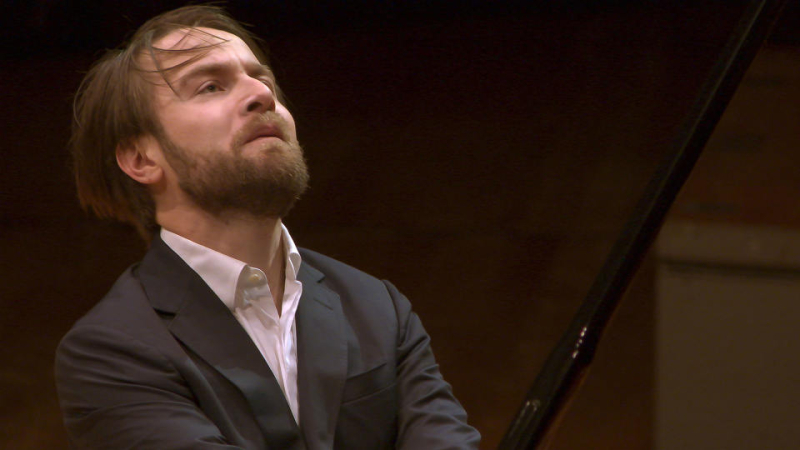
    Trifonov

    Above: pianist Daniil Trifonov

    ~ Author: Ben Weaver

    Saturday May 18th, 2019 – The MET Orchestra made its way over to Carnegie Hall for one of its popular annual orchestral concerts. Former principal guest conductor Valery Gergiev – director of the Mariinsky Theater of St. Petersburg, and a regular presence on the Met podium – led the performances (without a podium, which seems to be his preferred method; one of his many eccentricities that also include conducting with what appears to be a toothpick.)

    For the the first half of the concert Maestro Gergiev was joined by the star pianist Daniil Trifonov for Robert Schumann’s ever-green Piano Concerto in A minor. Mr. Trifonov is an excellent pianist, perhaps even a great one, even at his relatively young age. But as demonstrated by this particular performance (and not for the first time) he often displays his own eccentricities with music-making. He played the introduction to the concerto extremely slow (remarkably, one could hear some early echoes of Rachmaninoff in the piano and orchestra) – and then at the first sign of a something faster, Trifonov sped up like a runaway train. These extremes in the tempos – dragging slow and demonic fast – dominated the entire performance, but felt like an affectation, not organic music-making. This is not a new thing for Mr. Trifonov; his Carnegie Hall debut in 2011 (with Tchaikovsky’s 1st Piano Concerto, conducted by Gergiev) was criticized by the New York Times for similar behavior: “…he tended to offset extremely fast playing with extremely slow, more maundering than meditative: a manic-depressive approach…”

    Needless to say, the fast playing was dazzlingly note-perfect. Trifonov does not attempt more than he can actually accomplish. And in the slow sections he frequently displayed extraordinary sensitivity and beauty. But on the whole the performance was, alas, mostly frustrating and even boring. I have little doubt that maestro Gergiev supported all of Trifonov’s choices: Gergiev himself frequently takes similar liberties with the tempo, especially in non-Russian repertoire. Sometimes it works (his Wagner is often thrilling for it), but only sometimes.

    The audience greeted Trifonov’s performance warmly (to say the least) and he played a lovely, beautifully articulated and, dare I say, perfectly-paced encore – Schumann’s “Nicht schnell, mit Innigkeit” from Bunte Blätter, Op. 99, No. 1.

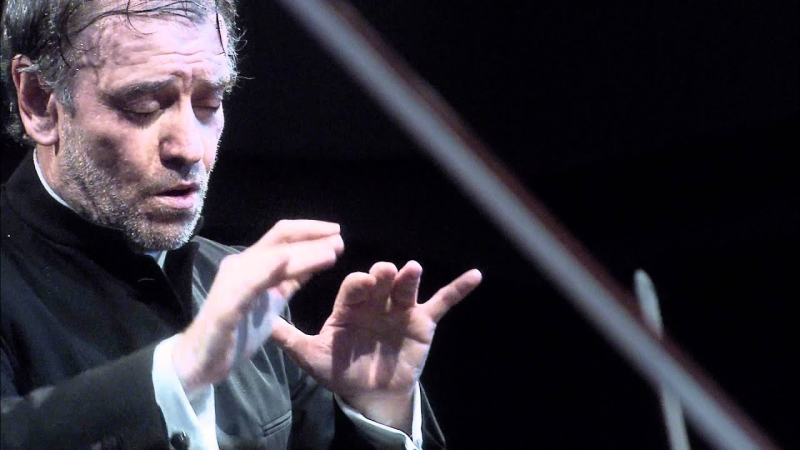
    Maxresdefault

    For the second half of the concert the MET Orchestra and Maestro Gergiev (above) took center stage for Franz Schubert’s last symphony, Symphony No. 9 in C major, completed in 1828, the year of his death. The manuscript collected dust in Schubert’s brother’s possession until 1837 when Robert Schumann, passing through Vienna, paid a visit to Ferdinand’s home and was rewarded with a “hoard of riches” of Schubert’s never-before seen manuscripts, including the final symphony. Schumann and his friend Felix Mendelssohn finally arranged the work’s premiere in 1839 under Mendelssohn’s baton. The premiere was not a success with the audiences and it took many years for the symphony to finally gain acceptance for the masterpiece it is. The work’s length, which Schumann called “heavenly,” was a big stumbling block. In due time composers like Anton Bruckner and Gustav Mahler out-composed Schubert’s 9th for time and the work finally did ascend to warhorse status.

    The symphony opens with a call from a horn, played beautifully by (probably) MET’s principal hornist John Anderer. The orchestra, under Gergiev’s toothpick, sounded superb. Gergiev has been burnishing his German music credential as the new principal conductor of the Munich Philharmonic. The nicely articulated rhythm were clean and sharp. This work was far more consistently paced than the opening Schumann concerto. Gergiev kept the symphony moving at a clip that never felt rushed. Many solo instruments were given a chance to shine, particularly the woodwinds in the second movement. The Scherzo was graceful and the once controversial final movement – where in the 1830s Mendelssohn found London musicians laughing at the second theme of the movement and refusing to play it – was thrillingly played. But something was missing from the whole: perhaps a little variety of rhythm and dynamics. Gergiev conducting was extremely consistent, but in a work faulted by some for being too repetitive, consistency turned out to be something of a negative.

    An extended ovation followed; the audience wanted an encore, but with an imperial wave Maestro Gergiev gave the orchestra permission to disband.

    ~ Ben Weaver

  • Larcher and Brahms @ The NY Philharmonic

    07_Banner_WDW__Vorlage

    Above: composer Thomas Larcher

    ~ Author: Brad S. Ross

    Thursday April 25th, 2019 – This evening at David Geffen Hall saw the performance of two imposing, if wildly dissimilar, symphonies—one old, the other new—as The New York Philharmonic made their best effort of this decidedly peculiar concert pairing.  Guest conducting the program was the Russian-born Semyon Bychkov, whose steady command brought typically formidable results from our city’s prized orchestra.  

    The first half of the concert was given over to the United States premiere of the Austrian composer Thomas Larcher’s visceral Symphony No. 2: Kenotaph.  It was prefaced with opening remarks by Larcher, who offered concise and mercifully brief pre-performance context for the work. The title (German for “cenotaph”) refers to an empty grave or monument to those buried elsewhere. It was composed between 2015 and 2016 amid the peak of the Syrian refugee crisis, which saw hundreds of thousands of migrants fleeing from their homeland towards a less-than-welcoming central Europe. This tragedy was foremost on Larcher’s mind as he wrote Kenotaph, which, as he put it, is not so much programmatic music as it is “music with empathy.”  Its form is cast, quite traditionally, in four movements over a duration of roughly 37 minutes.

    It opened with a bang on a furious, colorful Allegro, marked by numerous volatile bursts.  This momentum retreated briefly into a somber elegy, before returning with ferocious energy—an energy marked with shrieking strings, discordant brass bursts, and unrelenting percussion that led it to a frightening close.  Although occasionally on the discursive side, the movement was characterized by a gripping sense of musical drama that would set the tone for the rest of the work.

    It was followed by a mournful, string-heavy Adagio that opened on repeating glissandi in the high strings as warm brass chords and descending mallet lines swelled and trickled underneath—the effect was almost like something out of science fiction.  A voluminous march then launched the music into fearful new atmospheres as a lone violin line, performed by the concertmaster Frank Huang, faded the movement into a haunting silence.

    Next up was plucky and energetic Scherzo, molto allegro, driven by excitingly colorful percussion.  Accelerating tutti bell tones led the piece to a series of fortissimo bursts before an almost Baroque and, by comparison, shockingly tonal phrase brought the movement to a pleasant, bittersweet end.

    The final movement, Introduzione, was a somber and almost elegiac affair.  It began with a number of featured soli—trumpet, violin, viola—which, once again, were surprisingly tonal in sound.  The movement soon became violent and triumphant, as though the gates of hell had been thrust open and the devil himself was leading the charge.  The composition here was not unlike Camille Saint-Saëns’s Danse macabre, Malcolm Arnold’s Tam O’Shanter Overture, or some other ghastly jaunt of classical music history.  Larcher delightfully milked this for all it was worth and brought the movement to a number false codas before its final climax—always finding ways to say more without ever overstuffing the piece.  A quiet postlude followed that featured a ghostly violin solo—again performed by Huang.  Finally, as if burying the dead, a tasteful, yet haunting funeral march brought the symphony to its final and, appropriately, unresolved cadence.

    The audience’s response was kind, if not totally enthusiastic.  A modest number of curtain calls gave Larcher, Bychkov, and the work’s soloists much-deserved chances to take their bows, which, given the strangely contrasted pairing, is perhaps the best for which one could hope.  Nevertheless, musically Kenotaph should be regarded as one of the New York Philharmonic’s most exciting premieres of recent memory, alongside Esa-Pekka Salonen’s Cello Concerto, Anna Thorvaldsdottir’s Metacosmos, or Julia Wolfe’s Fire in my mouth.

    Had the evening had ended here—and it probably should have—this might have been one of the best concerts of the season.  Ticket-holders tend to require more than forty minutes of music to feel satiated, however, so after intermission the audience returned for an enjoyable, if unremarkable, performance of Johannes Brahms’s Fourth Symphony.

    Composed between the summers of 1884 and 1885, this would be the last of the Romantic composer’s symphonies before his death in 1897.  Cast in four movements over approximately 45 minutes, it comprises a lush and stately Allegro non troppo, a warm and overlong Andante moderato, a fairly dainty Allegro giocoso, and a lively Allegro energico e passionato, which finally injected some much-needed energy to the second half of the program.

    After the riveting first half of the concert, this listening experience was almost soporific by comparison.  Perhaps it’s simply unfair to judge such an antiquated work against the rigorous complexities of one so new, but it’s one this odd pairing begged to be made.  Nevertheless, one could not possibly walk away from this concert feeling anything less than satisfied.  All in all, it was another splendid night at the New York Philharmonic—the gem of this great city.

    ~ Brad S. Ross

  • The Chéreau ELEKTRA ~ On Film

    Elektradvd

    ~ Author: Oberon

    Patrice Chéreau’s production of Richard Strauss’s ELEKTRA originated at Aix-en-Provence in 2013, in the 1350-seat theatre there. It did not impress me when it came to The Met in 2016; though musically vivid, as a theatrical experience it got lost in the vast space of the world’s largest opera house.

    The Aix performance was filmed, and released on DVD in 2014. I came upon it by chance at the library, brought it home, and was blown away by both its musical and dramatic power. It is a production that cries out to be seen up-close, and the camera work for the DVD takes us right into the action, as if from the start we are in service at the House of Atreus and watching this domestic horror-story unfold before our eyes. A brief sampling from the DVD here.

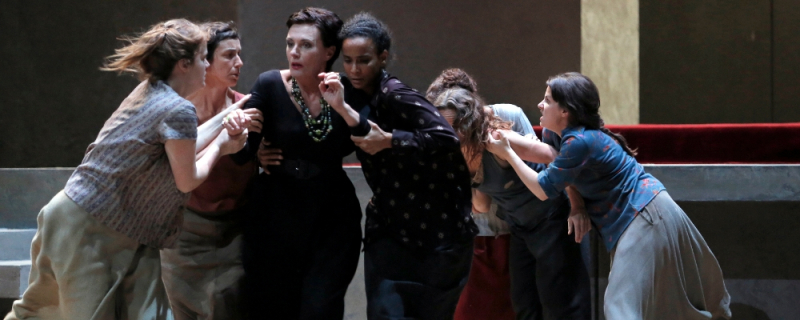
    The opera’s story is absorbingly told, with some liberties taken. The shifting loyalties of the maids and other household members are cunningly delineated.

    Veterans Renate Behle (visually fascinating), Franz Mazura, and Donald McIntyre make vivid impressions in smaller roles, and Chéreau’s idea of casting the beloved soprano Roberta Alexander as the sympathetic 5th Maid pays off handsomely: her singing and her portrayal are riveting, and she is hugely applauded during the bows.

    Memorable portrayals in the production:

    Rmassague32918919-icult-elektra-richard-strauss-direttore-esa160225184321-1456422413450

    Above: Tom Randle as Aegisth is aghast at being shown the corpse of his paramour Klytämnestra.

    24iht-loomis24-picA-articleLarge

    Above, siblings reunited: Evelyn Herlitzius as Elektra and Mikhail Petrenko as Orestes; the bass-baritone makes a strong impression as the haunted son of Agamemnon.

    9134600514_4a6e833a97_b

    Above, the sisters: Adrienne Pieczonka as Chrysothemis and Evelyn Herlitzius as Elektra. Ms. Pieczonka sounds fantastic in this film (of a live performance), her top notes pealing forth.

    Aix Elektra

    Above: Waltraud Meier as Klytämnestra. Ms. Meier’s singing, so alive with subtle inflection, did not always register at The Met, but she makes a striking impression – both vocally and visually – in the film. M. Chéreau eliminates the queen’s hysterical laughter on learning of the death of her son; I for one don’t miss it.

    3-format6001

    Above: Evelyn Herlitzius scored a great personal triumph as Elektra at Aix-en-Provence, and it is wonderful that her performance has been preserved. With a voice I would describe as “big lyric”, Ms. Herlitzius does not sing the music as we are accustomed to hearing it sung. Both in voice and in her athletic physique, the soprano seems almost youthful, though in fact she was around 50 years old when the film was made (You’d never guess it by watching her!). She powers thru the vocal demands, and shows off a secure, brightish top.

    However, the pressure she has put on her instrument in such arduous music has worn the voice down over time; her 2018 Met debut performances as Kundry were disappointing, showing the effects of hard usage on her timbre, the voice sometimes ineffectual in the large space. This makes having a document of her Elektra on fine vocal form all the more valuable, for her passion and commitment are unquestionable.

    You can find copies of this performance for purchase here. It’s well worth owning.  

    The Participants:

    Elektra Evelyn Herlitzius
    Klytämnestra Waltraud Meier
    Chrysothemis Adrianne Pieczonka
    Orest Mikhail Petrenko
    Aegisth Tom Randle
    Der Pfleger des Orest Franz Mazura
    Ein junger Diener Florian Hoffmann
    Ein alter Diener Donald McIntyre
    Die Aufseherin / Die Vertraute Renate Behle
    Erste Magd Bonita Hyman
    Zweite Magd / Die Schleppträgerin Andrea Hill
    Dritte Magd Silvia Hablowetz
    Vierte Magd Marie-Eve Munger
    Fünfte Magd Roberta Alexander

    Coro Gulbenkian

    Orchestre de Paris

    Conductor: Esa-Pekka Salonen

    ~ Oberon

  • Buon compleanno, Fiorenza Cossotto!

    Z-1101

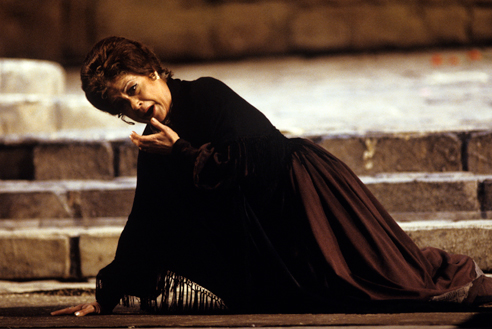
    To celebrate the birthday of La Cossotto, a scene from one of her fabulous performances as Santuzza in CAVALLERIA RUSTICANA at the Met in 1970. After the curse, it’s my “brava!” that gets the ovation going.

    CAV – scene – Cossotto – Domingo – Casei – Kraft – Met 1970

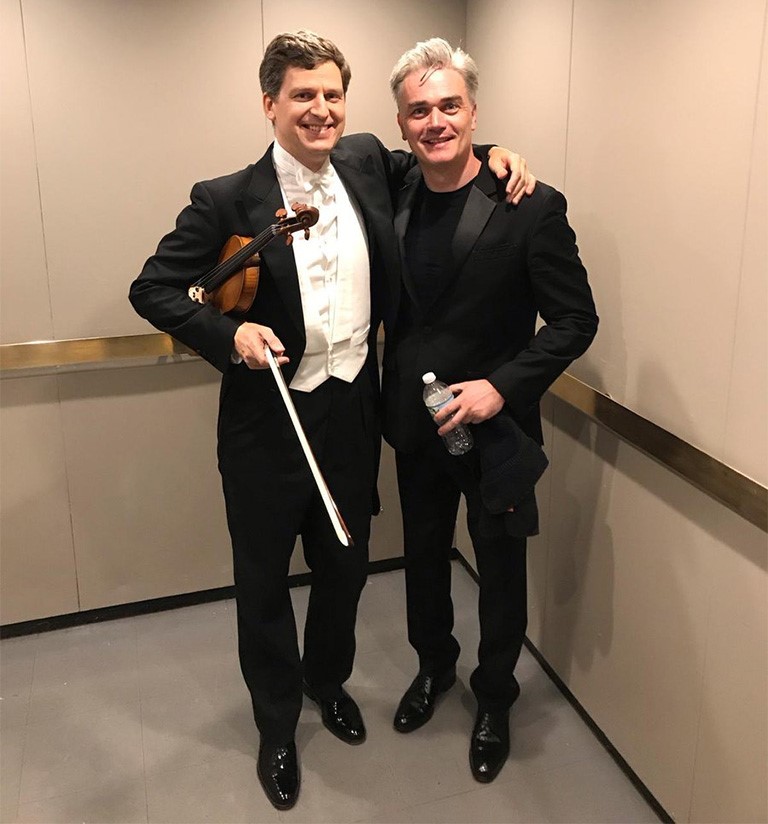
  • James Ehnes ~ The London Philharmonic

    Thumbnail_16373_1

    Above: violinist James Ehnes and conductor Edward Gardner, photo from Twitter @ IntermusicaLtd

    ~ Author: Ben Weaver

    Monday April 15th, 2018 – The London Philharmonic’s second New York City concert, a part of Lincoln Center’s Great Performers series, featured some old favorites on the program. Opening with Beethoven’s great and brooding Egmont Overture (why the complete incidental music is so rarely performed is a mystery to me; the work is full of great music!) Today we have gotten quite used to Beethoven performances by reduced ensembles, even when performed by major orchestras the number of players is typically reduced to be closer to an orchestra size Beethoven would have recognized. Not so with this performance of Egmont. Maestro Edward Gardner chose the full London Philharmonic ensemble – and why not, since they all crossed an ocean? The result was a big-boned, massive sound and Gardner’s driven, dramatic reading made for on thrilling start to the concert.

    Violinist James Ehnes then joined the orchestra for Sibelius’ magnificent and never tired Violin Concerto. There is no real introduction to the work: out of the shimmering violins rises the soloist. Ehnes’ beautiful tone, perfect pitch, and deeply-felt playing kept the audience in thrall. Ehnes doesn’t make a huge sound, but the musicality and dedication he brings to every note are second to none among his generation of violinists. Here Edward Gardner was a superb accompanist: he kept the orchestra in the background, letting his soloist shine. The audience’s reaction was predictably ecstatic, allowing Ehnes to play two contrasting encores: Ysaë’s blazing Sonata No. 3 and Bach’s wistful, gentle Largo from Violin Sonata No. 3.

    Mahler’s Symphony No. 1 received a thrilling performance after the intermission. In the first movement, the slow build from hushed strings that open the work to the “full blast of Mahler” was nicely shaped and paced by Gardner. The sudden return of the opening drone had a sinister glow to it, but horns chased away the clouds and the lovely second theme, a pastorale, returned. The rustic swing of the second movement was taken quite fast, though Gardner knew to slow down for the waltz, played lovingly by the orchestra.

    Here some mannerisms from Gardner began to make themselves obvious. Draggy slow parts and extra fast faster sections became the signature of the rest of the performance. Gardner softened the edges of the third movement with its halting funeral march and the child-like melody mocking it. The final movement reinforced Maestro Gardner’s extreme tempos and I don’t think his choices worked. The slow sections began to drag and the Symphony began to lose shape. The hyper-emphasized big moments (already big in Mahler) at the expense of everything else felt contrived. But the London Philharmonic was superb (special praise for the outstanding brass section in the Mahler). It is a great ensemble, I’d go so far as to say LPO is a better orchestra, with its warmer and more versatile sound, than their big cousin, the London Symphony. 

    One curiosity about the concert is there were an awful lot of things being dropped by audience members throughout the evening. At least it wasn’t constant cell-phones, I suppose.

    ~ Ben Weaver

  • My First WALKURE

    T16406_jon-vickers-canadian-tenor

    Above: Jon Vickers, my first Siegmund

    ~ Author: Oberon

    With Wagner’s RING Cycle currently playing at The Met, I’ve been thinking back to when I saw these operas for the first time. My first RHEINGOLD was conducted by Herbert von Karajan; it was part of a thrilling weekend I spent at The Met in 1969.

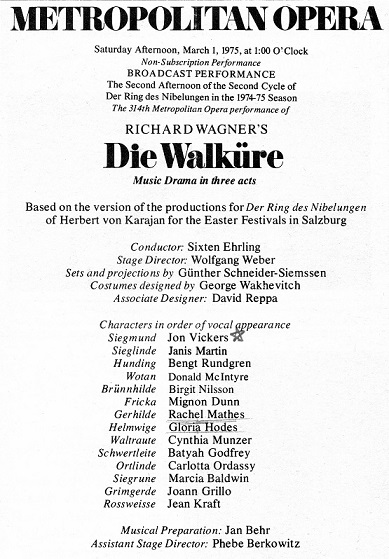
    It wasn’t until 1975 that I saw WALKURE, in a production based on Karajan’s Salzburg Festival production. Karajan of course had been due to stage and conduct the entire Cycle at The Met, but he never got beyond the first two operas before withdrawing from the project.

    My first WALKURE

    Of my first WALKURE, I wrote in my diary:

    “First time – an uneven performance: the good moments were very good, but much of the performance was a letdown.

    Sixten-ehrling

    Sixten Ehrling (above) did a really great job; he kept things moving, allowed the singers to be heard at all times, and his reading had warmth and clarity. The Valkyries were a mixed lot [I am not sure why I underlined two of the singers’ names on my cast page, especially as people like Marcia Baldwin, Batyah Godfrey, and Jean Kraft were favorites of mine at the time]. Bengt Rundgren was an impressive Hunding.

    Dunn Fricka

    Mignon Dunn as Fricka (above) got off to a rough start, but quickly got things in gear and was very fine. [She was another top favorite of mine, and in 1977 established herself as a star with her portrayal of Ortrud in LOHENGRIN].

    Wotanalone

    Donald McIntyre (above) as Wotan was truly effective: well-sung, very involved, a first-class actor. His long Act II monologue was a high point of the performance.

    Birgit Nilsson was not good as Brunnhilde. She looks really old, was uninvolved as an actress, and she behaved stupidly during the curtain calls. Her “Ho-Jo-To-Ho!” was full of swoops and off-pitch notes. Most of Act II was very ambiguous pitch-wise, and her voice seems to have diminished in size and scope. In Act III, she sounded somewhat better, but pitch was really a problem, and spoiled much of her performance.

    Janis Martin as Sieglinde was very good in Act I, but after that she slid downhill. She does not have the ringing upper range for this music, and seemed always to be singing at full-force. Stage-wise she was not exciting at all. Considering all this, I was surprised that she received a rapturous ovation during the curtain calls.

    Only one word is needed for Jon Vickers’ Siegmund: perfect! Bravo!!


  • @ My Met Score Desk for WALKURE

    54727491_10161727100955533_4208711738377371648_n

    Above: Stuart Skelton and Eva-Maria Westbroek as Siegmund and Sieglinde/a Met Opera photo

    ~ Author: Oberon

    Saturday March 30th, 2019 matinee – I admit that I am not feeling excited about the Met’s current RING Cycle performances. Much as I have been starved for Wagner in recent Met seasons, and despite the RING being very high on my list of favorite works, a lot of the casting this time around is uninspiring. And, if the free-standing RHEINGOLD I saw recently was any indication, Philippe Jordan’s Wagner conducting doesn’t really send me. So I went to this afternoon’s WALKURE simply because it’s WALKURE.

    En route to the theater, I encountered Michael Volle, the alternate Wotan, heading for the Met’s stage door in the passageway under Lincoln Center. I wondered if there would be a cast change, but – after a delayed start of fifteen minutes – the performance commenced with the announced cast.

    I did not stay for the third act; after debating with myself, I decided to leave before enduring another prolonged intermission. Then on the train going home, I thought: “What if that was your last WALKURE…ever?”

    Blasts of frigid air (common up in the Family Circle boxes) continued throughout the performance; whilst waiting for the House to go dark, we heard a gorgeous cacophony of Wagnerian leitmotifs from the musicians warming up.

    The singers today ranged from stellar to acceptable, but Maestro Jordan seemed far more impressive here than in the RHEINGOLD, and the orchestra playing was – for the most part – thrilling, both in its overall resonance and in the many featured opportunities; the cello (especially before “Kühlende Labung gab mir der Quell“), the clarinet (as the mead is tasted, and later in the prelude to the Todesverkundigung ), the somber horns and heartbeat timpani in that magnificent Annunciation of Death…and countless other phrases.

    Stuart Skelton’s Siegmund seemed to me to stand firmly in the top echelon of the role’s interpreters of the last half-century, alongside Jon Vickers and James King. Both musically and as a character, this role suits Mr. Skelton far better than Otello. His Siegmund has both power and poetry. The son of a god, he is deeper and more thoughtful than he might seem on the surface; for, in his own way, Siegmund has great nobility…and great humanity. In finding and liberating Sieglinde, he finds a joy and purpose in life hitherto denied him; that it will last less than a day makes him all the more poignant. His overwhelming tenderness towards his sister-bride, his awe in encountering Brunnhilde, and his helpless rage at his father’s deceit are all vividly expressed in his music. And Mr. Skelton took all of this to heart: with generous lyricism, warmth of tone, and vivid declamation, he brought Siegmund palpably to life, making him the central figure of the opera.

    Mr. Skelton’s Sword Monolog in Act I was among the very finest I have ever heard. But even before that, he had so many wonderful passages of clear-voiced, expressive singing: ” Kühlende Labung…”, and the great subtlety and feeling of resignation he brought to “Nun weißt du, fragende Frau, warum ich Friedmund nicht heiße!” 

    The mysterious, uneasy orchestral prelude to the Monolog set the mood for our tenor, who caught every nuance of the text and brought vocal colors into play with masterful modulations of dynamic. Sublime tenderness at “…ein Weib sah’ ich, wonnig und hehr...” was followed moments later by Mr. Skelton’s phenomenal sustaining of the cries of ” Wälse! Wälse!“, so tonally steady and true, whilst the orchestra generated white heat. The trumpet then rang out with the Sword Motif. Magnificent moments! 

    The tenor’s energy seemed to flag momentarily after these arduous pages of dramatic singing, but he quickly attained peak level again with a beautifully poetic “Winterstürme“.  From thence, Mr. Skelton and his Sieglinde, Eva-Maria Westbroek, gave a strikingly passionate account of the final pages of Act I, from the growing excitement as they begin to realize who they are, (Skelton’s “Du bist das bild das ich in mir barg” – “Yours is the image I held in my heart!”…yet another perfect moment) thru the drawing of the sword from the tree, and their escape into the night.

    Ms. Westbroek’s singing overcame the distractions of a widening vibrato and insecurity at the top of her range by sheer willpower: her passionate commitment to the music and to the character made her vocal flaws seem irrelevant. The soprano’s rendering of the narrative “Der Männer Sippe” had its vocal ups and downs, but underlying her singing was this deep raging fire: a hope for freedom…and love. This more than compensated for a lack of ‘ring’ in her upper notes. “Du bist der Lenz” likewise had many lovely touches along the way: and then the A-flat loomed. She got it.

    Sieglinde describes the sensation of having heard Siegmund’s voice before, as a child; and then, at “Doch nein! Ich hörte sie neulich” (“But no, I heard it of late…”) Ms. Westbroek suddenly cut loose vocally, as if liberated. This launched a magnificent outpouring of emotion and song from both singers as the sibling-lovers surrendered to the inevitable. The soprano staked out a long, resounding top-A as she named Siegmund. And the music rolled on, in an unstoppable flood of hope and desire. 

    A titanic ovation rocked the house and, as has long been a tradition at this point, the two singers – Ms. Westbroek and Mr. Skelton – stepped out for a bow as the crowd went wild. Günther Groissböck, our excellent Hunding, joined them and the applause re-doubled. It seemed like old times.

    G groissbock

    Mr. Groissböck (above) is not a cavernous-toned basso in the manner of Martti Talvela or Matti Salminen; the Groissböck Hunding is leaner and meaner. His voice has power, authority, and insinuation. Having patiently listened to Siegmund’s tale of woe, the basso kicks out the blocks with “Ich weiß ein wildes Geschlecht!” and delivers a knockout punch with “Mein Haus hütet, Wölfing, dich heute…”  Bravissimo! 

    Jamie Barton’s Fricka was prodigiously sung; the top notes sometimes have a slightly desperate feel, and to me her over-use of chest voice runs counter to the character: she is the queen of the gods, not a desperate, ex-communicated Sicilian peasant. Barton’s parting lines to Brunnhilde were more to the point: a self-righteous woman calmly dealing from a position of power; a wife who has the upper hand.  

    Greer Grimsley’s voice is now rather time-worn, but he knows the role of Wotan inside-out and makes a vibrant impression through his deep understanding of the character, using the words as a dramatic springboard, and hurling vocal thunderbolts at just the right moments. His long monolog in Act II was rich in detail and feeling, and his dismissal of Hunding was a memorable moment: “Geh!” first as a quiet command, then in a snarling fit of rage.

    A lot of water has flowed under the bridge of time since Christine Goerke gave her revelatory performances of the Dyer’s Wife in FRAU OHNE SCHATTEN at The Met in 2013. At that time, the huge Met contract she was offered following her triumph seemed both exciting and amply justified. But the ensuing seasons, during which Goerke has put her voice to unstinting use in the most demanding repertory, have taken a toll: notes above the staff are thinned out and approximated now, the power of the voice has lessened, and today there were passing pitch difficulties in the mid-range. Perhaps to compensate, the soprano seemed to be over-enunciating the text, spitting out and biting off her words.

    The soprano got off to a rocky start with a helter-skelter Battle Cry. But Ms. Goerke settled in for the opera’s heart and soul: the Todesverkundigung (Annunciation of Death), where the music lies very much in her comfort zone. Maestro Jordan took this scene a bit faster than I’d have liked, and sometimes let the voices be covered. The music is full of foreboding as Brunnhilde tells Siegmund he will die in the coming fight against Hunding, after which she will bear him to Valhalla; there, as Ms. Goerke beautifully tells him, he will be greeted by Wish-Maidens who will serve and delight him.

    When Siegmund asks if Sieglinde can come with him into the afterlife, Brunnhilde/Goerke replies – meltingly lovely of tone – “Erdenluft muß sie noch athmen” (“Earthly air must she keep breathing…”). Siegmund then rejects the bliss of Valhalla. When Brunnhilde chides him for placing his love for this “poor, ailing woman” above the glory of immortality, Siegmund’s reply is one of the great crushing dismissals in all opera:

    “So young and fair you shine before me,
    yet how cold and hard is your heart!
    If you can only mock me,
    then take yourself hence,
    you cruel, merciless maid!
    Or if you hunger for my distress,
    then freely feast on my woe;
    let my grief quicken your envious heart:
    But of Valhalla’s loveless raptures
    speak no more to me!”

    No mortal has ever answered Brunnhilde thus; now, moved by Siegmund’s plight and her eyes opened to her father’s deceit, Brunnhilde vows that Siegmund shall win the coming fight.

    This leaves the stage now to Mr. Skelton’s Siegmund. Gearing up for the battle, he looks upon the sleeping Sieglinde and sings – with infinite tenderness: “So slumber on, till the fight be fought, and we find our  peace and joy!”

    The ominous blaring of Hunding’s hunting horns is heard. And the fight is on! The voices of Skelton and Groissböck – so alive in the House – threaten one another. The orchestra storms wildly. Brunnhilde shields Siegmund, but Wotan suddenly appears out of nowhere, shatters Siegmund’s sword, and Hunding slays his enemy with a spear thrust. Pausing only to dispatch Hunding, Wotan/Grimsley turns his wrath on his disobedient daughter, who has fled with Sieglinde and the pieces of the shattered sword:

    “But Brünnhilde! Woe to that traitor!
    Dearly shall she pay for her crime,
    if my steed o’ertakes her in flight!” 

    Metropolitan Opera House
    March 30th, 2019 matinee

    DIE WALKÜRE
    Richard Wagner

    Brünnhilde..............Christine Goerke
    Siegmund................Stuart Skelton
    Sieglinde...............Eva-Maria Westbroek
    Wotan...................Greer Grimsley
    Fricka..................Jamie Barton
    Hunding.................Günther Groissböck
    Gerhilde................Kelly Cae Hogan
    Grimgerde...............Maya Lahyani
    Helmwige................Jessica Faselt
    Ortlinde................Wendy Bryn-Harmer
    Rossweisse..............Mary Phillips
    Schwertleite............Daryl Freedman
    Siegrune................Eve Gigliotti
    Waltraute...............Renée Tatum

    Conductor...............Philippe Jordan

    ~ Oberon

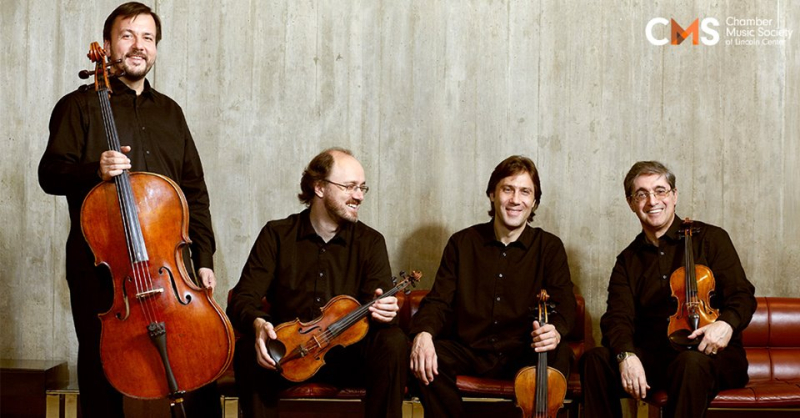
  • The Borodin Quartet ~ Chamber Music Society

    54390889_10156374663898666_1471336215130144768_n

    Above: the members of The Borodin Quartet: Vladimir Balshin, Sergei Lomovsky, Igor Naidin, and Ruben Aharonian.

    ~ Author: Oberon

    Sunday March 24th, 2019 – For the grand finale of their Russian Panorama festival, Chamber Music Society of Lincoln Center welcomed The Borodin Quartet. Formed in 1945 by four students from the Moscow Conservatory, the Borodin are world-renowned for their interpretations of the Shostakovich quartets.

    The Frankfurter Allgemeine Zeitung said of The Borodin Quartet: “…here we have not four individual players, but a single 16-stringed instrument of great virtuosity.” Truer words have ne’er been written. The members of the Borodin are Ruben Aharonian and Sergei Lomovsky (violins), Igor Naidin (viola), and Vladimir Balshin (cello); seldom have I heard such an intrinsically beautiful blending of sound as in this richly rewarding concert.

    To open the program: Nikolai Myaskovsky‘s Quartet No. 13 in A-minor, Op. 86, written in 1949. A composer of vast output, Myaskovsky is not well-known outside Russia, where he is considered part of a triumvirate alongside Prokofiev and Shostakovich; Myaskovsky’s music is far more conservative than that of his two compatriots, and he disdained European influences. On the evidence of this 13th quartet, opportunities to hear more of his music would be most welcome.

    To a pulsing rhythm, a cello solo is passed on to the violin and then to the viola; immediately the unique sound of the Borodins captivates the ear. The themes of this opening Moderato entwine in a miraculous intermingling of the four instruments. A sense of urgency rises, then subsides as Mr. Aharonian’s violin sings a sad, sweet song. A fugue springs up, then the melodic flood resumes, sweeping on to a reverential ending.

    The Presto fantastico is a swift, scherzo-like affair with a driven accompaniment figure until things slow for a poignant melody from the violin and cello in turn. To a plucking motif, cellist Vladimir Balshin plays a melancholy air. The music then peps up, dancing along at increasing speed to a witty, plucked finish.

    The Andante con moto e molto cantabile is solemn and wistful: the signature feeling we associate with the most poignant Russian music. Cello and violin are again featured, and the movement ends in a benedictive state. 

    The energetic start of the Molto vivo offers perfect contrast: violin and cello passages – the violin sailing over dense harmonies – evolve to a delightful section for duetting violins as the lower instruments are plucked. Violin and cello resume their thematic game of tag; the violin duo revives itself, joined by cello and viola as the the music comes to an amusing end.

    Shostakovich’s Quartet No. 13 in B-flat minor, Op. 138, was composed in 1970. In this single-movement work, the viola takes a prominent role; the quartet further features moments when the players tap on their instruments with the wood of their bows.

    From the opening solo, violist Igor Naidin’s playing made a deep impression. As the other players join, dissonances crop up. The violin wanders above, the cello deep, the harmonies brooding. The violins duet, and the music turns searing before resuming is slow, darkish aspect. The high violin makes stuttering comments, and from dense dissonances the trilling viola emerges. Now the tapping starts. The higher voices commence a rhythmic pattern, with the cello sounding below. A sense of mystery develops, broken by insistent slashings. The the viola plays alone, the music rich and gloomy, and the violin on the rise. Cello and viola duet; the viola begins to ascend and – against the tapping – Mr. Naidin sounds simply ravishing. The music ends on high, sustained tones. 

    Following the interval, Alexander Borodin’s Quartet No. 2 in D-major, from 1881, was given a phenomenal performance. The opening Allegro moderato, with superb playing from Mr. Balshin, was a pure delight. The Scherzo, quite bubbly, brings out the familiar melody of “Baubles, bangles, and beads“, adapted in the musical Kismet. Lyricism and finesse sustain the ebb and flow before returning to the charm of the Kismet theme, underscored now by the insistent sound of the cello’s tones. There’s a sudden rush, to a sprightly finish…:”Wow!” is what I wrote here.

    The cello’s plushy resonance and the violin’s silken sweetness intoxicate us in the Notturno: andante: music of magical romance. As heart-on-sleeve theme follows gorgeous theme, the players outdo themselves: the violins ethereal, the cello stunning, as the music becomes truly sublime.

    A rather weird entr’acte introduces the Finale, with the cello setting the pace as the viola takes off. All play briskly, the music scurrying before turning lyrical. The “entr’acte” returns, feeling a bit out of place. Slow and fast passages alternate, leading to the dense finish with the violin poised in heaven.

    Tonight’s Alice Tully Hall audience were not about to let The Borodin Quartet go without an encore: insistent applause and cheers brought the players back to their chairs, where they offered a hauntingly beautiful rendering of Shostakovich’s Elegy for String Quartet: a perfect ending to a perfect evening. 

    ~ Oberon

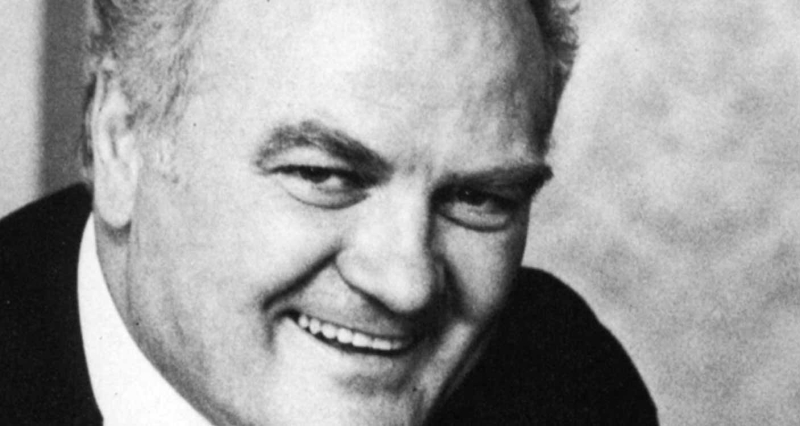
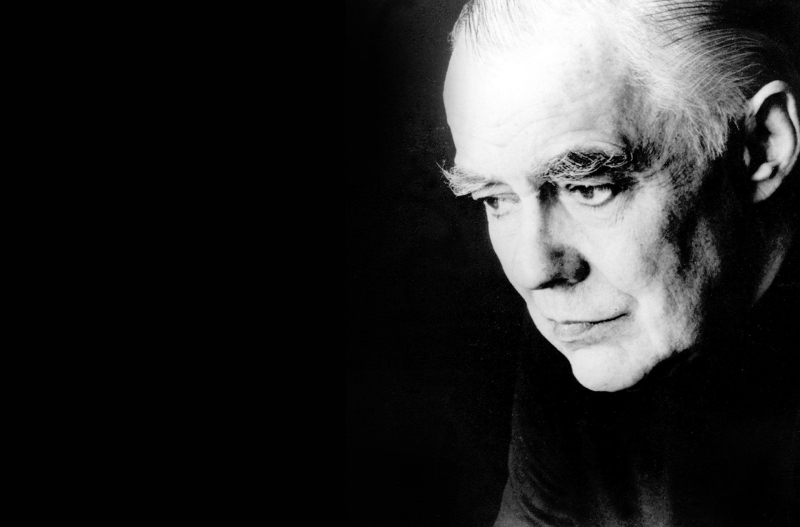
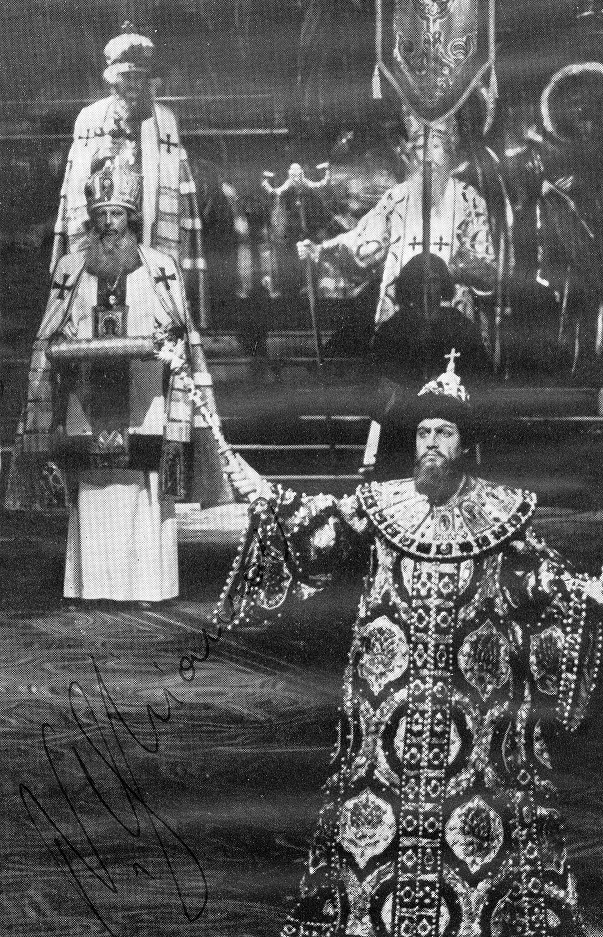
  • Nicolai Ghiaurov as Boris Godounov

    Scanned Section 2-1

    Nicolai Ghiaurov signed this photo for me after a performance of DON CARLO at The Met in 1968.

    Nicolai Ghiaurov – Skorbit Dusha! ~ BORIS GODOUNOV