Category: Reviews

  • Natalia Troitskaya as Adriana Lecouvreur

    00323174

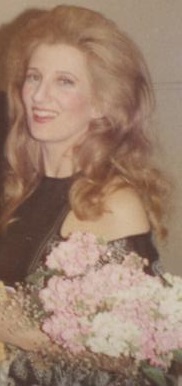
    Natalia Troitskaya, born in Belgrade of Russian descent, had a major career as a lirico-spinto soprano during the 1980s. She sang at many major European houses, having a long association with both the Vienna State Opera and the Staatsoper Hamburg. She sang in South America, and in the USA at Washington DC and Los Angeles.

    Troitskaya seemed to vanish from the operatic world around 1991; later, I learned that she had passed away in 2006 at the age of 55 following a long illness. She left hardly any commercial recordings, but there are some live performances that were preserved from broadcasts.

    Natalia Troitskaya – ADRIANA LECOUVREUR – Adriana’s entrance – Barbican~London 1987

  • Patricia Brooks as Violetta

    6a00d8341c4e3853ef00e54ff4f69f8833-800wi

    I’ve seen more than a eighty different sopranos in the title-role of Verdi’s TRAVIATA over the years. Patricia Brooks’s interpretation of the role of Violetta in Frank Corsaro’s memorable production for the New York City Opera in 1966, with Placido Domingo as Alfredo, remains at the top of the list. Employing her rather slender and agile voice to optimum effect, she created a portrait of the doomed courtesan that has resonated over the decades. Paradoxically feverish and fragile, Brooks moved audiences – literally – to tears.

    Listening again, nearly fifty years on, to my in-house recording of the Act I scena brings back a flood of memories of the myriad nuances – both vocal and dramatic – that gave the Brooks Violetta its unique place in the opera’s performance history.

    One thing about Ms. Brooks in this role: she was forever making tiny changes in both her singing and her acting of the role, maintaining its freshness over the half-dozen times I saw her in the role. As Matthew Epstein, a great Brooks admirer, said: “No two Brooks Violettas are alike!”

    Patricia Brooks as Violetta – w Molese – NYCO – 9~28~69

    There were other Violettas who moved and thrilled me, but none quite reached the soul of the desperate woman who sacrifices her own happiness so that someone else may be happy.

  • The First Time I Heard GÖTTERDÄMMERUNG

    Herbert-Ralph-02[d]

    Above: American bass-baritone Ralph Herbert

    Still being held captive by the evil sorceress Sciatica, I decided I needed a different “front page” article for my blog.

    Coming randomly upon an excerpt from Act II of Wagner’s GÖTTERDÄMMERUNG – from my premiere encounter with that opera – I was taken back over the decades to a wintry afternoon in January, 1962, when I heard Wagner’s “grand finale of the RING Cycle” for the very first time. At age fourteen, I had already been an opera-lover for three years when the complete RING was broadcast via the Texaco-Metropolitan Opera Radio Network.

    I never missed a Texaco matinee in the first 20 or so years of my operatic ‘career’, my first one having been Sutherland’s “debut season” LUCIA broadcast. I would sit alone in the family rec room, and no one was allowed to disturb me; the phone was taken off the hook. Once in a great while, if a particular opera was not grabbing my attention, my grandmother and I would play Honeymoon Bridge as the sun went down. We always loved Milton Cross’s narration of the curtain calls. 

    The RING Cycle of course became a great favorite work of mine over time; but at first, allured as was by by BUTTERFLY, TROVATORE, and GIOCONDA, it wasn’t easy to comprehend.

    RHEINGOLD was not very accessible for me: too much “male” singing. I did better with DIE WALKÜRE, in part because the story had more meaning for me, and three singers I already knew and liked – Birgit Nilsson, Gladys Kuchta, and Jon Vickers – had leading roles. Hearing Milton Cross describe the final scene of WALKÜRE prompted me to go out into the field behind our house and make a circle of empty boxes, newspapers, etc on the snow-covered ground. I set it afire in four different places and then realized I was in the middle of the ring.

    SIEGFRIED was something of a trial, at least until Jean Madeira (Erda) and Birgit Nilsson (Brunnhilde) started to sing. I remember liking the Norn Scene from GÖTTERDÄMMERUNG quite a bit, wherein Madeira was joined by Irene Dalis and Martina Arroyo; and the Dawn Duet was fun, thanks to Birgit’s lightning bolt high-C, but my mind began to wander during much of the rest of Act I, re-engaging when Nilsson and Irene Dalis met as the sundered Valkyrie sisters.

    Neu-frick-2-640x3001

    Above: bass Gottlob Frick

    I can remember distinctly being drawn into the mystery of the opening of Act II, especially as Milton Cross had described Alberich’s dreamlike appearance to his slumbering son, Hagen, sung by Gottlob Frick, who over the ensuing years has always been my idea of a great Wagner basso.

    In this eerie scene, Mr. Frick is joined by baritone Ralph Herbert as Alberich:

    Ralph Herbert & Gottlob Frick – Götterdämmerung ~ Act II Scene 1 – Met 1962 – Leinsdorf cond

    Of course, Birgit’s Immolation Scene was exciting, though at the time it seemed too long; now it sometimes seems too short.

    Erich Leinsdorf conducted this RING Cycle; a grand master of the Wagner repertoire, he had made his Met debut in 1938 (!) conducting WALKÜRE with Flagstad as Brunnhilde and Elizabeth Rethberg as Sieglinde, and made his farewell to The Met in 1983, conducting ARABELLA with Dame Kiri Te Kanawa. In all, Leinsdorf led nearly 500 performances for The Met, both at home and on tour.

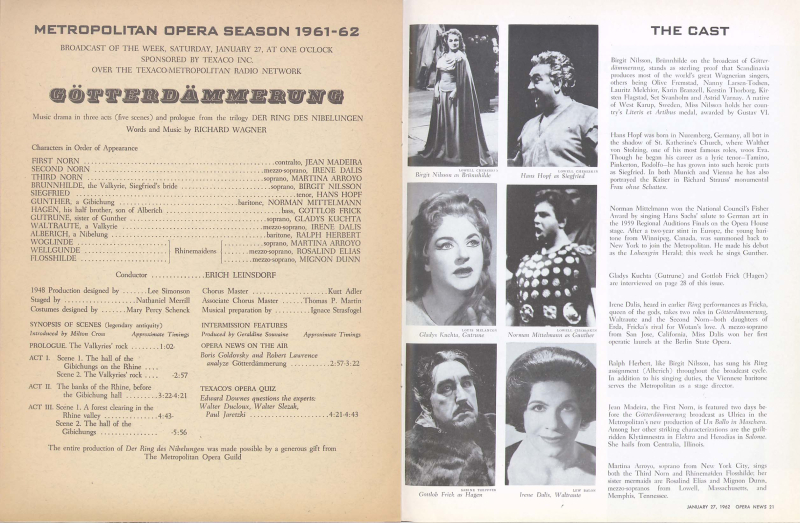
    ONGotterdammerung196162

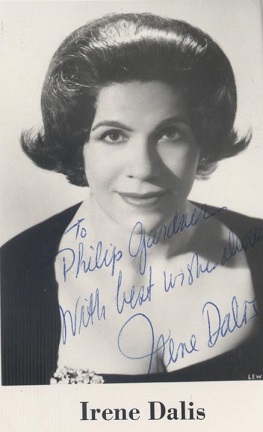
    It was fun coming across the Opera News cast page (above) for this particular broadcast, and to see that Ms. Dalis had sent me an autographed copy of the same head-shot used in the magazine:

    6a00d8341c4e3853ef00e54f21231a8833-800wi

    And here are Nilsson and Dalis in final part of the scene where Waltraute has asked Brunnhilde to give up the ring. It begins with Brunnhilde’s “Welch’ banger Träume Mären meldest du Traurige mir!” (“What tales of tortured dreams do you tell in such distress?”)

    Götterdämmerung ~ Birgit Nilsson & Irene Dalis – Leinsdorf cond – Met 1962

    Recalling those first few seasons of broadcasts, I remember one of my grandmother’s great comeback lines. Sutherland was singing Amina in SONNAMBULA and at the end of “Sovra il sen” I said: “Grandma, Joan Sutherland just hit E-flat above high-C!” “That’s nothin’…” she retorted, “…once I got up to P and held it all night!”

    ~~~~~~~~~~~~~~~~~~~~~~~~~~~~~~~~~~~~~~~~~~~~~~~~~~~~~~~~~~~~~~~~~~~~~~~~~~~~~~~~~~~~~~~~~~~~~

    I’m sorry not to be attending performances at this time, and blogging about them; hopefully I will become more mobile in the next few days, and start venturing out. I appreciate everyone continuing to visit Oberon’s Grove and finding things to read.

  • Nilsson & Rysanek in WALKURE

    Nilsson Rysanek

    In their signature roles of Brunnhilde and Sieglinde, I believe this series of performances may have been the last time Birgit Nilsson and Leonie Rysanek sang in DIE WALKURE together. Otmar Suitner conducts.

    Nilsson & Rysanek – WALKURE – scene from Act III – San Francisco 1982

  • Nilsson & Rysanek in WALKURE

    Nilsson Rysanek

    In their signature roles of Brunnhilde and Sieglinde, I believe this series of performances may have been the last time Birgit Nilsson and Leonie Rysanek sang in DIE WALKURE together. Otmar Suitner conducts.

    Nilsson & Rysanek – WALKURE – scene from Act III – San Francisco 1982

  • Renata Scotto’s “Ah! non giunge”

    Scotto

    At the end of October 1972, Renata Scotto was alternating performances of Amina in SONNAMBULA and the title-role of LUCIA DI LAMMERMOOR at The Met. I came down from Syracuse NY to see her as Amina on a Thursday night and her Lucia two nights later. Her tenor co-stars were Nicolai Gedda (Elvino) and Alfredo Kraus (Edgardo). The diva scored back-to-back triumphs.

    SONNAMBULA ends with Amina’s joyous cabaletta “Ah! non giunge”. Scotto, having held a rapt audience in the palm of her hand throughout the opera, now came down past the prompter’s box to the very edge of the stage and sang directly to us. As the second verse progressed, the house lights were slowly raised to full brightness; and so, in the end, singer and audience were “…uniti in una speme.

    Scotto sings ‘Ah non giunge!’ – SONNAMBULA – Met 10~28~72(1)


  • @ My Met Score Desk: NABUCCO

    J levine

    Above: James Levine

    Tuesday December 27th, 2016 – Listening to James Levine conduct tonight’s ‘alternate cast’ performance of Verdi’s NABUCCO at The Met was something of a revelation. The venerable Maestro was greeted by a sustained roar of cheers and applause when he was spot-lighted in the pit at the start of the evening. Within moments, he and the Met musicians had set the music blazing off the page.

    The score seemed remarkably fresh…and important: one could understand immediately why this opera sent Verdi’s star on its immortal trajectory. A great sense of passion and propulsion prevailed, but the more solemn passages also rang true. Chorus and orchestra were on high form, and the opera swept forward vividly. For all the sense of urgency that Maestro Levine brought to the music, there were also wonderfully detailed moments, most notably the ‘busy’ wind playing that bubbles under the melodic line of the quintet “S’appresan gl’istanti“. Taking things into overdrive, the Maestro propelled the big ensemble/finale of Act II to an exhilarating finish.

    Following a marvelous rendering of the overture – which highlights several themes to be heard later in the opera – the chorus drew us in to the plight of the Israelites; particularly moving was the passage for female voices over a rolling harp line.

    As Zaccaria, bass Dmitry Belosselskiy’s commanding voice immediately set the tone for an evening of big-scale, unstinting singing. Although his lowest notes were not firmly settled (he even left one out), the imposing voice rang grandly into the hall – I began to think what a Wotan/Wanderer he might be.

    I’ll go to hear any singer who tackles the role of Abigaille in Verdi’s NABUCCO. Tonight, the Russian soprano Tatiana Melnychenko took on this fearsome music in her Met debut; it’s her only scheduled Met performance of the season. In looking at her bio, it seems Ms. Melnychenko is making an international career by performing two roles: Abigaille and Lady Macbeth; she has already sung the former at Verona, Montreal, Barcelona, Covent Garden, and Liege. After two acts as Abigaille, I thought she’d be interesting to hear as Tosca, Minnie, Maddalena di Coigny, or Gioconda.

    The soprano seemed a bit tentative at first: the voice showing some unsteadiness and a hesitancy to sing in full chest-voice. Soon, though, she got matters in hand, and in the trio with Fenena and Ismaele, Ms. Melnychenko did some nice – even pretty – soft singing. Nancy Fabiola Herrera, and Adam Diegel played the couple who wouldn’t let opposing religious viewpoints stand in the way of their love. The tenor sang passionately in his ungrateful role whilst Ms. Herrera brought Mediterranean warmth to her vocalism, with strong dramatic accents and a nice dynamic mix. 

    Željko Lučić can be a very frustrating singer to listen to: the instrument is impressive, he can thunder forth or sustain a piano line, and his vocalism is imbued with an innate emotional quality; but so often, he wanders off pitch and that negates all the enjoyable aspects of his work. Tonight was one of his best performances in my experience, and while passing notes went slightly awry, the overall effect of his singing made a powerful impact.

    All voices heretofore mentioned were in play during the dramatic moments where Ismaele saves Fenena from execution, Nabucco subjugates the Israelites, and their temple is set aflame; with Levine spurring them on, the first act ended excitingly.

    We then move on to the great test-piece for soprano. Abigaille’s discovery of the fact that she is in truth a slave rather than a princess is expressed in a passionate recitative spanning two octaves; the soprano dealt with this quite well, with touch of wildness here and there, and some good soft, reflective phrases thrown in. She scaled down her big, somewhat unwieldy voice to make a pleasing effect in the reflective cavatinaAnch’io dischiuso un giorno“. Forewarned by the High Priest of Baal – sung by the young Serbian basso Sava Vemić with smouldering tone – of Fenena’s treachery in betraying her faith, Ms. Melnychenko then tackled the great cabalettaSalgo già del trono aurato“, throwing in some insinuating piano phrases amid the eager, full-throttle expressions of her anticipated seizing of the throne. She handled the demands of this treacherous music successfully, if not with the total élan of Elena Souliotis on the classic Decca recording. Melnychenko spit out the words “…l’umile schiava” with venomous irony. The top C’s were approached from slightly below, but then tonalized, and she sustained the final one to round-off the scena with overall positive marks.

    Levine led the atmospheric prelude to the second scene of Act II with evident love for the music; the cellos sounded wonderful. In the great recitative “Vieni, O Levita” and the ensuing invocation “Tu sul labbro“, Mr. Belosselskiy rolled out the tone in powerful, well-modulated phrases. The voice seems now more geared to the upper than the lower range, but he did sustain the concluding low-G to fine effect. People started applauding during the quiet postlude, spoiling the moment. 

    Abigaille rushes in, demanding that Fenena give up the crown; Ms. Herrera lashes out with a big retort: “Pria morirò…!” (“I’d sooner die!”). Suddenly Nabucco appears (he was rumored to be dead) and cries “Dal capo mio la prendi!” (“You’ll have to take the crown from my head!”).

    Nabucco Lucic

    Mr. Lučić (above) was so commanding here, and throughout the quintet that follows; his proclamation of himself as “god” (with thunderbolts greeting his blasphemy) and his truly affecting soft singing in his ‘mad scene’ maintained a very high level of dramatic vocalism. Ms. Melnychenko sustained the act’s final A-flat securely.

    I’d only planned to be there for the first half tonight; the excitement of the performance almost persuaded me to stay on, but the thought of a 40-minute intermission short-circuited that idea. On the 7th of January, I’ll be at the final NABUCCO of the season and will surely stay to the end of that matinee performance.

    It’s to James Levine that true credit and thanks must go for serving up this exciting performance, reminding us yet again of Verdi’s monumental place in the pantheon of operatic composers. The conductor not only gave the music great vitality but showed a keen attention to the needs of the singers. When Ms. Melnychenko seemed to want to slow down the pace in her cavatina, the conductor skillfully nudged her along, preventing the impetus from stalling.

    The House was nearly full, and indeed two of the three remaining NABUCCO performances are sold out. In recent seasons, it’s been the big, Met-sized productions that seem to be drawing crowds: TURANDOT, BOHEME, AIDA, and now NABUCCO. There’s definitely something to be said for the atmosphere that develops when The Met is packed.

  • An Act of AIDA

    Screen-Shot-2016-02-27-at-4.31.29-PM

    Above: Latonia Moore

    Tuesday November 22nd, 2016 – It’s an odd feeling to be dreading a night at the opera because of the hyper-extended intermissions. But so many performances at The Met in recent seasons have suffered from a draining of dramatic and musical impetus as intermissions stretch beyond the 30-minute mark that it really is a concern of mine.

    However, I did want to hear at least some of Latonia Moore’s Aida tonight. Latonia was a finalist in the Met Auditions in 2000, the same year my late friend Makiko Narumi participated. I met Latonia a couple of times at patrons events, loved her voice, and her personality. Up to tonight, she had sung a single Aida and a single Butterfly at The Met, whilst having an extensive career elsewhere.

    I knew going in that I would not be able to endure two intermissions; my plan was to leave after the Triumphal Scene. Aside from Ms. Moore, the cast was nearly identical to the one I heard earlier this month.

    Marco Armiliato and the Met musicians again gave a very atmospheric rendering of the prelude.  Marco Berti as Radames was not having a good evening. At the earlier performance, he had been quite impressive in terms of sheer lung-power and some very nice softer singing in the Tomb Scene. Tonight’s “Celeste Aida” was choppily phrased and beset by pitch problems. There was only a trickle of applause after this famous aria. Ekaterina Gubanova, despite some attractive passages (“Vieni, o diletta… appressati” in particular) again seemed slightly under-powered.

    With Latonia Moore’s entrance, things perked up. Her voice is warm, with a sensuous tinge to it, and it  carries well in the big house. She sang with passion and good sense of line, leaning on but not over-working the chest voice. Her “Ritorna vincitor” was vivid both in terms of sound and dramatic inflection, and she sang quite gorgeously in her plaintive “Numi pieta…” Ms. Moore won a hearty round of applause and bravas from the sizeable audience. My only slight concern was that the very highest notes showed a trace of discomfort; the high-B in the trio was not sustained the full count, nor did she linger on the upper notes of the aria. But overall, she gave some extremely satisfying singing.

    I pulled out my copy of Gore Vidal’s KALKI and read for about 15 minutes; and then I thought: “Why am I reading a novel at the opera? Shouldn’t the unfolding of a great score like AIDA sustain me thru the evening? Why is this intermission going to last another 20 minutes?” I packed up and left.

  • Danish String Quartet @ Zankel Hall

    Danish-Quartet

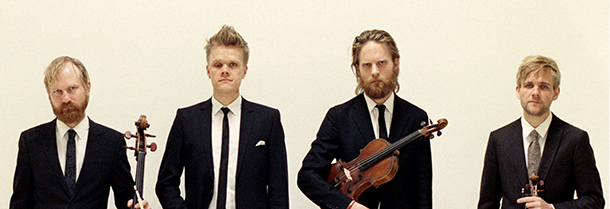
    Wednesday October 26th, 2016 – The Danish String Quartet (above) in concert at Zankel Hall in a program pairing final masterworks by Shostakovich and Schubert, with cellist Torleif Thedéen joining the Quartet for the Schubert. It was an extraordinary evening of music-making, with the two vividly contrasted pieces superbly played.

    The program opened with a performance of the last of Shostakovich’s fifteen quartets. Composed in 1974, it consists of six inter-connected movements and has the mood of a farewell to life; indeed, the composer died the following year, after a career periodically darkened by deep conflicts with the Soviet government. The ailing Shostakovich created a work of lyrically spare, bleak textures alternating with violent rhythmic gestures.

    The atmosphere of the 15th quartet precludes note-taking; from its quiet opening passage played by the second violin, we are drawn into a unique sound-world of severe beauty and grim intensity. The Danish String Quartet’s playing of the opening movement – which the composer indicated should be performed so slowly that listeners would flee the hall out of boredom – took on an almost religious aspect: a sustained and intimate meditation.

    The Quartet’s hallmark mastery of dynamics, the natural flow of the music from voice to voice, and their finely-balanced layering of sound, created an incredible atmosphere which was sustained throughout the 40-minute work. Moments of great delicacy stood in contrast to jagged slashings; an off-kilter waltz, sustained notes that spring out of nowhere, vibrant trills, a resonant viola cavatina, deep passion from the cello, an overall sense of desolation. Despite a few Playbill-flippers seated near me, the audience was held in a rapt state throughout the piece; the applause – deep and sincere, but not boisterous – signaled the impact the music and the musicians had made.

    Feeling both drained and enriched by this monumental musical experience, I remained in my seat throughout the intermission, deep in thought.

    Following the interval, the Schubert string quintet in C-major, with cellist Torleif Thedéen joining the ensemble. This quintet, written in 1828, was Schubert’s last extended piece of chamber music. It seems that the composer never heard this final masterwork performed; he died on October 2nd, 1828, and the quintet was not performed publicly until 1850.

    One of the longest works in the chamber music repertory, Schubert’s C-major quintet sounds more like a celebration of life than a prelude to death. The composer was desperately ill while composing it, but the work has a feeling of optimism – as though he felt he might actually re-bound and compose for another 30 or 40 years. It was not to be, and – as with Mozart, Chopin, and Pergolesi – we are left to ponder what might have been. 

    The Danish String Quartet’s traversal of the Schubert was so persuasive both in tonal beauty and rhythmic inflection that the work sped by. The songful-to-stormy opening movement, with its return to tranquility in C-major, is followed by one of music’s most marvelous adagios, underscored by plucked lower notes. The players seemed to be having serious fun in the Scherzo, and then moved on to the gypsy-flavour of the finale.

    At the close of the Schubert’s joy-filled final Allegretto, the Danes were given an enthusiastic ovation from the audience. The players responded with an encore: a lyrical, chorale-like quintet that was lovingly played.

    The Participating Artists:

    The Danish String Quartet:

      ~ Frederik Øland, Violin
      ~ Rune Tonsgaard Sørensen, Violin
      ~ Asbjørn Nørgaard, Viola
      ~ Fredrik Schøyen Sjölin, Cello

    Torleif Thedéen, Cello

    The Repertory:

    • SHOSTAKOVICH String Quartet No. 15 in E-flat Minor, Op. 144
    • SCHUBERT String Quintet in C Major, D. 956

  • Leonidas Kavakos: Double Duty @ The NY Philharmonic

    Kavakos

    Thursday October 20th, 2016 – Leonidas Kavakos (above) was both soloist and conductor for this evening’s program at The New York Philharmonic. Mr. Kavakos is the Philharmonic’s current Mary and James G. Wallach Artist-in-Residence, and in this capacity will blessedly be with us frequently in the current season. Tonight, the prodigiously talented violinist played Bach and then moved to the podium to conduct works by Busoni and Schumann.

    With the mystique of a Tolkien wizard, Mr. Kavakos worked his magic in a brilliant rendering of J.S. Bach’s Violin Concerto in D minor (reconstructed), BWV 1052; surrounded by an ensemble of the orchestra’s elite string players, and with Paolo Bordignon at the harpsichord, he cast a spell over the hall with his playing. Following a sizzling cadenza midway thru the first movement, the violinist and his colleagues drew us in with the lamenting beauty of the adagio. An unfortunate cellphone intrusion in the very last moments of the movement was brushed aside as Mr. Kavakos sailed forward with stunning virtuoso playing in the allegro, where he summoned up visions of the legendary “mad fiddlers” who played as if possessed by demons.

    The whole ensemble went merrily along on the soloist’s swift ride, and I must mention Timothy Cobb’s plush tone and amiable agility on bass. Shouts of ‘bravo‘ rang thru the hall as the concerto ended. Mr. Kavakos and Sheryl Staples, this evening’s concertmaster, clearly form a mutual-admiration-society; after bowing to the audience’s enthusiasm, the soloist signaled Ms. Staples to rise but instead she and all her colleagues remained seated, vigorously applauding Mr. Kavakos. When he finally got the players to stand, the applause re-doubled.

    The Geffen Hall stage crew swiftly re-set the space for the next work: I had discovered Ferruccio Busoni’s Berceuse élégiaque earlier this season when the Curtis Symphony Orchestra performed it at Carnegie Hall, and was very glad of an opportunity to experience it again tonight.

    This is music wrapped in a somber mystery. The composer wrote these lines as a brief ‘prologue’ to the piece:

    “The child’s cradle rocks, the hazard of his fate reels; life’s path fades, fades away into the eternal distance.”

    During the ten-minute course of this eerie lullaby, the music rises very slowly from the depths; the subtle interjections from the harp add a dreamlike quality, as does the celesta which joins the darkling ensemble near the end. As a chillingly marvelous finish, a gong sounds and its reverberations fade to nothingness.

    The Philharmonic’s Playbills are always loaded with fascinating articles and information; I read them on the train trip homeward after the concerts. One passage in the notes on the Busoni struck a tragic note: Gustav Mahler conducted the Philharmonic premiere of the Berceuse élégiaque on February 21st, 2011. Suffering from heart disease, Mahler was forced to withdraw from a second performance of the work; he sailed back to Europe and died in Vienna in May. The February 21st Philharmonic concert thus marked the last time he ever conducted. 

    Robert Schumann’s Symphony No. 2 was the evening’s concluding work. Here my companion and I were at a loss: the music is absolutely lovely from start to finish, and it was conducted and played with both steadfastness and genuine affection by Mr. Kavakos and the artists of the Philharmonic. But somehow it is simply too much of a good thing. We were trying to figure out the reasons why this music, so congenial, seems to go in one ear and out the other; there’s no edge to it anywhere, and nothing that reaches the heart. Also, for me, part of the problem is all the tutti playing: there’s a shortage of those passages where solos might lure us in or smaller components of the orchestra might bedevil one another. Only in the adagio, where the oboe, clarinet and horns had chances to step forward, did my interest perk up. For the rest, the music simply washed over us to beautiful but unmemorable effect.