Category: Uncategorized

  • In Their New Home: Martha Graham Dance Co

    Westbeth

    It was so wonderful to read (earlier this year) that the Martha Graham Dance Company were going to move into the marvelous and dance-mythic Cunningham Studios down at Westbeth. I’d only been in the Cunningham space a couple of times and I simply fell in love with the place; for a while it seemed like the studios might be lost to the dance world, and thus the announcement of the Graham plan made me so happy.
    6a00d8341c4e3853ef016767341761970b-800wi

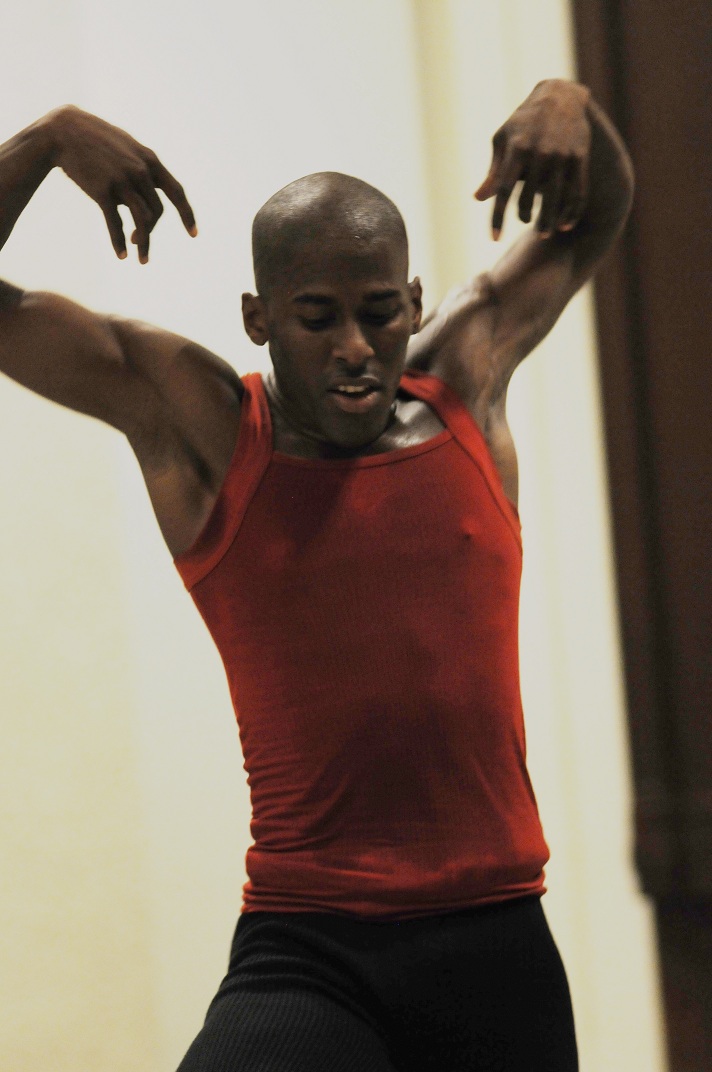
    Little did I know that I’d so soon be having an opportunity to visit the Graham dancers in their new home, but thanks to the kindness of Lloyd Knight (above, photo by Kokyat) who I’d met earler this year when he was working with Emery LeCrone, I had the unbelievable good fortune to spend the better part of an afternoon watching the Graham Company preparing for their upcoming performances in Akron, Ohio and at the Vail International Dance Festival. Lloyd was a perfect host, sending me in advance a list of the works they’d be rehearsing, introducing me to everyone and periodically checking in with me when he wasn’t busy dancing. Janet Eilber, the artistic director, gave me a gracious welcome.

    The last time I was in the ‘Cunningham space’ all the windows were covered with cardboard; today the windows were bare and despite the overcast sky, a gentle light filled the spacious studio. Views of the Manhattan skyline and of the Hudson River enhance the setting. In the eleventh floor elevator lobby, a friendly painter was sprucing things up with shades of rose and violet; an open door led out onto the roof.

    I was sorry to have just missed Katherine Crockett’s run-thru of Lamentation, but I did have a lovely conversation with her – she’s one of my dance idols – before she slipped out of the studio. Mariya Dashkina Maddux swirled thru the solo Serenata Morisca, a dance that is fiery and provocative and performed in a gypsy skirt. This solo, dating back to around 1916, was based by Graham on a Ted Shawn piece. Andrea Murillo performed the iconic Lamentation (1930) and a bit later she also danced the Serenata Morisca. A passionate duet, Conversation of Lovers from the 1981 ballet Acts of Light, was given a breath-taking interpretation by Xiaochuan Xie and Tadej Brdnik. With each of these works I was drawn deeper and deeper into the power and mystery of the Graham style. I was so grateful to talk with Denise Vale, the former Graham principal artist who is now the Company’s senior artistic associate; taking time from her coaching of the dancers, she helped me to actually see what I was watching. In a few sentences she illuminated my perception in ways that reading a dozen books about Graham most likely could not.

    To see a new work before its premiere has been an exciting dividend of being a blogger; Doug Varone has made an unusual and evocative work for four men and a bench which is set to the darkly haunting Ravel Gaspard de la Nuit. Lloyd Knight, Tadej Brdnik, Maurizio Nardi and Abdiel Jacobsen are the dancers in this work which has the feel of contemporary ritual; it is sensuous without being sexual and the bench tends to become a fifth dancer. The work will debut at Vail in August.

    Mariya Dashkina Maddux, Tadej Brdnik and Lloyd Knight took on the familiar roles of the married couple and the preacher man in Appalachian Suite, and then they were joined by Ms. Murillo for Embattled Garden.

    It was after 5:00 PM when Embattled Garden began, and the dancers had been working since noon. Where they found the energy shall remain a mystery, but I’ll never forget the experience of watching what amounted to a private performance of this vivid ballet, replete with the Noguchi set pieces. Only the dancers, Ms. Vale and myself were in the studio; Mariya (Masha) and Tadej were Eve and Adam, Andrea was Lilith and Lloyd the sinister Stranger. They gave a full-out rendering of this dramatic work, thrilling in intensity and so wonderful to contemplate in this space.

    Of all the days not to have a photographer available! My regular photographers were all out-of-town or otherwise occupied and so I planned to take some pictures myself. But my Leica seems to have developed a serious problem and so I have no documentation of this wonder-filled afternoon.

    The dancers were all so kind and generous; Tadej, who seemed to dance all afternoon, is a delightful guy, upbeat and amusing. I simply had a great time.
  • Amanda Selwyn’s DETOUR

    Copy of 3

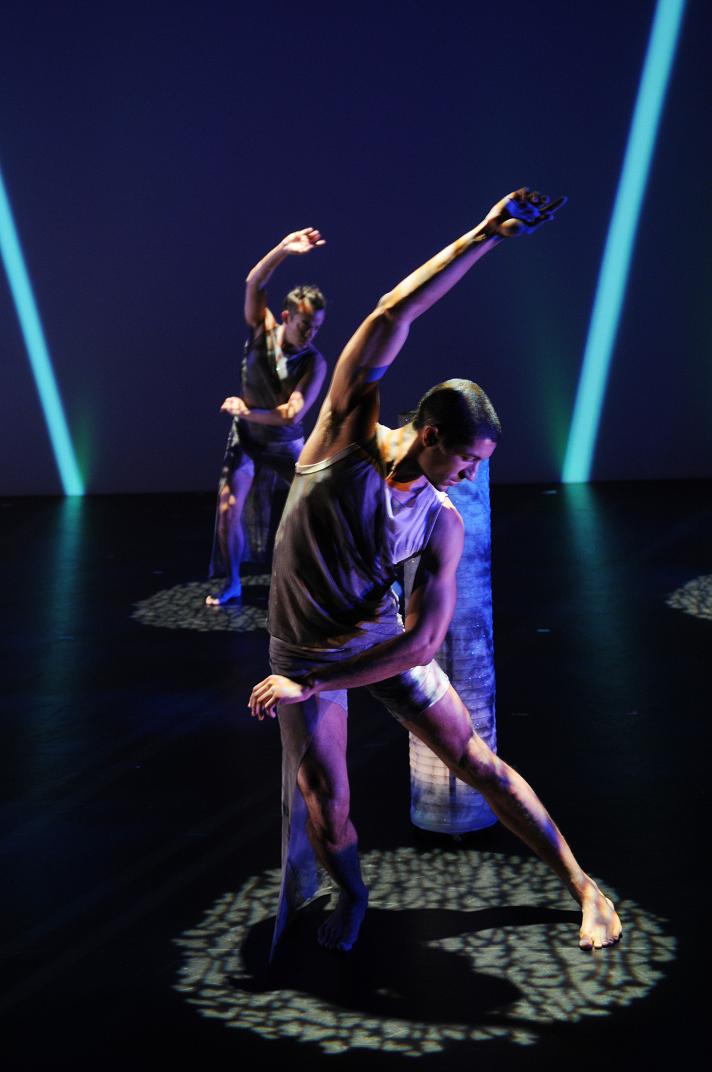
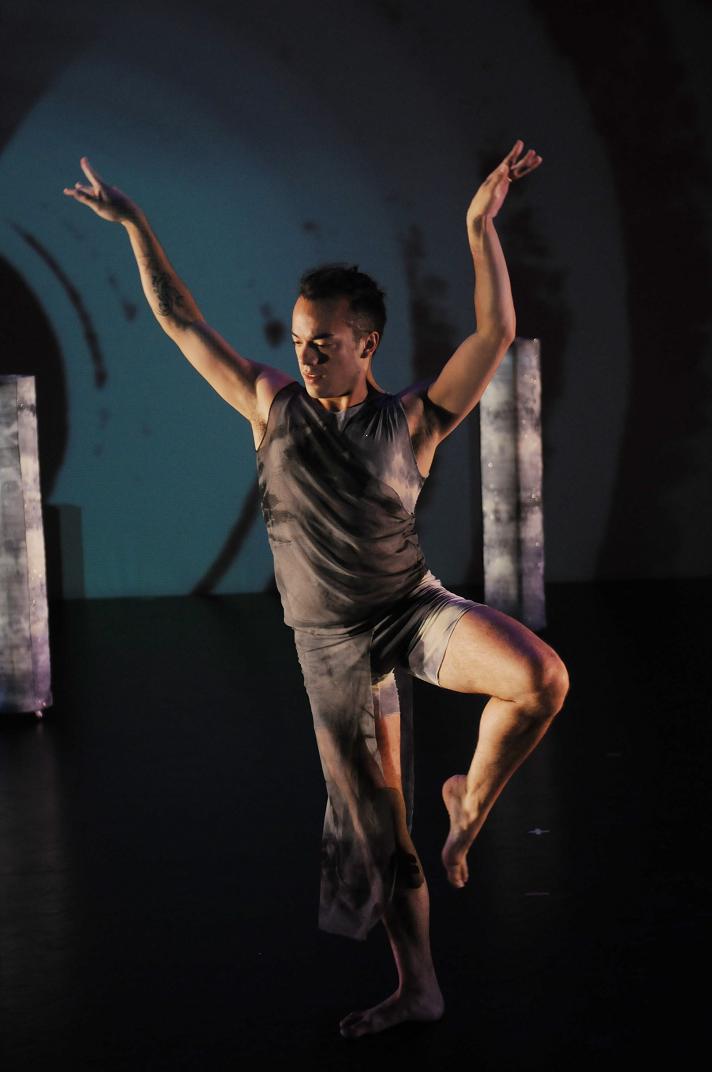
    Above: Justin Lynch in Amanda Selwyn’s DETOUR, photo by Kokyat.

    Friday June 22, 2012 – Last season my first encounter with Amanda Selwyn Dance Theatre was a very satisfying experience, so I was looking forward to tonight’s performance of DETOUR at New York Live Arts. I had met Amanda at her studio earlier this year and was taken with her as a personality and with her creative style.

    DETOUR proved just as engaging as Amanda’s FIVE MINUTES had been last year. Several factors gave the evening a special place among recent dance events: an evocative collage of music was effectively blended with varied sonic colours and tempos, excellent lighting and projections, changes of costuming which gave each section of the work its own flavour, very fine and committed dancing, and a nearly-full house that seemed keenly attentive. At 50 minutes, DETOUR held our focus wthout over-staying its welcome. Overall, an ideal evening of dance.  

    DETOUR is set in three sections, each with sub-sections, which flow into one another. The dancing takes place in a dreamscape (design: John McDermott) in which floating translucent columns, lit from within, shift quietly to create new pespectives for each movement of the work. The back-panel is drenched in ever-changing rich colours; projections and shadowy films of the dancers complete the visual aspect of DETOUR which seems to shift from illusion to illusion as the dancers come and go. 

    Copy of 10

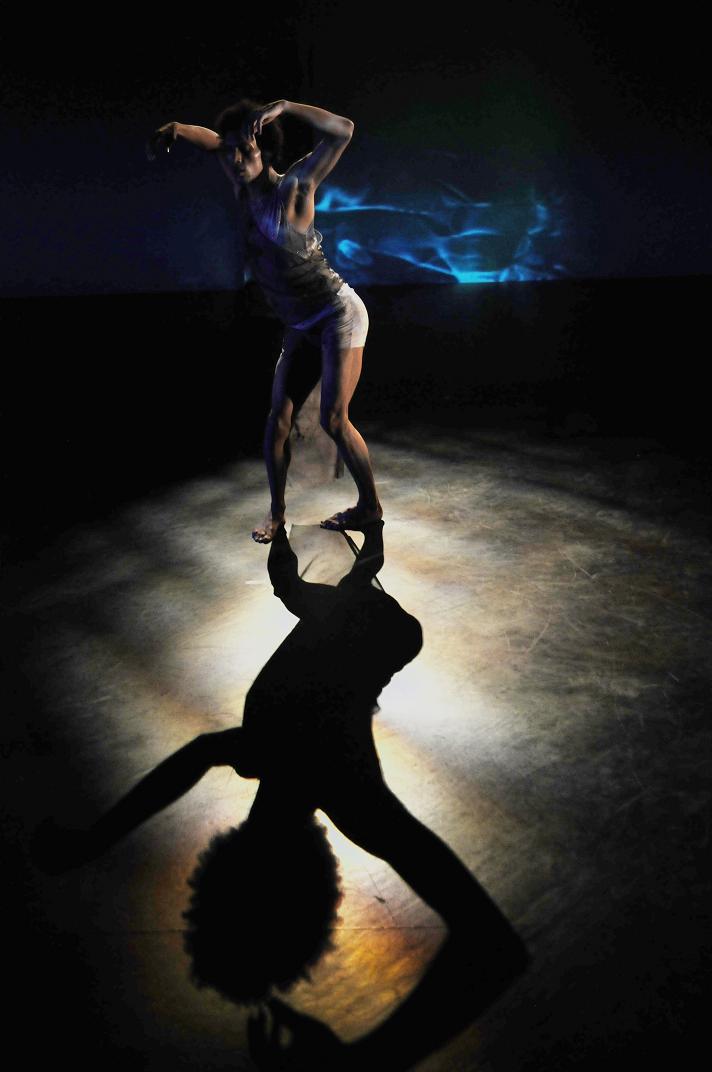
    Though essentially an ensemble piece, solo opportunities for the individual dancers abound (Alexander Dones, above); they move thru various encounters – romantic, ritualistic or antagonistic – without taking on specific relationships. The ever-shifting patterns of movement and partnering suggest a dream in which perceptions vary from moment to moment. The dancers are sexy and strong, with unique personalities which Selwyn allows them to manifest while maintaining the spirit of a mysterious tribe. Other-worldly aspects of the piece meld into a communal finale in which an awakening is implied. 

    Kokyat photographed the dress rehearsal of DETOUR and here is a series of his images from the work:

    Copy of 4

    The opening ensemble: Illusions

    Copy of 14

    Catherine Coury, Justin Lynch

    Copy of 30

    Robert Vail, Justin Lynch, Fracisco Silvino

    Copy of 36

    Copy of 40

    Jenny Gillan

    Copy of 44

    Ensemble

    Copy of 55

    Robert Vail

    Copy of 49

    Joori Jung

    Copy of 77

    Robert Vail

    Copy of 82

    Mackenzie Tyler

    Copy of 100

    Joori Jung, Justin Lynch

    An additional gallery of photos from DETOUR appears here.

    All photography by Kokyat.

  • New Chamber Ballet: Gallery II

    Copy of D1

    More photographs from New Chamber Ballet‘s Spring 2012 repertory evenings; above: Elizabeth Brown and Sarah Atkins in Miro Magloire’s EMILIA, set to Karlheinz Stockhausen’s Klavierstück VII and VIII.

    Also from EMILIA:

    Copy of D2

    Holly Curran

    Copy of D5

    Sarah Atkins

    Copy of D7

    Holly & Sarah

    Copy of D11

    Elizabeth Brown

    Copy of D9

    Elizabeth & Sarah

    The following series of pictures are from Miro Magloire’s ALLEGRETTO, INNOCENTE, a light-hearted trio to music of Haydn:

    Copy of C3

    Victoria North

    Copy of C31

    Madeline Deavenport

    Copy of C19

    Sarah Atkins

    Copy of C38

    Victoria

    Copy of C36

    Victoria, Maddie & Sarah in ALLEGRETTO, INNOCENTE.

    All photography by Kokyat.

  • In the Studio with Ian Spencer Bell

    Copy of 23

    UPDATE: I happened to be at City Center last night and took a peek in at Studio 4 during Ian’s performance. It’s the first time I’ve seen lighting used in the Studio there and it was really intriguing. Gives the space an other-worldly quality. Now I can’t wait for tonight’s performance – the second and last.

    The Studio Experience: I met Ian Spencer Bell earlier this year at a studio showing by the Martha Graham Dance Company. He recently contacted me regarding his upcoming performances at City Center Studio and – later this summer – at Jacob’s Pillow. Information here. In the top photo, Mara Driscoll and Nathaniel Darst.

    At the DANY studios on May 5, 2012, Kokyat and I had a look at the work Ian has created, set to Olivier Messaien’s mind-bending Quartet for the End of Time.

    Copy of 41

    Joshua Tuason, Jenna Liberati

    Copy of 17

    Joshua and Jenna

    Copy of 13

    Joshua & Jenna

    Copy of 6

    Mara Driscoll, Joshua Tuason and Nathaniel Darst

    Also to be shown is Ian’s solo work, SOCKET,of which he writes:

    “I named the solo for the electrical socket in the small room where I made the dance this past winter. Socket also refers a hollow piece of something—for holding and receiving. Dancers are sockets. I’ve started to incorporate the solo into the other material I’ve been making with the dancers. That movement came from video I took of the dancers on my phone, warming up and preparing for rehearsal—as well as some more formal compositions I’ve been making with them.”

    Here’s the information for the upcoming performances at City Center Studio:

    Ian Spencer Bell dances Socket
    and other new work with 
    Jenna Liberati
    Nathaniel Darst
    Joshua Tuason
    Mara Driscoll 

    Wednesday, May 30, 8 p.m.
    Thursday, May 31, 8 p.m.

    New York City Center Studios
    130 West 56th Street, Studio 4

    $20 suggested donation
  • …And Still More Theyre Lee Elliott

    DSC00899

    Another work by British artist Theyre Lee Elliott has come my way, thanks to a reader who shares the above painting from her collection.

    The connection between the artist and Oberon’s Grove began back in 2009 with this discovery, and I have really enjoyed the ever-expanding tale of Theyre Lee Elliott and his work here on my blog which has continued here, here and here as readers have sent personal recollections of the artist and samples of his work.

    If a search has brought you to this page and you have a recollection of Theyre Lee Elliott or any of his work in your collection, please help keep the story evolving. E-mail me at:

    [email protected]

  • Another Great Paul Taylor Evening

    MTAYMT

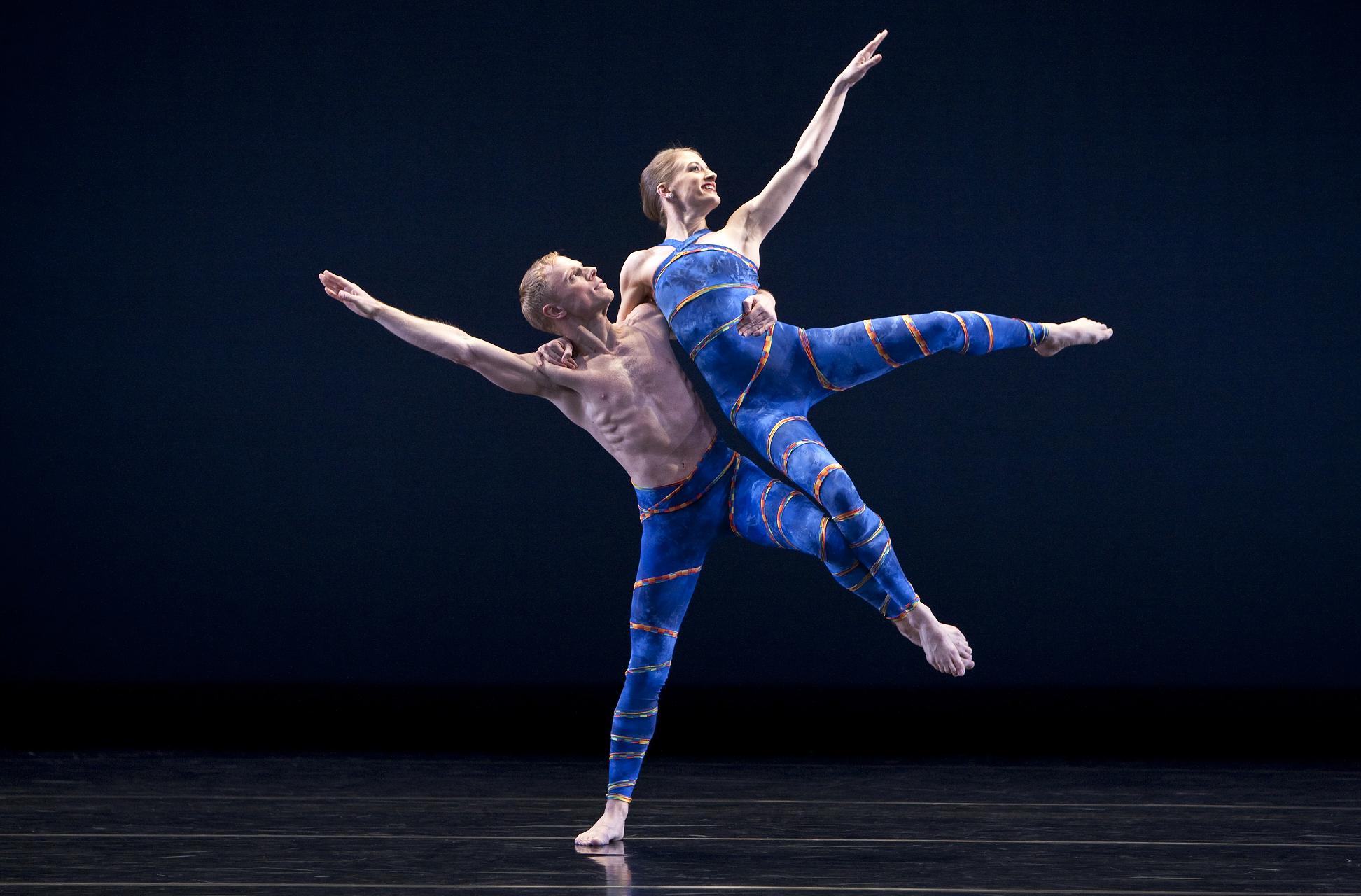
    Above: Michael Trusnovec and Amy Young in Paul Taylor’s MERCURIC TIDINGS, photo by Paul B Goode. Click on the image to enlarge.

    Wednesday March 21, 2012 – My beloved friend Kokyat is back from his trip to Europe and we met up tonight at Lincoln Center for a super evening of dance by the Paul Taylor Dance Company. In the past couple of years we have met – and Kokyat had photographed – some of the great dancers of the Taylor troupe and so there’s an extra feeling of excitement seeing them onstage. We also loved running into Taylor icons Rachel Berman and Richard Chen-See.

    For their Lincoln Center season, PTDC are showing a vast range of works from their repertoire (as well as two new creations). Tonight I got to see a pair of older works that I’d never encountered before, as well as the darkly amusing 3 EPITAPHS and the to-die-for MERCURIC TIDINGS. The dancers were on peak form from curtain-rise to the final ovation where the legendary chroeographer took a bow as the audience collectively went wild.

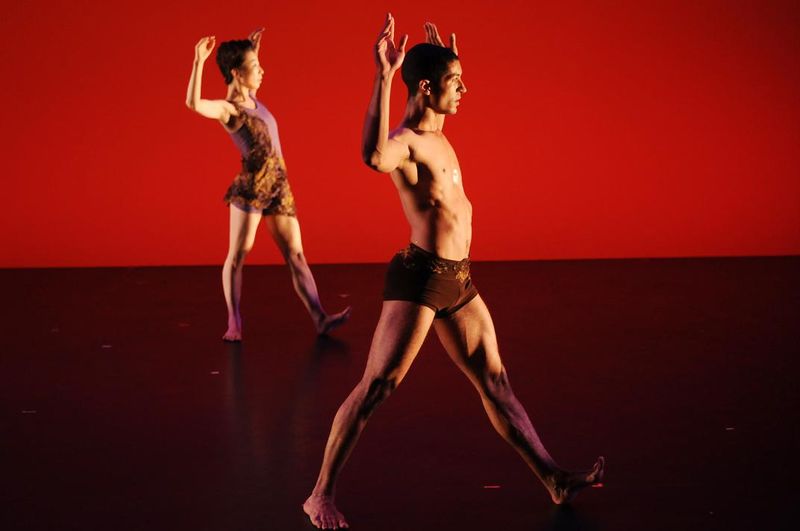
    In JUNCTION (of tranquility and fervor) eight dancers is brightly-coloured body tights dance to music from Bach’s cello suites. Some of the time the dancers are merely walking, but the variety of the pacing and the constant shifts of mini-groupings keep our interest keenly in focus. The work has an oddly appealing mix of gestural formality with off-kilter partnerings. The excellence of the dancers signalled yet again the personal appeal and technical prowess of the Company’s current roster: Amy Young, Robert Kleinendorst, Michelle Fleet, Parisa Khobdeh, Sean Mahoney, Jamie Rae Walker, Aileen Roehl and Michael Novak each found ways to shine as individuals even though the costuming gave them a uniform look.

    Danced (or rather shuffled, scuffed and bumped along) to old New Orleans jazz/funeral music, the 1956 3 EPITAPHS made me laugh aloud when I first saw it at The Pillow years ago. The five dancers are in overall grey tights with metallic fragments attached to the skullcaps which refract beams of light into the theater. The movement is klutzy, ape-like, droll. Removing their facemasks for the curtain calls we see a collection of beatiful visages: Eran Bugge, James Samson, Laura Halzack, Heather McGinley and Francisco Graciano.

    I’m not quite sure what to make of the 1981 HOUSE OF CARDS, but I know I liked it and I adored the Darius Milhaud score (La Creation du Monde) which reminded me of a jazz concert played in a Gothic cathedral. I can’t say for sure what this ballet is about, but does it matter?  It’s quirky and makes for good viewing. Most of the dancers are clad in the red and black colours of a deck of cards, but then there’s a couple cavorting in pink (Laura Halzack and Michael Trusnovec) and a woman (Heather McGinley) who seems wrapped in aluminun foil. In one segment I particularly liked, three couples stand face-to-face as in a folk-dance. Francisco Graciano looked like a handsome young gypsy, and – although her distinctive red hair was covered here – I can only hope Ms. McGinley’s roles with the Company extend exponentially: she’s got a lot of star power.

    LHRKliftMercuricTidings

    Above: Tom Caravaglia’s photo of Laura Halzack and Robert Kleinendorst in MERCURIC TIDINGS.

    The uplifting music of Franz Schubert (from his first and second symphonies) sets all these phenomenal dancers in motion for the concluding MERCURIC TIDINGS, a grandly lyrical and ritualistic work with thrilling structural elements and an achingly beautiful adagio (three featured couples in turn). The striking deep blue costumes (Santo Loquasto) accentuate the individual attractiveness of each dancer; the men are bare-chested, the women with their hair up like classical ballerinas.

    Pacing motifs and stylized port de bras decorate the enemble passages, all underlined by a quiet sense of pure joy. Bodies beautiful: Michael Apuzzo, Michael Novak and Jeffrey Smith wear their costumes like a second skin while the girls (Eran Bugge, Jamie Rae Walker and Elizabeth Bragg) seem at times like nymphs who have strayed here from the Faun’s antique refuge.

    FleetMichelle

    In a star-turn featured role, Michelle Fleet (above) sails airily about, her gorgeousness captivating my opera glasses whenever she appears. 

    The triptych adagio opens with heavenly dancing from Amy Young and Michael Trusnovec, two of Gotham’s most treasurable dance artists. After a while they are subtly replaced by the distinctive blonde Aileen Roehl partnered by Sean Mahoney, he of the magnificent physique. These two bring a nice intensity to their duet, which eventually gives way to the ravishing Laura Halzack dancing with another Taylor deity, Robert Kleinendorst. 

    The cumulative effect of all these beautiful bodies, this soul-stirring music and Mr. Taylor’s perfect choreographic response to it evoked a sustained ovation from the House. The audience, so attentive throughout, couldn’t contain their delight in showering the dancers with applause, and when Paul Taylor himself walked onstage at the end, he was hailed as the dance hero he is.

  • In The Studio with Tom Gold

    PHILIP_GOLD-1

    tomgolddance, founded by former New York City Ballet soloist Tom Gold, are preparing to offer their first New York City full-evening of ballets at Florence Gould Hall on Monday February 27th. Ticket information here. New York City Ballet principal dancers Jared Angle and Sara Mearns are among the stellar line-up of featured dancers. Photo by Matthew Murphy.

    tomgolddance have been touring for the past four years; Tom now presents four of his ballets for the New York audience, with music by Mozart, Desplat, Satie, Poulenc and Piazzolla. Photographer Matt Murphy and I stopped by a rehearsal last week where we watched some of NYCB‘s finest dancers working with Tom.

    PHILIP_GOLD-13

    Abi Stafford

    PHILIP_GOLD-3

    Gretchen Smith

    PHILIP_GOLD-24

    Russell Janzen

    PHILIP_GOLD-20

    Amanda Hankes

    PHILIP_GOLD-25

    Abi Stafford, Robert Fairchild

    PHILIP_GOLD-9

    Kristen Segin

    PHILIP_GOLD-14

    Jared & Sara

    PHILIP_GOLD-18

    Abi Stafford

    PHILIP_GOLD-23

    Tyler Angle, Sara Mearns

    PHILIP_GOLD-19

    Tom Gold

    ABT soloist Simone Messmer, such an entrancing dancer, arrived just as Matt and I were heading out. We stopped to catch up with her for a few moments before she started dancing; kind of sorry we didn’t get to see her in action in the studio, but that’s one more reason to look forward to February 27th.

    All photos by Matt Murphy, with my thanks to him for taking time out of his already-busy day to meet me at Tom’s rehearsal.

  • Dance from the Heart 2012

    P1260210

    Tuesday January 24, 2012 – “The best-laid plans…” I was planning to attend both nights of the annual Dance from the Heart programmes at Cedar Lake Theater but the ominous message “…due to a police investigation” came over the loudspeaker as the train I was on sat in the tunnel just south of 181st Street. Twenty minutes later we pulled into 168th; I should have switched to the #1 there but we quickly proceeded…into the tunnel where we sat for another ten minutes. By the time we reached 145th it was clear I’d never get down to Chelsea by curtain time. Trying to get home then was equally frustrating, due to a “sick passenger”.  Not a good night for the MTA.

    But I did get to Cedar Lake for the second night. Mixed-bag dance evenings are not really my cup of tea; there was exciting dancing all evening but from a musical and choreographic standpoint only about half the works on offer were of interest to me.

    The opening VIDA from Cecilia Marta Dance Company was jazzy, nicely lit and danced with a suggestive sway. In the duet Falling, of course Misty Copeland and Matthew Prescott looked great dancing together, but the schlocky arrangement of an Elvis Presley classic was not very inspiring. Why not use The King’s own version?

    6a00d8341c4e3853ef01539173f808970b-800wi

    It wasn’t til Clifton Brown and Kana Kimura stepped onstage to dance a duet from Jessica Lang’s i.n.k. that the evening really perked up for me: Clifton and Kana (Kokyat’s studio photo above) look wonderful together and their dancing is compelling and poetic. The Jakub Ciupinski score and the Shinichi Maruyama filmed projection enhanced the choreography and the dancing, making this all of a piece.

    Sustaining the high level set by the Lang, four dancers from Paul Taylor Dance Company performed an excerpt from Paul Taylor’s PIAZZOLLA CALDERA: a pair of torridly expressive duets, the first for two men (Jeffrey Smith and Michael Apuzzo) and the second for Michelle Fleet and Michael Trusnovec. This quartet of dance royalty whetted the appetite for the upcoming Taylor season at Lincoln Center, as if further whetting was needed. Bravi!

    The evening ended on a festive note with Jeremy McQueen’s CONCERTO NUOVO, a setting of Bach’s music most familiar in its Balanchine incarnation as CONCERTO BAROCCO. The all-women ensemble seemed like vivacious contemporary cygnets in their short ruffled white frocks, and each brought a distinctive personality to Jeremy’s visual polyphony. As this lively finale drew to an end, champagne was served.

    Lovely to see Arlene Cooper, Rachel Berman, Jessica Lane, Kanji Segawa, Jeremy McQueen, Lynda Senisi and Caleb Custer among the crowd. How fine it is that Cedar Lake Contemporary Ballet put their superb venue and their staff at the disposal of the Dancers Responding to AIDS team for this annual event. One more reason to love Cedar Lake!

  • 12 Solos by Andrea Gise

    1905126_300

    Tuesday November 29, 2012 – For the past year, choreographer Andrea Gise (above) has been creating a series of dance solos at a rate of one per month. Tonight at the Red Bean Studios, she unveiled the results of this project. In addition to new choreography, each solo was performed to new music.

    Scanning the list of participating dancers and composers I was surprised to see only two familiar names: Christina Ilisije (of Parsons Dance) and composer/performer Marlon Cherry, so there were lots of new movers and music makers to meet. Waiting for the performance to begin, the atmosphere was casual: dancers warmed up or mingled with the composers and audience members, removing the boundary between performer and viewer. A couple of the dancers ran thru their solos. Then everyone settled down to watch.

    Two of the solos were presented on film, the rest performed live. The dancers wore simple practice clothes and the lighting was uncomplicated; all focus was on the dance and the music. Certain movement elements ran threadlike thru the various solos; the dancers utilized the space in varying capacities from work to work. One solo flowed into the next as each dancer stepped into the space. This was dance in its most immediate and pure form.

    The variety of music was impressive; Andrea spoke later of having made a lot of the choreography without reference to the completed scores. That surprised me since so much of the evening seemed like a happy marriage of movement and sound.

    It’s maybe a bit unfair to single out individual performances since everyone participating – both dancers and composers – made fine individual impressions. But I don’t think anyone would begrudge mention of Pat Catterson’s performance of fight v. flight, the longest of the solos. Pat was the only dancer “over 30” among the cast and her solo was both physically demanding and emotionally varied.

    In Christina Ilisije’s solo bad cog, the dancer showed her trademark fluency of movement to a percussive/industrial score (with electrc guitar coming in later) by Philip Knowlton. Marlon Cherry’s opening piano theme evolved into moody, jazzy music while the lovely Remi Harris made her moves dovetail to the rhythmic patterns: this was image control. Two solos for men found Andrea Gise’s choreography at its most inventive: a sleep-study called non-disclosure act danced by Joshua Tuason, and a brilliant theatrical vignette entitled slick, performed by Felix Hess. From among the colorful palette of music we were hearing, Kristen Kairos’ work for two flutes was especially evocative as danced by Jennifer Eisenberg in quell

    The other dancers on the programme were Joanie Johnson and Joey Kipp (both on film), Ryan McNally (who opened the live show with a strong performance), and three distinctively beautiful women: Morgelyn Tarbeth-Ward, Ali Skye Bennett and Zoe Blake.

    In a Q & A at the end of the presentation, Andrea spoke of first being influenced by her reactions to the Gulf oil spill when undertaking this project: not just the spill itself but the resulting media coverage and efforts by government agencies to downplay the situation. We who had watched the dancing mentally began to filter back thru the evening to make connections between the dance and the theme. The seemingly abstract danceworks then took on other layers of meaning. She was wise, though, not to reveal too much until we’d seen the performance, thus allowing everyone to find their own reference points among the movement and the music.

  • LA BOHEME @ The Met

    Boheme1112.02

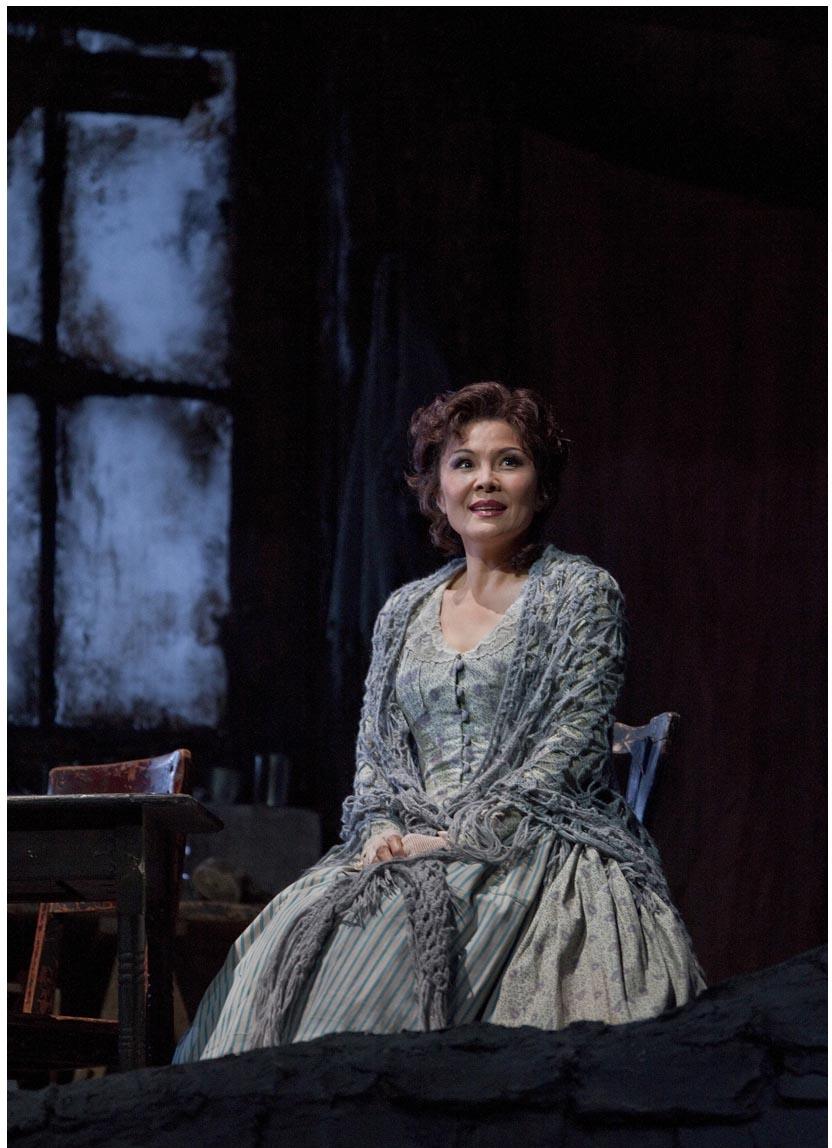
    Tuesday November 22, 2011 – Soprano Hei-Kyung Hong sang her first Met Mimi in 1987. Tonight, nearly a quarter-century later, she was repeating her classic interpretation. Along with Liu in TURANDOT, Mimi is a role that Ms. Hong has put her very personal stamp upon over the years. Photo by Cory Weaver/Metropolitan Opera.

    The Korean soprano’s voice remains a pure lyric instrument; over the years she never attempted to move into spinto territory and so the sound retains its shimmering silvery quality. Those who like big, lush outpourings of tone in Mimi’s music should look elsewhere: Hong’s Mimi is vocally delicate, vulnerable and wistful, as befits the character’s health and situation. She has long-since mastered the art of expressive portamento and of shading the words with emotional demi-tints. Thus in her long Act I narrative ‘Mi chiamano Mimi’ we are drawn into the story of this poignant character whose illness and poverty have not dampened her love of life and her constant hope for rebirth every Springtime. 

    I live alone, quite alone…
    There in my little white room
    I look out upon the roofs and the Winter sky.
    But when the thaw comes
    The first sunshine is mine…
    The first kiss of April is mine!”

    Interrupted by Rodolfo’s friends calling from below, the poet turns to see Mimi standing in the moonlit squalor of the garrett:

    “Oh lovely girl, oh sweet face
    bathed in the soft moonlight.
    In you I recognize
    the vision of love I’ve always dreamed of!”

    For those of us who still believe in love at first sight, this is the moment. As Mimi and Rodolfo leave arm in arm for the Cafe Momus, Hong’s long high-C floats into the House, and you think it can’t get any better than this.

    But it does: Hong’s third act is a masterpiece of vocal and dramatic portraiture. In a wintry setting near the Barriere d’Enfer, Mimi comes in search of her estranged lover, hoping Marcello will know where she can find him. The desperate fragility of Hong’s singing in the duet with Marcello, where her illness and her impending fate tear away at the painter’s kind heart was so moving, surpassed moments later as the soprano sang ‘Addio senza rancor’, her simple and humble farewell to Rodolfo who she thinks she will never see again.

    The romance is salvaged though: they will stay together until April comes again. But this will be Mimi’s final Springtime. After further quarrels and another separation, Rodolfo despairs of ever seeing her again. But Mimi comes back to the garret in the end, to die. As the other Bohemians go off to find medicine, a muff for her cold hands, and a doctor, the dying Mimi tenderly comforts her distraught lover. After a final lyric outpouring, Hong’s voice ebbs away to whispers as she falls asleep for the last time.

    6a00d8341c4e3853ef010536aacfcb970c-800wi

    Dmitri Pittas was the evening’s Rodolfo and while he could not match his Mimi in terms of vocal finesse or expressiveness, his appealing portrayal of a passionate young man unsure of himself and his new-found romantic feelings, was touching. The interesting dynamic created by the soprano and tenor tonight was that she was the one with a romantic history and he was the novice, trying to deal in reality with emotions he had previously only expressed in his poetry. Pittas has an appealing, Italianate sound and if he could not match the likes of a Pavarotti, a Corelli or a Tucker in this music, he gave his all in a committed performance that – dove-tailed with Ms. Hong’s tenderness and delicacy – generated an atmosphere of intimate romance.

    Index

    An outstanding vocal performance tonight from Alexey Markov. As the painter Marcello, the baritone upheld the excellent impression he had made as Chorebus in LES TROYENS at Carnegie Hall in March 2010. The voice is warm, sizeable and speaks well in the big House. We should hear him at the Met more frequently, where is would be most welcome in any number of roles.

    The other singers in this evening’s performance all fared well: Susanna Phillips was an engaging Musetta, though I wish she had done more singing and less ‘characterization’ during her famous Waltz where there was too much vocal mugging and winking and not enough sheer voce. She was better in the opera’s last two acts. Basso Matthew Rose, towering over the rest of the cast physically, sang his Coat Aria very well, and Patrick Carfizzi was a good Schaunard. It seemed to me that the philosopher and the musician might be lovers in the current staging though comic hijinx served as a cover for their embraces – until the end. Christian Jeong was a clear-voiced Parpignol; the toy-vendor now has an elaborate horse-drawn cart with which to lure in the kiddies. 

    On the podium Louis Langree seemed to favor slowish tempi but that simply served to allow the perfume of certain phrases to linger on the air. Despite moments when he allowed the orchestra to cover his essentially lyric cast of singers, the conductor and his orchestra did much to enhance the poetic atmosphere that the principal couple onstage were generating.

    Curtain-rise at Cafe Momus still evokes a big round of applause but the current staging has diluted some of the effectivenes of the scene. Several waiters and customers spent much of their time on the floor, trying to look up Musetta’s skirts. 

    Metropolitan Opera House
    November 22, 2011

    LA BOHÈME
    Giacomo Puccini

    Mimì....................Hei-Kyung Hong
    Rodolfo.................Dimitri Pittas
    Musetta.................Susanna Phillips
    Marcello................Alexey Markov
    Schaunard...............Patrick Carfizzi
    Colline.................Matthew Rose
    Benoit..................Paul Plishka
    Alcindoro...............Paul Plishka
    Parpignol...............Christian Jeong
    Sergeant................Jason Hendrix
    Officer.................Richard Pearson

    Conductor...............Louis Langrée

    I’ll never forget my first experience with listening to the whole of LA BOHEME in a Metropolitan Opera Texaco radio broadcast in January 1962. Lucine Amara and Barry Morell were Mimi and Rodolfo; my most vivid recollection of that performance was experiencing the opera’s final scene as the winter twilight descended outside. I was alone in the big house, just as I was alone in my life at that time. But I was beginning to get a sense for what was ahead for me: romance, passion, a more expansive world where I could be myself. It took years and many setbacks, but I did eventually find my path.

    I don’t look much like a lover these days, but the feelings are all still there. Maybe that’s why I always weep as Mimi awakens briefly from her death-like rest to bid a final farewell to Rodolfo:

    Are they gone? I was only pretending to sleep –
    because I wanted to be left alone with you.
    I have so many things I want to tell you,
    but really only thing: as huge as the ocean,
    deep and infinite as the sea…
    You are my love and my whole life!

    Some of my long-time opera friends wonder why I still bother going to performances. It’s for moments like these. And for voices like Hei-Kyung Hong‘s.