Blog

  • Unseen: Not Just Another TOSCA @ The Met

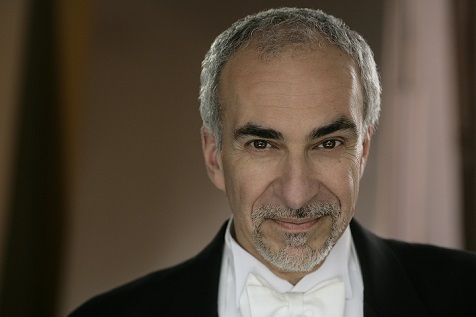
    Joseph Colaneri

    Above: Maestro Joseph Colaneri

    Saturday November 28th, 2015 matinee – Arriving at The Met for today’s matinee of TOSCA, I found that patrons are now being ‘wanded’ by security forces on entering the house. Once inside, I watched the auditorium not fill up: at curtain time there were an alarming number of empty seats. If a Saturday matinee of a popular opera on a holiday weekend cannot sell better than this, what’s to be done?  From my score desk, I avoided the dreariness of the Luc Bondy production, instead letting this exciting traversal of the score play out dramatically in my theatre of the mind. Later in the day, news came of Mr. Bondy’s death – he’s the same age as me. 

    Liudmyla Monastyrska’s 2012 Aida at The Met was interesting enough draw me back to the House this afternoon to hear her as Tosca. Roberto Aronica, a idiomatically solid Cavaradossi in a performance I attended earlier this season, and Marco Vratogna, new to me, shared the stage with the Ukrainian soprano. All three sang passionately, and they had the right sized voices for their roles in the big space. But in the end it was the opera itself, and conductor Joseph Colaneri’s marvelous feeling for the music, that kept me on to the end and had me shouting bravo! for the Maestro at the curtain calls.

    Colaneri is a real opera conductor: he knows that the voices come first and he can immediately establish a dynamic range to suit whatever cast he’s presiding over. Every singer is always heard, and if in the heat of the moment someone in the cast should rush ahead or linger too long on a note, Colaneri can immediately adjust and keep the flow of the music steady. My hat is off to him for this TOSCA, which seemed so fresh and alive, almost as if I was hearing it for the first time instead of the 500th.

    Today’s TOSCA was much more the sort of performance of this opera that I want to hear than the one I attended earlier this month, where Angela Gheorghiu’s walking-on-eggshells singing of the title role siphoned off much of the excitement. Today, Ms. Monastyrska displayed the needed vocal amplitude for the music of Tosca, and she and her colleagues sang with generosity and commitment all afternoon.

    Two powerful bassos each made their mark in the first act: Richard Bernstein (Angelotti) and John Del Carlo (Sacristan) both sounded huge, declaiming their lines vividly. Later, in Act III, Connor Tsui sang the song of the shepherd so impressively that I felt like applauding.

    Mr. Aronica, first of the principals to appear, has a sturdy, masculine sound which he flung into the house confidently. Some passing flatness at the passaggio was not a serious detriment to his performance. Having had to rein his voice in somewhat when singing opposite Mme. Gheorghiu in the earlier performance, he was today much better matched with Ms. Monastyrska and together they poured out the big melodies of the love duet with apt Puccinian fervor. Later, vowing to aid Angelotti, Aronica speared a triumphant high-B on “La vita mi costasse!” and held onto it.

    As the diva playing the diva, Ms. Monastyrska established her vocal credentials with her commanding offstage cries of “Mario! Mario!”. Once onstage, her voice revealed a slightly throaty throb, and a bit of flutter that quickly endeared itself as it gave a trace of vulnerability to the character. The Monastyrska sound sails easily into the hall, especially as she ventures to the upper end of her range. She puts very little pressure in the lower notes, and showed good instincts in lightening the voice for “Non la sospiri” and the playful banter about the colour of the Attavanti’s eyes. Some rather odd diction along the way didn’t bother me in the least, especially when she and Mr. Aronica cut loose to exciting effect in the climaxes of their duet.

    Diction and its effectiveness played a good part of the success of Marco Vratogna’s Scarpia. His voice has a darkish, menacing quality and his creepy verbal nuances revealed the sadism lurking under his quasi-elegant veneer. For all his dramatic bite, Vratogna could also deliver real, sustained vocalism when it suited him: his “Tosca divina, la mano mia…” was musically reassuring. The Attavanti fan having done its work, Ms. Monastyrska – her voice now at full flourish – gave a walloping shout at “Tu non l’avrai stasera…GIURO!” and went on to an exciting crescendo at “…egli vede ch’io piango!”  Maestro Colaneri then marshaled the orchestra and chorus for the grandiose finale, giving the music its full sweep but never overwhelming Mr. Vratogna’s relishing of the text as he salivates over his plan for Tosca’s ultimate surrender.

    Mr. Vratogna impressed at the start of Act II with his greasily subtle musings on being so close to having Tosca in his trap; increasingly angry with Spoletta, the baritone understandably blustered a bit. Cavaradossi is brought in and then taken off to be tortured and the cat-and-mouse game between Tosca and Scarpia begins.

    Ms. Monastyrska monumental high-A on “Solo, si!” was soon followed by one of her rare ventures into chest voice at “Sogghigno di demone!”…very effective. Maestro Colaneri built the drama thrillingly as Scarpia baited Tosca mercilessly; from a bold and brassy top C down to a plaintive murmur at “Che v’ho fatto in vita mia..?” Monastyrska had really gotten into it.

    Tosca blurts out the truth about Angelotti’s hiding place to Scarpia; her lover, on discovering she’s caved in, is about to disown her when news of Bonaparte’s victory at Marengo throws Scarpia for a loop. Colaneri in a great moment drove the orchestra relentlessly and Aronica tackled a passionate top-A on “Vittoria!”. The Monastyrska high-C as she sees her lover dragged away was massive – slightly raw, but thrilling.

    A false calm is restored. Scarpia/Vratogna offers his bargain. Describing his lust for Tosca, the baritone was slightly taxed by the highish tessitura here but verbally makes it all work. Monastyrska began the “Vissi d’arte” softly, slowly opening the voice and phrasing throughout with lovely modulations of colour and volume; she went totally lyric at “Diedi gioielli della Madonna al manto…” before the build-up to a house-filling B-flat, followed immediately by a pulling back on the A-flat and then a stunning crescendo to triple forte on the G. I’ve never heard it done this way, but the soprano pulled it off impressively.

    The murder scene was less effective than some I have heard – Monastyrska’s parlando phrases were not really effectively rendered – but Colaneri and his orchestra’s superb playing of the postlude to the murder was so atmospheric.

    Fantastic work from The Met horns at the opening of Act III; the prelude was yet another Colaneri jewel, evolving to the amazingly deep sounds that precede the introduction of the “E lucevan le stelle…” theme. Basso Tyler Simpson made his mark as the jailer, and then the haunting prelude to the tenor’s aria commences. Mr. Aronica was at his finest here, with an intense and passionate ending which won him sustained applause. 

    Monastyrska/Tosca arrives; she describes the murder of Scarpia vividly, culminating in a blindingly bright and very long high-C at “Io quella lama…”. Maestro Colaneri and his players sustained their high level as the soprano and tenor joined in a flowing duet before soaring to a stentorian high-B just before their unison “Trionfal!” And then Scarpia’s last trick is played out and the opera ends in a flash.

    The tedium of two Gelb-intermissions was relieved by chatting up a young pianist from Montreal, visiting the Met – and our City – for the first time. 

    Metropolitan Opera House
    November 28th, 2015 matinee

    TOSCA
    Giacomo Puccini

    Tosca...................Liudmyla Monastyrska
    Cavaradossi.............Roberto Aronica
    Scarpia.................Marco Vratogna
    Sacristan...............John Del Carlo
    Spoletta................Eduardo Valdes
    Angelotti...............Richard Bernstein
    Sciarrone...............Jeffrey Wells
    Shepherd................Connor Tsui
    Jailer..................Tyler Simpson

    Conductor...............Joseph Colaneri
  • At Home With Wagner IX

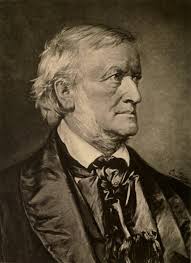
    Wagner

    What looked quite enticing on paper – a 1963 WALKURE from Stockholm – proved frustrating, not because the performance was sub-par in any way, but because it turned out to be mis-labled and incomplete.

    The recording starts mid-way thru Act I. Michael Gielen, a conductor I know little about, has the score well in hand although the orchestra isn’t always up to Wagner’s demands. Arne Tyrén is a less boisterous Hunding than some I have heard, and his voice can take on a wonderfully spooky quality. Birgit Nilsson’s ‘Ho-Jo-To-Ho’ is a marvel, her voice bright and fresh: she makes this daunting opening passage sound easy. Unfortunately, there’s not much more to be said of her performance here, since the Todesverkundigung is ruined by what seems to have been the wayward speed of the source machine used to tape the performance. The pitch rolls up and down with a seasick effect. Then, the third act is missing entirely!

    Nordmo loevberg

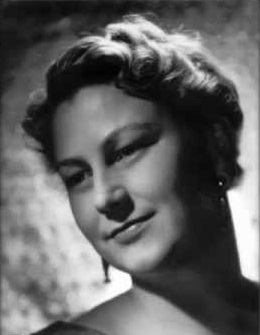
    The Wälsung twins are appealingly sung by Aase Nordmo-Lövberg (above) and Kolbjörn Höiseth. Ms. Nordmo-Lövberg, a very fine Elsa in Nicolai Gedda’s only performances of Lohengrin, brings poised lyricism and a fine sense of the words to the role of Sieglinde. 

    Kolbjorn-Hoiseth-300px

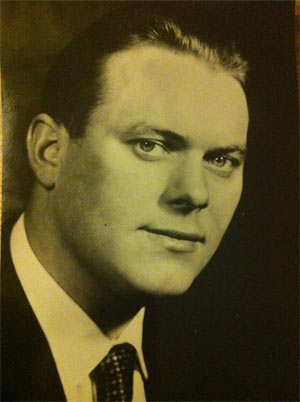
    Mr. Höiseth (above) sang briefly at The Met in 1975: he debuted as Froh in RHEINGOLD and repeated that role once; then he stepped in once for an indisposed colleague as Loge and once for an ailing Jon Vickers as Siegmund. I saw him in both the RHEINGOLD roles and he made a favorable impression. Here, as Siegmund, he is a good match for Nordmo-Lövberg – their voices are lyrically compatible. The tenor does experience a couple of random pitch problems, and seems just a shade tired vocally at the end of Act I – understandable, after such a taxing sing. But he makes a good effect in both the Sword Monologue and in the Winterstürme and also in the Act II scene where he attempts to calm to delirious Sieglinde as they flee from her pursuing husband. It’s a pity that the Todesverkundigung is so garbled: I would like to have heard Nilsson and Höiseth in this scene which is my favorite part of the opera.

    20011018-094545

    The mezzo-soprano Kerstin Meyer (above) had a more extensive Met career than her tenor colleague: she sang the Composer in the Met premiere of ARIADNE AUF NAXOS and also appeared as Carmen and Gluck’s Orfeo at the Old House. Here, as Fricka, she is impressive indeed: she begins lyrically – subtle and sure – and soon works herself into a state of righteous indignation. Her victory over Wotan is a triumph of will. Meyer sings quite beautifully, with clear expressiveness.

    Bjoerling-portrait

    Beautiful vocalism also marks the Wotan of Sigurd Björling (above). The voice is not stentorian, though he can punch out some impressive notes; the monologue is internalized, sung with a sense of hopelessness that is quite haunting. Despite errant pitch at times, Björling’s performance is moving and makes me truly regret that the third act is missing.

    ~~~~~~~~~~~~~~~~~~~~~~~~~~~~~~~~~~~~~~~~~~~~~~~~~~~~~~~~~~~~~~~~~~~~~~~~~~~~~~~~~~~~~~~~~~~

    Emc66-002-MF

    Above: Wolfgang Sawallisch

    A tremendous performance of GÖTTERDÄMMERUNG from Munich 1977 gave me a great deal of listening pleasure. I spent several hours with this recording, listening to whole acts repeatedly and zeroing in on favorite scenes to savor the individual characterizations of the very fine cast. Maestro Wolfgang Sawallisch’s shaping of the glorious score had a great deal to do with sustaining the air of excitement around this performance.

    This GÖTTERDÄMMERUNG was clearly recorded in-house; the sound of the microphone being fumbled with sometimes intrudes, and there are passages where a singer is too far off-mike to make a vocal impact…and other times when the recordist seems to be sitting literally in the singers’ laps.

    The first voice we hear is – incredibly – that of Astrid Varnay; essaying the role of the First Norn, Varnay sounds a bit matronly at times, but she is so authoritative and dramatically alert that it hardly matters. Her diction and word-colourings are endlessly admirable, and her low notes have deep, natural power – most especially on her final “Hinab!” As the Second Norn, Hildegard Hillebrecht is a bit unsettled vocally at times (the role lays low for her). Ruth Falcon’s singing of the Third Norn is more lyrical than some who have essayed the role.

    Sawallisch’s forward flow provides a nice build-up to Brunnhilde’s first entry; off-mike at first, it soon becomes evident that Ingrid Bjoner is on peak form for this performance. The voice won’t be to all tastes, but its silvery power, impressive lower range, and sustained phrasing which Bjoner brings forth are thrilling to me, a long-time fan. Jean Cox as Siegfried doesn’t quite equal his 1975 Bayreuth performance of the role, but he’s so sure of himself and has both the heft and the vocal stamina that’s needed. As Sawallisch builds the Dawn Duet with passionate urgency, Bjoner spears a couple of splendid high B-flats before her brightly attacked, sustained climactic high-C. 

    At the Gibichung Hall we meet the excellent Gunther of Hans Günther Nöcker and the vocally less-impressive but involved Gutrune of Leonore Kirchstein (near the end of the opera, she emits a gruesome scream on discovering the truth about Siegfried’s death). The dominating vocal force of the opera from here on in – along with Bjoner – is the resplendently sung and theatrically vivid Hagen of Karl Ridderbusch. The basso’s rendering of ‘The Watch’ is simply incredible. 

    Ae3fa3b49cd1956fc73b780d984a5e39

    Another potent performance is the splendid Waltraute of Ortrun Wenkel, who attained international fame for her remarkable performance as Erda in Pierre Chéreau’s 1976 production of the RING Cycle for Bayreuth which was telecast in its entirety and is preserved on DVD. Wenkel’s abundant tone and vivid sense of the character make her scene with the equally thrilling Bjoner Brunnhilde an outstanding part of this performance. If Waltraute’s parting high-A – always a thorny note for a contralto essaying this role – is cut short, it scarcely distracts from the excitement the Bjoner/Wenkel sister-scene has generated. 

    Bjoner is staunch in her defense of the ring from the attacking Gunther-Siegfried; abetted by Sawallisch and Mr. Cox, the soprano brings the first act of this performance to an exciting close.

    But then things soar even higher, for in an Act II that borders on insanity, the maestro and his cast all seemed to be in the grip of madness. The act begins with the eerie scene where Alberich (creepy singing from Zoltan Kelemen) appears as a vision to the sleeping Hagen. The summoning of the vassals is massively impressive, and later, in the great scene of oath-swearing, Cox and Bjoner blaze away. Throughout the act, the ever-keen Sawallisch guides his forces with a masterful hand. Simply thrilling.

    A nicely-blended trio of Rhinemaidens (Lotte Schädle, Marianne Seibel, and Liliana Netschewa) give us a lyrical interlude at the start of Act III: all three vocal parts are clearly distinguishable and they are finely supported by the atmospheric playing of the orchestra, with the horn calls very well-managed. Jean Cox is very much on-mike as he encounters the girls: his big, leathery high-C is sustained…and then he chuckles to himself.

    Following Hagen’s betrayal, Cox’s farewell to life and to Brunnhilde is wonderfully supported by Sawallisch: the orchestra playing here is so impressive, the tenderness of the final greeting so lovingly conveyed. 

    Now Sawallish takes up a deep, glowering rendition of the prelude to the Funeral March; contrasts of weight and colour add to the sonic build-up until the great theme bursts forth in its full-blown grandeur. The spot-on trumpet fanfare and the solid assurance of the horns are a great asset here.

    Ridderbusch is terrifying in vocal power and cruelty as he seizes control of the scene, but the raising of the hand of the dead Siegfried when Hagen goes for the ring puts Alberich’s son in his place at last. The cleansing descending scale sets the scene for Brunnhilde, and even though Bjoner is off-mike for the opening of the Immolation Scene, she is vocally unassailable: by “Wie sonne laute…” the  mike has found her and she shows both great power and great subtlety in this music. Bjoner’s low notes are vivid, her sustained, lyrical thoughts of the ravens imaginatively expressed, and her noble “Ruhe…ruhe, du Gott!” has a benedictive quality and is very moving. Following her passionate disavowal of the ring, the soprano surges forward with a thrilling greeting of Grane and some exalting top notes to seal her great success in this arduous role. Then Sawallisch and the orchestra bring the opera to a mighty close.

    6a00d8341c4e3853ef0192ac79f9a2970d-800wi

    Above: Jean Cox and Ingrid Bjoner

  • Rachmaninoff Finale @ The NY Phil

    Trifonov

    Above: pianist Daniil Trifonov

    Tuesday November 24th, 2015 – The third and final programme of The New York Philharmonic‘s Rachmaninoff Festival brought us Daniil Trifonov’s triumphant performance of the composer’s 3rd piano concerto as well as the ever-popular Symphonic Dances.

    Mr. Trifonov had the audience in the palm of his hand from the moment he walked onstage. He gave a magnificent performance, with terrific support from the orchestra. The 3rd piano concerto is everything the 1st isn’t: both in terms of structure and as a display of the soloist’s technique and artistry, the 3rd readily eclipses the composer’s earlier effort.

    Mr. Trifonov’s fluent – indeed astonishing – command of the keyboard held the audience under a spell. Particularly marvelous was the cadenza (the longer of the two provided by the composer) where the young pianist spun out the music to scintillating effect. With cunning inventiveness, Rachmaninoff has the flute suddenly speak up in the midst of the piano’s long paragraph: this wind theme passes on to the oboe, clarinet, and horn before the focus returns to the piano, which ends on a lovely fade-out.

    The composer paints on a big orchestral canvas in this concerto: a deep ‘Russian’ theme in the first movement impresses, and later there’s a big dance theme. The Philharmonic’s horns were ablaze tonight, the cellos plush, and the various wind voices piped up expressively.

    As the concerto raced to its conclusion, Mr. Trifonov carried the audience along on his dazzling ride. A full-house standing ovation ensued as the young master bowed graciously both to the house and his fellow musicians. I didn’t recognize his encore – and neither did my pianist/friend Ta-Wei – but it was deliciously played.

    Morlot

    Above: conductor Ludovic Morlot

    The piano had hidden Maestro Morlot during the concerto, but after the interval we had sight of him as he led the orchestra in a colourful performance of Symphonic Dances. New York City Ballet-lovers will be familiar with this score from Peter Martins’ 1994 setting of it. It’s a grand piece, with slashing rhythms in the first movement and a wonderful waltz in the second. Rachmaninoff uses the alto saxophone – a sound I always love to hear – to evocative effect, though I could not find a credit for the soloist in the Playbill. The harp also makes some rhapsodic interjections. Overall the orchestra, with Sheryl Staples as concertmaster, sounded superb and they seemed to truly enjoy playing this piece.

    After their rapt attentiveness during the concerto, the audience seemed to lose a bit of focus during the second half of the program. One couple down the row from us feasted on chocolates and Pellegrino whilst texting literally throughout the Symphonic Dances, and the woman on Ta-Wei’s right decided to conduct her own version of the score.

    At the end of the concert I asked Ta-Wei if he thought Rachmaninoff was a great composer or just a very good one. He replied: “Well, he knew what he was doing.” True, amply true.

  • Chamber Music Society: Nights in Vienna

    043015-GK

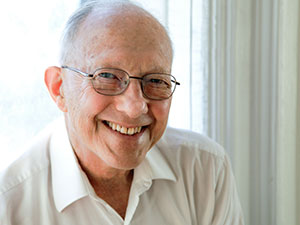
    Sunday November 22nd, 2015 – Pianist Gilbert Kalish (above) and a septet of his top-notch colleagues met on the stage of Alice Tully Hall this evening for a programme of works by three composers whose lives were linked to the city of Vienna. On a day when we are still trying to comprehend the recent terror attacks in Paris – and also remembering the death of John F Kennedy on this date 52 years ago – Chamber Music Society of Lincoln Center‘s offered music that was by turns heartening and thought-provoking, and all of it impeccably played.

    When New York’s great musical organizations – Chamber Music Society, the NY Phil, Carnegie Hall, The Met, Young Concert Artists – announce their upcoming seasons each year, I love to pore over the listings, searching for certain works or artists and putting the dates immediately on my calendar. Thus for many weeks I’ve been looking forward to today’s Chamber Music Society concert as an opportunity to experience first-hand Arnold Schoenberg’s Kammersymphonie; I discovered this piece years ago – it was actually my introduction to Schoenberg – and have always wanted to hear it played live. Today’s performance of the Webern arrangement was incredibly vivid.

    But, to start at the beginning, this musical celebration of Vienna opened with music of Haydn: the E-minor piano trio. Gilbert Kalish, who played in all three works this evening, is at that marvelous point in his career where his playing retains youthful vitality while his artistry – developed over a long career – is at its peak. His playing was marked by effortless technique, an assured rightness of style in each of the three contrasting works, and an Olde World feeling of grace without theatricality.

    Seeming taller and slimmer than the last time I saw him, violinist Nicolas Dautricourt strode onstage and for a moment I mistook him for ABT’s Marcelo Gomes. Mr. Dautricourt is a particular favorite of mine, both to watch and to hear; his stage presence is paradoxically relaxed and intense, and his playing is beautifully nuanced with especial attention to dynamic gradations. Cellist Torleif Thedéen was an ideal colleague for M. Dautricourt today: their rapport was inspiring to watch, aligning the harmonies and relishing the melodic opportunities Haydn has given them. Their affection and respect for Mr. Kalish was clearly evident both here and – later – in the concluding Brahms.

    Schoenberg’s Chamber Symphony spans a single movement, though the composer has identified five distinct sub-divisions: Sonata (Allegro), Scherzo, Development, Adagio, and Recapitulation and Finale. Originally written for ten wind and five string players, the composer asked his student Anton Webern to re-cast the piece for a smaller ensemble, the better to take it out on tour. The result: twenty-two minutes of sheer musical brilliance.

    The Kammersymphonie tonight was given a captivating performance: the quintet of musicians played with such richness of tone, such stimulating sense of colour, and such depth of feeling that one had the impression of a much larger ensemble playing. Gilbert Kalish’s sent waves of plush sound from the Steinway, giving the music an undercurrent of Late-Romantic lyricism; this same feeling was embraced by violinist Kristin Lee who seized upon the composer’s every melodic gesture with her pearly tone. Whenever the music turned more prickly, both Kalish and Lee were up for the adventure.

    Tara Helen O’Connor, one of the Society’s elite, sent her flute roulades wafting brightly overall whilst the gorgeous (no other word suffices) tone of Nicholas Canellakis’s cello seems always to achieve a direct hot-wire to the heart-strings.

    TommasoLonquich_bio2

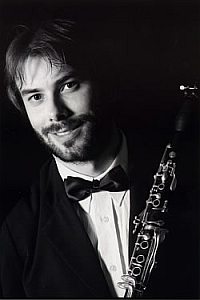
    New to me this evening was clarinetist Tomasso Lonquich (above) who made a spectacular impression both with his sumptuous tone and the passion of his playing. Whether at full cry or honing the sound down to a thread, Mr. Lonquich displayed his mastery at every moment; meanwhile his deep commitment to the music sometimes nearly drew him out of his chair as he polished off Schoenberg’s demanding phrases with compelling sincerity. 

    This staggeringly opulent ensemble drew a din of applause from the Alice Tully audience; as they took a second bow, my companion Adi – who had professed indifference to Schoenberg’s music before the concert began – found his opinion of the composer transformed. That’s what a great performance can accomplish.

    As so often at Chamber Music Society’s concert, I found myself at the interval wondering how this level of music-making could possibly be sustained into the second half. Needless to say, as violist Paul Neubauer joined Mssrs. Kalish, Dautricourt and Thedéen for the Brahms Third Piano Quartet, any thoughts of a letdown were immediately dismissed.

    Nearly twenty years were to pass between the time Brahms began working on this quartet (in 1855, at the time of his friend Robert Schumann’s last illness, when Brahms was torn between sorrow for his friend and desperate love for his friend’s wife, Clara) and its publication. His romantic inclinations toward Frau Schumann seem to perfume the music, especially in the third movement.

    Tonight, Mr. Kalish’s opening octave set the tone for a performance of beautifully blended voices and outstanding solo passages (Mr. Neubauer’s expressiveness so congenial) which achieved a level of  surpassing excellence in the Andante. Here Mr. Thedéen’s opening solo was poignantly set forth, with Mssrs. Dautricourt and Neubauer joining in turn: ravishing…a deep delight. The Andante ends magically, and then Nicolas Dautricourt launched the finale with a finely-turned solo. The audience’s enthusiasm at the end called the players back twice.

    There was an odd sensation at times tonight that someone was humming along with the music. At first I thought it might have been some acoustical oddity, but Adi noticed it as well.

    Prior to the start of the concert, co-artistic Director Wu Han announced the death of the venerable violinist on teacher Joseph Silverstein. This first movement from the Barber violin concerto shows Silverstein’s poetic qualities and persuasive tone to perfection.

    The Repertory:

    The Participating Artists:


  • More Rachmaninoff @ The NY Phil

    Daniil-trifonov-4-rach-logo-w

    Saturday November 21st, 2015 – The New York Philharmonic‘s Rachmaninoff Festival continued tonight, bringing together pianist Daniil Trifonov (above) and conductor Neeme Järvi for the composer’s 4th piano concerto. The evening opened with Arkady Leytush’s orchestration of Rachmaninoff’s Russian Song, Op. 11, No. 3 and ended with Maestro Järvi and the orchestra on peak form for the Rachmaninoff 1st symphony. Incredibly, the symphony was having its NY Philharmonic premiere performances in this series of concerts.

    The Russian Song is a deep, soulful song; lasting all of five minutes, it was a beautifully-played prelude for the concerto which followed. The basic theme goes thru moody rhythmic and harmonic shifts, with the sound of chimes and hammered bells giving a liturgical feeling. Just as we are getting immersed in these sounds, the piece is over. 

    Daniil Trifonov scored another hit with the Philharmonic audience in this, his second program in the orchestra’s Rachmaninoff series. The piano concerto No. 4 took Rachmaninoff nearly two years to complete and the result was unusually long as concertos go. At its premiere in 1927 – with the composer at the keyboard and Leopold Stokowski conducting the Philadelphia Orchestra – the critics bashed the piece and the composer set about editing it; it has come down to us in a relatively compact form of 25 minutes duration.

    Mr. Trifonov filled these minutes with luxuriant playing. From its sweeping start thru the pensive opening of the ensuing Largo, the third movement’s vivid cadenza, and on to the uninterrupted and varied demands the composer makes on the pianist in the final Allegro Vivace, Trifonov displayed an ideal blend of lyricism and the virtuosity. Finishing in triumph, the pianist basked in a prolonged standing ovation, and responded to the audience’s cheers with a briskly delicate rendering of the ‘Silver’ Fairy’s variation from SLEEPING BEAUTY. A magical moment.

    N jarvi

    Neeme Järvi (above)

    For all the felicities of Trifonov’s playing, I have to say that the piano concerto #4 didn’t really seize my imagination as a musical experience; but the Symphony No.1 absolutely did.

    This symphony was composed in 1895, and its 1897 premiere, conducted by an allegedly drunk Alexander Glazunov, was nothing less than a disaster and sent Rachmaninoff into a deep depression. The work was withdrawn, the score – in a two-piano draft – languishing in the archives of the Glinka Museum in Moscow. It wasn’t until after the composer’s death that the orchestra parts were found in the archives of the Leningrad Conservatory. The symphony was reconstructed in full and given a ‘second premiere’ in Moscow in 1945, where it was at last accorded a warm welcome. It now recognized as a exemplar of the Rachmaninoff style.

    The only mystery is why it has taken so long for the Philharmonic to present it, for these performances mark the orchestra’s first of this work. It was an unalloyed pleasure to encounter this symphony live, and thanks to Maestro Järvi and the artists of this great orchestra, the performance was truly engrossing.

    A veritable treasure chest of melodic and rhythmic delights, the 1st symphony provides numerous opportunities for the principal players to ‘sing’: Anthony McGill (clarinet), Liang Wang (oboe), and Robert Langevin (flute) all outstandingly clear and true, and tonight’s concertmaster Michelle Kim in a lovely violin solo. A grand passage for massed horns and violins was especially gratifying for me, a one-time horn player.

    I gave up trying to take notes (*) midway thru the symphony: I simply wanted to take it all in and savor the live experience. I’ll search the symphony out on YouTube and delve into it more deeply next week, but I do want to mention the particular inventiveness of the concluding Allegro con fuoco which starts with military drum rolls and eventually develops into a true Rachmaninoff ‘big melody’. Liang Wang’s dulcet oboe sounds yet again, then some wonderful rhythmic patterns develop. Things build, and then – out of the blue – there’s a tremendous, walloping bang on the gong: the sound is allowed to evaporate into thin air as the other musicians sit silently. Then they take up a last melodic passage, building to a big finale.

    My hope is that this symphony will soon be programmed for additional Philharmonic performances…hopefully under Maestro Järvi’s baton.

    * (The main reason I stopped taking notes was the distraction of a cellphone ringing in our immediate vicinity; a minor annoyance during the concerto, it became a full-blown nuisance during the symphony.  The ushers came twice to attempt to isolate the source without disrupting the music, but the irritant continued. For a few moments I lost the thread of my concentration, and then I decided just to surrender to the music for the rest of the evening.)

  • An Evening @ New Chamber Ballet

    11229387_10153700794988571_1643682530134201836_o

    Friday November 20th, 2015 – Miro Magloire’s New Chamber Ballet presenting works by Miro and resident choreographer Constantine Baecher in a nicely-mixed programme of new and olde music – expertly played – and danced by Miro’s uniquely talented band of ballerinas. In the intimate setting of the City Center Studios, there’s a sense of immediacy – both of the music and the dancing – that no other dance company in Gotham can quite match.

    In his most recent works, Miro’s choreography has been daring in its exploration of female partnering. Tonight’s concert opened with the premiere of a full version of Gravity, excerpted earlier this season and which I’d seen in a formative rehearsal.

    First off, a salute to violinist Doori Na for his impressive rendering of “Six Pieces for Violin” by Friedrich Cerha. The venerable Austrian composer, soon to celebrate his 90th birthday, is currently in the news locally as The Met is offering a new production of Alban Berg’s LULU which Mr. Cerha completed upon Berg’s death.

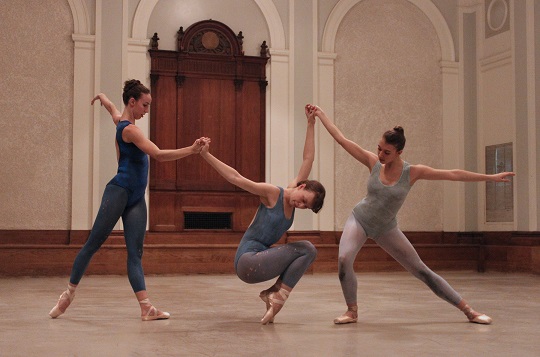
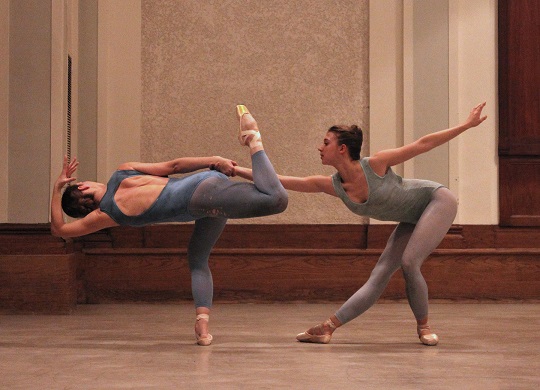
    Gravity was danced tonight by Elisabeth Brown, Traci Finch, and NCB’s newest member Cassidy Hall. The dancers alternate between posing and partnering: a duet for Elizabeth and Traci is observed by Cassidy, who then inserts herself into the dance. Elizabeth’s solo comes as the music falls silent; she then dances with Cassidy in a duet where Elizabeth, at full stretch, is nearly parallel to the floor in displaying a superb line.

    IMG_8922-edited-sm

    The dancers then polish off the ballet with a trio (Traci, Elizabeth and Cassidy, above). 

    More images from Gravity, photographed by Amber Neff:

    IMG_8883-edited-sm

    Cassidy Hall and Traci Finch

    IMG_8906-edited-sm

    Elizabeth Brown and Cassidy Hall

    Someone once wrote of Aristotle Onassis: “He was not the first man to want both his wife and his mistress.”  That very notion was the starting point of The Other Woman, Miro’s ‘classic triangle’ ballet set to a classic score: Bach’s B-minor violin sonata. 

    An en travesti Sarah Atkins, wearing a jaunty fedora, faces the age-old dilemma of the married man as he vacillates between his wife and his lover. Elizabeth Brown and Holly Curran offer contrasting attractions of face, form, and personality; in this very theatrical piece, their dancing is urgent and nuanced. The rival women confront one another while Sarah dances a space-filling solo. In the end it seems no real decision has been reached, and it feels like more chapters are yet to come before this story ends.

    Doori Na and pianist Taka Kigawa played the Bach so attractively, and moments later Taka returned play Beat Furrer’s ‘Voicelessness. The snow has no voice’ for Miro’s second premiere of the evening: Voicelessness. Taka’s playing was marvelous right from the murmuring start of the piece; he was able to sustain a pianissimo misterioso atmosphere throughout with great control. This was punctuated with the occasional emphatic high staccato.

    IMG_8328-edited-sm

    In this duet the two dancers – Amber Neff and Cassidy Hall, (above) – perform extremely demanding and intensely intimate feats of partnering. The two girls, abetted by Taka Kigawa’s keyboard, sustained the tension of the work most impressively.

    IMG_8354-edited-sm

    Above: Amber Neff and Cassidy Hall in Voicelessness

     
    More images from Voicelessness; these photos are by Sarah Thea who also designed the costumes for four of the five works seen tonight:
     
    IMG_8170-edited-sm
     
    Amber Neff, Cassidy Hall
     
    IMG_8201-edited-sm

    Amber Neff and Cassidy Hall
     
    Following the interval, Richard Carrick’s score ‘In flow’ for solo violin provided another showcase for Doori Na as Miro’s Friction unfolded. The ballet opens in silence before Doori’s violin sounds hesitantly; the angular, sinuous music includes an alarming forte ‘scrunch’ at one point. Dancers Holly Curran and Amber Neff moved thru the intricate partnering motifs with total assurance and dealt with the technical demands Miro makes on them with cool confidence.
     
    The evening closed with Constantine Baecher’s lively and very original ballet, Mozart Trio, set to excerpts from the composer’s piano sonatas played with genial clarity by Taka Kigawa.
     
    In this ballet about beginnings and endings, the dancers speak: they speak not only of where they are and what they are doing at the moment, but also – more cosmically – of where they are in their lives.
     
    Traci Finch narrates solos by Elizabeth Brown and Sarah Atkins in turn, describing their dancing and giving us bytes of biography. In the second movement, Sarah’s solo takes an autobiographical approach (“I’m in the middle!” she calls out – of her dance, of her career, of her life?). The third movement is an abstracted trio for all three dancers, full of energy and wit, until they reach the self-declared “end of the end!”
     
    New Chamber Ballet‘s next performances are set for February 26th and 27th, 2016. More details will be forthcoming as the dates draw nigh.

  • Vinson Cole

    Vinson cole

    Tenor Vinson Cole sings Richard Strauss’s Morgen.

    Vinson Cole – Morgen – Richard Strauss

    “And tomorrow the sun will shine once more, and on the path that I will take it will unite us – we fortunate ones – upon this sun-drenched Earth. And to the broad shore with its blue waves we will quietly go down; we will look into one another’s eyes, and the silence of happiness will descend upon us.”

  • Jennifer Muller’s Stages of Creation

    L1640936

    Striking a pose: the new Warhol piece by Jennifer Muller at a studio preview

    Tuesday November 17th, 2015 – Choreographer Jennifer Muller has been commissioned to create a new dancework for Introdans, the Netherlands-based contemporary dance company. The piece will premiere in February, 2016 on a program entitled Absolutely Amerika. This evening, at her studio on West 24th Street, Ms. Muller presented a sampling of this latest work, along with excerpts from some of the more recent additions to her Company’s repertoire.

    The room was packed with Muller friends and fans, and her lively and distinctive troupe of dancers seemed to ignore the fact that this was a studio showing, instead dancing at performance level. The dance-space is limited but the choreography is spacious and often fast-paced; yet the dancers moved with abandon, often coming within centimeters of the viewers – or of the ceiling, during the many lifts that the Muller repertory calls for.

    L1640814

    Two excerpts from FLOWERS were offered before dancer Michael Tomlinson (above, warming up) demonstrated a signature motif from the new work, which is inspired by quotes from the late Andy Warhol and is danced to a collage of music associated with the Warhol era.

    L1640965

    Above: the opening of MISERERE NOBIS

    I was particularly glad of another opportunity to see some passages from Jennifer’s 2014 masterpiece, MISERERE NOBIS, a compelling piece that has lingered in my mind since first encountering it. Originally danced by an all-female cast, Jennifer has now incorporated the Company’s men into this ritualistic work which is danced to Samuel Barber’s Adagio for Strings, which was inspired by Allegri’s immortal Miserere. The choreographer’s addition of men to the cast changed the flavor of the work slightly but didn’t diminish its power and beauty in the least.

    The evening closed with excerpts from ALCHEMY, an exciting multi-media piece which Ms. Muller premiered at New York Live Arts earlier this year. 

    The dancers were moving too fast most of the time for my camera to catch them, however here are a few images I was able to capture:

    L1640837

    Brittney Bembry, Michelle Tara Lynch

    L1640900

    Brittney Bembry

    L1640950

    Shiho Tanaka

    L1640970

    From MISERERE NOBIS

    L1640977
    Seiko Fujita

    L1640985

    Alexandre Balmain, Elise King

    L1650025

    Sonja Chung

    L1640989

    MISERERE NOBIS

    L1640915

    Jennifer Muller, ever the perfect hostess

    Jennifer Muller/The Works will be at New York Live Arts June 13th – 18th, 2016.

  • Jennifer Muller’s Stages of Creation

    L1640936

    Striking a pose: the new Warhol piece by Jennifer Muller at a studio preview

    Tuesday November 17th, 2015 – Choreographer Jennifer Muller has been commissioned to create a new dancework for Introdans, the Netherlands-based contemporary dance company. The piece will premiere in February, 2016 on a program entitled Absolutely Amerika. This evening, at her studio on West 24th Street, Ms. Muller presented a sampling of this latest work, along with excerpts from some of the more recent additions to her Company’s repertoire.

    The room was packed with Muller friends and fans, and her lively and distinctive troupe of dancers seemed to ignore the fact that this was a studio showing, instead dancing at performance level. The dance-space is limited but the choreography is spacious and often fast-paced; yet the dancers moved with abandon, often coming within centimeters of the viewers – or of the ceiling, during the many lifts that the Muller repertory calls for.

    L1640814

    Two excerpts from FLOWERS were offered before dancer Michael Tomlinson (above, warming up) demonstrated a signature motif from the new work, which is inspired by quotes from the late Andy Warhol and is danced to a collage of music associated with the Warhol era.

    L1640965

    Above: the opening of MISERERE NOBIS

    I was particularly glad of another opportunity to see some passages from Jennifer’s 2014 masterpiece, MISERERE NOBIS, a compelling piece that has lingered in my mind since first encountering it. Originally danced by an all-female cast, Jennifer has now incorporated the Company’s men into this ritualistic work which is danced to Samuel Barber’s Adagio for Strings, which was inspired by Allegri’s immortal Miserere. The choreographer’s addition of men to the cast changed the flavor of the work slightly but didn’t diminish its power and beauty in the least.

    The evening closed with excerpts from ALCHEMY, an exciting multi-media piece which Ms. Muller premiered at New York Live Arts earlier this year. 

    The dancers were moving too fast most of the time for my camera to catch them, however here are a few images I was able to capture:

    L1640837

    Brittney Bembry, Michelle Tara Lynch

    L1640900

    Brittney Bembry

    L1640950

    Shiho Tanaka

    L1640970

    From MISERERE NOBIS

    L1640977
    Seiko Fujita

    L1640985

    Alexandre Balmain, Elise King

    L1650025

    Sonja Chung

    L1640989

    MISERERE NOBIS

    L1640915

    Jennifer Muller, ever the perfect hostess

    Jennifer Muller/The Works will be at New York Live Arts June 13th – 18th, 2016.

  • Golden Age of the Violin @ CMS

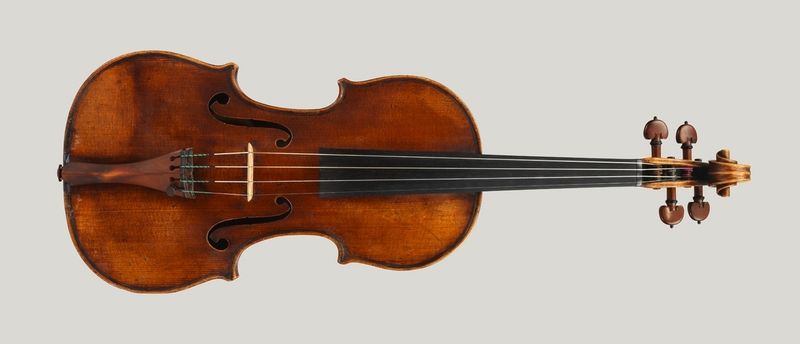
    Violin

    Following the senseless horror of the terrorist attacks in Paris this past Friday, we turn yet again to music as a source of consolation. These words from Leonard Bernstein have echoed thru my mind over this weekend since the appalling news from France reached us: “This will be our reply to violence: to make music more intensely, more beautifully, more devotedly than ever before.”

    Sunday November 15, 2015 – A trio of superb young violinists were featured at this evening’s concert given by at Chamber Music Society of Lincoln Center at Alice Tully Hall. Paul Neubauer and David Finckel – masters of the viola and cello respectively – joined their young colleagues in celebrating the expressive violin style epitomized by the legendary Fritz Kreisler.

    Kreisler was in fact the first violinist I ever heard; my parents had some of his recordings and by the age or eight or nine I was already preferring these – and Horowitz, Flagstad, and Toscanini – to my mom’s favorites: Lawrence Welk and the McGuire Sisters.

    The first music we heard this evening was also oldest music on the programme: a sonata for two violins by Jean-Marie Leclair. Leclair may be the only violinist/composer in history to have had a highly successful career as a ballet dancer prior to turning to composing full-time around 1723. Today’s sonata dates from 1730 and was played with lively charm by Danbi Um and Sean Lee. Passing the melodies back and forth, the duo were well-matched, nuance for nuance. The tender sadness of the sonata’s Andante graziosa maintained a forward momentum, and then our two violinists sailed confidently thru the swirls of notes than make up the concluding Presto.

    Mr. Lee returned to the stage immediately with Benjamin Beilman and Paul Neubauer for Anton Dvorak’s C-major terzetto, composed in 1887. It opens with a tranquil theme, becomes more animated, then gently shifts between moods. After a passage of hesitations, as if unsure where to go next, the composer gives us a warm lullabye-like melody with a genial ending. A feeling of propulsive dance – and a touch of Mendelssohnian sparkle – fills the Scherzo; a central song with the flavour of a country waltz is most attractive, followed by a da capo which sweeps forward in alternating currents of lyrical breadth and teasing delicacy. In the final movement, Mr. Neubauer’s viola had a shivering motif, followed by an impassioned theme from Mr. Beilman; then there’s a brisk rush to the finish. 

    David Finckel’s name in my Playbill is now triple-underlined and festooned with exclamations marks for his marvelous playing in the Alexander Borodin 1881 D-major quartet. The cello sets the pace for the opening Allegro moderato and is given some heartfelt melodies in the later movements; these were relished by Mr. Finckel whose tone has an intimate, romantic glow.

    A Spring-like feeling pervades the opening of the Scherzo: Allegro, and then a familiar tune is heard: my mother would have recognized it as the melody of the 1950s pop song Baubles, Bangles & Beads(from the musical KISMET) which was recorded – seemingly – by everyone, including Marlene Dietrich and Frank Sinatra. For all the tune’s appeal, it still sounds best in its original Borodin setting. The second movement then rushes ahead, only to withdraw to a pizzicato fadeout at the end.

    Borodin sets the third movement as a Nocturne and Mr. Finckel sets the mood to perfection. Danbi Um, in the first violin chair, then takes up a sweet, high theme. Mssrs. Lee and Neubauer make the middle voices sing, the latter in a lovely melodic exchange with Mr. Finckel’s cello (“Gorgeous blends!” I scrawled in my Playbill.) Ms. Um takes up a shining theme, passing it to Mr. Finckel who descends with it into the cello’s depths. This Nocturne, with all four players deeply immersed in the music, made a particularly satisfying impression. In the concluding movement, the quartet summarized the work in recurrent themes, playing with such conviction that the audience were swept along and responded with especially warm applause, summoning the musicians out for a second bow. 

    After the interval, Ben Beilman stood alone on the stage and delivered a stunning performance of Eugene Ysaÿe’s E-minor sonata (1924). The work is a virtuosic test piece for which Mr. Beilman gets top marks. This young artist displays thorough technical assurance as well as a masterful control of dynamics. He took the strenuous demands Ysaÿe places on the player in stride, and an appealing aspect of modesty in his delivery endeared him to the crowd. This is a serious musician with something to say to us. The applause that enveloped Mr. Beilman at the end of his dazzling performance was amply deserved, bringing him out for a double curtain call. 

    No one could blame Fritz Kreisler for featuring the violin in his A-minor quartet: it was, after all, his instrument. Mr. Beilman, fresh from the demands of the Ysaÿe, was at his most lyrically persuasive here, regaling us with the melodic treats Kreisler has laid out for him. Danbi Um seconded Ben’s beautiful playing with many graceful turns of phrase, while Mssrs. Neubauer and Finckel brought Olde World warmth and expressiveness to their playing.

    Though rife with melodic felicities, including a waltz tune “mit schlag” and a gorgeously-sustained Ben Beilman high fade-away at the conclusion of the Romanze, the Kreisler quartet is one of those perfectly pleasant works that falls short of being truly memorable. But I can’t imagine it being better-played than it was this evening.

    In her welcoming remarks tonight, Chamber Music Society co-artistic director Wu Han had spoken of the distress we have all been feeling after the horrible events in Paris. She said that from Friday night til Sunday morning she had been so consumed with sadness that she couldn’t play the piano, but that at last she sat down to practice and found solace at the keyboard. She promised us that the evening’s programme would be uplifting, and she was right. 

    The Repertory:

     The Participating Artists: