Rosalind Elias (above) and Franco Corelli singing the final scene of CARMEN on a Summer evening long ago.
Rosalind Elias & Franco Corelli – CARMEN – final scene – 1968
Rosalind Elias (above) and Franco Corelli singing the final scene of CARMEN on a Summer evening long ago.
Rosalind Elias & Franco Corelli – CARMEN – final scene – 1968

Rosalind Elias (above) and Franco Corelli singing the final scene of CARMEN on a Summer evening long ago.
Rosalind Elias & Franco Corelli – CARMEN – final scene – 1968

Saturday September 12th, 2015 – After celebrating their tenth anniversary season in 2014-2015, Miro Magloire’s New Chamber Ballet have commenced their second decade of presenting intimate, on-pointe evenings of dance with live music: a formula which maintains NCB‘s unique place in the Gotham dance-sphere and keeps Miro’s loyal followers coming back for more.
This evening’s programme was all-Magloire in terms of choreography, and mostly ‘modern’ in terms of music: aside from the Mozart setting of the opening ballet, the oldest work played tonight dates from 1952 (Morton Feldman’s Extensions 3), and anything that’s younger than me counts as ‘modern’.
It is, in fact, Miro’s musical integrity that accounts for my unflagging interest in his work: I can go to his performances knowing I can depend on him to serve up music – whether olde or written last year – that will fascinate. His musicians – Melody Fader (piano) and Doori Na (violin) – seem capable of leaping over whatever technical obstacles might be set in their path – a virtue in itself, since contemporary composers often seem intent on pushing the boundaries of an instrument’s capabilities.
Likewise, Miro continues to expand the choreographic possibilities of what an all-female troupe of dancers can do. His most recent works – three of them seen tonight – take same-sex ballet partnering into uncharted territory.
Miro is comfortable with both narrative and abstract works. The evening’s opener – IN THE PARLOUR – is set to Mozart’s violin sonata in E-minor K. 304, which was handsomely played by Melody Fader and Doori Na. In this domestic drama, three women express shifts in friendships and matters of trust. A beautiful solo for Elizabeth Brown begins haltingly, in silence; soon she is wafting serenely about the space. She pauses to write upon the wall; in this she is thwarted by a destructive Sarah Atkins. Meanwhile, a third woman – Holly Curran – seems unsure of whose side she’s on. Holly’s crisis is resolved as she allies with sneaky Sarah. The three girls danced flawlessly and sustained the mysterious atmosphere of the ballet.
Tristan Murail’s score for LA MANDRAGORE veers from turbulence to high, shining motifs, and then to a misterioso atmosphere; Melody Fader at the piano showed a sure feel for the moods of the piece. The two lithe and wonderfully supple dancers – Traci Finch and Amber Neff – moved thru the enmeshed, intimate partnering passages with physical strength and a sense of mutual assurance that was truly impressive.
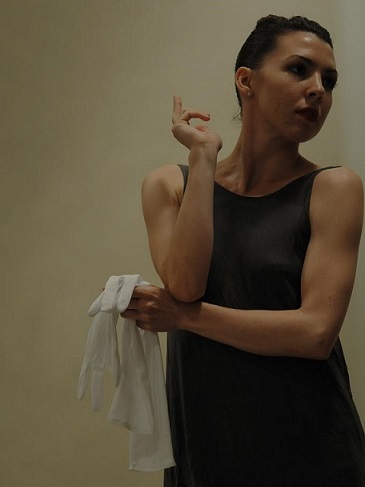
As Sarah Atkins (above, photo by Kokyat) strolls onto the stage wearing long white evening gloves and smoking a cigarette, a vision of Nijinska’s LES BICHES pops into mind; but Miro’s ballet GLOVE is in fact more intriguing than Nijinsk’a old Poulenc ballet. Melody Fader’s expert playing of Feldman’s Extensions 3 sets the scene for this small jewel of a work in which Holly Curran and Elizabeth Brown become increasingly desirous of obtaining Sarah’s gloves. There are comings and goings – the dancers periodically hide behind the piano, concocting their future moves – and the ballet ends with a mysterious seizure.
I had seen a rehearsal of parts of Miro’s newest creation GRAVITY; both at the rehearsal and at this evening’s performance, I was captivated by Doori Na’s masterful playing of the score for this ballet: numbers 3 and 5 from Friedrich Cerha’s Six Pieces for Solo Violin. In introducing this premiere tonight, Miro’s enthusiasm for Cerha’s music makes me quite certain we will see the remaining movements of the score being danced to in the near future.
Tonight’s enticing presentation of the work as it currently stands was delicious both musically and in the dancing: Elizabeth Brown, Traci Finch, and New Chamber Ballet debutante Cassidy Hall formed a strong sisterhood and smoothly wove their way thru the many demanding elements of Miro’s choreography. The work is sculptural, with partnering motifs that can be fluid one moment and angular the next. Among the many felicitous moments were…

…a rhapsodic wingspan gesture from Elizabeth Brown, supported by Traci…

…and a lovely slow attitude promenade by Traci and Cassidy, as seen in these rehearsal images.
GRAVITY has the feel of an impending Magloire masterpiece; let’s see where the Cerha takes the choreographer next.
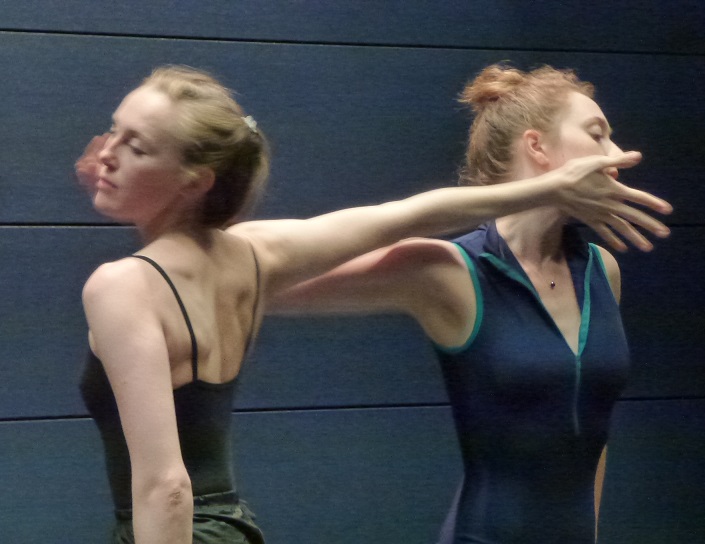
Above: rehearsing FRICTION: Amber Neff and Holly Curran
Doori Na and his violin propelled the evening to a fine finish in Richard Carrick’s In Flow, as set by Miro for his ballet FRICTION. Doori took the music from its hesitant opening thru a rather boozy passage of seasick pitch and on to some skittering and stuttering motifs to a big, passionate rhythm. For the dancers, again the intimacy is palpable; Amber and Holly are in full flourish for the demanding partnering and the dance well-captures the textures of the music. Holly’s black tights and toe shoes were an added visual enticement.
After ten years of reporting on the Manhattan dance scene, there are times when I think I’ve seen all there is to see. Yet a handful of choreographers and companies continue to hold my attention, and Miro and his New Chamber Ballet are among their small number…as much for the music as for the dancing. And that’s exactly how it should be.
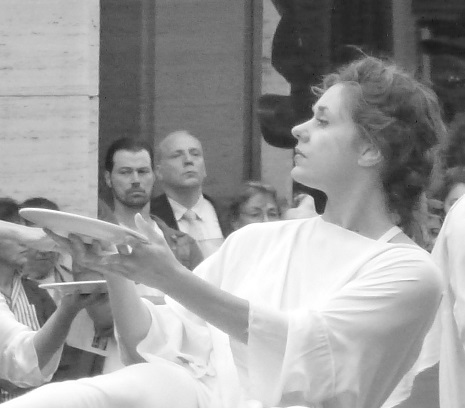
Above: Christina Ilisije
Friday September 11th, 2015 – Table of Silence, choreographer Jacqulyn Buglisi’s commemoration of the events of September 11th, 2001 – and her gift of peace to the world – was performed this morning at Lincoln Center.
This year the Table of Silence seemed particularly moving for some reason; I cannot quite put my finger on it. Perhaps is is simply that, as time goes by, life becomes more and more precious to us. It was a morning to think of great friendships, including some that have been cast asunder. It was also a day to celebrate those we hold most dear, among them the one I almost lost; his recovery was nothing less than a miracle.
So despite the memories of that awful event fourteen years ago, on this day what I was feeling was mostly gratitude: for the people, the music, the dance, the beauty of the natural world, and the simple pleasures that fill my life…all of which – I have come to realize – we cannot take for granted.
“Let us live each day to the fullest, and never miss a chance to let those dearest to us know of our love for them.”
The sky was overcast for today’s Table of Silence, but I took lots of photos. Here are a few, despite a lack of clarity:

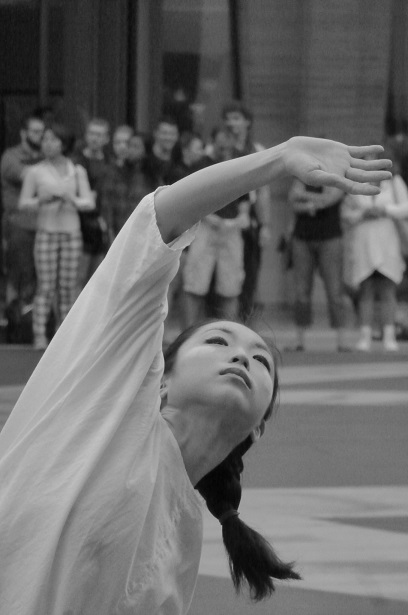

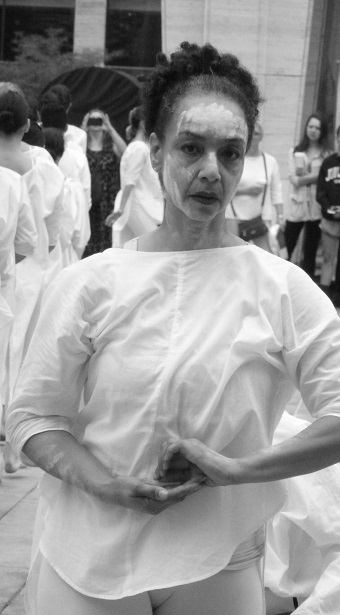


Kenny Corrigan

Lloyd Knight

Abdiel Cedric Jacobsen
There’s a Facebook album of images from today’s performance here.

News of the death of Camellia Johnson (above) eerily came on a day I had just been listening to her voice. In the course of my Summer project of transferring some of the rare items in my cassette collection to MP3, I had just come across a tape of parts of the Verdi REQUIEM in which Ms. Johnson is the soprano soloist.
The broadcast of this REQUIEM was something I came upon quite by chance; as the announcer was introducing the performance, I found myself with only one blank side of one tape to hand. I slipped it into the deck and decided to concentrate on recording excerpts in which the two women are prominent, Florence Quivar being a particular favorite of mine. Listen to what I preserved here:
Verdi REQUIEM – excerpts – Baltimore 1994 – C Johnson Quivar Heppner G Relyea – Zinman
In 1995, I had the good fortune to hear Camellia Johnson live at two different, wonderful venues. She sang with the Philharmonia Virtuosi at the Met Museum, and she gave a recital at Alice Tully Hall accompanied by Neal Goren. I remember being blown away by both the velvety warmth of her tone and her gift for finding a direct communicative channel to the audience. On both evenings she programmed Wagner’s Wesendonck lieder; at the Met concert, she gave a stunning performance of “To This We’ve Come” from Menotti’s THE CONSUL whilst with Mr. Goren she sang a lushly resonant “Du bist der lenz” from DIE WALKURE.
Camellia Johnson sang at The Met from 1985 thru 1994, debuting there as Lily in PORGY AND BESS. Her most frequent Met role was the Priestess in AIDA; she also scored a personal success with her sumptuous and emotionally charged singing of Madelon’s aria in ANDREA CHENIER.

Above: Paul Taylor takes a bow with dancers Amy Young and Eran Bugge after a 2011 performance of CLOVEN KINGDOM; photo by Kokyat
Paul Taylor – Creative Domain, a documentary film about the great American choreographer, will open at Film Society of Lincoln Center on September 11th, 2015, with showings thru September 17th. Thereafter, the film – which centers on the creation of Taylor’s 133rd dancework, Three Dubious Memories (2010) – will be seen in cities across the USA.
The Lincoln Center showtimes may be viewed here.

Above: from Lydia Johnson’s NIGHT OF THE FLYING HORSES; photo by Nir Arieli
Lydia Johnson Dance have announced auditions for male and female dancers, to be held in September (on Fridays…applicants will be notified of the specific date). Complete audition information here.
Above: Renzo Olivo, of Argentina, serving in the sunshine
Tuesday August 25th, 2015 – Right up until the morning of, I was unsure if I’d be making my annual trek to the US Open qualifying tournament this year. Over the last two or three years, I have changed from being a “Summer person” to being a “Winter person”. I – who used to sunbathe avidly, and always loved hot, steamy weather – have done a complete volte face. I now find heat and humidity oppressive and really annoying.
But the lure of watching tennis live overwhelmed my concerns for comfort and so, after having a ‘private car’ on the 7 train out to the tennis center, I tried to ignore the sun beating down and the trickles of sweat. Around 2:00 a lovely breeze kicked in, and if you sat high enough up in the stands, you could maintain reasonable comfort.
The day started badly as two of my favorites went down to defeat: Tatsuma Ito (above) was over-powered by the big-hitting Russian Aslan Karatsev…
…whilst Somdev Devvarman (above) fell in a three set battle to the Slovakian Norbert Gombos.
Wei had asked me to check out the tall young Chinese player Ze Zhang (above), who won his first-set in an exciting tie-breaker against France’s Tristan Lamasine. In the second set, Ze Zhang was serving for the match but somehow lost a bit of momentum; Lamasine stepped up his level and took the set. In the deciding third, Ze Zhang seemed to be hobbled by an injury to his serving arm; his big serve was compromised and often he would just tap the ball into play. The trainer was out and did what he could to alleviate the problem, but Lamasine took advantage of the situation, playing even harder and forcing a victory. The Chinese crowd were demoralized. But Ze Zhang has the goods; I’m sure we’ll be seeing much more of him in the seasons to come.
Japanese-American Taro Daniel (above), who impressed me at last Summer’s tournament, played a beautiful, dominating first set against the Argentine Renzo Olivo; Taro’s serve has a lovely slice to it. Olivo made some headway in the second, but Taro kept his cool and swept to victory.
I so enjoyed watching Taro’s match from my perch up in the stands. It was everything I love about tennis.
Above: Taro Daniel after the match.
I would have loved to have stayed on to see the 19-year-old Swede Elias Ymer, and my longtime favorite Alejandro Falla, but I was already sunburnt, and so I grabbed a big bottle of water and headed for the train. Both Ymer and Falla won their matches today, so hopefully I can catch them in the next round.
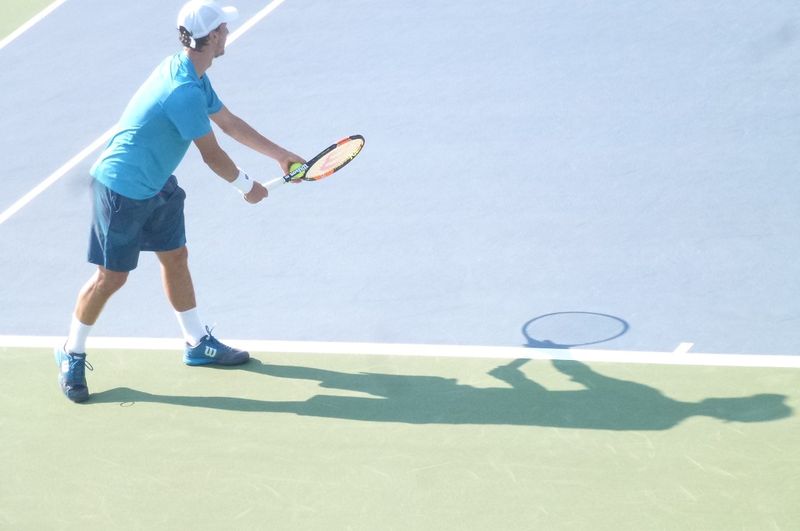
Above: Renzo Olivo, of Argentina, serving in the sunshine
Tuesday August 25th, 2015 – Right up until the morning of, I was unsure if I’d be making my annual trek to the US Open qualifying tournament this year. Over the last two or three years, I have changed from being a “Summer person” to being a “Winter person”. I – who used to sunbathe avidly, and always loved hot, steamy weather – have done a complete volte face. I now find heat and humidity oppressive and really annoying.
But the lure of watching tennis live overwhelmed my concerns for comfort and so, after having a ‘private car’ on the 7 train out to the tennis center, I tried to ignore the sun beating down and the trickles of sweat. Around 2:00 a lovely breeze kicked in, and if you sat high enough up in the stands, you could maintain reasonable comfort.

The day started badly as two of my favorites went down to defeat: Tatsuma Ito (above) was over-powered by the big-hitting Russian Aslan Karatsev…

…whilst Somdev Devvarman (above) fell in a three set battle to the Slovakian Norbert Gombos.

Wei had asked me to check out the tall young Chinese player Ze Zhang (above), who won his first-set in an exciting tie-breaker against France’s Tristan Lamasine. In the second set, Ze Zhang was serving for the match but somehow lost a bit of momentum; Lamasine stepped up his level and took the set. In the deciding third, Ze Zhang seemed to be hobbled by an injury to his serving arm; his big serve was compromised and often he would just tap the ball into play. The trainer was out and did what he could to alleviate the problem, but Lamasine took advantage of the situation, playing even harder and forcing a victory. The Chinese crowd were demoralized. But Ze Zhang has the goods; I’m sure we’ll be seeing much more of him in the seasons to come.

Japanese-American Taro Daniel (above), who impressed me at last Summer’s tournament, played a beautiful, dominating first set against the Argentine Renzo Olivo; Taro’s serve has a lovely slice to it. Olivo made some headway in the second, but Taro kept his cool and swept to victory.

I so enjoyed watching Taro’s match from my perch up in the stands. It was everything I love about tennis.

Above: Taro Daniel after the match.
I would have loved to have stayed on to see the 19-year-old Swede Elias Ymer, and my longtime favorite Alejandro Falla, but I was already sunburnt, and so I grabbed a big bottle of water and headed for the train. Both Ymer and Falla won their matches today, so hopefully I can catch them in the next round.

Above: Yoshihito Nishioka
Wednesday August 26th, 2015 – Today’s first match at the US Open qualifying tournament was a tough one for me, because I really like both players and I didn’t want to see either one of them lose. Japan’s Yoshihito Nishioka, who recently made tennis news with this improbable shot, was pitted against Yuki Bhambri of India.
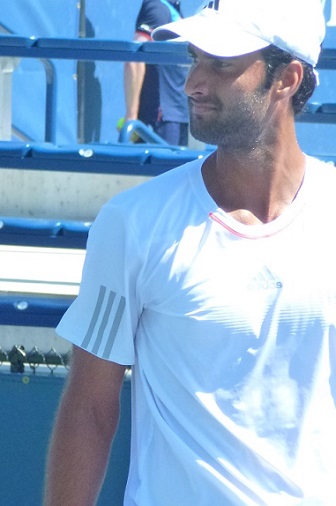
Above: Yuki Bhambri
Yuki is much taller than Yoshi, with a powerful build. But Yoshi, a lefty, has great technical skills and is able to generate strong pace. For eight games, they stayed on serve and there were some very dynamic rallies. Nishioka broke Bhambri in the 9th game and was able to stave off 3 break points in the following game to take the set.
The second set found the Japanese experiencing a perceptible dip in energy. Bhambri took advantage; he broke Nishioka and held on to take the set 6-1. I did a walkabout, wondering which way the match would go.
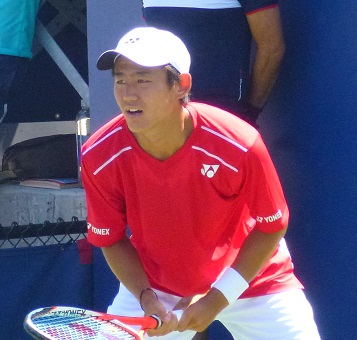
When I got back to the court, a breeze had kicked up and Nishioka, having changed to a red shirt, seemed revitalized. He took control and, with some well-fought points along the way, won the match…and the crowd’s acclaim.

Another fine Japanese player, Yuichi Sugita (above), was unfazed by the powerful hitting of his imposing opponent, Austria’s Gerald Melzer. Melzer had his moments, and his fans, and he managed to break Sugita in the second set. But overall, Sugita sailed confidently through the match with the authority of a young prince. I really loved watching him play.
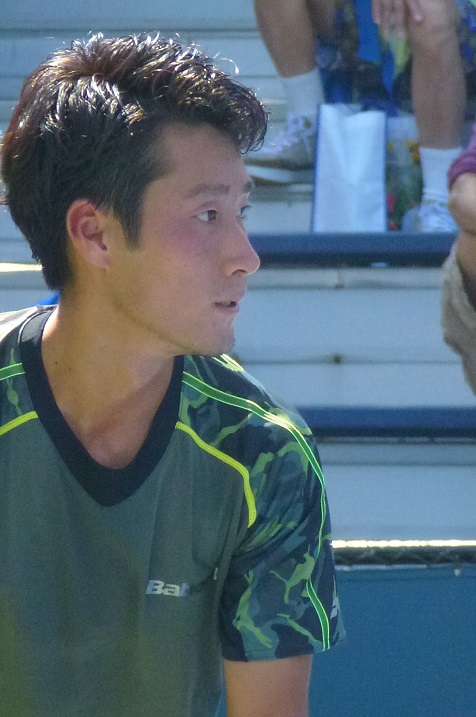
Above: Yuichi Sugita
After the Sugita-Melzer match, I’d hoped to see Nicolas Almagro in action. Yes, surprisingly the Spaniard, who had a career-high ranking of #9 in 2011 – has fallen down the charts following a prolonged layoff to recover from an injury and was thus forced to qualify for the US Open. Approaching the court where Almagro was playing, I could see there was no chance of getting anywhere within viewing distance. I later heard that he won his match, so that augurs well.




 Oberon's Glade