Blog

  • The Current Sessions Volume V, Issue II

    Photo-original

    Sunday August 23rd, 2015 – I like everything about the CURRENT SESSIONS: I like the idea, I like the venue, I like like the relaxed yet attentive audience…and I’ve liked just about every work and dancer I’ve ever seen there. Alexis Convento and Allison Jones continue to put together strong programs and to offer their audience a chance to experience the work of new and mid-career choreographers in an intimate setting, with first-class lighting and sound.

    In their presentations, the CURRENT SESSIONS particularly like to welcome mixed-media danceworks, and he first half of tonight’s program featured three such pieces, if one includes the lighting effects of the Niall Jones work. After the interval, pure dance took over. It was an evening of contrasting moods, with some very impressive individual performances.

    In the opening work, Ashley Robicheaux & Artists offered Spaces Part II: “We, two”. My fascination with this piece began even before the dancing started, as Kane Mathis appeared and began to play his 21-string Mandinka harp. Mr. Mathis was within arm’s reach of me as he played, producing other-worldly sounds. A film commences, showing closeups of the hands and eyes of the two dancers – Ashley Robicheaux and Holly Sass. The two women emerge from the shadows, wary and seeking. They perform a mirror-image duet which evolves into intense partnering. One lifts and twirls the other; an emotional spasm is quietened. They rush about; an eventual embrace leads to the renewal of intense struggle. Passions ebb and flow, and in the end one girl pulls the other offstage as the music fades. 

    Joe Monteleone//Monteleone Dance‘s MK Ultra Sound derives its inspiration from Project MK Ultra, a covert CIA project involving mind control using psychotropic drugs which ran from 1953 til 1973. In the dancework, Mr. Monteleone and Shelley White dance a stylized duet against visual projections, including a woman’s face upside down. The soundscape ranges from static with a heavy beat, thru spoken ‘instructions’, fragments of song, the story of the IIlluminati. Complacency settles on the dancers: in a trance, they seem lulled into security. The movement then becomes more agile and expressive, finally calming to the sound of breathing. At last the woman seems to break down. In flickering light and shadows, the couple watch the ultrasound images of a fetus. Fleeting tenderness, then a fade to black. 

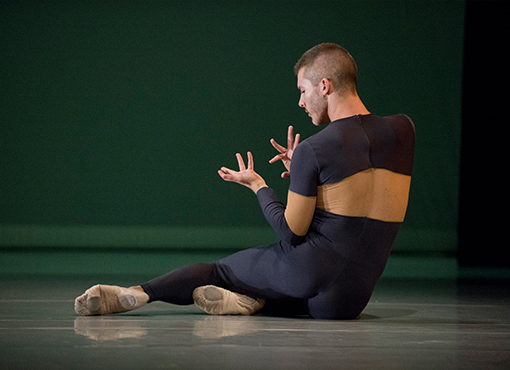
    Dancer Noel Genet sets the stage for his solo Solitude and Excess Features, choreographed by guest artist Niall Jones. Wearing trousers and a lace shirt, Mr. Genet first performs a spastic solo in place to the sound of silence. In a mélange of movement, the dancer reclines, rises, collapses, is weighted down, dances in the dark, writhes on the floor, jogs in place, crawls and shimmies, dances with his shadow, and concludes with an oddly graceful solo. Mr. Genet, utterly self-absorbed, gave a compelling performance; his sense of deadly earnest was soon evoking laughter from the audience. This quirky piece seemed at times like improv, but clearly it had all been thoroughly mapped out. The low-key levity of Mr. Genet’s performance sent the audience forth for intermission drinks in a congenial mood.

    A deep throbbing hum heralds the arrival of Jeff Docimo//Isodoc Dance Group for an excerpt from Mr. Docimo’s Cut Crawlers. Clad in black, the five dancers crawl furtively into the space, which they explore with wary curiosity. The piece seems wrapped in shadow, with ominous thunder underscoring the mystery of this lost tribe. Amara Barner’s solo is outstanding, as is Mr. Docimo’s – which has breakdance elements impressively woven in. These two later have a duet, showing off the choreographer’s athleticism. Throughout this work, a sense of structure was amply evident: both in movement and emotional resonance, Cut Crawlers was impressive.

    For her solo Bonjour Tristesse, Marissa Brown//Lone King turns with compelling rightness to the poignant music of Frédéric Chopin. Ms. Brown is seated in a folding chair, her eyes gazing intently at an unoccupied antique armchair across the diagonal from her. As the comely Ms. Brown rises from her reverie, her dancing is contemplatively physical, making excellent use of the space as movement and stillness alternate. At last, overcome by the music, she returns to her seat and to her obsession with the armchair: who had sat there? Where has that person gone? What has the dancer lost in losing that person? A beautiful and resonant work, expressively danced.  

    LoudHoundMovement (guest artist) closed the program with Brendan Duggan’s trio A Rib Where Her Voice Had Been, performed by Matthew Ortner, Holly Sass, and Shelby Terrell. First one woman and then the other vocalize softly. One woman dances a solo whilst the second dances a slow, almost imperceptible waltz with the man. The stage brightens, and to the sound of a big heartbeat motif, the dancers engage in a brisk trio, grasping and eluding one another and sometime lapsing into stand-still plastique. There’s a passage of 2-female partnering, with lifts and carryings; then they speak to each other in sign language as the man reclines. After he awakens, with a breakish solo, the women revert to their soft singing and then all evaporates into silence.

  • “Questo lido è a lei funesto!”

    L D

    As Laura Adorno and La Gioconda respectively, mezzo-soprano Luciana D’Intino (above) and soprano Eva Urbanová duke it out aboard Enzo’s ship, the Hecate, in this famous scene from Act II of Ponchielli’s LA GIOCONDA. From one of my favorite Italian operas, this excerpt begins with Laura’s prayer “Stella del marinar” and goes on to the fiery duet of the two rivals, “L’amo come il fulgor del creato!”

    GIOCONDA Act II exc Urbanova D’Intino Scala 1996

    Eva U

    Above: Eva Urbanová…the Czech soprano has had a substantial operatic career, and also has a following as a pop and rock singer. She sang at The Met from 1998-2004 where I saw her striking debut performance as Ortrud and also had the good fortune to experience her only Met Tosca, a portrayal that was enhanced by her detailed characterization as well as some surprisingly nuanced singing.

    Luciana D’Intino’s Met career to date has consisted of two appearances each in the “big three” Verdi mezzo roles: Eboli, Amneris, and Azucena. I saw her in all three operas and her performances were astounding in their vocal richness and as marvelous examples of what is now the fast-fading authentic Verdi style.

  • Graham Deconstructed: EMBATTLED GARDEN

    6a00d8341c4e3853ef015432a5d60c970c-800wi

    Above: Isamu Noguchi at Versailles in the 1950s

    Wednesday August 19th, 2015 – Martha Graham’s Embattled Garden (1958) is the choreographer’s re-telling of events in the Garden of Eden. The ballet is performed to a score by Carlos Surinach, with a set designed by Isamu Noguchi and costumes by Ms. Graham herself.

    This evening, as part of the Martha Graham Dance Company‘s series Graham Deconstructed, a full performance of the work was given in the intimate setting of the Graham Studios at Westbeth on Bethune Street. The heat in the theatre-space seemed stifling at first, but once the dancing started such earthly concerns were forgotten.

    As audience members arrived, a film of the original cast of EMBATTLED GARDEN was being shown. In her opening remarks, Janet Eilber, ever the gracious danceworld-hostess, told us that the film had been shot between a matinee and an evening performance: a time when the dancers are normally resting, eating, and gathering their strength for the second show. Thus some of the dancing is sketched in rather than full-out. Still, it’s quite a document.

    Ms. Eilber spoke of the exotic characteristics of this ballet: the tropical colours of the Noguchi set, the subtle ‘Spanish’ effects of the Carlos Surinach score (to which Graham’s choreography at one point responds with a flamenco motif), and the costuming details which evoke Iberia: the two men wear toreador-style trousers and Lilith’s tortoise-shell comb looks like a peineta (the supportive part of a classic mantilla). Although Biblical references to Eden are avoided in EMBATTLED GARDEN, Lilith’s rich-red fan has always symbolized The Apple for me. 

    Once the capacity audience had settled in, Ms. Eilber asked the four dancers to demonstrate some of the signature passages that define their respective roles. There was then a brief pause, and the ballet was shown in its full, sensual glory.

    Of the cast, only Mariya Dashkina Maddux as Eve had previously danced her role. Masha, as she is affectionately known, has recently become a mother and she returns to performing with that indefinable added glow which new-motherhood often imparts. One of the Company’s most lyrical movers, Masha as Eve found a perfect balance of pride and vulnerability. 

    The three dancers debuting in this ballet are Lloyd Mayor (Adam), Lauren Newman (Lilith), and Lorenzo Pagano (The Stranger); each made a vivid individual impression, and they are already putting their personal stamps on these iconic Graham roles

    Lauren Newman and Lorenzo Pagano make a wonderfully conspiratorial couple: it’s all in the eyes – they seemed to be in constant visual contact no matter where they were on the stage at a given moment. Ms. Newman was seductive and self-assured, whilst Mr. Pagano looked dazzling in the athletic choreography; his Renaissance handsomeness could shift from angelic to demonic in the twinkling of an eye. 

    Lloyd Mayor is probably getting tired of being referred to as ‘boyishly handsome’ but…there it is. As he takes on new Graham roles, his expressiveness finds new depths. His performance as Adam was passionate, physically alluring, and lushly resonant.

    This international cast – American, Italian, Ukrainian, and Swiss – were given a most enthusiastic salute of applause and cheers at the close of their performance. They had danced under sultry conditions which – as Ms. Eilber pointed out – were very suitable to the ballet’s steamy content.

    I felt that many in the crowd were seeing EMBATTLED GARDEN for the first time. And some may even have been having their first-ever Graham experience: I have no doubt they will be back for more.

  • Hina Spani

    Hqdefault

    The Argentine soprano Hina Spani (above) sings “In quelle trine morbide” from Puccini’s MANON LESCAUT.

    Spani’s career was centered in Italy – at La Scala and other major opera houses – and in Buenos Aires. Between 1915 and 1940, she performed over seventy operatic roles. 

    On December 3rd, 1924, at Toscanini’s request, Hina Spani sang at Puccini’s funeral in Milan.

  • Claudia Schreier & Company @ Ailey Citigroup

    Y9sFFU7MHcPVPSPHekpAuI0a2psEiYGmG3xQfZxEJVw

    Above: Amber Neff and Drew Grant dancing with Claudia Schreier & Company at Ailey Citigroup Theatre; photo by Nir Arieli

    Saturday August 8th, 2015 – Exactly one year ago tonight, Claudia Schreier won the Breaking Glass Project’s competition for female choreographers with her brilliant ballet, HARMONIC. Her prize was to present a full evening of her own work at Ailey Citigroup Theatre, and that prize was claimed tonight as five of Claudia’s works were performed by an array dancers drawn together specially for the occasion.

    The evening was an unalloyed triumph for all concerned, including two contemporary composers whose works were choreographed by Claudia (Jeff Beal and Douwe Eisenga – both of them were present and took a bow at the end); the choral group Tapestry who performed live for the ballet VIGIL; a chamber quartet playing Jeff Beal’s score for ALMOST MORNING live, and – of course – the superb ensemble of dancers.

    K5E9rMw6UqO0VVtyJciW6UK4NPyQplBgLO9YtZmNWic

    Above: the chamber musicians, with dancers Amber Neff and Drew Grant, in ALMOST MORNING

    When we first started watching House of Cards, my partner and I were very much taken with Jeff Beal’s score: “…this music would make a great ballet!” And now it’s come to pass: ALMOST MORNING is set to an original score composed for Ms. Schreier by the multi-Emmy Award-winning Mr.Beal. Six dancers appear in a series of overlapping duets interspersed among ensemble passages. The music pulses and percolates, but can also turn moody or melodious along the way. The musicians – Kieran Ledwidge (violin), Tia Allen (viola), Kirin McElwain (cello) and Ta-Wei Yu (piano) – delivered the score with propulsive assurance.

    The choreographer responds to this music with movement that has a broad overall sweep but also features countless felicitous and original touches. Amber Neff is thrice tossed into the air, spiraling before being caught by her partner Drew Grant; the blondes – Kaitlyn Gilliland and Elizabeth Claire Walker – dance in tandem; and a sustained duo for Ms. Walker and Mr. Grant is particularly striking. A pas de trois for Ms. Neff, Francis Lawrence, and Da’Von Doane progresses to a pensive solo danced by the incomparable Kaitlyn Gilliland. There are stretches of visual polyphony; the dancers form a circle before sweeping into a triple pas de deux set to the score’s most lyrical theme. Then the dancers rush off in the end, leaving the stage to the musicians.

    The conclusion of the ballet triggered the first of the evening’s enthusiastic ovations: having observed ALMOST MORNING in a keen state of silence, the audience demonstrated their approval for both the music and the dancing in no uncertain terms. And this was only the beginning.

    The evening continued on its soaring trajectory with HARMONIC, the ballet to Douwe Eisenga’s stimulating score which clinched the prize for Claudia Schreier at last year’s Breaking Glass competition. HARMONIC was originally created by Ms. Schreier in 2013 for the Columbia Ballet Collaborative, and was subsequently re-staged for Craig Salstein’s Intermezzo Dance Company, who performed it at Vassar College in March 2014. Inspired by Mr. Eisenga’s magical score, HARMONIC is a contemporary ballet that seems built to last.

    Tonight HARMONIC received a mesmerizing performance, with ABT’s entrancing Stephanie Williams displaying marvelous technique and a particularly attractive presence. Earlier this month, Stephanie danced – splendidly – for Joshua Beamish at The Joyce. The principal male role here was taken by Dance Theatre of Harlem’s intrepid Da’Von Doane; Da’Von danced in four ballets tonight and, after a long day of tech/dress/performance, he seemed totally fresh at the end of the evening and looked ready to repeat the whole programme. Strength and stamina are essential, but when you add Da’Von’s stunning physique, impeccable partnering, generosity of spirit, and his intangible gift for making everything seem right with the world, you have a paragon.

    VrNHJfYYogm9siRJvr8UW4yNJwsOXitV7P3HNzXAtv8

    Da’Von’s dancing with Ms. Williams (above) was electrifying to behold, for they are well-matched in terms of both daring and allure.

    One could say there are no supporting roles in Claudia Schreier’s ballets: she puts demands on everyone involved in a given work and then rewards them with opportunities to shine. Thus tonight in HARMONIC, Amber Neff and Elinor Hitt were utterly essential; they danced their hearts out, and basked beautifully in those passages of being partnered by Da’Von. Again, the audience response was thunderous.

    More images from HARMONIC:

    1O0yCW6DIWcuNbi1kgkPvPGcePxqUPemQqgrPxdPvz4

    1KVDMItwF91iXMsAH0RJgcUAIUCf9rcaCuNakLLIelU

    Elinor Hitt

    DJGLT5k-HOM4CJA1j2KxvMdRDzTWJ5ORhvToe5qMktY

    P6ARkgQ5VYLSGcmYLnuZH8l1PchvvsZI0BMCKKlz7Co

    Stephanie Williams

    A new production of Ms. Schreier’s 2009 ballet ANOMIE is imbued with a striking atmosphere of lyricism and poetry. Set to the heartfelt beauty of César Franck’s Prelude, Fugue and Variation

    YhV7QelfH4upXWT4oiaD-78zKzAtRftqDr9iTDjJF9A

    ANOMIE opens (above) with New York City Ballet’s distinctive Lydia Wellington posed in Daniel Applebaum’s arms in a pool of light; Lydia slowly unfolds and the ballet begins its beautiful flight. In addition to the abounding artistry of this wonderfully simpatico City Ballet duo, we could also savor the ever-vivid clarity of Amber Neff’s dancing, the aristocratic face and silken line of Elizabeth Claire Walker, and the handsomely assured presence of Drew Grant.

    MTvRlLhuisXRhclACmQpP0zgIyStKb4ZHLIJVPn9NeA

    Elizabeth Claire Walker (above) with Drew Grant…

    Km16R_5Ghax9vRLyntasKf3rdlEOq9zhuVWZ9d66jJE

    Elizabeth Claire Walker and Daniel Applebaum

    All five dancers appear in a diagonal, with a canonic dramatic port de bras motif, before Lydia Wellington and Daniel Applebaum meet again to end the ballet as in a fading dream.

    I can’t resist sharing more of Nir Arieli’s images from ANOMIE:

    0SI--26VGCSLSQ1gDOxIEQ4xgNID-k3mdpnnDljo19Q

    Daniel Applebaum and Elizabeth Claire Walker

    FvlGBVqpyOqaUaW8zjRLkEJd-fZiidefP2BCSIXMC-c

    Lydia Wellington, aloft

    WCtSTfFoPykM9C5iNf8-kojGyykv_vH4UVLRPgi0TO8

    Daniel Appebaum and Elizabeth Claire Walker: a most congenial partnership

    IA3Qcvp60nkoGJv_l9Cis0n4Ozy8gJ17Ln84d96OPnc

    Daniel Applebaum and Lydia Wellington

    RijS3j2j-Jpi87ApxZlCx2AGm4t0sNxnw_usIr_eYSU

    Lydia Wellington and Daniel Applebaum

    Following the interval, the atmosphere became spiritual as Vigil, a pas de deux danced by Elinor Hitt and Da’Von Doane to sacred choral music by Tomás Luis de Victoria and Sergei Rachmaninoff which was performed live onstage by the 20-member choir Tapestry. The singers, clad in black, arranged themselves in a semi-circle around the dance-space; they are a wonderful, physically diverse group of musicians and they harmonized with a kind of gentle intensity that created an atmosphere of both reverence and hope. 

    OMWIE-Czaw11xYyV6-Yp5ksiWQKagBj7OsbBC5lXRfk

    Above from VIGIL, danced by Elinor Hitt and Da’Von Doane

    Ms. Hitt was one of the revelations of the evening; her jazzy dancing in HARMONIC made us think of her as an extroverted allegro dancer, yet in VIGIL she displayed a poignantly expressive adagio style that put me in mind of Sara Mearns’ elegiac luminosity. It almost goes without saying that Da’Von Doane achieved another miracle of control, strength, and grace here; the partnership had a gorgeous flow and resonance, so finely attuned to the music. The dancers seemed angel-like in their white costumes, and their shaping of Ms. Schreier’s port de bras and the heavenly quality of the duet’s numerous lifts really cast a spell. The performance moved me to tears.

    More of Nir Arieli’s images from VIGIL: 

    49n005VJzsvCb1DSx1izV2GEyvS5GRJT2BntjAFD4Ws

    Q-zW7cFvJZoHyaykkqrjcfXBZ4hGjKNHsIcpnF_IquE

    VaQpT_k1TO1GAKh6316DP5wLFNXQoymriluYoN8f5K8

    VFHA0EntR26McD6nDkHZSs9sK94ep3yhkUTShl5V6O0

    PULSE, a driving full-company work, is set to Dutch composer Douwe Eisenga‘s marvelous Piano Concerto: I. With her customary flair for visualizing the music, Claudia Schreier molded the Eisenga score into another fascinating dancework: as exciting as HARMONIC, but bigger and splashier. In its dynamic thrust, PULSE reminded me at times of Robbins’s GLASS PIECES.

    CWHSP3A2JsVyFKX16Pv3HMRcTOaL9rzfcNk8A-Hg9EU

    Claudia’s full contingent of dancers took the stage for this impressively-structured ballet, and there were some dancers in the cast we hadn’t seen earlier in the evening, including New York City Ballet soloist Lauren King (above); always a welcome sight onstage, Lauren danced with her trademark mixture of lyricism and edge: a combination that always makes her so exciting to watch. Also appearing in PULSE were Nayara Lopes and Craig Wasserman, vivid dancers who I wish we could have seen more of over the course of the evening.

    Da’Von Doane’s opening solo in PULSE showed yet another facet of this dancer…a dancer to whom the word “amazing” can most truly be applied. The solo becomes an echo-duet for Da’Von and Craig Wasserman…

    TAfmoe5NcoVFqwZVPvC-J9V_zkqt3i68a-U0OkWrjHw

    …with motifs later taken up by the male ensemble (above): Da’Von, Craig, Daniel,and Francis.

    PULSE plunges forward, Claudia Schreier’s choreography ever-attentive to the nuances of the Eisenga score. At one moment, an air of mystery pervades only to surrender to the inevitable forward impetus of the music. There’s a buildup as waves of dancers enter…

    2ziWPMmcUodSe3Dt9DDlQiswd_cOeVh2NzDFOOW3RLo

    …and then suddenly we are lured into a solo passage for Kaitlyn Gilliland (above), dancing with goddess-like authority. Lines of dancers along a right-angle converge…

    UxOjxlMBczwmXTal7Fng6a1-szas2tTIKUoKcPRjIWo

    …and then Lauren King and Da’Von Doane (above) meet up for a duet, followed by other fleeting episodes. The women dance as a group, and then the men, and then everyone, as PULSE sprints to the finish line: a perfect finale for a grand evening of dance.    

    WZl3qKdcPsLlQ_y6I-HnVzT934N7DdbHhdc8fM-zGas

    Amber Neff and Da’Von Doane in PULSE: “We could have danced all night…in fact, we did!” To the dancers, one and all, heaps of roses and buckets of iced champagne.

    The performance ended with a colossal standing ovation and a din of cheers; the enthusiasm poured out into the lobby where the audience seemed reluctant to take leave after such an extraordinary evening. Although I have been following Claudia Schreier’s work for a few seasons, I must say that experiencing a full programme of her choreography surpassed my expectations, which were very high indeed. In addition to her enviable ability to choose just the right music and fill it with meaningful movement, her work is blessedly free of gimmicks or self-indulgence. Claudia knows the value of not over-extending her ideas, so that after each piece we are left wanting more.

    All photo by Nir Arieli, with my sincere thanks for his patience and his artistry.

  • Upcoming: Joshua Beamish/MOVE: the company

    JoshBeamish1

    Above: Joshua Beamish, photo by David Cooper

    Joshua Beamish/Move: the company will be at The Joyce August 4th and 5th, 2015; the performances are part of The Joyce’s Ballet Festival 2015.

    Joshua, who recently appeared as one of Wendy Whelan’s choreographer/partners for her RESTLESS CREATURE project, brings a diverse program to The Joyce. Featured works are the U.S. premiere of burrow, a duet for Royal Ballet dancers Matthew Ball and Nicol Edmonds, and the world premiere of Surface Properties, an ensemble work performed by ten dancers from American Ballet Theatre to a score by Mark Mellits and Michael Gordon. Also on the program are excerpts from Pierced, Beamish’s 2013 piece exploring the darker side of love.

    On July 30th, Joshua invited me down to the Martha Graham studios on Bethune Street where he showed me a run-thru of Surface Properties. This was only the second time that the dancers went thru the entire piece; it’s a big-scale and very active ballet, and the Mellits/Gordon score is propulsive and wonderfully danceable. Alternating full-ensemble passages with a series of fleeting solos and pas de deux, trois, et quatre, the work sustains our interest in its complex and sometimes whimsical partnering, unexpected match-ups of dancers, stylized port de bras elements, and unabashed physicality.

    The dancers, who rarely have a chance to do anything like this at ABT, leapt enthusiastically into this fresh experience, embracing the non-stop movement with technical brilliance and affording an opportunity to savor both their dancing and their personalities at close range. They are a super bunch: Zhongjing Fang, Isadora Loyola, Luciana Paris, Lauren Post, Cassandra Trenary, Stephanie Williams, Sterling Baca, Grayson Davis, Jose Sebastian, and Roman Zhurbin.

    I look forward to seeing Surface Properties, costumed and lit, on The Joyce stage.

  • Lydia Johnson’s WHAT COUNTS on Vimeo

    10433842_10203005424350583_5996794059085397772_n

    Above: Blake Hennessy-York and Sarah Pon of Lydia Johnson Dance rehearsing WHAT COUNTS

    A hit at its New York City premiere performances in June, 2015, choreographer Lydia Johnson’s WHAT COUNTS is now available for watching on Vimeo. Tune in here.

    The jazzy score comes to us from The Bad Plus, and the ballet is performed by a quintet of Lydia Johnson Dance’s distinctive dancers: Sarah Pon, Blake Hennessy-York, Laura DiOrio, Katie Martin-Lohiya, and Chazz Fenner-McBride.  

  • Lydia Johnson’s WHAT COUNTS on Vimeo

    10433842_10203005424350583_5996794059085397772_n

    Above: Blake Hennessy-York and Sarah Pon of Lydia Johnson Dance rehearsing WHAT COUNTS

    A hit at its New York City premiere performances in June, 2015, choreographer Lydia Johnson’s WHAT COUNTS is now available for watching on Vimeo. Tune in here.

    The jazzy score comes to us from The Bad Plus, and the ballet is performed by a quintet of Lydia Johnson Dance’s distinctive dancers: Sarah Pon, Blake Hennessy-York, Laura DiOrio, Katie Martin-Lohiya, and Chazz Fenner-McBride.  

  • Summer Morning

    L1590598

    This is the Summer of my discontent, I guess…

  • Maria

    6a00d8341c4e3853ef0176171e209c970c-pi

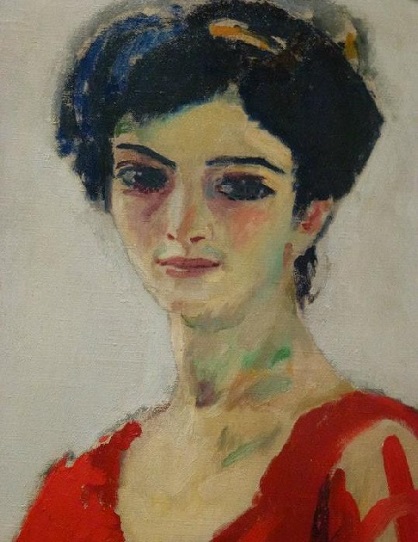
    Maria

    Kees van Dongen (1877-1968)