Blog
-
Mario Sereni Has Passed Away
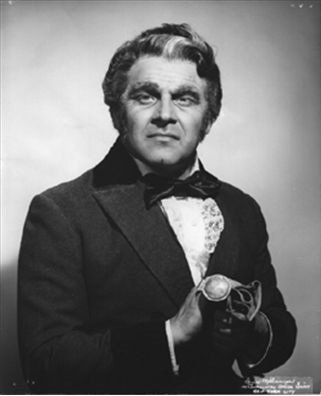
Above: Mario Sereni as Giorgio Germont in Verdi’s LA TRAVIATA
Mario Sereni, the Italian baritone who sang over 550 performances with The Metropolitan Opera between 1957 and 1984, has reportedly died at the age of 87.
Sereni had a warm, rich sound with an easy top, and an instinctive feel for phrasing off the words of his native language. I first saw him at the Old Met as Belcore in L’ELISIR D’AMORE (with Freni, Gedda, and Corena, no less!); once the new House opened and I was going to the opera frequently, Sereni was a singer I saw often. He was popular with the fans, and always very cordial when we greeted him after a performance.
Although he sang many of the great Verdi roles – Germont in TRAVIATA being particularly well-suited to his voice, and he also appeared as Amonasro, Count di Luna, Posa, Ford in FALSTAFF and Don Carlo in LA FORZA DEL DESTINO – it was in the more verismo-oriented operas that Sereni made his best impression, at least for me. His Tonio in PAGLIACCI was outstanding, and he was often cast in the sympathetic roles of Sharpless (MADAMA BUTTERFLY) and Marcello (LA BOHEME). One performance that I recall with special affection was his Carlo Gerard in ANDREA CHENIER, where he appeared opposite Raina Kabaivanska in her only Met performance as Maddalena. In the French repertoire, Sereni sang Valentin in FAUST and Escamillo in CARMEN; he even made a foray into Wagner, as the Herald in LOHENGRIN. Among other Sereni roles were Rossini’s Figaro, Donizetti’s Malatesta (DON PASQUALE) and Enrico (LUCIA), and Lescaut in the Puccini opera. Near the end of his Met career, he sang several performances of Schaunard in BOHEME, and that was the role of his final Met performance in 1984.
Mario Sereni appears on several complete opera recordings; my personal favorite is (again) his Carlo Gerard in CHENIER on EMI, opposite Antonietta Stella and Franco Corelli. Also on EMI, he sings with Victoria de los Angeles on her classic recordings of BUTTERFLY and TRAVIATA. And he is in fine fettle on the RCA recording of LUCIA DI LAMMERMOOR, with Anna Moffo and Carlo Bergonzi. Here is the Wolfscrag Scene from that recording, in which Bergonzi and Sereni make such a vivid impression, both vocally and dramatically.
-
CMS: Summer Evenings III

Above: violinist Alexander Sitkovetsky and pianist Wu Qian, featured performers at tonight’s Chamber Music Society of Lincoln Center concert
Wednesday July 22nd, 2015 – Chamber Music Society of Lincoln Center‘s inaugural Summer Series wrapped up this evening with a most impressive and enjoyable programme. The formula for these Summer concerts (as for all of the Society’s concerts, really) was a simple one: great music played in a wonderful space by first-rate musicians. That the series was a genuine success came as no surprise to me; and the best news is, planning for a Summer Series 2016 at CMS seems already to be in the works as I write this.
The Society draws from an A-list roster of musical artists, sometimes featuring established ensembles – such as the Amphion String Quartet who headlined the second concert in the Summer Series – and sometimes gathering together players from diverse musical backgrounds to illuminate a particular convergence of works. For tonight’s programme, pianist Wu Qian and violinist Alexander Sitkovetsky were the central figures; this husband-and-wife team (who make up two-thirds of The Sitkovetsky Trio) played in all three works. Joining them were the delightful young violinist Danbi Um, viola paragon Richard O’Neill, and the distinguished veteran cellist Laurence Lesser.
Antonín Dvořák’s Bagatelles for Two Violins, Cello, and Keyboard, Op. 47, opened the evening; this series of miniatures alternates spirited dance rhythms with soulful slower movements, all drawing upon the folk music which so often inspired the composer. Plucking cello, rhapsodic violins, and flowing piano motifs are among the attractions of these five small wonders. Wu Qian was at the keyboard, with the two violinists and Mr. Lesser’s amiable cello assuring a most appealing exploration of the unfolding thematic material which abounds in these charming, deftly scored bagatelles.
Robert Schumann’s Sonata in D minor for Violin and Piano, Op. 121 was given a remarkable performance by Mr. Sitkovetsky and Wu Qian. Although stationed in a way that seemed to preclude eye contact, the two developed an extraordinary telepathic rapport. Mr. Sitkovetsky had removed his white dinner jacket and, all in black, he proved as fascinating to watch as to hear, with expressive body English and moving in an almost choreographic response to the music.
Following a passionate, slashing start, Mr. Sitkovetsky intoned a heartfelt solo passage before the eruption of energy that propels the sonata’s first movement. The violinist’s playing is wonderfully rich, plumbing the depths of feeling with his resonant tone. For the energetic opening of the second movement, the violin/piano collaboration was rhythmically driven, though lapsing at one point into a melodious interlude.
A mandolin-like plucking motif opens the third movement, which evolves into a haunting theme: here Mr. Sitkovetsky’s Olde World sound and his ability to transform melody into poetry was at its most moving. In the final movement’s expansive variety of themes and energies, violinist and pianist were simply thrilling, causing the audience to celebrate their joint artistry with prolonged applause and calling the duo out for a second bow.
Danbi Um, in a glamorous deep emerald gown with a diamond clasp, looks as elegant as she plays. She took the first chair for the evening’s concluding Brahms (the Quintet in F minor for Piano, Two Violins, Viola, and Cello, Op. 34) and, with her ravishing ascents to the upper range, graced the music at every moment. The big singing themes of this work were delivered with striking lushness by the players – Mr. Sitkovetsky and Wu Qian, violist Richard O’Neill, and cellist Laurence Lesser joining Ms. Um; they sometimes created the sonic illusion of a much larger ensemble with their plush tone.
The performance was brimming with marvelous moments, including (in the first movement) a lovely violin/viola ‘conversation’ and a luminous moment when Ms. Um, with her refined tone, passed the melody to Mr. Lesser who took it up with achingly beautiful expressiveness.
The somewhat hesitant opening of the second movement – with Mr. Lesser’s subtle plucking motif – took a few moments to bloom into melody. Mr. O’Neill, a player we can admire as much for his artistry as for his humanitarian and charitable work, had a deeply moving theme with which to entice; then Mr. Lesser’s cello took a series of ever-deepening plunges. At the piano Wu Qian’s gently lilting playing underscored the ensuing rise of the string voices. In a moment of sheer perfection, Ms. Um and Mr. O’Neill jointly tapered the movement’s final note til it vanished into the air.
After some treading in a minor key, the third movement bursts forth; the pianist continually sounds a heraldry of march-like calls to action. Later, Wu Qian’s piano segues into a more lyrical passage where she is met by the Mr. Lesser’s genial cello…but their encounter is fleeting before another onrush of almost military vigor. Things calm down again momentarily, only to surge forward again with a triumphant feeling.
A pensive – almost eerie – feeling pervades the opening of the quintet’s finale. In music that is passionate and harmonically rich, we experience a mixture of vivid dance themes and passages of almost tragic-sounding lyricism.
As our estimable ensemble of players drew the evening to its close, the audience hailed them with sincere appreciation and affection. The evening was perhaps best summarized by a remark the man seated behind me made to his wife just as the house lights went down for the Brahms: “This is the place to be!”
The Repertory:
- Dvořák Bagatelles for Two Violins, Cello, and Keyboard, Op. 47 (1878)
- Schumann Sonata in D minor for Violin and Piano, Op. 121 (1851)
- Brahms Quintet in F minor for Piano, Two Violins, Viola, and Cello, Op. 34 (1862)
The Participating Artists:
- Wu Qian , piano
- Alexander Sitkovetsky , violin
- Danbi Um , violin
- Richard O’Neill , viola
- Laurence Lesser , cello
-
CMS: Summer Evenings II

Above: the musicians of the Amphion String Quartet; left to right: David Southorn, Mihai Marcia, Katie Hyun, and Wei-Yang Andy Lin
Sunday July 19th, 2015 – The second in Chamber Music Society of Lincoln Center‘s 3-concert summer series took place on a sweltering day. Outdoors, people were wilting from the intense heat and humidity, but in the cool, classical cavern of Alice Tully Hall, another capacity audience drew both physical comfort and spiritual sustenance from a well-devised and admirably played programme.
Putting Haydn and Mozart on the same bill of fare can sometimes result in Papa Haydn’s music being somewhat overshadowed by the younger composer’s. But that was not the case today, thanks to the Amphion String Quartet’s lovingly crafted rendering of Haydn’s penultimate completed string quartet: in G major, Op. 77, No. 1.
In the opening Allegro moderato, the Amphions brought both crisp clarity of articulation and a silky blend of timbres. The Adagio – which to me draws upon a depth of feeling that Haydn’s music does not always attain – produced some striking modulations and resonant pauses as the players, so sure of one another, seemed to breathe and phrase as one. Special mention must be made of the enticing sheen of cellist Mihai Marica’s playing. In the scurrying third movement of the Haydn, and also in its propulsive finale, the Amphion’s virtuosity and sense of fun were amply evident.

Above: pianist Gilles Vonsattel
Felix Mendelssohn is sometimes referred to as “the romantic classicist,” and this concert’s back-to-back programming of the Haydn (dating from 1799) and Mendelssohn’s Piano Quartet No. 3 in B minor, Opus 3, written a quarter-century later, showed most vividly the leap from Classicism to Romanticism that marked the arrival of the 19th century.
Mendelssohn’s music is really unlike anyone else’s; it has a wonderful freshness and vitality, and the composer’s enchanting trademark sound, affectionately referred to as ‘faerie music,’ has a charm all its own. It was a chance hearing of a Mendelssohn piano trio on the radio many, many years ago that opened my mind to the pleasures of chamber music; it was only after decades of devoting myself to opera that I got to the point where I had both the time and the energy to explore the chamber music repertoire, a genre of mind-boggling variety and endless reward.
Curiously, I’m finding these days that it’s instrumental soloists and chamber artists who have taken the place of great singers in my affection and admiration. I’ve always had a strong streak of unabashed ‘fanhood’; if I like a singer/dancer/musician, I really become an admirer and they become an idol. That happened for me today as Gilles Vonsattel played his way into my echelon of favorites in the Mendelssohn. In 2014, the Swiss-born American pianist participated in a memorable CMS performance of Messiaen’s ‘Quartet for the End of Time’. Playing my beloved Mendelssohn this evening, Mr. Vonsattel’s quicksilver technique and masterful turns of phrase kept me constantly drawn to the keyboard.
This Mendelssohn quartet is a veritable font of melody and shows a sophistication of musical imagination that seems extraordinary in a composer still in his teens. The second movement (Andante) is vastly pleasing to hear, opening with a lovely piano statement which gives way to lulling rhythms, with gently developing themes of longing from the violin (Ms. Hyun) and of pensive soulfulness from the cello (Mr. Marica). The third movement (Allegro molto) opens with an injection of Midsummer Night’s magic, proceeds to swelling melodies and becomes a big dance. In the finale, Mr. Vonsattel’s mercurial playing was simply irresistible.
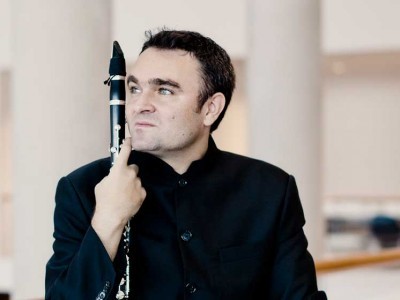
Above: clarinetist Jörg Widmann
For the evening’s concluding Mozart, the ‘Clarinet Quartet’, Jörg Widmann (who also took part – splendidly – in that ‘Quartet for the End of Time‘ mentioned above) displayed an engagingly natural feel for legato, his tone having a mellow glow. In both featured clarinet passages and in his sharing of ensemble moments, Mr. Widmann’s clarity and his impressive affinity for dynamic colourings drew the audience’s deep and concentrated attention.
David Southorn took up the violin 1 position in the Mozart, especially appealing in the first movement’s solo theme set against Mr. Marica’s plucked cello pacing. In the Quintet’s heart-filling Adagio, Messrs. Southorn and Widmann traded melodic phrases to beautiful effect, whilst in the variations that are part of the work’s finale, Wei-Yang Andy Lin drew forth a weeping quality from his viola.
Throughout the Quintet, Mr. Widmann and his colleagues conveyed the enormous richness of Mozart’s writing, providing a musical experience in which virtuosity and emotion seemed ideally blended.
The Repertory:
- Haydn Quartet in G major for Strings, Hob. III:81, Op. 77, No. 1 (1799)
- Mendelssohn Quartet in B minor for Piano, Violin, Viola, and Cello, Op. 3 (1825)
- Mozart Quintet in A major for Clarinet, Two Violins, Viola, and Cello, K. 581 (1789)
The Participating Artists:
Gilles Vonsattel, piano; Jörg Widmann, clarinet; Amphion String Quartet, ensemble
-
BalaSole Presents SALMAGUNDI

Above: Alexandra Jacob, a guest soloist in tonight’s performance by BalaSole Dance Company.
Friday July 17th, 2015 – The word “salmagundi” refers to a type of salad, but also to any kind of assortment, medley, or montage. Celebrating their fifth anniversary season tonight at Ailey Citigroup, Roberto Villanueva’s Balasole Dance Company offered a smorgasbord of dance, with a tasty array of solos – everything from tap to toe shoes – in a skillfully arranged and nicely lit production.
As is the custom at BalaSole performances, the evening opened and closed with ensemble works which are prepared and danced by all the participating soloists and emerging artists in the week leading up to the show. Roberto often uses baroque music for these group dances, but this time around he chose contemporary music with a seductive throb; the dancers seemed very much at home in this milieu.
LAURA ASSANTE was the first soloist; her piece entitled “Cancelled Stamp” was danced to the voice of the inimitable Nina Simone singing her classic “Love me or leave me”. Ms. Assante, a lively blonde with a great range of facial expressions, filled the song – which has a long piano riff midway thru – with energy and charm.
ANNA CUFFARI performed a pensive, searching solo entitled “Maktub“. She awakens in a pool of light to the sound of a harp. As the music expands into a passionate romantic theme, the dancer made excellent use of the space with her questing movement and expressive face and hands.
FREDRICK DAVIS (from Dance Theatre of Harlem, making a guest appearance tonight) displayed his striking classic technique in an excerpt from “Undisputed Love“. Set to the celestial sounds of Arvo Part’s “Fratres”, the danseur, in tights and a white shirt, seemed like a contemporary Albrecht lamenting his lost Giselle. Fredrick’s dancing had a fine sense of nobility and quiet ecstasy.
The comely ANDREA SAMONILOVA appeared next, reciting poetry for her solo entitled “Možná Jednou” (translation: ‘Maybe One Day’). Meshed with the spoken words is the sound of water flowing. The sad poetess seems like a lost soul as she stares into the audience, in search of someone. A winsome melody evokes memories of another time and place to which she cannot return. This solo, and Ms. Samonilova’s dancing of it, was both moving and mysterious.
XAVIER TOWNSEND made remarkable moves in his solo “Return”, including some risky B-boy passages that had the audience gasping. Running in place and enmeshed in a struggle for self-expression, the lithe and handsome dancer was able to combine his explosive energy with more lyrical moments to make his solo a big hit with the crowd.
CAMILLE SCHMOEKER performed a tap solo “Gilgal“, to an arrangement of the old gospel song “Joshua Fit The Battle of Jericho”. Using subtle shifts in the speed and volume of her tapping, the dancer, in a simple country frock, sometimes evoked line dancing in this solo which had a taste of Americana as well as a feeling of personal narrative.
The powerful physique of ELIJAH LAURANT made a commanding impression in “Delimited Connection“; music from Kangding Ray underscored the dancing with a pounding beat, but the dancer steered clear of literalism and held our interest with his unfolding, expressive moves and the strength of his technique.
ALEXANDRA JACOB, a guest soloist, was for a decade a star of Dance Theatre of Harlem. Tonight, she performed “Anástasis” (translation: ‘Resurrection’), choreographed on her by Roberto Villanueva. Clad in midnight blue and with her hair flowing free, Ms. Jacob’s on-pointe dancing showed a luminous quality as she moved among pools of light. Music by Olafur Arnalds, rather ominous of mood, set the dancer on her path: a restless feeling imbued with lyricism, and a gorgeous ability to communicate directly with the audience thru the poetry of movement.
BRIANA BUTLER enters in silence; on the ground, she pulls herself into a circle of light. Her solo, “Unstoppable“, is danced to music that is alternately mystical and thunderous. Ms. Butler’s strength and control developed the solo with propulsive energy, and she added some impressive gymnastic elements along the way before things settled again into silence.
ROBERTO VILLANUEVA always dances the closing solo at all BalaSole performances, and invariably his solos are highlights of the show. Today, his ‘awakening’ solo, “Air”, was danced to music by Max Richter. Roberto’s solos have an improvisational air but they are always carried off with the polished artistry and committed musicality of a born mover.
Prior to the show I watched the dress rehearsal, hoping to get some useful photos of all the participants; but that did not go so well for me and my camera today. I include a few here, but it’s totally random and I’m sorry to say not all the dancers are represented in their solos.
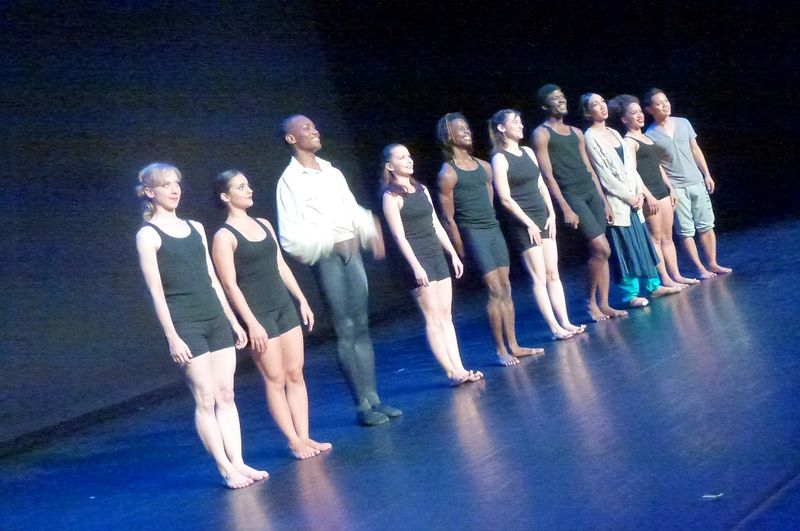
Above: the soloists, lined up in performance order – Assante, Cuffari, Davis, Samonilova, Townsend, Schmoeker, Laurent, Jacob, Butler, Villanueva

Above: the emerging/re-emerging artists – these dancers appeared in the ensemble works at the start and end of the performance. They are (left to right) Gabriella Perez, Sasha Smith, Laurel Higa, and Ezra Goh.

Above: Laura Assante
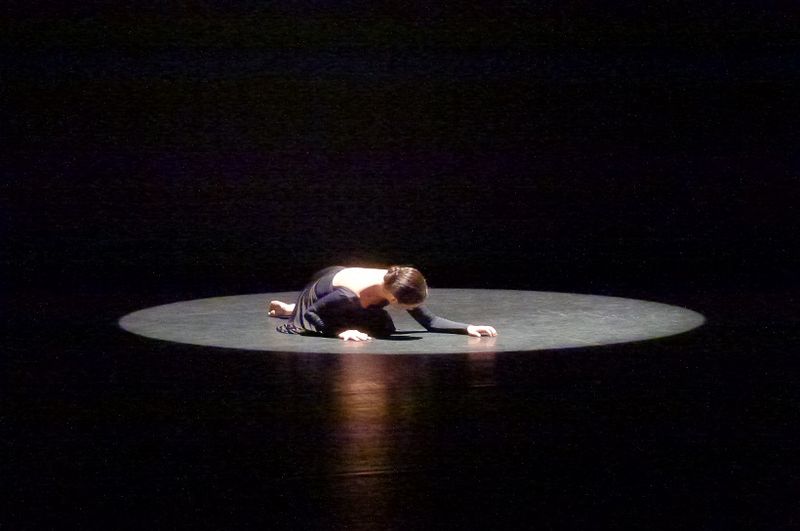
Above: Anna Cuffari
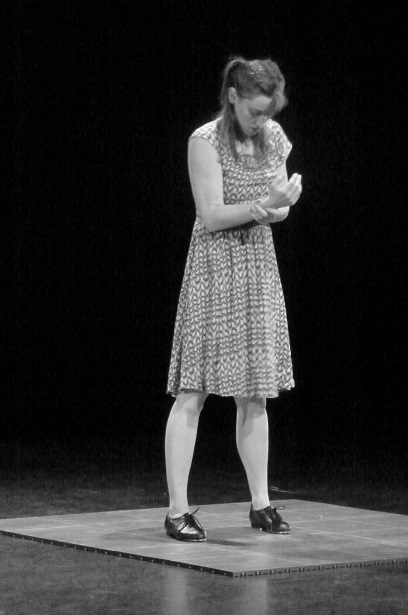
Above: Camille Schmoeker

Above: Elijah Laurant

Above: Briana Butler
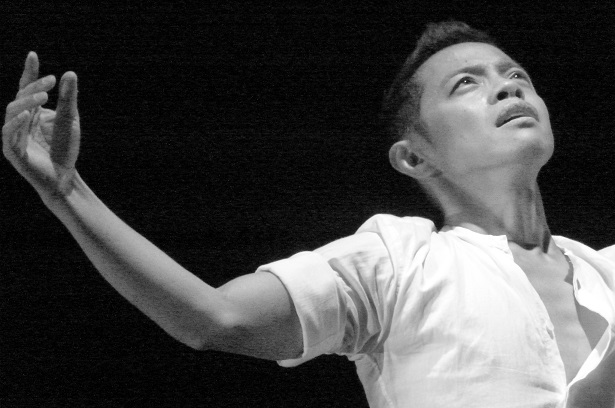
Above: Roberto Villanueva

Above: the guest artists, Alexandra Jacob and Fredrick Davis, taking a bow
-
CMS: Summer Evenings I

Above: violinist Erin Keefe, photographed by Lisa-Marie Mazzucco
Wednesday July 15th, 2015 – Chamber Music Society of Lincoln Center are presenting their inaugural Summer Series: three concerts at Alice Tully Hall. The scheduled programs feature works by the greatest composers played by some of the finest musicians of our time: a surefire recipe for success.
Tonight’s opening concert was sold out, with music lovers outside Tully Hall pleading with anyone who might have a spare ticket. Onstage, as the house lights dimmed, the Society’s co-artistic director Wu Han welcomed us with her usual warmth and enthusiasm, ending her speech by wishing us all “…happy summer fishing…I hope you catch some trout!” – a reference to the program’s closing work, Schubert’s beloved “Trout” quintet.
Erin Keefe and Juho Pohjonen then appeared for Mozart’s B-flat major violin sonata, K. 378. Ms. Keefe’s gown, in rich shades of tourquoise and purple, evoked Klimt: it appeared someone had thrown handfuls of gold dust onto the frock, giving it a shimmering sheen. Ms. Keefe plays as handsomely as she looks and – joined by Mr. Pohjonen, who was at the keyboard for all three works tonight – they set the evening on its way with their gracious rendering of the Mozart.
In the opening movement, Allegro moderato, the two players trade off cascading motifs. The heart of the sonata, the Andante sostenuto e cantabile, has a touching song-like quality which the violin introduces almost hesitatingly, the pianist seemingly completing each ‘sentence’. Later, the violin takes up a more sustained theme, the opening bars of which seem to have been drawn from the old Jesuit hymn ‘Schönster Herr Jesu’; we used to sing this tune in church under the title ‘Fairest Lord Jesus’, and hearing it again this evening gave the sonata a personal appeal.
The concluding Rondo: Allegro had a joyous lilt and the players showed especial affinity for the sprightly, deftly driven final section. They linger momentarily as if thinking of going off on a different tangent, but instead they resume the original trajectory and there’s a charming rush to the finish line.
Tonight’s performance of Beethoven’s piano trio in E-flat major (Op. 70, #2) kept me enthralled, both by the intrinsic beauty of the music itself and by the exquisite details brought forth by the three players: Mr. Pohjonen (piano), Paul Huang (violin) and Jakob Koranyi (cello).
Juho Pohjonen is a poet of the keyboard; he seems both a wonderfully attentive colleague and a player whose musicality reaches us from his own personal dreamworld. Treading this line between keen awareness and a deep spirituality, this enigmatic pianist is always fascinating to encounter. Violinist Paul Huang, the youthful-looking but already superbly accomplished current holder of a prestigious Lincoln Center Career Grant, proved his capacity for keeping an audience of serious music aficionados under his spell at his Morgan Library recital earlier this year. Depth of expressiveness and poignant lustre of tone have set cellist Jakob Koranyi among the most admirable musicians of the day; his mastery of dynamic control, so often encountered in the Beethoven trio tonight, is a particular joy.
Dressed in white dinner jackets, the three young men reveled in the slow melodic unfolding of the Poco sostenuto in the opening movement of the trio which had begun with an almost melancholy phrase from the solo cello which is taken up by the violin then the piano in turn. Beethoven’s heritage, as successor to Mozart and Haydn, illuminates the second movement; then the third seems to herald Mendelssohn with its lyricism and grace. In the Finale: Allegro, the three players produced a wealth of nuanced detail which was wonderfully fresh and luminous, and never for a moment seemed fussy or merely ornate.
In their revelatory performance, Messrs. Pohjonen, Huang, and Koranyi were truly inspiring; their generous playing and impressive artistry set this Beethoven firmly in the top echelon of memorable musical experiences of recent seasons.
Schubert’s “Trout” quintet was sumptuously played by Ms. Keefe with Roberto Diaz (viola), Mr. Koranyi (cello), Timothy Cobb (double bass) and the luxuriant pianism of Mr. Pohjonen. Making their mark in the ensemble, Mr. Diaz’s caramel richness of tone and Mr. Cobb’s genial tread (and his amiable seizing of every melodic moment) meshed with Mr. Keefe’s arching lyricism, Mr. Koranyi’s striking opulence of expression, and the combination of delicacy and power in Mr. Pohjonen’s playing, to hold the audience in a state of receptive eagerness.
The inclusion of a variations movement, where Schubert’s popular song “Die forelle” is heard in a variety of rhythms and textures, was part of the composer’s agreement with Herr Paumgartner, the wealthy amateur cellist who commissioned the quintet. Schubert then has the last word; after a false ending which – as usual – fooled the audience into premature applause, the composer tacks on an Allegro giusto which is both short and deliciously sweet.
The Society’s remaining two Summer Series performances (July 19th and 22nd) are reportedly nearly sold out, but it’s worth a try by going on-line here, or by calling the Alice Tully box office (212-875-5788), or by going there in person.
The Repertory:
- Mozart Sonata in B-flat major for Violin and Piano, K. 378 (1779-80)
- Beethoven Trio in E-flat major for Piano, Violin, and Cello, Op. 70, No. 2 (1808)
- Schubert Quintet in A major for Piano, Violin, Viola, Cello, and Bass, D. 667, Op. 114, “Trout” (1819)
The Participating Artists:
- Juho Pohjonen , piano
- Paul Huang , violin
- Erin Keefe , violin
- Roberto Diaz , viola
- Jakob Koranyi , cello
- Timothy Cobb , double bass
-
Pillow Prep: MADBOOTS

Above: studio showing of (SAD BOYS), the newest work from MADBOOTS; photo by Travis Magee
Thursday July 9th, 2015 – MADBOOTS, the daring and unique all-male dance company founded by Austin Diaz and Jonathan Campbell, will be presenting their newest work (SAD BOYS) from August 26th – 30th, 2015, at the Doris Duke Theatre at the Jacob’s Pillow Dance Festival. Tickets and more performance information here. Support this production by donating here.
Today MADBOOTS hosted a studio showing of (SAD BOYS) for friends of the Company; my photographer/friend Travis Magee met me there to document the event. Joining Austin and Jonathan for (SAD BOYS) are dancers Robbie Moore, Dan Walczak, and Chuck Wilt.
Performed to a deftly assembled musical suite, (SAD BOYS) runs nearly an hour and unfolds in sequences of madly passionate movement laced with interludes of reflective stillness. It explores so many facets of the transition from youth to manhood: the desire for companionship, the hesitant awakening of sexual awareness, and the harsh lessons of mistaken affection. Tenderness, amiable horseplay fraught with desire, betrayal, brutality, and soul-rending despair are all elements of this journey which so many of us have made over the years. (SAD BOYS) resonates with both the wary pleasures and the terror of self-discovery.
The choreography is space-filling, alternating raw physicality with unexpected passages of lyricism. The five dancers are unabashed in the athleticism of their dancing and in the intimacy of their interaction. As the dance progresses, the boys gradually shed their clothing, leaving themselves in a state of touching vulnerability by the end.
Without giving away anything more about (SAD BOYS), here are some of Travis Magee’s images from the studio showing:
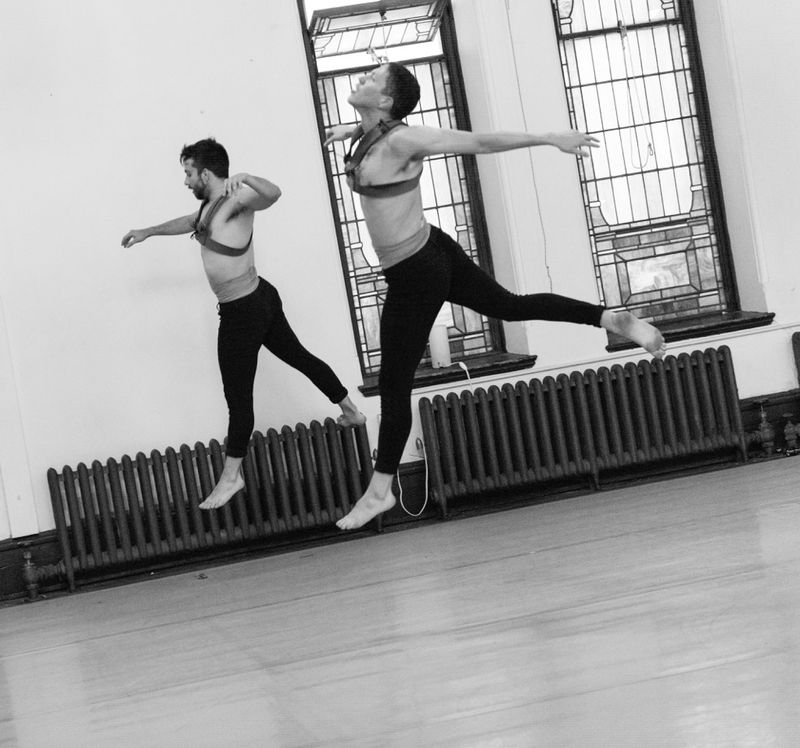
Jonathan Campbell and Austin Diaz
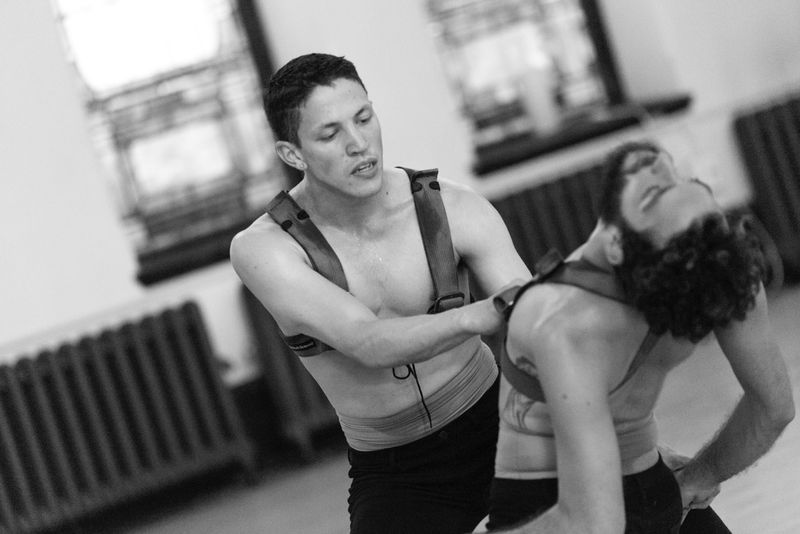
Austin Diaz and Dan Walczak

Dan Walczak
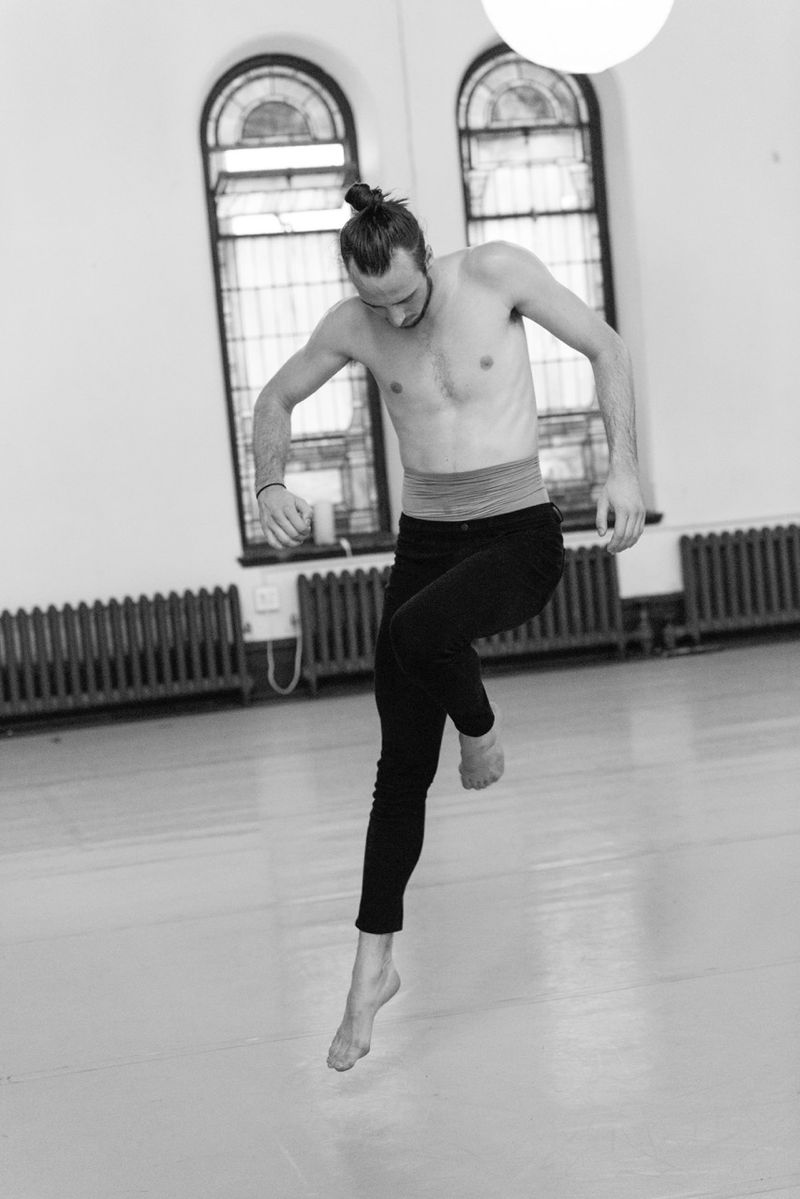
Chuck Wilt

Robbie Moore, Jonathan Campbell, Austin Diaz

Dan Walczak, Austin Diaz
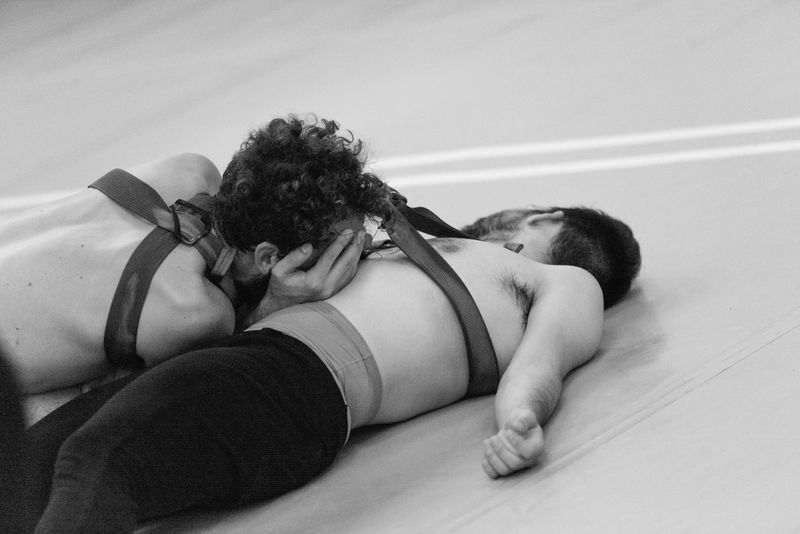
Dan Walczak, Jonathan Campbell
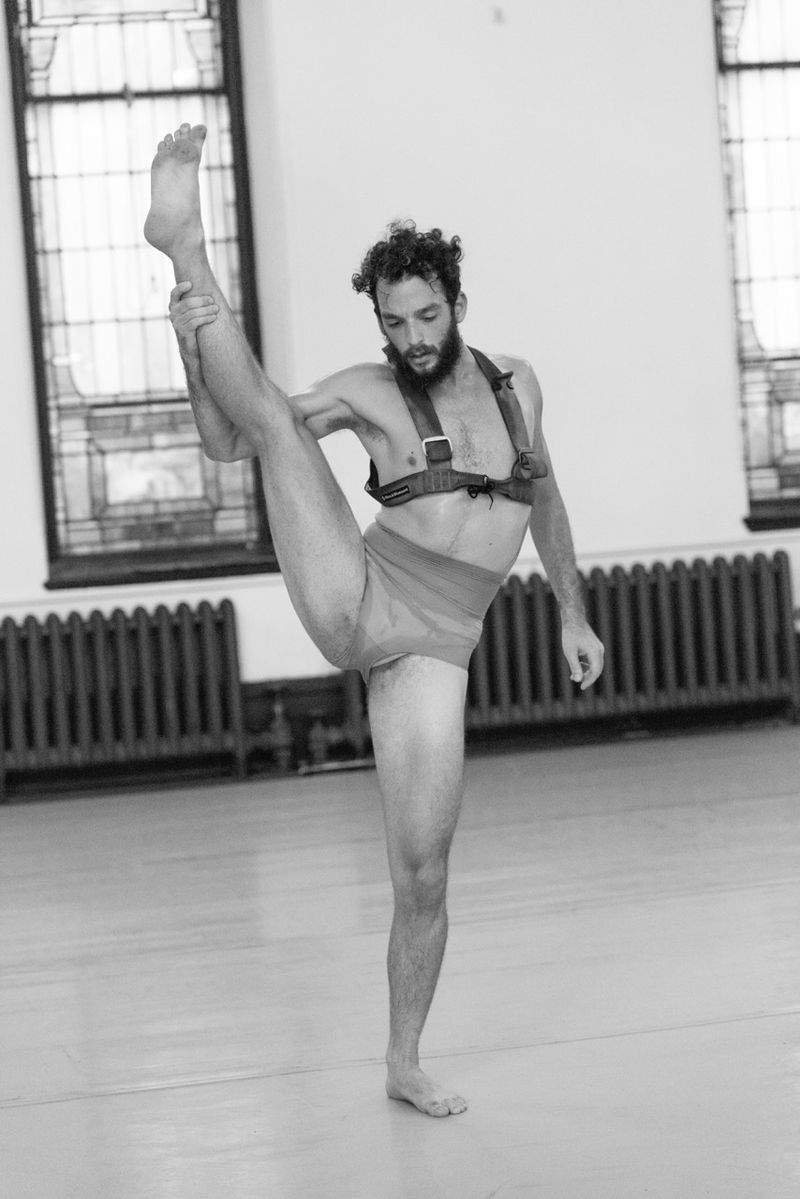
Dan Walczak
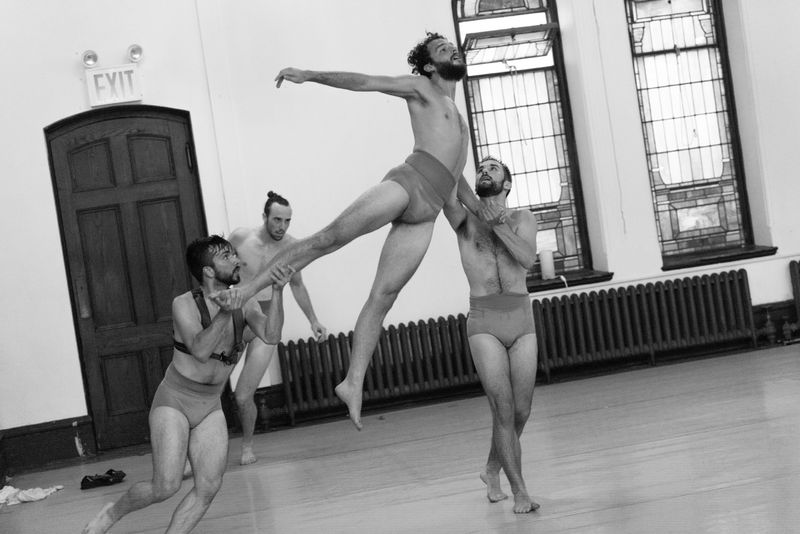
Jonathan, Chuck, Dan, and Robbie
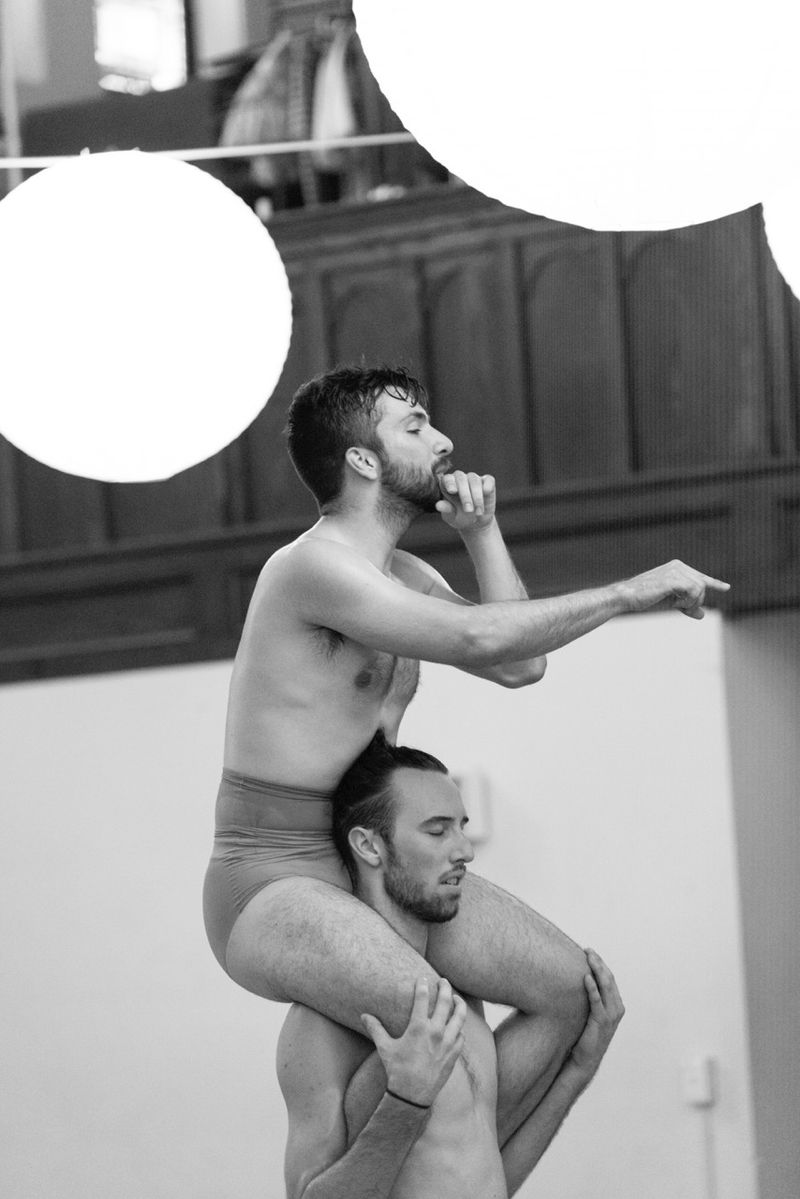
Jonathan Campbell, Chuck Wilt
-
Rehearsal: Knight/Beamish DANCE FOR NEPAL

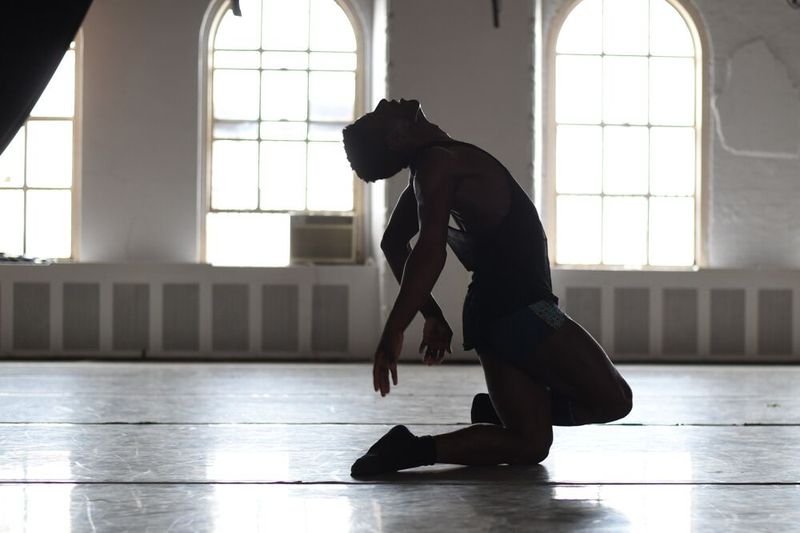
Above: Lloyd Knight rehearsing a new Joshua Beamish solo, ‘Adoration‘, for the upcoming gala benefit DANCE FOR NEPAL; photo by Nir Arieli
Saturday June 27th, 2015 – On Tuesday June 30th, 2015, DANCE FOR NEPAL will be presented at the Union Square Theatre. The program, conceived by Simona Ferrera, is under the artistic direction of Lloyd Knight, principal dancer of The Martha Graham Dance Company. All proceeds from this gala performance will benefit the survivors of the devastating earthquake that struck Nepal on April 25th, 2015. A stellar group of dancers will perform; tickets and more information here.
On an overcast afternoon, photographer Nir Arieli and I dropped in at the Martha Graham studios for a rehearsal/preview of the new Beamish solo work. The choreographer has chosen the adagio from Haydn’s concerto in C-Major for cello and orchestra: a perfect setting for his fluent and expressive choreography and for Lloyd Knight’s powerful, emotive dancing. Demanding in its physicality, the solo has a deeply spiritual quality which gives Lloyd a perfect impetus for his interpretation: a striking mixture of muscularity and grace.
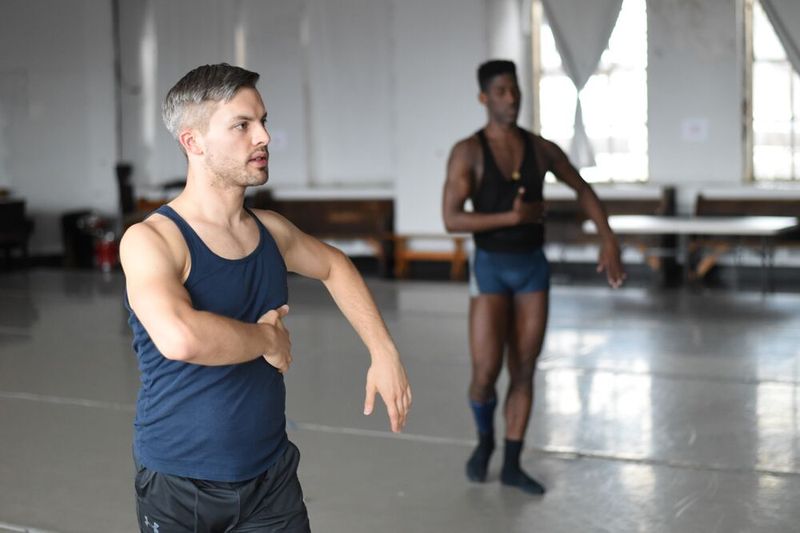
Joshua Beamish (above, with Lloyd), the Canadian dancer/choreographer and founder of MOVE: the company, was recently seen here in New York City as one of Wendy Whelan’s choreographer-cavaliers in her RESTLESS CREATURE presentation at The Joyce. In August 2015, Josh will be presenting MOVE: the company for two performances at The Joyce. Details here.
The studio atmosphere today was paradoxically calm and intense; I could have gone on watching endlessly since the combination of the music, Josh’s mapping of the movement, and Lloyd’s inspiring dancing were a welcome balm to the spirit.
Here’s a gallery of Nir Arieli’s images from this rehearsal; I have chosen quite a few since they really capture the atmosphere:
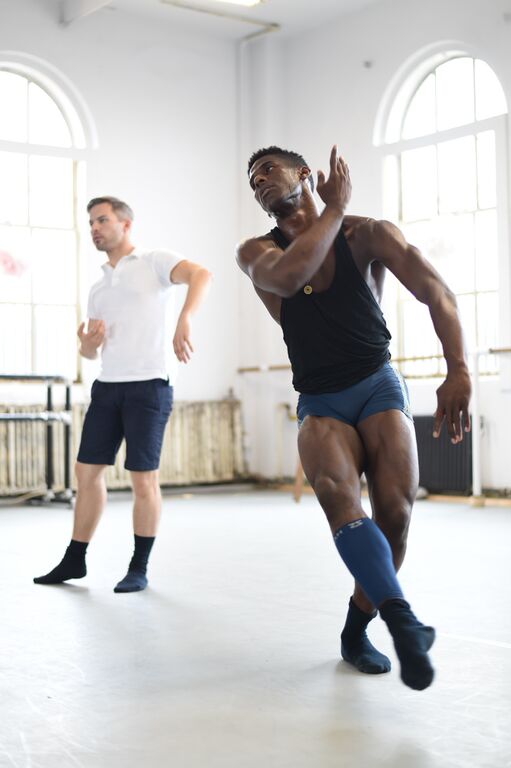


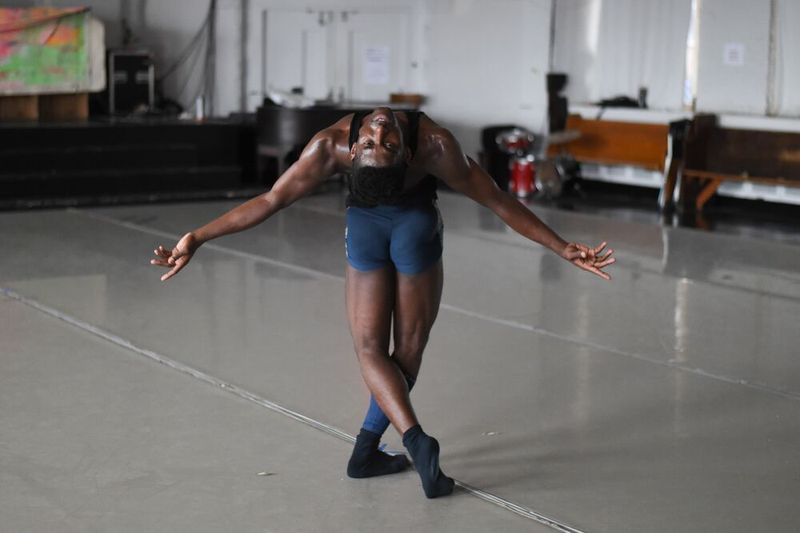


Click on each image to enlarge.
-
Kochetkova/Cornejo SWAN LAKE @ ABT

Friday June 26th, 2015 – This evening my 2014-2015 officially ended with a bang when Maria Kochetkova and Herman Cornejo gave the ABT audience a SWAN LAKE to cheer about. The two dancers were recently paired in a very fine performance of BAYADERE and now, having established a lovely rapport, they must be seen in GISELLE, COPPELIA, and ROMEO & JULIET.
ABT really needs a new SWAN LAKE, and their audiences deserve it. Though at fifteen years of age the production is not old by ballet standards (think of Balanchine’s NUTCRACKER or MIDSUMMER NIGHT’S DREAM), so much of it looks merely random and dutiful rather than dramatic and intriguing. Its main redeeming value is that any incoming pair of principals can step into the classic elements of the white/black/white scenes and feel perfectly at home; it’s the court scenes that really need freshening.
Tonight in the opening scene we had a superbly-danced pas de trois from Sarah Lane, Skylar Brandt, and Joseph Gorak; all three had ample technique and charm, and Mr. Gorak’s beautifully pointed feet were an added delight. The national dancers in the Black Swan scene are burdened with over-costuming and funny fake moustaches; tonight, only Nicole Graniero (in Hungarian) managed to seize my opera glasses with her vivid performance. Later, as Herman Cornejo was anguishing over which unwanted princess to choose, I wanted to text him and suggest that he grab Nicole and elope to Morocco.
James Whiteside was wonderfully alluring in the solo where he glamors every woman in the hall (and probably some of the men); yet however well this solo is performed, I always feel Rothbart doesn’t need to be humanized and that the less the character does, the more potent his force seems.
But all these quibbles vanished in the face of the wonderful telling of the central love story from Ms. Kochetkova and Mr. Cornejo. Having sailed thru some high-flying combinations in the opening scene, it was at the lakeside that Herman’s Siegfried took on the poetic expressiveness that made his performance so compelling. Such a handsome young prince with the cheekbones, the silken mop of hair, the dark eyes filled with wonder – and later with despair. Slowly overcoming her fear of this ardent youth, Ms. Kochetkova surrendered to his tenderness in an adagio filled with haunting romantic nuance. The ballerina’s pin-pointe turns and poised balances wove a spell thru Odette’s music.
In the Black Swan, the Kochetkova/Cornejo duo simply soared; the detailed courtship and Kochetkova/Odile’s brazen mimicking of the Odette motifs made for a vivid narrative in the adagio. Herman’s solo was a virtuoso show-stopper – igniting a volley of cheers and applause – and in her solo turn, the ballerina displayed her agility and technical command to impressive effect. Then the couple whipped the crowd into fits of rapture in the coda, where Kochetkova’s dazzling speed-of-light fouettés had real sparkle, with Herman taking up the challenge with his own barrage of pirouettes. A roar went up as they struck the final pose.
In the last scene by the lake, the hapless lovers take final leave of one another; their joint suicide leads to the breaking of the curse and Rothbart’s destruction by the swans. The pink sunrise, with the lovers shown embracing in some afterlife, is a final miscalculation in this production. But as Kochetkova and Cornejo came forward for their bows, nothing else mattered: the audience, pleased as punch, were still screaming as I headed up the aisle.
-
The Royal Ballet: Mendelssohn & Mahler
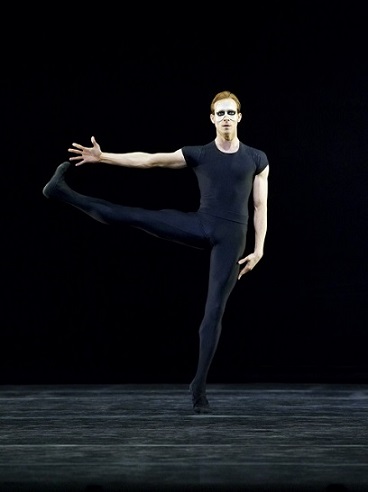
Above: Edward Watson in the Royal Ballet’s production of SONG OF THE EARTH; photo by Johan Persson
Thursday June 25th, 2015 – The Royal Ballet are presently at Lincoln Center, and this evening’s double-bill of Sir Frederick Ashton’s THE DREAM and Sir Kenneth MacMillan’s SONG OF THE EARTH seemed particularly appealing to me, not least for the music of two of my favorite composers: Felix Mendelssohn and Gustav Mahler. The fact that Edward Watson would be appearing in the MacMillan made an appealing prospect irresistible.
Ashton’s THE DREAM was the first ballet I ever saw live, performed by The Joffrey at New York’s City Center on October 16th, 1974; Rebecca Wright, Burton Taylor, and Russell Sultzbach had the principal roles that evening. I’ve not seen the ballet again since that performance.
The Royal Ballet’s production of the Ashton boasts a particularly evocative and gorgeous set, and lovely costumes – notably those for the corps of ‘adult’ fairies (unlike in Balanchine’s version, there are no children to be seen in the Ashton, aside from the Changling Boy). Ashton tells the story in a more abbreviated rendering than Mr B – Ashton’s mortal couples are less-fully-fleshed-out as characters than Balanchine’s; Ashton’s Titania has a more sensuous quality and his Puck is more annoying (in a good way) than their Balanchine counterparts. Ashton sometimes has Oberon and Puck doing virtuoso passages at the same time, and they oddly seem to cancel one another out.
The Mendelssohn score (played by the New York City Ballet orchestra – though in a different arrangement than that used for the Balanchine), sounded as charm-filled as ever, with some lovely singing from the Brooklyn Youth Chorus.

Above: Matthew Golding as Oberon in THE DREAM; photo by Bill Cooper
Matthew Golding’s tall, long-limbed Oberon, with beautifully up-right pirouettes, was handsomely characterized with a mixture of nobility and sexiness. Natalia Osipova was a lushly sensuous Titania, with an interesting touch of earthiness. Dancing in oddly-battered toe shoes, she had just polished off a lovely solo passage when suddenly she slipped and fell to the floor; she re-bounded at once and went on to a winning performance, beautifully meshed with Mr. Golding in their pas de deux.
Valentino Zucchetti was a sprightly Puck; his performance was a big hit with the audience and though I prefer the Balanchine portrait of this character, Zucchetti’s dancing had plenty of verve. Jonathan Howells met the challenge of dancing Bottom on pointe. The mortal couples were finely danced, making the most of their fleeting vignettes: a special bravo to Ryoichi Hirano for his excellent Lysander. A pretty quartet of principal fairies, given their Shakespearean names, added yet another delectable element to the performance.

Above: Edward Watson, Laura Morera, and Nehemiah Kish in SONG OF THE EARTH; photo from The Royal Ballet‘s website
I had no idea what to expect from Kenneth MacMillan’s SONG OF THE EARTH. In pondering what it might be like, my first thought was that Mahler’s score is singularly unsuited to dance. But how wrong I was! I ended up being thoroughly mesmerized by the unexpected ‘rightness’ of MacMillan’s setting of the music, and by the superb dancing of the three principals.

If there’s a more distinctive danseur on the planet than Edward Watson (above), I’ve yet to find him. The lithe muscularity, the pale skin, the ginger hair, and the hypnotic eyes – clearly gleaming thru a half-masque tonight as MacMillan’s Messenger of Death – combined with a lyrically powerful technique make his performances (far too rare here in Gotham) something to cherish. The moment I saw his name listed for this evening’s performance I knew I had to be there.

A great pleasure to see Nehemiah Kish (above) again; he danced with MORPHOSES in their premiere New York season. Tall and with an easy command of space, his role in the MacMillan serves as both a compliment and a counter-poise to Edward Watson’s character: at the very end of the ballet, Mr. Kish appears masked, clearly ‘marked’ by Mr. Watson’s influence.
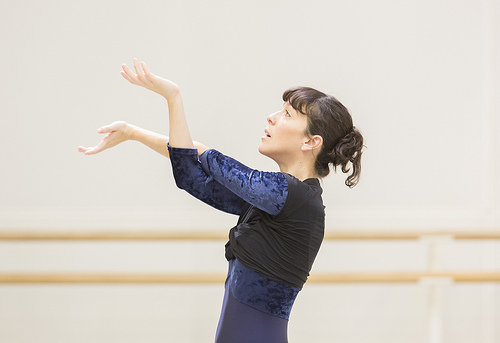
New to me and making a magnificent impression was Laura Morera, a Spanish-born ballerina whose clarity of steps and of gesture as well as a radiant, far-searching gaze, marked her as a unique presence: despite the overwhelming allure of Mssers. Watson and Kish, I found it hard to take my eyes off Ms. Morera. She showed a deep connection to the music, and a blessed freedom from theatricality. (The rehearsal photo of Laura Morera above is from The Royal Ballet website…I simply love it…and her!)
The Mahler score of Das Lied von der Erde calls for two vocal soloists: they alternate in singing the songs. For his ballet, MacMillan has them unobtrusively step out from the opposite sides of the proscenium to sing; thus the focus remains on the dancers throughout. Tenor Thomas Randle seemed a bit stressed by the vocal demands cruelly placed on him by Mahler, but he managed well enough. Katherine Goeldner, who a few seasons back was an excellent Carmen on this very stage, summoned up some very expressive vocalism, making an especially haunting effect in the final passages of the work as she repeats the word “Ewig…” (‘Forever’) in gradations from piano to lingering pianissimo.
To attempt to describe for New York dance-goers the overall look of the choreography MacMillan devised for this musically epic piece one might say it combines the stripped-down immediacy of Balanchine’s black-and-white ballets with the ritualistic aspects of Martha Graham’s mythic masterworks.
In the abstract yet curiously meaningful passages for the corps, MacMillan has created a stylized world thru which the principals and soloists come and go with alternating sensations of urgency and angular introspection. Irony manifests itself at times, but overall the work takes itself very seriously and that in itself makes it all the more compelling.
There were times when I wished for a bit more sense of unity of movement from the ensemble; of course Mahler’s endless thematic ebbs and flows don’t provide a real rhythmic blueprint for synchronization of steps and gestures. Nevertheless, everyone looked wonderfully handsome and attractive, individual personalities emerging even in the regimented sequences.
To the splendid performances from Ms. Morera, Mr. Watson, and Mr. Kish were added some radiant dancing from Yuhui Choe and Lara Turk. There were others, too, who caught the questing gaze of my opera glasses but I’m not familiar enough with the Company to single them out.
In a week that brought the news of Albert Evans’ untimely death, it was moving to be back in the theatre where I saw him dance hundreds of times. So lovely, too, to run into Wendy Whelan, who shared that stage with Albert on countless evenings. My feeling is that Albert would not want us to stop dancing…not even for a moment.
 Oberon's Glade