Blog

  • TAKE Dance: THERE AND HERE

    Safe_image.php

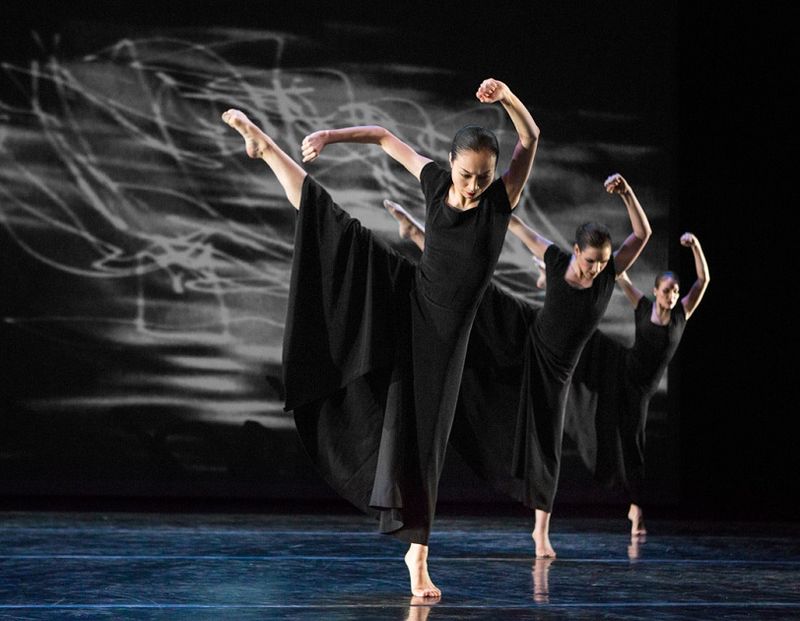
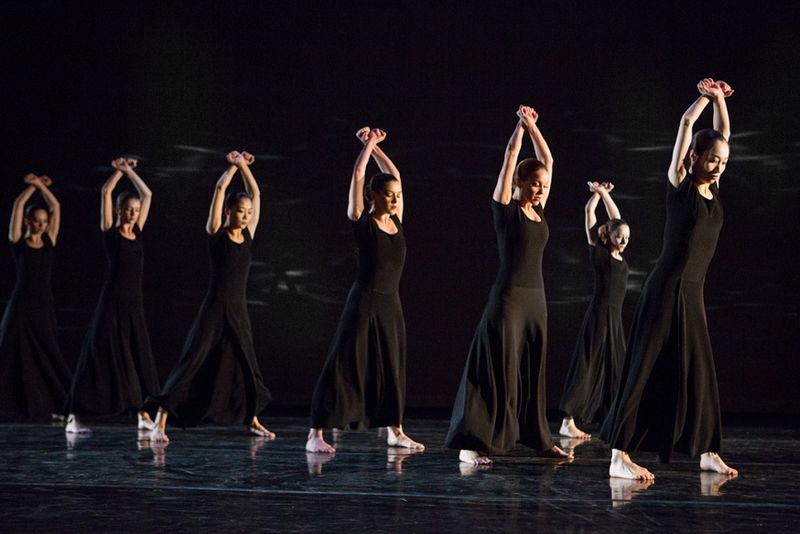
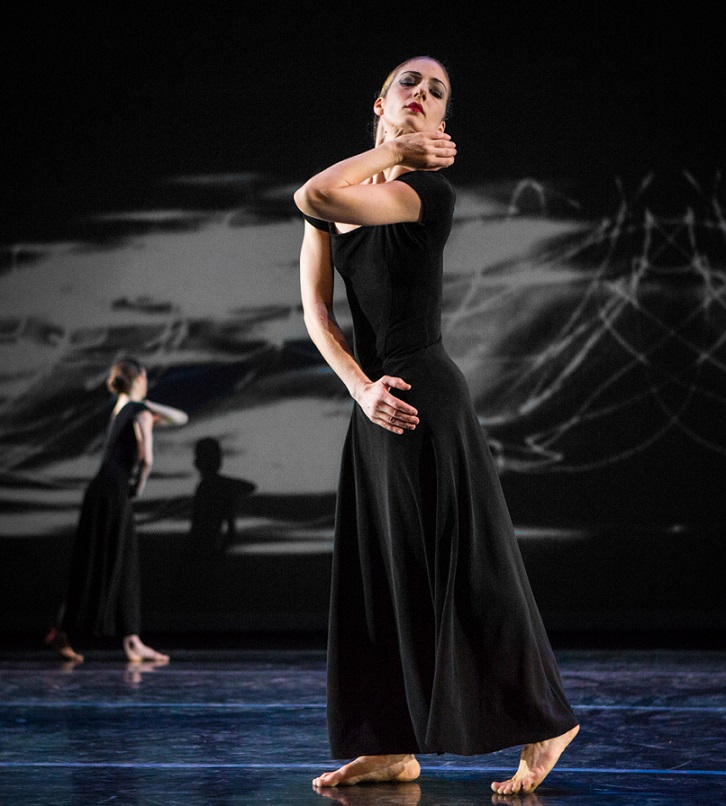
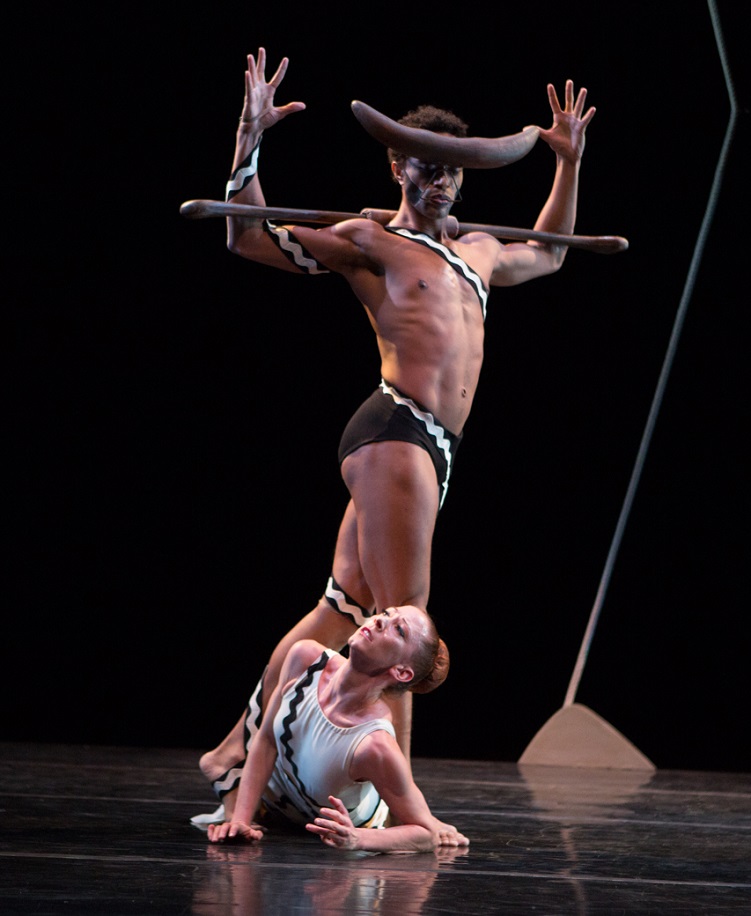
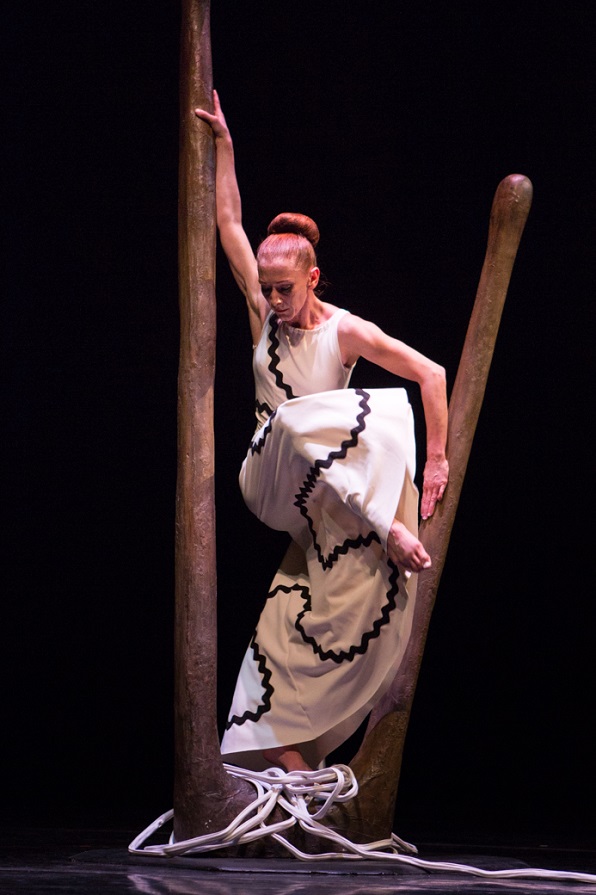
    Friday March 27th, 2015 – Takehiro Ueyama’s TAKE Dance celebrating their tenth anniversary with an evening-long work entitled THERE AND HERE, presented at the Schimmel Center. For this special occasion, guest artists Miki Orihara, Amy Young, Nana Tsuda, and Orion Duckstein joined the members of Take’s company, and Take himself appeared in an enigmatic role. Take talks about influences and inspiration here.

    Composer Kato Hideki performed his mystical score live, perched on high in the shadows at the rear of the stage. The music feels improvisational, giving the dancers a soundscape in which their individual expressiveness can be sustained. Hideki’s score has an other-worldly quality, with the sounds of wind blowing, resonant drumming, and a sustained motif of perpetual sonic beeps, which seems like a signal from another world that is trying to reach us.

    For indeed THERE AND HERE straddles two worlds: the world of the living and the unknown world of the afterlife. The performing space, open to the riggings on the sides, is a patch of desert – the sands of time – with a small mound to one side. Pieces of broken altar-rock are scattered in the space, indicating it as a once-sacred setting for some lost or forgotten tribe.

    Darkness has settled over the land, yet a spirit (Nana Tsuda) slowly awakens to sombre, eerily ominous music. Over time various wanderers come into the space, moving in a stylized manner; at times they seem almost like sleepwalkers. Fleeting connections between dancers – all but Take clad in red, unisex overalls – maintain the sense of mystery. Much of the choreography is slow-paced and ritualistic; from time to time there are bursts of activity and ensemble passages where the dancers seem increasingly absorbed into the landscape. The stones are piled, cast down, walked or sat upon; and sand sometimes falls from the sky or is sprinkled in handfuls by the participants. 

    In this purgatorial setting, there were numerous passages which seized our imagination: Jill Echo quietly seeks to re-build the shattered altar; John Eirich and Nana Tsuda rushing about like flying birds and go scampering up the hill; a combative duet for John and Brynt Beitman; an inventively-choreograhed pas de deux duet for Amy Young and Orion Duckstein. Brynt has a solo, observed by the others seated on the rocks. A vivid swaying motif is danced to drummed rhythms; Gina Ianni’s impressive solo (later joined by John Eirich) and a wild duet for Marie Zvosec and Kile Hotchkiss followed by solos for Kile and Brynt show off the members of Take’s company to distinct advantage.

    The girls fling themselves into the arms of the waiting boys, then all the dancers collapse in a domino effect. As the others perform gestural sequences, Orion is isolated and is perhaps being judged. Amy Young appears as a living statue; to intense music she sifts the sands. In a moment of exquisite beauty, Miki Orihara walks along a pathway of stone blocks – so simple yet so effective.

    At last Take – a priestly figure all in black – returns, and the restless spirits at last sink into rest on the desolate Earth.

  • Verdi REQUIEM at St John the Divine

    164572_1653439729885_6792945_n

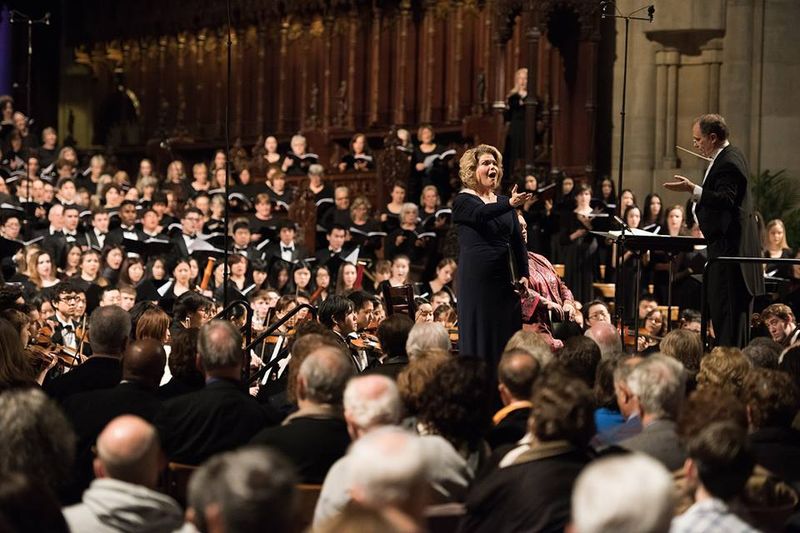
    Thursday March 26th, 2015 – Oratorio Society of New York presenting the Verdi REQUIEM at the Cathedral of St John the Divine. This was my second experience of this magnificent work in a sacred setting: many years ago I attended a performance of it in the Chapel at Trinity College, Hartford CT. On that evening, an organ and a small ensemble of instrumentalists played in lieu of a full orchestra, but the work still made a vivid impression. Tonight we had the admirable young musicians of the Manhattan School of Music Orchestra (and their symphonic chorus) joining the Oratorio Society for a full-force rendering of Verdi’s ‘sacred opera’.

    A huge audience – an overflow crowd, actually – filled the cathedral and (except for one cellphone beeping at a particularly inopportune moment) they listened in reverential silence. It was overall a very fine performance of the REQUIEM but sonically it was problematic in that the reverberant echoing throughout the huge space often turned the music into a blur. Much of the music’s definition was lost, and much detail from the inner orchestral voices vanished in the clouds of echo. There was the illusion of notes being played twice, and the music sometimes seemed to be fighting itself.

    Kent Tritle conducted, and a strong quartet of soloists took part:

    Jennifer Check, soprano
    Sara Murphy, mezzo-soprano
    Alex Richardson, tenor
    Matthew Boehler, bass

    These four singers often seemed to me to be swamped by the sound of the orchestra and chorus flowing over them in both directions. How they managed to pick up their cues, I will never know. Nevertheless, there were many savorable vocal passages. Mr. Boehler, who made a fine impression recently in IOLANTA at The Met, projected the text with vivid dynamic detail, and Mr. Richardson sang musically and with passion.

    Sara Murphy, whose opulent mezzo made a marvelous impact when she sang Ligeti and Schnittke with the American Symphony Orchestra earlier this season, was very impressive tonight both for beauty of tone and clarity of projection. So much music I want to hear her sing! 

    11111962_913591532037896_5248156677226624389_n

    Jennifer Check (above, photo by Brian Hatton), who stepped in to the soprano part rather late in the day, sounded lovely. Her voice has power but also a silvery lyrical quality, and in the Offertorio she produced a spine-tingling sustained piano E-natural (which modulates magically to an E-flat…one of the most felicitous moments in this glorious work). For the great final ‘aria’, Requiem aeternam, Ms. Check closed her score and gave an intense, very personal performance of this prayerful solo; using her right hand in gently expressive gestures, she seemed to send forth a benediction of peace and tranquility.

  • Paul Taylor @ Lincoln Center 2015 #4

    Piazzolla Caldera michelle

    Above: Michelle Fleet in Paul Taylor’s PIAZZOLLA CALDERA; photo by the late Tom Caravaglia

    Tuesday March 24th, 2015 – The tonight’s programme, my final opportunity to see the Paul Taylor Dance Company during their current Lincoln Center stint, featured two works I’d seen earlier in the season: SUNSET and EVENTIDE, plus the darkly alluring PIAZZOLLA CALDERA.

    SUNSET, with its off-duty soldiers and a quartet of white-clad girls, is set to music by Edward Elgar with a nostalgic feeling and to a central section where only the sounds of loons crying is heard. There are playful passages – Aileen Roehl gets tossed daringly from man to man – but the overall atmosphere is pensive, with fleeting possibilities of romance. The men march off to duty, leaving the girls downcast. In a high-lighted role, Eran Bugge was superb; she is left at the end clutching a red beret which one of the soldiers has dropped. 

    Eventide 1

    Above, from EVENTIDE: James Samson, Laura Halzack, Francisco Graciano, and Heather McGinley in a Paul B Goode photo.

    I really fell under the spell of EVENTIDE during this Taylor season. This romantic work, with its melodious Vaughan Williams score, was poetically danced tonight. A series of duets presents us with the opportunity to savor the expressive qualities of ten of the Company’s distinctive artists while in ensemble passages the simple act of walking takes on a poignant resonance. 

    Piazzolla Caldera 3

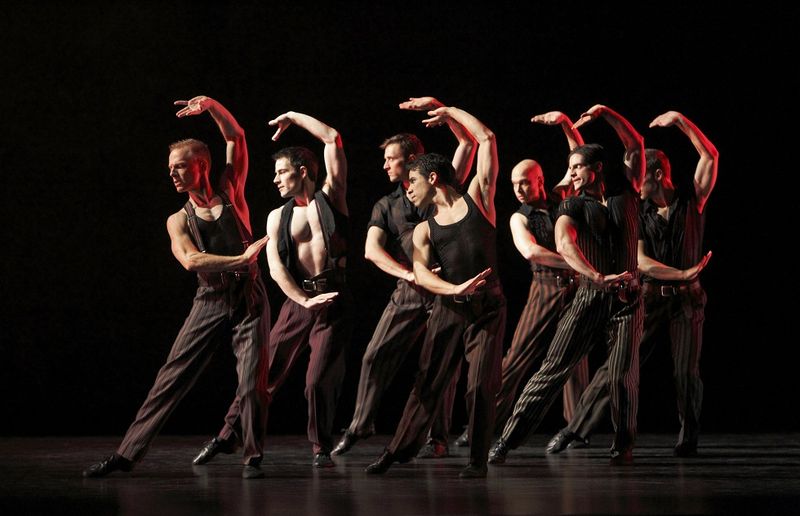
    Above: the Taylor men in PIAZZOLLA CALDERA; photo by Paul B Goode

    PIAZZOLLA CALDERA premiered in 1997, drawing Paul Taylor into the world of the tango. The tango grew out of many musical influences – Spanish, Italian, Indian, African and Jewish – and reached a height of artistic expression in the music of Astor Piazzolla. For his ballet, Paul Taylor avoided using any actual tango steps but was able magically to distill the essence of this exotic dance form. In a smoke-filled, dimly lit and disreputable bar, working-class men and women meet to dance and imbibe in a steamy after-hours atmosphere. They pose, provoke, titillate, and deny each other in a series of sexually fraught duets and trios.

    Parisa Khobdeh showed a vivid mixture of tension and allure in a commanding performance; she drifted in and out of a pas de trois with Eran Bugge and Robert Kleinendorst, later seizing the stage for herself. In a sexy/drunken duet, Francisco Graciano and Michael Apuzzo seemed alternately on the verge of kissing or knifing each other, while the sizzling pairing of Michelle Fleet and Michael Trusnovec gave fresh meaning to the word “electrifying”. PIAZZOLLA CALDERA was the perfect finale for an evening of great dance, and the crowd went wild at the end of the show.

  • Upcoming: Ballet Hispanico @ The Joyce

    NIR_6042

    Above: Ballet Hispanico‘s Mario Ismael Espinoza and Kimberly van Woesik in CARMEN.maquia; rehearsal photo by Nir Arieli

    Ballet Hispanico return to the Joyce Theater from April 14th – 26th, 2015 with 15 performances featuring five dynamic programs. Tickets start at $10 and are on sale here.

    Under the artistic direction of Eduardo Vilaro, Ballet Hispanico‘s style combines the fire and passion of their Latino roots with elements of contemporary ballet.

    Highlights of this year’s Joyce season include a raw and athletic world premiere by Mexico-based choreographer Miguel Mancillas and the dazzling New York premiere of Show.Girl. by Miami-based, Princess Grace Award-winning choreographer Rosie Herrera. Also in the Joyce repertory are Ballet Hispanico’s striking production of Gustavo Ramírez Sansano’s CARMEN.maquia, a contemporary look at the iconic story of a passionate gypsy woman; the marvelous all-male Sombrerísimo, choreographed by Annabelle Lopez Ochoa and commissioned by New York City Center for the 10thanniversary of the Fall for Dance Festival; and El Beso, choreographed by Gustavo Ramírez Sansano, with original costumes by Venezuelan fashion designer Angel Sanchez.

    For the first time during its New York Season, Ballet Hispanico will also offer a 90-minute matinee on Saturday, April 18th that is specially curated for children and families featuring excerpts from the Company’s diverse repertory and a Q & A with the dancers. Hosted by Artistic Director Eduardo Vilaro and Education Director AnaMaria Correa, Ballet Hispanico’s fun, interactive, and educational Performances for Young People – now celebrating 30 years – give families a glimpse into the beauty of the arts and Latino culture.

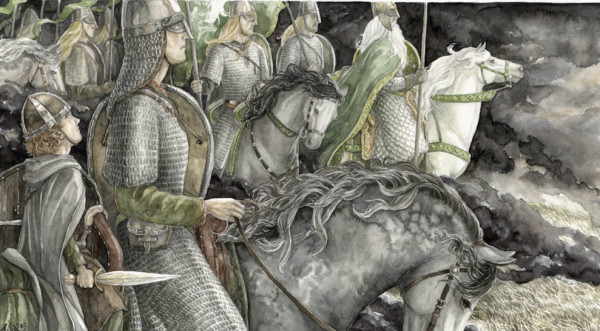
  • Lament for the Rohirrim

    Riders of rohan

    “Where now the horse and the rider? Where is the horn that was blowing?
    Where is the helm and the hauberk, and the bright hair flowing?
    Where is the hand on the harpstring, and the red fire glowing?
    Where is the spring and the harvest and the tall corn growing?
    They have passed like rain on the mountain, like a wind in the meadow;
    The days have gone down in the West behind the hills into shadow.
    Who shall gather the smoke of the dead wood burning,
    Or behold the flowing years from the Sea returning?”

    ~ THE TWO TOWERS/JRR Tolkien

  • Paul Taylor @ Lincoln Center 2015 #3

    Brandenburgs 5

    Above: Michael Trusnovec and ensemble in Paul Taylor’s Brandenburgs; photo by Paul B Goode

    Saturday evening March 21st, 2015 – This evening, the programme at Paul Taylor Dance Company’s Lincoln Center season featured Taylor’s latest creation, Death and The Damsel, book-ended by two of his celebrated works from the 1980s: Sunset and Brandenburgs.

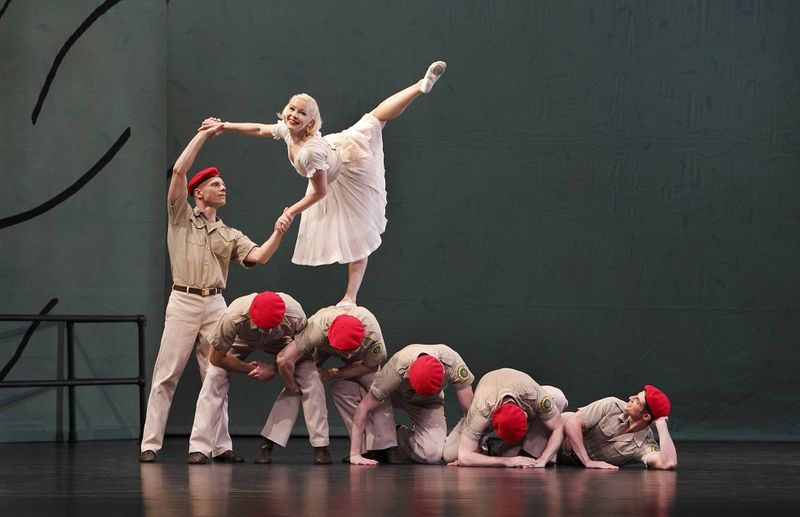
    The simple but evocative Alex Katz set design for Sunset shows a flat aquamarine sky with suggestions of tree limbs in black. Along one side of the stage is an iron fence, which might also be a ballet barre. A group of soldiers in khakis and red berets are lounging and casually dancing. We know not what country they serve; they are simply universal soldiers. 

    Sunset 2

    Above: Robert Kleinendorst and Michael Trusnovec in Sunset; photo by Paul B Goode

    Unlike Jerome Robbins’ Fancy Free, to which it is sometimes compared, Sunset is mostly devoid of humor or playfulness. Perhaps Taylor’s soldiers are part of an occupying force. When three white-clad girls appear, there are flirtations, tensions, and hopes. But Sunset retains throughout an under-current of sadness, fed by the wistful lyricism of the Edward Elgar score.

    Sunset 3

    Above: Aileen Roehl and the ensemble in Sunset; photo by Paul B Goode

    Passing playfulness – with four lovely ladies Aileen Roehl, Michelle Fleet, Parisa Khobdeh, and Eran Bugge – gives way to the sounds of birdcalls as dusk approaches. The tone becomes more pensive. In a sustained passage with the men, Ms. Bugge seems angelic, the white purity of her dress matching the purity of her dancing. The men then march off: to guard duty? To battle? Or to an unknown fate. 

    Paul Taylor’s newest work, Death and the Damsel, is set to Bohuslav Martinů’s Sonata #2, beautifully played live from the pit by Myron Lutzke (cello) and Margaret Kampmeier (piano). Massive backdrops of Gotham cityscapes (designed by Santo Loquasto) loom over the action; especially marvelous is Loquasto’s view of the Chrysler Building.

    Jamie Rae Walker awakens from sleep in her tiny loft-room. In her introductory solo, Ms. Walker does everything from fouetté turns to cartwheels, expressing her innocence and her joy at living in the most exciting city on Earth. Suddenly her peace of mind is disturbed by the entrance of vampiric creatures dressed in black leather with Goth hairdos and makeup. 

    The action suddenly shifts to a dance club where Ms. Walker is heartlessly gang-raped. In a duet which combines terror and deadly allure, the girl is partnered by the glowingly sinister Michael Trusnovec. Later, she tries to fend off the gorgeously evil and predatory Laura Halzack. The ballet ends with Ms. Walker apparently being devoured by her attackers (though the people seated behind us were saying the ending was somewhat different at an earlier performance they had seen). Whether the scenario represents the damsel’s nightmare or her secret fantasy we cannot guess; but the work did offer a big opportunity for Ms. Walker and she made the most of it.

    Brandenburgs 2

    Above: the Taylor men in Brandenburgs; photo by Paul B Goode

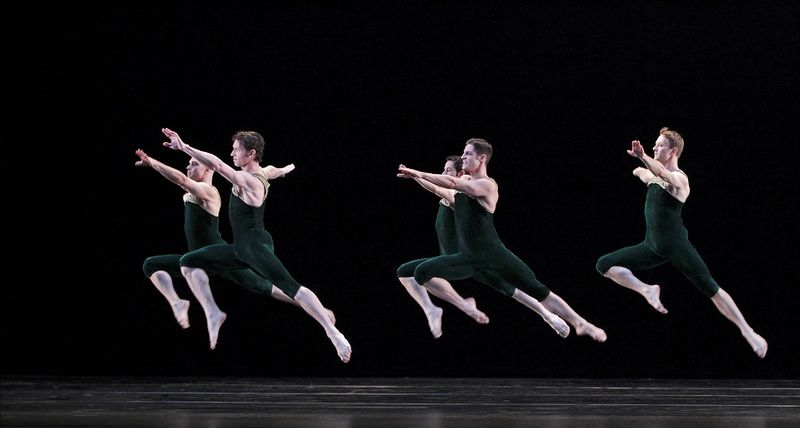
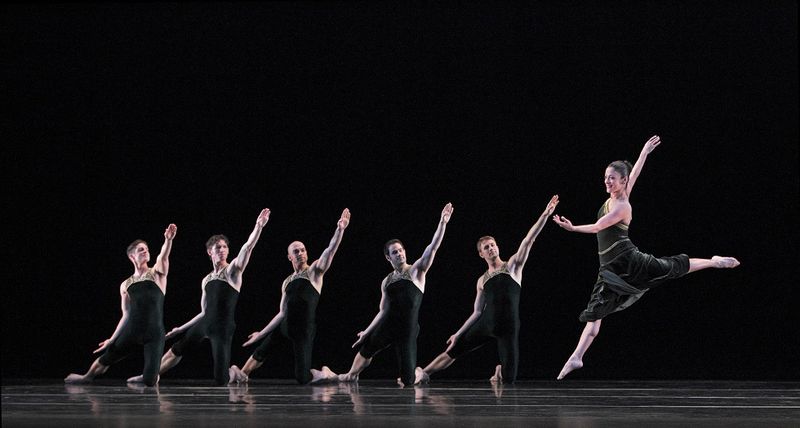
    Paul Taylor’s 1988 abstract Bach ballet Brandenburgs brought the evening to a marvelous close. Wearing Santo Loquasto’s rich forest-green velvety costumes, the men perform stylized leaps and semaphoric gestures that made me think of some of Martha Graham’s unison passages. Three beauties appear – Michelle Fleet, Parisa Khobdeh, and Eran Bugge – each dancing a solo enmeshed with the men: each woman radiant and creating her own perfumed atmosphere. In an adagio solo demanding peerless physical control and expressiveness, Michael Trusnovec was simply magnificent. Tonight’s Brandenburgs showed Taylor’s choreography and his thrillingly talented dancers at their very finest.

    Brandenburgs 1

    Above: Parisa Khobdeh and the ensemble in Brandenburgs; photo by Paul B Goode

    I loved running into Annmaria Mazzini and John Eirich tonight.

  • Schubert & Schnittke @ CMS

    JuhoPohjonen

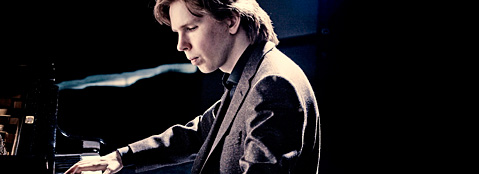
    Above: Juho Pohjonen

    Friday March 20th, 2015 – Three outstanding artists joined forces this evening at Alice Tully Hall as Chamber Music Society of Lincoln Center presented yet another outstanding programme in their Intimate Expressions series.  Pianist Juho Pohjonen joined violinist Benjamin Beilman for Schubert and cellist Jan Vogler for Schnittke; then all three musicians concluded the performance with Schubert’s trio #1 in B-flat major.

    Despite a late-Winter snowfall and chilling winds, a large audience filled Tully Hall, and it was in a marvelous state of silent anticipation that the listeners opened their hearts and minds to the extraordinary music coming from the stage. This state of mutual communication, where the players can’t help but be aware of the spell they are casting over the Hall, is one of the great pleasures of Chamber Music Society‘s presentations.

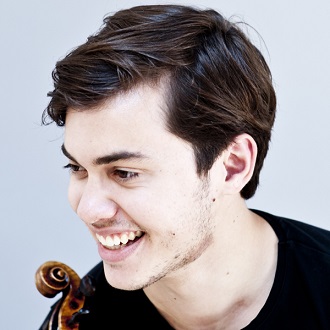
    The level of artistry today was extraordinarily high. When Benjamin Beilman and Juho Pojhonen walked onstage we were struck by their youthful appearance and a trace of shyness as they acknowledged the welcoming applause. But as soon as they began to play, their surety of technique and depth of musicality drew us in to their compelling delivery of the opening Schubert. 

    Benjamin_beilman_artistpage

    Above: Benjamin Beilman

    The Schubert Fantasy in C-major (1827) is a long work in seven inter-connected movements and it places extraordinary demands on the violinist while also requiring a pianist who is far more than an accompanist, but rather a partner in expressiveness.

    The extraordinary delicacy of Mr. Pohjonen’s opening measures showed us at once that we were in the presence of a master of dynamic control; the silken seamlessness of his playing was ideally taken up by Mr. Beilman in his opening lyrical flight. As the sonata progresses, the violin’s poignant theme of longing shifts to a dynamic dancelike passage. In a set of variations, Mr. Beilman showed his skill in alternate plucking and bowing, as well as in flourishes of fast fiorature and rolling cascades of melody. A rapturous theme for violin and piano has a heart-rending quality, and soon we return to the still calm of the work’s opening statements. The gallantly graceful pace of the finale lulls into a last evocative slow passage before a dash to the finish. The audience embraced the two young paragons with warm enthusiasm for their savorable performance.

    29782

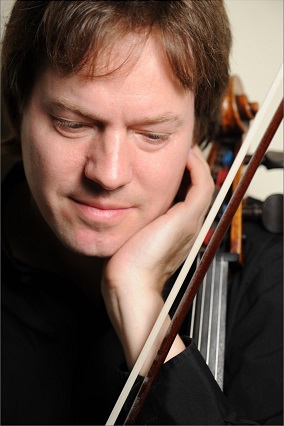
    Above: Jan Vogler

    Jan Vogler was making his CMS debut today, and a welcome event it was: he took on the the daunting combination of angularity and soulfulness that make the Schnittke sonata so remarkable, and again Mr. Pojhonen at the Steinway was an ideal accomplice.

    Commencing with a rather ominous cello theme, this sonata often has a dreamlike (even nightmarish) sense of mystery. The cellist at one point slithers up and down a snakelike scale passage with a creepiness that evokes thoughts of the eerie prelude to Klytemnestra’s murder in Strauss’s ELEKTRA. In fact, the Schnittke might be said to echo the Strauss opera in its mixture of violence and unexpected flashes of  lyricism. 

    I scrawled several brief notes, not wanting to take my eyes off our intrepid players: “march-like piano”, “rambunctious cello”, “bizarre waltz”, “restless quest”…and then suddenly Mr. Pohjonen lays into the lowest notes of the keyboard to produce a violent sonic boom. He then immediately swirls upward to the highest range, whilst Mr. Vogler takes up a desolate theme. The cello goes to the depths – and such resonant depths – interrupted by an aching/annoying 2-note motif before ending up on a very sustained tone. A brief, mysterious plucked passage before settling back into the deep while the piano creates a soft cloud of starshine in the highest range.

    Let’s have Mr. Vogler back for the second Schnittke sonata, at the earliest opportunity.

    After the interval, the three gentlemen set to a performance of Schubert’s Trio in B flat major, immediately establishing the kind of congenial rapport that makes a great piece of music even greater.

    The trio was probably written in 1827; the original autograph score is lost. It is in four movements, and I can’t imagine a more pleasing rendition than tonight’s with its fusion of the three voices constantly sending those delightful little chills up the spine. The nostalgic theme that opens the Andante expanded into a vivid emotional experience with playing that was subtle and full of nuance. The three gentlemen were in a playful mood for the witty and sparkling Scherzo – with its lovely surprise of a slower interlude – and then moved on to the sprightly dance of the final Rondo, which includes an unusual ‘fluttery’ motif.

    In this trio, the three players showed both graceful dexterity and a mutual desire to draw forth each thread of melody for our delight. Both in programming and in the choice of artists, Chamber Music Society sets the highest standard. I entered Alice Tully Hall tonight with great expectations, only to find they were not simply met, but surpassed. Incredibly, that seems to be the norm here at CMS.

    The Repertory:

    The Participating Artists: Juho Pohjonen (piano); Benjamin Beilman (violin); Jan Vogler (cello)

  • Score Desk for DONNA DEL LAGO

    Loch_Katrine

    Above: Loch Katrine, Scotland – the setting of LA DONNA DEL LAGO

    Saturday February 28th, 2015 matinee – This performance of Rossini’s LA DONNA DEL LAGO was a late addition to my opera plans for the season. The Rossini repertory no longer interests me much, but I thought it might be good to experience one of his operas again in-house, and I’ve always liked Juan Diego Florez, so…why not?

    Back in 1982, I heard Rossini’s LA DONNA DEL LAGO in a concert performance at Carnegie Hall; the principal roles were taken by Frederica von Stade, Marilyn Horne, Rockwell Blake, and Dano Raffanti. It was quite a night. Then in 2007, the New York City Opera staged it with a cast that included fine performances by mezzo-soprano Laura Vlasak Nolen, and tenors Barry Banks and Robert McPherson.

    After taking some cuts in the prelude, conductor Michele Mariotti rushed the opening chorus with some resulting disunity. Someone tried to start entrance applause for Joyce DiDonato, but it didn’t catch on; it might have been the same person who tried to get some applause going after her opening aria, but he ended up with three solo hand-claps.

    It seemed to me today that Elena (the opera’s eponymous heroine and triple love-interest) suits Ms. DiDonato much better than Donizetti’s Maria Stuarda did. She did some genuinely lovely singing – with persuasive coloratura – along the way; a slight flutter in her timbre at low-to-mid volume sometimes intrudes on complete enjoyment of her singing. But overall this is a fine role for her. 

    Juan Diego Florez sang with his usual fluency and expressiveness, tossing off added high notes and blending beautifully with Ms. DiDonato. Fleeting traces of sharpness in the tenor’s singing didn’t detract from the overall handsomeness of his vocalism, I should have stayed to hear the luminous aria “O fiamma soave” in Act II, but I didn’t.

    I can recall the favorable impression Daniela Barcellona made singing Maddalena in RIGOLETTO at a special all-Verdi concert performance which The Met offered on September 22, 2001, as a benefit for the families of 9/11 first responders. She subsequently sang Bellini’s Adalgisa twice at The Met (also in 2001), and has since had an extensive career in Europe. Her return to The Met as Rossini’s Malcolm Groeme was a main factor in my decision to go to today’s matinee, but alas her voice now shows a widening vibrato – and a quick look at her bio shows the telltale reasons: Amneris and Santuzza are not roles one would think of for her type of voice, and once ventured it is not easy to switch back to bel canto. She had some beautiful low notes today, and managed the coloratura quite well. But sustained notes revealed an unsteady quality.

    John Osborn (Rodrigo di Dhu) pricked up our ears and perked up the performance with his powerful forays to the top register and the overall conviction of his singing. It is not the most ingratiating tenor sound you will hear, but he knows what to do with it in this demanding music, Oren Gradus, though not a bel canto specialist, did what he could with the role of Duglas D’Angus.

    Musically, the opera moves in fits and starts. A ravishing melody or brilliant passages of fiorature will be followed by rum-ti-tum filler. Rossini’s idea of introducing a solo harp into the Act I finale stirs our interest, but the vocal melody that follows in pedestrian. This is followed by a jog-trot stretta to end the act.

    It it hadn’t been for the looming Gelb intermission, I would most likely have stayed on to hear that Florez cavatina in Act II. The house was reasonably full and very attentive, but I did notice several fellow-defectors after the first act.

    Metropolitan Opera House
    February 28, 2015 Matinee

    LA DONNA DEL LAGO
    Gioachino Rossini

    Elena...................Joyce DiDonato
    Giacomo V/Uberto........Juan Diego Flórez
    Malcolm Groeme..........Daniela Barcellona
    Rodrigo Di Dhu..........John Osborn
    Duglas..................Oren Gradus
    Albina..................Olga Makarina
    Serano..................Eduardo Valdes
    Bertram.................Gregory Schmidt

    Conductor...............Michele Mariotti

  • Gallery: Martha Graham/Joyce Season 2015

    150212_M_Graham_steps_012_web

    Above: XiaoChuan Xie (foreground) in Martha Graham’s Steps in The Street; photo © Yi-Chun Wu

    Photographer Yi-Chun Wu has provided a portfolio of images from the Martha Graham Dance Company’s 2015 season at The Joyce Theater. In terms of both repertory and dancing, these Graham Company performances were outstanding. Read about two particularly memorable evenings here and here.

    150212_M_Graham_steps_003_web

    From Martha Graham’s Steps in The Street

    150212_M_Graham_steps_007_web

    Carrie Ellmore-Tallitsch in Graham’s Steps in The Street

    150212_M_Graham_steps_006_web

    Carrie Ellmore-Tallitsch and the ensemble in Graham’s Steps in The Street

    150212_M_Graham_summer_007_web

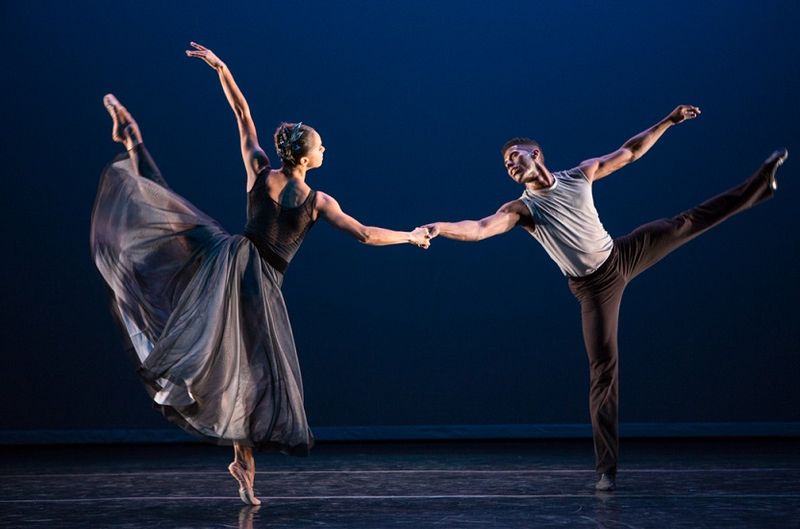
    Guest artist Misty Copeland of American Ballet Theatre and Graham principal Lloyd Knight in Martha Graham’s At Summer’s Full

    150212_M_Graham_echo_004_web

    PeiJu Chien-Pott in Andonis Foniadakis’ Echo

    150212_M_Graham_echo_005_web

    Charlotte Landreau in Andonis Foniadakis’ Echo

    150212_M_Graham_echo_014_web

    Abdiel Jacobsen and Ying Xin in Andonis Foniadakis’ Echo

    150212_M_Graham_errandMaze_007_web

    Abdiel Jacobsen and Blakeley White-McGuire in Martha Graham’s Errand Into The Maze

    150212_M_Graham_errandMaze_012_web

    The Joyce season marked Blakeley White McGuire’s farewell performances as a member of the Graham company. On the closing night of the season, Blakeley (above) danced Errand Into The Maze with her long-time Graham colleague, Tadej Brdnik, also taking his final bows as a member of the Company.

    All photos © Yi-Chun Wu.

  • Schubert’s WINTERREISE @ CMS

    Huber-Gerharer

    Above: Gerold Huber and Christian Gerhaher

    Tuesday February 24th, 2014 – Baritone Christian Gerhaher and pianist Gerold Huber performing Schubert’s immortal masterpiece, Winterreise, as part of Chamber Music Society of Lincoln Center‘s Winter Festival, Intimate Expressions. The performance comes to us in the midst of a particularly cold and somber Winter.

    Composed in 1827, when Franz Schubert was 30 years old and had less than two years remaining in his life, the twenty-four songs of Winterreise are set to poems of Wilhelm Müller. The poet, who had earlier provided the texts for the composer’s song cycle, Die schöne Müllerin, was a nearly-exact and equally short-lived contemporary of Schubert. They never met, and Müller died just as Schubert was beginning work on Winterreise.

    Winterreise is not a narrative song cycle, but rather a collection of vocal miniatures on themes of solitude and despair, set against a relentless and unforgiving wintry landscape. Though the subject matter is overall quite gloomy, there is some variety of tempo and rhythm among the songs. But in the final twelve of the Winterreise songs, we experience a feeling of darkness gathering about Schubert, and his sense of impending doom. The last Winterreise songs evoke feelings of great beauty overshadowed by death. The composer died in 1828.

    Tonight’s performance had all the makings of a superb musical experience – which, in fact, it was – yet the overall effect of the cycle was somewhat compromised. In her opening remarks, CMS co-artistic director Wu Han announced that the pianist Gerold Huber was suffering from a heavy cold. He had generously agreed to perform, but we were cautioned that he might be in need of taking a break midway thru the cycle. This was indeed the case; after about a half-hour, pianist and singer walked offstage and the audience took the opportunity to stretch, chat, and check their cellphones. This intrusion of reality broke the spell of the music. When the artists returned, it took a while for the hall to settle in again, and there were further minor disruptions in the second half of the performance, with a corresponding decline in focus.

    Mr. Gerhaher has a wonderful lyric instrument capable of both power and shaded nuance; and yet it was the pianist – Mr. Huber – who most thoroughly entranced me with the subtle delicacy of his playing in the cycle’s most intimate moments. Together the two gave as fine a rendering of Winterreise as one might hope under the circumstances. The great benefit for me was, it sent my estimation of this cycle, which I have never previously appreciated and have in fact avoided, soaring. Perhaps that is one of the gifts of growing older.

    I look forward to hearing Mr. Gerhaher on March 1st singing the Brahms GERMAN REQUIEM at Carnegie Hall. And I will hope to encounter Mr. Huber again at some point for he is an artist of intrinsic expressiveness.