Blog

  • American Symphony Orchestra’s MUSIC U

    Cd_cover460

    Sunday April 19th, 2015 – This note from the press release describes the inspiration for today’s programme, entitled ‘MUSIC U’, by the American Symphony Orchestra: “In a country without kings and courts, universities have served as the patrons for many of America’s greatest composers.” Leon Botstein and the ASO were joined by the Cornell University Glee Club & Chorus in a celebration of five Ivy League composers.

    RandallThompson480

    In 1940, Randall Thompson (above) who taught at Harvard and was director of the Curtis Institute, was commissioned to compose a choral work for the opening exercises of the new Berkshire Music Center at Tanglewood, to be performed by the entire student body. The composer offered a setting of the Alleluia. Distraught over the Nazi invasion of France, Thompson could not bring himself to compose a joyous fanfare. Instead, he produced this solemnly beautiful and introspective piece, inspired by the Biblical passage (Job 1:21): “The Lord gave and the Lord has taken away; blessed be the name of the Lord.”

    Performing a cappella under the direction of Robert Isaacs, the young singers from Cornell displayed a lovely vocal blend in the heavenly harmonies of this slow, lilting choral miniature. The gentle pace quickens somewhat near the work’s end, but falls back into calm with a very sustained final note that hung on the air.

    Parker

    After a rather long pause, the concert continued with the oldest work (late 19th century) on the programme: the cantata Dream-King and his Love by Horatio Parker (above), one-time Dean of Music at Yale. This cantata won first prize in its category in a competition judged by Dvořák himself. A fanciful romantic text tells the tale of a maiden visited in her dream by a kingly lover.

    The work is melody-filled and seems to echo some of the exotic works of Jules Massenet. From the lyrical opening (the harp is prominent) thru passages dance-like, rapturous, and triumphant by turns, the music opens out like a perfumed lotus blossom. The naturally youthful sound of tenor soloist Phillip Fargo fell pleasingly in the ear, and the singers from Cornell again gave of their best.

    Rochberg-George-01

    The Symphony No. 2 by George Rochberg (above), who ran the music department at the University of Pennsylvania, was the longest work on the programme. Composed in 1955-1956, this symphony today sounds like a generic work from an era when classical music was not quite sure what direction it was headed in. It’s a big-scale piece, one which seems to take itself very seriously. One can sense such influences as Prokofiev, Stravinsky and Schönberg in the writing, and the composer’s fine craftsmanship is never in doubt. Yet despite its rhythmic variety and interesting sonic textures – oboe and horns are well-employed – the piece seemed over-extended. Melody is pretty much banished – a promising duet passage for two violas evaporated after a few seconds – and although melody is not essential, it is inevitably gratifying. Maestro Botstein’s commitment to the work and the excellent playing of the ASO – many fleeting bits of solo work are strewn throughout the score – made as strong a case for the symphony as one could hope to hear.

    300h

    Music for Cello and Orchestra by Harvard’s Leon Kirchner (above)…

    Nicholas-Canellakis

    …with soloist Nicholas Canellakis (above) opened the second half of the concert. The cellist is a frequent participant in Chamber Music Society of Lincoln Center‘s superb concerts.

    Today, Kirchner’s music seemed to me to have found what was missing from the Rochberg: a connection to the heart. Throughout the Kirchner, the solo cello gives his piece a sense of unity and purpose that – to my ears – the Rochberg lacks. Kirchner’s orchestration is colorful and dense, with excellent use of percussion, and the music sometimes takes on a cinematic quality. I love hearing a piano mixed into an orchestral ensemble work, and at the reference to TRISTAN UND ISOLDE, my friend Adi and I exchanged smiles.

    Mr. Canellakis was simply breathtaking right from the cello’s passionate opening statement. He was deeply involved in the music, moving seamlessly from a gleaming upper register to the soulful singing of his middle range. Capable of both redolent lyricism and energetic, jagged flourishes, Nicholas’s playing seemed so at home in the venerable Hall. The audience gave him lusty and well-deserved round of applause as he was called back to the stage after his exceptional performance.   

    Robertosierraheadshot

    The chorus then returned to the stage for the concert’s grand finale: the world premiere of Cantares by Roberto Sierra (above), which Cornell University commissioned for this concert in celebration of their 150th anniversary. In this panoramic work, the cultures of the African, Spanish, Native Peruvian, and Aztec peoples are entwined in vivid musical settings of texts dating back to the 16th and 17th centuries. The composer has re-imagined these invocations and narratives for the contemporary world; for this piece, the Cornell choristers leapt readily from Quechua to Spanish.

    A long sustained tone opens Cantares; then, emerging from dark turbulence, the chorus begins to ‘speak’. A trumpet call, a wandering xylophone, a celestial harp, an oddly ominous rattle: these are all heard as kozmic sound-clouds drift by. The music is mystical and – with the under-pacing of rhythmic chant – takes on an other-worldly feeling.

    The second movement evokes African ritual and that continent’s ancient connection to Cuba. The music seems to echo thru time in its heavenly, ecstatic vibrations. Somehow Chausson’s Poeme de l’amour et de la Mer came to mind.

    An orchestral interlude has the flutter of birdsong and a dense-jungle yet transparent appeal and leads into the final Suerte lamentosa, an epic of dueling cultures told from both the winners’ and the losers’ points of view.

    The work is perhaps a trifle too long, but the composer has been successful in drawing us to contemplate the oft-forgotten (or ignored) events surrounding the injection of Christianity into the Western Hemisphere. And musically it’s truly brilliant.

  • New Chamber Ballet: Four Works

    L1550484

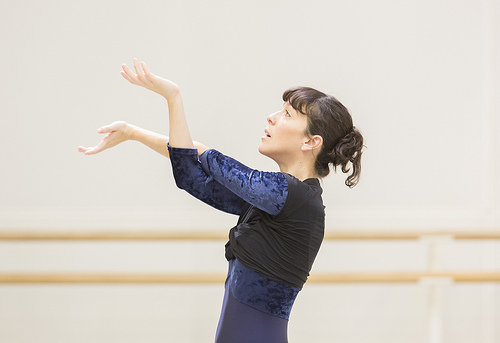
    Above: Elizabeth Brown of New Chamber Ballet rehearsing the solo Moments, observed by choreographers Miro Magloire and Constantine Baecher

    Saturday April 18th, 2015 – “Ballet is Woman,” said George Balanchine; and Miro Magloire‘s New Chamber Ballet seems to be living proof of it. Miro’s obvious delight and skill in choreographing for female dancers has resulted in a series of works which honor the ballerina tradition whilst at the same time pushing boundaries, especially in the realm same-sex partnering. Tonight, the customary New Chamber Ballet formula of women dancing in an up-close-and-personal setting to live music brought us works by both Miro and NCB‘s resident choreographer Constantine Baecher, including two world premieres.

    Now celebrating their tenth anniversary, New Chamber Ballet have always presented an ensemble of finely-trained ballerinas with vivid, individualized personalities. The current quartet maintains the high standard: these are women who are comfortable with having their audience literally within reach, able to dance with confidence and poise in an intimate setting. Their dancing is enhanced by the accomplished musicality of violinist Doori Na and pianist Melody Fader who are always ready, willing, and able to tackle whatever music Miro hands them – and that’s saying a great deal.

    Entangled, a quartet for on- and off-pointe dancers, is performed to Paganini’s Caprices expertly played by Doori Na. The girls, in Sarah Thea’s minty-green sheer costumes with a harem feeling, are paired off: two on pointe (Sarah Atkins and Traci Finch) and two in slippers (Elizabeth Brown and Amber Neff). 

    L1550289

    The ballet opens with Amber and Elizabeth face to face (rehearsal image, above); they rush away from one another and then meet again – repeatedly – in an approach-avoidance sequence. Their dance becomes spastic; they struggle on the floor and there are shakes and shapes. Doori, the violinist, is meanwhile making fast and furious with the demanding Paganini score. The pointe couple appear: Sarah and Traci in stylized balletic poses with stretched arabesques and sculptural port de bras. The couples alternate; the soft-slipper girls have a shuffling little jig. As the adagio begins, the pointe pair lean into one another before they are left alone to a high violin shimmer. Innovative floor choreography follows. We half expect a faster final movement, but instead the ballet ends quietly.  

    Elizabeth Brown, a founding member of New Chamber Ballet, has been thru a serious injury episode and has come back in phenomenal physical condition and more expressive than ever. A unique dancer, Elizabeth performed Miro’s solo Moments to Salvatore Sciarrino’s Caprices 5,2, and 6. Doori Na plays the annoying (in a good way) and demanding score with touches of wit. The opening section is all about line and control, and Elizabeth here reveled in these beautiful, slow-to-still poses. The choreography becomes more animated, gestural, and space-filling, with a spirited circle of piqué turns. New Chamber Ballet audiences tend to be rather reserved, but lusty cheers went up after Moments.

    L1550245

    Above: Traci Finch and Amber Neff rehearsing Miro Magloire’s newest ballet, La Mandragore

    La Mandragore (The Mandrake) is a new duet by Miro set to Tristan Murail’s solo piano work of the same title. Melody Fader at the keyboard showed a particular affinity for this music which begins misterioso, becomes turbulent, then sinks back into eerie calm. Dancers Traci Finch and Amber Neff meet Miro’s complex partnering demands head-on; they are fearless, strong and supple as they wrap around one another, performing lifts and mutually supportive feats in an unusual mixture of power and intimacy. Miro pushes the two dancers to extremes and they respond with compelling assurance and grace.  

    The world premiere of NCB resident choreographer Constantine Baecher’s Two Tauri and A Tiger marked yet another success for Constantine, who has created several works for New Chamber Ballet over the years. Two Tauri opens with Elizabeth Brown rushing on to a stimulating Mozart theme played by Melody Fader; Elizabeth’s solo is questing and energetic. Traci Finch enters next, followed by Sarah Atkins, each dancing a restless and animated solo. The movement has a playful, windswept feeling with an aspect of childlike joy, as when Elizabeth and Traci join hands and spin mirthfully about. 

    The music pauses and we hear the dancers breathing; they re-group in silence, have a walkabout, and a bit more spinning. As Melody intones a more staid Mozart theme, the ballet becomes pensive. The girls circle around, holding hands and relying on counter-balance. This passage recalls Balanchine’s fondness for similar linkings, and also evokes Matisse’s La Danse. As the music animates, the dancers rush about and a pair will playfully drag the third as in a children’s game. This recedes into a more temperate passage with some stretching motifs. Overall, Two Tauri seems like a romping, good-natured piece; yet I feel there might be some underlying shadows, too. I’ll need to see it again to get a deeper sense if it. One thing for sure: the three dancers seemed to be genuinely having a good time dancing it.

    So nice to see Candice Thompson, Amy Brandt, Emery LeCrone, and Lauren Toole among the audience tonight.

    New Chamber Ballet will conclude their 10th anniversary season with performances on June 12th and 13th, 2015. Further details will be forthcoming.

  • Lydia Johnson Dance: Rehearsal Gallery

    L1550552

    Above: Katie Lohiya and Oliver Swan-Jackson of Lydia Johnson Dance

    Friday April 17th, 2015 – Lydia Johnson Dance are in rehearsal for their upcoming New York season; the performance dates are June 11th thru 13th, 2015 at Ailey Citigroup Theater. Tickets here. The programme will feature two world premieres: “What Counts” set to music by The Bad Plus, and an as-yet-untitled piece to music by Osvaldo Golijov and Marc Mellits. Last season’s “Barretts Mill Road: A Remembrance”, danced to Mozart, will return; and the evening includes a revival of “Untitled Bach” (2010) for ten dancers which is set to selections from Bach’s violin sonatas and partitas.

    Lydia’s choreography continues to impress as a unique fusion of ballet and contemporary dance; her intense focus on musicality has set her creations in high profile among the vast number of danceworks being made here in Gotham year after year. Her dancers seem constantly to find new depths of eloquence in performing these ballets which are essentially abstract but rooted in matters of the heart. Thus the dancing is never dryly technical but instead reverberates with evocations of the human spirit. 

    The Company’s ballet mistress Deborah Wingert had given company class prior to my arrival at the studio today; Deborah has also been engaged in coaching for the Company and is working closely with Lydia in molding a unity of stylistic expression for these dancers who come from diverse training backgrounds.

    Here are some images of the LJD dancers at work:

    L1550562

    Chazz McBride and Min-Seon Kim

    L1550572

    Grant Dettling and Sarah Pon

    L1550626

    Katie Lohiya

    L1550634

    Laura DiOrio, Blake Hennessy-York, Min Kim, Chazz McBride

    L1550641

    Chazz McBride, Blake Hennessy-York

    L1550649

    Chazz and Blake

    L1550933

    Laura DiOrio

    L1550847

    Blake Hennessy-York

    L1550896

    Oliver Swan-Jackson, Katie Lohiya

    L1550909

    Sarah Pon, Blake Hennessy-York

    So lovely to run into Lisa Iannicito McBride at Lydia’s studio today; Lisa has been a key member of LJD and several important works were created on her. She took time off to have a wonderful son; it was just great seeing her again!

    6a00d8341c4e3853ef016767d40943970b-800wi

    Here’s Lisa in Lydia’s CROSSINGS BY RIVER, a gorgeous female-ensemble work set to Golijov that I am dying to see again…photo by Kokyat.

  • Great Performers: Lisa Batiashvili/Paul Lewis

    Lisa Batiashvili

    Monday March 30th, 2015 – Violinist Lisa Batiashvili (above) joined pianist Paul Lewis for this recital at Alice Tully Hall, the second event of our Great Performers at Lincoln Center subscription series.  Sonatas by Schubert and Beethoven book-ended the programme, with some delicious treats in between.

    Ms. Batiashvili, who is artist-in-residence for the current New York Philharmonic season, is a slender, elegant beauty gowned in rose-pink. From the opening measures of the Schubert ‘Duo’ in A-major, she and Mr. Lewis formed an ideal alliance: both players are masters of subtlety, the violinist with her shining clarity of tone, the pianist capable of great delicacy as well as a sense of gentle urgency. Throughout the sonata’s opening Allegro moderato, their mutual musicality yielded an uncommonly lovely experience, drawing the large audience into Schubert’s world.

    In the exuberant charm of the Scherzo which follows, the two players mixed virtuosity with fleeting passages of ‘sung’ melody; then came the Andantino, with its poignant theme and gracious motif of trills where the artists lingered in music’s expressive delights. The final Allegro vivace blends declamation and lilt, carrying us along with its waltzing buoyancy.

    As a sort of mega-encore, Ms. Batiashvili and Mr. Lewis offered a vibrant performance of Schubert’s Rondo in B minor (“Rondo brillant”) which opens regally and proceeds to a blend of jaunty upward leaps, inviting melodies, and coloratura flights of fancy.

    An-Pianist-20Paul-20Lewis-20130214220256259727-300x0

    Paul Lewis (above, in a Pia Johnson photo)

    Following the interval, each artist took a solo turn. Mr. Lewis’s rendering of the Busoni arrangement of Bach’s Nun komm, der Heiden Heiland was profoundly beautiful in its grace and simplicity. Ms. Batiashvili played Telemann’s Fantaisie No. 4 in D major, its classic three-movement (fast-slow-fast) structure compressed into a five-minute time span, a miniature solo-concerto which was handsomely played.

    The Beethoven sonata No. 10, which closed the evening, begins gently with shimmering trills; a simple two-note motif later in the first movement has a hypnotic quality, then back to a trill-filled conclusion before we move on to the achingly gorgeous, sustained melodies of the Adagio espressivo: here Ms. Batiashvili and Mr. Lewis were at their most ravishing. There’s no pause as the Adagio yields immediately to the brief, playful Scherzo with both players spinning the music onward. The fourth movement, Poco allegretto, seems calm at first but there’s underlying tension building: you can sense an impending flood of energy and surely enough it bursts forth. Both players were on a high here, yet cunningly the composer draws back into a lulling, rather sentimental passage. What then seems like a race to the finish gets momentarily sidetracked again – Beethoven is playing with us – before the last sprint.

    Superb music-making in a most congenial space: we left Ms. Batiashvili and Mr. Lewis basking in the warmth of the audience’s cheers and applause. 

    The Program: 

    Schubert: Violin Sonata in A major

    Schubert: Rondo in B minor (“Rondo brillant”)

    Bach (arr. Busoni): Nun komm, der Heiden Heiland, for piano

    Telemann: Fantaisie No. 4 in D major, for solo violin

    Beethoven: Violin Sonata No. 10 in G major

  • Miro Magloire for CBC

    L1540856

    Above: dancers from Columbia Ballet Collaborative rehearsing a new Miro Magloire ballet; the girls are Vanessa van Deusen, Shoshana Rosenfield, Alyssa Hubbard, and Morgan Caglianone

    Sunday March 29th, 2015 – This evening I stopped in at Barnard College where Miro Magloire, artistic director of New Chamber Ballet, is creating a new work for Columbia Ballet Collaborative‘s upcoming performances – a matinee and an evening show at The Miller Theater, Columbia University on Saturday April 18th, 2015.

    L1540721

    Above: violinist Pala Garcia, Miro Magloire

    The music Miro has selected is “tanz.tanz” for solo violin by composer Reiko Fueting, who is a professor at Manhattan School of Music; it will be played live by violinist Pala Garcia.

    L1540947

    A nice, relaxed atmosphere in the studio this evening; the dancers were experimenting with a seated back-to-back formation from which Miro wanted them to rise…

    L1540804

    …this produced some mirth from the girls, but eventually they figured out how to make it work. 

    L1540883

    There was also an attempt to cover their neighbor’s mouth or eyes by feeling: more levity. But again it soon was absorbed into the dance.

    L1540861

    Miro later had them draw into a Matisse-like circular formation, moving faster and faster.

    L1540730

    There are fleeting partnered passages (Morgan and Alyssa, above)…

    L1540931

    …and reflective moments where the girls sit, each in her own dreamy world (Vanessa, above).

    L1540880

    As the rehearsal was drawing to a close, Shoshana Rosenfield (above) breezed thru a beautiful solo passage, full of swift, lyrical turns.

    For the Spring 2015 season, Columbia Ballet Collaborative welcomes new ballets by five choreographers: Charles Askegard, former dancer with American Ballet Theatre and New York City Ballet and co-founder of Ballet Next; Roya Carreras, graduate of UC Irvine’s Claire Trevor School of the Arts and dancer with Danielle Russo Dance Company (NYC); Serena Mackool, senior at the School of General Studies and former dancer with Tulsa Ballet, Ballet San Antonio, and Proyectos en Movimiento; Miro Magloire, founder and artistic director of New Chamber Ballet; and Katya Vasilaky, Postdoctoral Earth Institute Research Fellow at Columbia University and former dancer with San Francisco Ballet. CBC is also proud to present selections from George Balanchine’s Who Cares?.

    Tickets will be $10 with a Columbia University ID, $15 with a non-Columbia University student ID, and $22 for general admission. They are available for purchase via these links: 

    3pm Show

    8pm Show

  • The Tempest Songbook @ The Met Museum

    RTRH4C0927 copy

    Above: from THE TEMPEST SONGBOOK, singers Jennifer Zetlan and Thomas Richards, and dancers PeiJu Chien-Pott and Abdiel Jacobsen; photo by Richard Termine. Click on the image to enlarge.

    Saturday March 28th, 2015 – This long-awaited evening proved to be every bit as engrossing as I imagined it would be. Following last season’s stunning production of THE RAVEN, Gotham Chamber Opera’s Neal Goren again called upon choreographer/director Luca Veggetti for THE TEMPEST SONGBOOK, an imaginative fusion of song, dance, and drama performed with unfettered directness of purpose at the Grace Rainey Rogers Auditorium in the Metropolitan Museum of Art.

    RTRH4C0334A copy

    Above: from THE TEMPEST SONGBOOK, production photo by Richard Termine

    As in THE RAVEN, this production of THE TEMPEST SONGBOOK is pared down to a sublime simplicity: no sets, no elaborate costumes or cluttered staging: just pure music – excellently played and sung – and sleek, expressive choreography performed by four of the dance world’s most captivating artists. The only element of set decor, aside from a bench, was a large luminous orb suspended over the stage. On its textured surface, Jean-Baptiste Barrière’s dreamlike projections – some of them real-time moving images of the onstage action – created an atmospheric element without detracting from the action of the singers and dancers. The simple, timeless costume designs (Peter Speliopoulos) flattered the wearers and allowed for ease of movement. Clifton Taylor’s lighting at times cast dancing shadows upon the walls.   

    RTRH4C0188 copy

    Above: Thomas Richards, Jennifer Zetlan, and the dancers; photo by Richard Termine

    The score is a felicitous blending of the olde and the new: music attributed to Henry Purcell for a 1712 production of The Tempest has been woven together with the contemporary Finnish composer Kaija Saariaho‘s song cycle The Tempest Songbook in such a persuasive manner that a cohesive new opera has been born. The rhythmic variety and melodic richness of Purcell found a counter-poise in Ms. Saariaho’s sometimes declamatory/sometimes other-worldly vocal settings.

    RTRH4C0270 copy

    Above: Jennifer Zetlan, Abdiel Jacobsen; photo by Richard Termine

    The period instrument ensemble, seated onstage, drew us into this Tempest world immediately with a strikingly resonant prelude. The two singers, Jennifer Zetlan and Thomas Richards, showed consummate musicianship and were able to move effortlessly between the Purcell and Saariaho styles in the twinkling of an ear. Ms. Zetlan, petite and lovely – and possessed of a distinctive vocal energy – can sound girlish one moment and amply dramatic the next whilst Mr. Richards – voluminous of voice yet capable of honing his tone down to long-fading pianissimi with admirable control – was a commanding presence both vocally and physically. Both singers are blessed with crystal-clear diction, making the sub-titles unnecessary; they entered into the action with élan.

    RTRH4C0298 copy

    Above: Thomas Richards, Jennifer Zetlan, Abdiel Jacobsen

    Luca Veggetti has been working frequently with the Martha Graham dancers in the last couple of seasons, and for THE TEMPEST SONGBOOK, four of this incredible Company’s finest were called upon. Ying Xin and Lloyd Mayor were a shadow-couple: totally dressed in black and their faces veiled, they seemed by turns sinister or supportive as they moved deftly about the space in Luca’s unique, trademark maneuvers. My only regret was that their masques withheld their beautiful faces from us…until the curtain calls.

    RTRH4C0544 copy

    Above:Thomas Richards, Abdiel Jacobsen; photo by Richard Termine

    PeiJu Chien-Pott and Abdiel Jacobsen were more of this world; they both danced (and partnered) with the power and commitment that make their Graham performances so impressive. Abdiel used his entire body as an expressive instrument, and his face has a poetic, visionary aspect that makes watching him such a complete pleasure. PeiJu gave an astonishing performance; lithe and elegant of frame and silken of hair, she displayed extraordinary flexibility and a heaven-reaching extension. Her black boots gave her a grounded look, but her dancing soared. All four dancers, indeed, were thoroughly sublime: no wonder the Graham Company holds such an exalted place in my dance pantheon.

    L1540443

    Above: PeiJu Chien-Pott portrait, from Oberon’s Grove

    RTRH4C0090 copy

    Above: production photo by Richard Termine

    In its Diaghilevian spirit of gathering the muses of music, dance, mime, and art together, Gotham Chamber Opera have given us yet another memorable production. The wondrous silence of the large audience as the work unfolded is testament to the spell cast by this exceptional presentation. Roses and champagne for everyone involved!

  • TAKE Dance: THERE AND HERE

    Safe_image.php

    Friday March 27th, 2015 – Takehiro Ueyama’s TAKE Dance celebrating their tenth anniversary with an evening-long work entitled THERE AND HERE, presented at the Schimmel Center. For this special occasion, guest artists Miki Orihara, Amy Young, Nana Tsuda, and Orion Duckstein joined the members of Take’s company, and Take himself appeared in an enigmatic role. Take talks about influences and inspiration here.

    Composer Kato Hideki performed his mystical score live, perched on high in the shadows at the rear of the stage. The music feels improvisational, giving the dancers a soundscape in which their individual expressiveness can be sustained. Hideki’s score has an other-worldly quality, with the sounds of wind blowing, resonant drumming, and a sustained motif of perpetual sonic beeps, which seems like a signal from another world that is trying to reach us.

    For indeed THERE AND HERE straddles two worlds: the world of the living and the unknown world of the afterlife. The performing space, open to the riggings on the sides, is a patch of desert – the sands of time – with a small mound to one side. Pieces of broken altar-rock are scattered in the space, indicating it as a once-sacred setting for some lost or forgotten tribe.

    Darkness has settled over the land, yet a spirit (Nana Tsuda) slowly awakens to sombre, eerily ominous music. Over time various wanderers come into the space, moving in a stylized manner; at times they seem almost like sleepwalkers. Fleeting connections between dancers – all but Take clad in red, unisex overalls – maintain the sense of mystery. Much of the choreography is slow-paced and ritualistic; from time to time there are bursts of activity and ensemble passages where the dancers seem increasingly absorbed into the landscape. The stones are piled, cast down, walked or sat upon; and sand sometimes falls from the sky or is sprinkled in handfuls by the participants. 

    In this purgatorial setting, there were numerous passages which seized our imagination: Jill Echo quietly seeks to re-build the shattered altar; John Eirich and Nana Tsuda rushing about like flying birds and go scampering up the hill; a combative duet for John and Brynt Beitman; an inventively-choreograhed pas de deux duet for Amy Young and Orion Duckstein. Brynt has a solo, observed by the others seated on the rocks. A vivid swaying motif is danced to drummed rhythms; Gina Ianni’s impressive solo (later joined by John Eirich) and a wild duet for Marie Zvosec and Kile Hotchkiss followed by solos for Kile and Brynt show off the members of Take’s company to distinct advantage.

    The girls fling themselves into the arms of the waiting boys, then all the dancers collapse in a domino effect. As the others perform gestural sequences, Orion is isolated and is perhaps being judged. Amy Young appears as a living statue; to intense music she sifts the sands. In a moment of exquisite beauty, Miki Orihara walks along a pathway of stone blocks – so simple yet so effective.

    At last Take – a priestly figure all in black – returns, and the restless spirits at last sink into rest on the desolate Earth.

  • Verdi REQUIEM at St John the Divine

    164572_1653439729885_6792945_n

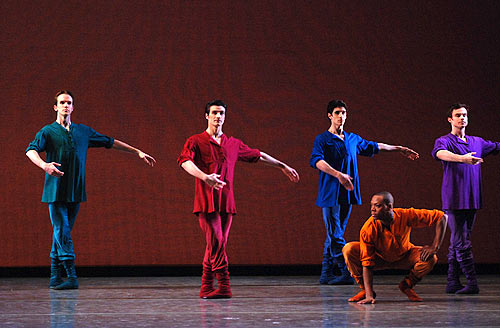
    Thursday March 26th, 2015 – Oratorio Society of New York presenting the Verdi REQUIEM at the Cathedral of St John the Divine. This was my second experience of this magnificent work in a sacred setting: many years ago I attended a performance of it in the Chapel at Trinity College, Hartford CT. On that evening, an organ and a small ensemble of instrumentalists played in lieu of a full orchestra, but the work still made a vivid impression. Tonight we had the admirable young musicians of the Manhattan School of Music Orchestra (and their symphonic chorus) joining the Oratorio Society for a full-force rendering of Verdi’s ‘sacred opera’.

    A huge audience – an overflow crowd, actually – filled the cathedral and (except for one cellphone beeping at a particularly inopportune moment) they listened in reverential silence. It was overall a very fine performance of the REQUIEM but sonically it was problematic in that the reverberant echoing throughout the huge space often turned the music into a blur. Much of the music’s definition was lost, and much detail from the inner orchestral voices vanished in the clouds of echo. There was the illusion of notes being played twice, and the music sometimes seemed to be fighting itself.

    Kent Tritle conducted, and a strong quartet of soloists took part:

    Jennifer Check, soprano
    Sara Murphy, mezzo-soprano
    Alex Richardson, tenor
    Matthew Boehler, bass
    These four singers often seemed to me to be swamped by the sound of the orchestra and chorus flowing over them in both directions. How they managed to pick up their cues, I will never know. Nevertheless, there were many savorable vocal passages. Mr. Boehler, who made a fine impression recently in IOLANTA at The Met, projected the text with vivid dynamic detail, and Mr. Richardson sang musically and with passion.

    Sara Murphy, whose opulent mezzo made a marvelous impact when she sang Ligeti and Schnittke with the American Symphony Orchestra earlier this season, was very impressive tonight both for beauty of tone and clarity of projection. So much music I want to hear her sing! 

    11111962_913591532037896_5248156677226624389_n

    Jennifer Check (above, photo by Brian Hatton), who stepped in to the soprano part rather late in the day, sounded lovely. Her voice has power but also a silvery lyrical quality, and in the Offertorio she produced a spine-tingling sustained piano E-natural (which modulates magically to an E-flat…one of the most felicitous moments in this glorious work). For the great final ‘aria’, Requiem aeternam, Ms. Check closed her score and gave an intense, very personal performance of this prayerful solo; using her right hand in gently expressive gestures, she seemed to send forth a benediction of peace and tranquility.

  • Paul Taylor @ Lincoln Center 2015 #4

    Piazzolla Caldera michelle

    Above: Michelle Fleet in Paul Taylor’s PIAZZOLLA CALDERA; photo by the late Tom Caravaglia

    Tuesday March 24th, 2015 – The tonight’s programme, my final opportunity to see the Paul Taylor Dance Company during their current Lincoln Center stint, featured two works I’d seen earlier in the season: SUNSET and EVENTIDE, plus the darkly alluring PIAZZOLLA CALDERA.

    SUNSET, with its off-duty soldiers and a quartet of white-clad girls, is set to music by Edward Elgar with a nostalgic feeling and to a central section where only the sounds of loons crying is heard. There are playful passages – Aileen Roehl gets tossed daringly from man to man – but the overall atmosphere is pensive, with fleeting possibilities of romance. The men march off to duty, leaving the girls downcast. In a high-lighted role, Eran Bugge was superb; she is left at the end clutching a red beret which one of the soldiers has dropped. 

    Eventide 1

    Above, from EVENTIDE: James Samson, Laura Halzack, Francisco Graciano, and Heather McGinley in a Paul B Goode photo.

    I really fell under the spell of EVENTIDE during this Taylor season. This romantic work, with its melodious Vaughan Williams score, was poetically danced tonight. A series of duets presents us with the opportunity to savor the expressive qualities of ten of the Company’s distinctive artists while in ensemble passages the simple act of walking takes on a poignant resonance. 

    Piazzolla Caldera 3

    Above: the Taylor men in PIAZZOLLA CALDERA; photo by Paul B Goode

    PIAZZOLLA CALDERA premiered in 1997, drawing Paul Taylor into the world of the tango. The tango grew out of many musical influences – Spanish, Italian, Indian, African and Jewish – and reached a height of artistic expression in the music of Astor Piazzolla. For his ballet, Paul Taylor avoided using any actual tango steps but was able magically to distill the essence of this exotic dance form. In a smoke-filled, dimly lit and disreputable bar, working-class men and women meet to dance and imbibe in a steamy after-hours atmosphere. They pose, provoke, titillate, and deny each other in a series of sexually fraught duets and trios.
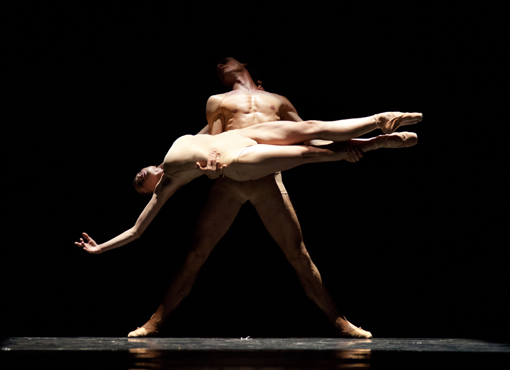
    Parisa Khobdeh showed a vivid mixture of tension and allure in a commanding performance; she drifted in and out of a pas de trois with Eran Bugge and Robert Kleinendorst, later seizing the stage for herself. In a sexy/drunken duet, Francisco Graciano and Michael Apuzzo seemed alternately on the verge of kissing or knifing each other, while the sizzling pairing of Michelle Fleet and Michael Trusnovec gave fresh meaning to the word “electrifying”. PIAZZOLLA CALDERA was the perfect finale for an evening of great dance, and the crowd went wild at the end of the show.

  • Lament for the Rohirrim

    Riders of rohan

    “Where now the horse and the rider? Where is the horn that was blowing?
    Where is the helm and the hauberk, and the bright hair flowing?
    Where is the hand on the harpstring, and the red fire glowing?
    Where is the spring and the harvest and the tall corn growing?
    They have passed like rain on the mountain, like a wind in the meadow;
    The days have gone down in the West behind the hills into shadow.
    Who shall gather the smoke of the dead wood burning,
    Or behold the flowing years from the Sea returning?”

    ~ THE TWO TOWERS/JRR Tolkien