Blog

  • Chamber Music Society’s Season Finale

    Banner1

    Above: The Emerson String Quartet (Lawrence Dutton, Paul Watkins, Eugene Drucker, Philip Setzer) in a Lisa Mazzucco photo

    Tuesday May 19th, 2015 – Marking the end of their wonderful 2014-2015 season, Chamber Music Society of Lincoln Center presented the Emerson String Quartet, joined by violist Paul Neubauer and cellist Colin Carr, in a programme featuring the New York City premiere of a Lowell Liebermann work plus classics from Mozart and Tchaikovsky.

    It seems like only yesterday that I opened the CMS 2014-2015 season brochure and found myself anticipating every single one of the concerts listed; how quickly the months have flown by! But a few weeks ago, the Society announced their first Summer Season, and so now we will not have to wait until Autumn to be back at Tully Hall, hearing the great music and incredible artists who make the Society such a valuable part of our lives. 

    Tonight Alice Tully Hall was packed for this, the second performance of this programme. The Emerson String Quartet, surely one of the greatest chamber ensembles of all time, showed their mastery in works of contrasting styles; their marvelously integrated sound has a richness all its own: there are times you’d swear you’re listening to larger orchestra.

    Lowell Liebermann’s String Quartet No. 5 is one of the finest new works I have heard in recent years; not only is it superbly crafted, but it also draws a deep emotional response – something you can’t honestly say about a lot of newer music. Mr. Liebermann, who was seated directly behind us, wrote this brief note for the Playbill: “…I have no doubt that my mindset composing the piece and its resultant overriding elegiac tone was at least partly influenced by any number of depressing/terrifying events of the kind with which we are bombarded daily, in what seems more and more like a world gone mad.”  That sentence encapsulates to perfection my own feelings as I turn to the news each day and think “Can these things really be happening? Can people really have become so vain, shallow, and heartless? Has humanity lost its soul?” And so we turn to great music, both for consolation and also – sometimes – to weep with us. And that’s exactly what this quartet does.

    The music wells up from a deep cello phrase to eerie murmurings and a mournful viola theme. There’s a muted lullabye and a lamenting theme passed from viola to violin 2. Poignant textures draw us deeper and deeper into the music, and then it starts to scurry. A dance for viola is taken up by the violin; agitation builds. A full-scale canon develops, then more swirling dance music. A buzz, a violin duo, and then calm is restored with a yearning theme. A simply gorgeous violin solo is passed to violin 2 and then to the viola, which sings of anguish. A plucked passage from violin and viola takes us to a violin solo of pristine sadness before the music starts to echo its beginnings, fading in a ghostly glimmer. A profound silence filled the hall as the musicians finished: this evocative and thought-provoking piece had clearly made a deep impression. The composer was called to the stage, as bravos resounded. Both the music and the playing of it left me spell-bound.

    I kind of wished there’d been an intermission at that point, the better to remain in reverie; but Mozart’s Quintet in E-flat major K 614 brought the esteemed violist Paul Neubauer to the stage with the Emerson for music that was an antidote to the Liebermann and, almost against my will, I was drawn out of my pensive state into a sunnier place.

    Though written in Mozart’s last year, this Quintet is optimistic in tone and quite jolly in its dance motifs. Its elegant andante, prancing minuet, and jaunty finale were all played with spirit and grace, with much lovely ‘communicating’ between the players.

    For the evening’s concluding performance of Tchaikovsky’s Souvenir de Florence, Philip Setzer took the 1st violin stand with Mr. Neubauer and cellist Colin Carr adding their rich voices to the Emerson’s choir. The sound of this ensemble was really phenomenal, of symphonic resonance.

    The Souvenir is a pleasure from first note to last, but just as Tchaikovsky’s adagios in Swan Lake and Sleeping Beauty strike us most deeply in the heart, it’s the second movement of Souvenir that speaks directly to the receptive spirit. It reminded me so much of the composer’s Serenade for Strings which Balanchine transformed into his remarkable and eternal ballet masterpiece Serenade. Tonight’s performance of this Adagio cantabile was so richly played and so moving: music as consolation.     

    The Repertory:

    The Participating Artists:

  • At Home With Wagner VIII

    1310368-Richard_Wagner

    In 1968, Lorin Maazel conducted the RING Cycle at Bayreuth and from that cycle, the WALKURE looked especially tempting to me: not only are the ever-thrilling pairing of Leonie Rysanek and James King cast as the Wälsungs and such stalwart Wagnerians as Berit Lindholm, Theo Adam and Josef Greindl featured, but a rare performance as Fricka by Janis Martin – a singer in whom I’ve recently taken a renewed interest and who in December 2014 passed away – drew me to purchase this set. It’s an exciting performance in many ways, and Ms. Martin’s Fricka is one of the best-sung I have heard.

    Leonie Rysanek and James King sang Sieglinde and Siegmund together often, including on the commercial release of the entire Cycle conducted by Karl Böhm; the two singers know these roles inside-out but somehow they always manage to make the music seem fresh and genuinely exciting. Rysanek, always a powerhouse singer at The Met, scales down her voice here to suit the more intimate space of the Bayreuth Festspielhaus. She creates many poetic effects but when the emotional temperature of the drama rises, Rysanek – as ever – turns up the voltage. In Act I she produces her trademark hair-curling top notes and the famous scream (at Wieland Wagner’s bidding) as the sword is pulled from the tree. 

    James King is in superb voice; he sings with tireless generosity – his Sword Monolog one of the finest I’ve heard, with his astonishing cries of “Walse! Walse!” sustained with epic fervor – and he’s always vivid in the expressing the passions of the final pages of Act I. That pillar of Wagnerian basso singing, Josef Greindl, is as ever a strong and fearsome Hunding. The three singers, with vital support from Masetro Maazel (his tempos tending towards speed rather than breadth) make for a truly stimulating rendering of this act.

    As Wotan, Theo Adam’s powerful voice greets his favorite daughter; Berit Lindholm is bright and true in Brunnhilde’s battle cry, and then Janis Martin as Fricka arrives to throw a monkey-wrench into her husband’s plans. Ms. Martin, at this point in her career about to transition from mezzo to soprano (in the 1970s she was to be my first in-house Sieglinde, Kundry and Marie in WOZZECK); thus the highest notes of Fricka’s music hold no terrors for her. Her singing is clean, wide-ranging, and impressive. As she and Mr. Adam debate the matters at hand, Lorin Maazel’s orchestra underscores both sides of the argument. Ms. Martin exits, secure in her triumph.

    T adam

    Theo Adam (above) was my very first Wotan at The Met in RHEINGOLD in 1969, and I saw him some 20 years later, still very impressive in WALKURE. His sound per se is not highly individualized – it’s basically darkish and grainy – but he always manages to use it to optimum effect. His long monolog, with keen support from Maazel and increasingly urgent responses from Lindholm, is appropriately central to the drama of the performance.

    Rushing on, pursued by Hunding’s hounds, Rysanek and King make much of their scene together. For Ryssanek, moments of lyric tenderness veer off to outbursts of hysteria; King is heroically comforting. Rysanek emits a demented, curdled scream at the sound of Hunding’s approaching horns, and as she swoons, King sings “Schwester! Geliebte” as tenderly as I have ever heard it done. 

    In the great Todesverkundigung scene (the Annuncation of Death, where Brunnhilde appears as in a vision and warns Siegmund of his impending death in battle), Maazel brings weightiness without impeding the forward flow. A doom-ladened feeling of tension and barely controlled urgency underscores the exchange between soprano and tenor, with Ms. Lindholm expressing increasing desperation as she feels herself losing control of the situation. Maazel brilliantly emphasizes Brunnhilde’s shift of allegiance: a feeling of high drama as she rushes off. 

    The poignant cello ‘lullabye’ as Siegmund blesses Sieginde’s slumber is taken up by the orchestra with a rich sense of yearning, til Hunding’s horns intrude to terrifying effect. Awakening in a daze before grasping the situation, Rysanek’s mad scene reaches fever pitch. Adam thunders forth Wotan’s intercession, Rysanek screams as Siegmund is slain. After Wotan has dispatched Hunding with great contempt, Adam and Maazel rise to a thunderous finish as Wotan storms away to catch the traitorous Brunnhilde.

    Synek_Portrait1a

    Above: Liane Synek

    An excellent Helmwige from Liane Synek (sample her singing here, as Brunnhilde in a passage from a WALKURE performance in Montevideo 1959): she stands out from some rowdy singing by her sister-Valkyries. 

    Sieglinde’s desperate plea to be slain turns to joy as Brunnhilde informs her that she is with child, giving wing to Leonie Rysanek’s cresting ‘O hehrstes Wunder!’, the crowning moment of one of the soprano’s greatest roles.

    The scene is then set for the final father-daughter encounter; both Lindholm and Adam have moments of unsteadiness and the sound-quality is sometimes marred by overload. But both singers are truly engaged in what they are singing, with Theo Adam particularly marvelous in the long Act III passage starting at “So tatest du, was so gern zu tun ich begehrt…” (“So you did what I wanted so much to do…”) Once Brunnhilde has fallen into slumber, the bass-baritone and Maestro Maazel give an emotionally vibrant performance of Wotan’s farewell.

    ~~~~~~~~~~~~~~~~~~~~~~~~~~~~~~~~~~~~~~~~~~~~~~~~~~~~~~~~~~~~~~~~~~~~~~~~~~~~~~~~~~~~~~~~~~~

    Lilowa

    Above: mezzo-soprano Margarita Lilowa

    A RHEINGOLD from Vienna 1976 piqued my curiosity – mainly to experience the conducting of Horst Stein whose superb 1975 Bayreuth GOTTERDAMMERNG I wrote about here. I was also wanting to hear Margarita Lilowa’s Erda, having recently really enjoyed her singing as Mary in a recording of FLIEGENDE HOLLANDER, and Peter Hofmann in what is said to be his Vienna debut performance, as Loge.

    The recording is clearly not from a broadcast but rather was recorded in-house; the sound varies – some overload in spots, some distancing of the voice, a couple of dropouts – and in quieter passages the breathing of the person making the recording can be heard: an unsettling effect. Also during the Alberich/Mime scene there’s some annoying mike noise. But overall, with steadfast concentration, the performance has many rewards. And chief among them is Maestro Stein’s expert shaping of the score.

    The Rhinemaidens are Lotte Rysanek (Leonie’s sister, who sometimes sounds a bit like her famous sibling), Rohangiz Yachmi, and Axelle Gall. Their more attractive moments come in solo lines rather than in a vocal blend. Zoltán Kelemen, the Alberich of the era, is superb here. He paints a full vocal portrait of the dwarf, from his early semi-playful pursuit of the Rhinemaidens thru the rape of the Gold, on to the vanity of his bullying Lord of Nibelheim, his shattering fall into Loge’s trap, and the vividly expressed narrative leading up to the Curse.

    Grace Hoffmann and Theo Adam are experienced Wagnerians who inhabit their roles thoroughly. The mezzo’s voice is no longer at its freshest (she was in the twenty-fifth year of her career here) but she is authoritative in characterization. Adam, strong and true of voice, makes a fine impression throughout, especially in his final hailing of Valhalla.

    Hannelore Bode’s voice seems too weighty and unwieldy for Freia, but the giants who pursue her are impressive indeed: Karl Ridderbusch and Bengt Rundgren are so completely at home as Fasolt and Fafner, and their dark, ample voices fill the music richly. Hale and hearty one moment, and wonderfully subtle the next, both bassos make all their music vivid. A lyric Froh (Josef Hopferweiser) and an ample-toned Donner (Reid Bunger – his “Heda! Hedo” has a nicely sustained quality) are well-cast.      

    Peter-Hofmann-calendar-250x350px

    Above: tenor Peter Hofmann

    Peter Hofmann’s Loge has a baritonal quality, and he blusters a bit but soon settles in to give a sturdy if not very imaginative performance of the Lord of Fire. The Nibelheim scene finds Adam, Hofmann, and Kelemen all at their keenest in sense of dramatic nuance, and Heinz Zednik is a capital Mime, well-voiced and inflecting the text with eerie colours.

    Ms. Lilowa’s Erda, sounding from a distance at first, comes into focus after her first line or two and has a round-toned, steady voice, making the most of her brief but important scene.

    Horst Stein’s overall vision of the score seems nearly ideal to me, and there are a number of particularly satisfying passages: his underscoring of the big lyric themes in Loge’s narrative, the detailing of the orchestral parts at Loge’s mention of Freia’s apples, the descent to Nibelheim. And once in Alberich’s domain, Stein shows keen mastery of nuance, both in colorfully supporting the dialogue and in a truly ominous “dragon” theme for Alberich’s transformation. Throughout the performance, it’s Stein who keeps us keenly focused on this marvelous score.

    ~~~~~~~~~~~~~~~~~~~~~~~~~~~~~~~~~~~~~~~~~~~~~~~~~~~~~~~~~~~~~~~~~~~~~~~~~~~~~~~~~~~~~~~~~~~

    Mcintyre

    Above: Sir Donald McIntyre

    Another RHEINGOLD – a recording of a performance I actually attended – is from a Met broadcast of February 15th, 1975. It’s interesting to compare my reactions to the recording with what I had written in my opera diary on the day of the performance, some forty years earlier.

    The 1974-75 season was a rich one for me; I was living (though not enrolled) at Sarah Lawrence College with TJ. We’d had our summer on Cape Cod together and, as we prepared to part company and resume our separate lives, we found we’d become so attached to one another that, only a few days after I’d returned to the tiny town and he’d moved into the college dorm, we threw caution to the wind and I went down and got a temp job at IBM in Westchester County and slept with him in his twin bed (he had drawn, luckily, one of the few ‘private’ room on the entire campus). We went down to Manhattan for the opera and the ballet three or four times a week.

    The Met were doing the RING Cycle that season, with Sixten Ehrling conducting. The virtues (or not) of his readings of the scores were hotly debated by the fans; he was sometimes booed when entering the pit, and sometimes cheered when he took his bows at the end of each opera. I thought at the time his conducting was “maybe lacking in grandeur, but well-paced and considerate of the singers.” Listening to it now, his RHEINGOLD seems perfectly fine, with many very satisfying passages…despite some fluffs from the horns here and there.

    Ehrling-Sixten-05

    Above: Sixten Ehrling

    (Note: in 1998, when I started working at Tower Records, I met Maestro Ehrling and his charming wife, a former ballerina. The first day I met him, he was in a cantankerous mood because all the clerks were busy and he was in a rush. I stepped up, greeted him with a little bow, and immediately began to talk to him about his RING Cycle. He became a regular customer and regaled me with all sorts of wonderful stories about the singers he had worked with. He also liked to correct my pronunciation; when I referred to Wotan’s daughter as “Broon-HILL-da” he yelled: “BROON-hil-d…” I ended up really enjoying our little friendship, and missed him when he became too ill to come to the store…though he’d often send his wife to us, with strict instructions as to what to buy for him. He passed away in 2005.)  

    Christine Weidinger, Marcia Baldwin, and – especially – Batyah Godfrey are good Rhinemaidens; they raise the performance level starting with the first appearance of the ‘gold’ motif. Marius Rintzler seems at first to be a bass-oriented Alberich (though later his topmost notes are wonderfully secure) and he becomes actually scary as his plan to steal the treasure takes over his mind. Abetted by Ehrling, the scene of the rape of the gold is dramatically vivid.

    Ehrling scores again in his super-reading of the descent to Nibeheim. Rintzler as Alberich, in his own domain, lords it fabulously over his brother and his slaves. Later, betrayed, Rintzler’s performance rings true in its desperation and his powerful declaiming of the curse.

    The opera’s second scene shows Ehrling at his best, with a nice sense of propulsion and excellent support of his singers. This matinee marked the Met debut of Donald McIntyre as Wotan; he would become known and beloved worldwide a few years later when the Chereau RING was filmed for international telecast at the Bayreuth Festival. On this afternoon in 1975, he makes a superb impression: he begins a bit sleepily (Fricka has just awakened him) but once he claps eyes on the finished Valhalla, his godliness rises to full stature. His singing throughout is generously sustained; by turns imperious and subtle, he makes an ever-commanding dramatic impression. McIntyre’s final scene, hailing the new home of the gods and dismissing the Rhinemaidens who plead from below for the return of the ring, is really exciting.

    Mignon Dunn, always a great favorite of mine, is an immediately distinctive Fricka. The role is rather brief, but Mignon makes the most of every opportunity, and her gift for vocal seduction manifests itself near the end, as she lures Wotan’s thoughts away from the mysterious Erda and turns them instead towards Valhalla (where she hopes to keep him on a tighter tether…but, it doesn’t work.)

    Glade Peterson, as Loge, seems rather declamatory at first. His ample voice serves him well in the monolog, despite some moments of errant pitch. He lacks a bit of the subtlety that can make Loge’s music so entrancing. As the hapless Mime, Ragnar Ulfung is both note-conscious and characterful; he makes a string impression though once or twice he too wanders off-pitch.

    The giants are simply great: John Macurdy’s Fafner is darkly effective – he has less to sing than his brother Fasolt, but he will eventually get the upper hand…violently. Bengt Rundgren as the more tender-hearted of the two is truly authoritative, with page after page of finely inflected basso singing.

    Mary Ellen Pracht, a Met stalwart, does well as Freia, and William Dooley is a splendid Donner…his dramatic, full-voiced cries of “Heda, Hedo!” are in fact a high point if the opera, and are punctuated by a fantastical thunder-blast. Tenor Kolbjørn Høiseth is rather a fuller-toned Froh than we sometimes hear; there’s something rather ‘slow’ about his delivery. (A few days later, he sang a single Loge at The Met, and then a single Siegmund.)

    In the house, the amplifying of Erda’s Warning ruined the moment musically, but this does not affect the broadcast which is picked up directly from the stage mikes. And so Lili Chookasian makes an absolutely stunning effect with her rich, deep tones. Where are such voices as hers today? After “Alles was ist, endet!” and “Meide den Ring!”, one feels chills running up and down the spine. Magnificent!

  • Open Rehearsal: New Chamber Ballet

    L1570082

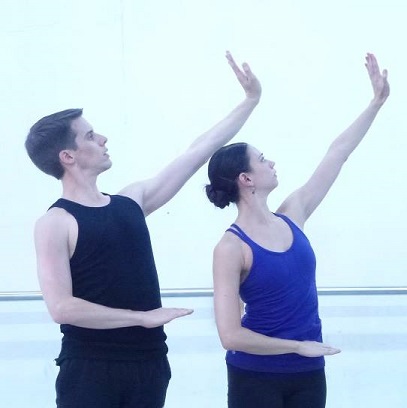
    Above: dancers Holly Curran and Amber Neff of New Chamber Ballet

    Saturday May 16th, 2015 – Preparing for their final performances of the current season, New Chamber Ballet opened their rehearsal at MMAC today to friends of the Company. The works being rehearsed were Constantine Baecher’s Two Tauri And A Tiger (music: Wolfgang Amadeus Mozart) – which the Company premiered in April 2015 – and a new ballet by NCB‘s artistic director Miro Magloire: Friction, set to music by Richard Carrick.

    L1570052

    Friction is commissioned as part of an Artist Residency at the Center for Faith and Work. At the moment, the ballet is still in its developmental stages; it is a duet danced by Holly Curran and Amber Neff (above) and the rehearsal process has given rise to a new word: “fricting”. The dance draws on motifs of friction from the dancer’s feet upon the floor, from the dancers’ body contact with one another, and from the application of bow to strings of Doori Na’s violin.

    L1570079

    Above: Holly and Amber

    L1570085

    Above: Miro observing

    L1570122

    Constantine Baecher (above) then discussed the movement elements of his ballet Two Tauri and A Tiger. Melody Fader was at the piano to play the Mozart score as the three dancers demonstrated the free-flowing, improvisational phrases on which the work is built.

    L1570157

    Above: Traci Finch, Elizabeth Brown, and Sarah Atkins, about to start Two Tauri

    Observing the creative process in retrospect (I have already seen the ballet performed) gave me an entirely different feel for the piece. The dancers spoke of the joys (and challenges) of improvising, especially in the context of the intimate setting of New Chamber Ballet’s performances. 

    L1570100

    Above: Sarah and Traci waiting to dance

    New Chamber Ballet will close their 10th anniversary season Friday, June 12th and Saturday, June 13th, 2015, at 8:00 PM at City Center Studios, 130 West 56th St, 5th floor. Both of the works we saw in the studio today will be on the programme.

  • Berlioz’s THE TROJANS @ Covent Garden 1957

    Thebomtroj

    A recording of the Royal Opera’s 1957 English-language production of Hector Berlioz’s monumental opera THE TROJANS has come my way and it has many felicitous elements. The translation appropriately relies on Early Modern English pronouns (thee/thou/thine) to evoke the ancient kingdoms of Troy and Carthage. With a few passing cuts in this epic opus, Rafael Kubelik helms the performance impressively and the sound quality is quite good for a recording made 50+ years ago.

    For years after I discovered opera in 1959, I subscribed to the British magazine OPERA. The cast of this TROJANS is full of ‘Covent Garden’ names that were familiar to me thru the magazine long before I heard any of their actual voices: people like Amy Shuard, Forbes Robinson, Noreen Berry, Marie Collier, Joan Carlyle, Michael Langdon, and Lauris Elms.

    At The Met, Blanche Thebom was an established star (Met debut 1944) by the time she appeared as Dido in London, and Jon Vickers made his role-debut as Aeneas in this ’57 performance, which became a signature part for the great tenor.

    Curiously, this is a performance in which each of the three principal singers proves less than ideal, yet the overall performance – thanks to Maestro Kubelik and the strong supporting cast – still makes a vivid impression. 

    Amy Shuard does not seem absolutely at home in the role of Cassandra; she has passing pitch problems and some of the music seems to lay too low for her to make her finest impression. Her commitment is undoubted, and her sense of the drama and her fine high notes are positive aspects. But often one just wants more power and colour in the lower-middle and lowest ranges of this music, which rather awkwardly straddles the mezzo/soprano divide.

    Blanche Thebom as Dido has the right aristocratic feeling for Dido’s music; she becomes more passionate as her love for Aeneas is inflamed – and then thwarted – by destiny. Thebom’s strong top notes stand out, and she fills scene after scene with perfectly good singing; yet her voice sometimes seems matronly and a bit lacking in tonal bloom. 

    It would be nice to be able to say that Jon Vickers’ first Aeneas was an unalloyed triumph, but despite his excellent diction and superbly individual voice – which amply conveys the the character’s innate humanity and rather grizzled tenderness – and his sense of vocal identification with every aspect of the hero’s personality, he is not at ease in the role’s top-most notes. He omits the highest vocal arc of the love duet, reveals some effort in the demanding “Inutiles Regrets!” and seems rather uncomfortable in his final  cry of “Italie!” As Vickers sang the role in the ensuing years, his voice found itself increasingly at home in this demanding music; and indeed even here in 1957 there is much impressive singing.

    Despite some reservations about both Thebom and Vickers, they do achieve some especially fine soft harmonies as they sing of the mysterious wonders of love in the great duet “Nuit d’ivresse.”

    The stalwart baritone Jess Walters sings strongly as Chorebus; his duet with Ms. Shuard is full of apt dramatic touches from both singers – and the soprano’s concluding top-B is her best note of the performance.

    Lauris-elms

    Lauris Elms (above) makes an especially lovely impression as Dido’s sister, Anna. Anna’s role includes two wonderful duets: the first, with Dido, in which she urges her widowed sister to consider opening her heart to another love; and the second, with Dido’s minister Narbal. Narbal’s concerns about the effects of the Dido/Aeneas attachment on Dido’s ability to rule are brushed off by her sister who is so delighted at Dido’s new-found happiness. Ms. Elms has a full-throated lyric mezzo sound and dips into her lower range without over-emphasis; her voice is clear and so is her diction. I keep going back to Anna’s two duets, just to enjoy Ms. Elms’ vocalism.

    Joining Lauris Elms in the Anna/Narbal duet, basso David Kelly – who was an indispensable Covent Garden regular for fifteen years – is a perfect match for the mezzo; his diction and well-produced voice make for a very effective portrayal.

    Verreau-Richard-2

    I was particularly pleased with the Iopas of Richard Verreau (above); this French-Canadian tenor was my first Faust in a performance at the Old Met in 1963. He sings the high-lying solo “O blonde Cérès” quite beautifully, in a more passionate and extroverted interpretation of the aria than is sometimes heard. In the second of LES TROYENS’ two taxing and exposed solos for lyric tenors, Irishman Dermot Troy sings the plaintive aria of the homesick sailor Hylas with attractive lyricism.

    TROYENS is such a unique and treasure-filled opera; whatever concerns this recording raises, I am sure I will return to it time and again.

  • Berlioz’s THE TROJANS @ Covent Garden 1957

    Thebomtroj

    A recording of the Royal Opera’s 1957 English-language production of Hector Berlioz’s monumental opera THE TROJANS has come my way and it has many felicitous elements. The translation appropriately relies on Early Modern English pronouns (thee/thou/thine) to evoke the ancient kingdoms of Troy and Carthage. With a few passing cuts in this epic opus, Rafael Kubelik helms the performance impressively and the sound quality is quite good for a recording made 50+ years ago.

    For years after I discovered opera in 1959, I subscribed to the British magazine OPERA. The cast of this TROJANS is full of ‘Covent Garden’ names that were familiar to me thru the magazine long before I heard any of their actual voices: people like Amy Shuard, Forbes Robinson, Noreen Berry, Marie Collier, Joan Carlyle, Michael Langdon, and Lauris Elms.

    At The Met, Blanche Thebom was an established star (Met debut 1944) by the time she appeared as Dido in London, and Jon Vickers made his role-debut as Aeneas in this ’57 performance, which became a signature part for the great tenor.

    Curiously, this is a performance in which each of the three principal singers proves less than ideal, yet the overall performance – thanks to Maestro Kubelik and the strong supporting cast – still makes a vivid impression. 

    Amy Shuard does not seem absolutely at home in the role of Cassandra; she has passing pitch problems and some of the music seems to lay too low for her to make her finest impression. Her commitment is undoubted, and her sense of the drama and her fine high notes are positive aspects. But often one just wants more power and colour in the lower-middle and lowest ranges of this music, which rather awkwardly straddles the mezzo/soprano divide.

    Blanche Thebom as Dido has the right aristocratic feeling for Dido’s music; she becomes more passionate as her love for Aeneas is inflamed – and then thwarted – by destiny. Thebom’s strong top notes stand out, and she fills scene after scene with perfectly good singing; yet her voice sometimes seems matronly and a bit lacking in tonal bloom. 

    It would be nice to be able to say that Jon Vickers’ first Aeneas was an unalloyed triumph, but despite his excellent diction and superbly individual voice – which amply conveys the the character’s innate humanity and rather grizzled tenderness – and his sense of vocal identification with every aspect of the hero’s personality, he is not at ease in the role’s top-most notes. He omits the highest vocal arc of the love duet, reveals some effort in the demanding “Inutiles Regrets!” and seems rather uncomfortable in his final  cry of “Italie!” As Vickers sang the role in the ensuing years, his voice found itself increasingly at home in this demanding music; and indeed even here in 1957 there is much impressive singing.

    Despite some reservations about both Thebom and Vickers, they do achieve some especially fine soft harmonies as they sing of the mysterious wonders of love in the great duet “Nuit d’ivresse.”

    The stalwart baritone Jess Walters sings strongly as Chorebus; his duet with Ms. Shuard is full of apt dramatic touches from both singers – and the soprano’s concluding top-B is her best note of the performance.

    Lauris-elms

    Lauris Elms (above) makes an especially lovely impression as Dido’s sister, Anna. Anna’s role includes two wonderful duets: the first, with Dido, in which she urges her widowed sister to consider opening her heart to another love; and the second, with Dido’s minister Narbal. Narbal’s concerns about the effects of the Dido/Aeneas attachment on Dido’s ability to rule are brushed off by her sister who is so delighted at Dido’s new-found happiness. Ms. Elms has a full-throated lyric mezzo sound and dips into her lower range without over-emphasis; her voice is clear and so is her diction. I keep going back to Anna’s two duets, just to enjoy Ms. Elms’ vocalism.

    Joining Lauris Elms in the Anna/Narbal duet, basso David Kelly – who was an indispensable Covent Garden regular for fifteen years – is a perfect match for the mezzo; his diction and well-produced voice make for a very effective portrayal.

    Verreau-Richard-2

    I was particularly pleased with the Iopas of Richard Verreau (above); this French-Canadian tenor was my first Faust in a performance at the Old Met in 1963. He sings the high-lying solo “O blonde Cérès” quite beautifully, in a more passionate and extroverted interpretation of the aria than is sometimes heard. In the second of LES TROYENS’ two taxing and exposed solos for lyric tenors, Irishman Dermot Troy sings the plaintive aria of the homesick sailor Hylas with attractive lyricism.

    TROYENS is such a unique and treasure-filled opera; whatever concerns this recording raises, I am sure I will return to it time and again.

  • Season Finale: Score Desk for BALLO IN MASCHERA

    -hvorostovsky-radvanovsky

    Above: Dmitry Hvorostovsky and Sondra Radvanovsky

    Tuesday April 28th, 2015 – For my final Met performance of the current season, Verdi’s BALLO IN MASCHERA with probably the strongest overall cast of any opera produced at the Met this season. I felt no need to see the Met’s mixed-bag, neither-here-nor-there production again, so I was back at my score desk. Of the twenty-plus performances I attended at the Met this season, most were experienced from score desks; there is less and less of a need to actually see what it happening onstage, so why spend the money on a ‘room with a view’? And besides, I hardly ever stay to the end of anything thanks to the slow agony of the Gelb-length intermissions. Tonight, though, my two amusing friends Adi and Craig helped make the long breaks somewhat more tolerable.

    Tonight’s audience was one of the largest I’ve seen at the opera all season. The Met’s always been a ‘singers house’; the box office is voice-driven and has been since the days of de Reszke and Caruso. There was Flagstad, and Birgit and Franco; and there was Pav, and now there’s Netrebko and Kaufmann. People come for the singing because that’s what opera is all about.

    The evening began with an announcement that James Levine would be replaced on the podium by John Keenan. This may have been a rather last-minute decision since Levine’s special wheelchair platform was in place. Keenan is a very fine Wagner conductor, but in the Italian repertoire Joseph Colaneri would be my choice if Levine is ailing. Much of Act I tonight had an unkempt quality; the singers seemed to want different tempi than Keenan was offering them, and they tended to speed ahead, leaving the orchestra to catch up.

    Piotr Beczala – superb in IOLANTA earlier in the season – sounded a bit tired in Act I. His opening aria was not smooth and the climactic top A-sharp was tight and veered above pitch. He began to settle in vocally at Ulrica’s, though the (written) low notes in “Di tu se fedele” were clumsily handled – no one would have cared if he’d sung them up an octave. By the time he reached the great love duet, Beczala was sounding much more like his usual self, and his “Non sai tu che se l’anima mia” was particularly fine. Spurred on by his resplendent soprano, the Polish tenor invested the rest of the duet with vibrant, passionate singing.

    As Ulrica, Dolora Zajick was exciting: the voice has its familiar amplitude and earthy chest notes intact and she also sang some beautiful piani, observing Verdi’s markings. It’s not her fault that the production idiotically calls for amplification of her deep call for “Silenzio!” at the end of her aria. Dolora’s chest tones don’t need artificial enhancement.

    Heidi Stober was a serviceable Oscar; her highest notes could take on a brassy edge and overall she lacked vocal charm. Memories of Reri Grist, Roberta Peters, Judith Blegen, Lyubov Petrova, and Kathleen Kim kept getting in my ear, perhaps unfairly.

    Dmitry Hvorostovsky as Count Anckarström was in splendid voice from note one, and his opening aria “Alla vita che t’arride” was beautifully phrased with a suave legato, the cadenza rising up to a majestically sustained high note. In the scene at the gallows (or rather – as this production places it – “in an abandoned warehouse…”) the baritone was vividly involved, first as a loyal friend urging his king to flee and later as the shamed, betrayed husband.

    Sondra Radvanovsky, who in 2013 gave us a truly impressive Norma at The Met, was – like the baritone – on top form. With a voice utterly distinctive and unlike any other, and with the seemingly innate ability to find the emotional core of any role she takes on, Radvanovsky has a quality of vocal glamour that makes her undoubtedly the most exciting soprano before the public today. What makes her all the more captivating is that, if a random note has a passing huskiness or isn’t quite sounding as she wants it to, she’s able to make pinpoint adjustments and forge ahead. This makes her singing interesting and keeps us on high alert, wondering what she’ll do next. Thus she generates a kind of anticipatory excitement that is rare these days.

    Launching Amelia’s “Consentimi o signore’ in the Act I trio, Sondra shows off the Verdian line of which she alone today seems true mistress. When we next meet her, she is out on her terrified search for the magical herb. Unfurling the grand recitative “Ecco l’orrido campo…” with instinctive dramatic accents, she draws us into Amelia’s plight. The great aria that follows is a marvel of expressiveness (though I do wish she would eliminate the little simpering whimpers during the orchestral bridge…a pointless touch of verismo); and then terror seizes her and she goes momentarily mad before calming herself with the great prayerful ascent to the high-C. The ensuing cadenza was both highly emotional and superbly voiced.

    In the love duet, with Beczala now vocally aflame, Sondra gave some of her most incredibly nuanced, sustained singing at “Ma tu, nobile…”- astounding control –  before the two singers sailed on to the impetuous release of the duet’s celebratory finale and ended on a joint high-C.

    Amelia’s husband unexpectedly appears to warn the king that his enemies are lurking; after Gustavo has fled (has Sondra ever contemplated taking a high-D at the end of the trio here? I’ve heard it done…), soprano and baritone kept the excitement level at fever pitch during the scene with the conspirators: page after page of Verdian drama marvelously voiced, ending with a rich high B-flat from the soprano as she is hauled off to be punished.

    I hate the break in continuity here: ideally we would follow the couple home and the intensity level would suffer no letdown; instead we have another over-long intermission.

    But the mood was quickly re-established when the curtain next rose: Hvorostovsky thundering and growling while Radvanovsky pleads for mercy. Now the evening reached a peak of vocal splendour as the soprano sang her wrenchingly poignant plea “Morro, ma prima in grazia…” Displaying a fascinating command of vocal colour and of dynamics that ranged from ravishing piani to gleaming forte, the soprano was in her greatest glory here, with a spectacular cadenza launched from a sublime piano C-flat before plunging into the heartfelt depths and resolving in a ravishingly sustained note of despair.

    Hvorostovsky then seized the stage. In one of Verdi’s most thrilling soliloquies, the character moves from fury to heartbreak. After the snarling anger of “Eri tu”, Dima came to the heart of the matter: using his peerless legato and vast palette of dynamic shadings, he made “O dolcezze perdute, o memorie…”  so affecting in its tragic lyricism before moving to a state of resignation and finishing on a gorgeously sustained final note. In the scene of the drawing of lots, Hvorostovsky capped his triumph with an exultant “Il mio nome! O giustizia del fato!” – “My name! O the justice of fate: revenge shall be mine!” His revenge will bring only remorse. 

    We left after this scene, taking with us the fresh memory of these two great singers – Radvanovsky and Hvorostovsky – having shown us why opera remains a vital force in our lives.  

    Metropolitan Opera House
    April 28, 2015

    UN BALLO IN MASCHERA
    Giuseppe Verdi

    Amelia.............................Sondra Radvanovsky
    Riccardo (Gustavo III).............Piotr Beczala
    Renato (Count Anckarström).........Dmitri Hvorostovsky
    Ulrica (Madame Ulrica Arvidsson)...Dolora Zajick
    Oscar..............................Heidi Stober
    Samuel (Count Ribbing).............Keith Miller
    Tom (Count Horn)...................David Crawford
    Silvano (Cristiano)................Trevor Scheunemann
    Judge..............................Mark Schowalter
    Servant............................Scott Scully

    Conductor..........................John Keenan

  • Führerbunker

    Holocaust_Memorial_large

    Above: the Berlin Holocaust Memorial

    On Thursday April 30th, 2015, the 70th anniversary of the death of Adolf Hitler will be marked. On that date in 1945, with the Red Army only blocks from his bunker underneath the Reich Chancellery, Hitler and his wife Eva Braun committed suicide.

    On 16 January 1945, Hitler had moved into the Führerbunker, a secure underground haven of residential and office space from whence he continued to rule Germany for three more months. He was joined by his senior staff, Martin Bormann, and later by Eva Braun. At some point Joseph Goebbels with his wife Magda and their six children also took up residence in the upper Vorbunker. Two or three dozen support, medical, and administrative staff were also living there. These included Hitler’s secretaries (among them Traudl Junge), a nurse named Erna Flegel, and telephonist Rochus Misch. Hitler’s dog Blondi was also one of the occupants of the underground bunker; Hitler could sometimes be seen strolling around the chancellery garden with Blondi.

    This recent article in The Guardian tells of the lingering effects of Hitler’s reign of horror on the city of Berlin. Reading the story of course prompted me to watch, yet again, Oliver Hirschbiegel’s 2004 film ‘Der Untergang‘ (Downfall). 

    Der untergang

    In this powerful film, which I cannot recommend highly enough, the Swiss actor Bruno Ganz creates a portrait of Hitler in the final days of his life that has a harrowing feeling of reality. The dictator’s slow grasp of the fact that his Reich is doomed is detailed in scenes in which the character veers from cool efficiency and calculation to epic temper tantrums as he berates his generals and clings desperately to the belief that Germany can still prevail. Once that illusion has been shattered by incoming reports that the bunker is surrounded, Hitler becomes a ghost of himself. He marries Eva, has cyanide capsules tested on his beloved dog Blondi, and finally withdraws with his wife to the private room where they end their lives, having bid farewell to his faithful staff.

    In the film’s most chilling scene, Magda Goebbels (another uncannily ‘real’ characterization, from actress Corinna Harfouch) systematically murders her six children; she then sits down to a game of solitaire before going up to the Chancellery garden where her husband shoots her before taking his own life. This scene so powerfully depicts the sway Hitler held over his followers, creating a vast cult in which he was viewed as nothing less than a god. Following his death, many of the faithful shot themselves rather than face a world where Hitler was no longer.

    German_instrument_of_surrender2

    Above: the instrument of surrender, which ended the war in Europe.

  • All-Brahms @ Chamber Music Society

    Cho-liang lin

    Above: violinist Cho-Liang Lin

    Friday April 24th, 2015 – With their customary flair for matching great music with great musicians, Chamber Music Society of Lincoln Center put together an inviting all-Brahms programme and gathered a world-class ensemble to perform it. It would be fair to say this concert was a highlight of the season to date, but then that seems to be true of each of the Society’s offerings.

    Cho-Liang Lin has always been a particular favorite of mine; he boasts a wonderful discography, with his Stravinsky/Prokofiev disc one I especially like. Tonight he joined pianist Wu Qian for the opening Brahms work: the Violin Sonata in A major Op. 100.  The piece opens with brief, hesitant violin interjections before sailing forth into melody. The second movement – an unusual setting in which Brahms seems to combine an andante and a scherzo (and it works!) – opens with a theme of tenderness and longing, so expressively played by Lin and Qian. Later, when more animated passages arise, their clarity of articulation was most welcome. The serene melody recurs, with major/minor shifts giving an affecting quality. A plucky little dance makes for a sprightly interlude before returning to the andante where the violin now lingers on high. An unexpected little coda gives the movement a brisk finish.

    The sonata’s final movement opens with a poignant theme, lovingly ‘voiced’ by Mr. Lin while Ms. Qian’s piano ripples gently. The music becomes more animated – each player alternately carries the melody by turns – but retains its lyrical heart and eschews virtuosity in favor of something more heartfelt. A friend of the composer said: “The whole sonata is one caress,” and that’s how it seemed this evening in such a beautifully dovetailed rendering from our two artists.

    The Trio in C minor for Piano, Violin, and Cello dates from the same year as the sonata, and follows it immediately in the composer’s catalog of works. Both pieces were written while Brahms was on vacation (a ‘working vacation’, obviously) at Lake Thun, Switzerland; he is thought to have been inspired by the scenery, which is understandable: 

    Lake thun
    The Piano Trio No. 3 was a favorite of Brahms’ dear friend Clara Schumann; she is said to have turned pages for Brahms when he played the work with his two friends – the cellist Robert Hausmann and violinist Joseph Joachim.
     
    This evening’s performance marked the Chamber Music Society debut of the Sitkovetsky Trio. Although  violinist Alexander Sitkovetsky has appeared with the Society before, tonight marked his first performance there with his established chamber music colleagues Richard Harwood (cello) and Wu Qian (piano). Their playing of the C-minor trio drew a well-deserved, vociferous reception from the Tully crowd.
    Concert_pic
     
    Above: The Sitkovetsky Trio
     
    In the Trio’s opening Allegro energico the three musicians got off to a grand start, the melodies pouring generously from the Brahmsian font. The blend of violin and cello was particularly enriching whilst at the Steinway, Wu Qian brought the same lyrical glow to the music that had made her performance in the sonata so impressive. A unison passage for violin and cello had a richly burnished quality, and all three players displayed both technical precision and real passion for the music.
     
    The charming and subtle second movement – Presto non assai finds the violin and cello plucking delicately; but beneath the lightness of touch there’s an inescapable quality of sadness. Then a feeling of gentle nostalgia develops in the Andante grazioso that follows, and the strings and piano trade expressive passages. This leads directly into the dynamic opening of the Allegro molto in which reflective phrases mingle with more extroverted ones; the trio concludes with in a rockingly positive mood.
     
    After the interval, we jumped back 20+ years in Brahms’ compositional career for the Sextet #2 in G Major (Opus 36); Mssrs Sitkovetsky and Harwood were joined by Cho-Liang Lin, violists Paul Neubauer and Richard O’Neill, and – fresh from his marvelous Carnegie Hall concerto debut – cellist Nicholas Canellakis. As the musicians settled in and did a bit of tuning, my level of anticipation shot up: we were in for something special.  

    When Brahms started work on his second sextet, it seems he was in a highly emotional state, having been secretly engaged to a young singer named Agathe von Siebold. Realizing that marriage was not for him, the composer sent her a brusque message terminating the engagement. But he managed to preserve the memory of his brief love in this second Sextet: the letters of Agathe’s name ‘spell’ a theme in the work’s first movement; he later wrote: “Here is where I tore myself free from my last love.”

    Paul Neubauer launched the performance with a gently rocking two-note motif in continuous repetition; this motif is later passed from one player to another, giving a continuity to the music. Outstanding beauty of tone from Nicholas Canellakis and plenty of viola magic from both Mr. Neubauer and the passionate Richard O’Neill as the melodies make the rounds of the ensemble, passing from artist to artist.

    The scherzo (rather restrained and thoughtful, actually) opens on high and features delicate plucking and curling drifts of melody. Halfway thru there’s a joyous dance which subsides into into rolling waves before its boisterous conclusion.

    Cho-Liang Lin’s playing had a searching quality in the opening of the Andante which wends its way at a stately pace thru rather doleful minor-key passages until there’s an unexpected lively outburst. Calm is restored, and now major and minor phrases alternate to lovely effect; Mr. Lin’s melodic arcs sailed sublimely over the finely-blended lower voices; the music becomes almost unbearably beautiful, leading to a peaceful coda. 

    In the final movement, a brief agitato introduction settles into a lilting flow with some lively interjections. The music cascades on: bold and sunny, its energy carries us forward with inescapable optimism. A perfect finale, and the Tully audience could scarcely wait til the bows were off the strings give the six superb players the standing ovation they so surely merited.

    The Repertory:

    The Participating Artists:

  • Huang/Schwizgebel @ The Morgan Library

    Huangschwizgebel

    Wednesday April 22nd, 2015 – Violinist Paul Huang and pianist Louis Schwizgebel (above) in a noontime recital at the Morgan Library, presented by Young Concert Artists in collaboration with the Morgan Library and Museum.

    Earlier this year I heard Paul Huang playing in a Young Concert Artists Composers Series concert at Merkin Hall. His artistic maturity seemed remarkable in one so young. Shortly after that concert, it was announced that Paul was one of five recipients of an Avery Fisher Career Grant.

    Swiss-Chinese pianist Louis Schwizgebel won the Geneva International Music Competition at the age of seventeen, and two years later, he won the Young Concert Artists International Auditions in New York. In 2012 he was awarded the Arthur Rubenstein Prize in Piano at the Juilliard School, and in 2013 he was announced as a BBC New Generation Artist.

    Franz Schubert’s Rondo brilliant in B Minor, D. 895 (Op. 70) opened the programme, with both the musicians looking dapper in black suits with red silk handkerchiefs in their breast pockets. Gilder Lehrman Hall at The Morgan is a wonderful venue for chamber music, with its comfortable, steeply-raked seating and its fine acoustic which gives the music real immediacy. Displaying ‘Olde World’ warmth of tone and depth of sensitivity, the Huang/Schwizgebel duo gave an exhilarating performance of this demanding Schubert showpiece.

    Thematically rich, with an upward-leaping signature motif, the Rondo (composed 1826) showed the two young musicians in a fine rapport, mining both the dramatic and the virtuosic passages with flair. Shifts of key and pacing were astutely mastered, and Mr. Huang’s technical command was impressive. Incidentally, the manuscript score of this work is housed at The Morgan.

    Arvo Pärt’s Fratres is well-known to Gotham’s ballet lovers since it was used by Christopher Wheeldon for his 2003 ballet LITURGY at New York City Ballet. After a twitchy, nervous passage for solo violin, the piano makes an emphatic entrance. Thereafter we are taken on a musical/spiritual journey that veers from urgency to pensiveness, rises to a passionate cry to heaven, and develops into a soulful hymn. A repeated, rising theme for the violin seems to depict souls ascending to heaven before the work reaches its ethereal finish. Mssrs. Huang and Schwizgebel gave an engrossing performance of this piece which is surely among Pärt’s finest and most memorable compositions.

    Cesar Franck’s Sonata for Violin and Piano in A Major is so poignantly familiar; right from the start we are drawn into its melodic soundscape. Louis Schwizgebel’s playing of the first solo piano passage radiated romantic tenderness, and the piano introduction to the second movement was superbly played. Paul Huang brought intense beauty to each theme that Franck so generously gives to the violin; the clarity and expressiveness of his playing was something uplifting to experience.

    Responding to very warm applause from the large audience, Paul and Louis offered a heartfelt rendition of Robert Schumann’s Träumerei as an encore, thoughtfully dedicating it to Susan Wadsworth, the director of Young Concert Artists, and to everyone involved in the organization. The recital celebrated a beautiful Spring day in high style; I felt so fortunate to have been there.

  • American Symphony Orchestra’s MUSIC U

    Cd_cover460

    Sunday April 19th, 2015 – This note from the press release describes the inspiration for today’s programme, entitled ‘MUSIC U’, by the American Symphony Orchestra: “In a country without kings and courts, universities have served as the patrons for many of America’s greatest composers.” Leon Botstein and the ASO were joined by the Cornell University Glee Club & Chorus in a celebration of five Ivy League composers.

    RandallThompson480

    In 1940, Randall Thompson (above) who taught at Harvard and was director of the Curtis Institute, was commissioned to compose a choral work for the opening exercises of the new Berkshire Music Center at Tanglewood, to be performed by the entire student body. The composer offered a setting of the Alleluia. Distraught over the Nazi invasion of France, Thompson could not bring himself to compose a joyous fanfare. Instead, he produced this solemnly beautiful and introspective piece, inspired by the Biblical passage (Job 1:21): “The Lord gave and the Lord has taken away; blessed be the name of the Lord.”

    Performing a cappella under the direction of Robert Isaacs, the young singers from Cornell displayed a lovely vocal blend in the heavenly harmonies of this slow, lilting choral miniature. The gentle pace quickens somewhat near the work’s end, but falls back into calm with a very sustained final note that hung on the air.

    Parker

    After a rather long pause, the concert continued with the oldest work (late 19th century) on the programme: the cantata Dream-King and his Love by Horatio Parker (above), one-time Dean of Music at Yale. This cantata won first prize in its category in a competition judged by Dvořák himself. A fanciful romantic text tells the tale of a maiden visited in her dream by a kingly lover.

    The work is melody-filled and seems to echo some of the exotic works of Jules Massenet. From the lyrical opening (the harp is prominent) thru passages dance-like, rapturous, and triumphant by turns, the music opens out like a perfumed lotus blossom. The naturally youthful sound of tenor soloist Phillip Fargo fell pleasingly in the ear, and the singers from Cornell again gave of their best.

    Rochberg-George-01

    The Symphony No. 2 by George Rochberg (above), who ran the music department at the University of Pennsylvania, was the longest work on the programme. Composed in 1955-1956, this symphony today sounds like a generic work from an era when classical music was not quite sure what direction it was headed in. It’s a big-scale piece, one which seems to take itself very seriously. One can sense such influences as Prokofiev, Stravinsky and Schönberg in the writing, and the composer’s fine craftsmanship is never in doubt. Yet despite its rhythmic variety and interesting sonic textures – oboe and horns are well-employed – the piece seemed over-extended. Melody is pretty much banished – a promising duet passage for two violas evaporated after a few seconds – and although melody is not essential, it is inevitably gratifying. Maestro Botstein’s commitment to the work and the excellent playing of the ASO – many fleeting bits of solo work are strewn throughout the score – made as strong a case for the symphony as one could hope to hear.

    300h

    Music for Cello and Orchestra by Harvard’s Leon Kirchner (above)…

    Nicholas-Canellakis

    …with soloist Nicholas Canellakis (above) opened the second half of the concert. The cellist is a frequent participant in Chamber Music Society of Lincoln Center‘s superb concerts.

    Today, Kirchner’s music seemed to me to have found what was missing from the Rochberg: a connection to the heart. Throughout the Kirchner, the solo cello gives his piece a sense of unity and purpose that – to my ears – the Rochberg lacks. Kirchner’s orchestration is colorful and dense, with excellent use of percussion, and the music sometimes takes on a cinematic quality. I love hearing a piano mixed into an orchestral ensemble work, and at the reference to TRISTAN UND ISOLDE, my friend Adi and I exchanged smiles.

    Mr. Canellakis was simply breathtaking right from the cello’s passionate opening statement. He was deeply involved in the music, moving seamlessly from a gleaming upper register to the soulful singing of his middle range. Capable of both redolent lyricism and energetic, jagged flourishes, Nicholas’s playing seemed so at home in the venerable Hall. The audience gave him lusty and well-deserved round of applause as he was called back to the stage after his exceptional performance.   

    Robertosierraheadshot

    The chorus then returned to the stage for the concert’s grand finale: the world premiere of Cantares by Roberto Sierra (above), which Cornell University commissioned for this concert in celebration of their 150th anniversary. In this panoramic work, the cultures of the African, Spanish, Native Peruvian, and Aztec peoples are entwined in vivid musical settings of texts dating back to the 16th and 17th centuries. The composer has re-imagined these invocations and narratives for the contemporary world; for this piece, the Cornell choristers leapt readily from Quechua to Spanish.

    A long sustained tone opens Cantares; then, emerging from dark turbulence, the chorus begins to ‘speak’. A trumpet call, a wandering xylophone, a celestial harp, an oddly ominous rattle: these are all heard as kozmic sound-clouds drift by. The music is mystical and – with the under-pacing of rhythmic chant – takes on an other-worldly feeling.

    The second movement evokes African ritual and that continent’s ancient connection to Cuba. The music seems to echo thru time in its heavenly, ecstatic vibrations. Somehow Chausson’s Poeme de l’amour et de la Mer came to mind.

    An orchestral interlude has the flutter of birdsong and a dense-jungle yet transparent appeal and leads into the final Suerte lamentosa, an epic of dueling cultures told from both the winners’ and the losers’ points of view.

    The work is perhaps a trifle too long, but the composer has been successful in drawing us to contemplate the oft-forgotten (or ignored) events surrounding the injection of Christianity into the Western Hemisphere. And musically it’s truly brilliant.