Blog

  • Pontus Lidberg Dance: Recent & Upcoming

    Pnts1515

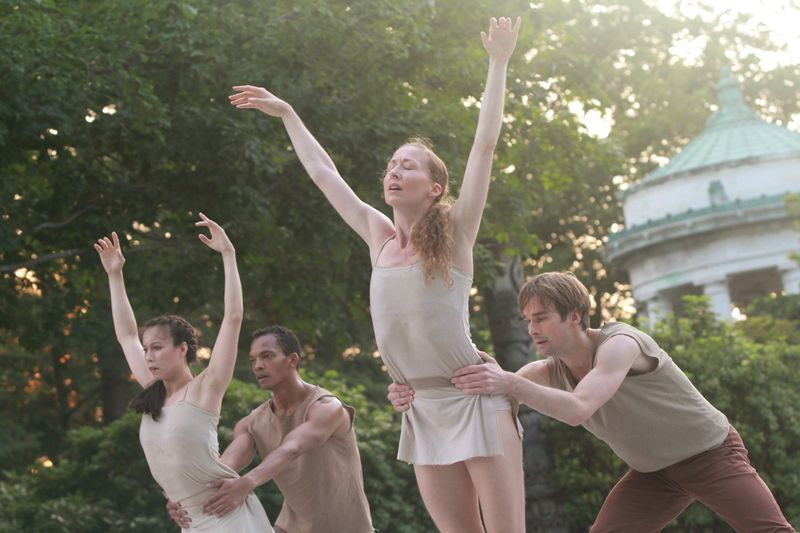
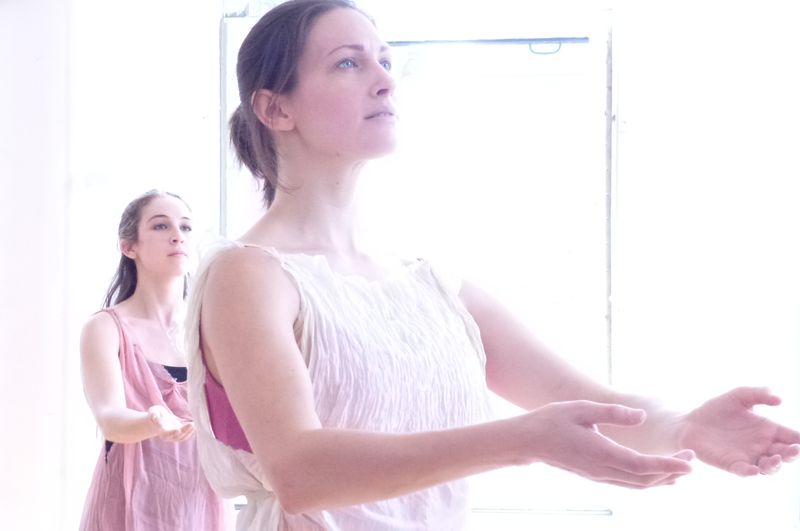
    Above: from Pontus Lidberg’s FAUNE; photo by Nir Arieli

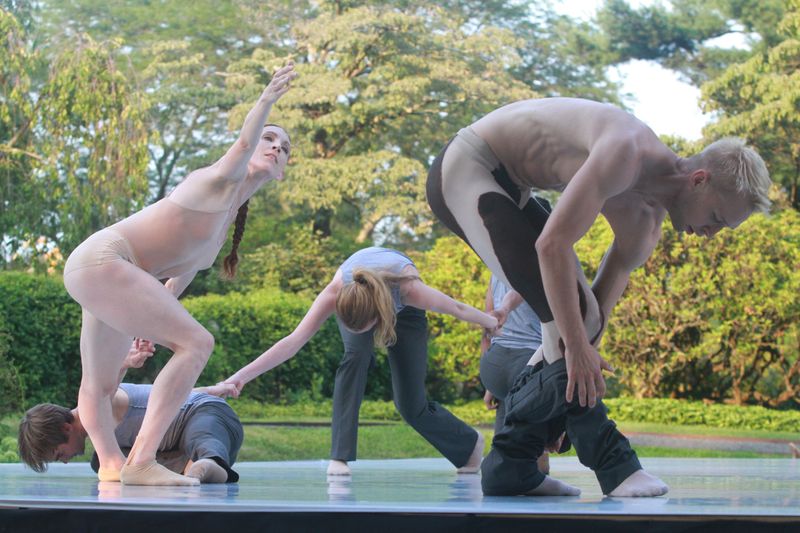
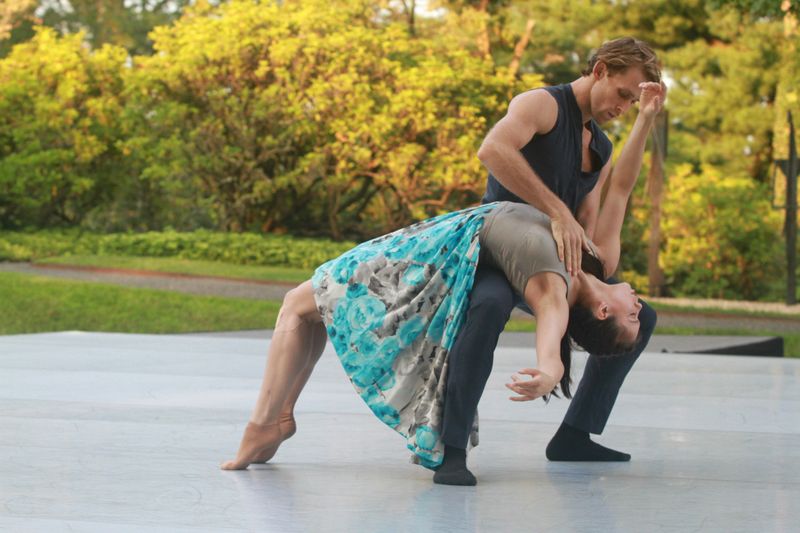
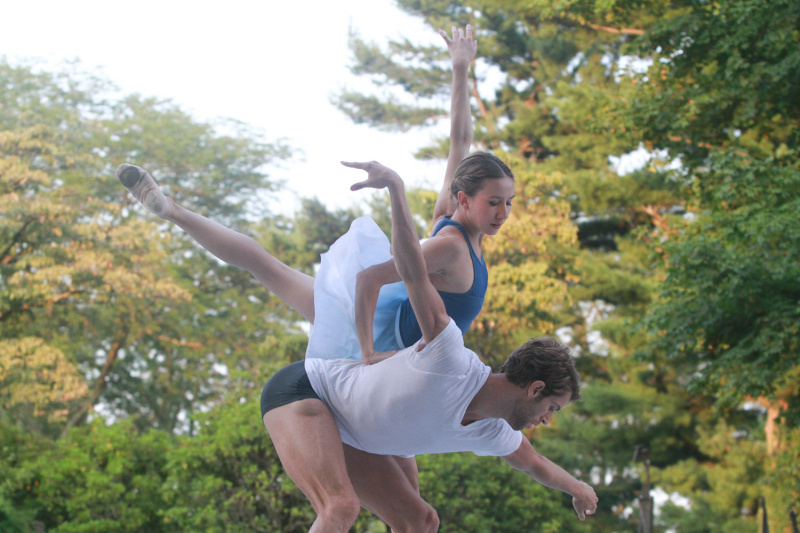
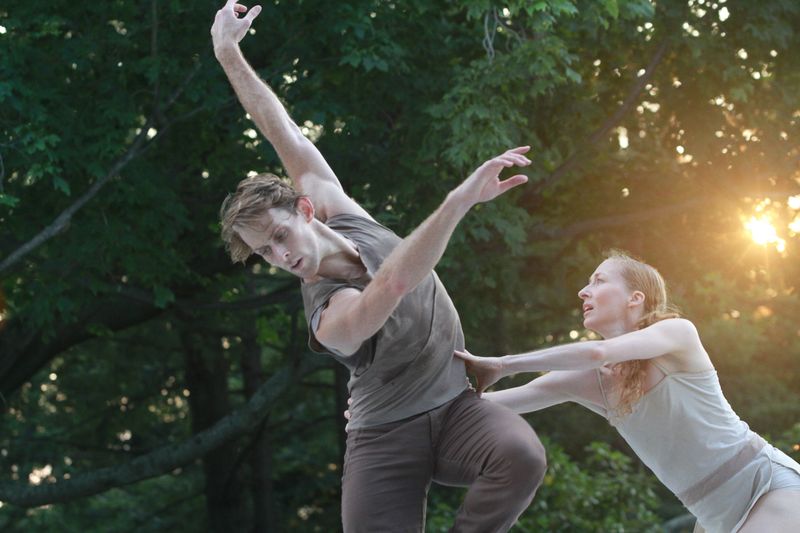
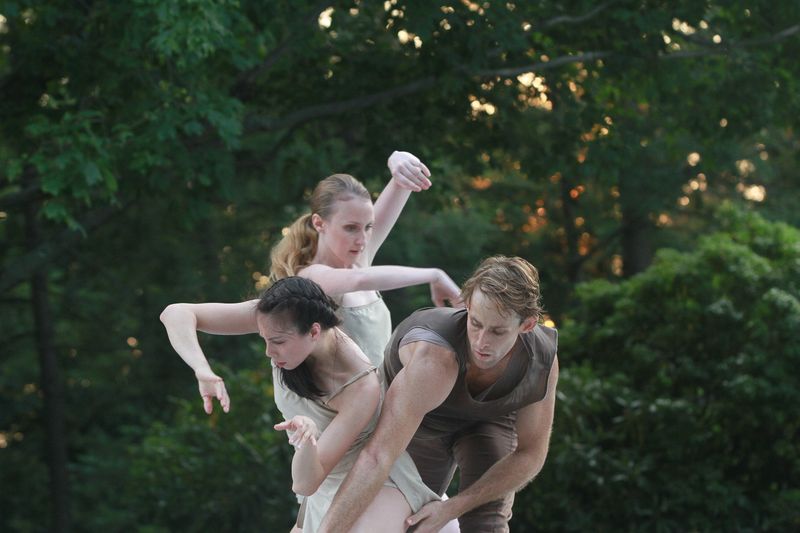
    Photographer Nir Arieli has sent me some images from Pontus Lidberg Dance‘s recent performance at Kykuit, the Rockefeller Estate at Pocantico, NY. The Company danced there on August 8th, 2014, in beautiful outdoor setting.

    Pnts1534
    Above: Adrian Danchig-Waring and Georgina Pazcoguin in an excerpt from WITHIN (Labyrinth Within)
     
    Pnts1551
    Above: Isabella Boylston and James Whiteside in a work-in-progress: a new duet scheduled to premiere at Fall For Dance on October 18th, 2014.
     
    Pnts1576
    Above: Adrian Danchig-Waring and Nadja Sellrup in TACTILE
     
    Pnts1594
    Above: Pontus Lidberg Dance in TACTILE
     
    Pnts1596
     
    Above: Pontus Lidberg Dance in TACTILE
     
    UPCOMING: Pontus Lidberg Dance will perform Pontus’s atmospheric Debussy ballet FAUNE on Saturday October 11th at the Hudson Valley Dance Festival. And on October 18th and 19th, Pontus’s duet for  Isabella Boylston and James Whiteside will premiere at the annual Fall For Dance Festival at New York’s City Center.

  • Tchaikovsky/Balanchine @ New York City Ballet

    10708211_10152712762704814_256726488_n

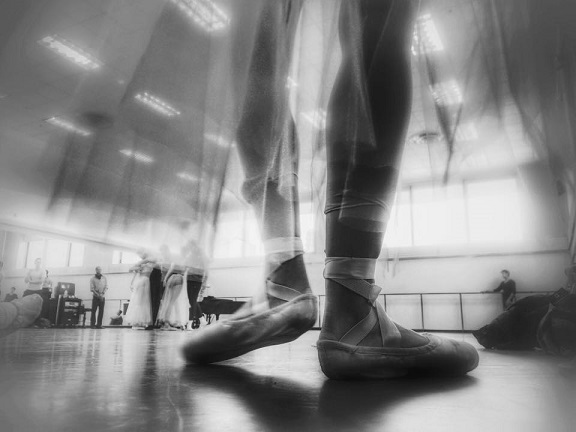
    Above: at a New York City Ballet rehearsal; photo by Craig Hall

    Wednesday September 24th, 2014 – An impressive line-up of favorite dancers in familiar roles, the music of Tchaikovsky, the choreography of Balanchine: what better way for me to start a new season at New York City Ballet?

    Under Clothilde Otranto’s baton, the four Tchaikovsky scores were nicely served up by the NYC Ballet‘s intrepid musicians. Tonight was probably considered an ‘easy’ night for these players: scores they have played dozens of times. They always deserve their spot-lighted ‘curtain call’ at the end of the evening, and it was good to hear a warm swelling of applause for them tonight.

    Ms. Otranto seemed to be favoring fast tempi in SERENADE tonight; the musicians assured that the emotional colours of the music came thru, and the dancers took it all in glorious stride. From curtain-rise, the corps provided an endless panorama of beautiful faces, forms, and personalities. It’s funny that I still find myself looking for people like Amanda Edge and Pauline Golbin among these ice-blue-gowned angels: and where’s Amanda Hankes tonight? Ah, well, they have danced into other phases of their lives – gone from this stage but never forgotten. 

    For present loveliness, we have a delectable quartet of demi-solistes: Faye Arthurs, Alina Dronova, Meagan Mann, and Mary Elizabeth Sell. And Gwyneth Muller always moves me as the consoling maternal figure at the end of the ballet.

    This was a blonde SERENADE: Sara Mearns, Sterling Hyltin, and Teresa Reichlen all looked sumptuous, especially when their hair came down for the final movement. Sara’s luxuriant dancing was given noble grounding by Jared Angle, ever the ideal cavalier. Sterling – her lingering balances spot-on – found just the right mixture of elegance and vivacity, catching the many musical moods in which her ‘character’ finds herself. Tess was divine lyricism personified, and Adrian Danchig-Waring seemed to have come down from Mount Olympus. The sight of Adrian and Tess crossing the stage together, raising Sara from her dream, and Tess’s marvelous slow-turning supported arabesque summed up everything that is SERENADE. The audience responded with a deeply resonant ovation; I am sure there were people in the audience seeing SERENADE for the first time, and I’m sure they will want to see it again.

    The quiet radiance of Maria Kowroski’s Preghiera in MOZARTIANA showed the great ballerina at her most communicative: the lovely passage with her hands in prayerful attitude was especially evocative tonight, as was the gentle silence of her pin-point bourrées. Later, as the ballet’s mood becomes more expansive, Maria’s swirling turns and trademark extension were woven into the music with queenly assurance. I couldn’t take my eyes off her. Tyler Angle was on fine form, his dancing marking the first of three displays of male virtuosity which had the audience cheering this evening. Maria and Tyler have formed an impressive partnership and I look forward to their future endeavors. The ever-excellent Daniel Ulbricht maintained the elegance of the ballet with his stylish dancing – his Gigue has become a signature role – and the Menuet was graciously performed by Marika Anderson, Megan Johnson, Emily Kikta, and Gwyneth Muller.

    A rousing rendition of the TCHAIKOVSKY PAS DE DEUX caused the audience to shed any trace of decorum and yell lustily as Ashley Bouder and Gonzalo Garcia traded technical fireworks in a vivid and smile-inducing performance. After a graciously musical adagio, Gonzalo gave an astonishing performance of his solo – some of the best dancing he’s ever done – nailing the myriad turns at the end before a final brilliant combination to the knee, expertly timed. The crowd went wild. Ashley then swept thru her own dazzling display of danced coloratura, tossing in spicy little pauses and teasing us with her technical savoir faire. Another roar went up as her solo’s final fantastical turns stopped on the proverbial dime. Now with the audience squarely in the palms of their hands, these two magicians of dance swept thru a blazing coda – Ashley’s deluxe fouettés yet another savorable moment – and brought down the house. 

    In the haunted ballroom setting for the Élégie of TCHAIKOVSKY SUITE #3, Rebecca Krohn and Ask LaCour brought tears to my eyes with their poetic evocation of an ideal found…and lost. Rebecca’s restless, almost feral allure was captivating to behold. And Ask is so perfect here: covering the space with questing leaps in pursuit of his elusive muse. Their performance moved me deeply, their parting and Ask’s sinking back into a reverie of heartache drawing up so many emotions.

    Abi Stafford and Justin Peck sustained a mood of mystery in the Valse Mélancolique, Justin’s innate sense of drama nearly drawing the coolly captivating Abi into his world. Yet it is she who prevails: at the end he backs away from her, completely under her spell. Abi and Justin are among my favorite dancers to watch; having them cast together here was a very nice gift.

    In the Valse, a particularly appealing trio of diverse beauties – Olivia Boisson, Lara Tong, and Claire Kretzschmar – looked fetching in one of the ballet’s many featured corps passages.

    In a bewitching performance, Erica Pereira spun marvelously thru the plentitude of pirouettes Balanchine demands of her in the Scherzo; her lustrous black hair and shimmering silver-white tulle flowing as she traced a comet-like trajectory around the stage. Antonio Carmena matched Erica’s spinning flourishes with his airy leaps; they fly off in opposite directions at the end. 

    And now we come to the grand finale: Theme and Variations. The recently refurbished costumes for this ballet seem to glow as Tiler Peck and Joaquin de Luz set forth the elegant opening Theme. Moments later, in her first solo variation, Tiler displayed her epic perfection as a classical ballerina with some truly glorious dancing. The audience showered her with a torrent of applause. The ballet progressed – with excellent suppport from the corps – as Tiler and Joaquin moved continually from one peak of perfection to another. Joaquin’s marziale variation was thrillingly executed, the devilishly handsome dancer basking in another avalanche of cheers, the iconic de Luz smile justifiably lighting up. The ballet swept forward, buoyed not only by the two spectacular principals but by a very impressive quartet of demi-solistes: Lauren King, Brittany Pollack, Mary Elizabeth Sell, and Lydia Wellington. Their cavaliers in the finale were Daniel Applebaum, Allen Peiffer, David Prottas and Andrew Scordato.

    As Ms. Otranto guided the evening to its triumphant close, the audience burst yet again into a passionate ovation: Tiler and Joaquin – and indeed the entire Company – were saluted at the end of a great evening…a great evening for dance, for Tchaikovsky, and for the enduring magnificence of Mr. B.

  • Score Desk for LA BOHEME

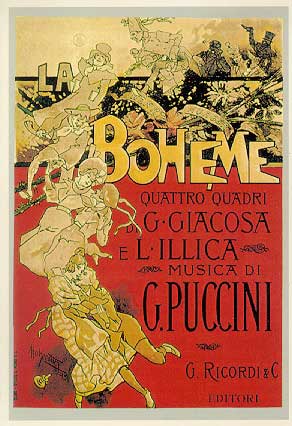
    Boheme

    Tuesday September 23rd, 2014 – After a touch-and-go Summer of contract negotiations where – at one point – it seemed inevitable that there would be a lock-out at the Metropolitan Opera, the shut-down was miraculously averted and The Met opened last night with a new production of LE NOZZE DI FIGARO. The casting of the three major female roles in the Mozart opera didn’t appeal to me, so I skipped it and started my season on the second night.

    The house seemed fuller than on most evenings last season, perhaps an indication that New York City opera-goers prefer traditional productions. And yes, curtain-rise on Franco Zeffirelli’s Cafe Momus still evokes a big round of applause.

    Admittedly tonight’s cast, on paper, didn’t have much allure. The Met seem to be putting all their eggs in one basket this first week: the singers aligned for MACBETH (Netrebko, Lucic, Calleja, Pape) are about the closest you can come to an all-star cast in this day and age. Friends asked me why I bothered with this BOHEME and as the curtain fell on the Cafe Momus scene I in fact asked myself why I was there. 

    Bryan Hymel in the role of Rodolfo was the main attraction for me tonight; his impressive performances in LES TROYENS and MADAMA BUTTERFLY drew me back to hear him in this, his second Puccini role at The Met. He did not seem at his best tonight though there were many appealing moments in his singing of the role. He was not much helped by conductor Riccardo Frizza who tended to unleash too much orchestral volume at key moments. Hymel’s account of the famous aria “Che gelida manina” was nice, and he sustained the high-C to fine effect despite the conductor’s overdrive of volume. At the end of the big Cafe Momus ensemble, the two sopranos were perched none-too-sweetly on their high-B when Hymel chimed in on the same note and gave the climax the necessary zest.

    Neither of the women were very pleasing to the ear. Ekaterina Scherbachenko (Mimi) lacked a persuasive feeling for the Italian style and didn’t bring a lot of nuance or colour to Mimi’s Act I narrative. When she ventured to the upper register, an uncomfortable feeling set in. Oddly, she did not attempt the written high-C at the end of the love duet; instead she sang an E-natural whilst Mr. Hymel sustained a high-C. This put me in mind of the 1968 Met broadcast of BUTTERFLY where Teresa Stratas ducked the final high-C of Act I, leaving her tenor Barry Morell to finish on his own.

    Myrto Papatanasiu revealed a dime-a-dozen overly-vibrant lyric soprano as Musetta, snatching at her interjectory phrases until she got to the Waltz which was reasonably well-sung despite rather shallow tone. I don’t suppose we’ll ever again experience a Musetta the likes of Carol Neblett or Johanna Meier: big voices and big personalities. 

    NextWaveKelseylg812

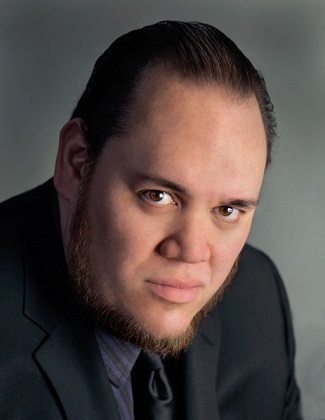
    The evening’s most impressive singing came from baritone Quinn Kelsey (above, in a Ken Howard headshot) as Marcello. This is a Met-sized voice for sure and I got a vast amount of pleasure listening to him nail Marcello’s music, phrase after phrase. I would have liked to have heard him in the third and fourth acts where the character has so much great music to sing, but the overall lack of magic in the evening sent me home after Momus. I hope The Met will give Quinn Kelsey more opportunities.

    Of the remaining members of the cast, no one managed to make a special impression. The children’s chorus deserve a note of praise.

    There’s nothing wrong with taking curtain calls after each act provided the audience is displaying sufficient enthusiasm to summon the singers out before the gold curtain. After both of the first two acts tonight, the applause had completely stopped but the bow lights came on and the singers came out, forcing people to clap for them out of a sense of obligation. I understand that the bows are ‘scripted’ into the performance but someone needs to determine whether there is any applause happening before sending the singers out.

    Metropolitan Opera House
    September 23, 2014

    LA BOHÈME
    Giacomo Puccini

    Mimì....................Ekaterina Scherbachenko
    Rodolfo.................Bryan Hymel
    Musetta.................Myrtò Papatananasiu [Debut]
    Marcello................Quinn Kelsey
    Schaunard...............Alexey Lavrov
    Colline.................David Soar
    Benoit..................Donald Maxwell
    Alcindoro...............Donald Maxwell
    Parpignol...............Daniel Clark Smith
    Sergeant................Jason Hendrix
    Officer.................Joseph Turi

    Conductor...............Riccardo Frizza

  • Yin Yue/Jiangxi Zhongshan Dance School

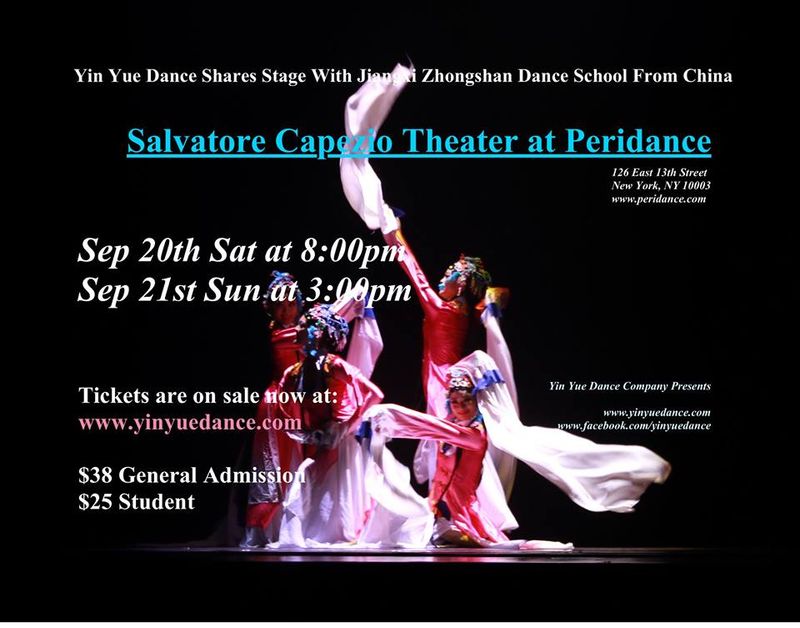
    10557287_10152602223041926_5101198420257482650_n

    Sunday September 21st, 2014 – Yin Yue Dance Company and students from China’s Jiangxi Zhongshan Dance School shared the stage at Peridance this afternoon in a programme that combined the contemporary with the classical in an East-Meets-West cultural dialogue.

    Yin Yue is an award-winning Shanghai-born choreographer who graduated from Tisch, New York University. For this event, she summoned a contingent of dancers from the Jiangxi Zhongshan Dance School, a private professional dance school located in Nanchang, Jiangxi Province, China, who have arrived in New York City, bringing  traditional Chinese classical/contemporary and folk dance as they meet the New York audience for the first time.

    The programme was well-devised to contrast the two styles: the young women from Nanchang performed in colourful, elaborate costumes while Yin Yue’s dancers appeared in stark settings and casual contemporary streetwear. The two companies alternated throughout the afternoon.

    The student company opened the show with a brilliant and festive piece Gan Yun You You in which elements of Chinese opera were featured. Later – in Spring Ballet – the girls danced on pointe in long pink tutus to the voice of a pop-oriented coloratura soprano. A quartet of solos – each dancer in red-highlighted costumes – went on a bit too long. Then Qinghua Rhyme was danced on pointe to a pop beat, while an Arabian Nights atmosphere pervaded Blossom: the girls all wearing red harem-style costumes and each carrying a red rose. Nuo Dance, the afternoon’s concluding work, featured the dancers wearing masks. At the end, a baby was delivered and he started to cry. Throughout their peformance, the dancers from the Jiangxi Zhongshan School showed surprising maturity of presentation and seemed thoroughly at home on the stage.

    Yin Yue and her fellow dancers – Liane Aung, Grace Whitworth, and Luke Bermingham – performed five works, ranging from quartets to a solo by Mr. Bermingham. Yin Yue’s choreography is strong and sure; she makes excellent use of space and lighting and she persuasively employs partnering and passages of dancing in-sync. Her strongest work was the solo for Mr. Bermingham – One Step Before The Exit – which seemed to express the loneliness of contemporary life and a (thwarted) desire to connect.

    Yin Yue’s undoubted gift for impressive dramatic movement is somewhat compromised by a lack of variety in her choice of music. Everything seems to be danced to a beat overlain in darkly throbbing industrial noise and/or static. The vaguely ominous atmosphere created by this type of music – so favored by many of today’s younger choreographers – becomes a cliché after a while. A bit of Chopin, alluded to in the playbill, never materialized. In taking a wider view of musical possibilities, I believe the choreographer will find ever-expanding avenues of expression.

  • 10th Anniversary @ New Chamber Ballet

    Miro ncb rehearsal

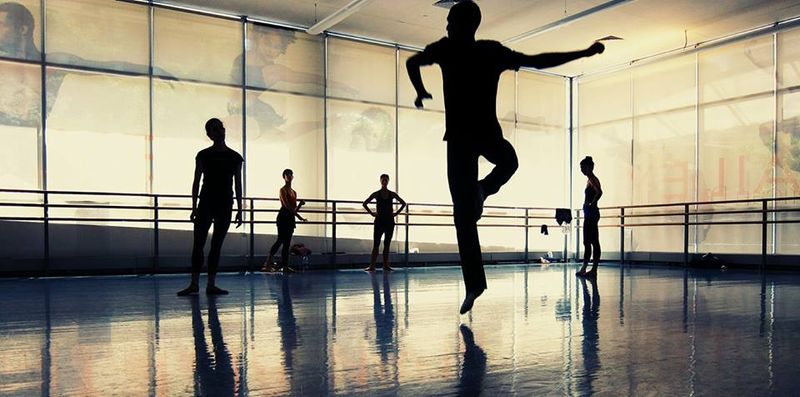
    Above: New Chamber Ballet company class; photo by Amber Neff

    Friday September 19th, 2014 – Miro Magloire’s New Chamber Ballet have inaugurated their tenth anniversary season with a programme featuring three Miro Magloire premieres and a work by NCB resident choreographer Constantine Baecher’s “Happy Dance Of The Wild Skeletons” (to music of John Cage), as well as Miro’s intriguing “Tilting and Leaning“, set to piano music by Pierre Boulez.

    Over the past decade, New Chamber Ballet have carved out a special niche for themselves in the Gotham dance world. Their “up-close-and-personal” concerts – always danced to live music – have drawn ever-expanding audiences, and tonight they played to a standing-room-only crowd.

    Much praise is due pianist Melody Fader and violinist Doori Na who perform the often complex scores that Miro likes to use with a high level of musicality. Exceptional tonight was their performance of Mauricio Kagel’s ‘Klangwölfe’ for the ballet RAW.

    In recent seasons Miro has presented narrative works: domestic dramas about ghosts, sibling rivalries, or mysterious letters. This evening’s three new works are more abstract though of course certain themes might be implied. The first ballet is aptly titled FAST FORWARD; danced to Beethoven’s ‘Rondo for Violin and Piano’, the work has three ballerinas – Sarah Atkins, Holly Curran, and Traci Finch – rushing about the space in speedy (even risky) combinations. The breathless quality of the movement is a fine response to the zesty drive of the Beethoven as played by Doori and Melody.

    Miro020-3289003989-O

    Above: Sarah Artkins in Miro’s TILTING/LEANING; photo by Adam Jason

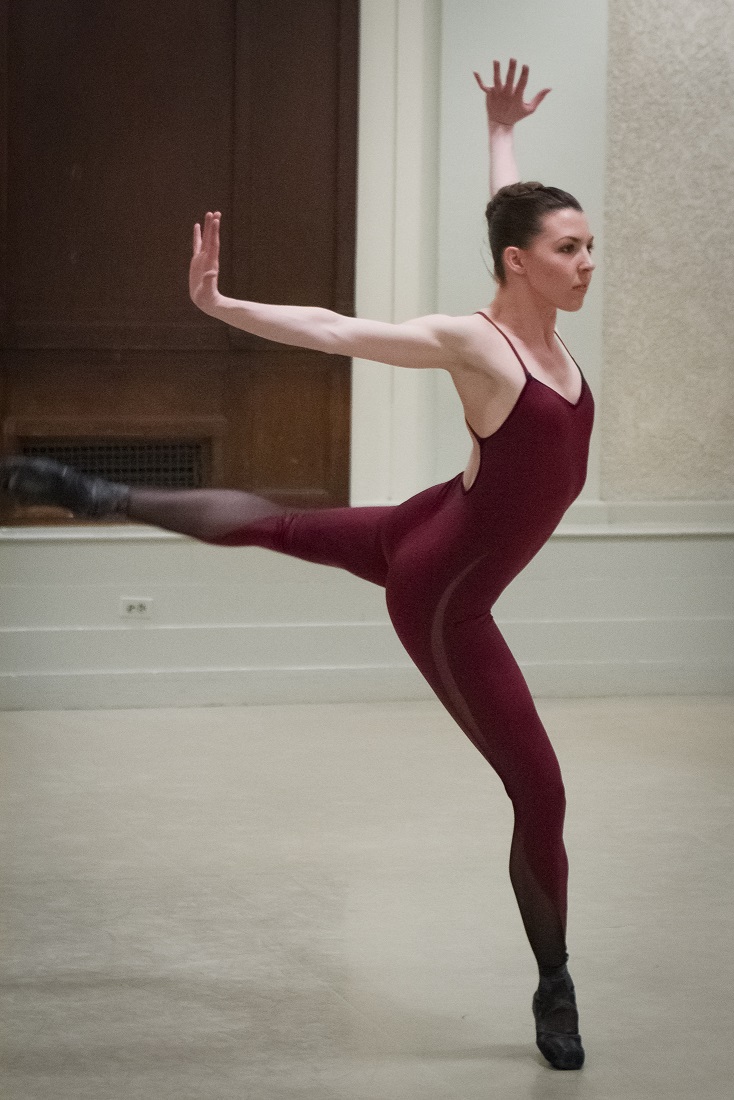
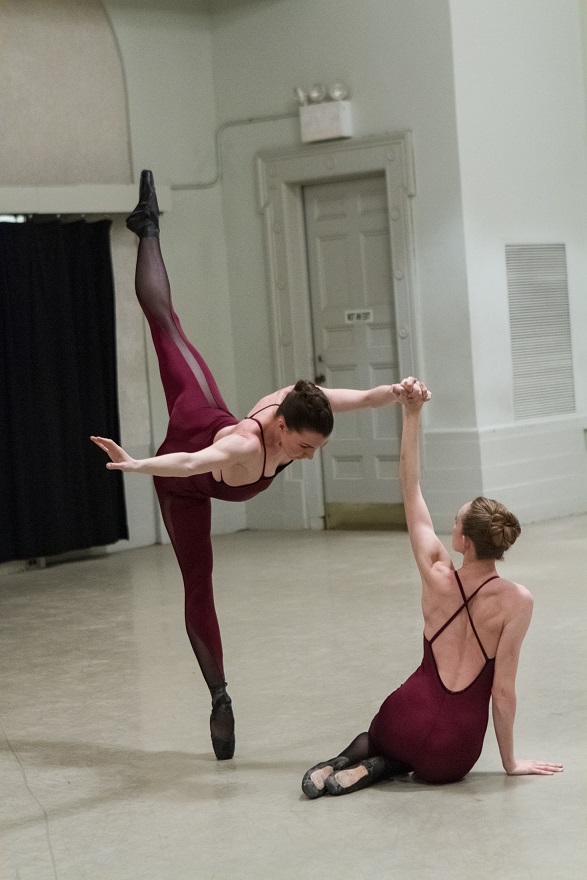
    Melody Fader took in stride the demands of Pierre Boulez’s ‘Notations’ which accompanies last season’s intriguing duet TILTING/LEANING. Dressed in Sarah Thea Swafford’s sleek wine-coloured body tights, dancers Sarah Atkins, Traci Finch, and Amber Neff go from intense to playful and back again in choreography where they balance against one another in unique and quirky shapes.

    Miro052-3289006317-O

    Supported arabesques are a signature motif in TILTING/LEANING (Sarah and Amber above, in an Adam Jason photo). At the end Sarah and Amber appear to ‘fold’ Traci into an improbable little bundle. This ballet rewards repeated viewings with its resonant nuances.

    L1480519

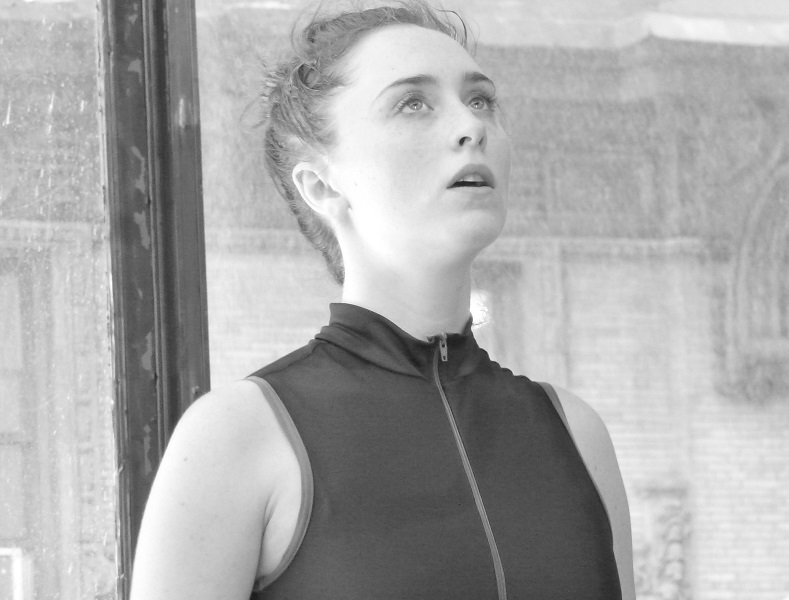
    For Holly Curran (rehearsal image, above), Miro has created an unusual tour de force solo entitled IN THE COLD. While Melody Fader spins out some Satie at the piano, Holly appears alternately shell-shocked, frantic, or trembling with the chills. Repetitive, compulsive moves give way to a spacious manège of leaps; the dancer periodically assumes a potent arabesque or pauses to rearrange herself before contemplating her next move. The solo, which choreographically rather plays against the expected responses to the Satie melodies, was excellently mastered by dancer and pianist.

    10486513_10152694171488571_8874687051716580051_n

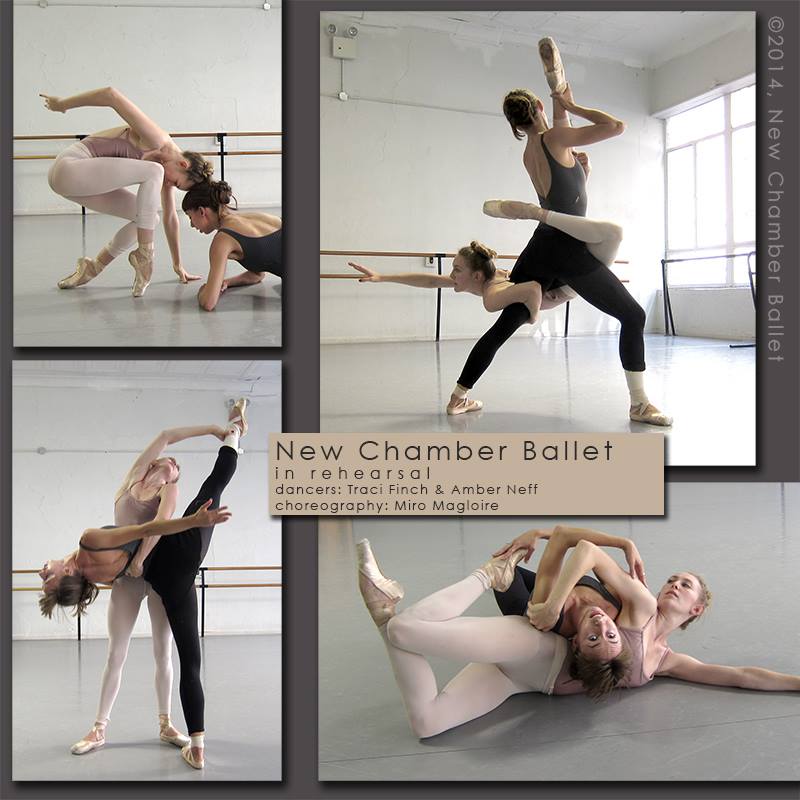
    Above: rehearsal images from Miro’s new duet RAW

    Miro’s meshing of music and movement created yet another fresh vision with RAW. Introducing the work, Miro spoke affectionately of the German-Argentine composer Mauricio Kagel who was Miro’s composition teacher. The choreographer pays homage to his musical mentor with one of his most inspired works to date: RAW is such a fascinating piece that when it ended I immediately wanted to see (and hear) it again.

    Doori Na – his strings muted – and Melody Fader evoked a misterioso atmosphere: Doori showed great control as he spun out a thread of sound, and Melody later drew forth a shimmering, high-lying theme from the keyboard. Dancers Traci Finch and Amber Neff are literally entwined much of the time in this duet; their handling of the strenuous partnering motifs, including lifts and intimate bondings, gave the ballet a captivating intensity. An aggressive passage eventually leads to serene, almost worshipful images as Amber leans against the piano and Traci kneels at her feet. RAW seems to veer from sensuous to sterile to pensive, and it is perhaps Miro’s most intimate creation to date.

    To end the evening, Miro invited the viewers to circle the dancefloor, the better to watch Constantine Baecher’s impetuous romp of a duet, HAPPY DANCE OF THE WILD SKELETONS. Melody Fader plays John Cage’s ‘Bacchanale’ on a prepared piano as dancers Traci Finch and Amber Neff – in girlish playsuits and bobbi-sox – indulge in playful, slap-happy hijinx. Their hair comes down at the end, as they revel in the sheer joy of being silly.

    Happy anniversary, Miro!

    The Company’s next performances will be on November 21st and 22nd. 2014. Visit their website here.

  • Persichetti’s WINTER CANTATA

    01

    I’ve fallen in love with Vincent Persichetti’s WINTER CANTATA which I discovered quite by chance when I plucked a CD of the composer’s choral works off the shelf at the library a couple weeks ago.

    Composed in 1964, the work was inspired by a collection of haiku (‘A Net of Fireflies‘) which Persichetti’s daughter had given him as a gift. To the intriguingly spare accompaniment of flute and marimba, the chorus of women’s voices weave a magical tapestry of wintry images. Intricate harmonies and tapering sustained notes are particularly pleasing vocal elements; the flute and marimba evoke cool air and gently swirling flakes of snow. There are eleven brief movements, and an Epilogue which draws its text from one line of each of the previous eleven poems.

    The CD, featuring the Mendelssohn Club of Philadelphia conducted by Tamara Brooks, may be found here.

  • Isadora: Lament, Hope, and Renewal

    Duncan_2

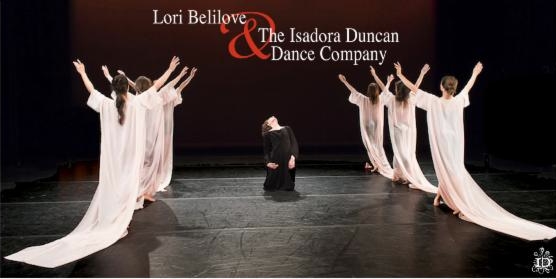
    Wednesday September 17th, 2014 – Lori Belilove and the Isadora Duncan Dance Company presented an evening of film, live performance and discussion in an intimate salon setting at the Company’s home space on West 26th Street. A few days after marking the anniversary of Isadora’s untimely death (on September 14th, 1927), Lori and her Company keep the spirit of ‘the mother of modern dance’ vividly alive.

    For me, this week brought the unusual happenstance of back-to-back evenings of Martha Graham and Isadora Duncan. These two pioneering forces on the frontiers of modern dance seem to me to be twin goddesses: from them, so many blessings flow – even onto the present day.

    Central to this Isadora evening was the showing of a silent film clip of brief fragments from Dance of the Priestesses, a ‘lost’ Duncan work. This film, made in 1963, features extremely rare footage of Anna Duncan, one of the original Isadorables. In the film,  Anna dances with Julia Levien and Hortense Kooluris, two women who were the teachers of Lori Belilove: thus the direct line of passing the torch from generation to generation is maintained. 

    The film was entrusted to Lori Belilove and it inspired her to embark on a restoration of Dance of the Priestesses which, until now, had been little more than a legend. The dance is set to music by Christoph Willibald von Gluck from his opera IPHIGENIE EN TAURIDE. In the film, Anna, Julia and Hortense show a wonderful weighted quality. Lori was able to impart this to the dancers of her current Company and, after viewing the film, we were treated to a beautiful live rendering of the piece. Lori has set it for five women (Isadora’s ensemble works can be danced by small or large contingents of dancers). The girls looked stately in their midnight-blue gowns, with Morgana Rose Mellett in a prominent role and Kim D’Agnese, Emily D’Angelo, Faith Kimberling, and Nicole Poulos as her sister/priestesses. Their performance evoked the ancient gods and the mythic rituals of times long vanished.

    686

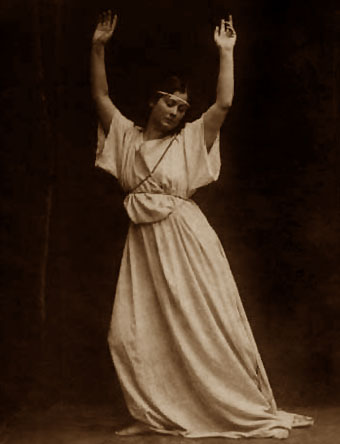
    Also on film, we saw a full performance of Slow March (photo above) as performed by the Company last May.

    Isadora created danceworks in several moods, stemming from her mental state at the time of creation. Joyous, celebratory dances gave way to dark, lamenting themes following the death of her two children. Lori Belilove performed two of these despairing solos tonight: Death and The Maiden (set to Chopin) and Mother (set to Scriabin). The mood was brightened by two Chopin mazurkas danced by Mlles. D’Agnese, Mellett, Kimberling and D’Angelo in signature pink-and-white Grecian tunics. Lori and the four girls joined in an extended finale: Dance of the Blessed Spirits and Orpheus’ Lament, both drawn from themes from Gluck’s opera ORFEO ED EURIDICE

    Pianist Melody Fader played all the selections for the evening, an enhancement to the atmosphere of the performance. 

    Watching the dances this evening, I couldn’t help but think that today’s young choreographers could benefit greatly in studying Isadora’s work. In terms of musicality, structure and creation of mood, Isadora’s instincts always seem spot-on. As dancer Miki Orihara wrote in her notes for her recent solo concert, we may look into the future of dance by investigating the past.

  • Notes on a Voyage

    Mg

    Tuesday September 16th, 2014 – Whenever I come away from a performance (or rehearsal) of the Martha Graham Dance Company, I feel the need to invent new adjectives to describe both the works being danced and the people dancing them. Tonight, as part of the on-going GRAHAM/Deconstructed series, we saw an open rehearsal of the 1947 Graham classic, Errand Into the Maze, and a new work, Notes on a Voyage, created by former Graham dancer Peter Sparling.

    Errand Into the Maze, with its powerful score by Gian Carlo Menotti, seems startlingly fresh and meaningful each time I see it. Though billed as a ‘rehearsal’, the dancers – PeiJu Chien-Pott and Ben Schultz – gave a performance of deep commitment and generous physicality. Pei-Ju, luminous in a white shift, painted the terror and the ultimate triumph of her journey in a vividly nuanced performance. With his handsomely inked torso, Ben seemed an unconquerable force as he stalked his prey. Yet in the end, PeiJu overcomes her fear and casts him down. The packed house watched this masterpiece with intense focus and burst into an enthusiastic and richly-deserved applause for the two dancers at the end.

    6a00d8341c4e3853ef017ee9f9df65970d

    And now let me take a moment to congratulate the award-winning PeiJu Chein-Pott (above)! Read the story here.

    Photo antonia k miranda

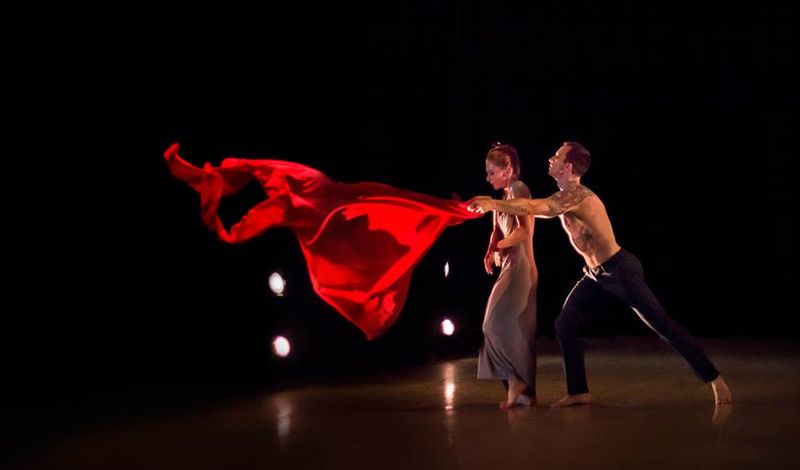
    Above: Blakeley White-McGuire and Ben Schultz in Notes On A Voyage, photo by Antonia K Miranda

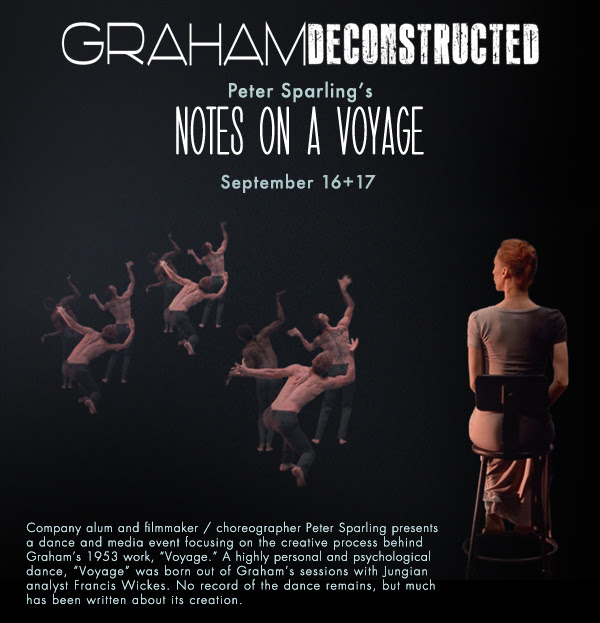
    In his striking multi-media work, Notes On A Voyage, Peter Sparling has summoned up a vision of Martha Graham’s lost 1953 work, Voyage. Stuart Hodes, who was among the original cast, gave valuable insights into the creation (and ultimate disappearance) of Voyage which evolved out of Martha Graham’s sessions with Jungian analyst Francis Wickes. No filmed or notated record of the dance remains, but it has been written about and spoken of in Grahamian circles over the intervening decades.

    Mr. Hodes revealed that, after a two-year period of creation, Voyage premiered and Martha Graham was not pleased with it. She immediately began re-working it, but it never again saw the light of day outside the studio…until now, in Mr. Sparling’s thoughtful and provocative rendering.

    The original Voyage had a Noguchi setting. Martha’s notes indicate she viewed the piece as taking place in a house on the edge of a desert; yet Noguchi’s design showed a boat. This paradox was somehow resolved at the time. For the current re-imagining, the space is empty aside from an extremely high stool in one corner, and a bolt of red fabric.

    Mr. Sparling found the William Schuman piano music, and he conceived a brilliantly executed film to accompany the dance. The voice of Ellen Lauren is heard, reading excerpts – fragments, really – from Martha Graham’s journals and letters. The overall atmosphere compellingly fuses the elusive past with the vibrant presence in the personages of the four magnificent dancers: Blakeley White-McGuire, Tadej Brdnik, Lloyd Knight, and Ben Schultz.

    Descibed as ‘a woman seeing herself thru the eyes of three men’, the central character takes on – in a succession of duets – the aspects of a goddess, a warrior, and a lover. Shirtless in fitted trousers, the three men display the agility and strength that Graham always demanded of her male dancers. Dancing first with Lloyd, then Ben and finally Tadej, Blakeley filled the space with both restless energy and moments of pensive calm, sometimes skittering up to the high seat from which she could view her own world. Blakeley’s performance was a pure astonishment of personal magnetism, her alluring physicality and her compelling gift for turning movement into magic gave me one heart-racing thrill after another. What a remarkable and generous artist she is.

    A great night, then, in every regard. So lovely to find Xiaochuan Xie, Alessandra Larson, Abdiel Cedric Jacobsen, and Ian Spencer Bell among the crowd.

    ~~~~~~~~~~~~~~~~~~~~~~~~~~~~~~~~~~~~~~~~~~~~~~~~~~~~~~~~~~~~~~~~~~~~~~~~~~~~~~~~~~~~~~~~~~~

    Upcoming: On October 30th, the Martha Graham Dance Company will present Appalachian Spring Up Close and Personal – a complete performance of Appalachian Spring in costume and with the classic Noguchi set pieces. This performance marks the 70th anniversary of the work’s premiere on October 30th, 1944. This one-night-only event will also feature film and photos from the premiere, and an introduction with quotes from Graham’s correspondence with Aaron Copeland as they created this beloved American classic. Mariya Dashkina Maddux will lead the cast in Graham’s role of The Bride. She will be joined by Lloyd Mayor, Natasha Diamond-Walker, Lloyd Knight, Xiaochuan Xie, Ying Xin, Charlotte Landreau, and Lauren Newman. Ticket information will be forthcoming.

  • Finding Isadora’s ‘DANCE OF THE PRIESTESSES’

    L1460609

    Above: dancers Morgana Rose Mellett and Emily D’Angelo of the Isadora Duncan Dance Company

    Friday August 29th, 2014 – Today I went down to the Gibney Dance Center where friends of the Isadora Duncan Dance Company had been invited to an intimate studio session in anticipation of the upcoming renewal of a ‘lost’ Duncan work, DANCE OF THE PRIESTESSES.

    Lori Belilove, artistic director of the Company, welcomed us and then told the story of how DANCE OF THE PRIESTESSES has miraculously re-surfaced after several decades of being nothing more than a bit of legend.

    There had been talk of a film of the work having been made in 1963 and featuring one of the original Isadorables, Anna (Denzler) Duncan. Incredibly the film surfaced and was presented to Lori by some benevolent angel.  Lori set to work with her dancers to re-construct the piece, and we will be able to see it danced both on the film and live at a presentation at the Gibney Dance Center on September 17th, 2014, at 6:30 PM.  Further details of this event will be forthcoming.

    The dancework is drawn from the story of Iphigenia, daughter of Agamemnon, who was rescued from her fate as a human sacrifice by the goddess Artemis. Iphigenia becomes a priestess at the temple of Artemis in Tauris, a position in which she has the gruesome task of ritually sacrificing any foreigners who land on that kingdom’s shores.  Iphigenia is eventually confronted with the necessity of sacrificing her long-lost brother Orestes but that horrific duty is averted by the intercession of the goddess Athena.

    The story was immortalized in Christoph Willibald von Gluck’s gorgeous opera, IPHIGENIE EN TAURIDE. And it is to Gluck’s music that DANCE OF THE PRIESTESSES is performed.

    After providing us with this background, Lori asked each of us to cross our hands over our sternum and to breathe deeply; we can immediately sense our own center and the connectedness of the entire body. Her dancers then demonstrate some of the exercises with which they warm up: similar to a ballet barre, and yet the movement emanates from the torso rather than being guided by the limbs.

    The dancers looked so beautiful doing these deceptively ‘simple’ exercises which actually call for great concentration and control. The movement has a slow and ecstatic quality as the wheel-like flow of the arms, radiating from the sternum, reach down to the Earth and then soars skyward.

    Having shown us these stylistic elements, the dancers then performed a brief passage from DANCE OF THE PRIESTESSES. The ritualistic pouring of the libation oil and the stately pacing of the celebrants, arms opening in eloquent gestures of offering and supplication, create a timeless atmosphere of feminine power and beauty.

    The dancers – Kim D’Agnese, Faith Kimberling, Emily D’Angelo, and Morgana Rose Mellett – each have distinguishing physical characteristics which maintain their individuality even when dancing in unison. Watching them was a truly savorable experience.

    I’m hoping to see a rehearsal of the full work prior to the Gibney showing on September 17th.

    Watch a brief film clip of Anna Duncan performing at Jacob’s Pillow in 1942 here.

  • At Home With Wagner VI

    Richard-wagner-1351529175-view-0

    Wagnerian afternoons in the Summer: from the Bayreuth Festival 1961 comes the prologue and first act of GOTTERDAMMERUNG featuring Birgit Nilsson at her most marvelous. Conducted by Rudolf Kempe, the performance generates tremendous excitement, most notably in the thrilling build-up to the Dawn Duet. Nilsson unleashes her patented lightning-bolt top notes, and hearing her on this form reminds me of my first encounters with her live at The Met where in 1966 she sang a series of Turandots that were simply electrifying.

    Elisabeth Schärtel

    The performance is very fine all around, opening with a thoroughly absorbing Norn Scene which begins with the richly expressive singing of contralto Elisabeth Schärtel (above) followed soon after by the equally impressive Grace Hoffman. It’s rather surprising to find Regine Crespin singing the Third Norn. She had made a huge success at Bayreuth in 1958 as Kundry, and had repeated that role at the next two festivals. In 1961 she was invited back to the Green Hill for Sieglinde, and thus she was able to take on the Norn as part of her summer engagement. She sings beautifully, with her distinctive timbre, though there is a trace of tension in her highest notes.

    317372_340994792689362_1142580761_n

    Above: Birgit Nilsson; we used to refer to her as “The Great White Goddess” or simply “The Big B”. The thrilling accuracy and power of her singing here, as well as her ability to create a character thru vocal means, is breath-taking.

    Hans Hopf is a fine match for Nilsson in the Dawn Duet; he is less persuasive later on when his singing seems a bit casual. Wilma Schmidt (Gutrune) and the always-excellent Thomas Stewart (Gunther) make vocally strong Gibichungs, and the great Wagnerian basso Gottlob Frick is a dark-toned Hagen with vivid sense of duplicity and menace. Rudolf Kempe again shows why he must be rated very high among the all-time great Wagner conductors: his sense of grandeur and ideal pacing set him in the highest echelon.

    ~~~~~~~~~~~~~~~~~~~~~~~~~~~~~~~~~~~~~~~~~~~~~~~~~~~~~~~~~~~~~~~~~~~~~~~~~~~~~~~~~~~~~~~~~~~ 

    Gerhard Stolze

    Gerhard Stolze (above) is the Loge in a RHEINGOLD from the Bayreuth Festival 1964; I have a special love for Mr. Stolze in this role as he was my first Loge – at The Met on February 22, 1968, a broadcast performance conducted by Herbert von Karajan and my first experience of a RING opera live. Here at Bayreuth, as later at The Met, Stolze brings a wonderfully debauched, almost greasy vocal quality to the vain, spoiled demi-god. The voice is large and effortlessly penetrating, but he can also be tremendously subtle: after screaming “Durch raub!’ (‘By theft!”) when Wotan asks Loge how the Rhinegold might be acquired, Stoltze goes all lyrical as he says: “What a thief stole may be stolen from the thief…” this is but one of Stotze’s countless brilliant passages in the course of his portrayal. At Nibelheim and later, as Loge taunts the captured Alberich, Stolze is simply superb.

    Two other singers who appeared in my Met/Karajan RHEINGOLD are also heard in this Bayreuth performance: Theo Adam has a big, burly voice and sings imposingly if not always with a lot of tonal allure. His Wotan builds steadily throughout the opera to an imposing rendering of Wotan’s greeting to Valhalla and the entire final scene. Zoltán Kelemen is a splendid Alberich; his handsome baritone sound sometimes shines thru in what is essentially a dramatic character role. Power and calculation mark his traversal of the first scene; later, in Nibelheim, Kelemen is wonderfully subtle. Having been tricked by Loge and kidnapped, he’s truly fabulous as he summons his slaves to bring the treasure up as ransom for his freedom. Later, having lost everything, his crushing sense of vulnerability gives way to a violent hurling of the curse at Wotan.

    Z Keleman

    Above: Zoltán Kelemen as Alberich

    Grace Hoffman is a capital Fricka, bringing verbal urgency and vocal attractiveness to her every line, most expressive as she draws Wotan back to her after Erda’s intervention. Jutta Meyfarth, a very interesting Sieglinde on the 1963 Bayreuth WALKURE conducted by Rudolf Kempe, is too stentorian and overpowering as Freia, a role which – for all its desperation – needs lyricism to really convince. Hans Hopf, ever a stalwart heldentenor, probably should not have tried Froh at this point in his career: he sounds too mature. Marcel Cordes is a muscular-sounding Donner; there is an enormous thunderclap to punctuate Donner’s “Heda! Hedo!”

    The estimable contralto Marga Höffgen brings a real sense of mystery to Erda’s warning. Gottlob Frick is a vocally impressive Fasolt, his scene of despair at giving up Freia is genuinely awesome. Peter Roth-Ehrang (Fafner) and Erich Klaus (Mime) are names quite unknown to me; the basso is a bit blustery but has the right feeling of loutishness. Herr Klaus is a first-class Mime, with his doleful singing in the Nibelheim scene giving way to a fine mix of dreamy dementia and raw power as he tells Loga and Wotan of his dwarvish despair. Barbara Holt as Woglinde plucks some high notes out of the air; Elisabeth Schwarzenberg and the excellent Sieglinde Wagner as her sister Rhinemaidens.
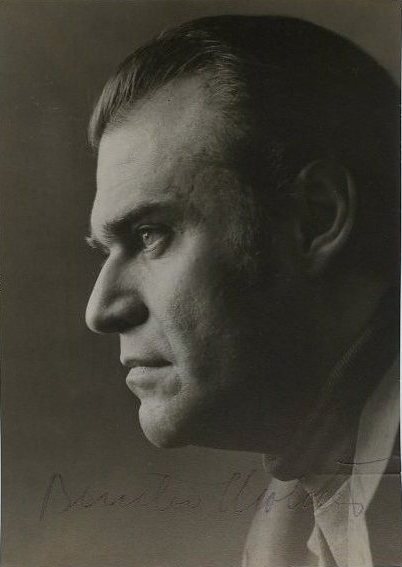
    Klobucar

    Berislav Klobucar (above), who conducted 21 Wagner performances at The Met in 1968 (including taking over WALKURE from Herbert von Karajan when the latter withdrew from his half-finished RING Cycle for The Met) opens this RHEINGOLD with a turbulent prelude. Klobucar has an excellent feel for the span of the opera, for the intimacy of the conversational scenes, and for the sheer splendour of the opera’s finale.

    ~~~~~~~~~~~~~~~~~~~~~~~~~~~~~~~~~~~~~~~~~~~~~~~~~~~~~~~~~~~~~~~~~~~~~~~~~~~~~~~~~~~~~~~~~~~
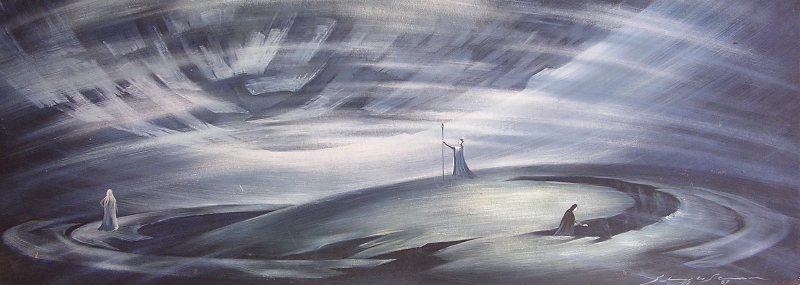
    1967-rheingold-salzburg-easter-festival-karajan-1967

    Above: a Günther Schneider-Siemssen design for the Herbert von Karajan Salzburg Festival production of the RING Cycle, 1967.

    Thinking of my Karajan/RHEINGOLD introduction to the RING at The Met in 1968 caused me to next take up the conductor-director’s complete WALKURE and GOTTERDAMMERUNG from the 1967 Salzburg Festival where his production of the Cycle originated. Of course, he only ended up conducting RHEINGOLD and WALKURE at The Met though the two remaining operas were staged there in his absence, with the productions credited to him. The settings remained in use at The Met thru 1981, and then the Otto Schenk production commenced in 1986.

    I must admit to never having listened to Karajan’s commercial RING Cycle (maybe a few random scenes but never any of the complete operas); it’s simply one of those inexplicable sins of omission which all opera lovers must eventually confess to. Maybe someday I will get around to it, though I’m so taken up with all these live RING recordings that Opera Depot keep tempting us with.

    At any rate, I must say I don’t much care for Karajan’s first act of WALKURE, at least not as it was performed at Salzburg in 1967. It feels to me terribly slow and overly polite. Gundula Janowitz and Jon Vickers seem much of the time to be vocally walking on eggshells: they whisper and croon gently to one another and the lifeblood seems to drain out of the music. Martti Talvela is his usual excellent self as Hunding; once he has gone to bed, Vickers commences a properly reflective sword monologue (the first orchestral interjection of the Sword motif ends on a cracked note). The tenor is stunning in his prolonged cries of “Wälse! Wälse!”, and then comes Janowitz’s ” Der Männer Sippe” which is verbally alert but there’s a slight tension in her upper notes and a feeling of being a bit over-parted. They sing very successfully thru the familiar “Winterstürme” and “Du bust der Lenz” all filled with attractive vocalism but Karajan maintains a rather stately pacing thru to end end of the act: there’s no impetus, no sense of being overwhelmed by sexual desire. Actually I found it all somewhat boring, and my mind tended to wander.

    A complete volte face for Act II, one of the finest renderings of this long and powerful act that I have ever encountered. Karajan launches the prelude, weaving together the various motifs, and Thomas Stewart unfurls Wotan’s opening lines commandingly. Regine Crespin’s sings a spirited “Ho-Jo-To-Ho!” and then Fricka arrives on the scene…
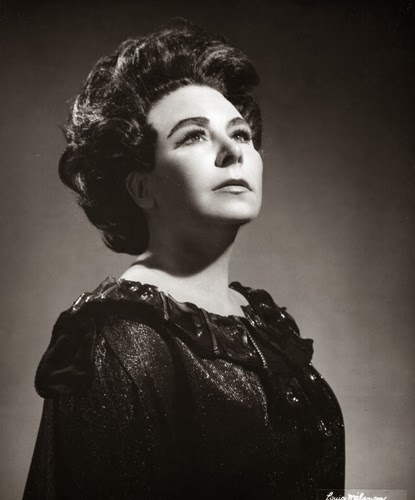
    16 Ludwig Fricka Walkure Melancon 1967

    …in the marvelous person of Christa Ludwig (Louis Melançon photo, above). When people ask me, “Who was the greatest singer you ever heard?” I invariably reply “Christa Ludwig” even though on a given day the memory of some other voice might seem to rival her. But in everything I have heard from her, both live and on recordings, Ludwig seems to have the ideal combination of a highly personal timbre, natural and effortless technical command, a remarkably even range, phenomenal abilities as a word-colorist, and overwhelming warmth and beauty of sound. Her Fricka here is magnificent in every way, and so supremely Christa

    6a00d8341c4e3853ef01901e20b373970b-800wi

    The scene between Fricka and Wotan is so impressive, yet incredibly Thomas Stewart (above, with Karajan) goes on to surpass himself with one of the most thrilling and spine-tingling renderings of Wotan’s monolog that I have ever experienced. Stewart vocally displays every nuance of the god’s emotional state as he confides in his daughter, first in his long ‘historical’ narrative which grumbles and whispers its way into our consciousness. Crespin is an ideal listener, her beauteously sung queries lead her father to divulge more and more. Soon Stewart is pouring out both his vanity and despair; the temperature is at the boiling point when he reaches “Das ende! Das ende!”, overcome by tears of anguish. Instructing Brunnhilde to honor Fricka’s cause and defend Hunding in the impending fight, Stewart crushes Crespin’s protests with a furiously yelled “Siegmund falle!” (“Siegmund must die! That is the Valkyrie’s task!”) and he storms away. I had to stop at this point; Stewart’s performance had both moved and shaken me and I wanted to pause and reflect.

    As beautifully as Crespin and Vickers sing the ‘Todesverkundigung’ (Annunciation of Death), the scene does not quite generate the mysterious atmosphere that I want to experience here. Thomas Stewart’s snarling “Geh!” as he send Hunding to his fate is a fabulous exclamation mark to end the act.

    Act III opens and there is some very erractic singing from the Valkyries in terms of pitch and verbal clarity. Crespin’s top betrays a sense of effort in her scene with Sieglinde, and Janowitz’s voice doesn’t really bloom in Sieglinde’s ecstatic cry ” O hehrstes Wunder!”  Thomas Stewart hurls bold vocal thunderbolts about as he lets his anger pour out on Brunnhilde and her sisters.

    And then at last the stage is cleared for the great father-daughter final scene. Crespin is at her very best here, singing mid-range for the most part and with some really exquisite, expressive piano passages. Only near the end, when the music takes her higher, does the tendency to flatness on the upper notes seem  to intrude. Stewart is impressive throughout. Karajan takes the scene a bit on the slow side, but it works quite well.

    It should be noted that the voice of the prompter sometimes is heard on this recording, especially in Act I.

    ~~~~~~~~~~~~~~~~~~~~~~~~~~~~~~~~~~~~~~~~~~~~~~~~~~~~~~~~~~~~~~~~~~~~~~~~~~~~~~~~~~~~~~~~~~~
    Ridderbusch

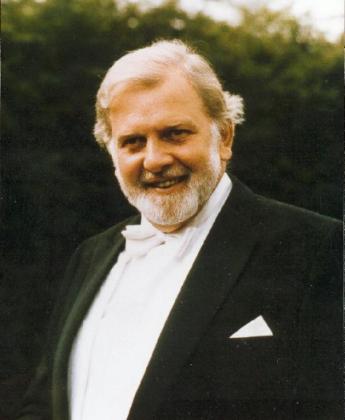
    Above: Karl Ridderbusch, who sang Hagen in the 1967 Salzburg Festival RING Cycle.

    Herbert von Karajan’s GOTERDAMMERUNG, from the Salzburg Festival 1970, starts off with a very fine Norn Scene. Lili Chookasian – after a few warm-up measures – and Caterina Ligendza are authetically Wagnerian as the first and third sisters, with the resplendent Christa Ludwig luxuriously cast as the 2nd Norn. Her superb vocalism is marked by a great lieder-singer’s colourings of the text.

    Helga Dernesch and Jess Thomas give a sturdily-sung rendition of the Dawn duet. Though Dernesch’s highest notes seem somewhat tense, she does sustain a solid high-C at the duet’s conclusion. Karl Ridderbusch is a potent Hagen, able to bring out a softer grain to the tone when he wants to. His sound is somewhat baritonal, but he still hits the lowest notes with authority. Thomas Stewart is an outstanding Gunther, a role that often loses face as the opera progresses. Gundula Janowitz  is not my idea of a good Gutune: she sound mature and a bit tired.

    Christa Ludwig’s Waltraute is a performance of the highest calibre; her superb musicality wedded to her acute attentiveness to the words make this scene the highlight of the performance. Dernesch is good here also, but both she and Jess Thomas seem to flag a bit in vocal energy in the rape scene.

    Act II opens with another of my favorite RING scenes: Alberich (Zoltán Kelemen) appears to his son Hagen (Karl Ridderbusch). Kelemen, so musical in the 1964 Klobucar RHEINGOLD reviewed above, here resorts to sprechstimme and all manner of vocal ‘effects’: I wonder if this is what Karajan wanted, or is this simply what the baritone came up with. Ridderbush sings much of Hagen’s music here in an appropriately dreamy half-voice. A bit later he turns on the power with his “Hoi ho!”, summoning the vassals; the men’s chorus lung it lustily in response. Despite the continued feeling of effort behind Helga Dernesch’s high notes, she hits them and holds them fair and square. Jess Thomas sounds a bit tired as Siegfried; though he manages everything without any slip-ups, the voice just seems rather weary. Gundula Janowitz’s Gutrune is much better in Act II than earlier in Act I, and Thomas Stewart’s Gunther transforms what is sometimes viewed as a ‘secondary’ role into a major vocal force in this performance.

    I had high hopes for the opening scene of Act III: the Rhinemaidens – Liselotte Rebmann, Edda Moser, and Anna Reynolds are all fine singers. Yet they don’t quite achieve a pleasing blend. Jess Thomas sounds brassy and one keeps thinking he might have a vocal collapse, but he stays the course. It is left to Dernesch to be the performance’s saving grace and she nearly accomplishes it: the sense of vocal strain is successfully masked for the most part and she hits and sustains the high notes successfully though it’s clear she is happier singing lower down; she did in fact become a highly successful dramatic mezzo in time. Dernesch gives the Immolation Scene a tragic dimension, and then Karajan sweeps thru the long orchestral postlude with a sense of epic grandeur.

    Overall, Karajan’s GOTTERDAMMERUNG is impressive to hear. Were Helga Dernesch and Jess Thomas thoroughly at ease vocally the overall performance would have been quite spectacular. As it is, it’s Christa Ludwig, Thomas Stewart, and Karl Ridderbusch who make this a memorable Twilight of the Gods.