Blog

  • Irma Kolassi

    Kolassi

    Above: Irma Kolassi

    Listening to Irma Kolassi’s definitive recording of Chausson’s Poème de l’amour et de la mer set me in a nostalgic mood today, remembering my lovers of yesteryear and the ways in which so many of them have slipped out of my life. For not only is this music full of poignant regret but the voice is steeped in some forgotten perfume, so evocative and personal is her timbre.

    This marvelous singer is now largely forgotten, but only to listen to a few measures of her in the Chausson draws us away from the bleakness that permeates so many aspects of life today and back to a time when romance – and its alter-ego, remorse – filled the heart and permeated the dreams of a restless spirit. 

    You can read about Irma Kolassi here and listen to her voice in “Crépuscule” (‘Twilight’) from Fauré’s La Chanson d’Eve here.

  • Score Desk for TOSCA @ The Met

    Tosca_(1899)

    Friday December 20, 2013 – Having greatly enjoyed the Portuguese soprano Elisabete Matos in her two previous roles at The Met (Minnie in FANCIULLA DEL WEST and Abigaille in NABUCCO) I was very much looking forward to her single scheduled Met performance of the current season. But since the Bondy production of TOSCA is such an eyesore, I opted for a score desk tonight as Matos sang her second Puccini role at The Met. {Rumor has it the Bondy production will soon be seen for the last time here in New York City; however, we cannot be sure of getting something better in their place.}

    A great many empty seats in the House was not a good sign; and the audience tended to laugh freely at the MetTitles making me think there were a lot of newbies present. But Marco Armiliato, on the podium for an opera that suits him to a T, gave an extroverted, blood-and-thunder reading of the score. The first act especially was genuinely exciting in every regard.

    Two bassos with enormous voices set the tone for the performance: Richard Bernstein was a capital Angelotti and John Del Carlo a stentorian Sacristan. Marcello Giordani, that most unpredictable of tenors, served notice in “Recondita armonia” that he was really in voice tonight. The aria was generously sung, with clear and expressive phrasing, a thrillingly sustained foray to the climactic B-flat, and a fine diminuendo to a very long piano on the last note.

    Ms. Matos and her tenor then gave a vididly declaimed version of the lovers’ banter and they were really exciting in the sustained passages of the ensuing love duet. George Gagnidze’s Scarpia added more decibels to the evening, and his dramatic inflections were spot on. Ms. Matos lost points with me only on the phrase “Tu non l’avrai stasera…giuro!” where she shrilled on the final word: I like to hear this done in chest voice (or sung ‘from the crotch’ as we used to say of Tebaldi). Mr. Gagnidze and the Met chorus brought the act to a thunderous conclusion with the Te Deum.

    Then, as so often happens at The Met these days, a long intermission seemed to drain the energy from the evening; and I have never heard such banging, thudding and shouting from behind the curtain as the stagehands struck the set.

    Act II found the principals and conductor doing their utmost to restore the dramatic tension siphoned away by the long interval. Mr. Giordani produced an amazingly sustained “Vittoria!” and Mr. Gagnidze was thoroughly impressive in every regard. Ms. Matos struck off steely but not always stable high notes and made a strong dramatic impact with Tosca’s iconic lines: “Assassino! Voglio vederlo!”, “Quanto?…il prezzo?”, “Ah…piuttosto giu m’avento!” and “E morto…or gli perdono!”: these were all delivered with the intensity of a seasoned verismo diva. Her rendering of the great aria “Vissi d’arte” was persuasive in its vulnerability and the prolonged top B-flat at the climax was exciting though she could not sustain the following descending phrase of A-flat and G…and the conductor did nothing to aid her.

    Faced with another extended intermission, I left after the Act II curtain. I would like to have heard Giordani’s “E lucevan…” and the big duet and the opera’s flaming finale, but the thought of another lull diminished my enthusiasm.

    Metropolitan Opera House
    December 20, 2013

    TOSCA
    Giacomo Puccini

    Tosca...................Elisabete Matos
    Cavaradossi.............Marcello Giordani
    Scarpia.................George Gagnidze
    Sacristan...............John Del Carlo
    Spoletta................Eduardo Valdes
    Angelotti...............Richard Bernstein
    Sciarrone...............Jeffrey Wells
    Shepherd................Thatcher Pitkoff
    Jailer..................David Crawford

    Conductor...............Marco Armiliato

  • When the Winter Chrysanthemums Go

    Winter mum

    When the winter chrysanthemums go,
    there’s nothing to write about
    but radishes.

    ~ Matsuo Basho


  • In The Silence of the Secret Night

    Dima

    Dmitry Hvorostovsky sings Rachmaninov’s In The Silence of the Secret Night from a 1990 recital. This was not long after he had won the 1989 Cardiff Singer of the World Competition.

  • Regret & Remorse

    431048_2844874155001_1782237399_n

    “Now that it is over,
    is there a lesson
    to be learned from all this?
    A bright side? A silver lining?

    Only a lesson learned
    much too late.
    The bright side is black and
    the silver lining is tarnished
    beyond cleansing.”

    ~ Gary Jurechka

  • SenseDance @ Peridance

    6a00d8341c4e3853ef017c31d57b4e970b-800wi

    Above: Erin Ginn of SenseDance

    Sunday November 24th, 2013 – Henning Rubsam’s SenseDance in a programme of new and older works at Peridance. On a frigid evening I trekked across The Village to attend this performance in which several friends were involved. The performance, which played to a full house, started late which put me in a grumpy funk. As the evening progressed, the dancers slowly dispelled my cranky mood.

    Much of the programme was given over to duets, well-danced, in many different styles. The first two of these were from past works: Sarabande from MERCILESS BEAUTY (2006) is a straight-up ballet pas de deux to Bach danced by the lyrically lovely Erin Ginn and and her partner, Nathan Bland; it ends with the girl borne off in a sustained overhead lift. On a more playful note, Save The Country from the 1997 Laura Nyro tribute ART OF LOVE found Jacqueline Stewart and Oisín Monaghan rolling around on the floor.

    Three premieres sustained the duet motif: in the first – RUSSIAN LESSON – to a ‘spoken’ score, Juan Rodriguez and Matt Van overcome a language barrier with some athletic sparring mixed with some cozying up: it feels like they are headed for a hotel room. This piece could be sub-titled Found In Translation.

    6a00d8341c4e3853ef01538f8b348f970b-800wi

    Above: Temple Kemezis, photo by Matt Murphy

    Spoken word features also in BORDERS, a stylized and other-worldly duet danced by Temple Kemezis and  Henning Rubsam; this displayed Mr. Rubsam’s choreography at its most impressive, and Temple, with her unique look and potent dancing, seemed wonderfully at home in this dancescape.

    6a00d8341c4e3853ef0148c70fd5a0970c

    Above: Oisín Monaghan, photo by Kokyat

    Oisín Monaghan then joined Heidi Green in a ‘young romance” duet – AN EINSAMER QUELLE – set to music of Richard Strauss. Some dancers are blessed with a unique and instantly identifiable ‘signature’ and Oisín is surely one of these. To date, no choreographer seems to have truly captured Oisín’s essence in dance – several have come very, very close – but perhaps it is exactly that elusive quality that keeps us fascinated. Here he and Ms. Green gave an attractive performance.

    Henning Rubsam’s HALF-LIFE is something of a signature piece for the choreographer. RELOAD has now been added to the title, and the cast has expanded from four to seven. I felt the original quartet setting to be preferable – our focus is now drawn in too many different directions as the dancers come and go. I missed the clarity and crispness of the original. Nevertheless, the ballet was very well-danced tonight with an outstanding performance from Matt Van.

    The evening’s final new work was SARAO, a jazzy pas de deux to music by Ricardo Llorca. This piece featured some of the evening’s most imaginative partnering and was finely executed by Erin Ginn & Matt Van. 

    6a00d8341c4e3853ef0192ac7d1e48970d-800wi

    Above: Lloyd Knight, photo by Nir Arieli

    Making a guest appearance with SenseDance, Lloyd Knight of the Martha Graham Dance Company joined Temple Kemezis in CAVES, a 2006 duet to a Ricardo Llorca score with a Spanish guitar ambiance. The two dancers brought both their physical prowess and their strong personalities to bear on this work which seems to alternate between allure and antagonism. Ms. Kemezis executes deep pliés in second and a sort of crab-walk reminiscent of Wendy Whelan in Christopher Wheeldon’s MORPHOSES. Lloyd Knight’s authoritative partnering, keen feeling for dynamic tension, and tantalizing torso all meshed into a compellingly charismatic performance. In this suggestive’ battle of the sexes’ duet, the woman wins – doesn’t she always? Sustained applause followed this pas de deux, though the bows were saved for the end of the evening.

    Excerpts from Henning Rubsam’s 2012 BRAHMS DANCES closed the evening on a romantic note. Duets for Ms. Stewart with Matt Van and Ms. Green with Nathan Bland had a nocturnal feeling, and then a large ensemble passage which evoked a waltz-filled ballroom.

  • New Chamber Ballet: Baecher and Magloire

    1426491_541344345952393_316149436_n

    Saturday November 23, 2013 – New Chamber Ballet‘s 2013-2014 season continued this evening with a program featuring a Miro Magloire premiere and a revised version of a Constantine Baecher ballet. As always at New Chamber Ballet, live music was an essential component of the performance: pianist Melody Fader and violinist Doori Na were in their element, particularly in the very demanding (commissioned) score by Michel Galante for Miro’s new ballet.

    In Miro’s “A Present” which opened the evening, three women (Elizabeth Brown, Holly Curran, and Amber Neff) go to great lengths to have and to hold onto a necklace which has been sent them by an unknown admirer. A note is enclosed with the gift, but we never learn who it is from or what it says. After some under-handed pilfering and a frantic chase, the bauble is destroyed and the note torn to shreds. Doori Na played a suite of melodies from Tchaikovsky’s Nutcracker, arranged for solo violin, while the three girls fought for possession of the mysterious gift.

    Another conflict ballet comes in the form of Miro’s “Sister, My Sister” wherein dancer Amber Neff is annoyed – to the point of becoming homicidal – by her sister, soprano Charlotte Mundy. The Morton Feldman score calls for Ms. Mundy to vocalize on single, sustained notes. This gets under her sister’s skin. Melody Fader and Doori Na (unseen) played the angular Feldman score as the two women battled it out.

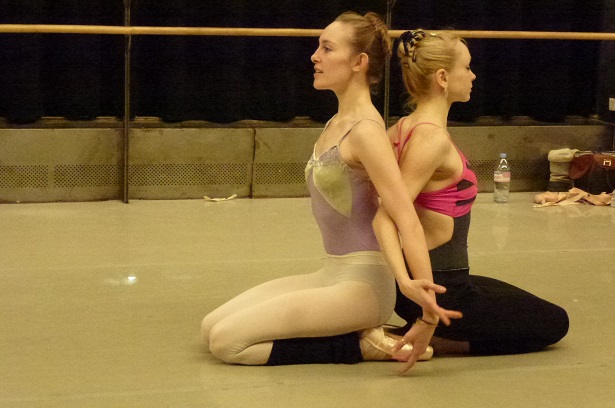
    “Stay With Me”, the new Magloire/Galante collaboration, is perhaps Miro’s finest achievement to date. There are narrative undercurrents but no specific scenario is suggested: the ballet is essentially two duets – the first for Holly Curran and Traci Finch and the second danced by Ms. Curran with Sarah Atkins. The girls wear simple tights and halter tops. In the first duet, Holly and Traci dance an entwined mirror-image adagio; Traci at one point executes a wonderfully fluid backbend. Sarah Atkins silently observes the end of the Traci/Holly duet and then she takes Traci’s place – as the latter walks away – and continues the dance with Holly. The choreography presents a stylized language of intimacy, and the mystery of who these women are and what they mean to one another remains unsolved as the ballet ends.

    IMG_20131117_220510_edited

    Above: dancers Holly Curran and Traci Finch in a rehearsal image by Amber Neff

    The Galante score for “Stay With Me” is fascinating and it challenges the two musicians in terms of both technique and stamina. The piece opens with both piano and violin playing in the highest range. Doori’s violin slithers up and down rapid chromatic scales or lingers for measure after measure on a single pinging tone, while Melody at one point produces a series of sweeping downhill glissandi covering the full keyboard; elsewhere the piano writing favors ethereal high shimmers. Kudos to these two musicians for their spell-binding performance. “Stay With Me” is a ballet I will want to see and hear again soon.

    Constantine Baecher’s “Allow You To Look At Me” was originally a sort of joint-biography of Mr. Baecher and dancer Elizabeth Brown and their long-time association. In tonight’s revision, now titled “Allow You To Look At Me Again” that intensely personal element has been discarded in favor of a more generalized narrative about what it means to perform and to expose oneself to public scrutiny. Narrator Jonathan Parks-Ramage now reads the biographies of each of the three participants – Ms. Brown, Holly Curran and Mr. Baecher – rather than the former poetic story of Constantine and Elizabeth’s mutual admiration. At the piano, Melody Fader plays familiar melodies which underline the personal facets of each dancer’s self-view. The solo for Elizabeth Brown, danced to Debussy’s ever-poignant Clair de Lune, was the evocative apex of the ballet and a lovely portrait of this dictinctive dancer. The work, though now less personal, remains powerful.


  • Columbia Ballet Collaborative @ MMAC

    L1280914

    Above: Audrey Crabtree-Hannigan of Columbia Ballet Collaborative; she appeared tonight in works by Dan Pahl and Donna Salgado

    Friday November 22, 2013 – Columbia Ballet Collaborative danced for a packed house at Manhattan Movement and Arts Center tonight; extra rows of chairs were set out to accomodate an over-flow crowd which included many dancers and choreographers. Enthusiasm ran high for the six new works which were offered: well-contrasted pieces in a well-lit production and featuring an energetic ensemble of dancers, many of whom appeared in more than one ballet.

    Claudia Schreier’s Harmonic opened the evening: yet another success for this choreographer who has an instinctive gift for movement and musicality. Her pas de quatre, to vividly danceable music by Douwe Eisenga, was well-danced by John Poppe, Rebecca Green, Sarah Silverblatt-Buser and Claire Wampler, each of whom has a solo passage woven into the fast-paced ensemble; John partners each of the girls in turn. Strong individual performances and good eye contact between the dancers held our focus, with excellent use of space and interesting patterns evolving in this seamless dancework. I have a feeling we’ll be seeing this piece again.

    Dan Pahl set his new work The Sum of Its Parts to music by The Shanghai Restoration Project. The score opens like a giant machine, progressing to elements of rock, electric fiddle, and club music. Six girls filled the space with so much energy that they seemed like a dozen dancers: some really fine individual work here. Wearing metallic silver tops, the girls look like contemporary Valkyries with a suggestive sway in their movement. Two chairs are sat in, danced on and vaulted over; there’s quite a bit of floor-work and it’s very well integrated into the ballet’s overall structure.

    6a00d8341c4e3853ef019afffd9bfa970d-800wi

    Above: Rebecca Walden danced in ballets by Ja’ Malik and Richard Isaac

    Ja’ Malik created an on-pointe ballet to Philip Glass’s exciting four-part suite ‘Company’; the ballet is entitled Brief Company. Ja’ makes excellent use of the classic ballet vocabulary in a contemporary setting and his dancers met all the demands of Ja’s choreography with both energy and artistry. Rebecca Walden opens the ballet in a beautiful solo passage; clad in pale aquamarine, she then begins to circle the stage in silence. In the darkness she comes upon the prone body of a man: guest dancer Joshua Henry. He rises as if from deep sleep and they dance a duet with complex partering motifs. Mr. Henry, tall and powerful of physique, was a good match for the impassioned Ms. Walden. Four girls form an integrated ensemble around the central couple. Mr. Henry’s expressive solo is danced in a patch of light, and then the ballet seemed poised to end in an agitated ensemble movement; but instead Ja’  interestingly clears the stage, leaving Ms. Walden to circle the space, resuming her silent, questing walk as darkness falls. Ja’s ballet elicited a whooping ovation from the crowd.

    Richard Isaac has created a contemporary ‘white ballet’ with its title Night Music drawn from Mozart’s immortal ‘Eine Kleine Nachtmusik’. The piece has a formal feeling, the dancers stepping out of a line-up to perform solos in the opening passage which is set to an Alexander Rastakov Mozart-hommage. As the lights blaze up, a spacious quartet ensues, danced to the Nachtmusik proper. After a structured walkabout the dancers re-group in a row before erupting into movement again. An especially intriguing segment finds Rebecca Walden being manipulated like a doll by her fellow dancers (Dan Pahl, Delaney Wing and Ms. Silverblatt-Buser).   

    L1280636

    Above: Rebecca Green appeared in new works by Devin Alberda and Claudia Schreier

    A relentess pulsing rhythm marks the opening of Devin Alberda’s pas de trois entitled Sissy Fists, the title a play on ‘Sisyphus’ but loaded with other implications. To music by Anna Meredith, two tall boys – John Poppe and Taylor Minich, in sleek body tights – are joined by Rebecca Green, dancing on pointe. The boys seem to be bonding but Ms. Green tends to intervene. Tension and traces of levity thread thru this dancework; as the music turns ominous, the boys’ mutual partnering becomes more fervent. The choreography’s dynamics reflect the music; there’s a darkening quality that I really like. It’s a ballet I want to see again.

    The evening’s largest piece, A Portrait of Growth, is an all-female ensemble work by Donna Salgado to music by the husband-and-wife duo Houses, is the programe’s finale. Exploring the development of self-identity, this dancework seems especially suited to a college-based company. The ten girls break from unison passages to individual expression; solos danced by Audrey Crabtree-Hannigan, Julia Davis-Porada and Melissa Kaufman-Gomez draw us to their distinctiveness. And there is a line-up from which each girl momentarily steps forward in a brief phrase with a personal hue. The ballet reflects a period of time when life seems fulls of promise and possibility.

  • Celebrating Britten @ The NY Philharmonic

    2926592313

    Thursday November 21, 2013 – The New York Philharmonic‘s celebration of the 100th anniversary of the birth of Benjamin Britten was a lovely fête which brought forth the composer’s familiar Serenade for Tenor, Horn and Strings and the less-frequently-performed Spring Symphony.

    The performance took on added drama when the scheduled tenor was forced to withdraw for health reasons literally on the eve of the concert. This caused the Philharmonic to launch a desparate search for tenors who could 1) sing this demanding music and 2) were available on such short notice. Things turned out very well indeed, with a disarmingly attractive performance of the Serenade by Michael Slattery and a thoroughly impressive rendering of the Spring Symphony by Dominic Armstrong who, as Maestro Alan Gilbert told us, had never so much as looked at the score til the morning of the performance.

    The richly emotional Serenade for Tenor, Horn and Strings opens and closes with solo passages for horn which are played without use of the valves that stabilize pitch. The instrument is difficult enough to play as it is – I know: I played horn in high school – but Britten throws in this extra complication to render the sound with a ‘hunting horn’ ambiance. Thus the Philharmonic’s formidable principal horn, Philip Myers, appeared onstage with two horns – one for the Prologue and Epilogue, and the second ‘normal’ horn for the remaining movements of the work.

    Britten sets the Serenade’s poems, which span five centuries of English verse, in the upper range of the tenor voice; this gives the music an air of rather eerie innocence, yet the singer must also show great maturity in terms of both technique and sensitivity to the texts. The vocal movements are: “Pastoral” (with text by Charles Cotton), a hymn to sunset which sounds like a lilting lullabye; “Nocturne” (to words by Alfred, Lord Tennyson), where the horn calls echo as evening falls over the land; William Blake’s “Elegy”, which addresses a dying rose and is tinged with plaintive melancholy. In the Serenade‘s most unsettling passage, to an anonymous 15th-century text, the “Dirge” is a fugue of relentless, creeping madness evoking the fires of Hell which will ‘burn thee to the bare bone…and Christ receive thy soul’ (this song haunts me for days everafter whenever I hear it). In sharp contrast, Ben Jonson’s “Hymn” is light-hearted and upbeat, bringing the singer’s task to an ‘excellently bright’ conclusion. As the voice falls silent, the offstage horn closes the Serenade on a benedictive note.

    M slattery

    I had heard tenor Michael Slattery (above) often during his time at Juilliard, and was pleased to be present at his impromptu Philharmonic debut tonight. Slender and boyish in his elegant tux, Michael took the high tessitura in stride, with many felicitous passages of vocal color and inflection: his diction was clear and touchingly expressive. Philip Myers played with gleaming, burnished tone and exceptional power in the phrases that serve as a counter-poise to the voice. Maestro Gilbert drew evocative playing from the string ensemble, and the entire performance had a nocturnal incandescence that was truly pleasing. Michael Slattery reacted with disarming sincerity to the audience’s warm applause, being called out with Mr. Myers and the conductor for extra bows.

    The Spring Symphony was commissioned by the Koussevitzky Music Foundation and is dedicated to Serge Koussevitzky and the Boston Symphony Orchestra though it was actually premiered at the Conncertgebouw in Amsterdam during July 1949 before its American premiere the following month at Tanglewood by Koussevitzky and the BSO. Britten calls for a huge orchestra, adult and children’s choruses, and three vocal soloists. The score is dazzling in its range of instrumental colours and textures, and the texts include both hymns of praise to the coming of Spring and some charming moments of levity in depicting day-to-day happenings. This work is quintessentially British: the poems invoke English pastoral imagery and the deftly ‘sudden’ ending – “And now, my friends, I cease” – is punctuated by a  plump C-major chord.

    Maestro Gilbert marshalled his forces for a thoroughly impressive and enjoyable performance: a special “hurrah” for the Brooklyn Youth Chorus who are called upon to both sing and whistle. The ‘save the day’ performance by tenor Dominic Armstrong revealed an attractive voice with mastery of dynamics and colours as well as of textual incisiveness that belied his unfamiliarity with the work. The slender and very pretty soprano Kate Royal has a feather-light lyric soprano and sang charmingly while the distinctive voice of Sasha Cooke – heard only two days earlier at Chamber Music Society – stood out for glowing tone and poetic resonance.

    This was my first time experiencing the Spring Symphony – I’d never even heard it on a recording – and it was a very good idea of Maetro Gilbert’s to choose it as a birthday salutation for the composer, for it is not often performed.

    I must register one tiny complaint – nothing to do with the music or the musicians – but I do wish that plastic water bottles could be banned from the concert stages. In the ‘old days’ small tables were set next to the soloists’ chairs with glasses of water which the singers could sip decorously between numbers. Now we have a distracting ritual of bending over, uncapping the bottle and gulping away like basketball players on the bench. The ‘old way’ of hydrating is much more elegant, and far less conspicuous.