Blog

  • Columbia Ballet Collaborative: Rehearsals

    L1030096

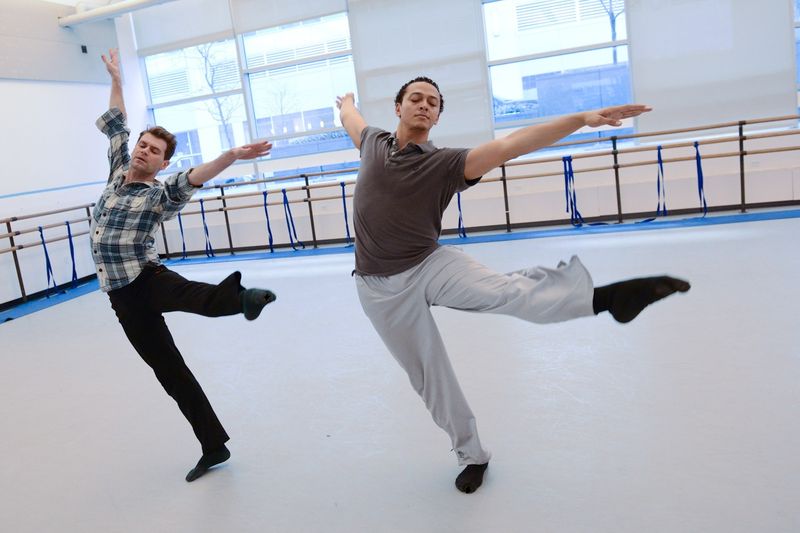
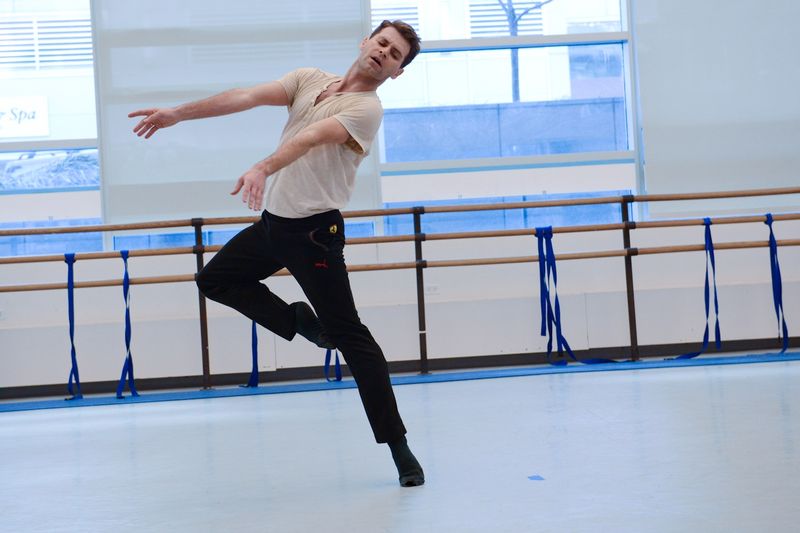
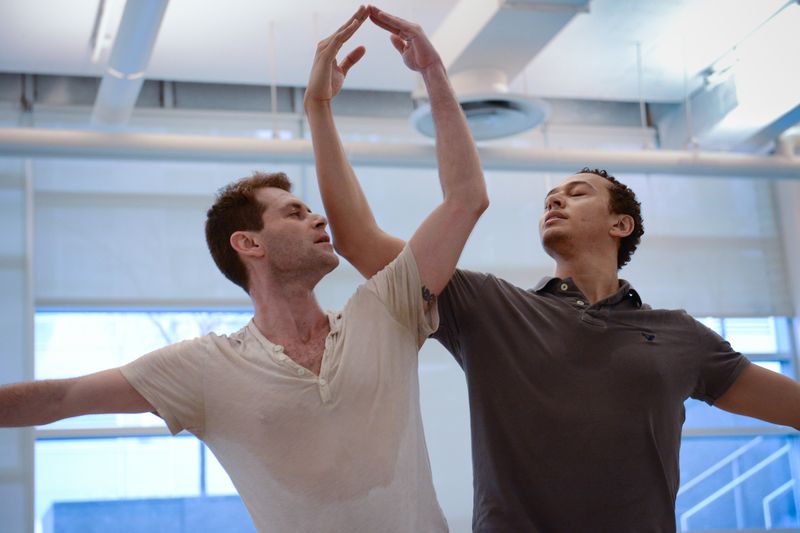
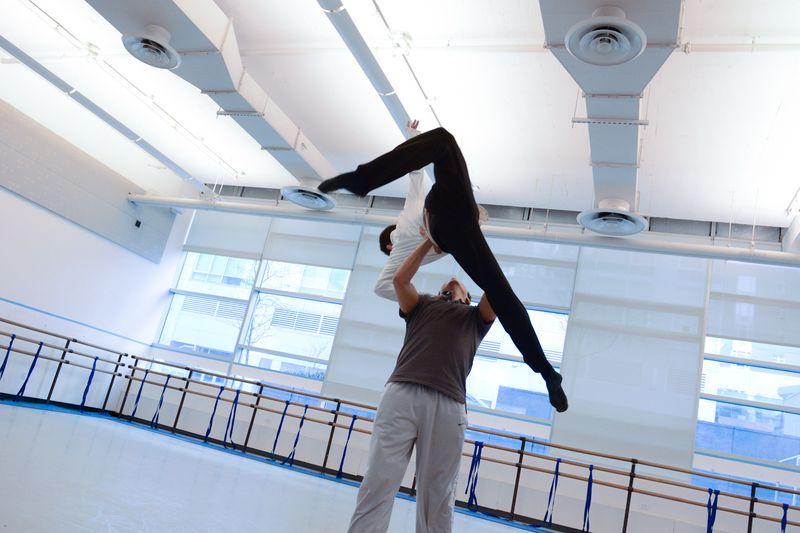
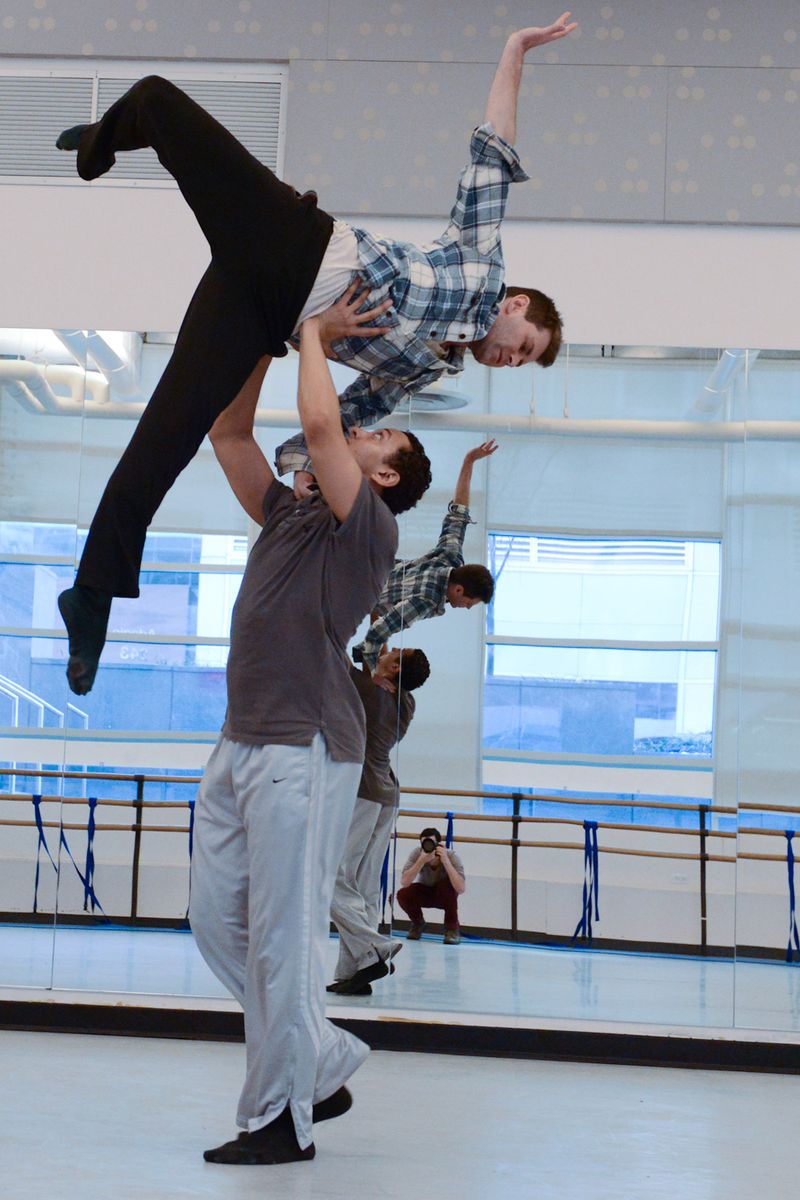
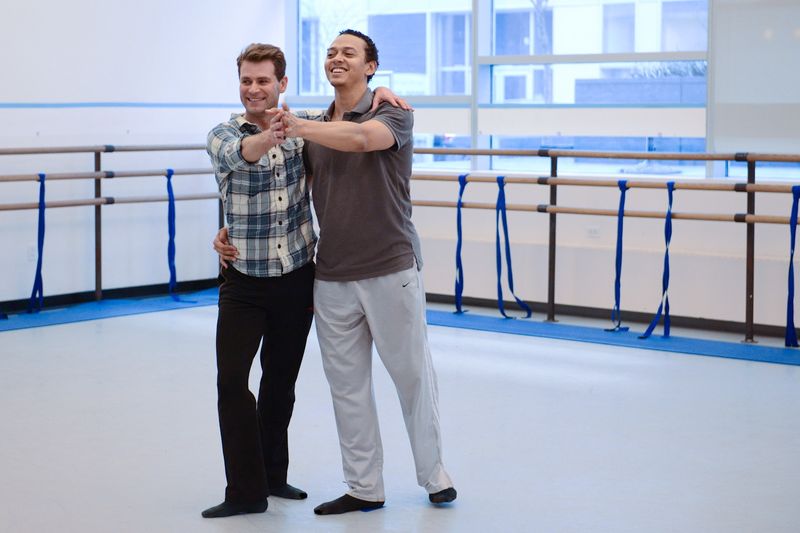
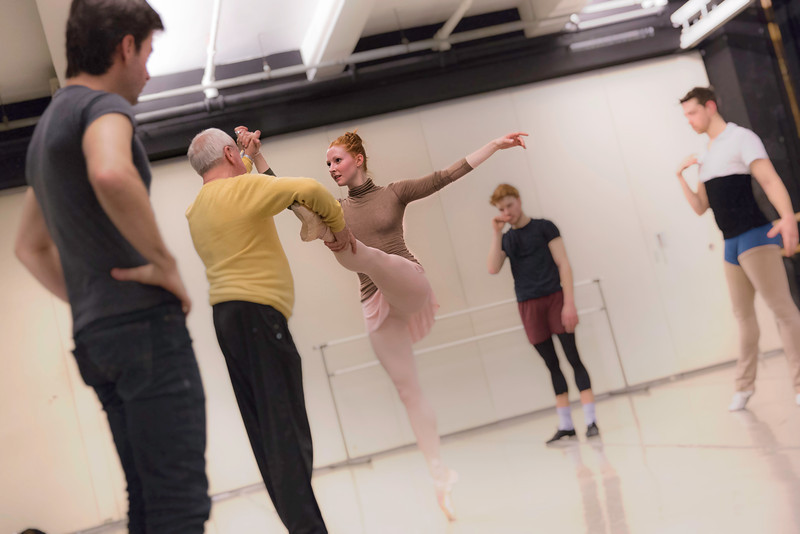
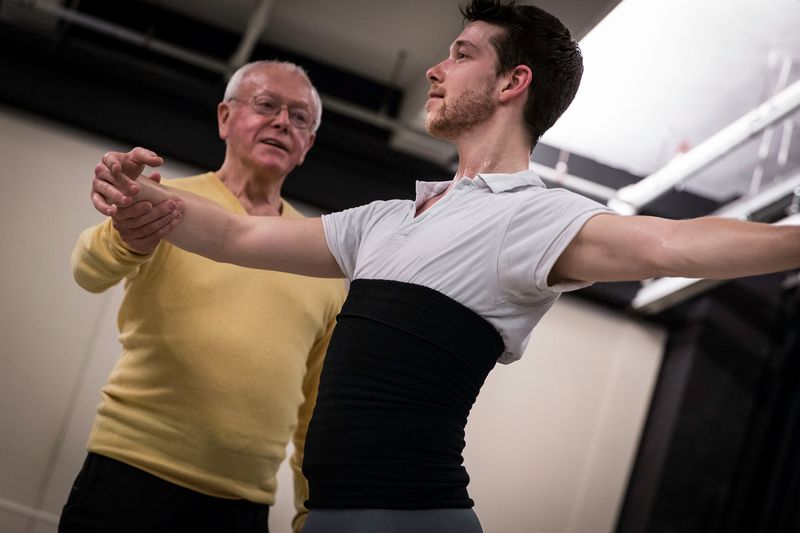
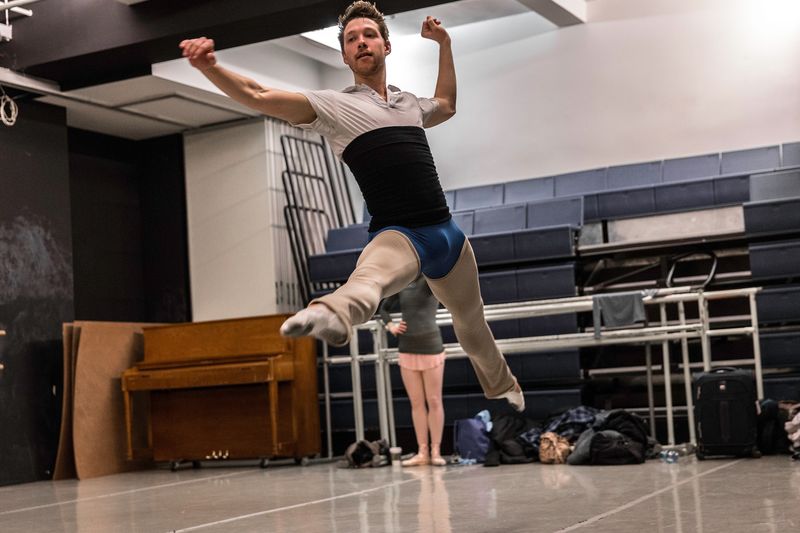
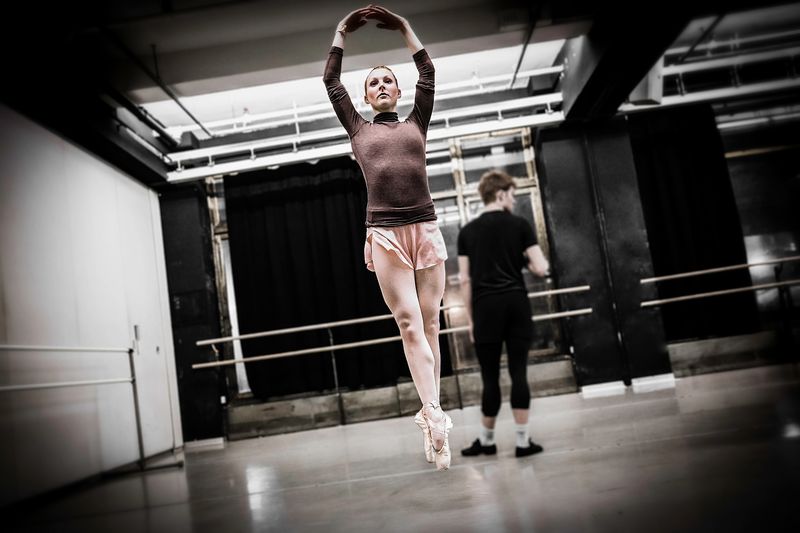
    Above: choreographer Lisa de Ribere works on a pas de deux to be danced by Rebecca Azenberg and John Poppe at the upcoming performances by Columbia Ballet Collaborative.

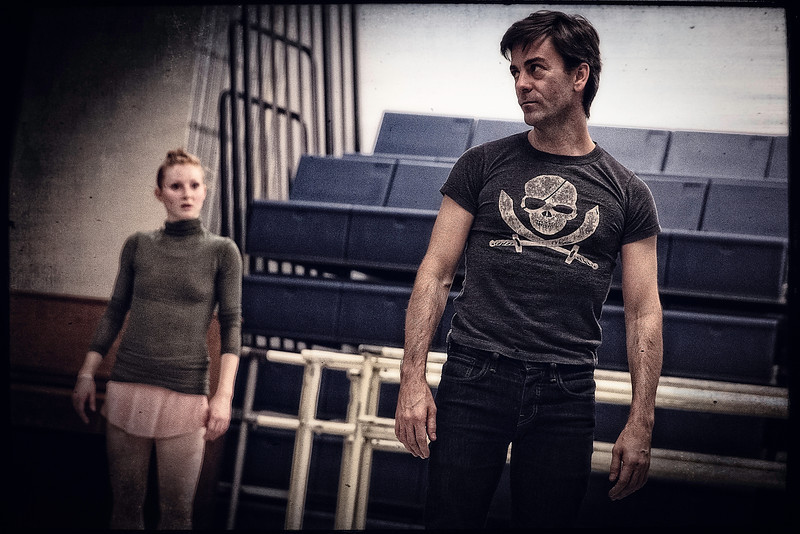
    Friday October 27th, 2012 – I stopped by at Barnard College where two of the five choreographers involved in the upcoming performances by the Columbia Ballet Collaborative were rehearsing. Lisa de Ribere is creating an ensemble work, while Emery LeCrone is reviving a solo piece originally made on Drew Jacoby, and now to be danced by Kaitlyn Gilliland.

    L1030068

    Lisa’s studio was my first stop; several dancers I know were there and she was sorting out a fast-paced section of her two-part ballet which uses music by John Pizzarelli (Traffic Jam) and Norman Dello Joio – an interesting pairing to be sure.

    L1030171

    At the start of the pas de deux (above) in which Rebecca and John slowly and warily investigate one another before moving on to a more intimate quality.

    L1030179

    Rebecca Azenberg & John Poppe

    Click on each image to enlarge.

    L1030233

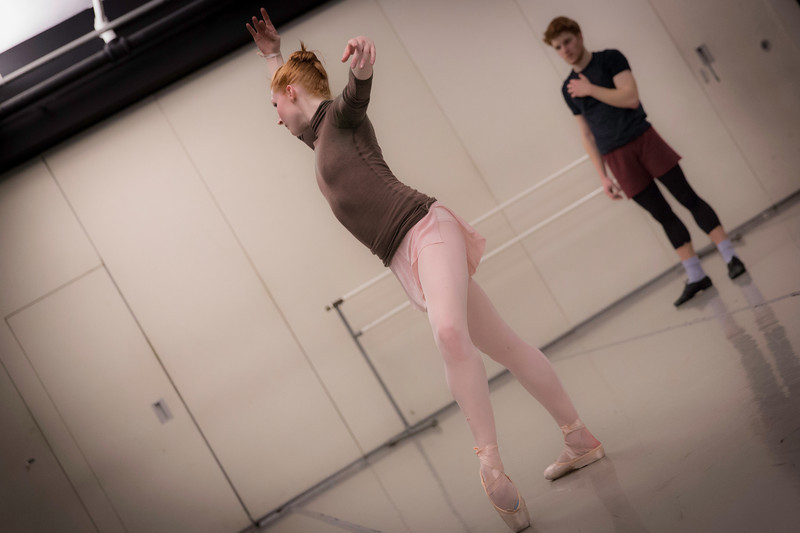
    I then moved to the Streng Studio where choreographer Emery LeCrone (above) was working with one of Gotham’s most gorgeous dancers, Kaitlyn Gilliland, on a solo entitled ARIA.

    L1030605

    Kaitlyn Gilliland

    Set to music by the Balanescu Quartet, ARIA is a space-filling solo which suits Kaitlyn long limbs and her innate spiritual quality to perfection. Emery and Kaitlyn have an easy rapport and mutual appreciation, so the rehearsal was a particularly pleasant experience.

    L1030432

    Kaitlyn!

    The Columbia Ballet Collaborative‘s Autumn 2012 performances will take place at Manhattan Movement and Arts Center on November 16th and 17th. Details here. In addition to the works by Lisa and Emery, ballets by John Poppe, Nick Kepley and Daniel Mantei will be performed. I’m hoping to get to rehearsals of the three gentlemen’s creation in the next few days.

  • Ballet Next @ The Joyce/Program A

    BalletNext_1617

    Above: A Paul B Goode photo from Ballet Next‘s presentation of Alison Cook Beatty’s TINTINNABULI. Click on the image to enlarge.

    Sunday October 28, 2012 matinee – While the governor and The City and the MTA stoked fears of an apocalypse with the impending arrival of Hurricane Sandy, Ballet Next went calmly about their business today, presenting their scheduled matinee at The Joyce. The Company weathered their own small storm when one of their dancers sustained an injury, necessitating changes in Alison Cook Beatty’s TINTINNABUILI, the afternoon’s opening work. But if you hadn’t seen this piece in a rehearsal you’d never have known anything was amiss.

    I have had the pleasure of knowing Alison Cook Beatty as a dancer for the past couple of years, and was happy to learn that she’d been chosen to create a piece for Ballet Next. Alison started off on the right foor by choosing excellent music (Arvo Part) and then went on to create a very pleasing contemporary-style ballet. Inspired by the excellence of the dancers at her disposal (can a young choreographer ask for a finer leading lady than Michele Wiles?) Alison’s TINTINNABULI has a spiriitual quality stemming from the celestial music which was played live by an ensemble of violinists, with piano and cello.

    Opening in a striking diagonal of light, Michele Wiles dances an angular but still lyrical solo observed by Tiffany Mangulabnan and Stuttgart Ballet principal Jason Reilly. Tiffany and her two ‘sisters’ Kristie Latham and Lily Nicole Balogh seem like the three Fates, willing Michele and Jason into a union. In this hair-down ballet, the girls look gorgeous. Tiffany has two very fine solo passages, one spacious and other-worldly, the second a more intense and fiery ritual dance; in the latter, her hair took on a life of its own. The culminating pas de deux for Michele and Jason   features some heavenward lifts, while the trio of girls circle and bind the couple.

    As a choreographer, Alison has things well-in-hand, drawing on the music for inspiration at every turn. And the dancers did her proud wth their committed and passionate dancing. My only slight concern about the piece was that the second half stretched out a bit; this is music that can readily be compressed and I think I would have tightened it a little to make a more succinct statement. As Balanchine once said “…that I too could eliminate”.

    Margo Sappington’s ENTWINED began life as a sensuous Satie pas de deux. In the ensuing months, Sappington enlarged the work with a duet (Georgina Pazcoguin and Kristie Latham), a pas de trois for those two girls plus Charles Askegard, and a solo for Michele Wiles. The initial duet now conclude the ballet, danced tonight by the lovely Katrina Gonzalez with Charles Askegard giving another demonstration of the art of ballet partnering. With Ben Laude’s limpid Satie from the keyboard, the ballet sustained its atmosphere; in the end it is the original pas de deux that still seems to make the most striking effect.

    Mauro Bigonzetti’s LA FOLLIA has become Ballet Next‘s signature work, and rightly so. In this dynamic and demanding work, two ballerinas – Michele Wiles and Georgna Pazcoguin – sweep thru a series of angular combinations with super-sharp pointe work, meanwhile communicating with one another in an elaborate sign-language. It’s breathtaking, and was excitingly danced today by the two women, sending the crowd out to face the storm on an inspired and positive wave of Vivaldi.

    I truly enjoyed both programmes of Ballet Next this week, though I did rather miss having a more classical pas de deux in the repertory. When Michele and Charles dance WHITE SWAN together, it is really something. I hope they will bring that back, or work up another duet from the standard rep: it gives us the chance to savour their partnership, as well as providing a contrast to the new works they are creating.

  • Atlanta Symphony @ Carnegie Hall

    Polegato-Brett-Headshot

    Above: baritone Brett Polegato, one of tonight’s soloists at Carnegie Hall

    Saturday October 27th, 2012 -The Atlanta Symphony Orchestra brought three 20th century works to Carnegie Hall in a wonderfully crafted evening under the baton of Robert Spano. My front row seat put me right at the heart of things, beneath a row of lovely cellists that I could have reached out and touched. This was my third evening at Carnegie in a week’s time, and I felt so at home there.

    I chose this programme because I wanted to hear the Canadian baritone Brett Polegato; his voice intrigued me when I first heard him singing on a tape of the 1995 Cardiff Competition which my friend Mollie had so kindly sent me. It’s taken me all this time to hear him ‘in person’ and it was well worth the wait; my impressions of him from that tape proved totally valid: he’s a first-rate singer.

    But to start at the beginning, Mr. Spano opened the programme with Copland’s APPALACHIAN SPRING, by far the best-known of the evening’s three weeks. In classical music, familiarity can breed not so much contempt as a taking for granted of certain works. If you say ‘NUTCRACKER‘ or “Eine kleine nachtmusik‘, people will shrug and smirk and say “Again?” But these pieces are popular for a reason.

    Listening to the Atlanta players in the Copland, I realized again how really original and purely enjoyable this score is. And it put me so much in mind of my recent links with the Martha Graham Dance Comany and with the Japanese artist Isamu Noguchi who designed the sets for Graham’s iconic ballet. Tonight APPALACHIAN SPRING felt like the masterpiece that it is, so lovingly played.

    CHICHESTER PSALMS is one of the few Leonard Bernstein works that I admire, and possibly the only one that truly enjoy. I actually came to know this music thru Peter Martins’ ritualistc setting at New York City Ballet. Its rhythmic freshness and its heartfelt melodic strands make it so appealing, and tonight we had an adult male soprano rather than a boy treble; John Holiday’s gorgeous tone stole gleamingly into the huge Hall. His voice gave the music an erotic/exotic throb that a boy singer could never produce. The audience gave Mr. Holiday a rousing cheer as he bowed, and he very much deserved it.

    William Walton’s BELSHAZZAR’S FEAST was an early success for the composer and it sounded magnificent last night as played and sung by the musicians and chorus of the Atlanta Symphony. The work tells the story of the proverbial writing on the wall, and of Belshazzar’s demise and the triumph of godliness. It plays out strikingly, though it does seem to me that Walton became just a shade long-winded in the final pages of the score: he doesn’t seem to know when to stop. Be that as it may, it was an inspired performance all round.

    Brett Polegato’s noble tone sailed out into the Hall with warmth, focus and power, his exemplary clarity of diction making reference to the printed texts unnecessary. In the unaccompanied passage ‘Babylon was a great city…’ the singer forged a direct link with the audience, his voice speaking to us with remarkable directness and emotional force.

    The evening posed the question, why isn’t Brett Polegato at The Met? And why, for that matter, isn’t Mr. Spano there as well?  They are both masters of their respective crafts.

    1f318148667991b369f2f610fbbb8cfd

    You can experience their work on the Grammy Award-winning recording of Vaughan-Williams SEA SYMPHONY

    Tonight’s concert:

    Performers

    • Atlanta Symphony Orchestra
      Robert Spano, Music Director and Conductor
    • John Holiday, Countertenor
    • Brett Polegato, Baritone
    • Atlanta Symphony Orchestra Chorus
      Norman Mackenzie, Director of Choruses

    Program

    • COPLAND
      Appalachian Spring
    • BERNSTEIN
      Chichester Psalms
    • WALTON
      Belshazzar’s Feast
  • Ives 4th + Mahler 8th @ Carnegie Hall

    Mahler 2

    Above: Gustav Mahler

    Friday October 26, 2012 – The  Collegiate Chorale and the American Symphony Orchestra teamed up at Carnegie Hall tonight for a symphonic double-bill, with a delightful ‘prelude’ in the form of Leopold Stokowski’s arrangement of The Star-Spangled Banner. I rarely have the opportunity to work symphonic concerts into my calendar of dance and operatic events (and I continue to suffer from a lack of chamber music in my diet). So I am grateful to the Collegiate Chorale and publicist Michelle Brandon Tabnick for this evening’s invitation.

    The evening marked the 50th anniversary of the American Symphony Orchestra and in celebration, tickets were sold at 1962 prices, with a $7.00 top. There was a nice atmosphere in the house and a warm reception for all the musicians involved.

    Maestro Leon Botstein swept his forces thru the ‘Stokowski’ Star-Spangled Banner with its wonderful deeper sonorities near the end.  Players and audience alike stood for the anthem, and I personally felt a pang of sadness at the state of our country today. But we won’t go into that here.

    The players then settled in and the Ives began. This is a fabulous score and I found myself smiling and even chuckling softly to myself as the work progressed: it takes itself so seriously, yet to me it abounds with wit and irony. It seemed clear that some in the audience had not previously encountered Ives’ work: they didn’t know what to make of it. But for me, this was 30-minutes of pure sonic pleasure.

    Ives

    Above: Charles Ives

    The wondrous layering of sound, the floating cacophonies wafting over the dense militaristic undercurrents, the dazzling individual instrumental voices shining forth: the ear is constantly titillated. In a stunning volte face, Ives gives us straightforward melody in the 3rd movement which must have felt like a sonic oasis to the uninitiated. Throughout, the piano (expert playing from Blair McMillen) gives the symphony the unexpected feel of a concerto trying to make itself heard thru the waves of sound. A terrific performances, and the players have my admiration for what must be a nightmare of counting.

    After intermission, the vast tapestry of the Mahler 8th unfurled itself in the venerable hall. Relentless in its cresting waves of vocal sound flooding over the massive orchestral forces, this is a work like no other. The two choruses simply pour it on all evening, whilst an octet of principal voices – the sopranos often kept in the upper reaches of their range – trade off solo passages of melodic intensity.

    Duncan-Tyler-01[Colin-Mills]

    Of the vocal soloists, three stood out: baritone Tyler Duncan (above, in a Colin Mills portrait) brought a welcome sense of lyric beauty to his solo. Basso Denis Sedov was equally fine, using his expressive hands to shape the music. In the taxing top soprano line, Rebecca Daviss’ voice gleamed beautifully all evening.

    Maestro Botstein was a few minutes into the symphony’s second half when he suddenly stopped; I could not hear his over-the-shoulder remark, but with a tap of the baton he started over. The performance then surged onward, and the audience stayed on at the end to cheer.

    • Blair McMillen, piano
    • Rebecca Davis, soprano
    • Abbie Furmansky, soprano
    • Katherine Whyte, soprano
    • Fredrika Brillembourg, mezzo-soprano
    • Susan Platts, mezzo-soprano
    • Clay Hilley, tenor
    • Tyler Duncan, baritone
    • Denis Sedov, bass
    • Brooklyn Youth Chorus
    • The Collegiate Chorale
  • Upcoming: Pontus Lidberg for MORPHOSES

    Morphoses02b

    Above: MORPHOSES rehearsal director Reid Bartelme and ABT’s Isabella Boylston in rehearsal for Pontus Lidberg’s WITHIN; photo by Jade Young. MORPHOSES will present Pontus’s evening of dance and film entitled WITHIN (Labyrinth Within) at The Joyce from November 7th thru 11th. Information and tickets here.

    The performances will open with the newly-staged ballet which has evolved from Pontus’s haunting film LABYRINTH WITHIN. Watch a brief trailer for the film – which features New York City Ballet principal Wendy Whelan, Pontus Lidberg and Giovanni Bucchieri – here. Following the ballet, the film will be shown.

    Morphoses03crop

    A couple of weeks ago, Jade and I went to a rehearsal of the ballet at the Gibney Dance Center. It happened to be Isabella Boylston’s (above) first rehearsal of the work;, and indeed it fell on a day of firsts since I had earlier watched the New York City Ballet‘s compelling soloist Adrian Danchig-Waing in his first-ever APOLLO rehearsal. Adrian is Isabella’s partner in the Pontus Lidberg work, so I felt like a bit of a stalker following him from one studio to another. 

    Morphoses01

    Isabella Boylston and Adrian Danchig-Waring, photo by Jade Young.

    Isabella worked with Reid Bartelme, Pontus’s rehearsal director, while Adrian perfected the partnering with Laura Mead, a lovely dancer I’d met earlier this year when she danced for Cherylyn Lavagnino. Laura will alternate with Isabella at The Joyce performances.

    6a00d8341c4e3853ef01676808dae9970b-800wi

    Laura Mead, photographed by Kokyat.

    I was curious to find that a second couple are also involved in the ballet, since in the film it is definitely a romantic triangle (real or illusory). But Gabrielle Lamb – a favorite dancer of mine – and the handsome Berlin-born danseur Jens Weber were working on another pas de deux, Gabrielle wearing the stiletto pumps that Wendy Whelan wears in the film.

    Morphoses12c

    Gabrielle and Jens, photo by Jade Young

    Now I’m very curious to see how the two couples will be woven into the story once the ballet takes the stage, and also to find how the staged dance dovetails with the film.

    As the appointed studio time seemed about to run out, Pontus let the other dancers go but he stayed behind to work on his solo passages with Reid. Evening was falling outside, and the studio took on a very dreamlike atmosphere.

    6a00d8341c4e3853ef01348752c312970c-800wi

    If you have seen the film, you will recall the striking image of flowers growing thru the floorboards of the mysterious old castle where the film was shot; that’s a Wendy Whelan photo, above.

    Morphoses06b

    For today’s rehearsal, Pontus had brought his own flower. His dancing is so poetic, and in these last lingering moments of the rehearsal the outside world seemed to vanish and the beautiful dancer drew us into his dreamworld.

    Click on Jade’s images to enlarge.

  • Ballet Next @ The Joyce/Program B

    548378_10151181026112034_44545427_n

    Above: Charles Askegard and Michele Wiles of BALLET NEXT, photo by Paul B Goode.

    Wednesday October 24, 2012 – On this, the second evening of Ballet Next‘s current season at The Joyce, an exciting new ballet entitled BACHGROUND by Mauro Bigonzetti seemed to fascinate the audience, evoking a sustained ovation at the end. An excellent Stravinsky pas de deux choreographed by Charles Askegard and Brian Reeder’s dreamlike and evocative PICNIC were also performed – all to live music, and all danced by top-notch dancers.

    Charles Askegard’s setting of some of the fantastical music from Stravinsky’s BAISER DE LA FEE creates a fast-paced duet for the tall danseur and his partner, New York City Ballet‘s truly incredible Georgina Pazcoguin. As choreographer, Charles, who could write a textbook on the art of ballet partnering, devises a full range of of sizzling partnering motifs, some quite unique to his own language. He then proceeds to show us how it’s done. In combinations witty and fresh, Charles sets the Stravinsky score aglow, and both dancers have the agility and musicality to make it shine. In a brisk series of supported pirouettes, Gina made me dizzy. The duet sails brightly forward, propelled by the playing of violinist Hajnal Pivnik and pianist Ben Laude. A refreshing way to open an evening of dance.

    Brian Reeder’s PICNIC is set to the Shostakovich Cello Sonata in D, played by Elad Kabilio and Ben Laude. Finely lit by Alex Fogel and Brandon Sterling Baker, the ballet was inspired by the 1975 film PICNIC AT HANGING ROCK. Set in 1900, the story revolves around a group of Australian schoolgirls who go on an excursion to Hanging Rock; some of them never return, and the mystery of their disappearance was never solved.

    The ballet has been expanded since my first encounter with it earlier this year. Michele Wiles, Erin Arbuckle, Lily Nicole Balogh, Kristie Latham and Tifffany Mangulabnan are the white-frocked young ladies and Charles Askegard the mysterious observer who leads them astray. The girls seem quite innocent, though a kiss shared by Erin and Lily momentarily threatens to cross the line from chaste to impassioned. The narrative is gently applied, and the girls have many opportunities for expressive dancing: there are even fouettes for Kristie and Tffany. Musically and visually, PICNIC is all of a piece.

    Seated on folding chairs in geometric patterns of light and shadow, the six dancers in Mauro Bigonzetti’s BACHGROUND stare at us provocatively before erupting in a series of solos and duets in which the choreographer seems to ask the impossible in terms of elasticity, stretch and sheer nerve…and they all deliver brilliantly. Pianist Ben Laude plays Bach; the individual dancers come forward to dance as their colleagues watch or – in some cases – briskly turn their chairs to face upstage.

    Clifford Williams in a solo of mind-boggling contortions launches the ballet on its jaggedly thrilling way; his torso, gleaming with sweat, glows under the lights as he shapes his limbs into unbelievable poses. His performance drew sustained applause. Georgina Pazcoguin steps ravishingly forward; at first she seems like the Novice in THE CAGE about to have her way with Mr. Williams’ spent body, but he’s magically replaced by Jesus Pastor. In their pas de deux, Gina and Jesus embrace and unfold in torrid stylizations, Gina’s extension remarkably deployed. Kristie Latham and Lily Balogh dance in sync, speaking a complex gestural language; there is a pas de quatre danced in silence by the two girls, Clifford and Jesus. Jesus, wonderfully handsome and enticingly scruffy, has a solo that is passionately physical, and Michele Wiles and Clifford Williams perform another stunningly shaped pas de deux.

    Some of the partnering elements are lifted directly from Mr. Bigonzetti’s New York City Ballet hit OLTREMARE, but choreographers and composers have self-borrowed for centuries and when it works this well, why worry? The cumulative effect of music, movement, lighting and strikingly physical performances by the dancers in BACHGROUND evoked a prolonged ovation from the sold-out house.

  • Verdi REQUIEM @ Carnegie Hall

    Angel

    Tuesday October 23, 2012 – I’d been looking forward to this performance for weeks; the Verdi MESSA DA REQUIEM is one of my favorite pieces of music, glorious from first note to last. I have experienced some thrilling live performances over the years, including three superb evenings at Tanglewood. Great conductors, great soloists and top-notch choral groups have placed their stamp on this grandiose and poignant score.  

    Tonight’s performance will not fall in the memorable category, although the playing of the Philadelphia  Orchestra was thrilling, and the singers of the Westminster Symphonic Choir gave their hearts and souls to the work’s resplendent choral passages.

    Opening the work with an achingly slow and very inspiring rendering of the score’s first pages, conductor Yannick Nézet-Séguin went on to a very impressive performance of the entire work. He moulded the great arcs of music with a fine sense of grandeur and he and his players shone in the more introspective moments. Only his rather pretentious holding of the applause by not lowering his baton after a reasonable pause at the end seemed off-kilter; it wasn’t that profound of a performance.

    The REQUIEM is sometimes referred to as a ‘sacred opera’; it is so very operatic by nature that, as with all operas, performances of it tend to stand or fall by its principal vocalists. Tonight we had an even split of a surprisingly excellent mezzo-soprano and a very fine basso, aligned with a soprano who seemed sometimes on the verge of distress and a tenor who labored valiantly to make his once-generous voice flesh out Verdi’s magnificent melodies.

    791

    Christine Rice (above), a singer totally new to me, gave a very pleasing performance in every respect, Her timbre has a soprano feel to it, but she used a comfortably plush and resonant chest voice to make the most of her every phrase. In an evening of often wayward vocalism, I found myself sighing with relief whenever Ms. Rice stood up to sing. Basso Mikhail Petrenko might not have the sheer vocal heft of some of the singers who have preceded him in this music, but his sound is steady and warm and his vocalism is expressive. The opening pages of the Lacrymosa, where Ms. Rice and Mr. Petrenko joined forces, was the evening’s purest sonic pleasure.

    Marina Poplavskaya’s opening phrase was painful to the ear; her voice sounded unsteady and ill-sorted. As the evening progressed, a feeling of lack of vocal support grew. Her voice often sounded pallid and tentative, and she used a piano approach to high notes to cover a spreading quality that emerged when she sang full-out. Shortness of breath was worrisome, as were vagaries of pitch here and there; her lower-middle register did not always speak. And some of the most thrilling moments of the REQUIEM, when the soprano voice should sail out over the massed choral and orchestral forces, went for naught tonight as Ms. Poplevskaya’s sound was erased by the sopranos of the chorus.

    Opera lovers can’t help but be aware of Rolando Villazon’s vocal struggles in recent seasons. This very likeable singer tried to sing with his usual generosity and passion, but the sound now is smallish and grey. The top does not bloom, but narrows instead. And he has a very strange method of attacking notes with a biting huskiness. Attempting to make the music interesting, he drew down the tone to a thread at times but it did not sound well-supported; and a patch of off-pitch singing in the Hostias was disconcerting.

    It was a sad night for the soprano and tenor though the audience, typically, did not seem to notice anything was amiss. I wonder how much more impressive the evening would have been if different vocalists had taken on these roles. It was a squandered opportunity, in my view.

    • The Philadelphia Orchestra
      Yannick Nézet-Séguin, Music Director
    • Marina Poplavskaya, Soprano
    • Christine Rice, Mezzo-Soprano
    • Rolando Villazón, Tenor
    • Mikhail Petrenko, Bass
    • Westminster Symphonic Choir
      Joe Miller, Conductor
  • Baroque Collaboration @ The Players Club

    6a00d8341c4e3853ef0148c873b581970c-800wi

    Above: Jared Angle, in a Henry Leutwyler portrait.

    Friday September 28, 2012 – In a unique mingling of dance and song, New York City Ballet principal dancer Jared Angle and countertenor Anthony Roth Costanzo met up in the salon at the Players Club for a Baroque feast. Jared’s NYCB colleague Troy Schumacher (who is also the founder of Satellite Ballet) choreographed the Vivaldi piece in which Jared danced. At the harpsichord, the remarkable Bradley Brookshire made marvelous music all evening. The programme was presented as part of the Salon/Sanctuary Concerts series.

    Costanzo

    Above: Anthony Roth Costanzo, whose singing of Handel, Purcell and Vivaldi showed a delicious timbre, breath control of enviable security, and coloratura that left the listener astounded. For all the magic of his virtuoso vocalism, it was in the sustained poetry of the slow passages that the slender and agile young singer was at his most ingratiating. Tapering the phrases with staggering dynamic command, the voice spoke to us of a time when the great castrati brought audiences to the point of madness. If one or two highest notes seemed slightly strained, it hardly mattered. This was fabulous vocalism, and all the more fascinating for the engaging use of eyes and hands with which Anthony mesmerized his listeners.

    Bradley_2007_Headshot

    Bradley Brookshire (above) played solo works by Bach and Scarlatti, his scale passages rippling off the keyboard with fantastical velocity and precision. A master of timing and of coaxing colours out of his instrument, Bradley even made the silences speak. His musical rapport with the countertenor was a complete delight to experience.

    It was in the Vivaldi cantata Qual per ignoto calle that the artistry of the evening’s three participants converged. Clad in black tights and a simple grey shirt, Jared Angle stepped into the space where he encountered the bare-footed counter-tenor. Troy Schumacher’s choreography drew the singer into the dance, his lithe frame very much at ease with the movement. Jared circled Anthony like an unseen spirit, a guardian angel. Using his wonderfully expressive hands to poetic effect, Jared moved with consummate grace, sometimes lifting the singer and cradling him with consoling tenderness. There were passages where Jared displayed hs vituosity in leaps and turns, but he always returned to keeping watch over his charge. Bathed in the golden light of this antique salon, Jared’s face took on an other-worldly beauty. The duet hovered on the brink of unspoken romance – inevitable when two handsome men meet in an intimate setting – but the purity of the spell was never broken.