Blog

  • Patricia Brooks as Mélisande

    Brooks 2

    Above: Patricia Brooks

    One of my dearest memories from my early opera-going experiences is of my first PELLEAS ET MELISANDE, in a lovely production at New York City Opera in 1970. Debussy’s haunting score moved me, even though it was not always easy to comprehend. And the poetry of the words conveyed a sense of mystery; since I had studied French in high-school (with a native-born Frenchwoman as my teacher) it was engrossing to listen to the language being sung.

    One of the most memorable portrayals in the superb cast was that of the mysterious, fragile Mélisande by Patricia Brooks. Apart from her iconic Violetta, Mélisande was the Brooks role that I recall most vividly. I was so excited to find this recording on YouTube.

    Read more about this soprano here.

    Julius Rudel is the conductor, with the following cast:

    Arkel – Malcolm Smith; Geneviève – Francis Bible; Golaud – Louis Quilico; Pelléas – André Jobin; Mélisande – Patricia Brooks; Yniold – Robert Puleo; Physician – Don Yule; Shepherd – William Ledbetter

    The above names may be largely forgotten by now, some 55 years on. To me they were remarkable artists who played a part in my abiding passion for opera.

    If you are not familiar with the Brooks voice, this will give you an idea of her unique qualities as a singer:

    Patricia Brooks as Violetta – w Molese – NYCO – 9~28~69


  • Gihoon Kim at The Met

    Gihoon & sophia

    Above: Korean baritone Gihoon Kim with Met Opera fan Sophia Cerovsek

    ~ Author: Oberon

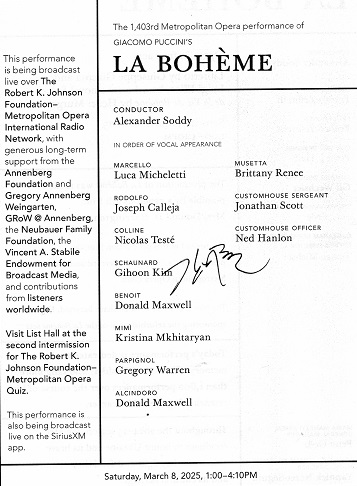
    Saturday March 8th, 2025 matinee – I wanted to catch Gihoon Kim’s Schaunard in the Met’s BOHEME a second time. Since watching the Korean baritone take the title Cardiff Singer of the World at the 2021 competition, where his Tanzlied from Korngold’s DIE TOTE STADT brought the beloved soprano Roberta Alexander (one of the judges) to tears, I have followed Gihoon’s career, and even befriended him on Facebook. He has a wonderful voice and a sunny, life-embracing personality.

    Although I was at a score desk, I’d heard about Gihoon’s dance routine (and the ensuing duel) in Act IV, so this time I stood up and took in all the action. Hilarious! Later in the act, it is Schaunard who first realizes that Mimi has breathed her last: “…è spirata…” , which Gihoon spoke in a hushed voice. After the performance, I went to say hello to him at the stage door.

    Gihoon-1 jpg

    Aside from Gihoon, the only singers in the cast whose work I was familiar with were Joseph Calleja (Rodolfo) and Kristina Mkhitaryan (Mimi, who I’d previously seen as Musetta). Brittany Renee (Musetta), Luca Micheletti (Marcello), and Nicolas Testé (Colline) took the other leads today, and the British conductor Alexander Soddy was on the podium.

    Although there was sometimes a feeling that the cast was under-rehearsed, overall the performance came off quite well; Maestro Soddy did cover the voices at times (a trend at the Met these days), but his tempi were nice, and I liked the energy he developed as the military parade passes by the Café Momus.

    I had not heard Joseph Calleja (Rodolfo) in the House since his 2019 Pollione. The voice has always had a fast but fascinating vibrato, and that was in play today; for me, it adds a special appeal to his singing. Today, his highest range seemed somewhat compromised; he may have been ill, or perhaps this is how he sounds now, after having sung, in recent years, some roles that stretched his essentially lyrical voice. Whatever the trouble, he managed to find a work-around, keeping the higher notes brief, or trying a headier resonance. At the end of the love duet, he at first harmonized with the soprano, but then went for the concluding top note which was a bit husky but which his Mimi’s clear note helped to masque. Thereafter, Mr. Calleja was a truly poetic Rodolfo; his singing has a vulnerable trace that is most appealing. His most magical moment came at the end of Act III when he produced a gorgeous falsetto tone on “…la stagione dei fiori…”  Really exquisite. Earlier, at the end of “Che gelida manina…” he had created the same intimate atmosphere with his delicate “Via piaccia dir?“, sustained down to a whisper.  

    Today’s two sopranos both have vibrant voices, capable of filling the Met (so long as the Maestro kept the orchestra’s volume agreeable). Both Kristina Mkhitaryan and Brittany Renee have a bit more vibrato in their tone than I could wish, but other opera friends of mine feel this is a trend nowadays, and they are not bothered by it.

    Ms. Mkhitaryan’s Mimi made her entrance after a lovely flute solo; oddly, for the first time, I sensed that a shadow of doom lies over the seamstress right from her hesitant “Scusi…”. As her narrative-aria unfolded, the vibrato became less intrusive; her singing was poetic. The orchestra slowed a bit, so she could make the most of the lyrical Ma, quando vien lo sgelo...”; and in the lingering phrases that follow, the soprano was most persuasive. In their classic duet, she and Mr. Calleja beautifully expressed their blooming love. The tenor’s haunting “Che m’ami, di...” was met by the soprano’s delicate “Io t’amo!“.  Nothing in the world compares to falling in love at first sight; I’ve done it hundreds of time thru the years…usually in vain.

    Ms. Mkhitaryan’s singing in the Act III duet with Marcello was tinged with desperation, and her Donde lieta usci...” was truly touching, especially her hushed “Bada, sotto il guanciale c’è la cuffietta rosa…” which made me choke back tears. The aria had a ravishing, sustained ending. In the final minutes of Mimi’s life, Ms. Mkhitaryan summoned a lovely palette of vocal pastels; she even introduced a touch of playfulness as she and Rodolfo recalled their first meeting. But then the fatal cough sets in, her final lines trailing off into eternity.

    Ms. Renee’s Musetta, like most takes on this role, is an extrovert. Her noisy disruption of the Momus party was laced with moments of shrill shrieking, but she settled in for the Waltz, especially nice in the insinuating subtleties of the second verse, and then capping off the ensemble with a bright top note. At the end of the third act, Musetta again gets shrewish as she and Marcello indulge in name-calling. Ms. Renee was at her most compelling when we see the other side of her as she prays for Mimi’s recovery, and she and Marcello comprehend the depth of their love for one another.

    From note one, Luca Micheletti was a superb Marcello; this can really be a star role – when it’s truly well sung and acted – and that’s what this baritone made it. Every note and line counted for something, so that even the big moments – like leading the Act II ensemble, singing the melody of Musetta’s waltz – are part of a grander scheme. In his Act III duet with Ms. Mkhitaryan, and again in his Act IV duet with Mr. Calleja, the singer sounded just the way you want an Italian baritone to sound: passionate, expressive, and assured. I will look for him in the future…bravissimo!

    No less impressive than his painter/colleague, Nicolas Testé as the philosopher Colline excelled. Taking every opportunity to make his mark, the French basso highlighted such moments as joining Micheletti/Marcello in a commanding “Abbasso, abbasso l’autore!” as they dismiss Rodolfo’s feeble effort to get a fire going in the stove of their frigid garret. His observations of the two ‘loving’ couples at Momus were spot on. But of course it was in the Coat Aria of Act IV that M. Testé (abetted by excellent horn playing from the pit) struck vocal gold. Really beautifully done…grand merci!! 

    It was not a perfect performance, but it was extremely moving; and sometimes that is all that matters. I found myself thinking of my sister’s passing last July; like Mimi, she slipped away quietly – with loved ones watching over her – at the end of her battle with cancer. Ironically, LA BOHEME was one of only two operas my sister ever saw – at the Old Met in her college days. I was always jealous that the cast she had seen included Dorothy Kirsten, Carlo Bergonzi, and Anneliese Rothenberger.

    Sitting at my score desk, people often come up to talk to me during intermission; they’ve spotted me from Family Circle, with my reading lamp on, my score open, and taking notes. Today, three young engineering students from Columbia University stopped by, each wearing a necktie and all looking very dapper. They were all seeing their first opera; they asked me many questions, and I found my usually-reticent self babbling away about how wonderful opera is, and how it changed my life (literally!). Once I get started on the topic, it’s impossible to shut me up.

    Earlier, I’d been chatting with the young woman seated in front of me; she was seeing her second opera this afternoon, and she asked for suggestions of what other operas she should try. In the course of our chat, she apologized for mispronouncing the names of the great operas, and of the characters in them. I assured her that all opera lovers start out that way; you can only imagine how I mangled the title of Leonora’s great aria “Pace! Pace, mio dio!” for several weeks before I heard the correct pronunciation. To this day, I still blush to myself when I think of it. 

    ~ Oberon

  • Israeli Chamber Project @ Merkin Hall ~ 2025

    Israeli chamber project 2025

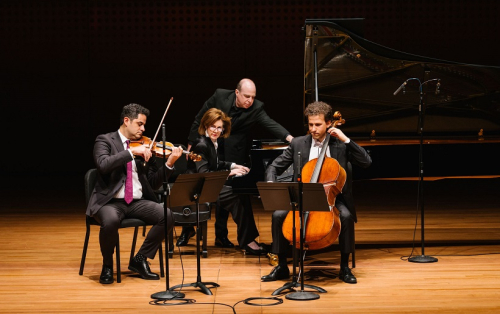
    Above: cellist Michal Korman and harpist Sivan Magen

    ~ Author: Oberon

    Thursday February 27th, 2025 – My previous encounter with the Israeli Chamber Project, in April of 2024, was nothing short of revelatory. Read about that concert here. Hoping to be similarly transported tonight, I was settling in when I realized there was no heat in the hall. It was so uncomfortable that I actually considered leaving at the intermission. Thank goodness I stayed, as the concluding Shostakovich was simply spectacular.  

    This evening’s program, entitled ORPHEUS’ HARP, featured four works in which the Project’s harpist, Sivan Magen, regaled us with his extraordinary artistry. Completing the program were piano trios by Shostakovich and Paul Ben-Haim.

    To open the concert, Mr. Magen was joined by violinist Itamar Zorman and the lovely cellist, Michal Korman, for Orpheus, Symphonic Poem for Violin, Cello and Harp by Franz Liszt/Camille Saint-Saëns. String chords sound, soon joined by the rhapsodic harp: Mr. Magen’s playing is truly delectable, his mastery of dynamics and his agility are spellbinding. The music begins to flow, with alternating currents of major and minor. The plush blend of timbres is a balm to the ear: the unison strings are rapturous, the harp magical. Large scale tremelos from cello and violin lend a sense of drama. The cello goes deep, heralding a lamenting passage; through a series of chords, the piece reaches a pianissimo conclusion. 

    Jacques Ibert’s Two Interludes for Clarinet, Cello and Harp dates from 1946. Tibi Cziger’s clarinet joins Ms. Korman and Mr. Magen in the wistful opening of the Andante espressivo; the music becomes increasingly sensuous, with the dusky sound of the Korman cello wonderfully alluring. Mr. Cziger’s rich timbre, his savorable piani, and his ravishing trills are entwined with Mr. Magen’s entrancing harp passages. The second interlude, Allegro vivo, has a Spanish lilt; it is music both lively and mysterious. The cello sounds sexy, the clarinet enticing, the harp exotic; their harmonies are so evocative.

    Paul Ben-Haim’s Variations on a Hebrew Melody for Piano Trio was composed in 1939. Read about the Munich-born composer here. Pianist Assaff Weisman joins Mr. Zorman and Ms. Korman in the work’s tumultuous opening; the doom-ladened cello, sizzling violin, and darkling piano create a creepy – even ominous – atmosphere. Unison, sighing strings give way to an enchanting piano solo, wherein Mr. Weisman slowly darkens the atmosphere before a rise of passion brings forth his trills and high filigree. Mr. Zorman introduces a dance filled with mood swings; the music turns waltzy. The piano sneaks up on us, suddenly sounding alarms. This is fabulous music, marked by an epic piano glissando

    The violin plays high over cello staccati, the pianist regales us with more magic before launching another dance, which comes to a dramatic halt. Mr. Weisman now introduces Ms. Korman, whose cello takes up a poignant lullaby in which Mr. Zorman joins. The music turns dreamy as this bittersweet work reaches its sublime finish.

    Following the interval, Robert Schumann’s Three Fantasy Pieces, Op. 73 for Clarinet and Harp were presented by Mssrs. Cziger and Magen. In the first movement we could enjoy the clarinetist’s dulcet tone and his elegant finesse. The music is spellbinding; Mr. Magen’s playing is nothing less than sublime, and the music finds a magical finish. Fanciful harping and lyrical themes from the clarinet mesh in the second movement, which proceeds with some expert coloratura from Mr. Cziger. The third song has an exuberant start which calms to a melodic flow. An interlude veers into minor mode before we come to a swift, sweet finish. The communication between the two artists was delightful to watch from my front-row seat.

    Mssrs. Magen and Weisman then took up Carlos Salzedo‘s Sonata for Harp and Piano which dates from 1922. A harpist himself, the composer ironically played the piano for the work’s premiere. The music leans towards modernism; from its fast, fun start, the piano plays a major role. A delicious sense of mystery develops, with subtle, intriguing harp motifs and trilling from both, as the instruments converse. Dynamic variety keeps the music ever-engaging; drama takes over with some extroverted keyboard passages, and then subtleties emerge. Mr. Weisman regales us with cascades of notes, and Mr. Magen has a passage with ‘prepared’ strings that alter the mood. Melismas herald an ethereal, pianissimo mood wherein a mystical atmosphere pervades. Some very delicate plucking follows; after a brief speed-up, a pacing motif leads to a dirge until some violent slashings seem to portend a dramatic finish; instead the music fades, as if it had all been a dream.

    The concert ended with a thrilling rendering of Dmitri Shostakovich’s Piano Trio No. 1 in C-minor, Op. 8, played to perfection by Ms. Korman and Mssrs. Zorman and Weisman. Cast in a single movement, this music has an immediate beauty; a pensive start turns playful as the fiddle commences a dance. Order is restored, but then things again get jaunty…and briefly urgent. A charming violin passage leaves Ms. Korman to a heartfelt cello solo, with the delicate piano lending support as Mr. Zorman then takes over, his high register shining. A more animated mood evolves, and Mr. Weisman’s playing gets quite grand. Buzzing strings intrude, and some wild violin measures turn into a dialogue with cello.

    There is a full stop, and then a caressive melody is passed from violin to piano before the cello joins. In cantabile mode, Mr. Zorman sounds divine…and then Ms. Korman takes up the theme, with the Weisman piano adding more colours. Lush, melodious music for the strings is embellished with shimmering sounds from the piano. Passion now rises, almost to madness; epic grandeur leads on to a swift finish.

    This concert reassured me of the power of music – especially when it’s so gorgeously played – to sustain us in an increasingly dismal world. I fear so much will be lost to us in the months ahead, but music can always help us find light in the darkness. Thank you, artists of the Israeli Chamber Project, for a truly uplifting evening.

    ~ Oberon

  • The Wanderer Summons Erda

    Zhang Nikitin_yevgeny

    Above: contralto Qiu lin Zhang, basso Yvgeny Nikitin

    In this scene from the final act of Wagner’s SIEGFRIED, Wotan (in his guise as The Wanderer) wakens the Earth Mother Erda from her deep slumber. She wearily evades his questions, and it becomes clear that the doom of the gods is at hand.

    SIEGFRIED – Act III scene- Evgeny Nikitin – Qiu Lin Zhang – Eschenbach – BBC Proms 2006 

  • Mendelssohn Evening @ CMS

    F m

    Above: Felix Mendelssohn

    ~ Author: Oberon

    Tuesday February 25th, 2025 – Chamber Music Society of Lincoln Center offering an all-Mendelssohn evening featuring a de luxe ensemble of musicians: pianist Anne-Marie McDermott, violinist Arnaud Sussmann, cellist Nicholas Canellakis, and the Escher Quartet.

    This concert was a much-needed lift of my spirits after weeks of unbearably frigid weather and a weekend of unsettling health issues. Just setting foot in Alice Tully Hall made me feel better; and then the music – and the musicians – provided just the right antidote to my malaise. By the end of the program, I was thoroughly rejuvenated. 

    20250225_CMS_Mendelssohn_DressRehearsal__Preview_045

    Mr. Canellakis and Ms. McDermott (above photo by Da Ping Luo) opened the program with the Sonata No. 1 in B-flat major, Op. 45. The sonata’s Allegro vivace commences with a unison passage; a rolling melody emerges, in which he cello’s lower range is explored. Moving into minor mode, the music becomes insistent. Arpeggios from the Canellakis cello turn into long tones sustained over a roaming piano. The music turns passionate, then grand, leading to a brisk finish full of Ms. McDermott’s marvelous playing.

    The winsome piano introduction to the Andante signals the appearance of a familiar theme. Nick’s melodious cello sings over elegant passages from the Steinway; Ms. McDermott then plays a delicate dance accompanied by plucked cello figurations. An increase of passion lasts only moments; the piano resumes its lightness and the music fades away.

    The concluding Allegro assai brings a flow of melody; things get more animated, sweeping forward with lyrical, haunting passages. An energetic ending looms, but Mendelssohn instead provides a peace-filled finish. 

    20250225_CMS_Mendelssohn_DressRehearsal__Preview_063

    Above, the Escher Quartet: Adam Barnett-Hart, Brendan Speltz, Brook Speltz, Pierre Lapointe; photo by Da Ping Luo

    The Eschers then took the stage for the Quartet in F-minor for Strings, Op. 80.

    Fanny Mendelssohn, Felix Mendelssohn’s beloved older sister, had died unexpectedly at the age of 41 in May of 1847. Felix, devastated, was unable to attend the funeral; he went to Switzerland to recover. There, he hiked and painted, and forced himself to compose, managing to compete his F-minor quartet. It would be one of his last completed works; he died on  November 4th at the age of 38.

    The Allegro vivace assai has an agitated feel: fast, fantastical music with sentimental pauses woven in. The Eschers’ trademark blend is at its most persuasive, viola and cello emerging with darker hues. Classic harmonies abound, and then the foursome become speed demons.

    Unison passages open the familiar Scherzo; while energetic, the music abounds in subtleties that hint at deeper underlying thoughts. Viola and cello sing in unison before the scherzo reaches what seems like a delicate finish, only to be extended by a sort of coda.

    Anguish overtakes the mood in the Adagio as Brook Speltz’s velvety cello sings a poignant melody. This is music full of longing. Themes are passed about, each of the four voices distinctively expressive. The quartet’s dynamic range is lovingly in evidence. Almost unbearably beautiful harmonies are set forth, with violist Pierre Lapointe in a lamenting passage before before Adam Barnett-Hart’s violin makes a final, poignant ascent.

    The minor mode feels ominous as the finale commences. The insistent cello carries the musicians to fresh themes, with shifts from major to minor seeming to evoke Mendelssohn’s struggle with his emotions in his mourning state. Mr. Barnett-Hart’s marvelous artistry shines in the work’s concluding measures. The Eschers, ever immaculate in their music-making, were warmly hailed by the packed house.

    Following the interval, the Eschers re-appeared for an Andante and Scherzo culled from Four Pieces for String Quartet, Op. 81, opening with an Andante sostenuto filled with courtly elegance. Mr. Lapointe savors a solo viola melody, and then things speed up. Sweet violin phrases are met by animation from the cello. Mr. Barnett-Hart’s cadenza leads to a da capo, and the music comes to a pretty finish.

    Next on offer was more music from Opus 81: a Scherzo in Midsummer Night’s Dream mode which introduces duetting from Mr. Barnett-Hart and his fellow violinist, Brendan Speltz. This is witty and wonderful music, thoroughly captivating.

    20250225_CMS_Mendelssohn_DressRehearsal__Preview_006

    Above: Arnaud Sussmann, Anne-Marie McDermott, and Nick Canellakis; photo by Da Ping Luo

    To conclude the evening, the Trio No. 2 in C-minor for piano, violin, and cello, Op. 66, was given a thrilling rendering by Ms. McDermott, joined by violinist Arnaud Sussmann and Mr. Canellakis.

    Rolling piano motifs and restless strings open the main theme of the first movement, in which melodious themes are passed among the three musicians. Ms. McDermott, in some of the most amazing playing I have ever heard from her, set forth cascading keyboard passages – filled with both passion and subtlety – to dazzling effect. The Canellakis cello has a tender melody, taken up by the Sussmann violin, with magical support from Ms. McDermott; her playing was epic, and the trio swept onward with interwoven harmonies from the gentlemen. Bravi, bravi, bravi!!

    The gentle Andante espressivo, with its nostalgic piano introduction, becomes waltz-like as the strings join lovingly. Piano interludes enchant; Mr. Canellakis delights with his poetic playing, while the sheer perfection of Mr. Sussmann’s artistry creates a simply gorgeous atmosphere in which we can linger and dream. Passion rises, only to settle into bliss. 

    Next, music that shows us why Mendelssohn is the King of the Scherzo…it’s swift and sure, the playing dazzling. The musicians seemed to be having a blast here.

    The cello, and then violin, set the mood of the concluding Allegro appassionato…and passion is indeed the byword here. Bending minor-key themes are intriguing; Ms. McDemott is simply sensational at every moment. Crazy fun! But then a reverential interlude suddenly emerges, Mr. Sussmann’s violin singing sweetly over the piano accompaniment. This introspection gives way to thrilling build-up of emotion, with Ms. McDemott’s keyboard on the verge of bursting into flame.

    As the last note sounded, the audience rose to salute the players with a roaring ovation that brought them forth for a second bow, much to everyone’s delight. I literally felt reborn. 

    ~ Oberon

  • Taís Víera ~ Poème de l’Amour et de la Mer

    Snapshot tais 2

    Taís Víera is the soloist in a performance of Ernest Chausson’s Poème de l’Amour et de la Mer with the Orquestra Sinfônica Municipal de Santos, conducted by Luís Gustavo Petri.

    Watch and listen here.

  • TRISTAN UND ISOLDE ~ Act II ~ Auckland Philharmonia

    Karneus

    Above: Katarina Karnéus singing Brangäne in a concert performance of Act II of Wagner’s TRISTAN UND ISOLDE by the Auckland Philharmonia, conducted by Giordano Bellincampi.

    CAST:

    Tristan – Simon O’Neill; Isolde – Ricarda Merbeth; Brangäne – Katarina Karnéus; Kurwenal – Johan Reuter; King Marke – Albert Dohmen; Melot – Jared Holtin

    Watch and listen here.

  • Grigory Sokolov ~ Rameau’s Les Cyclopes

    Snapshot sokolov

    Grigory Sokolov astounds with his playing of Rameau’s Les Cyclopes; watch and listen here.

  • HOTEL DU LAC

    Tumblr_lqoyq7QFaT1qajllro1_500

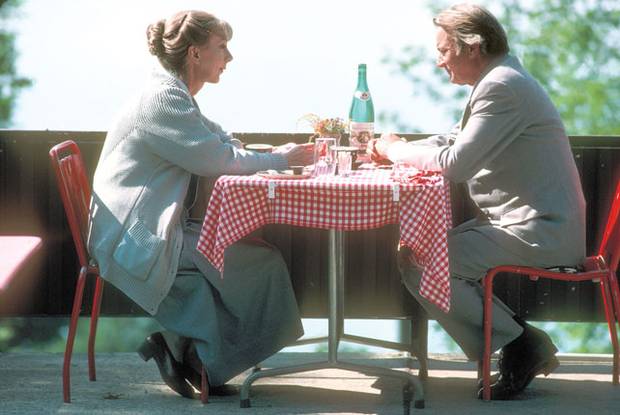
    Above: Anna Massey as Edith Hope in HOTEL DU LAC

    HOTEL DU LAC is a 1986 jewel of a film which I watch once or twice every year. As far as I know, it’s never been released on DVD, but I have my old VHS copy. Though I have watched it at least a score of times, it still touches me, in part because it deals with romance/sex among people of a certain age.

    The central character, Edith Hope, is a successful middle-aged writer of romance novels. After many years of leading a seemingly contented solitary life, she accepts a marriage proposal only to leave her prospective groom standing on the church steps when she has a sudden change of heart on her wedding day. Her friends are outraged, and she flees London for a bit of peace at an off-season hotel on Lake Lucerne: the Hotel Du Lac. Here she meets – and nearly marries – Philip Neville, a successful businessman who makes her a surprising offer.

    The other guests at the hotel provide comic relief though all are, in their own way, sad and lonely people. Edith’s London set also provide for some interesting personality studies.

    18-anna-massey

    Two of my very favorite actors, Anna Massey and Denholm Elliott (above), are so perfectly cast as Edith and Philip. Both these remarkable thespians have since passed away; it makes me feel blue to think we’ll not be seeing their faces and hearing their memorable voices in future films. The rest of the cast are excellent.

    Jean-marc-barr_34274_5222875f0c7ac

    And you know me: always an eye for the handsome face. A very young Jean-Marc Barr (above, photographed a few years further on) plays Alain, a waiter at the Hotel Du Lac who loses his job when blamed for something he didn’t do. Msser. Barr went on to appear in many films, including EUROPA, BREAKING THE WAVES, and DOGVILLE. As Alain, he’s deliciously naive and sincere.

    Anna Massey, by the way, was the daughter of actor Raymond Massey. She passed away in 2011.

  • Polina Osetinskaya ~ Prokofiev Piano Concerto #1

    Polina

    Pianist Polina Osetinskaya (above) plays my favorite piano concerto – the Prokofiev 1st – at a 2016 concert with the Saint Petersburg Philharmonic, conducted by Vladimir Altshuller.

    Watch and listen here.