
Fedora Barbieri sings Dalila’s “Mon coeur souvre a ta voix” at a concert given in 1952 at the War Memorial Opera House in San Francisco.
Listen here.
Fedora Barbieri sings Dalila’s “Mon coeur souvre a ta voix” at a concert given in 1952 at the War Memorial Opera House in San Francisco.
Listen here.
Angela Gheorghiu sings “Depuis le jour” from Charpentier’s LOUISE from a televised concert concert given at Radio Hall Bucharest in 1988.
Watch and listen here.

Angela Gheorghiu sings “Depuis le jour” from Charpentier’s LOUISE from a televised concert concert given at Radio Hall Bucharest in 1988.
Watch and listen here.
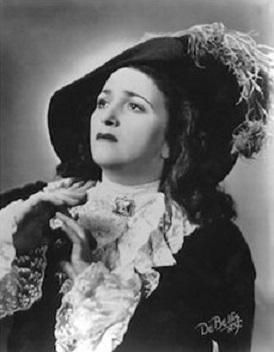
Zinka Milanov in one of her greatest roles – Leonora in Verdi’s LA FORZA DEL DESTINO – from a 1958 Metropolitan Opera broadcast. Flaviano Labo, Mario Sereni, and Cesare Siepi are Zinka’s co-stars, and Fritz Stiedry is wielding the baton.
Listen here.
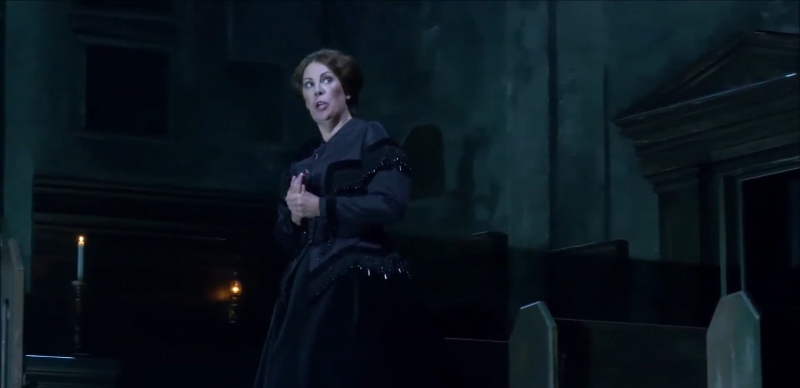
Sondra Radvanovsky sings Lady Macbeth’s “La luce langue” from the Verdi opera.
Watch and listen here.

Above, Yvgeny Kissin at Carnegie Hall; performance photo by Steve J Sherman
~ Author: Ben Weaver
Friday May, 24th, 2024 – Evgeny Kissin is giving back-to-back concerts of the same program at Carnegie Hall this month. I attended the first one this evening, and it was a magnificent night of music, one of the best things I have heard in a concert hall this season. Kissin’s program is so popular, in fact, that not only were additional seats added on the stage (more about that later), but he will repeat this program on May 29th.
Surprisingly this was my first time hearing Kissin live, though I have admired his many recordings over the years. He is a very unaffected performer, seemingly almost shy. His very sincere physical presence and unpretentious playing made an enormously positive impression throughout the night.
Kissin began the program with Beethoven’s Piano Sonata No. 27 in E minor, Op. 90, composed in 1814. It reflects Kissin’s overall demeanor that he began with one of Beethoven’s least performed piano sonatas. Made up of only two movements – unusual for Beethoven – it open with a familiar Beethovenian bombast, but that falls away almost immediately and an achingly lovely melody takes over; it will return throughout the movement. The tonal contrasts throughout the the work can be hard to weave together. Kissin’s cleared those hurdles effortlessly. His playing was very clean and unfussy, each note etched like a diamond. Despite the Sonata’s Romanticism, Kissin seemed to be connecting it to Haydn and Mozart.
Throughout the night one noticed Kissin’s very judicious use of the pedal, never letting the sound get murky and messy. This gave a great clarity to Chopin’s Nocturne in F-sharp minor, Op. 48, No. 2 and Fantasy in F minor, Op. 49 (both composed in 1841.) The long, melancholic melodies of the Nocturne – a particular specialty of Chopin’s – was played gently and without undue sentimentality. At each carefully built climax, Kissin pulled back just in time before falling into schmaltz. He launched into the Fantasy’s opening march right away. It felt like another example of Kissin not milking the crowd for affection.
With Brahms’ Four Ballades, Op. 10 (composed in 1854) Kissin again reigned in much bombast, reminding us that Brahms, though composing at the height of Romanticism, was more of a classicist in temper. Which is not to suggest that his playing was lacking in brimstone. But Kissin’s very carefully chosen moments of when to let things blow up were fascinating to hear. The focus was always on the music and not the individual at the keyboard.
Prokofiev’s Piano Sonata No. 2 in D-minor, Op. 14 (composed in 1912) is an early composition for the young composer (he was still a student at the St. Petersburg Conservatory), and it shows him trying out new ideas that would become trademarks in his future works. The Scherzo in particular sounds like echt Prokofiev: a playful melody played with demonic speed and attitude. Kissin’s hands were flying over the keyboard in a blur. With Prokofiev, Kissin ended the official program with the most outwardly virtuosic piece played as dazzlingly as one can imagine.
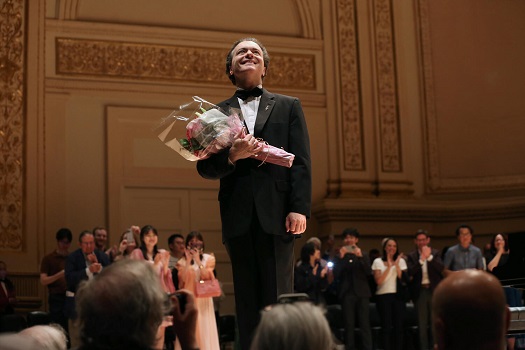
Photo by Steve J Sherman
The audience response was predictably wild. Kissin quickly offered 3 encores, all played superbly and all connected to the main program. A Mazurka by Chopin, March from Prokofiev’s opera “The Love for Three Oranges,” and Brahms’ gentle Waltz, Op. 39, No. 15.
During the opening Beethoven piece, the audience had been remarkably quiet. Perhaps making a note of this in my head jinxed the situation because what followed during the rest of the program was people repeatedly dropping things (probably their cell phones) and ringing cell phones. There is also always a risk in placing members of the audience onstage: one young girl in a white dress, sitting near the edge of the stage, was very bored and was swinging her legs the entire 1st half of the program. Thankfully her father probably took her home during intermission because they did not return. And just as Kissin launched into Prokofiev’s sonata, an elderly couple decided to exit the stage, down the steps, and out the door. Audience etiquette remains an untamable beast.
~ Ben Weaver
Performance photos by Steve J Sherman courtesy of Carnegie Hall
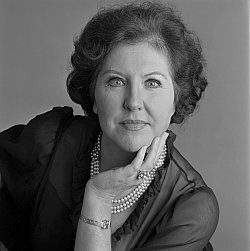
The Dutch mezzo-soprano Sophia van Sante and pianist Gérard van Blerk perform three songs by Gustav Mahler at a 1974 recital at The Hague.
Listen here.

Above: Elizabeth Bainbridge
A performance of Verdi’s UN BALLO IN MASCHERA in 1975 was televised live.
Watch and listen here.
Conductor: Claudio Abbado
Riccardo – Plácido Domingo; Renato – Piero Cappuccilli; Amelia – Katia Ricciarelli ; Ulrica – Elizabeth Bainbridge; Oscar – Reri Grist; Silvano – William Elvin; Samuele – Gwynne Howell; Tom – Paul Hudson
Placido Domingo and Reri Grist were in my first-ever BALLO at The Met in 1970. And Ms. Bainbridge is a grand, Olde School English contralto Ulrica.

 Oberon's Glade