
Montserrat Caballé vocalizes to an arrangement of The Swan, from Camille Saint-Saëns’ Carnival of the Animals.
Watch and listen here.
Montserrat Caballé vocalizes to an arrangement of The Swan, from Camille Saint-Saëns’ Carnival of the Animals.
Watch and listen here.

Ángeles Gulín and Carlo Bergonzi sing “Vicino a te“, the final duet from Giordano’s ANDREA CHENIER, from a performance given at London in 1970. Anton Guadagno conducts.
Listen here.
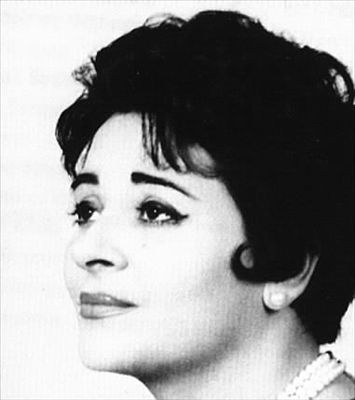
The beloved Spanish soprano Victoria de los Angeles (above) sings Ernest Chausson’s Poème de l’amour et de la mer with the Orchestre de l”Association des Concerts Lamoureux, conducted by Jean-Pierre Jacquillat. The recording dates from 1969.
Listen here.

Lisette Oropesa sings Elvira in Bellini’s I PURITANI in a concert performance given by the Teatro San Carlo, Naples, in July 2022.
Watch and listen here.
Cast:
Arturo Talbot – Xabier Anduaga; Elvira – Lisette Oropesa; Sir Riccardo Forth – Davide Luciano; Sir Giorgio – Gianluca Buratto; Enrichetta – Chiara Tirotta; Lord Gualtiero Walton – Nicolò Donini; Sir Bruno Robertson – Saverio Fiore
Conductor: Giacomo Sagripanti

Above: performance photo by Alan Barnett
Author: Shoshana Klein
Saturday November 18th, 2023 – The New York Choral Society gave a concert on Saturday afternoon at the Gerald Lynch Theater, joined by the new-music focused Bergamot Quartet and composer/conductor/vocalist Raquel Acevedo Klein. The premise had to do with Hildegard von Bingen, and most of the repertoire was arrangements of her music for choir.
I love a continuous performance, but for this one, I never really had in idea of where we were in the program, even though there was supposedly a multi-movement work sharing the title of the concert in the middle – at some points it was clear that the choir was singing in English and I suppose that was the giveaway, but the setup and video never really changed, so it was a little hard to tell.
The concert began with Raquel Acevedo Klein only, singing with some electronic manipulations, as everyone else gathered on stage. It was a sizeable group, so it was effective to have something going on instead of just having the audience watch while people found their spots onstage.

The electronic element was interesting: Ms. Acevedo Klein (above, photo by Alan Barnett) is able to make some very cool things happen. She and the quartet mostly acted as sort of interludes between the choral pieces, sometimes with some overlap. It was a nice juxtaposition to have the older and newer, but didn’t feel like it had a lot of direction.
The video element was somewhat engaging as well, with one big screen behind the ensemble and two smaller ones flanking the stage. There were busy animations happening throughout the production, definitely tied to the music but only in instrumentation – usually when the quartet only was playing, the visuals would be sparser, one specific animation that recurred and tied things together a bit. When the whole choir was active, there would be many visuals that would come back to create a busy landscape, sometimes involving “angel” imagery, but usually not in a typical Christian imagining (which I did kind of appreciate, but this was never really explored as far as I could tell).
The pieces were certainly not bad – I’ll definitely admit I’m not much of a choir person and surely missed plenty of nuance. Overall, the performance was interesting but repetitive, and I just didn’t have a sense of the structure, narrative, or takeaway, which – given all of the extra elements – it seemed like there was going to be.
~ Shoshana Klein
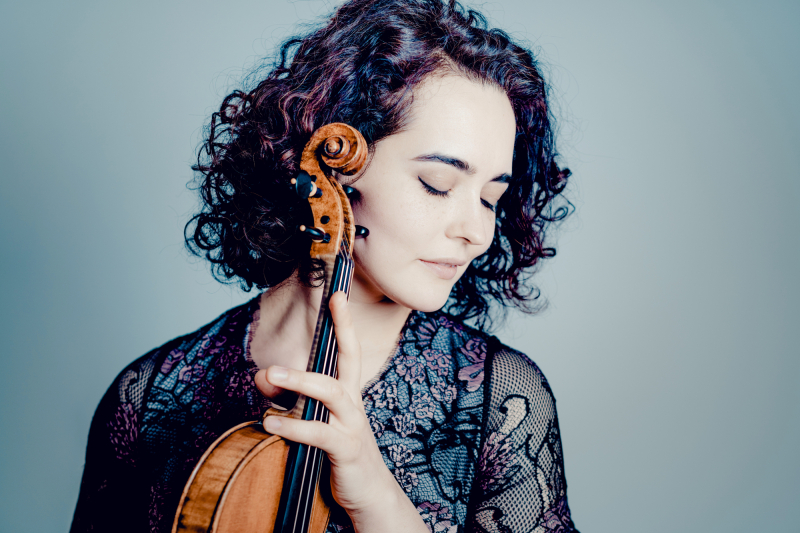
Above: violinist Alena Baeva, photo by Andrej Grilc
Author: Ben Weaver
Friday November 17th, 2023 – Maestro Paavo Järvi returned to the New York Philharmonic’s David Geffen Hall for concerts featuring less familiar works by two of 20th Century’s greatest composers: Benjamin Britten and Sergei Prokofiev.
Benjamin Britten’s Violin Concerto, Op. 15 – the only work he composed in that genre – was written in 1938-39, soon after Britten heard the world premiere performance of Alban Berg’s Violin Concerto in 1936. Indeed, the soloist who premiered Berg’s work, Antonio Brosa, would premiere Britten’s Concerto in 1940 conducted by Sir John Barbirolli, and do so with the New York Philharmonic in NYC. (In another bit of trivia, Britten composed some of the concerto while staying with Aaron Copland.) Britten revised the composition as late as 1965 (when he heard that Jascha Heifetz was considering performing it, though Heifetz would supposedly go on to declare the work “unplayable”), and it was this final edition that violinist Alena Baeva performed in these concerts. (It’s playable after all.)
Opening with a series of timpani strokes can only evoke Beethoven’s Violin Concerto from more than a century earlier. The violin enters with a lament in the instrument’s highest registers – something Britten does often in the concerto. The second half of the first movement is taken over by a sort of a march, a persistent distant thumping, which reminded me of the villagers hunting Peter Grimes in Britten’s opera, composed a few years later.
Ms. Baeva, in her New York Philharmonic debut, makes a rather small and tinny sound that struggled to make an impression in the concerto’s dramatic moments. To Maestro Järvi’s credit, he kept the orchestra under control, so as not to cover the soloist altogether. But in the more intimate parts, Ms. Baeva was a deeply moving narrator, which makes me want to hear her in a chamber music setting. In the extended cadenza that concludes the second movement, Ms. Baeva was mesmerizing and dazzling. The final movement is a series of variations in the form of a passacaglia, and it concludes with a lament (movement is marked Andante lento), and here Ms. Baeva’s lyrical side was wonderfully moving.
Sergei Prokofiev’s Symphony No. 6 in E-flat minor, Op. 111 lives – unfairly – in the shadow of his more famous Fifth. Composed in 1945-47, and premiered later that year by Evgeny Mravinsky and the Leningrad Philharmonic, it is a magnificent work that never drags despite its roughly 45-minute run time.
The Sixth’s fortunes changed over the years. Despite an acclaimed premiere in 1947, it was soon condemned by all the usual Stalinist suspects and disappeared from Soviet concert halls until the 1960s. (It was more popular in the West; Leopold Stokowski first conducted it with the NY Philharmonic in 1949). One of the complaints against the work was that it was not cheerful enough to inspire the Soviet people. Which is perhaps fair enough, but Prokofiev was not trying to cheer anyone up with this particular symphony. It opens darkly in the low strings before moving on to more lyrical themes. The second movement is the most emotional part of the symphony, woodwinds shrieking in agony. And the third movement is the most cheerful of the three, but not cheerful enough to appease Stalin.
The Sixth sounds to me like the most mature of Prokofiev’s work. It never disintegrates into circus music, which – no matter how ironically – can on occasion be tiresome. Paavo Järvi certainly has this music in his bones and the NY Philharmonic delivered a stupendous performance. I ended up taking almost no notes as the music played because I was so hypnotized by what we heard. This is the sort of music the New York Philharmonic plays as well as anyone, and better than most.
Also included on the program was an unknown to most of us Overture No. 2 by the Estonian composer Veljo Tormis. Composed in 1958-59 it is a thrilling, expertly crafted work. Its highly dramatic, driven, almost cinematic opening (it would fit many movie chases beautifully), gives way to a lovely, if brief, cello solo (Patric Jee as the principal cellist in this performance). The middle section of the overture is reduced to a wonderful chamber-scale (just three violins at one point) before the breathless opening section returns. The work ends with three chords, long pauses between each one. Frequently, an audience will applaud prematurely, and certainly with an unfamiliar composition such as this, the risks were high. And yet – the silence held, Paavo Järvi controlling not just the orchestra, but, however briefly, the audience as well.
Which brings me to a brief point about audience behavior and etiquette; we all know that both have degraded seriously over the years. At this performance, sitting just an empty seat away myself and my companion, a young woman played Candy Crush on her phone the entire evening. She was there with two friends, who seemed more interested in the music than she was…but they did not ask her to stop. I am reminded how, some years ago, the actor and playwright Wallace Shawn got in trouble at a Carnegie Hall concert for yelling at another audience member for behaving badly. Perhaps we should have been celebrating Mr. Shawn instead.
~ Ben Weaver
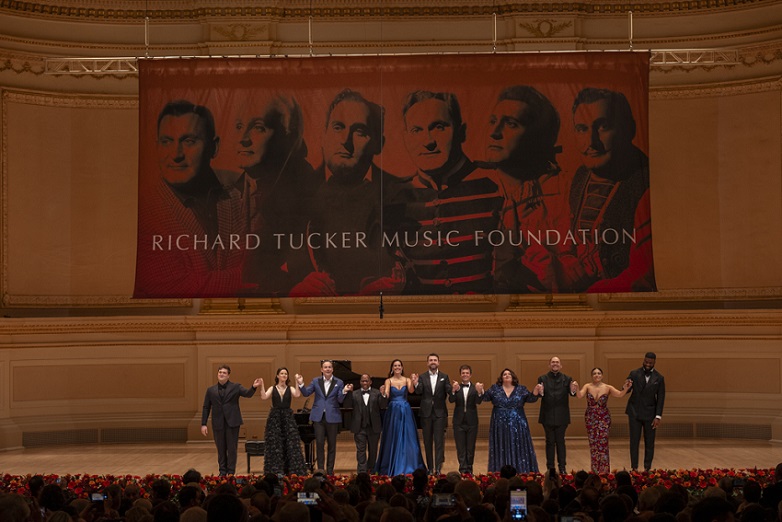
Above, the artists take a bow at the end of the 2023 Tucker Gala: Sean Michael Plumb, Liv Redpath, Stephen Costello, Howard Watkins, Federica Lombardi, Ben Bliss, Bryan Wagorn, Angela Meade, Quinn Kelsey, Ailyn Pérez, and Soloman Howard. Photo by Dario Acosta.
Author: Oberon
Sunday October 29th, 2023 – The annual Richard Tucker Foundation gala took place this evening at Carnegie Hall. Barry Tucker, son of the illustrious tenor, greeted us and explained that financial considerations had compelled the Foundation to present this year’s concert without an orchestra. But soon after the program began, concerns about the lack of an orchestra were assuaged by the excellence of the two pianists who took turns at the Steinway: Bryan Wagorn and Howard Watkins. Bravo, bravo, bravo gentlemen!
Of the announced roster of artists, Angel Blue, Matthew Polenzani, and Christian van Horn had withdrawn, and basso Soloman Howard joined the line-up on short notice.
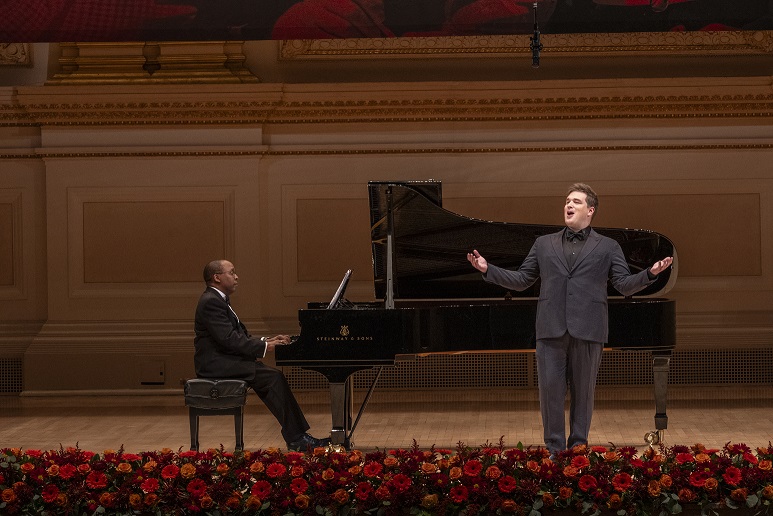
The program opened with Sean Michael Plumb, a 2022 Tucker Career Grant recipient, giving an excellent rendering of Figaro’s “Largo al factotum“, with Howard Watkins at the keyboard providing brilliant support. Mr. Plumb’s voice, wide-ranging and handsome of timbre, sounded great in the great Hall.

Bryan Wagorn played beautifully the Catalani aria “Ebben, ne andro lontana” from LA WALLY, sung by Angela Meade. The pervasive flutter of the Meade voice has never been to my liking, but this aria suited her far better than some of the roles she has sung at The Met. She sang passionately, summoning some chesty resonances; the singing was mostly unrelentingly loud, missing the nuances that can make the aria so personal. She was very much an audience favorite, both here and – later – in a duet from TROVATORE.

Soloman Howard, a tall and charismatic basso, offered Fiesco’s great aria “Il lacerato spirito” from Verdi’s SIMON BOCCANEGRA. His singing was powerful: an emotion-ladened outpouring of a father’s despair which becomes poignantly reflective at “Il serto a lei de’ martiri pietoso il cielo diè…”; so engaged was Mr. Howard in the character that one could almost hear the chanting of the mourners from the chapel, even though no chorus was present. The moving final descent at “Prega, Maria, per me…” was heart-breaking in its expressiveness. And Mr. Wagorn at the piano captured the music’s atmosphere to perfection.

New to me, soprano Liv Redpath looked fetching in a ruffled black frock. Rather than the announced Act I aria from LUCIA DI LAMMERMOOR, Ms. Redpath intrigued us with a sterling performance of Ophélie’s mad scene from Ambroise Thomas’s HAMLET. Assured of technique, with a lovely array of pastels in her colour palette – as well as a silvery, limpid quality to her coloratura – the comely soprano had the Carnegie crowd fully engaged. Mr. Watkins at the piano created the scene’s atmosphere from note one.
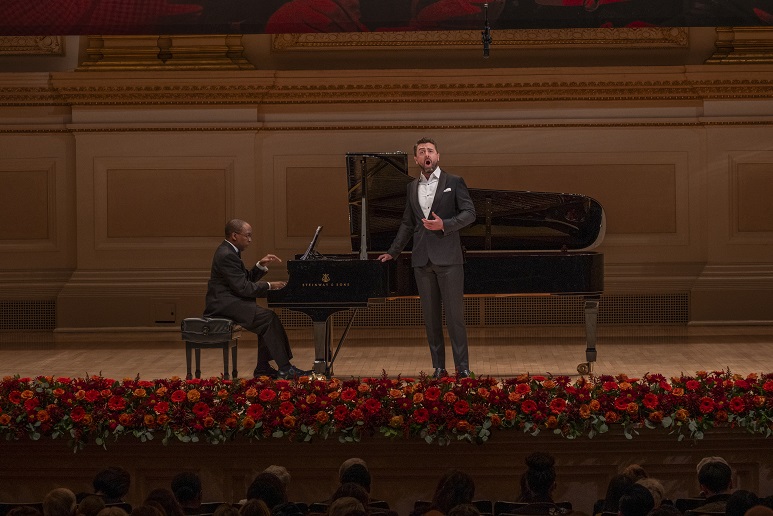
Bringing his lovely timbre and engaging style to the Duke of Mantua’s aria “Parmi veder le lagrime” was the tall, slender tenor Ben Bliss. A Mozart specialist, Ben always manages to combine passion and elegance in his singing. Mr. Watkins was again perfect, setting a properly impatient pace for the cabaletta, “Possente amor mi chiama” (‘A powerful love calls me!’).
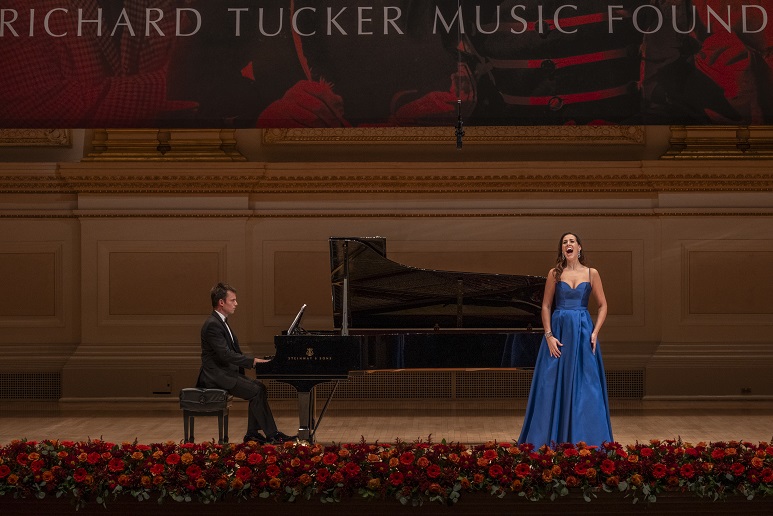
The tall and striking Italian soprano Federica Lombardi, who has won a lot of hearts at The Met with her superb singing of Mozart’s Contessa Almaviva, Elettra, and Donna Anna, tonight offered a spellbinding performance of Anna Bolena’s mad scene from the Donizetti opera. Clad in an elegant blue gown, the soprano looked queenly indeed, and her long arms and expressive hands seemed to shape the music to touching effect. Following a ravishing “Al dolce guidami“, she sang a single verse of the cabaletta “Coppia iniqua!” which was taken a bit too fast and which really needs both verses (and the chorus’s interjections) to be really meaningful. Nevertheless, the overall effect of Ms. Lombardi’s performance was fascinating.

The next two selections were thrilling: Quinn Kelsey’s sustained, gorgeously phrased singing of Macbeth’s “Pieta, rispetta, amore” is everything you want from a Verdi baritone. The voice is huge, warm, and awash with a sense of the human spirit: singing that simply reduced me to tears.

Stephen Costello followed Mr. Kelsey with a magnificent rendering of the haunting aria “Deserto in terra” from Donizetti’s DON SEBASTIANO. In this aria, Don Sebastiano, king of Portugal, stands alone on a battlefield strewn with corpses and longs for the consolation of his beloved. Mr. Costello’s depth of feeling, his passion, and his poignantly styled phrasing went straight to my heart, and his top notes were amazingly clear and sustained. Luciano Pavarotti and John Osborn have given us glorious voicings of this aria, and Mr. Costello’s can stand proudly alongside them.
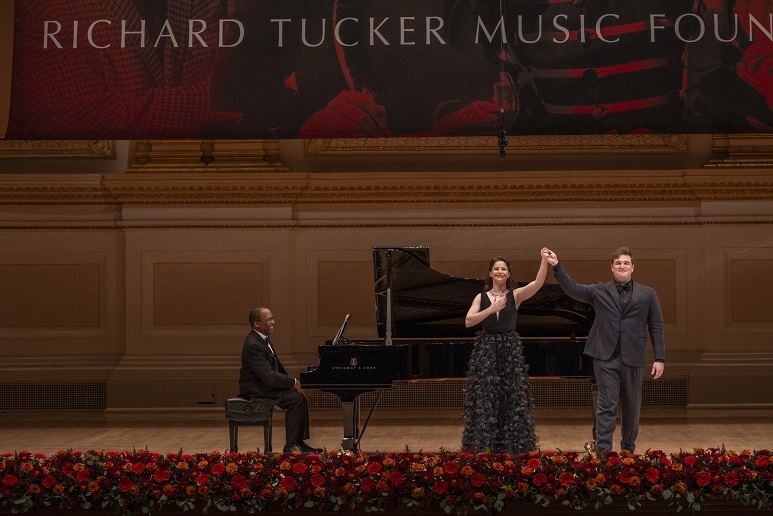
More Donizetti, on a cheerier note, brought us Ms. Redpath and Mr. Plumb in the charming duet of Norina and Dr. Malatesta from DON PASQUALE. They sang it beautifully, not over-doing the comic effects.

Ailyn Pérez sang Butterly’s “Un bel di” most attractively, though for me it is an aria that doesn’t work very well in concert, being too narrative. Ms. Pérez produced some silky piano moments, exploring the character’s vulnerability beneath her steadfast belief in her husband’s return. The soprano’s gown was something else.
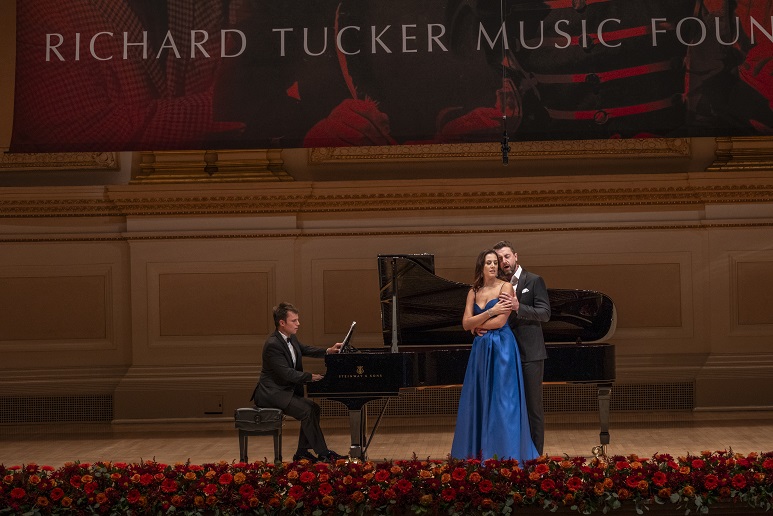
Ms. Lombardi and Mr. Bliss made a very attractive couple – both physically and vocally – in the duet “Parigi o cara” from TRAVIATA. They are well matched in height, and they established an instant rapport, their timbres blending to perfection, their ardent phrasing so savourable. Bravi! Could we have them together in the Met’s next TRAVIATA revival?

Ms. Meade and Mr. Kelsey gave a full-tilt performance of the Leonora/Di Luna duet from TROVATORE…

…and then Mr. Costello (stepping in for the absent Matthew Polenzani) and Sean Michael Plumb sang the affecting, brotherly duet “Au fond du temple saint” from LES PECHEURS DES PERLES with its heartfelt harmonies. The two brought poetic ardor to their singing, their timbres entwining persuasively. They embraced at the end.
There were encores: Ms. Lombardi in a zarzuela aria which was a bit too long, though finely sung, and Mr. Bliss in a song that was too small-scaled for the big space. Ms. Pérez gave a sensual touch to Manuel Ponce’s “Estrillita“, with some ravishing pianissimi. Mr. Kelsey and Mr. Costello added further laurels to their vocal triumphs earlier in the evening, the baritone with a mind-bogglingly perfect “If ever I would leave you” from CAMELOT, and Mr. Costello pouring out his heart and soul in a thrilling “Core ‘ngrato“.
All photos by Dario Acosta, courtesy of the Richard Tucker Foundation.
~ Oberon

Above: Corinna Lee Nicholson, Lynda Senisi, and Corinne McLoughlin in Jill Echo’s If You Find Yourself Missing; photo by Nir Arieli
Author: Oberon
Thursday October 26th, 2023 – TAKE Dance presenting the world premiere of Bamboo Dreams, the latest creation by the Company’s Artistic Director, Takehiro Ueyama. Also on the bill: the world premiere of If You Find Yourself Missing by TAKE Dance’s Associate Director, Jill Echo.
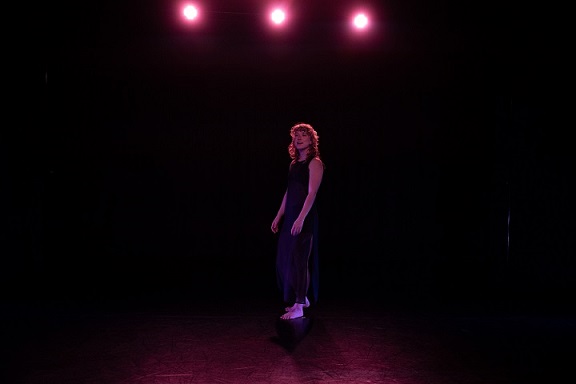
If You Find Yourself Missing is not only choreographed by Ms. Echo, but she also designed the costumes, and wrote the text, which is spoken by Corinne McLoughlin (above). Comprising the musical setting are The Blue Hour by Federico Albanese and Dna by Akira Kosemura.

Corinna Lee Nicholson and Lynda Senisi (above) are the dancers, with Ms. McLoughlin joining the dance moves in addition to voicing the text. This dancework raises the question: “Where is home?” The choreography is restless and poetic by turns, and beautifully articulated by the trio of women.
More of Nir Arieli’s images from If You Find Yourself Missing:


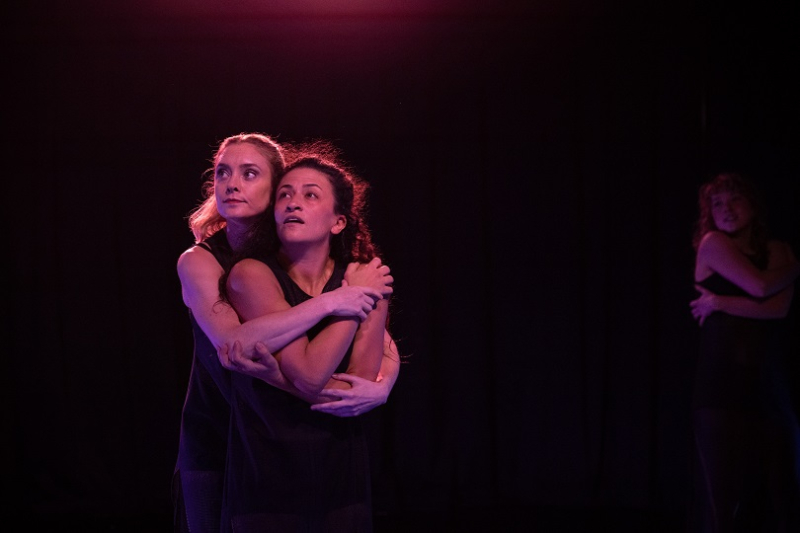
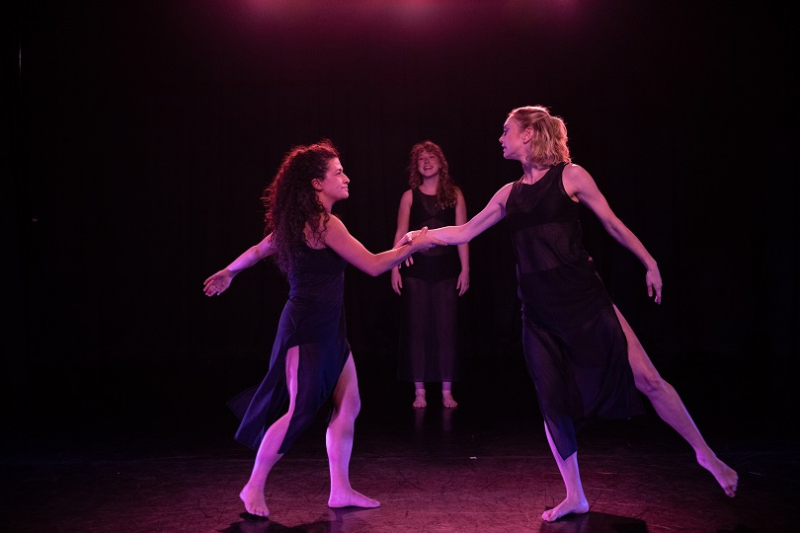

Corrine, Lynda, and Corinna take a bow after If You Find Yourself Missing
Take’s latest, Bamboo Dreams, is danced to atmospheric music by Ryuchi Sakamoto, who passed away in March 2023. Take first heard Sakamoto’s music as a teen-aged baseball player in Japan, and now he honors the composer’s memory with this ballet.
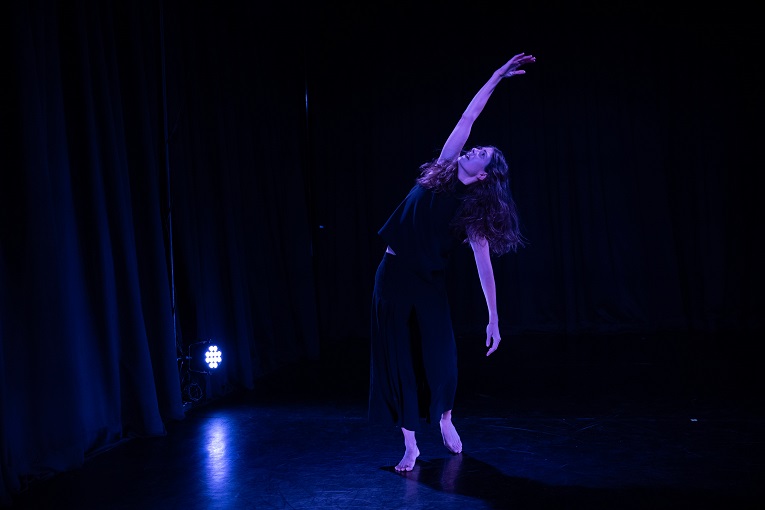
It commences with a vibrant, demanding solo for Kristen (Arnold) Bell (above), dancing with her customary authority and perfectly shaping the phrases.

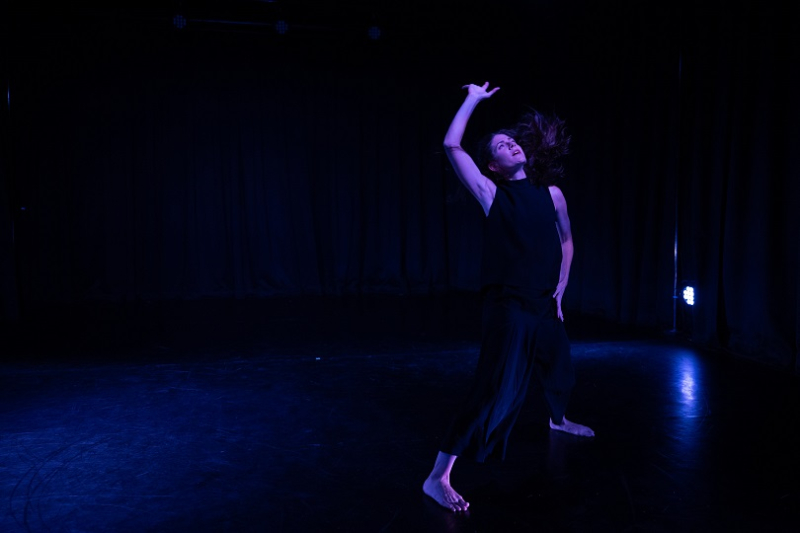
Kristen Bell in Bamboo Dreams; photos by Nir Arieli

There follows a duet for Ms. Nicholson and Orion Duckstein (above). From 1999-2010. Mr. Duckstein was a member of the Paul Taylor Dance Company, where Take also danced for eight seasons. Orion is a beautiful mover, actor, and super-partner, forming a compelling alliance with Ms. Nicholson, whose lithe beauty and fluent movement are intriguing at every moment.
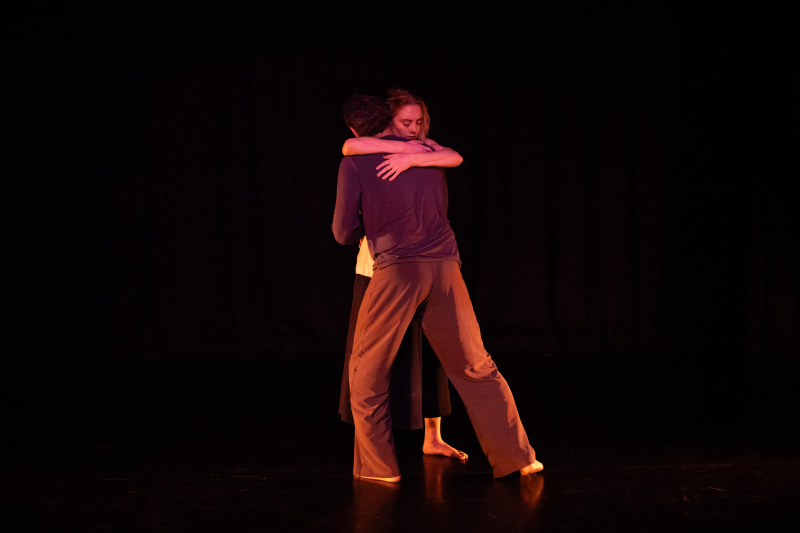

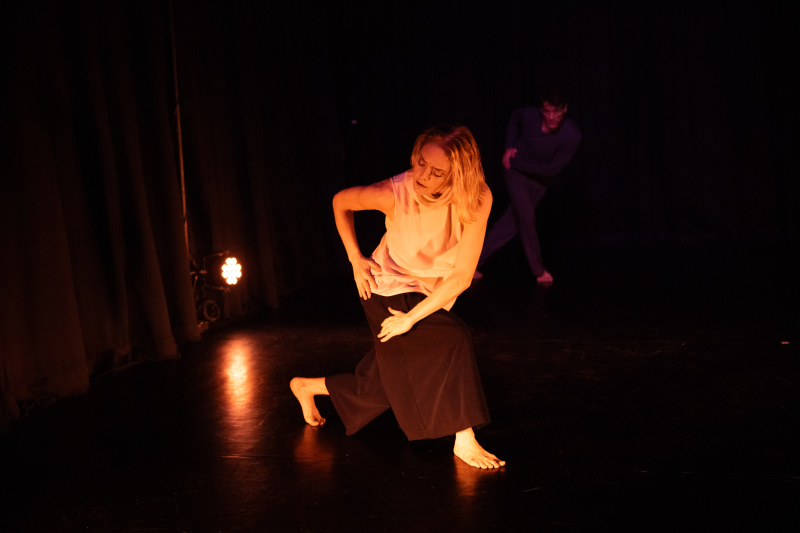

Photos by Nir Arieli
Lynda Senisi and Kristen Bell now join the Nicholson/Duckstein duo. The ensuing quartet veers from huddling together to space-filling combinations. Each dancer is distinctive; you can focus on them as individuals, assured of their technical prowess and expressiveness.
More of Nir Arieli’s images from the quartet:


Lynda Senisi (above) made a particularly vivid impression in this work…and all evening, actually.


Photos by Nir Arieli

A movement from last season’s duet, 10/18/22, now forms the finale of Bamboo Dreams. It opens with a solo for Kristen Bell (above, photo by Nir Arieli).
Watching 10/18/22 for the first time last season, it immediately became one of my favorite dance duets, in part because it is danced so movingly by two of my favorite dancers: Kristen Bell and Corinna Lee Nicholson, The ballet honored the memory of longtime TAKE Dance board president and friend, James Kraft, who passed away on that specific date; it is danced to solo violin music by J S Bach.

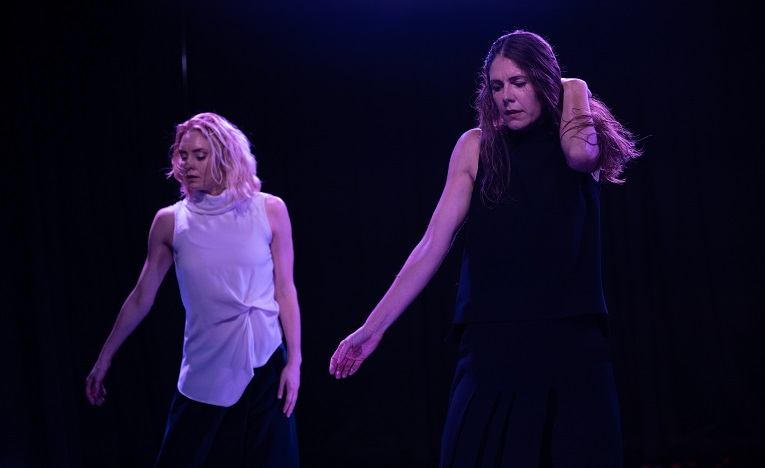


The choreography veers from lyrical to athletic, from serene calm to moments when we might suspect the two women of being a bit deranged. Kristen and Corinna invested all their energy, strength, thoughtfulness, and commitment into this work, to striking effect. A ritualistic scattering of rose petals leaves a poignant impression:

All photos by Nir Arieli.
~ Oberon
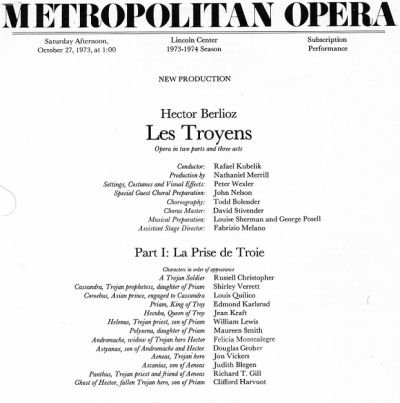
On October 27th, 1973, after spending a very long time in the closet, I had my first gay sexual experience. It was both thrilling and a bit frightening, but what I remember most was a great feeling of relief…and then wondering why it had taken me so long to do it.
That day, I had spent the long afternoon with several of my opera-friends at The Met watching LES TROYENS It was my first time seeing this monumental work, and it was unbearably exciting. Among the group was Z, the boy I had set my sights on since moving back home from Houston earlier in the year.
Looking back, it all seemed pre-arranged, but at the time it felt spontaneous. After the Berlioz matinee, our friends all went their separate ways. But Z and I had 5th Ring tickets for an evening performance of FAUST at the New York City Opera. He sat in front of me in the single seats, whilst I was aching with desire; at this point, nothing had been said about spending the night together.
After Marguerite had succumbed to Faust’s poetic charms in the Garden Scene, we mutually decided it was time to leave. Z looked at his watch and announced that he’d missed the “last bus” home. Haltingly I said, “You can stay with me at the hotel.”
We walked over to the Henry Hudson; nothing much was being said. We stayed up for a while, talking opera, and then it was time. He sat on the twin bed, undressing. “Should I sleep in the chair?” he asked. “I’ve slept in smaller beds with bigger people…” I replied. (This was a lie; I had only ever slept with my girlfriend, and always in big beds).
So, keeping our briefs on, we got under the covers and turned out the lights. For what felt like an eternity, nothing happened. I began to think that maybe I had mis-read the situation and that we were simply going to sleep together. He had his back to me; the warmth and smell of his body were killing me. Suddenly, I put my arms around him, and several wonderful things happened.
After a while, we grew drowsy. “I’ve never done this before,” I said sleepily. “Me neither!” he replied. Keeping him in my arms, we drifted off.
Waking to daylight, I got quickly out of bed and got dressed: I was meeting friends for breakfast. Z was groggy; he dressed slowly. I assumed he would head home, but – without saying anything – he tagged along to the diner.
Our friends were obviously intrigued when we showed up together, but nothing was said. Only the quiet, bookish TJ looked at me knowingly. The conversation turned to the inevitable topic – opera – and my magical “morning after” became just another day.
The aftermath: in the ensuing weeks, whenever I was in New York City, Z was friendly on the surface, but evasive on a personal level. He stood me up for a couple of lunch dates. I was naive enough to think that, because we had shared a sweet experience, we would become lovers. I became distraught.
Unhappy to the core, I confided in TJ. He listened to my story patiently, then told me that Z already had a boyfriend and that he was unlikely to become the lover I was looking for. TJ and I spent more and more time together, and I became very comfortable with him as my confidante. Finally, I invited him to visit me in the little town. Our first night was awkward: I was such a novice, but he – who was four years younger than me – was already pretty experienced, starting with having been raped by his college roommate.
Over time, TJ and I developed a deep relationship; he invited me to spend the summer of 1974 with him on Cape Cod, working for a small-time ballet company. At summer’s end, I drove him to Sarah Lawrence where his senior year was about to begin.
Our unspoken plan was to resume our lives – he at school and me back in the little town – and see each other whenever I came to the City. As we sat in the car saying goodbye, he suddenly started crying; it was then that I realized how strong our attachment was. Instead of leaving, I spent the night in the dorm with him. I left the next morning, but a few days later I received a letter from him, asking me to come and live with him in the dorm.
This was the beginning of my life, really. When TJ had finished school, we moved to Hartford, where I spent the next 22 years. After a year, our domestic life faltered when I became smitten with someone else. TJ and I had a bad break-up, and he never spoke to me again. I embarked on a long and promiscuous journey, having a strange tendency to fall in love with everyone I slept with.
Meanwhile, my ultimate goal – to be living in New York City before my 50th birthday – loomed before me. At times, I thought it would never happen; but by a simple twist of fate, I moved to My City three months before the date I had set for myself.
~ Oberon
 \
\
 Oberon's Glade