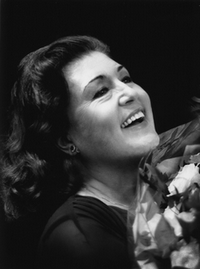
The great Bulgarian soprano Anna Tomowa-Sintow sings “Ernani involami” from Verdi’s ERNANI at the Metropolitan Opera’s 100th Anniversary Gala on October 22, 1983. James Levine is on the podium. I was there!
Watch and listen here.
The great Bulgarian soprano Anna Tomowa-Sintow sings “Ernani involami” from Verdi’s ERNANI at the Metropolitan Opera’s 100th Anniversary Gala on October 22, 1983. James Levine is on the podium. I was there!
Watch and listen here.

Above: Paul Neubauer, Sterling Elliott, Daniel Phillips, Mika Sasaki, and Nina Bernat; photo by Cherylynn Tsushima
Author: Lane Raffaldini Rubin
Friday December 12th, 2025 – When Wu Han, the co-artistic director of the Chamber Music Society of Lincoln Center, came out on stage to make introductory remarks before this annual performance of J.S. Bach’s Brandenburg Concertos, she perfectly captured the spirit of these six pieces and the CMS’s tradition of presenting them all in one evening each holiday season. In front of a full house at Alice Tully Hall, she explained the underlying challenge of programming this music: hiring the right personnel! If at first blush this is merely a collection of six concertos, one quickly finds that each has a unique ensemble of players, instruments, and characters.
At each year’s CMS performances of the Brandenburgs, the order of the concertos is jumbled to keep things interesting. Tonight, the first half of the evening happened to feature the first three concertos and the second half featured the final three.
The CMS players began with the 3rd Brandenburg, setting the tone with a rounded, wholesome sound. Daniel Phillips led the ensemble of three violin soloists, three viola soloists, and three cello soloists. This concerto has an Italianate interplay between the many solo parts and was handled by the CMS players with taut buoyancy, particularly in the third movement with hunt-like passages of running notes. The three cellists produced an impressively large sonority together.
The 1st Brandenburg Concerto followed, bringing an entirely different character and sound to the stage. The first movement opened with its stately, gallant theme with an ensemble that includes horns and double reeds in addition to strings and continuo. Phillips led this concerto as well, this time from the piccolo violin, which produced a bright sound in his solo passages. In the second movement, oboist James Austin Smith offered shapely solos and Phillips played with a blooming vibrato. The joyful third movement featured brilliant solo passages for Phillips, which was unfortunately marred by the muddle of the two horn players.
The fourth movement felt like a bonus after the flourishes of the third movement. It features a sequence of trios separating the recurring minuet, passing music around to different sections of the ensemble in each trio. The conclusion of one of the reed trios, which featured clockwork precision among the oboes and a characterful sound from the bassoon, was met with an audibly satisfied sigh from audience. Violinist Bella Hristova had her moment to shine in another trio, to which she lent a burnished, Romantic sound that suited this music surprisingly well. She played her solos with vivid phrasing and snappy rhythms.
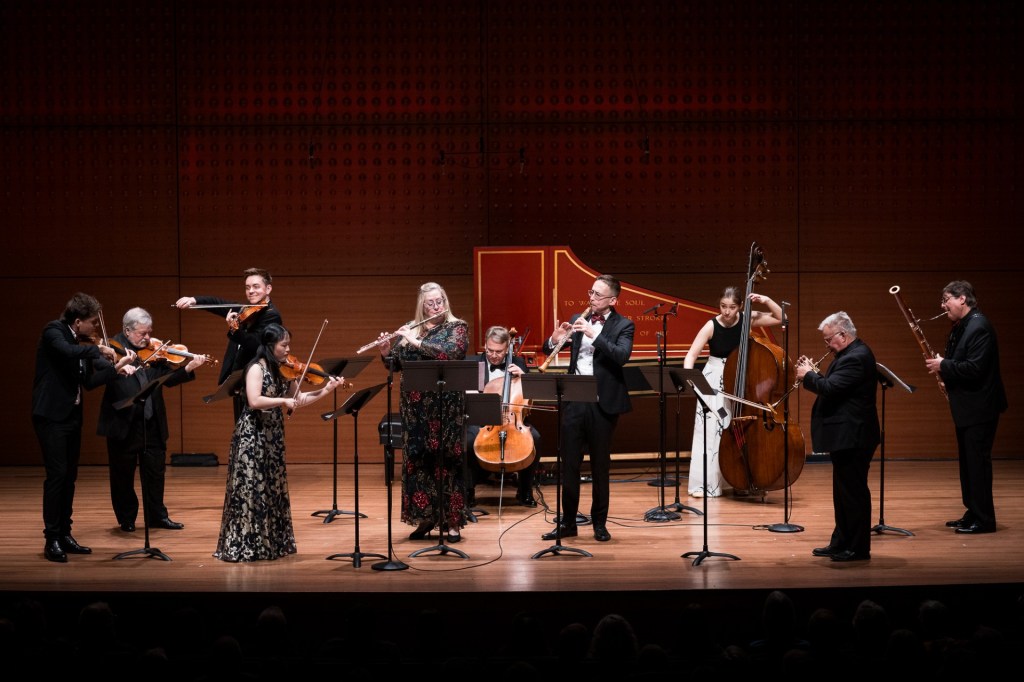
Above: trumpeter David Washburn (right) was playing his farewell CMS Brandenburgs this season; photo by Cherylynn Tsushima
Violinist Tien-Hsin Cindy Wu led a superb reading of the 2nd Brandenburg, which gave pride of place to trumpetist David Washburn in what would be his final run of Brandenburg performances after sixteen seasons. This concerto features complex interplay among the concertante parts and was given a contoured, at times suspenseful shape by the players. Wu’s violin solos were electric throughout, and Washburn dazzled with flawless execution of the monumentally difficult part for piccolo trumpet. In the last movement, Washburn and Smith (playing the oboe solo part) were visibly gleeful in their shared passages. Washburn, the clear star of the evening, received an enthusiastic ovation from the audience.
The second half of the concert began with the 5th Brandenburg, which is undoubtedly the least interesting of the set. Mika Sasaki’s extended cadenza on the harpsichord was the highlight as well as Sooyun Kim’s elegantly played flute part.
Things picked back up with the 6th Brandenburg, led by violists Matthew Lipman and Tien-Hsin Cindy Wu (Wu played violin and viola in these performances). This concerto features strings and continuo but, notably, omits violins, leaving the two viola parts as the highest voices. The result is an earthen sound which nonetheless was given buoyancy by the players. In the second movement, cellist Sterling Elliott and double-bassist Nina Bernat brought a grinding continuo sound to the ensemble. The magisterial third movement features a gigue-like ritornello and the players fully burst forth at the coda.
The 4th Brandenburg provided the evening’s finale. Here Hristova led from the violin alongside flutists Sooyun Kim and Tara Helen O’Connor. They gave the first movement a pastoral piping, swift but full-bodied in sound. Hristova, the most technically impressive of the night’s violinists, had many virtuosic passages which she tossed off effortlessly. Her Romantic sound did not serve this concerto as well as the 1st Brandenburg, perhaps because the flutes lend this music a more rustic, country-dance flavor.
If Wu Han set up high expectations for the evening, the CMS players delivered. Pervasive in their performance was a sense of abundance in this music and a festive spirit of enjoying this music together.
~ Lane Raffaldini Rubin
Performance photos by Cherylynn Tsushima, courtesy of Chamber Music Society of Lincoln Center
~ Author: Oberon
Sunday December 14th, 2025 matinee – Luckily, I ran into my long-time dance-friend Takehiro Ueyama at a Paul Taylor performance earlier this season; he told me he was crafting a new piece for the Juilliard Dance Division’s New Dances series, so the next day I picked up a ticket and this afternoon I watched four distinctive danceworks, set to a wide range of musical scores. All four pieces were having their world premieres in this series of shows.
During my first years of living in New York City, I went to performances at Juilliard countless times. I’d made friends with several young singers in the voice division; many of them went on to very successful careers.
But I hadn’t been to a Juilliard event in a long time, and I’m very glad I was there today. I’d forgotten what a pleasant venue the Peter Jay Sharp Theatre is; I should go there more often….though it has one drawback for review writing: like The Joyce, the deep darkness during shows makes note-taking an unpleasant chore.
Gianna Reisen, a choreographer and movement director who has choreographed for New York City Ballet, Los Angeles Dance Project, School of American Ballet, and Carolina Ballet, today offered Passenger, for which she drew upon music from Einstein on the Beach by Philip Glass. Two dozen dancers from the class of 2029 took the stage, whilst a chorus of young singers appeared in the pit, along with violinist Benjamin Seah, and organist Matthew Schultheis.
Sounds of the organ set a mood: the dancers are seated in a circle on the floor, with one lone man standing. The ‘counting chorus’ from the pit gives a curiously appealing rhythmic undercurrent. The dance has a ritualistic feel – which I love – and stylized moves and gestures, given in-sync, create a sense of community. The hypnotic music gives the dancers a basis for their moves, with the large ensemble moments mixed in with break-away solos, duos, and trios.
In a mood shift. Mr. Seah’s violin slithers up and down scale passages; the movement becomes more agitated, and various dancers hold our attention in fleeting solos. A leaping and bouncing ensemble gives way to stillness. Throughout the afternoon, the large audience was wonderfully attentive; after each dancework, students in the crowd shouted approval for their classmates who were either dancing or making music…such a congenial atmosphere.
Takehiro Ueyama, a Juilliard alum, former Paul Taylor dancer, and founder of TAKE Dance, has created a dreamlike dancework – The wind, the sea, and the sky – to the adagio assai from Maurice Ravel’s piano concerto in G-major, performed today in a transcription for two pianos by Lucien Garban. The excellent pianists were Dovie Lepore-Currin and Isaac Parlin, and the twelve dancers were from the Class of 2028. With his characteristic thoughtfulness, Take dedicated the piece to the memory of his mentor, Kazuko Hirabayashi, a Juilliard alumna (1962) and faculty member from 1968-2011. Read about this fascinating woman here.
The opening section of Take’s work is performed to the heavy ticking rhythm of an invisible clock. A young man is seated at a table, spotlit in a stageful of fog. He seems to be pondering some plan. He is joined by a female accomplice; their duet takes place on, around, or under the table. The corps of dancers now come forward in silence, the light turns briefly hellish as they sway and fall.
The piano music commences, and the table seems cage-like. The principal couple and the corps seem to be unfolding some mystical drama as blinding lights pierce the heavy fog. The music, now pensive, finds couples joining in movement patterns; as things intensify, the dancers rush about in a circle. At last, a dreamy mood is established, over which darkness finally falls.
Following an over-long intermission. My’Kal Stromile, a 2018 Juilliard graduate who has choreographed for Opera National de Paris and Boston Ballet, presented dancers from the Class of 2027 in kit-of-parts with the Dolphins Quartet playing Paganini’s Variations on 24 Caprices for Solo Violin in their own arrangement.
The musicians were upstage, silhouetted behind a scrim, and their delightful playing was a big hit with the crowd. A quartet of red-clad dancers dance up a storm – beautiful movers all – and, to the unlikely sound of a cowbell playing a funky beat, more dancers join. Fantastic fiddling leads into a dreamier passage, in which the violin alternates between plucking and sighing. A stylized men’s trio features some slo-mo posing; the music accelerates, then slows for a pas de deux to a caressive theme which morphs into a cello solo. As the lights begin to fade, the cellist’s face is illuminated…a perfect touch. The dancers were vociferously applauded, and screams were unleashed as the musicians came forward. Such a joy-filled atmosphere.
The closing work, Augmented: MAM 1 from Studio Wayne McGregor, was finely choreographed by Jessica Wright, and excitingly danced by members of the Class of 2026. The music (mostly just noise) was tedious – I thought this type of dancework went out years ago, but apparently not. One passage, a duet to electronic music, was genuinely captivating. The audience gave the piece a tumultuous ovation.
Deserving of a special bravo this afternoon was lighting designer Clifton Taylor. And I was ever-so-glad to see Linda Gelinas – who I saw dancing many times at The Metropolitan Opera – listed as Faculty Rehearsal Director for Take’s piece. His rehearsal assistant was my longtime friend Kristen Bell, one of Take Dance’s stellar movers and shapers.
~ Oberon
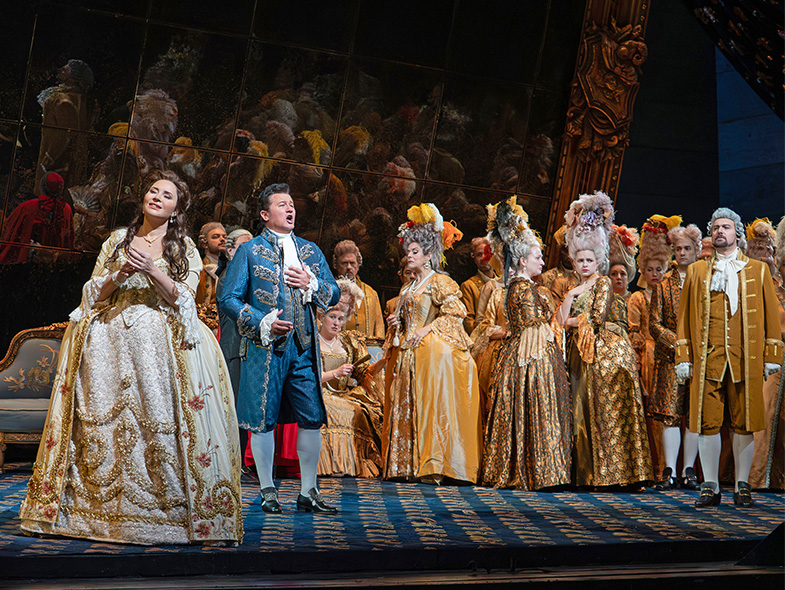
Above: Sonya Yoncheva, Piotr Beczala, Nancy Fabiola Herrera, and Igor Golovatenko in Act I of ANDREA CHENIER; a MetOpera photo.
~ Author: Oberon
Saturday December 13th, 2025 matinee – Giordano’s ANDREA CHENIER is high on my list of favorite operas; it stands as a beacon in the verismo repertoire, and is all the more meaningful as it draws upon the life of a real person: the poet André Marie Chénier; read about him here. Like the Carmelite nuns in Poulenc’s DIALOGUES DES CAMELITES, Chénier was executed in the final days of the Reign of Terror.
In my earliest years of opera-obsession, the title-role of this opera at The Met was shared by three great tenors: Franco Corelli, Richard Tucker, and Carlo Bergonzi (Mario del Monaco had left The Met in 1959) whilst Maddalena de Coigny was a favoured role of Zinka Milanov and Renata Tebaldi, though my first Maddalena was Raina Kabaivanska (unforgettable in her only Met appearance in the role, opposite Tucker). A host of wonderful baritones took on the role of Carlo Gerard, among them Warren, Merrill, Bastianini, and Colzani; my first Gerard was Mario Sereni, who sings the role on my favorite commercial recording of the opera, opposite Franco Corelli and Antonietta Stella.
The principals in this afternoon’s CHENIER were Sonya Yoncheva, Piotr Beczała, and Igor Golovatenko, with Daniele Rustioni on the podium.
The first voice to be heard today belonged to Ben Strong, currently in the Met’s Young Artist Program, as the Major-Domo; even in this brief role, he was able to make his mark. Igor Golovatenko’s house-filling voice immediately seized the imagination; portraying a life-long 2nd generation servant at maison Coigny, Carlo Gerard watches his father, now in his old age, struggle with his duties. Gerard curses the aristocracy: his “T’odio, casa dorata!” is a powerfully sung threat, but it is met with a surge of volume from the pit that nearly covers the climax; such onslaughts will continue throughout the afternoon.
CHENIER offers excellent opportunities in its character roles, and as Act I continues we hear Nancy Fabiola Herrera – who has sung Maddalena, Carmen, and Herodias at the Met – as the Comtesse de Coigny, singing beautifully. Two graduates of the Young Artist Program – tenor Tony Stevenson and mezzo-soprano Siphokazi Molteno – made excellent impressions today as the Abbé and Bersi. Alexander Birch Elliott sounds impressive as he introduces the evening’s entertainment, a ballet with sweet choral harmonies and the lovely sounds of harp and horn.
Ms. Yoncheva, who drew some negative comments after the season prima of CHENIER, sounds fine thus far today. As Maddalena, she playfully baits the poet Andrea Chenier, who responds with the famous Improviso. Mr. Beczala’s singing has a trace of pitchiness early on, but he is soon delivering powerful, passionate singing, sometimes infringed upon by the orchestra. The tenor won hearty applause for his generous vocalism.
Gerard now brings in a chorus of rag-tag peasants, singing ominously; the servant lashes out at the nobility, then tenderly urges his father to come away with him. Ms. Herrera has the act’s final lines as order is restored, and the aristocrats join in a stately gavotte…dancing on their graves.
Five years pass before the story resumes in 1794, when the Reign of Terror is in full bloom. New characters – Mathieu (the wonderful basso buffo Maurizio Muraro), the spy L’Incredibile (vividly voiced by Brenton Ryan), and Chenier’s friend Roucher (recent Met newcomer Guriy Gurev, excellent of voice). Ms. Molteno’s Bersi plays at being a “daughter of the revolution” whilst secretly trying to get a message to Chenier from the now-destitute Maddalena. Throughout this act, the orchestra will offer unnecessary bursts of sound, pressuring the voices.
At last, evening falls. Mr. Muraro has a delightful “la-la-la” tune as the street lamps are lit. Now Ms. Yoncheva emerges from the shadows for her meeting with Chenier. To me, the soprano sounds quite wonderful today, skillfully pulling back ever-so-slightly on some of the higher notes to keep the vibrato under control. Her lyricism in “Eravate possente” is just lovely, as is her moving “Son solo al mondo…” Beczala/Chenier reassures Maddalena with his persuasive “Ora soave…” in which the orchestra is too prominent. The soprano spins out some poetic phrases here, and their duet ends on joint high-note, big and brave despite the onslaught from the pit.
Gerard, having eaves-dropped, emerges and attacks Chenier, who fights back. Collapsing from a stab-wound, Gerard tells Chenier: “Protect Maddalena!“. When the crowd surges around, outraged by the attack on Gerard, he refuses to identify his attacker. The orchestra ends the act noisily.
After a second endless intermission, the Revolutionary Tribunal assembles. Gerard, recovered, is greeted enthusiastically; his noble response is spoilt by the orchestra. Olesya Petrova as Old Madelon offers her juvenile grandson to join the revolutionary cause. Ms. Petrova’s singing, tonally fabulous and dynamically masterful, brings forth a gorgeous piano G on “…dolce…”
Mr. Ryan’s narrative arietta is nimbly expressed, and he leaves Gerard alone to offer one of the greatest arias ever written for the baritone voice: “Nemico della patria“. From its powerful start, the singer thrills us with his passionate vocalism; despite having to fend off sonic blasts from the pit, Mr. Golovatenko was simply magnificent, and the audience’s response was thunderous…and so well-deserved.
Maddalena now appears, to beg her former servant to help free Chenier. Mr. Golovatenko tells her passionately of his infatuation with her thoughout his time as Maison Coigny. He is on the verge of raping her; with her chest-voiced response “Ebbene, prendimi…” she shames him. In the great aria “La mamma morta“, Ms. Yoncheva is truly compelling as she describes the horror of watching her mother being murdered, and of Bersi selling her body to buy food and medicine for her former mistress. The soprano’s narrative is extraordinarily poignant; out of despair, Maddalena has found love and forgotten her sorrows…”Io son l’obblio!” was heroically sustained, and then the soprano took the high ending of the aria, drawing fervent applause.
Jeongcheol Cha and Christoper Job sound so sinister as Dumas and Fouquier-Tinville, presiding over Chenier’s trial. Mr. Beczala gives his all in his “Si, fu soldato!” wherein he sings of his love of country…to no avail. “Morte!!” is the dreaded verdict.
Awaiting execution, Chenier reads to Roucher his final line of poetry. There’s a trace of tiredness in Beczala’s voice now, after an afternoon of coping with the noise from the pit, but he summons up deep reserves to triumph at the aria’s climax. Mr. Muraro’s humming of the Marseillaise is a momentary diversion. Maddalena arrives and bribes the jailer (the ever-wonderful Richard Bernstein) to let her take the place of a condemned woman, Idia Legray. Yoncheva’s “Benedica il destino...” tore at my heartstrings. Gerard rushes off to seek a reprieve from Robespierre.
Together at last, Maddalena and Chenier sing one of opera’s most thrilling love duets: “Vicino a te...” Both singers sang their hearts out, the soprano’s voice aglow with passion, the tenor still pouring out tone with great generosity.
The curtain calls, taken before the Met’s signature gold curtain, recalled the many years wherein that’s the way bows were always done. Although this deprives the singers in supporting roles a chance to walk out and be applauded, it was grand to see a bouquet of red roses fly across the footlights and land at Ms. Yoncheva’s feet.
At the stage door, I met (and got a kiss from!) Ms. Petrova, and chatted up Mssrs. Bernstein and Muraro. Mssrs. Beczala and Golovatenko were engulfed by fans wanting selfies, but Ms. Yoncheva still had not appeared by the time I left for home.
~ Oberon
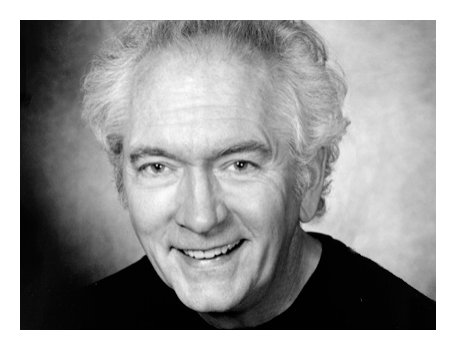
Baritone Richard Stilwell sings Hector Berlioz’s “Les Nuits d’Été” from a 1975 telecast. Willem van Otterloo conducts the Netherlands Radio Philharmonic Orchestra.
Listen here.
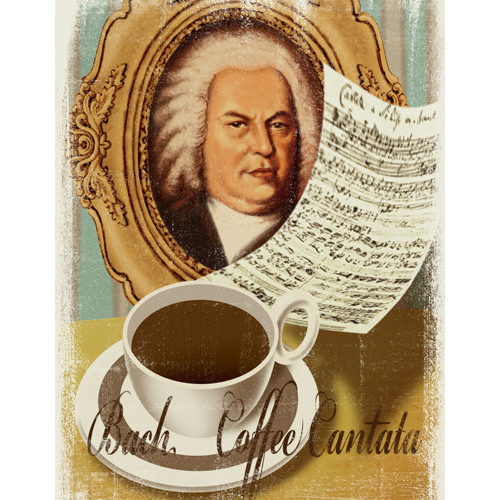
Tuesday December 9th, 2025 – This was a concert I attended because of the participating singers. Joelle Harvey is a great favorite of mine, and – after his recent, magnificent Don Ottavio at The Met – I wanted very much to hear Paul Appleby again…immediately. John Moore (then known at John Michael Moore) was in the Met Young Artists Program at the same time as my friend Lisette Oropesa, and I’ve always tried to keep tabs on that group of youngsters, which includes Sasha Cooke, Kate Lindsey, and Shenyang.
I admit to running hot or cold when it comes to Bach. I was a late-comer to getting into classical music – beyond my obsession with opera – and Bach never really grabbed me, at least not until I encountered the Brandenburgs. Aside from those luminous concerti, which I have heard annually at CMS in the Yuletide season for several years now, I am not really familiar with most of Bach’s music, and in fact tonight was my first time hearing these cantatas.
The instrumental ensemble backing up the singers this evening was a prestigious one: Kenneth Weiss was at the harpsichord, with violinists Ani Kavafian and Cho-Liang Lin, violist Lawrence Dutton, cellist Timothy Eddy, and bassist Blake Hinson. They were joined by flautists Yoobin Son and Demarre McGill, and bassoonist Peter Kolkay…the last-named I had not heard for a while, and so I was glad to encounter him again this evening.
“Non sa che sia dolore”, BWV 209, (c. 1747) opened the program, commencing with some delectable flute playing from Yoobin Son, her pearly tone so inviting in an extended solo. Mssrs. Eddy and Hinson were an amiable rhythm section, and Ms. Kavafian’s violin sounded sweetly. Joelle Harvey, lovely in a black frock and with her long tresses falling around her shoulder, now steps forward to sing, looking as beautiful as she sounds. Her voice is wonderfully present, alive with dynamic variety and enchanting colours. In her first aria, the sound of her voice was entwined with that of Yoobin Son’s magic flute. After a brief recitative, her lively second aria brought a flow of coloratura that fell most pleasingly on the ear.
John Moore and Ms. Harvey traded arias and also duetted in Durchlauchtster Leopold, BWV 173.1 (c. 1722). Mr. McGill and Yoobin Son created a flute-fest here, and Peter Kolkay’s bassoon extended the colour-palette. The piece heaps compliments on Prince Leopold of Anhalt-Cothen, Bach’s employer. I suppose a modern-day equivalent would be a cabinet meeting at the Trump White House, wherein flattery is carried to extremes.
The flutes wrap their warbling attractively about the Harvey voice, and Mr. Moore displays a voice far more powerful than I recall from his ‘young artist’ days, as well as a dramatic edge to his recitatives. A vocal duet is matched by duetting flutes, and embellished by a sprightly violin line from Cho-Liang Lee. The baritone brings some heady notes into play in a joint recit with Ms. Harvey; the soprano has an animated aria, brightly sung. In his final aria, introduced by the Kolkay bassoon, Mr. Moore’s voice was vividly powerful, and he must have intoned the name “Leopold!” a dozen times. The cantata closes with the singers and flautists in a double duet.
During the interval, I was telling my companion about Paul Appleby’s gorgeous singing of Don Ottavio at The Met and how pleased I was to be hearing his voice again tonight; my friend – who has sung the tenor part in the Coffee Cantata – warned me that the role is brief.
The program’s second half opened with the dramatic Amore traditore, BWV 203 (written between 1718-1719), a solo work for which Mr. Moore is joined by only the cello and harpisichord. The sparseness of the accompaniment somehow made this piece all the more riveting. Mr. Eddy’s cello has a very active role at first; the singer is called on for some florid passages to which the cello replies in a solo interlude. Mr. Moore’s darkish timbre asserts itself in a dramatic rectitative, followed by a twinkling harpsichord introduction to the concluding aria, which offers further opportunities to Mr. Weiss’s superb playing with another solo to display his perfect technique. This work was the most interesting on the program, at least for me.
The ensemble – minus Yoobin Son and Peter Kolkay – now joined for the finale: the Coffee Cantata, composed around 1734. My friend was correct – the tenor has little to do here; luckily I’ve booked to hear Mr. Appleby again soon, as Tamino in the Taymor FLUTE at The Met…where Ms. Harvey will be his Pamina.
The Coffee Cantata is pretty silly, actually, and the singers had fun with it. Mr. Appleby has a few lines at the start, and later participates in the concluding trio. Mr. Moore plays a father who is alarmed by his daughter’s addiction to coffee. A program note suggests that Bach drank 30 cups of coffee a day, which may have inspired him to write this inane cantata. Mr. Moore has the lively opening aria, followed by an angry recit/lecture to his daughter: she must give up coffee or abandon the hope of ever marrying. The sparring continues with arias for both Mr. Moore and Ms. Harvey, which are finely sung. DeMarre McGill’s flute adds delicious flourishes to the music, which ends with a trio for the three voices. The flute and Mr. Hinson’s double-bass are active in this finale, which ends with the observation that grandmothers and mothers have always loved their coffee…so why should the daughter be any different?
~ Oberon
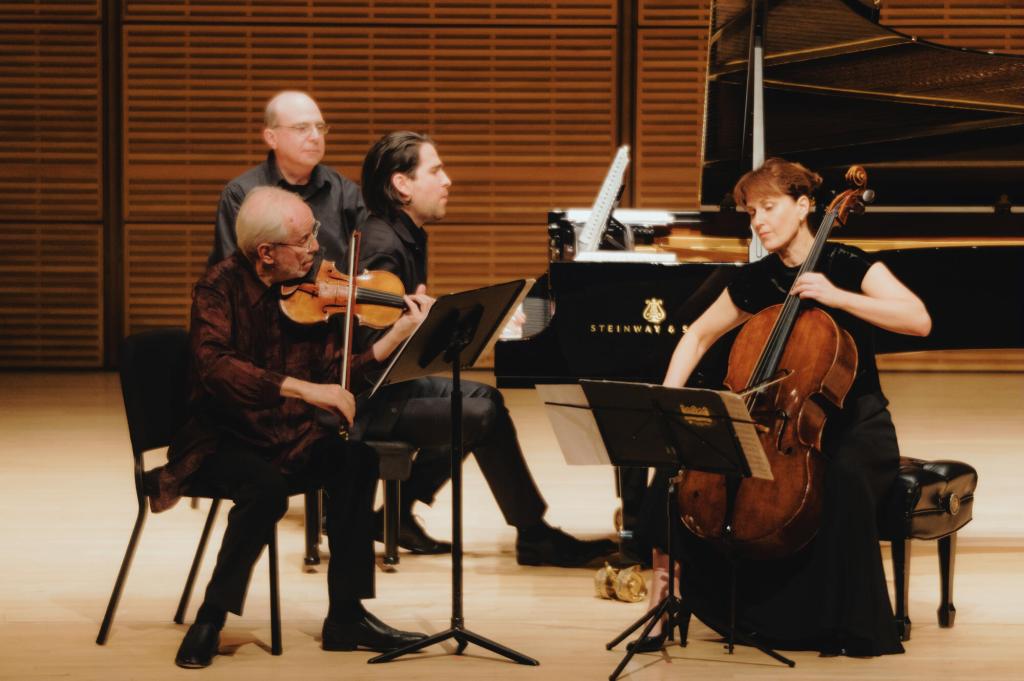
Above, the evening’s artists: Gidon Kremer, Georgijs Osokins, and Giedrė Dirvanauskaitė. Photo by Lawrence Sumulong, courtesy of Carnegie Hall.
~ Author: Lane Raffaldini Rubin
Friday December 5th, 2025 – Carnegie Hall’s season-long celebration of the 90-year-old Estonian composer Arvo Pärt continued on Thursday in Zankel Hall.
The performance featured the violinist Gidon Kremer alongside pianist Georgijs Osokins and cellist Giedrė Dirvanauskaitė. Pärt wrote the definitive violin version of his iconic 1977 piece Fratres for Kremer, now 78 years old himself. Therefore a performance of Fratres by Kremer was indispensable to Carnegie’s thorough accounting of Pärt’s musical legacy.
The program, which included three works by Pärt as well as music by Giya Kancheli and Sergei Rachmaninov, was all about homage and admiration between a constellation of musical figures.
Kremer’s style was the inspiration for an entire paradigm of violin playing that prioritized substance, vitality, and driving directionality of phrasing over refinement and sweetness. He opened the door for chamber music groups like the Emerson String Quartet to develop a similarly gritty sound in their ensemble playing and, for many violinists, offered an alternative to Jascha Heifitz’s teutonically rigid poise, Yehudi Menuhin’s maudlin lyricism, or Nathan Milstein’s hyper-disciplined technique. As with Fratres, Kremer is the definitive interpreter of much of Piazzolla’s music and his recordings of Beethoven’s sonatas and Mozart’s concertos breathed new life into a deeply rutted corner of the violin repertoire.
So it was disappointing to hear Kremer’s playing in its current, diminished state. Fratres is not a bravura showpiece but it does rely on several virtuosic violin techniques like false harmonics and rapid string crossings, which Kremer executed with varying levels of security. Osokins was a solid partner at the keyboard and the two musicians pulled off a dignified performance despite Kremer’s technical shortcomings and flimsy sound.
Pärt’s Mozart-Adagio was a fascinating, rarely heard gem played by the full trio. Pärt’s piece is simply an augmentation of the second movement of Mozart’s Piano Sonata No. 2 in F Major (K. 280), with new material written for the violin and violoncello parts. It’s as if an artist added brushstrokes to the canvas of a revered earlier artist. The result is a modest but gorgeous retelling of Moart’s minor-key siciliana (a slow triple-meter figure with a dotted rhythm). Dirvanauskaitė played with richness, especially in the lower register of the violoncello, Osokins possessed an exceptional clarity of tone at the keyboard, and Kremer’s intuitive dexterity as a chamber musician was on full display.
Osokins’s reading of Für Alina, which opened the program, was the highlight of the evening. Für Alina, written in 1976, was the first instantiation of Pärt’s tintinnabuli compositional method, which features a melodic voice and a harmonizing accompanying voice. “Melodic” might seem like the wrong word for Pärt’s proportionally rigorous, rules-based, often stepwise lines. But the music they produce is sublime in its ruthless simplicity and aching consonance. Osokins brought out the “little bell” sonority of this ur-tintinnabular piece, the notes making up a cascade of discrete raindrops in the midst of silence.
After the three Pärt works, the full trio rounded out the first half of the program with Giya Kancheli’s Middelheim of 2016, a piece written in thanks to the doctors and nurses of the Antwerp hospital of the same name where Kancheli, in his eighties, convalesced after heart operations. The piece opens with a strident statement in the piano that makes use of sympathetic vibrations to establish an eerie mood. A menacing figure that quotes Shostakovich acts as a leitmotif, recurring across the piece’s free-flowing series of transformations. Kancheli’s trio, which sounded profane and urbane compared to Pärt’s “sacred minimalism”, was well crafted and exploited the strings with soaring melodic lines and a range of ornamental effects.
A small printed insert in the program announced the addition of a “short solo piece, Serenade, by Ukrainian composer Valentin Silvestrov, who was [Kremer’s] friend as well as a friend of Arvo Pärt.” Kremer dedicated the performance of this music “to Ukraine and its people, who—in defending their independence—are enduring terrible suffering.” Silvestrov’s piece resembled the introductory movements of J.S. Bach’s sonatas for unaccompanied violin but had a distinct if subtle Slavic character. It was a humble offering on Kremer’s part, and it may have been meant as penance for the next piece on the program, Rachmaninov’s Trio élégiaque No. 2 – about as Russian as music gets.
Rachmaninov dedicated the piece to his hero and mentor Peter Ilyich Tchaikovsky and wrote it immediately following the latter composer’s death in 1893. The piece not only pays direct homage to Tchaikovsky but is also heavily based on Tchaikovsky’s own 1891 Trio in A-minor. Rachmaninov’s piece relies more heavily on the role of the piano to establish melodic themes and effectuate transitions, but both pieces feature steep climbs toward dramatic high points and have descending “lamentation” figures underpinning them. Osokins’s playing was scintillating throughout the piece. Kremer, lacking his old edge, remained animated and burnished. Dirvanauskaitė brought hushed flutters and prayer-like cantabile playing in passages that brought to mind Beethoven’s Heiliger Dankgesang.
As an encore, the trio played a charming arrangement of Franz Schubert’s lied “Du bist die Ruh (You are peace)”, as if to take one more stand against Russia’s aggressions in Ukraine. It was an affecting end to an evening bound together by music of respect, admiration, and dignity.
~ Lane Raffaldini Rubin
Sunday December 7th, 2025 – Music by five of the of the giants of the Baroque period was on offer this evening as Chamber Music Society continues their current season, in which the violin is being celebrated.
The program for this concert was announced months ago, but there were two surprising additions: two recently-discovered works by Johann Sebastian Bach led to the opening of the Alice Tully Hall stage’s back wall to reveal the dramatically-lit 19-ton Kuhn concert organ. Paolo Bourdignon seated himself before this monumental, 4192-pipe instrument to play the ‘new’ Bach pieces (both dating from c. 1705) which were having their NY concert premieres.
The first, Ciacona and Fuga in D-minor for Organ, BWV 1178, immediately bowled us over with the epic power of the towering instrument. As the piece progresses, we experience the vast dynamic range M. Bourdignon could summon, from profoundly rich chords to delicate filigree within echoed passages.
Next up,we heard the Ciacona in G-minor for Organ, BWV 1179; this – being in the minor key – had a darkish quality, laced with enticing subtleties. Througout both of these short works, the organist revealed his mastery of style and technique.
Georg Philipp Telemann’s 1735 Fantasia No. 10 in D-major for Violin, TWV 40:23, one of twelve fantasias the composer wrote, brought forth Chad Hoopes, one of five fantastic violinists to be featured during the evening. The opening Presto has a merry feeling, and the clarity of Mr. Hoopes’ playing drew us in. The central Largo sounded oddly familiar; it has a poignant sense of longing. The violinist charmed us with his sweet tone and delicate trills. The final Allegro – commencing with a joyous tune – was neatly dispatched, drawing warm applause from the packed house.
Violinist James Rhee now took the stage for George Frideric Handel’s Sonata in A-major, with cellist Edward Aaron and Mssr. Bourdignon providing the elegant continuo. The three instantly achieved a cordial blend in the opening Larghetto – music with a gracious air – before moving on to an Allegro in which each player had a chance to shine; this was expertly played. In a brief and tender Adagio, Mr. Rhee’s playing was magical. The concluding, familiar Allegro had a lovely flow to it, the trio reveling in the perfection of their partnership.
From Arcangelo Corelli, we heard his 1714 Concerto Grosso in D-major for strings and continuo, Op. 6, No. 4. A series of introductory chords are followed by a burst of animation as violinists Kristin Lee and Richard Lin trade passages. The Corelli brought double-bass player Anthony Manzo’s first appearance of the evening; after the interval, he and M. Bourdignon will delight us thoughout Vivaldi’s Four Seasons. The Lee/Lin duo showed ideal pacing and pretty harmonies in the moderato of the Corelli; then they set off Baroque fireworks during the concluding Allegro, wherein they and the supporting ensemble were all bowing at breakneck speed.
More from JS Bach: the Concerto in E-major for Violin, Strings, and Continuo, BWV 1042, written “before 1730“. This music has the quality of encountering a friend one has not heard from for many years: it’s so recognizable yet ever so welcome and endearing. Arnaud Sussmann enjoyed a personal triumph here: his playing was simply sensational from first note to last. His shimmering cadenza in the opening Allegro presaged the magic spell he cast in the haunting Adagio that follows. The violinist’s uncanny control of dynamics – and his deep feeling for the music – turned this into a transportive experience; Mssrs. Arron and Manzo gave the violinst heartfelt support. In the final, fantastical Presto, the ensemble – which further included Ms. Lee, Mssrs. Hoopes, Rhee, and Lin, and violists Aaron Boyd and James Thomspon – took in stride the swift tempo with some pristine, prestissimo playing. At the end, Superman Sussmann basked in the vibrant applause of his colleagues and the elated crowd.
Ending the evening with a big Baroque bang was Antonio Vivaldi’s The Four Seasons, Op. 8 No. 1-4, which first burst upon the world in 1725. I became familiar with this music thru watching several performances of the Jerome Robbins ballet of the same title at New York City Ballet back in the day.
Each ‘season’ had a different featured violin soloist: Mr. Hoopes confirmed his excellence in the evening’s opening Telemann with La primavera (Spring)…in fact, he supasssed himself, meriting a scrawl of exclamation points in my notes. In Spring’s opening Allegro, Mssrs. Hoopes and Sussmann engage in a bit of competition. In the Largo, Mr. Thompson’s viola seemed to comment on the violinist’s melody from across the stage. The concluding Allegro is a virtual breath of Spring, with Mssrs. Arron and Manzo bringing lovely details for this danza pastorale.
Mr. Hoopes stepped over into the very classy violin lineup as James Rhee took the centerstage position for L’estate (Summer). The opening Allegro non molto has a sneaky start, but soon Mr. Rhee is regaling us with some whirlwind playing, with the Arron cello as a co-conspirator. The ravishing Adagio finds Mr. Rhee in a sustained song of delicate pianissimi and spine-tingling trills. In the concluding Summer storm, Mr. Rhee’s playing becomes madly passionate, drawing a huge wave of applause.
Kristin Lee, in a striking, ruffled frock, became the goddess of L’autunno (Autumn); her playing is swift and joyous at first, joined by Mr. Arron’s’ cordial cello. Ms. Lee then offers us a sweet softness…and a sustained trill…in a brief interlude. In the Adagio – which is sometimes thought to depict sleeping drunkards – the cello, bass, and harpsichord create enticing colours as they join the violinist in drifting, dreamlike harmonies that have a mysterious feeling. The air clears for la caccia (The Hunt), an Allegro that has a swaying, emphatic feeling, crowned by agile playing from Ms. Lee.
And finally, we come to L’inverno (Winter) where the virtuoso playing of Richard Lin crowned the evening. It commences with a passage for the soloist and cellist which sounds like scraping ice off a frozen surface. Then Mr. Lin simply takes off, like an Olympic skater bent on earning Gold. With his awesome technique and suave tone, the violinist’s playing is dizzying and delightful. The Largo brings a sweet melody over plucked motifs, and then a mood swing into an allegro rush to the finish line.
The crowd, which had been wonderfully quiet and attentive, now swept to its collective feet, hailing the musicians like conquering heroes. Nothing quite compares to a standing ovation in this space where – for two blessèd hours – we have left the darkness of the world behind.
But let us not lose hope just yet; this uplifting Handel chorus can raise our spirits, at least for a moment.
“Let their celestial concerts all unite,
Ever to sound His praise in endless blaze of light.”
~ Oberon
[Note: by coincidence, two writers from this blog wrote about the same concert, which was given by the Pittsburgh Symphony at Carnegie Hall on December 3rd, 2025. Scroll down the blog to read Shoshana Klein’s write-up.]
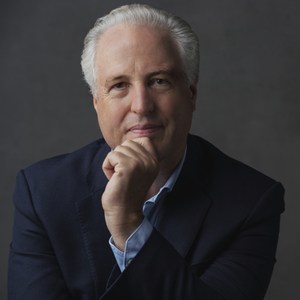
Above: Maestro Manfred Honeck
Author: Grayson T. Kilgo
I was sitting in the center rear orchestra at Carnegie Hall on Wednesday night, which is typically the best place to take in the full sound of an ensemble without losing detail. The warmth of the brass lands cleanly there, and the acoustics make even the smallest gestures unmistakable. It’s also the place where every cough and every dropped cellphone announces itself, uninvited, a reminder that Carnegie never lets you forget you’re part of the room whether you want to be or not. Small microphones on wires hung from the ceiling for the night’s live WQXR broadcast, which meant Pittsburgh’s first appearance at Carnegie in eleven years was not only a sold-out return to New York, but also a performance carried to a national audience.
I read through the program notes before the lights dimmed. The night opened with the New York premiere of Lera Auerbach’s Frozen Dreams, followed by Seong-Jin Cho in Rachmaninoff’s Rhapsody on a Theme of Paganini, and closed with Shostakovich’s Fifth Symphony. It was, in a way, an all-Russian program. Auerbach was born in the former Soviet Union before defecting to New York as a teenager, and placing her commissioned work alongside Rachmaninoff and Shostakovich set up a progression that moved from a contemporary voice to something more historically grounded. Building the night around a modern commission, a major concerto with a widely known soloist, and a symphony the orchestra is closely identified with under music director Manfred Honeck showed a clear sense of programming and identity. Their Grammy-winning recording of the Shostakovich is still regularly referenced, so bringing it back to Carnegie felt less like a safe choice and more like a quiet assertion of identity.
The ensemble, in long tuxedo tails with a few bold expressions of concert black mixed in, took their seats and prepared to execute the program.
Frozen Dreams opened almost imperceptibly. Honeck gently opened his hand, letting the atmosphere open with it, and the sound arrived in a quiet, suspended layer. Auerbach’s writing moved through muted brass, thin glissandos, and brief figures that dissolved almost as soon as they formed, with trills in the strings and winds adding a cold, unsettled texture. From my seat I couldn’t see the percussion, but I heard something glass-like underneath that gave the sound an edge. The piece felt caught between memory and the present moment, and I found myself able to stay with that tension rather than resist it. I wondered if others in the hall felt the same, since this kind of meditative dissonance sits outside what many people expect from a more traditional program. For me it was less about narrative and more about holding a moment still, and it closed with the same quiet release with which it began.
Seong-Jin Cho took the stage for Rachmaninoff’s Rhapsody on a Theme of Paganini, the centerpiece of the night. The work moves through twenty-four variations on Paganini’s Caprice No. 24, shifting between quick, sharp writing and the wide lyricism of the eighteenth variation. Cho, whom I had only known through recordings and reviews, is described as a player of clarity and restraint, and that came through immediately. The fast variations were clean and controlled, and in the quieter moments he drew out color and expression without exaggeration. The performance felt technically flawless and balanced from start to finish.
During his well-deserved Chopin encore, the Waltz in C-sharp minor, I noticed the principal cellist watching him closely, almost absorbed. It stayed with me. Cho offered clarity and space throughout the night, and at times I found myself wanting the orchestra to meet that with a bit more edge in the larger passages. The performance was thoughtful and precise, and the strongest live account of the rhapsody I have heard.
Shostakovich’s Fifth is where the identity of the Pittsburgh Symphony came through most clearly. Honeck has led the orchestra since 2008, and the tightness of the ensemble reflects how deliberately he has shaped its sound. Their connection to this symphony runs deep, including a Grammy-winning 2017 recording, but hearing it in person made you feel how much boldness sits underneath their control. Pittsburgh plays with a kind of daring that sits on an edge without toppling over.
The first movement held tension without heaviness. The scherzo had a dry bite that stayed pointed without drifting into caricature. The third movement created one of the stillest stretches of the night. The long, exposed string lines carried clearly, and the room went unusually quiet for a hall this size.
The finale built steadily, gaining strength without sudden pushes. The brass became very present; Carnegie naturally magnifies that, but Pittsburgh’s section has a physical solidity that lands deep in the chest. The percussion added weight without blurring the texture. After the last chord, the room sat quiet for a beat before applause broke. As I exited onto 57th Street, I felt spent but satisfied. The program had range, and Pittsburgh played with a presence that made their return to New York feel fully theirs.
~ Grayson T. Kilgo
~ Author: Shoshana Klein
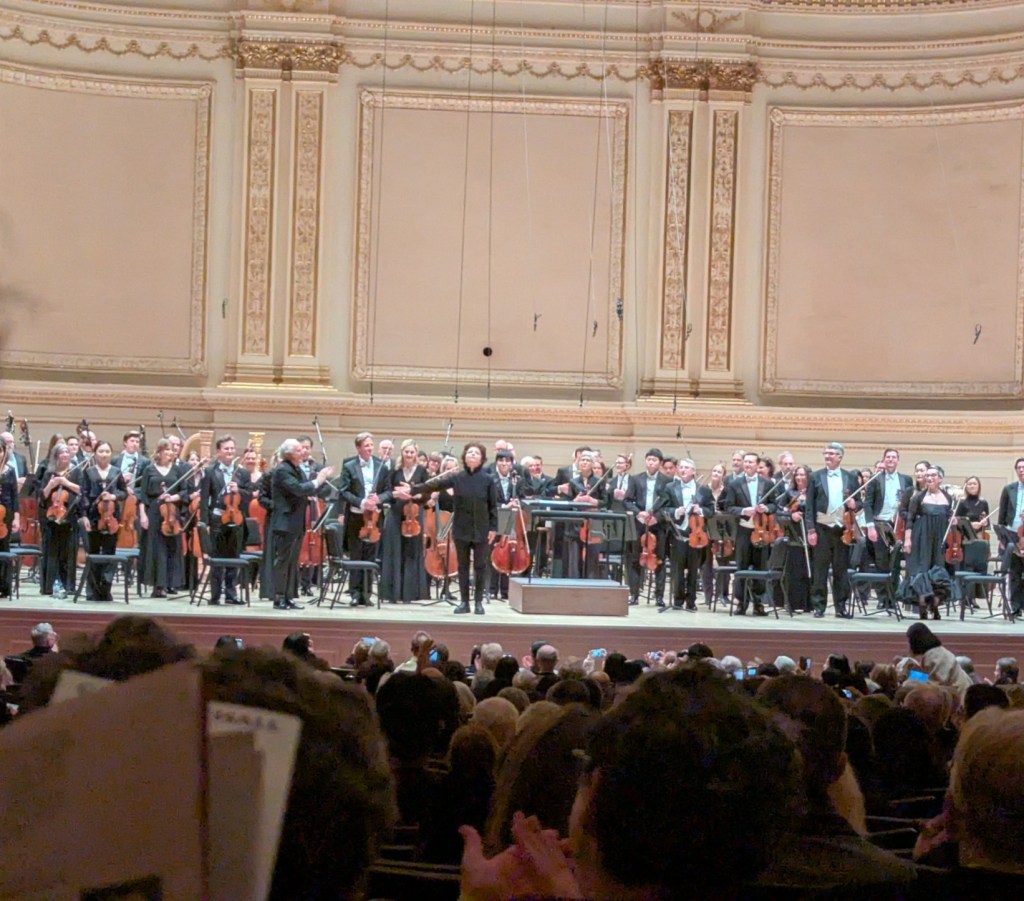
Above: composer Lera Auerbach takes a bow, applauded by the conductor, Manfred Honeck. Photo by the author.
Wednesday December 3rd, 2025 – I have (mostly) fond memories of hearing the Pittsburgh Symphony regularly when I was in undergrad – as a music student, you’re expected to attend often – what better way to learn from your teachers than to hear them perform live every weekend?
There have been some notable roster changes since then – concertmaster Noah Bendix-Bagley left for Berlin, prompting a long search for someone to fill those large (though young) shoes. A few years ago, principal bassoonist Nancy Goeres retired – I was excited to hear her replacement, Julia Harguindey. More recently, Lorna McGhee, principal flute, left for Boston, which is a huge loss for the wind section–every time I heard her I was amazed at her tone. In much more niche news, I miss my oboe teacher, Scott Bell, trustily sitting second throughout my years there. He’s happily retired and likely busy playing Bridge. Really, much of the orchestra has turned over since 2018 or so, and not to their detriment!
The evening’s program:
LERA AUERBACH Frozen Dreams (NY Premiere)
RACHMANINOFF Rhapsody on a Theme of Paganini
SHOSTAKOVICH Symphony No. 5
This extremely standard program started off with one thing less well–known: the commissioned piece Frozen Dreams by Lera Auerbach. The composer framed the piece in an interesting and philosophical way in the program notes – the tension between music being both static and different for every listener. The piece had great textures and rhythms – marimba or waterphone paired with string pizzicato was a great effect – and the piece used pitch bends, lots of string harmonics texturing, and some complicated hocketing – almost all executed very well.
The Rachmaninoff started off a little stronger than I was expecting – not as timidly as it could in order to build, and not at all slow either, one of the earlier variations almost leaving the winds behind. Pianist Seong-Jin Cho was great – I don’t know of him but he seems masterful, especially with the full bodied orchestra behind him. I always forget how the familiar themes of this piece sneak their way in. The piece briefly showed off Max Blair, sounding great as always as assistant principal, as did English horn player Tim Daniels.
The flagship movement – the sappy climax of the piece – was balanced well, not at all over the top but still engaging, from both soloist and orchestra. A well-deserved encore was a delicate Chopin Waltz (C-sharp minor). Cho played it very subdued with sparingly used builds towards important moments – really a treat.
Shostakovich’s 5th Symphony hits differed in our own brand of fascism – I always end up reading program notes, even when I know the history of a piece. These were particularly well done, explaining the controversy between this piece being a “propaganda symphony” and an act of defiance and truth in Soviet Russia.
The first movement gives opportunities to hear most of the winds. Those who have been there forever still sound amazing and look exactly the same as I remember, and the new bassoonist and guest principal flute player sounded great.
The second movement took me by surprise – conductor Manfred Honeck took a lot of liberty with the time, stretching things and breathing a lot of life into it. Perhaps some of this was not having listened to the piece in quite a while, but it felt fresh and exciting.
Cynthia DeAlmeida – with whom I am well acquainted and got to say a quick hello to afterward, does get a mention for her solo in the 3rd movement – very worth paying attention to (even if you’re not in undergrad trying to soak up as much oboe playing as you can), with a very present and shimmery tone. Mike Rusinek took over the solo on the clarinet with a much more translucent sound. Pittsburgh’s strength has always been its soloistic and individual solo wind players, and that certainly hasn’t changed.
The fourth movement started fast to my ear – I heard a story about Bernstein and this piece, that he misread or misinterpreted a tempo marking and ended up doing the accelerando at the end of the piece in double time (who knows if this is accurate, but it does end very fast in his recording). This interpretation started fast and ended very slowly! I always thought the speed up added to the feeling of frenzy, that there was something to cover up, emotionally – but I guess intentional slowness could do the same thing.
In conclusion, the PSO is still a wind-forward orchestra and even better than before with some turnover. I know some of my enjoyment of this concert was nostalgia, but I can’t help but be impressed!
~ Shoshana Klein
 Oberon's Glade