Blog

  • Gerda Lissner Foundation Winners Concert ~ 2026

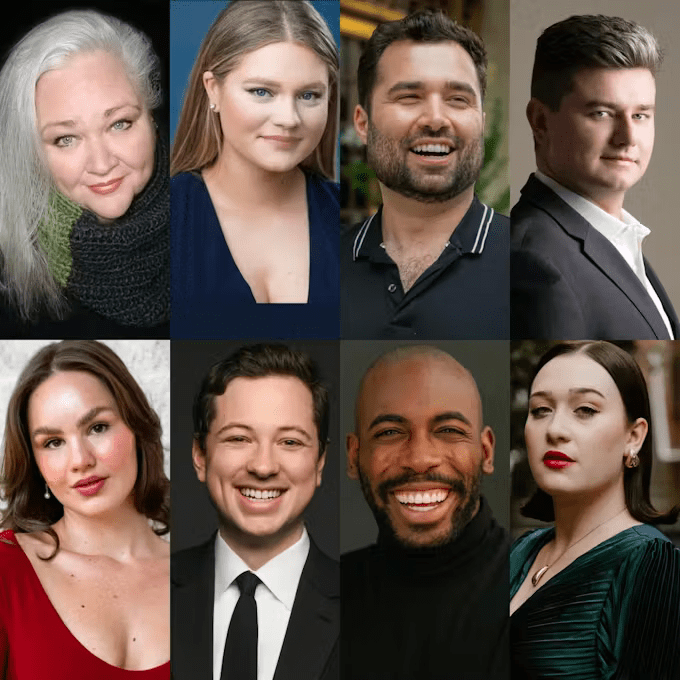
    Above, special guest Stephanie Blythe and winners Magdalena Kuźma, Titus Muzi III, Ben Reisinger, Jennifer Robinson, Finn Sagal, Korin Thomas-Smith, and Anna Thompson. 

    ~ Author: Oberon

    Wednesday April 29th, 2026 – Last year’s Gerda Lissner Foundation winners’ concert was an outstanding evening of singing. Could this year’s winners maintain the high level? The answer was an emphatic “Yes”.

    Midge Woolsey greeted the audience and introduced the first of the singers, tenor Ben Reisinger, with Arlene Shrut at the piano. Mr. Reisinger, currently a MET Young Artist,  had already made a vivid first impression on me when he sang the role of the Sailor in the Met’s new production of TRISTAN UND ISOLDE. Of his performance, I wrote: “As the prelude faded away, a fantastic voice beamed out from the Family Circle: Ben Reisinger, a Met Young Artist, filled the darkened hall with his poetic rendering of the Sailor’s song. His voice holds great promise for the Wagnerian rep – and so much more – in the years to come: bravo…bravissimo!” I still get a frisson of emotion when I remember that moment. 

    Ben sounded fantastic again tonight in two classic arias from the tenor repertoire: Rodolfo’s narrative from Act I of LA BOHEME and Lensky’s despairing song from EUGENE ONEGIN as he awaits a duel with his friend, Onegin. As Rodolfo, Ben proved to be a fine story-teller, displaying a powerful voice that can be honed down to a poetic softness. His sustained high-C was thrilling; he then brought the aria to a subtle finish. As Lensky, the tenor produced lovely piano tones as he mused on his fate and on his love for Olga. Passion and regret were expressed with intensity as the aria moved towards its heart-breaking finish. 

    Ms. Shrut remained at the keyboard to accompany baritone Korin Thomas Smith. This singer knows how to engage an audience; his CENERENTOLA aria was a comedic masterpiece, acting out the story whilst producing voluminous tone. Deft coloratura was at his disposal as Rossini took the music from fast to very fast. Veering from humor to lust, the baritone then took up one of my favorite arias “Vision fugitive” from Massenet’s HERODIADE. Here, his passionate and expressive singing resonated richly in the hall. The aria’s ending was like a vocal knockout punch.  

    Francesco Barfoed took over the Steinway as the three winners of the Art Song Competition appeared in turn. I’d heard this pianist before, and I expected great things from him this evening…and he delivered. Having spoken briefly about the pieces we were about to hear, Mr. Barfoed then took his place at the piano to play a wide-ranging series of nine songs.

    Soprano Jennifer Robinson, in a pale rose gown, has a pretty, lyrical voice. Her diction is excellent, her way with words especially effective in Ricky Ian Gordon’s “Will there really be a morning?” in which a sense of developing passion settles into a peaceful finish. In Joseph Marx’s “Nachtgebet“, Ms. Robinson showed off a shimmering high range. Then, with Mr. Barfoed’s plush playing, the soprano launched Strauss’s “Cäcilie” excitedly before taking on a more pensive air; the song ends with a rush of ardor. 

    Magdalena Kuźma, clad in a striking black gown, has already sung Giannetta in ELISIR and Mozart’s Papagena at The Met. A lovely woman and an ardent songstress, she opened with Rachmaninoff’s “Son” (Dreams), displaying sensuous shadings and smooth legato. You can really feel a personality behind the voice, and even during the song’s piano postlude, she continued to sustain the mood with her expressive face…and a ballerina’s hands and arms. With Hugo Wolf’s “Bekehrte”, Mr. Barfoed’s magical playing entwined with the soprano’s intriguing voice to truly draw us in; there was both intensity and a sense of wonderment in their performance. Finishing with Jean Sibelius’s surprisingly sensuous “Var det en dröm“, the Kuźma/Barfoed alliance reveled in the rolling restlessness of the piano and the smouldering lusciousness of the voice to carry their set to a big, passionate finish.

    Although this was not a competition, Ms. Kuźma had set a high bar, to which baritone Finn Sagal responded with his thoroughly engaging voice and presence. In terms of charisma, this guy is off the charts. Mr. Barfoed played the ominous opening bars of Schubert’s Der Doppelgänger and then the Sagal voice stole eerily into the Hall, darkish and intense. His dynamic control and his measured use of straight-tone were uncanny, his deep notes rich and vividly present. When sheer power was called for, it was his to spend lavishly. His performance gave me the chills. Moving on to Gabriel Fauré’s Automne, Mssrs. Sagal and Barfoed created a poetic atmosphere, the voice so perfectly placed and so responsive to the text, with his resonant sound tapered to enticing softness in all the right places. A different side of Mr. Sagal’s personality shone in Marc Blitzstein’s hilarious The New Suit (‘Zipperfly’), which simply dazzled the crowd. I was happy to read in the playbill that this singer is also active in opera; I can imagine him being marvelous in a host of roles: everything from Wozzeck to Papageno.    

    F. Paul Driscoll, editor of OPERA NEWS for two decades, now introduced the great mezzo-soprano Stephanie Blythe and the renowned pianist Warren Jones. During their amiable chat, Ms. Blythe told a charming story about getting advice from Barbara Bonney; then she and the pianist offered a Brahms song, followed by Cole Porter’s humorous “Tale of the Oyster“, which was grandly done. I am glad to say that the Blythe voice remains awe-inspiring. 

    Ms. Shrut now returned to the piano to play for the program’s last two singers: baritone Titus Muzi III and soprano Anna Thompson.

    Mr. Muzi impressed in arias from NOZZE DI FIGARO and FALSTAFF. In the former, his sizeable voice and commanding presence evoked the character of Count Almaviva, and he tossed in some cunning little embellishments along the way – something I always like to hear in Mozart’s operas. In Ford’s “jealousy aria” Mr. Muzi’s dramatic treatment of the ‘recit’  felt like a mad scene for male voice. When the melody commenced, the singer’s grandly resonant timbre rang through the Hall, making me wonder how he’d fare in the rest of the Verdi repertoire. From the piano, Ms. Shrut offered dramatic accents to underscore the text as the aria reached its grand finish.

    Anna Thompson, a striking woman with a sizeable, vibrant voice who is about to join the Merola Program in San Francisco, gave us the ‘mirror aria’ from Massenet’s THAIS and the Czardas from FLEDERMAUS. Both were impressively voiced, up to the high-D at the close of the THAIS aria and a comparable note to end the Czardas. She was vociferously cheered. 

    Cheers also for our two pianists, for Ms. Woolsey (ever the perfect hostess), and to all the folks at the Lissner Foundation who find and help develop the young voices that keep the worlds of lieder and opera alive.   

    ~ Oberon
  • Lisa Batiashvili & Giorgi Gigashvili ~ Recital @ Zankel Hall

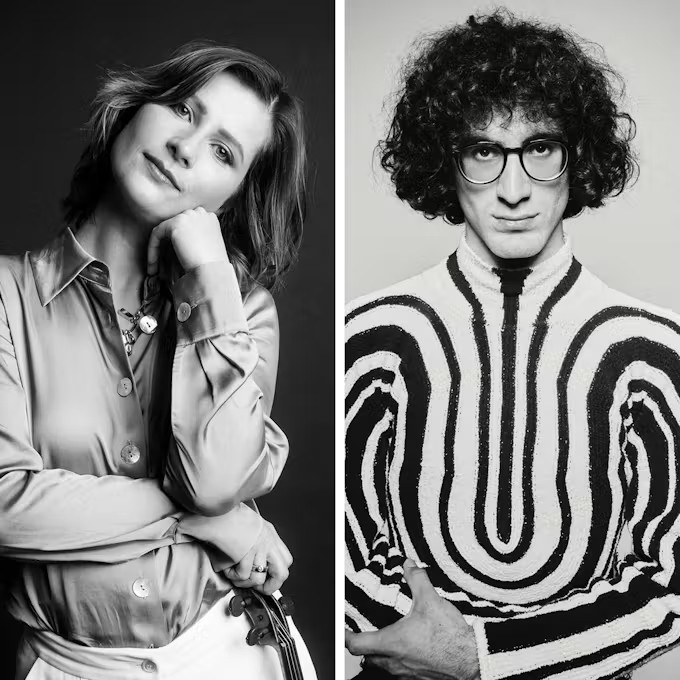
    Above: Lisa Batiashvili and Giorgi Gigashvili; photos by André Josselin and Giorgi Kolbaia respectively.

    ~ Author: Oberon 

    Tuesday April 28th, 2026 – One of my all-time favorite violinists, Lisa Batiashvili,  was joined tonight by pianist Giorgi Gigashvili for a recital at Zankel Hall. Familiar works by Beethoven, Prokofiev, and Franck flanked the US premiere of Josef Bardanashvili’s To Gia Kancheli (P.S.). I have so many beautiful memories of hearing – and watching – Ms. Batiashvili playing with the NY Philharmonic back in the days of Alan Gilbert’s presiding baton. They were so simpatico.   

    Looking as beauteous as ever, the radiant violinist took the stage with her towering young pianist. Mr. Gigashvili was rather casually dressed, but it suited his personality; later, as the encores commenced, he revealed another layer that further endeared him to the crowd.   

    The Violin Sonata No. 3 in E-flat Major, Op. 12, No. 3, of Beethoven opened the evening. The piece calls for great virtuosity; it opens grandly, with both players kept busy by the composer’s demands. At times, the piano seemed too prominent, but as the sonata progressed, a better balance emerged. A gorgeous central theme led to a da capo; applause at its end was jolting, though understandable. 

    The restful air of the Adagio was introduced by the pianist, with Ms. Batiashvili’s violin commenting; the players then reverse roles. The violin sings poetically over rippling piano figurations; a rise of passion subsides. At times, the music feels improvisational. The concluding Rondo dashes onward, with some melodramatic inserts. Rambling scales from the keyboard lead to a virtuoso conclusion, with both players reveling in the composer’s demands.

    Prokofiev’s Violin Sonata No. 1, penned over a span of years from 1938 to 1946, was said by the composer to have been inspired by Handel’s violin sonatas, with their slow-fast-slow-fast structure. Deep, darkish sounds from the piano and a series of suspenseful trills from the violin create a rather bleak atmosphere. There is a sense of longing, and then a passage of great power; imminent danger is suggested in the piano’s wanderings in the low register. Mr. Gigashvili produces massive sounds before subsiding into more scalework, which slowly fades away. 

    The second movement, marked Allegro brusco, brings a vigorous debate between the two players: banging on the keyboard, and slashing strokes from the violin strings. Things settle into a melodic flow,  but then an emergency is signaled, and the music gets big and crazy. Peace is restored as Ms. Batiashvili soars on high, but the ending has a bustling feeling.  

    The Andante brings piano passages that are echoed by the violin. The music gets gorgeous, then ethereal. Haunting memories arise, and – after a unison passage – a chilling darkness settles over us. The sonata’s finale is a folk dance with an emphatic start which calms into a sweet tune, and then sails melodiously onward, with cunning little detours along the way. Ms. Batiashvili’s rapid plucking and Mr. Gigashvili’s restless pounding of the keyboard seem to herald a fiery finish; but instead, slithering scales lend a poignant air. This monumental performance by the two artists drew an excited response from the crowd.  

    Following the interval, Ms. Batiashvili returned to the stage: a vision in a vivid red gown, slit to the thigh, with red stiletto heels. 

    The new Bardanashvili work, To Gia Kancheli (P.S.), was having its US premiere this evening. It is a lovely memorial from one composer to another. Lasting only five minutes, the piece speaks of a multi-faceted friendship between the two composers; it was written especially for Ms. Batiashvili and Mr. Gigashvili. The opening mood is of loneliness: a touching elegy that springs from memories shared by two friends. But then, in a stroke of brilliance, the music turns jazzy – even sultry – with enticing bits of rubato thrown in. Played to perfection by Lisa and Giorgi, the short work made me want to explore more of Mr. Bardanashvili’s music.

    César Franck’s Violin Sonata was the concert’s closing work. This wonderfully familiar piece draws mainly on two themes that are – once heard – forever etched on the memory. As so often when a beloved work closes an evening, I stopped taking notes and simply let the musical experience thrill me. Ms. Batiashvili and Mr. Gigashvili gave a perfect performance, exploring the music that veers from passionate power to heavenly quietude whilst bringing forth nuances that were new to me. What a revelation…!

    The audience’s vociferous response guaranteed that there would be encores; when the players emerged for their bows, the pianist was sporting an I LOVE NEW YORK t-shirt, setting off more shouts of approval. The duo gave us three encores – each ravishingly played – which neither myself nor my companion recognized. Had they continued playing til the witching hour, we’d have stayed on…and on…  

    ~ Oberon

    Update: The encores were:

    AZARASHWILI Nocturne (arr. for violin and piano)

    DEBUSSY “Beau soir” (arr. for violin and piano)

    KANCHELI “When Almonds Blossomed” (arr. for violin and piano) 

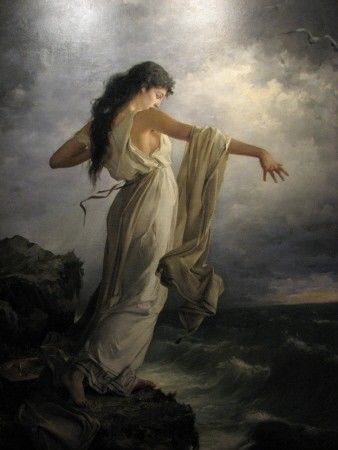
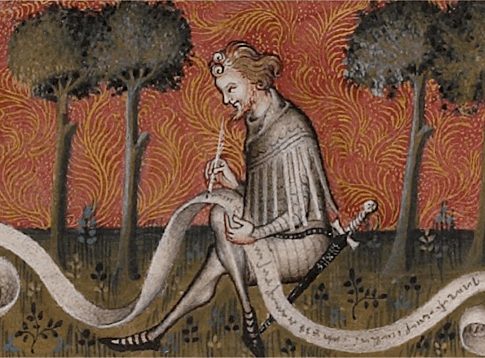
  • Marina Viotti ~ “Ô ma lyre immortelle” from Gounod’s SAPHO

    Conductor Christophe Rousset and Les Talens Lyriques in a recording session for their disc entitled A Tribute to Pauline Viardot.

    Among the numbers included is the great aria “Ô ma lyre immortelle” from Gounod’s nearly-forgotten opera SAPHO. The Swiss-born mezzo-soprano Marina Viotti makes a striking impression with this rarity.

    Watch and listen here.

    The painting above, by Miguel Carbonell i Selva, dates from 1881.

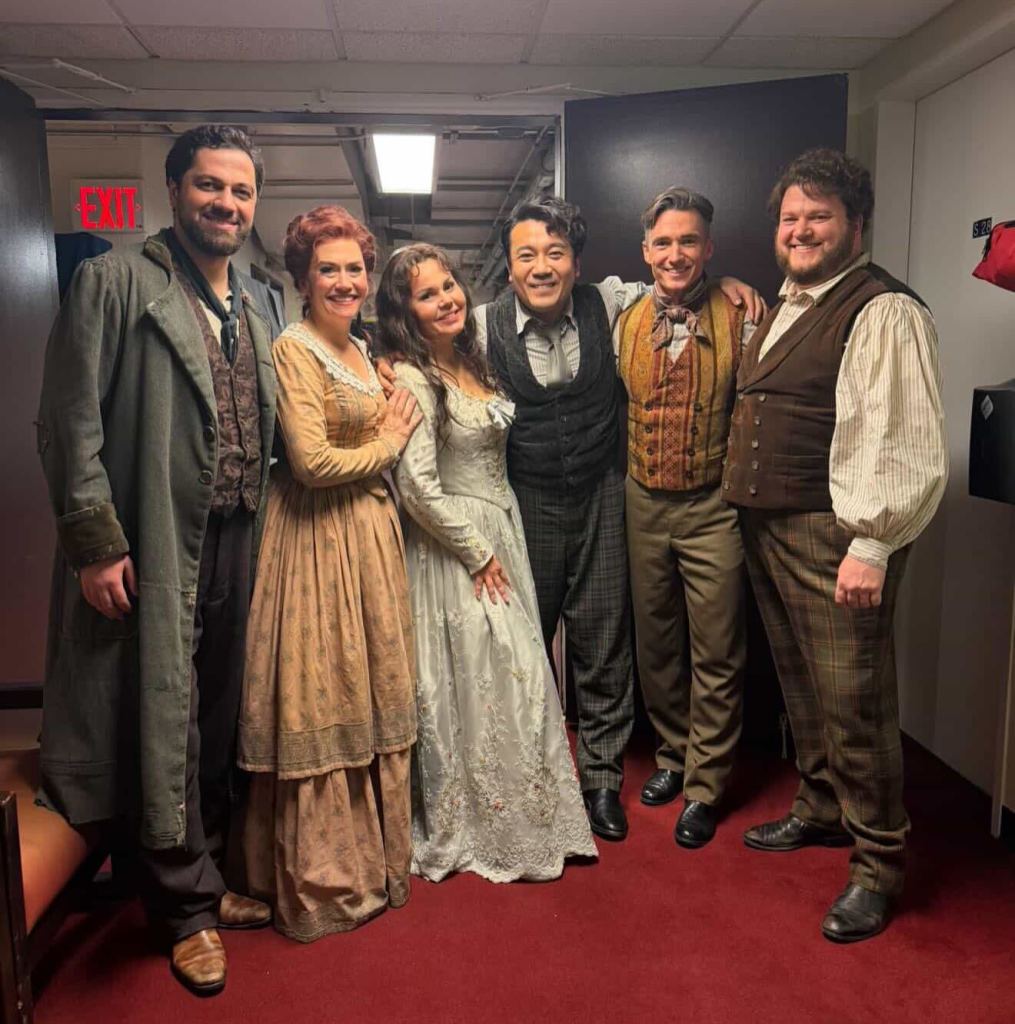
  • Aleksandra Kurzak as Mimi at The Met

    Above, this afternoon’s BOHEME cast at The Met: Giorgi Manoshvili, Heidi Stober, Aleksandra Kurzak, Long Long, Alexander Birch Elliott, and Anthony Clark Evans

    ~ Author: Oberon

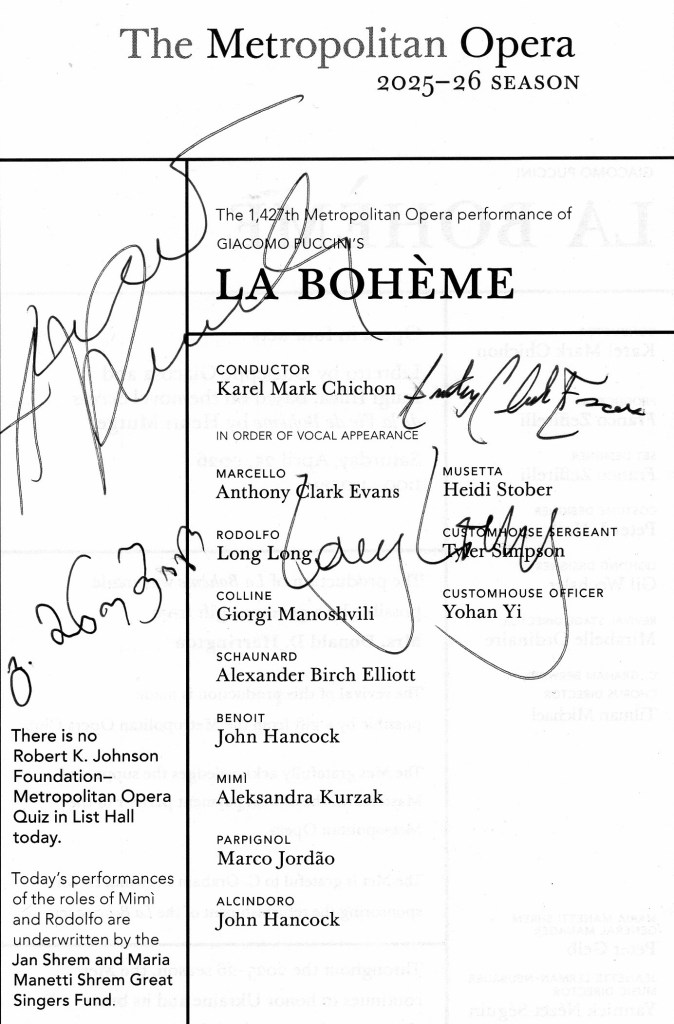
    Saturday April 25th, 2026 matinee – Taking on her second Puccini role of the Met season – Mimi in LA BOHEME – the Polish soprano Aleksandra Kurzak confirmed her success as an outstanding interpreter of the great composer’s fascinating female characters. Earlier this year, she was a captivating Butterfly, and in prior seasons, she has played Tosca with equal conviction and vocal authority. Her Mimi today was as impressively sung as one could ask; joined by a very appealing group of colleagues, the performance took flight…despite some intrusions of too much volume from the pit: a chronic annoyance in the House these days.

    I’m always at my score desk as soon as the House opens, and today I had an unexpected pleasure in hearing the English Horn player practicing the theme of Mahler’s timeless masterpiece, “Ich bin der welt abhanden gekommen…” …my chosen epitaph.

    Baritone Anthony Clark Evans as Marcello was the first voice to be heard today: a handsome, house-filling sound with an appealing sense of lyricism. He is soon joined by Chinese tenor Long Long, a passionate Rodolfo with a finely-utilized dynamic range, and a tenderness of expression that would become increasingly valuable as the afternoon progressed.  The painter and poet are soon joined by a marvelous Georgian basso, Giorgi Manoshvili, as Colline, and Alexander Birch Elliott’s Schaunard in a polished and verbally detailed delivery of the musician’s music. In the dual roles of Benoit and Alcindoro, it was a pleasure to hear John Hancock, whose performances at the once-vital New York City Opera are clear in my memory.

    Ms. Kurzak’s entrance drew a premonition in Long Long’s immediate noting of her “…viso d’ammalata…”, so tenderly voiced. The exchange between the two was lovely and intimate.  In his aria, the tenor’s expressiveness brought a nice diminuendo on “Chi son?” and later, his lyrical outpouring at “Talor dal mio forziere…” was wonderful, carrying him to a vibrant high-C and a most persuasive finish.  In her own narrative, Ms. Kurzak did much with the subtle inflections of her words, and her sweet piano effects. At “Ma quando vien lo sgelo…”, her legato bloomed gorgeously, giving a luscious quality to her singing. Her magical “Il profumo d’un fior…” was exquisite. The orchestra was very dense in its introduction of the love duet, but the voices took over as the couple sang rapturously of their new-found romance. Mimi’s assuring “I’ll stay close beside you…” (something every lover wants to hear) was so touching.  

    At Cafe Momus, the little exchanges between Mimi and her new set of Bohemian friends were deftly handled. Tenor Marco Jordão again made his mark as Parpignol, as he had a few weeks ago with a different cast. The orchestra tended to be over-bearing in spots, but Ms. Kurzak’s sweet little tune about the bonnet was prophetic. Heidi Stober, a vibrant Musetta, sang an enticing waltz, prompting droll admonishings from Mr. Hancock’s Alcindoro. The big finale, with Mr. Evans belting out the waltz-theme to fine effect, heralded a very long intermission.

    At the Barrière d’Enfer, the orchestra evokes falling snow and the clinking of wine glasses inside the tavern. Ms. Stober sweetly reprises the melody of her waltz. Ms. Kurzak and Mr. Evans match voices in their duet, the soprano covering a vast dynamic palette whilst also using a bit of chest voice effectively; Mr. Evans so simpatico. As Mimi hides, Marcello goads Rodolfo, whose pangs of remorse are palpable, into revealing the truth about Mimi’s health. Ms. Kurzak’s comments are darkly expressive. At “Una terrible tosse…” Long Long’s despair pours forth, leading the trio to a powerful climax. Ms. Kurzak’s  “Addio senza rancor” is so touching, with many sublime pianissimo effects and a heart-breaking finish. My own heart is torn apart by their talk of parting. Ms. Kurzak crushes me with her “Sempre tua per la vita…” and Long Long’s diminuendi are so affecting as the couple resolve to stay together until Spring.

    Back in the garret. Mssrs. Long and Evans match voices in their nostalgic duet: they exchange finely-wrought lines, then harmonize to a polished finish. This was a vocal highlight of the afternoon. The four Bohemians re-unite for a boisterous scene, halted by the sudden appearance of Musetta, who has brought the dying Mimi to the very room where she and Rodolfo had first met. Every line and note from here on in is coloured by grief. Mr. Manoshvili’s Coat Aria is superbly sung, so poignant with its sustained finish. Now comes the crushing nostalgia of the final conversation between Mimi and Rodolfo. Long Long’s remorse is hauntingly voiced. The sheer quietude of Ms. Kurzak’s “Sono andati...” demolishes me completely…the colours she summons, her finely-timed use of chest-tone, and the heart-rending, extraordinary delicacy of her singing as she echoes her “Mi chiamano Mimi...” put the finishing touches on her compelling portrait of the doomed seamstress.

    At the stage door, I met Ms. Kurzak, and Mssrs. Long, Evans, and Manoshvili.   

    ~ Oberon 

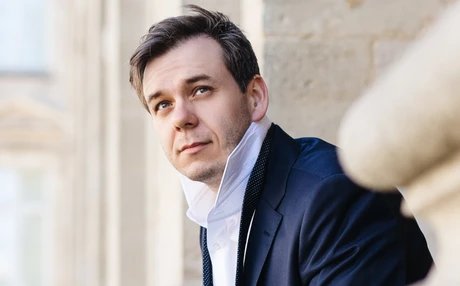
  • Benjamin Bernheim in Recital

    ~ Author: Mark Anthony Martinez II

    Wednesday April 22nd, 2026 – Benjamin Bernheim (above) is a world-renowned operatic tenor who has performed frequently at the Metropolitan Opera in productions such as Gounod’s Roméo et Juliette. This evening, he made his New York solo recital debut. It seemed funny to me that such a big name had never done a solo recital in a city where he performs regularly, but I was glad to be a part of this inaugural event.

    Benjamin Bernheim is particularly known for his French repertoire, and much of the night’s program consisted of that. The concert, for whatever reason, didn’t provide programs, but aside from most of the pieces Bernheim sang, I was thankfully familiar with the repertoire.

    Bernheim and his collaborative pianist, Carrie-Ann Matheson, strode out onto the stage and greeted the audience. Before singing, Bernheim took to the microphone and talked to the audience about the program. Bernheim was quite entertaining on the microphone and had a playful energy that he kept up the entire night. In his introduction, he introduced Ms. Matheson, his longtime collaborator, and the two began with a set of three Duparc songs: “L’Invitation au voyage,” “Chanson triste,” and “Phidylé.

    I’m less familiar with the chanson repertoire, but Bernheim had such good diction that I could understand and follow along. One funny note: one thing that helps with following along with French mélodie is that the general rule is that all French songs are about sex. So it was easy to follow along when the lyrics are comprised of words like “...luxe, calme, et volupté.”

    The crowd was hushed, and Bernheim truly showcased a measured, beautiful mezzo piano/mezzo forte in his singing. I had heard Bernheim sing the titular role in Roméo et Juliette, but this singing today was a lot more refined and expressive. What ended up happening was that when the pieces did eventually become forte, the impact was so much greater. Bernheim also had a wonderful hootiness that is so often used in French repertoire. It helps, I guess, to be a native speaker, where the sounds in the music are just a part of the language itself.

    What was really beautiful to see was how different members of the audience were affected by Bernheim’s singing. One older gentleman in the same row was silently weeping during several of the songs.

    Bernheim, as a singer, was quite poised and didn’t need to make histrionic gestures, as I’ve seen other singers do in solo recital. However, he didn’t need to take much space or create a lot of movement to communicate the beauty in the songs. I always feel like art songs are actually more emotional pieces than arias because they are meant more as communication than bombast, and his clear and pretty voice conveyed everything that he needed to.

    What was particularly nice was that Bernheim shared the stage almost equally with Matheson. It is very easy to forget the pianist in a collaborative voice recital, but after every applause, the two came out together holding hands.

    After the Duparc songs, Bernheim and Matheson briefly left the stage, then came back to do a set of arias.

    The aria set started off with Lensky’s aria from Tchaikovsky’s Eugene Onegin. It seemed odd to me that, in an aria set comprised totally of French pieces, it would start with a Russian one. Bernheim sang the song beautifully, adding a particular delicateness to it that I have not frequently seen.

    The one minor note that I had was that although, musically, things sounded beautiful, in this particular aria there was a bit of a dissonance when you factor in that the character Lensky knows he’s about to die in a duel, but the performer was smiling happily throughout the song. Nothing major, but just a funny note, because Bernheim’s disposition seems to be very sunny in general, so it might be hard for him to escape that mindset in a song that is otherwise about despair.

    In the aria set, the highlight was Bizet’s “Je crois entendre encore.” This tenor aria from the opera Les pêcheurs de perles is notoriously difficult, not because of the high notes, of which there are many, but because of the delicacy required to perform it correctly. It is almost entirely sung in piano, and the B-flat and C in the piece should ideally be done in piano as well. Legendary singers have had issues with this piece and have pitched it down in concert or in performance, but Bernheim navigated the fiendish piece with seeming ease.

    He did have to clear his throat afterward and take a small break, which he acknowledged to the audience with a bit of comedic charm.

    After several more sets of arias, Bernheim finished with an unusual but lovely set of contemporary French songs, not inherently classical in nature. He sang Charles Trenet’s “Douce France,” Joseph Kosma’s “Les feuilles mortes,” and Jacques Brel’s “Quand on n’a que l’amour.

    What was so lovely about these pieces was that they closed the program with some contemporary flair and made the recital not just about songs from the canon, but about living works that people grew up listening to.

    ~ Mark Anthony Martinez II

  • Chanticleer presents the 650-year-old music of Guillaume de Machaut

    ~ Author: Lane Raffaldini Rubin

    Wednesday April 22, 2026 – How many things in our lives are over 650 years old?

    On Wednesday, Trinity Church (itself a merely 330-year-old institution) hosted the singers of Chanticleer in a program of sacred and secular music by Guillaume de Machaut, the preeminent composer and poet of fourteenth-century France. Despite the fact that the invention of the printing press was still more than a century away at the time of Machaut’s death in 1377, we have a nearly comprehensive record of Machaut’s written work and on Wednesday the all-male, San Francisco-based vocal ensemble Chanticleer offered a revelatory cross-section of that body of work.

    The singers entered from the back of the nave and processed down the center aisle while chanting the 10th-century introit “Dominus illuminatio mea” (the only music of the evening not written by Machaut). It was an impressive entrance for the thirteen-man ensemble, who sang in flawless unison while walking the entire length of the church, without the benefit of the chamber music gestures and eye contact that such rhythmic unity usually demands.

    The rest of the evening was dedicated to Machaut’s music, with the Messe de Nostre Dame bookending a series of profane works about courtly love. Machaut’s Messe, likely written for Reims Cathedral in the early 1360s, is believed to be the first cyclic setting of the mass—in other words: prior to Machaut, composers wrote vocal settings of individual portions of the mass’s traditional liturgy (e.g. Credo or Agnus Dei) so that, during any given mass, an assortment of various composers’ liturgical settings would be assembled and sung. Machaut’s Messe provides the entire “Ordinary of the Mass” (the liturgical portions that do not vary based on the calendar) and thus set a new standard for composers of music for the Church.

    The Kyrie, the first portion of the Messe, features a spare texture and frequent melismas passed between voices. A cadence falls at the end of each line of text, lending the piece a disjointed character. The singers treat these cadences with canyonlike expansiveness, making the Kyrie like a series of horizons.

    Chanticleer brough their immaculate ensemble motion to the Gloria, which was a profusion of uncannily strange modal harmonies. This movement and the Credo that follows end with long melismatic Amens, rendered particularly charming thanks to the French Latin pronunciation that the group adopted for Machaut’s sacred music.

    Although the Credo is characterized by the same disjointedness as the Kyrie, Chanticleer imparted varied timbral characters to different sections of the text, as if the ensemble were an organ with varying stops pulled to produce diverse qualities of sound.

    The Sanctus had a remote tonal center from the Credo before it. The homophonic textures of its opening lines were like beams of bright light, not unlike the sunny character of Mozart’s own Sanctus written four hundred years later. In the Agnus Dei the floating melodic tracery of the countertenor is joined by the warm sonority of the rest of the four-part choir, leaving the Messe to conclude with an ascending, aerial motion.

    Throughout, Chanticleer brought a sense of mystery to this music, creating a sublime but enigmatic atmosphere in Trinity Church.

    But between the Gloria and Credo of the mass, Chanticleer offered three extended groupings of Machaut’s courtly secular music. Each cluster was led by a lai, a lengthy monophonic setting of a poem. Machaut’s lais show the limitations of his music’s expressive and dramatic power. The issue in the Messe of the over-frequency of cadences also characterized this music, leaving it not with the vocal floridity or fluidity we associate with poetic songs of subsequent centuries but with a repetitive, even monadic cellularity.

    The sound of the lais, as well as the ballades, motets, and other forms we heard, are sounds of pure abstraction—lines, columns, points, and solid fields of color—gorgeously rendered by Chanticleer but intractably foreign to our present-day ears which are accustomed to tension and release, consonance and dissonance, major and minor, narrative arc, and slippages between legible structural forms.

    “Riches d’amour” came closest to the dramatic expression I’m describing. The ethereal, planetary motion of two voices (Matthew Mazzola and Tim Keeler) brought aching melancholy to this song about a man’s unrequited love for his mistress and the “bitterness” this brings him. The music ends with a harmonically unresolved cadence, adding to the grasping, unfulfilled longing of the lover.

    The entire evening offered a gratifying and rare opportunity to let this 650-year-old sound wash over you. Chanticleer has given us the chance to travel to a time before the codification of common practice music—before major and minor practically became laws of nature in the West. This time travel shows us the extents to which music has evolved and grown from the liturgical and proportional experiments of clergy like Machaut into the most highly developed medium for communicating human emotions in the half-millennium that followed.

    For me, this raises fascinating and unanswerable questions about the original perception of Machaut’s music: how did this music sound in the year 1377? Was it radical? natural? easy-listening? thorny and confusing? boundary-pushing?

    We have scholarly ways to address those questions but, ultimately, the ear of the fourteenth-century listener—who never heard Bach, Mozart, and the rest, up through our own time—will never be retrievable to us.

    ~ Lane Raffaldini Rubin

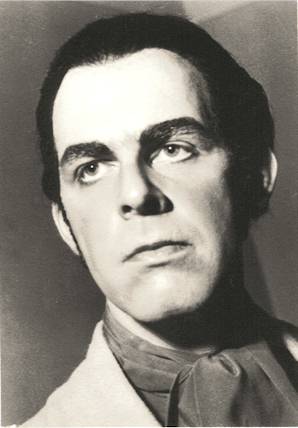
  • DAS RHEINGOLD @ The Met ~ 1957

    Above: bass-baritone Hermann Udhe

    A 1957 radio broadcast of Wagner’s DAS RHEINGOLD from The Met; it’s in surprisingly good sound for the time period.

    In the cast are several singers who were Met mainstays at the time: the great Hermann Uhde is Wotan, Blanche Thebom (she of the long tresses) is Fricka, Ramon Vinay (a favored Otello and Tristan) is Loge, the monumental contralto Jean Madeira (Erda), and two formidable bassos – Dezső Ernster and Kurt Böhme – are the giants. The Rhinemaidens are lovely: Heidi Krall (under-utilized by The Met, in my opinion), the luscious Rosalind Elias, and Sandra Warfield (who married our Froh – and a future Otello – James McCracken). Less-familiar names – Mariquita Moll, Norman Kelley, Lawrence Davidson, and Arthur Budney – hold up well in their roles; Mssrs. Davidson and Budney are, in fact, quite impressive as Alberich and Donner.

    Listen here.

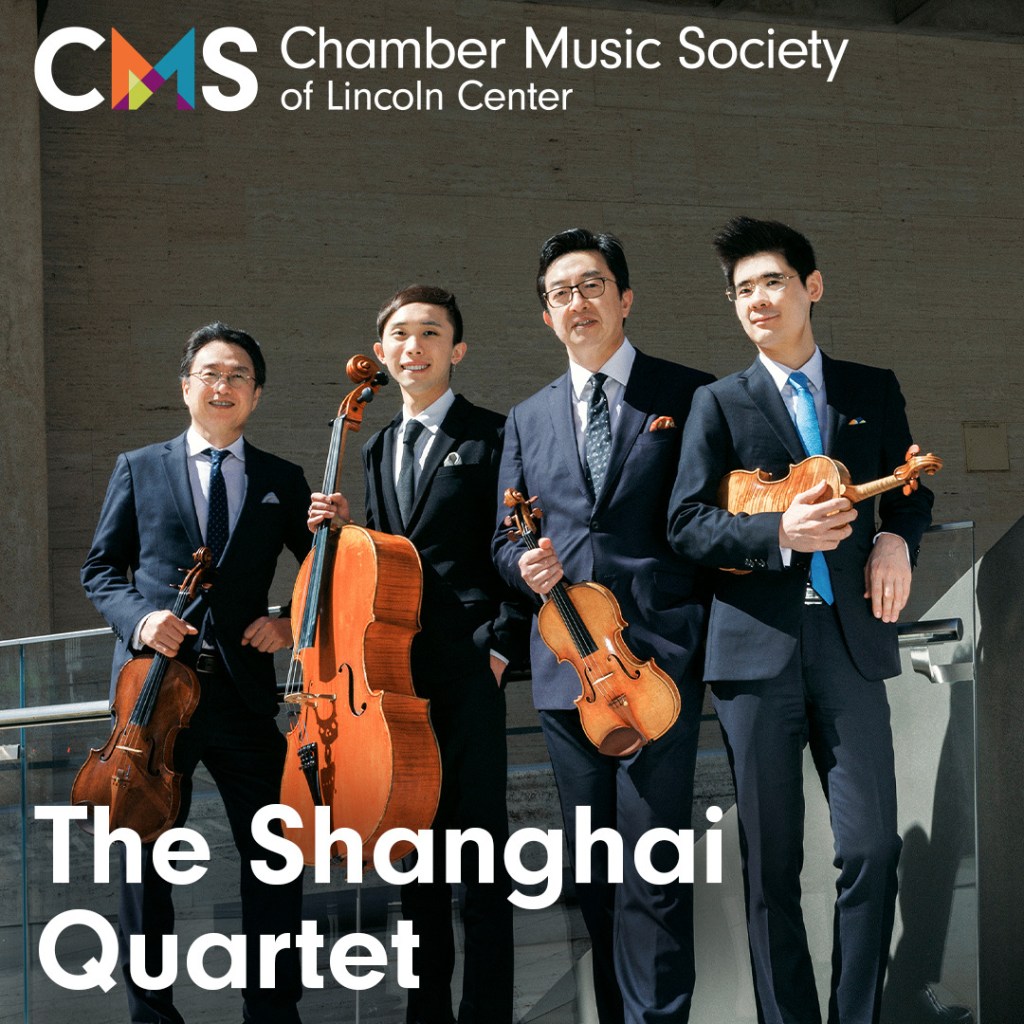
  • The Shanghai Quartet @ Chamber Music Society ~ 2026

    Above, the artists of the Shanghai Quartet: Honggang Li, Sihao He, Weigang Li, and Angelo Xiang Yu

    ~ Author: Oberon

    Sunday April 19th, 2026 – A nicely-contrasted program from the Shanghai Quartet this evening at Chamber Music Society of Lincoln Center. I had not heard them for a while, so it was a lovely reunion. Since my last connection, they have taken on a ‘new’ cellist, Sihao He, whose performances at CMS as a ‘free-lancer’ have been especially beautiful. In joining violinists Weigang Li and Angelo Xiang Yu, and violist Honggang Li, Sihao He brings his silken tone and deft technique into the established ‘Shanghai’ sound. His presence has a touch of mystery which makes him all the more intriguing.

    I have to admit that, for my first several years of listening to chamber music, I avoided Haydn. I thought that all of his music sounded the same; such an idiotic notion. I would avoid concerts in which his was often an opening work. At some point, luckily, I finally succumbed to his mastery. I now find his music thoroughly engaging, and today’s playing of his Quartet in G-minor for Strings, Hob. III:74, No. 3, “The Rider”, gave a lot of pleasure.

    Dating from 1793, the work was so nick-named because of the final movement’s allusion to the sound of galloping horses. It is considered one of the composer’s crowning achievements. While some of the composer’s earlier quartets gave prominence to the first violin, “The Rider” gives equal opportunity to all four players…and the Shanghai artists seized these opportunities, giving an impressive and engrossing performance.   

    The opening Allegro has a sneaky start; soon the melodies are flowing freely, with music that calls for ample virtuosity as well as a sense of joy. Dancelike, it sets the evening merrily on its way. The ensuing Largo is a graciously lyrical interlude, its slow tempo giving it a hymn-like feeling. The cellist’s depth of tone lends a sense of grandeur, and the ending is gorgeous. The Minuet is so fresh sounding, the themes veering between major and minor. Urgent pulsing rhythms define the final Allegro con brio, loaded with scalework. A sly, sudden pause – as if the composer is winking at us – leads into a lively finale. This last movement, which has given the piece its “Rider” moniker, provides the first violinist with some brilliant passagework, in which Weigang Li reveled.

    Having its CMS premiere today, Tan Dun’s Feng Ya Song  (String Quartet No. 1) was written in 1982 and revised in 2018. Composed during a tense period following China’s Cultural Revolution, it was at first labeled “spiritual pollution”. It is music that filled me with a sense – not of loneliness, but of being alone. Sighs and whispers fill the air, interspersed with dense harmonies. Chills are felt; patches of melody drift by like passing clouds. A driven, unison passage feels almost cinematic.

    Following a pause, the music resumes, with certain threads from the opening movement seemingly re-woven; aloneness becomes palpable. Momentarily I fell into a dream. The final movement, a ritual song, opens dramatically. Bringing forth earlier motifs but now treated more expansively, the work reaches an austere ending. 

    Following the interval, George Gershwin’s Lullaby for String Quartet (written c. 1919-20) opens delicately; rocking motifs rise from the plucked cello. The familiar melody – some tune my grandmother used to hum – emerges, bringing Sihao He’s cello to the melodic fore. A sudden unison passage feels a bit like waking the baby, but the music ends in the stratosphere, soft and serene.

    Closing the evening in epic fashion was the Quartet in F-Major, Op. 96, “American”, composed by Antonín Dvořák in 1893. Thru the years since I began wandering from my unshakable operatic obsession into the realms of symphonic and chamber music, this composer has alternately turned me off and on like a light switch; I never know how I will react on a given day. Thanks to the Shanghai’s glorious playing, tonight felt like a Dvořák revelation. 

    The ‘American’s’ first movement gives all four musicians a banquet of melody on which to feast; they played it to perfection. In the Lento, Weigang Li’s violin soared rapturously over a swaying rhythm before passing the melody on to Sihao He’s cello; his rich, deep playing was so savourable. The Molto vivace had a vibrancy that felt like awakening to a bright sunrise after a long, cold winter; and then, the players’ speed and brilliance in the final movement brought the audience to its collective feet. I always love gazing around this Hall during a standing ovation: so many happy faces as we unite in the love of great music.

    But, there was an added treat to come: as an encore, The Shanghai Quartet gave us the cavatina from Beethoven’s Opus 130. More wonderful, engrossing music-making!

    And spending the evening with a new-found friend made it all the more meaningful. 

    ~ Oberon

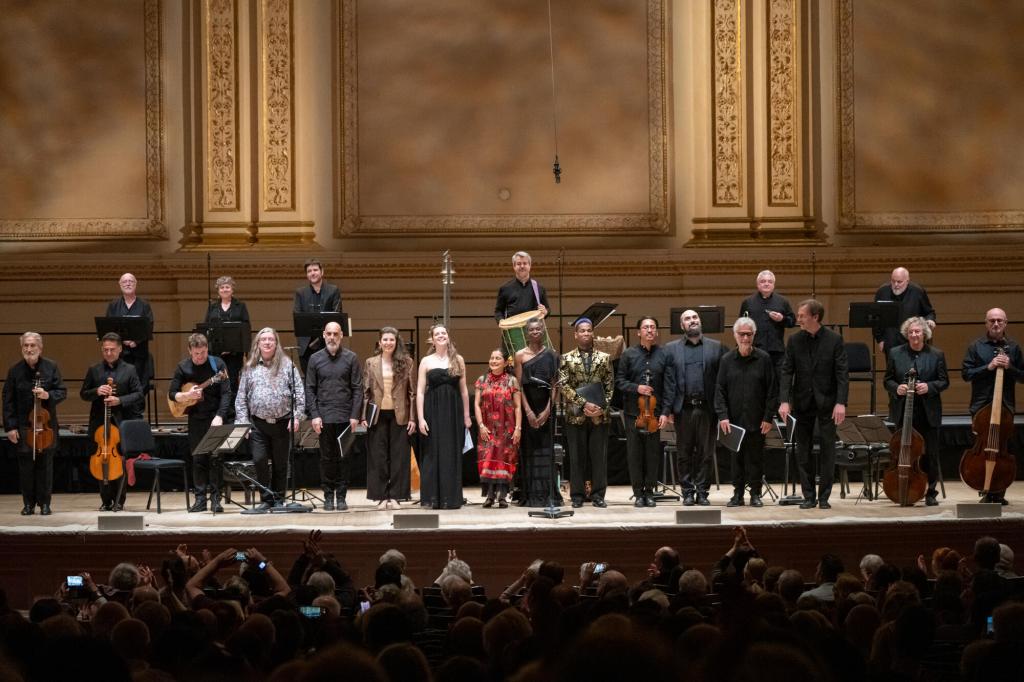
  • Jordi Savall brings a multihyphenate program to Carnegie Hall

    Performance photo by Stephanie Berger

    ~ Author: Lane Raffaldini Rubin

    Tuesday April 14, 2025 – Jordi Savall led a head-scratcher of a concert titled “Songs, Battles, and Dances: From the Old World to the New” on the main stage at Carnegie Hall. He was joined by the two ensembles that he leads (Hespèrion XXI and La Capella Reial de Catalunya) as well as the Mexican baroque ensemble Tembembe Ensamble Continuo, the Canadian soprano Neema Bickersteth, and the Guadeloupean-born Franco-Swiss bass-baritone and dancer Yannis François.

    It was about as multihyphenate a group of musicians as can be imagined.

    The program promised to deliver “a sound journey . . . between the Old and New worlds” that “explores how music served as a tool of faith, resistance, and survival during seven centuries of global transformation.”

    Admirably, this aspiration is standard fare for Savall, whose concerts tend to be fascinating curations of music from widely ranging geographies and epochs. His approach is typically archaeological and genealogical, unearthing forgotten works and composers and revealing their affiliations.

    Tonight’s program, however, was a flawed collage of musical worlds that failed to communicate that lofty message.

    The thread of the program began with a sequence of works nominally dedicated to peace, first among them the ironically martial fanfare “Pax in nomine Domini” that featured a marching drum, tuned bells, and brass.

    The first highlight of the evening came when the theme shifted from peace to enslavement, a rather abrupt shift heralded by the darkening of the hall lights. An unaccompanied quartet of male singers, arrayed in a huddle at the side of the stage, presented the traditional Sephardic lamentation “El pan de la aflicción” (“The Bread of Affliction”) based on text from the Latin Passover Haggadah. A plangent, tugging minor-key chorale ravishingly sung by members of the Capella Reial, its text ends with hope: “This year we are slaves/next year we shall be free.”

    Incongruous, then, was the choice to follow this chorale with a chivalric and profane drinking song dedicated to St. Martin and then, after that diversion, to return to music of enslavement from four centuries later and an ocean away. The soprano Neema Bickersteth joined members of Hespèrion XXI in the first of three Black spirituals that she presented over the evening.

    The first, “Another man done gone” was the most compelling, both musically and thematically. This spiritual features a straightforward, repetitive text (“Another man done gone . . . I don’t know where he’s gone . . . He killed another man . . . I don’t know where he’s gone . . . But boy that man’s done gone”) that suggests the precarity and absence of justice that enslaved Black Americans faced. Bickersteth’s lovely clear tone bloomed into a more sorrowful (if still tame) vibrato at the musical high points of this simple text.

    The second spiritual “Look over yonder”, performed later on in the program, began as an alluring plainchant inflected by vocal tone-bending but ossified rather quickly into a standard twelve-bar blues—an unexpected disappointment.

    In “You gonna reap what you sow” Bickersteth was joined by Yannis François for a piece that bore no connection to the rest of the program, neither textually, formally, nor vocally. There are many “slave songs” that achingly (yet gorgeously) convey the human tragedy of Black American enslavement, so there is no excuse for Savall to have not identified and selected only those of exceptional musical and thematic quality. This lapse in judgment ultimately has the effect of pandering and condescending to both the audience and the singers.

    The evening’s most cringeworthy moment, however, came during François’s performance of “Tonada el Congo”, an anonymous piece from around 1780 preserved in a manuscript found in colonial Peru. Its text offers the perspective of a kidnapped person, stolen and carried down the Congo River to be sold into slavery:

                They are taking me away to the sea,

                although they have no right,

                and my beloved mother

                I must leave behind.

    It’s no laughing matter. But the music is celebratory in nature and François, inexplicably, adds jaunty dance steps between verses. Presumably this music was not written by (or meant to be performed by) a real-life enslaved person, but the music’s joyfulness rather than defiance or melancholy is baffling and difficult to receive without highly raised eyebrows.

    Savall did offer a redemptive and genuinely moving gesture as an encore at the end of the program. Bringing the evening back to the question of peace—offering, as he called it, “a prayer for peace” in the face of today’s violence and war—the collective of ensembles on the stage presented “Amazing Grace” with Bickersteth and Savall sharing the spotlight. The expressive low register of Savall’s treble viol wove a perfect braid with Bickersteth and the other vocalists. Here, finally, we get the sense that all musics, regardless of their origins, might share the same human impulse for harmony.

    ~ Lane Raffaldini Rubin

  • Soprano Erika Baikoff @ Chamber Music Society

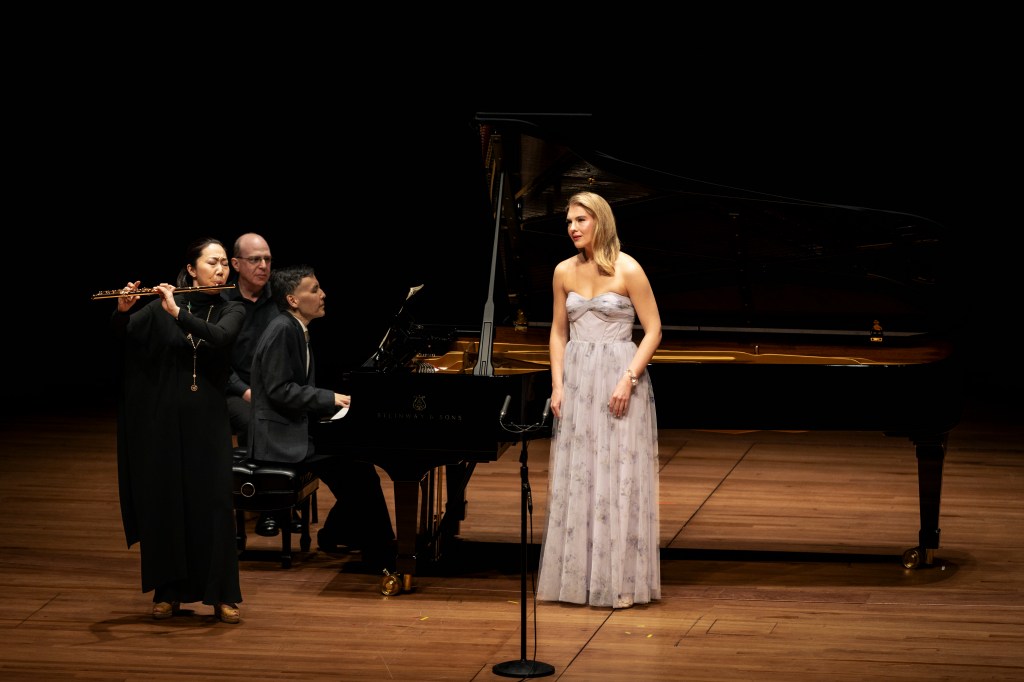
    Above: Flautist Sooyun Kim, pianist Ken Noda, and soprano Erika Baikoff; photo by Paul Mardy

    ~ Author: Oberon

    Sunday April 12th, 2026 – Soprano Erika Baikoff joined a select group of artists onstage at Alice Tully Hall for an evening of music by French composers.

    Camille Saint-Saëns’ Trio No. 1 in F-major for Piano, Violin, and Cello, Op. 18, dating from 1864, was the concert’s opening work. Orion Weiss was at the Steinway, joined by violinist Lun Li and cellist David Requiro.

    The opening Allegro vivace presents a flow of melody, underscored with sparkling piano phrases. Things get more intense, with rich string themes and rippling scales from the keyboard. The music gets tempestuous, but soon calms.  Virtuosity is in full flourish before the movement reaches a grand finish.

    The Andante commences in a misterioso mood; a poignant theme emerges, followed by some melodramatic passages. Mr. Li’s violin sings of sadness, and the Requiro cello glows, exploring tonal depths. After a brief cadenza from Mr. Weiss, the original theme returns.

    Dotty piano notes and plucking strings introduce the Scherzo – a short and lively movement which gets rather rambunctious before reaching an ironic ending. The concluding Allegro is luxuriantly played; at times feeling waltzy, it has a boisterous detour and a curious conclusion.

    The trio, while perfectly pleasing, seems to go on a bit longer than one might want; compared to the composer’s  most beloved works – Danse macabre, Carnival of the Animals, and SAMSON & DALILA – it is perfectly pleasing music but not truly memorable.

    Henri Duparc’s gorgeous song “L’Invitation au voyage” brought forth Ms. Baikoff, accompanied by Ken Noda at the Steinway. A blonde beauty clad in a creamy white gown, the soprano has a light vibrato that gives life to the music. The voice can entice us with its delicacy…and with touches of straight-tone. Mr. Noda’s playing ravishes the ear with his silken subtleties, whilst Ms. Baikoff spins out her silvery phrases. The iconic words “…luxe…calme…et volupté…” give me a blissful frisson.     

    Flautist de luxe  Sooyun Kim then joins the soprano and pianist for Maurice Ravel’s haunting Shéhérazade, dating from 1903. The texts for this three-movement piece comes from Tristan Klingsor, with whom Ravel worked closely to match melodic instincts to poetic details.   

    “Asie” (Asia) is the work’s longest movement; it provides a delicious, exotic escape from European culture. Mr. Noda’s playing is simply fantastic, and Ms. Baikoff continues to seduce the ear with exquisite pianissimo top notes. The music turns briefly stormy, and then agitated. There is a sublime piano interlude, leading to the second song. 

    Ms. Kim walks slowly onto the stage; clad all in severe black, which evokes a priestly dignity, she commences “La flûte enchantée ” (The Enchanted Flute): a brief, mesmerizing piece wherein a slave girl hears her lover serenading her with his flute outside her dwelling. Ms. Kim’s playing was magical; she then walked on across the stage and exited as if in a passing dream.

    For the concluding L’indifférent (The Indifferent One), a languid, almost sultry atmosphere is evoked. The song, which hints at gender ambiguity and unrequited infatuation, was sung and played by Ms. Biakoff and Mr. Noda with seductive delicacy.

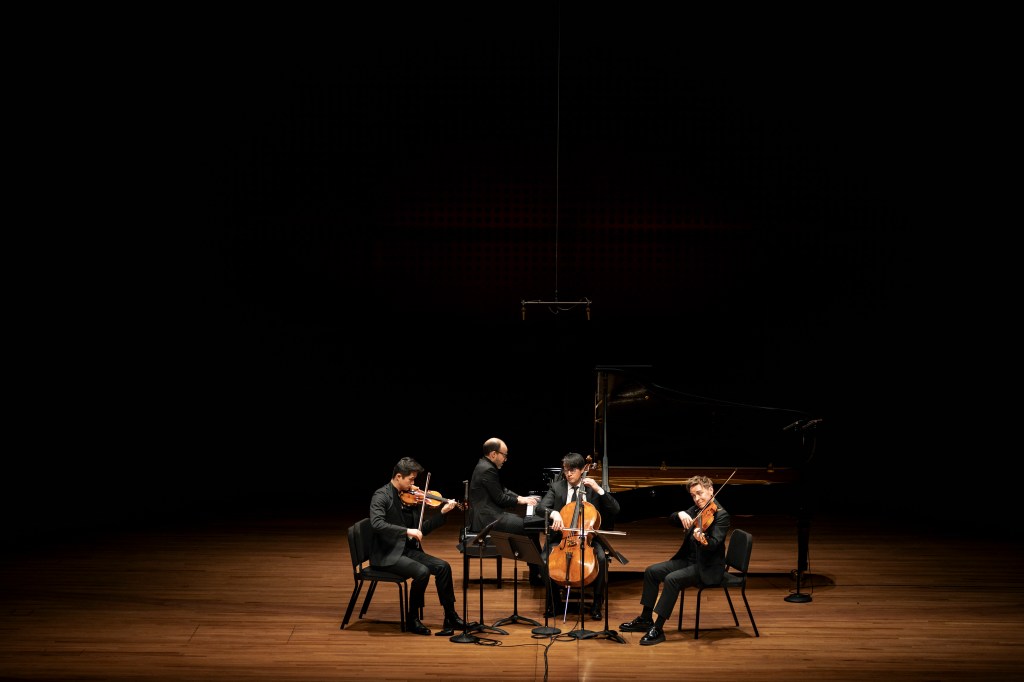
    To end the concert, violist Matthew Lipman joined Mssrs. Li, Requiro, and Weiss for Gabriel Fauré’s Quartet No. 1 in C-minor  for Piano, Violin, Viola, and Cello, Op. 15. This work was three years in the making (1876 to 1879), having its  premiere in February 1880 at a concert of the Société Nationale de Musique in Paris.

    This is music full of warmth and optimism, and the musicians’ playing of it was heartfelt from note one. The strings commence with a rich unison theme, whilst Mr. Weiss plays gloriously. Epic beauty seems to fill the hall; Mr. Li’s radiant tone and the velvety sound of Mr. Requiro’s cello are finely balanced, whilst violist Matthew Lipman is – as always – a treat to the ear and the eye alike. The music gets grand, and then settles into a luxurious calm.

    The Scherzo opens with the strings plucking whilst the pianist rambles amiably about the keyboard; animation sets in, the music speeding along until the plucking resumes. There is a false ending, and then some cascading piano scalework.

    Fauré’s harmonic innovations illuminate the Andante, drawing on the poignant cello, the ecstatic violin, and a sense of longing from the viola to create a dreamlike atmosphere. Mr. Weiss brings extraordinary delicacy to the music; there is a unison rise from the strings which carries us on to the luminescence of the pianist’s concluding measures.

    The Allegro molto (the current version is an 1883 re-write of the original) has the viola, cello, and violin passing melodious fragments around, leading to an outpouring of achingly beautiful music. There is a plush cello passage, and the Li violin sails on high. Following some glimmering measures from the, the quartet reaches its splendid finish.

    Above: Violinist Lun Li, pianist Orion Weiss, cellist David Requiro, and violist Matthew Lipman; photo by Paul Mardy

    Fauré’s marvelous music, and the opulent playing of it, made for a perfect finish to a most enjoyable evening.

    ~ Oberon 

    Performance photos by Paul Mardy, courtesy of Chamber Music Society of Lincoln Center, with my thanks to Beverly Greenfield.