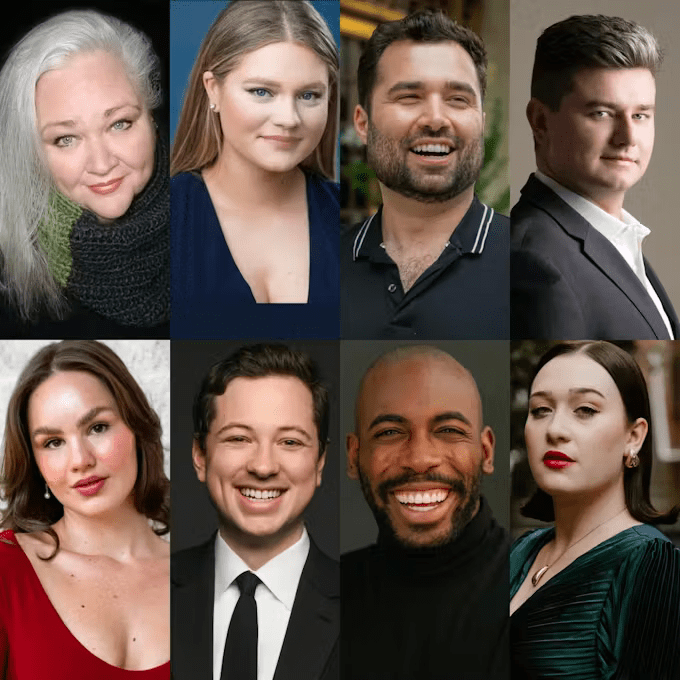
Above, special guest Stephanie Blythe and winners Magdalena Kuźma, Titus Muzi III, Ben Reisinger, Jennifer Robinson, Finn Sagal, Korin Thomas-Smith, and Anna Thompson.
~ Author: Oberon
Wednesday April 29th, 2026 – Last year’s Gerda Lissner Foundation winners’ concert was an outstanding evening of singing. Could this year’s winners maintain the high level? The answer was an emphatic “Yes”.
Midge Woolsey greeted the audience and introduced the first of the singers, tenor Ben Reisinger, with Arlene Shrut at the piano. Mr. Reisinger, currently a MET Young Artist, had already made a vivid first impression on me when he sang the role of the Sailor in the Met’s new production of TRISTAN UND ISOLDE. Of his performance, I wrote: “As the prelude faded away, a fantastic voice beamed out from the Family Circle: Ben Reisinger, a Met Young Artist, filled the darkened hall with his poetic rendering of the Sailor’s song. His voice holds great promise for the Wagnerian rep – and so much more – in the years to come: bravo…bravissimo!” I still get a frisson of emotion when I remember that moment.
Ben sounded fantastic again tonight in two classic arias from the tenor repertoire: Rodolfo’s narrative from Act I of LA BOHEME and Lensky’s despairing song from EUGENE ONEGIN as he awaits a duel with his friend, Onegin. As Rodolfo, Ben proved to be a fine story-teller, displaying a powerful voice that can be honed down to a poetic softness. His sustained high-C was thrilling; he then brought the aria to a subtle finish. As Lensky, the tenor produced lovely piano tones as he mused on his fate and on his love for Olga. Passion and regret were expressed with intensity as the aria moved towards its heart-breaking finish.
Ms. Shrut remained at the keyboard to accompany baritone Korin Thomas Smith. This singer knows how to engage an audience; his CENERENTOLA aria was a comedic masterpiece, acting out the story whilst producing voluminous tone. Deft coloratura was at his disposal as Rossini took the music from fast to very fast. Veering from humor to lust, the baritone then took up one of my favorite arias “Vision fugitive” from Massenet’s HERODIADE. Here, his passionate and expressive singing resonated richly in the hall. The aria’s ending was like a vocal knockout punch.
Francesco Barfoed took over the Steinway as the three winners of the Art Song Competition appeared in turn. I’d heard this pianist before, and I expected great things from him this evening…and he delivered. Having spoken briefly about the pieces we were about to hear, Mr. Barfoed then took his place at the piano to play a wide-ranging series of nine songs.
Soprano Jennifer Robinson, in a pale rose gown, has a pretty, lyrical voice. Her diction is excellent, her way with words especially effective in Ricky Ian Gordon’s “Will there really be a morning?” in which a sense of developing passion settles into a peaceful finish. In Joseph Marx’s “Nachtgebet“, Ms. Robinson showed off a shimmering high range. Then, with Mr. Barfoed’s plush playing, the soprano launched Strauss’s “Cäcilie” excitedly before taking on a more pensive air; the song ends with a rush of ardor.
Magdalena Kuźma, clad in a striking black gown, has already sung Giannetta in ELISIR and Mozart’s Papagena at The Met. A lovely woman and an ardent songstress, she opened with Rachmaninoff’s “Son” (Dreams), displaying sensuous shadings and smooth legato. You can really feel a personality behind the voice, and even during the song’s piano postlude, she continued to sustain the mood with her expressive face…and a ballerina’s hands and arms. With Hugo Wolf’s “Bekehrte”, Mr. Barfoed’s magical playing entwined with the soprano’s intriguing voice to truly draw us in; there was both intensity and a sense of wonderment in their performance. Finishing with Jean Sibelius’s surprisingly sensuous “Var det en dröm“, the Kuźma/Barfoed alliance reveled in the rolling restlessness of the piano and the smouldering lusciousness of the voice to carry their set to a big, passionate finish.
Although this was not a competition, Ms. Kuźma had set a high bar, to which baritone Finn Sagal responded with his thoroughly engaging voice and presence. In terms of charisma, this guy is off the charts. Mr. Barfoed played the ominous opening bars of Schubert’s Der Doppelgänger and then the Sagal voice stole eerily into the Hall, darkish and intense. His dynamic control and his measured use of straight-tone were uncanny, his deep notes rich and vividly present. When sheer power was called for, it was his to spend lavishly. His performance gave me the chills. Moving on to Gabriel Fauré’s Automne, Mssrs. Sagal and Barfoed created a poetic atmosphere, the voice so perfectly placed and so responsive to the text, with his resonant sound tapered to enticing softness in all the right places. A different side of Mr. Sagal’s personality shone in Marc Blitzstein’s hilarious The New Suit (‘Zipperfly’), which simply dazzled the crowd. I was happy to read in the playbill that this singer is also active in opera; I can imagine him being marvelous in a host of roles: everything from Wozzeck to Papageno.
F. Paul Driscoll, editor of OPERA NEWS for two decades, now introduced the great mezzo-soprano Stephanie Blythe and the renowned pianist Warren Jones. During their amiable chat, Ms. Blythe told a charming story about getting advice from Barbara Bonney; then she and the pianist offered a Brahms song, followed by Cole Porter’s humorous “Tale of the Oyster“, which was grandly done. I am glad to say that the Blythe voice remains awe-inspiring.
Ms. Shrut now returned to the piano to play for the program’s last two singers: baritone Titus Muzi III and soprano Anna Thompson.
Mr. Muzi impressed in arias from NOZZE DI FIGARO and FALSTAFF. In the former, his sizeable voice and commanding presence evoked the character of Count Almaviva, and he tossed in some cunning little embellishments along the way – something I always like to hear in Mozart’s operas. In Ford’s “jealousy aria” Mr. Muzi’s dramatic treatment of the ‘recit’ felt like a mad scene for male voice. When the melody commenced, the singer’s grandly resonant timbre rang through the Hall, making me wonder how he’d fare in the rest of the Verdi repertoire. From the piano, Ms. Shrut offered dramatic accents to underscore the text as the aria reached its grand finish.
Anna Thompson, a striking woman with a sizeable, vibrant voice who is about to join the Merola Program in San Francisco, gave us the ‘mirror aria’ from Massenet’s THAIS and the Czardas from FLEDERMAUS. Both were impressively voiced, up to the high-D at the close of the THAIS aria and a comparable note to end the Czardas. She was vociferously cheered.
Cheers also for our two pianists, for Ms. Woolsey (ever the perfect hostess), and to all the folks at the Lissner Foundation who find and help develop the young voices that keep the worlds of lieder and opera alive.
~ Oberon
 Oberon's Glade