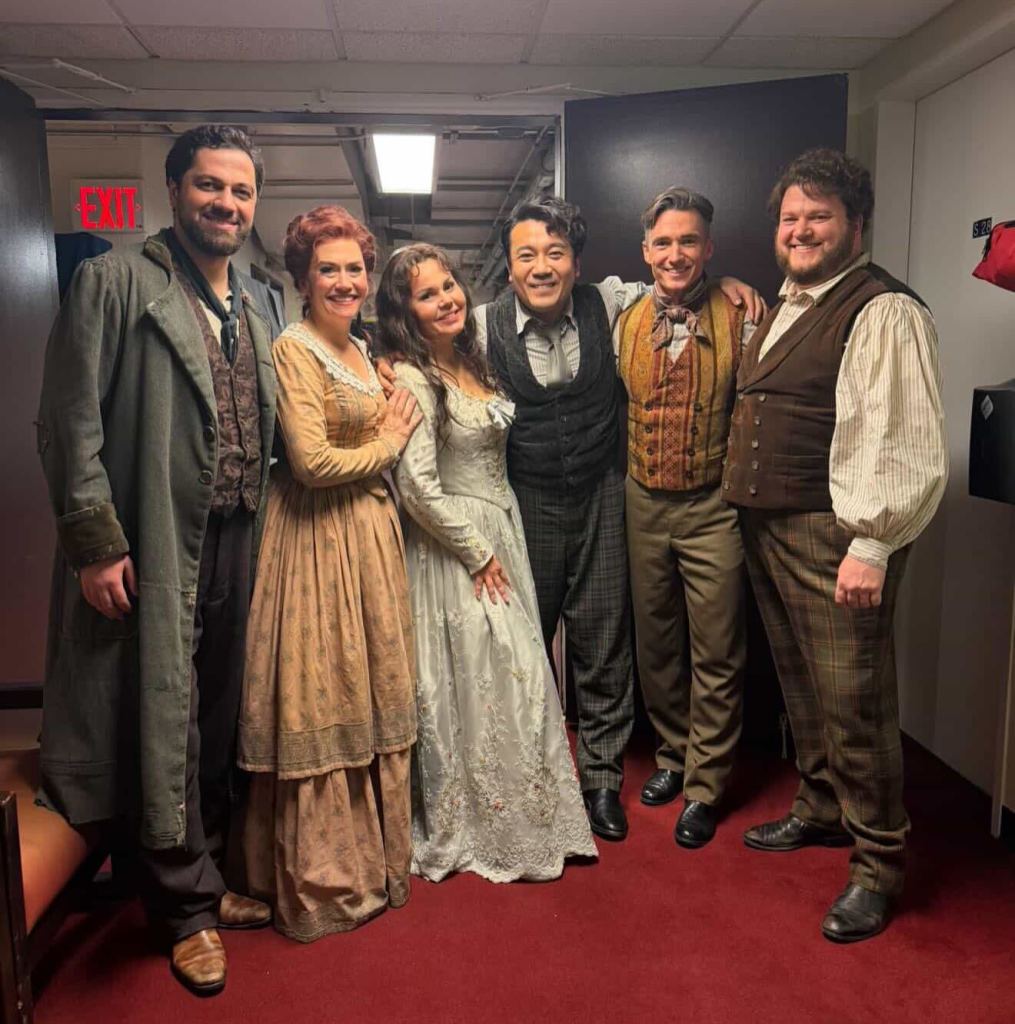
Above, this afternoon’s BOHEME cast at The Met: Giorgi Manoshvili, Heidi Stober, Aleksandra Kurzak, Long Long, Alexander Birch Elliott, and Anthony Clark Evans
~ Author: Oberon
Saturday April 25th, 2026 matinee – Taking on her second Puccini role of the Met season – Mimi in LA BOHEME – the Polish soprano Aleksandra Kurzak confirmed her success as an outstanding interpreter of the great composer’s fascinating female characters. Earlier this year, she was a captivating Butterfly, and in prior seasons, she has played Tosca with equal conviction and vocal authority. Her Mimi today was as impressively sung as one could ask; joined by a very appealing group of colleagues, the performance took flight…despite some intrusions of too much volume from the pit: a chronic annoyance in the House these days.
I’m always at my score desk as soon as the House opens, and today I had an unexpected pleasure in hearing the English Horn player practicing the theme of Mahler’s timeless masterpiece, “Ich bin der welt abhanden gekommen…” …my chosen epitaph.
Baritone Anthony Clark Evans as Marcello was the first voice to be heard today: a handsome, house-filling sound with an appealing sense of lyricism. He is soon joined by Chinese tenor Long Long, a passionate Rodolfo with a finely-utilized dynamic range, and a tenderness of expression that would become increasingly valuable as the afternoon progressed. The painter and poet are soon joined by a marvelous Georgian basso, Giorgi Manoshvili, as Colline, and Alexander Birch Elliott’s Schaunard in a polished and verbally detailed delivery of the musician’s music. In the dual roles of Benoit and Alcindoro, it was a pleasure to hear John Hancock, whose performances at the once-vital New York City Opera are clear in my memory.
Ms. Kurzak’s entrance drew a premonition in Long Long’s immediate noting of her “…viso d’ammalata…”, so tenderly voiced. The exchange between the two was lovely and intimate. In his aria, the tenor’s expressiveness brought a nice diminuendo on “Chi son?” and later, his lyrical outpouring at “Talor dal mio forziere…” was wonderful, carrying him to a vibrant high-C and a most persuasive finish. In her own narrative, Ms. Kurzak did much with the subtle inflections of her words, and her sweet piano effects. At “Ma quando vien lo sgelo…”, her legato bloomed gorgeously, giving a luscious quality to her singing. Her magical “Il profumo d’un fior…” was exquisite. The orchestra was very dense in its introduction of the love duet, but the voices took over as the couple sang rapturously of their new-found romance. Mimi’s assuring “I’ll stay close beside you…” (something every lover wants to hear) was so touching.
At Cafe Momus, the little exchanges between Mimi and her new set of Bohemian friends were deftly handled. Tenor Marco Jordão again made his mark as Parpignol, as he had a few weeks ago with a different cast. The orchestra tended to be over-bearing in spots, but Ms. Kurzak’s sweet little tune about the bonnet was prophetic. Heidi Stober, a vibrant Musetta, sang an enticing waltz, prompting droll admonishings from Mr. Hancock’s Alcindoro. The big finale, with Mr. Evans belting out the waltz-theme to fine effect, heralded a very long intermission.
At the Barrière d’Enfer, the orchestra evokes falling snow and the clinking of wine glasses inside the tavern. Ms. Stober sweetly reprises the melody of her waltz. Ms. Kurzak and Mr. Evans match voices in their duet, the soprano covering a vast dynamic palette whilst also using a bit of chest voice effectively; Mr. Evans so simpatico. As Mimi hides, Marcello goads Rodolfo, whose pangs of remorse are palpable, into revealing the truth about Mimi’s health. Ms. Kurzak’s comments are darkly expressive. At “Una terrible tosse…” Long Long’s despair pours forth, leading the trio to a powerful climax. Ms. Kurzak’s “Addio senza rancor” is so touching, with many sublime pianissimo effects and a heart-breaking finish. My own heart is torn apart by their talk of parting. Ms. Kurzak crushes me with her “Sempre tua per la vita…” and Long Long’s diminuendi are so affecting as the couple resolve to stay together until Spring.
Back in the garret. Mssrs. Long and Evans match voices in their nostalgic duet: they exchange finely-wrought lines, then harmonize to a polished finish. This was a vocal highlight of the afternoon. The four Bohemians re-unite for a boisterous scene, halted by the sudden appearance of Musetta, who has brought the dying Mimi to the very room where she and Rodolfo had first met. Every line and note from here on in is coloured by grief. Mr. Manoshvili’s Coat Aria is superbly sung, so poignant with its sustained finish. Now comes the crushing nostalgia of the final conversation between Mimi and Rodolfo. Long Long’s remorse is hauntingly voiced. The sheer quietude of Ms. Kurzak’s “Sono andati...” demolishes me completely…the colours she summons, her finely-timed use of chest-tone, and the heart-rending, extraordinary delicacy of her singing as she echoes her “Mi chiamano Mimi...” put the finishing touches on her compelling portrait of the doomed seamstress.
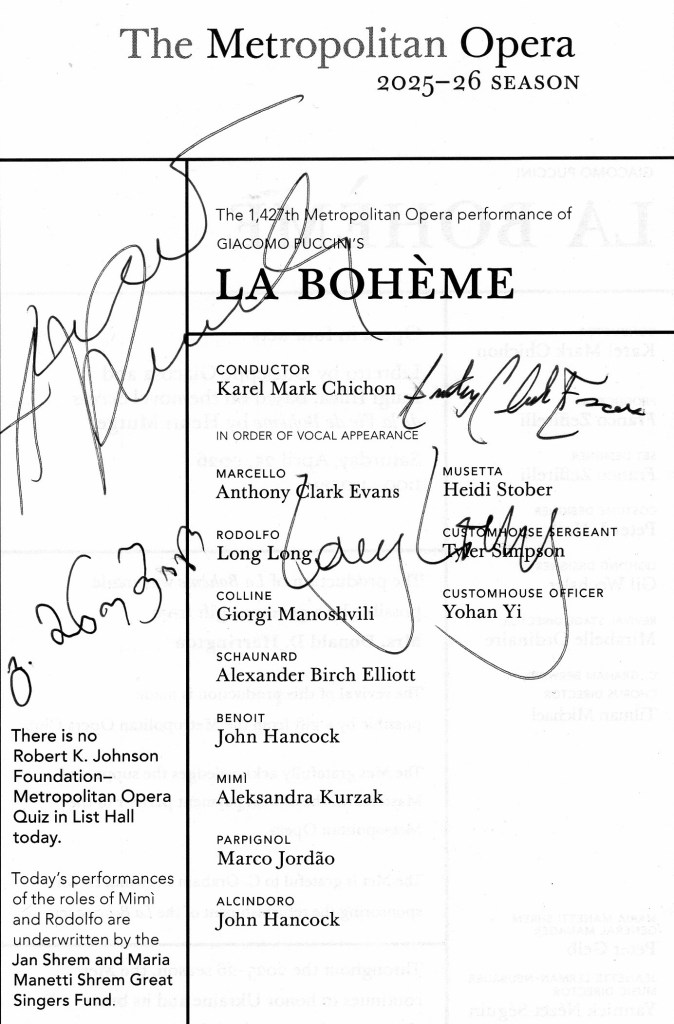
At the stage door, I met Ms. Kurzak, and Mssrs. Long, Evans, and Manoshvili.
~ Oberon

