~ Author: Mark Anthony Martinez II
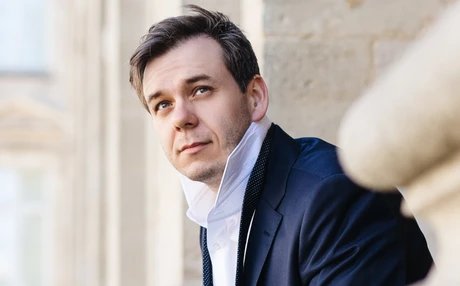
Wednesday April 22nd, 2026 – Benjamin Bernheim (above) is a world-renowned operatic tenor who has performed frequently at the Metropolitan Opera in productions such as Gounod’s Roméo et Juliette. This evening, he made his New York solo recital debut. It seemed funny to me that such a big name had never done a solo recital in a city where he performs regularly, but I was glad to be a part of this inaugural event.
Benjamin Bernheim is particularly known for his French repertoire, and much of the night’s program consisted of that. The concert, for whatever reason, didn’t provide programs, but aside from most of the pieces Bernheim sang, I was thankfully familiar with the repertoire.
Bernheim and his collaborative pianist, Carrie-Ann Matheson, strode out onto the stage and greeted the audience. Before singing, Bernheim took to the microphone and talked to the audience about the program. Bernheim was quite entertaining on the microphone and had a playful energy that he kept up the entire night. In his introduction, he introduced Ms. Matheson, his longtime collaborator, and the two began with a set of three Duparc songs: “L’Invitation au voyage,” “Chanson triste,” and “Phidylé.”
I’m less familiar with the chanson repertoire, but Bernheim had such good diction that I could understand and follow along. One funny note: one thing that helps with following along with French mélodie is that the general rule is that all French songs are about sex. So it was easy to follow along when the lyrics are comprised of words like “...luxe, calme, et volupté.”
The crowd was hushed, and Bernheim truly showcased a measured, beautiful mezzo piano/mezzo forte in his singing. I had heard Bernheim sing the titular role in Roméo et Juliette, but this singing today was a lot more refined and expressive. What ended up happening was that when the pieces did eventually become forte, the impact was so much greater. Bernheim also had a wonderful hootiness that is so often used in French repertoire. It helps, I guess, to be a native speaker, where the sounds in the music are just a part of the language itself.
What was really beautiful to see was how different members of the audience were affected by Bernheim’s singing. One older gentleman in the same row was silently weeping during several of the songs.
Bernheim, as a singer, was quite poised and didn’t need to make histrionic gestures, as I’ve seen other singers do in solo recital. However, he didn’t need to take much space or create a lot of movement to communicate the beauty in the songs. I always feel like art songs are actually more emotional pieces than arias because they are meant more as communication than bombast, and his clear and pretty voice conveyed everything that he needed to.
What was particularly nice was that Bernheim shared the stage almost equally with Matheson. It is very easy to forget the pianist in a collaborative voice recital, but after every applause, the two came out together holding hands.
After the Duparc songs, Bernheim and Matheson briefly left the stage, then came back to do a set of arias.
The aria set started off with Lensky’s aria from Tchaikovsky’s Eugene Onegin. It seemed odd to me that, in an aria set comprised totally of French pieces, it would start with a Russian one. Bernheim sang the song beautifully, adding a particular delicateness to it that I have not frequently seen.
The one minor note that I had was that although, musically, things sounded beautiful, in this particular aria there was a bit of a dissonance when you factor in that the character Lensky knows he’s about to die in a duel, but the performer was smiling happily throughout the song. Nothing major, but just a funny note, because Bernheim’s disposition seems to be very sunny in general, so it might be hard for him to escape that mindset in a song that is otherwise about despair.
In the aria set, the highlight was Bizet’s “Je crois entendre encore.” This tenor aria from the opera Les pêcheurs de perles is notoriously difficult, not because of the high notes, of which there are many, but because of the delicacy required to perform it correctly. It is almost entirely sung in piano, and the B-flat and C in the piece should ideally be done in piano as well. Legendary singers have had issues with this piece and have pitched it down in concert or in performance, but Bernheim navigated the fiendish piece with seeming ease.
He did have to clear his throat afterward and take a small break, which he acknowledged to the audience with a bit of comedic charm.
After several more sets of arias, Bernheim finished with an unusual but lovely set of contemporary French songs, not inherently classical in nature. He sang Charles Trenet’s “Douce France,” Joseph Kosma’s “Les feuilles mortes,” and Jacques Brel’s “Quand on n’a que l’amour.”
What was so lovely about these pieces was that they closed the program with some contemporary flair and made the recital not just about songs from the canon, but about living works that people grew up listening to.
~ Mark Anthony Martinez II

