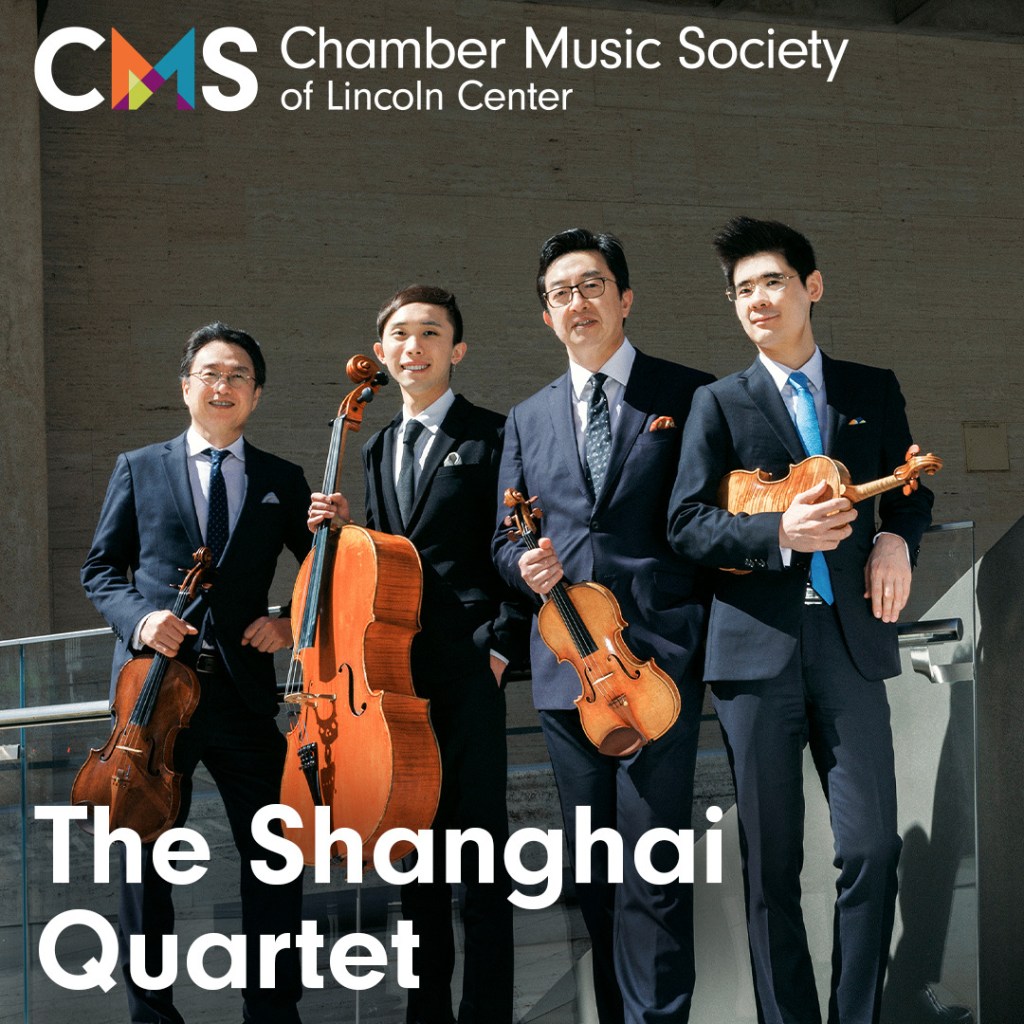
Above, the artists of the Shanghai Quartet: Honggang Li, Sihao He, Weigang Li, and Angelo Xiang Yu
~ Author: Oberon
Sunday April 19th, 2026 – A nicely-contrasted program from the Shanghai Quartet this evening at Chamber Music Society of Lincoln Center. I had not heard them for a while, so it was a lovely reunion. Since my last connection, they have taken on a ‘new’ cellist, Sihao He, whose performances at CMS as a ‘free-lancer’ have been especially beautiful. In joining violinists Weigang Li and Angelo Xiang Yu, and violist Honggang Li, Sihao He brings his silken tone and deft technique into the established ‘Shanghai’ sound. His presence has a touch of mystery which makes him all the more intriguing.
I have to admit that, for my first several years of listening to chamber music, I avoided Haydn. I thought that all of his music sounded the same; such an idiotic notion. I would avoid concerts in which his was often an opening work. At some point, luckily, I finally succumbed to his mastery. I now find his music thoroughly engaging, and today’s playing of his Quartet in G-minor for Strings, Hob. III:74, No. 3, “The Rider”, gave a lot of pleasure.
Dating from 1793, the work was so nick-named because of the final movement’s allusion to the sound of galloping horses. It is considered one of the composer’s crowning achievements. While some of the composer’s earlier quartets gave prominence to the first violin, “The Rider” gives equal opportunity to all four players…and the Shanghai artists seized these opportunities, giving an impressive and engrossing performance.
The opening Allegro has a sneaky start; soon the melodies are flowing freely, with music that calls for ample virtuosity as well as a sense of joy. Dancelike, it sets the evening merrily on its way. The ensuing Largo is a graciously lyrical interlude, its slow tempo giving it a hymn-like feeling. The cellist’s depth of tone lends a sense of grandeur, and the ending is gorgeous. The Minuet is so fresh sounding, the themes veering between major and minor. Urgent pulsing rhythms define the final Allegro con brio, loaded with scalework. A sly, sudden pause – as if the composer is winking at us – leads into a lively finale. This last movement, which has given the piece its “Rider” moniker, provides the first violinist with some brilliant passagework, in which Weigang Li reveled.
Having its CMS premiere today, Tan Dun’s Feng Ya Song (String Quartet No. 1) was written in 1982 and revised in 2018. Composed during a tense period following China’s Cultural Revolution, it was at first labeled “spiritual pollution”. It is music that filled me with a sense – not of loneliness, but of being alone. Sighs and whispers fill the air, interspersed with dense harmonies. Chills are felt; patches of melody drift by like passing clouds. A driven, unison passage feels almost cinematic.
Following a pause, the music resumes, with certain threads from the opening movement seemingly re-woven; aloneness becomes palpable. Momentarily I fell into a dream. The final movement, a ritual song, opens dramatically. Bringing forth earlier motifs but now treated more expansively, the work reaches an austere ending.
Following the interval, George Gershwin’s Lullaby for String Quartet (written c. 1919-20) opens delicately; rocking motifs rise from the plucked cello. The familiar melody – some tune my grandmother used to hum – emerges, bringing Sihao He’s cello to the melodic fore. A sudden unison passage feels a bit like waking the baby, but the music ends in the stratosphere, soft and serene.
Closing the evening in epic fashion was the Quartet in F-Major, Op. 96, “American”, composed by Antonín Dvořák in 1893. Thru the years since I began wandering from my unshakable operatic obsession into the realms of symphonic and chamber music, this composer has alternately turned me off and on like a light switch; I never know how I will react on a given day. Thanks to the Shanghai’s glorious playing, tonight felt like a Dvořák revelation.
The ‘American’s’ first movement gives all four musicians a banquet of melody on which to feast; they played it to perfection. In the Lento, Weigang Li’s violin soared rapturously over a swaying rhythm before passing the melody on to Sihao He’s cello; his rich, deep playing was so savourable. The Molto vivace had a vibrancy that felt like awakening to a bright sunrise after a long, cold winter; and then, the players’ speed and brilliance in the final movement brought the audience to its collective feet. I always love gazing around this Hall during a standing ovation: so many happy faces as we unite in the love of great music.
But, there was an added treat to come: as an encore, The Shanghai Quartet gave us the cavatina from Beethoven’s Opus 130. More wonderful, engrossing music-making!
And spending the evening with a new-found friend made it all the more meaningful.
~ Oberon

