~ Author: Kevin DallaSanta
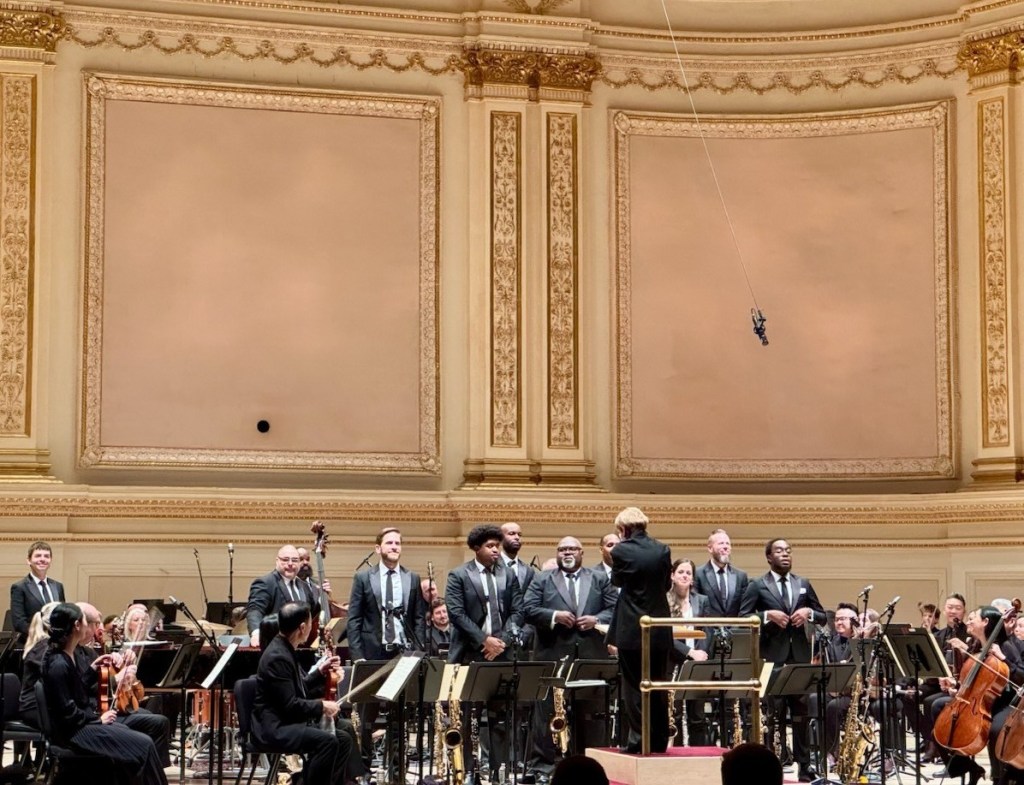
Friday May 29th, 2026 – A joy of musical life in New York is the repeated hearings of top orchestras. Several international orchestras come annually to Carnegie Hall, and many domestic ones, such as Philadelphia, visit even more frequently. With repeated hearings, we get to know their signature sound and eagerly anticipate their interpretations of familiar repertoire.
However, biting into the big apple brings both the knowledge of good and the knowledge of less-than-good. At their best, the Philadelphia Orchestra plays with a stronger telepathy than any of the Big Five, with tight handoffs between sections and a general cohesive unity. Unfortunately, their recent stop at Carnegie struggled to reach the standards set by previous visits.
The concert began with Beethoven’s Symphony No. 7, by any interpretation one of the composer’s most festive and dancelike works. Yet Friday’s rendering was weighty and sluggish. The fault was not necessarily with the tempos, but in spirit: articulations were soggy, entrances and exits were haphazard, and Philadelphia’s typically refined approach gave way to a loudness which was physically unpleasant, like an express train passing through the Lincoln Center station.
Inexplicably, the only movement of Beethoven 7th which might benefit from such a lugubrious approach—the funerary Allegretto—took off with a jolt of caffeine. Its gossamer texture and heartbreaking pathos gave way to the air of a sea shanty. By the third movement, out of four, the patron next to me was reading the list of donors in the playbill. When the bequest of Mrs. John Smith IV commands more attention than Ludwig, something has gone off the rails.
In fairness, the symphony places substantial demands on the musicians, with three fast and long movements, and little chance to rest in the slow movement. Beethoven rushes the instrumentalists up and down scales, and pushes them to a rare triple-fortissimo in the finale. The result is, ideally, tremendously exciting for the audience; but certainly exhausting for the musicians, who were only halfway through the evening’s demanding repertoire.
Strange performances are sometimes attributable to the relationship (or lack thereof) between ensemble and conductor. But Marin Alsop is principal guest conductor at Philadelphia, to the extent of holding a named chair, so there is little chance of miscommunication between her and the musicians. She conducted from memory, and with no shortage of vigorous physical gestures; yet the resulting clamor sounded neither like Philadelphia nor like Beethoven.
Perhaps the musicians were already thinking ahead to the second half, which featured Wynton Marsalis’s sonorous “Jungle” Symphony No. 4, joined by the composer and his jazz ensemble. (The original program was to premiere his Symphony No. 5, but evidently the work was not completed by May 19th, when the substitution was announced.) The work, an homage to New York City, takes sonic inspiration from its eponym; and this aspect may have inadvertently influenced the interpretation of Beethoven earlier in the program.
Although nominally jazzy, Marsalis’s symphony came across as an academic work of new music. The harmonies were more atonal than blue, and elements of minimalism and recurring motifs gave the work a formal structure. Marsalis is fluent in both classical and jazz idioms, and this score primarily explored the former, concluding with an extended cadenza over the tonic by the composer.
Yet there were brief moments of jazz: references to Dixie, blues, and other paradigms. This helped place the evening in alignment with Carnegie’s “United in Sound” festival, celebrating 250 years of American music, a genre in which Marsalis has played a very significant part. Those who came for jazz, however, may find more of what they are looking for at the Rose Theater, where Marsalis performs with his Jazz at Lincoln Center Orchestra.
In a week, Philadelphia concludes their season at home, and the musicians will summer before returning to Carnegie in October. Their frequent visits are certainly welcome and benefit a city which, by any statistical reasoning, ought to have more than one major orchestra. But as anybody traveling the Northeast Corridor knows, the gods of Acela and I-95 are capricious, and often charge a heavy toll. With hope, Philadelphia’s autumn appearance, which opens Carnegie’s Mahler cycle, will bring a return to form.
~ Kevin DallaSanta
(Performance photo by the author.)

