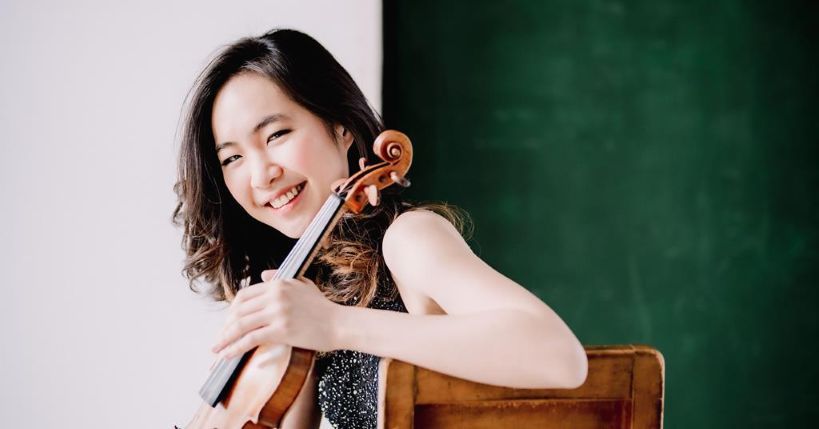
Above: violinist Danbi Um
Author: Kevin DallaSanta
Saturday July 11th, 2026 – The dog days of summer, from July to mid-August, are an ancient conception, originating in the rising stars of Canis Major, the “Great Dog” constellation. It is fitting, then, that the Chamber Music Society of Lincoln Center hosts a Summer Evenings series featuring rising stars of the classical world. Billed as the “summer’s hottest ticket,” the series helps to bridge the long gap between spring and fall seasons, a stretch where many patrons have retreated to summer homes, and musicians to alpine festivals.
The concert of July 11th featured six musicians in four chamber works: Mozart’s Piano Trio No. 4, Ravel’s Violin Sonata, Gershwin’s Three Preludes (arranged for violin and piano), and Dvorak’s Piano Quintet No 1. The program gave the impression of a recital, with varied musicians and varied repertoire, and no special pretense of thematic unity.
If anything, thematic unity arose from the juxtaposition of the Ravel Violin Sonata and Gershwin’s Three Preludes, two jazz-influenced works by composers who both died in 1937. Both pieces were played by violinist Danbi Um, accompanied by pianist Wu Han, who is Co-Artistic Director of the Society.
Ravel’s Violin Sonata is a pinnacle of the repertoire and a challenge for both violinist and pianist. (The sonata is sometimes labeled his second; as his first was published posthumously.) Played well, the first movement has a transcendental effect, with the opening bars sweeping the audience away into an otherworldly landscape. High registers in both instruments sparkle like icicles in the winter sun; and open fifths, evoking medieval churches, echo the Dies Irae—the famous melody of the requiem mass. Ravel’s brilliant scoring seems to meld the violin and piano into one instrument.
The second movement, labeled “Blues,” most clearly reflects the composer’s fascination with jazz, incorporating major sevenths, dotted rhythms, and portamentos. Yet the work is not pastiche, but wholly Ravel, and grounds itself in classical form. Violinists thus have a wide range of interpretive pathways; Um chose technical finesse and a lyrical tone, which highlighted the beauty, melancholy, and strangeness of the composer’s harmonies.
After the ferociously difficult finale—a perpetuum mobile—the Gershwin Preludes were essentially an encore for the pair. While in New York City, the composer wrote the work for solo piano, and Heifetz arranged it for accompanied violin. Um and Han played with verve, and the audience seemed appreciative of the technical bravura. Like the defunct Mostly Mozart summer festival, Summer Evenings skew towards the traditional, but evidently a bit of jazz is a licit thrill.
The first work in the program, Mozart’s Fourth Piano Trio, is noted for its unusual choice of key (E-major); and indeed the key appears to be the most distinctive feature of the work. Melodies and form are standard for the composer, and the cello part, excellently played by Sterling Elliott, was too often relegated to a continuo role. As one audience member loudly remarked between movements: “that was pretty”.
In the first three works of the program, and particularly in the Mozart, the balance suffered from an overly loud piano. The decision to raise the lid fully, rather than partially, depends on venue, repertoire, and instrumentalists; but a fully raised lid often drowns out string players. The loud piano was more successful in the Dvorak, which had a greater number string players for balance, and was scored in more of an orchestral style.
Dvorak’s first quintet, less frequently performed than his second, was written prior to the composer’s tenure in New York City and concomitant enthusiasm for “American” music. As such, the quintet reflects Czech idioms of a young composer whose fame had not yet spread beyond Prague. The work features the piano in nearly a concerto role, with the string quartet generally working in unison. Dvorak’s writing is lush and thickly scored, with grand finales in the first and final movements. Czech elements appear most prominently in unexpected harmonic transitions and the boisterous 6/8 rhythms of the final movement.
The composer was yet to achieve fame in Vienna, and later in America, but a youthful optimism shines through his early works. So too was the mood onstage, and the group of players had an average age not far from the composer’s. In the summer drought of classical music, this chamber concert was a welcome draught: and with optimism their stars are ascendant.
~ Kevin DallaSanta

