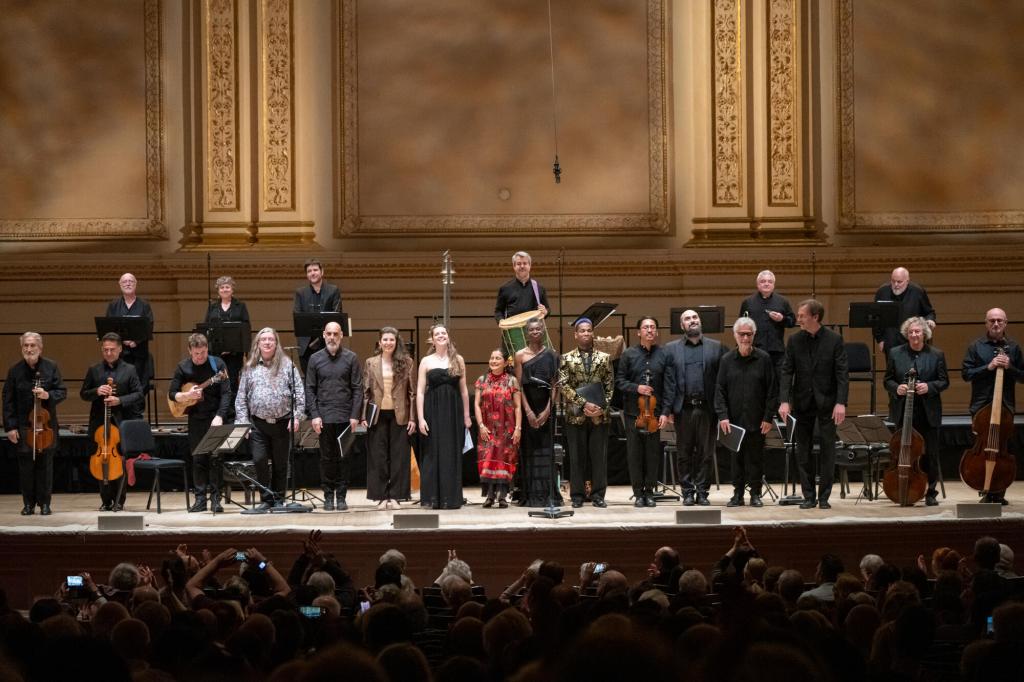
Performance photo by Stephanie Berger
~ Author: Lane Raffaldini Rubin
Tuesday April 14, 2025 – Jordi Savall led a head-scratcher of a concert titled “Songs, Battles, and Dances: From the Old World to the New” on the main stage at Carnegie Hall. He was joined by the two ensembles that he leads (Hespèrion XXI and La Capella Reial de Catalunya) as well as the Mexican baroque ensemble Tembembe Ensamble Continuo, the Canadian soprano Neema Bickersteth, and the Guadeloupean-born Franco-Swiss bass-baritone and dancer Yannis François.
It was about as multihyphenate a group of musicians as can be imagined.
The program promised to deliver “a sound journey . . . between the Old and New worlds” that “explores how music served as a tool of faith, resistance, and survival during seven centuries of global transformation.”
Admirably, this aspiration is standard fare for Savall, whose concerts tend to be fascinating curations of music from widely ranging geographies and epochs. His approach is typically archaeological and genealogical, unearthing forgotten works and composers and revealing their affiliations.
Tonight’s program, however, was a flawed collage of musical worlds that failed to communicate that lofty message.
The thread of the program began with a sequence of works nominally dedicated to peace, first among them the ironically martial fanfare “Pax in nomine Domini” that featured a marching drum, tuned bells, and brass.
The first highlight of the evening came when the theme shifted from peace to enslavement, a rather abrupt shift heralded by the darkening of the hall lights. An unaccompanied quartet of male singers, arrayed in a huddle at the side of the stage, presented the traditional Sephardic lamentation “El pan de la aflicción” (“The Bread of Affliction”) based on text from the Latin Passover Haggadah. A plangent, tugging minor-key chorale ravishingly sung by members of the Capella Reial, its text ends with hope: “This year we are slaves/next year we shall be free.”
Incongruous, then, was the choice to follow this chorale with a chivalric and profane drinking song dedicated to St. Martin and then, after that diversion, to return to music of enslavement from four centuries later and an ocean away. The soprano Neema Bickersteth joined members of Hespèrion XXI in the first of three Black spirituals that she presented over the evening.
The first, “Another man done gone” was the most compelling, both musically and thematically. This spiritual features a straightforward, repetitive text (“Another man done gone . . . I don’t know where he’s gone . . . He killed another man . . . I don’t know where he’s gone . . . But boy that man’s done gone”) that suggests the precarity and absence of justice that enslaved Black Americans faced. Bickersteth’s lovely clear tone bloomed into a more sorrowful (if still tame) vibrato at the musical high points of this simple text.
The second spiritual “Look over yonder”, performed later on in the program, began as an alluring plainchant inflected by vocal tone-bending but ossified rather quickly into a standard twelve-bar blues—an unexpected disappointment.
In “You gonna reap what you sow” Bickersteth was joined by Yannis François for a piece that bore no connection to the rest of the program, neither textually, formally, nor vocally. There are many “slave songs” that achingly (yet gorgeously) convey the human tragedy of Black American enslavement, so there is no excuse for Savall to have not identified and selected only those of exceptional musical and thematic quality. This lapse in judgment ultimately has the effect of pandering and condescending to both the audience and the singers.
The evening’s most cringeworthy moment, however, came during François’s performance of “Tonada el Congo”, an anonymous piece from around 1780 preserved in a manuscript found in colonial Peru. Its text offers the perspective of a kidnapped person, stolen and carried down the Congo River to be sold into slavery:
They are taking me away to the sea,
although they have no right,
and my beloved mother
I must leave behind.
It’s no laughing matter. But the music is celebratory in nature and François, inexplicably, adds jaunty dance steps between verses. Presumably this music was not written by (or meant to be performed by) a real-life enslaved person, but the music’s joyfulness rather than defiance or melancholy is baffling and difficult to receive without highly raised eyebrows.
Savall did offer a redemptive and genuinely moving gesture as an encore at the end of the program. Bringing the evening back to the question of peace—offering, as he called it, “a prayer for peace” in the face of today’s violence and war—the collective of ensembles on the stage presented “Amazing Grace” with Bickersteth and Savall sharing the spotlight. The expressive low register of Savall’s treble viol wove a perfect braid with Bickersteth and the other vocalists. Here, finally, we get the sense that all musics, regardless of their origins, might share the same human impulse for harmony.
~ Lane Raffaldini Rubin

