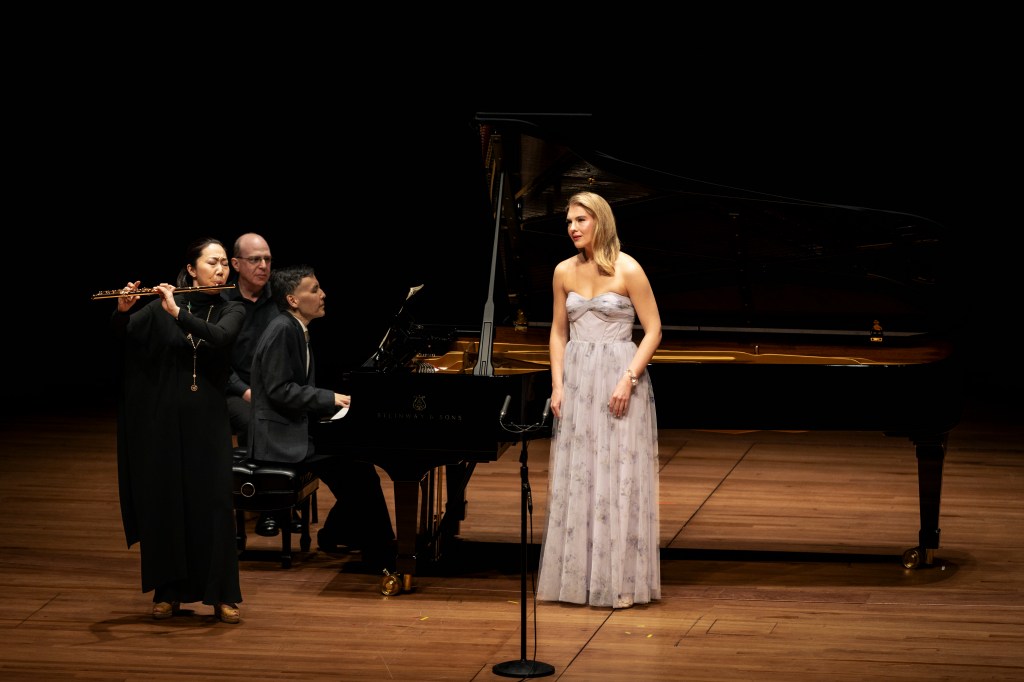
Above: Flautist Sooyun Kim, pianist Ken Noda, and soprano Erika Baikoff; photo by Paul Mardy
~ Author: Oberon
Sunday April 12th, 2026 – Soprano Erika Baikoff joined a select group of artists onstage at Alice Tully Hall for an evening of music by French composers.
Camille Saint-Saëns’ Trio No. 1 in F-major for Piano, Violin, and Cello, Op. 18, dating from 1864, was the concert’s opening work. Orion Weiss was at the Steinway, joined by violinist Lun Li and cellist David Requiro.
The opening Allegro vivace presents a flow of melody, underscored with sparkling piano phrases. Things get more intense, with rich string themes and rippling scales from the keyboard. The music gets tempestuous, but soon calms. Virtuosity is in full flourish before the movement reaches a grand finish.
The Andante commences in a misterioso mood; a poignant theme emerges, followed by some melodramatic passages. Mr. Li’s violin sings of sadness, and the Requiro cello glows, exploring tonal depths. After a brief cadenza from Mr. Weiss, the original theme returns.
Dotty piano notes and plucking strings introduce the Scherzo – a short and lively movement which gets rather rambunctious before reaching an ironic ending. The concluding Allegro is luxuriantly played; at times feeling waltzy, it has a boisterous detour and a curious conclusion.
The trio, while perfectly pleasing, seems to go on a bit longer than one might want; compared to the composer’s most beloved works – Danse macabre, Carnival of the Animals, and SAMSON & DALILA – it is perfectly pleasing music but not truly memorable.
Henri Duparc’s gorgeous song “L’Invitation au voyage” brought forth Ms. Baikoff, accompanied by Ken Noda at the Steinway. A blonde beauty clad in a creamy white gown, the soprano has a light vibrato that gives life to the music. The voice can entice us with its delicacy…and with touches of straight-tone. Mr. Noda’s playing ravishes the ear with his silken subtleties, whilst Ms. Baikoff spins out her silvery phrases. The iconic words “…luxe…calme…et volupté…” give me a blissful frisson.
Flautist de luxe Sooyun Kim then joins the soprano and pianist for Maurice Ravel’s haunting Shéhérazade, dating from 1903. The texts for this three-movement piece comes from Tristan Klingsor, with whom Ravel worked closely to match melodic instincts to poetic details.
“Asie” (Asia) is the work’s longest movement; it provides a delicious, exotic escape from European culture. Mr. Noda’s playing is simply fantastic, and Ms. Baikoff continues to seduce the ear with exquisite pianissimo top notes. The music turns briefly stormy, and then agitated. There is a sublime piano interlude, leading to the second song.
Ms. Kim walks slowly onto the stage; clad all in severe black, which evokes a priestly dignity, she commences “La flûte enchantée ” (The Enchanted Flute): a brief, mesmerizing piece wherein a slave girl hears her lover serenading her with his flute outside her dwelling. Ms. Kim’s playing was magical; she then walked on across the stage and exited as if in a passing dream.
For the concluding L’indifférent (The Indifferent One), a languid, almost sultry atmosphere is evoked. The song, which hints at gender ambiguity and unrequited infatuation, was sung and played by Ms. Biakoff and Mr. Noda with seductive delicacy.
To end the concert, violist Matthew Lipman joined Mssrs. Li, Requiro, and Weiss for Gabriel Fauré’s Quartet No. 1 in C-minor for Piano, Violin, Viola, and Cello, Op. 15. This work was three years in the making (1876 to 1879), having its premiere in February 1880 at a concert of the Société Nationale de Musique in Paris.
This is music full of warmth and optimism, and the musicians’ playing of it was heartfelt from note one. The strings commence with a rich unison theme, whilst Mr. Weiss plays gloriously. Epic beauty seems to fill the hall; Mr. Li’s radiant tone and the velvety sound of Mr. Requiro’s cello are finely balanced, whilst violist Matthew Lipman is – as always – a treat to the ear and the eye alike. The music gets grand, and then settles into a luxurious calm.
The Scherzo opens with the strings plucking whilst the pianist rambles amiably about the keyboard; animation sets in, the music speeding along until the plucking resumes. There is a false ending, and then some cascading piano scalework.
Fauré’s harmonic innovations illuminate the Andante, drawing on the poignant cello, the ecstatic violin, and a sense of longing from the viola to create a dreamlike atmosphere. Mr. Weiss brings extraordinary delicacy to the music; there is a unison rise from the strings which carries us on to the luminescence of the pianist’s concluding measures.
The Allegro molto (the current version is an 1883 re-write of the original) has the viola, cello, and violin passing melodious fragments around, leading to an outpouring of achingly beautiful music. There is a plush cello passage, and the Li violin sails on high. Following some glimmering measures from the, the quartet reaches its splendid finish.
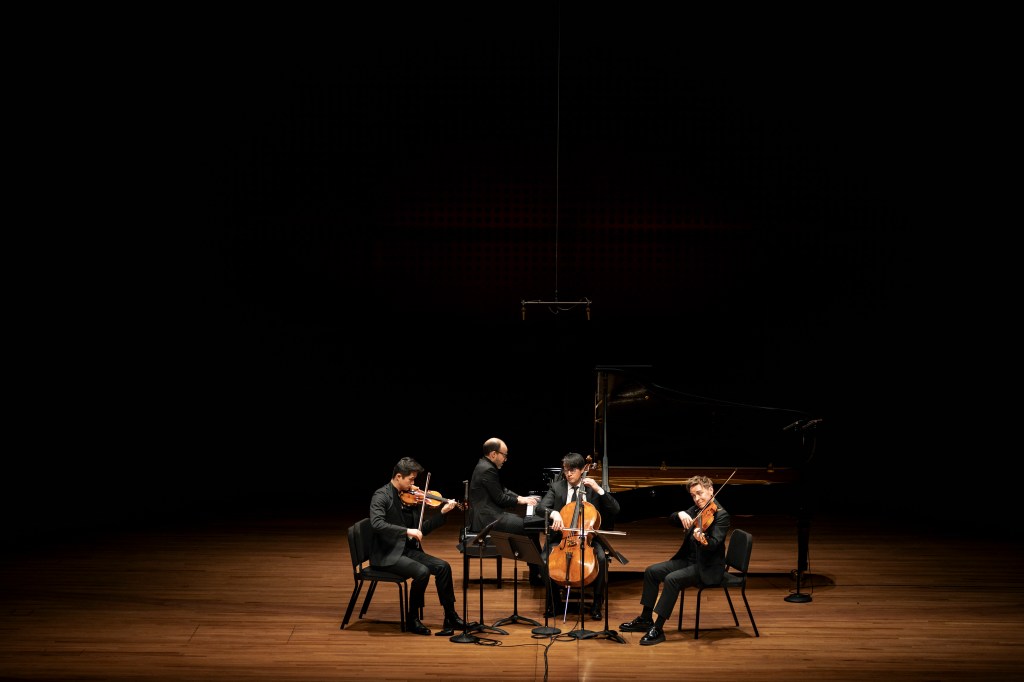
Above: Violinist Lun Li, pianist Orion Weiss, cellist David Requiro, and violist Matthew Lipman; photo by Paul Mardy
Fauré’s marvelous music, and the opulent playing of it, made for a perfect finish to a most enjoyable evening.
~ Oberon
Performance photos by Paul Mardy, courtesy of Chamber Music Society of Lincoln Center, with my thanks to Beverly Greenfield.

