~ Author: Lane Raffaldini Rubin
Wednesday April 22, 2026 – How many things in our lives are over 650 years old?
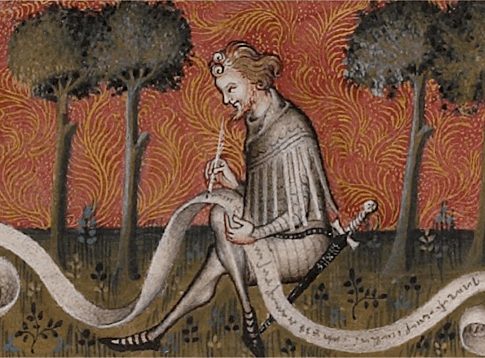
On Wednesday, Trinity Church (itself a merely 330-year-old institution) hosted the singers of Chanticleer in a program of sacred and secular music by Guillaume de Machaut, the preeminent composer and poet of fourteenth-century France. Despite the fact that the invention of the printing press was still more than a century away at the time of Machaut’s death in 1377, we have a nearly comprehensive record of Machaut’s written work and on Wednesday the all-male, San Francisco-based vocal ensemble Chanticleer offered a revelatory cross-section of that body of work.
The singers entered from the back of the nave and processed down the center aisle while chanting the 10th-century introit “Dominus illuminatio mea” (the only music of the evening not written by Machaut). It was an impressive entrance for the thirteen-man ensemble, who sang in flawless unison while walking the entire length of the church, without the benefit of the chamber music gestures and eye contact that such rhythmic unity usually demands.
The rest of the evening was dedicated to Machaut’s music, with the Messe de Nostre Dame bookending a series of profane works about courtly love. Machaut’s Messe, likely written for Reims Cathedral in the early 1360s, is believed to be the first cyclic setting of the mass—in other words: prior to Machaut, composers wrote vocal settings of individual portions of the mass’s traditional liturgy (e.g. Credo or Agnus Dei) so that, during any given mass, an assortment of various composers’ liturgical settings would be assembled and sung. Machaut’s Messe provides the entire “Ordinary of the Mass” (the liturgical portions that do not vary based on the calendar) and thus set a new standard for composers of music for the Church.
The Kyrie, the first portion of the Messe, features a spare texture and frequent melismas passed between voices. A cadence falls at the end of each line of text, lending the piece a disjointed character. The singers treat these cadences with canyonlike expansiveness, making the Kyrie like a series of horizons.
Chanticleer brough their immaculate ensemble motion to the Gloria, which was a profusion of uncannily strange modal harmonies. This movement and the Credo that follows end with long melismatic Amens, rendered particularly charming thanks to the French Latin pronunciation that the group adopted for Machaut’s sacred music.
Although the Credo is characterized by the same disjointedness as the Kyrie, Chanticleer imparted varied timbral characters to different sections of the text, as if the ensemble were an organ with varying stops pulled to produce diverse qualities of sound.
The Sanctus had a remote tonal center from the Credo before it. The homophonic textures of its opening lines were like beams of bright light, not unlike the sunny character of Mozart’s own Sanctus written four hundred years later. In the Agnus Dei the floating melodic tracery of the countertenor is joined by the warm sonority of the rest of the four-part choir, leaving the Messe to conclude with an ascending, aerial motion.
Throughout, Chanticleer brought a sense of mystery to this music, creating a sublime but enigmatic atmosphere in Trinity Church.
But between the Gloria and Credo of the mass, Chanticleer offered three extended groupings of Machaut’s courtly secular music. Each cluster was led by a lai, a lengthy monophonic setting of a poem. Machaut’s lais show the limitations of his music’s expressive and dramatic power. The issue in the Messe of the over-frequency of cadences also characterized this music, leaving it not with the vocal floridity or fluidity we associate with poetic songs of subsequent centuries but with a repetitive, even monadic cellularity.
The sound of the lais, as well as the ballades, motets, and other forms we heard, are sounds of pure abstraction—lines, columns, points, and solid fields of color—gorgeously rendered by Chanticleer but intractably foreign to our present-day ears which are accustomed to tension and release, consonance and dissonance, major and minor, narrative arc, and slippages between legible structural forms.
“Riches d’amour” came closest to the dramatic expression I’m describing. The ethereal, planetary motion of two voices (Matthew Mazzola and Tim Keeler) brought aching melancholy to this song about a man’s unrequited love for his mistress and the “bitterness” this brings him. The music ends with a harmonically unresolved cadence, adding to the grasping, unfulfilled longing of the lover.
The entire evening offered a gratifying and rare opportunity to let this 650-year-old sound wash over you. Chanticleer has given us the chance to travel to a time before the codification of common practice music—before major and minor practically became laws of nature in the West. This time travel shows us the extents to which music has evolved and grown from the liturgical and proportional experiments of clergy like Machaut into the most highly developed medium for communicating human emotions in the half-millennium that followed.
For me, this raises fascinating and unanswerable questions about the original perception of Machaut’s music: how did this music sound in the year 1377? Was it radical? natural? easy-listening? thorny and confusing? boundary-pushing?
We have scholarly ways to address those questions but, ultimately, the ear of the fourteenth-century listener—who never heard Bach, Mozart, and the rest, up through our own time—will never be retrievable to us.
~ Lane Raffaldini Rubin

