The great Canadian contralto Maureen Forrester sings Gustav Mahler’s Kindertotenlieder, which she recorded with the Boston Symphony Orchestra under Charles Munch’s baton in 1958.
Listen here.
The great Canadian contralto Maureen Forrester sings Gustav Mahler’s Kindertotenlieder, which she recorded with the Boston Symphony Orchestra under Charles Munch’s baton in 1958.
Listen here.
Franco Corelli and Giangiacomo Guelfi in scenes from Verdi’s LA FORZA DEL DESTINO from an RAI broadcast in 1956. Arturo Basile conducts.
Listen here.
Franco Corelli and Giangiacomo Guelfi in scenes from Verdi’s LA FORZA DEL DESTINO from an RAI broadcast in 1956. Arturo Basile conducts.
Listen here.
An audio-only recording of a performance of BOHEME given at Macerata in 1977 with Raina Kabaivanska (Mimi), José Carreras (Rodolfo), Elvida Ferracuti (Musetta). Rolando Panerai (Marcello), and Carlo Cava (Colline). Ferruccio Scaglia conducts.
Listen here.
The sound of planes passing over is an occasional distraction.
Soprano Lina Cavalieri was considered one of the great beauties of her day.
Helen Traubel sings – magnificently – Isolde’s Narrative and Curse from the first act of Wagner’s TRISTAN UND ISOLDE.
Helen Traubel – Isolde’s Narrative and Curse – Rodzinski cond
“With the gleaming sword,
I stood over him,
Ready to avenge Morold’s death.
He looked up – not at the sword,
not at my hand –
he looked into my eyes.
His anguish
touched my heart.
The sword…I let it fall!
His wound I healed so that he could travel homeward…and no longer trouble me with his gaze.”
Above: Maria Agresta and Charles Castronovo in LA BOHEME; a MetOpera photo
Saturday January 22md, 2022 matinee – This performance had its ups and downs, The conducting of Carlo Rizzi was hit-or-miss; he sometimes allowed the orchestra to swamp the singers. But I did like his speedy take on the first several minutes of the Cafe Momus scene.
Charles Castronovo repeated his very persuasive Rodolfo from the November run. His singing is emotional without straying from the notes, and he has both power and subtlety in perfect measure. His Mimi this afternoon, Maria Agresta, sounded sadly out-of-sorts, her vibrato prominent, and her highest notes not entirely comfortable. Offsetting these reservations was her congenial phrasing and some lovely piano effects.
Lucas Meachem (above) was a magnificent Marcello, making every phrase count. The voice is large and warm, and he handily dominated the ensemble ‘reprise’ of the “Musetta Waltz” theme in Act II. His duet with Ms. Agresta in Act III was impressively sung. Gabriella Reyes screeched and shrilled Musetta’s lines at first, but settled in for a nice rendering of the Waltz; I feel that she might be better cast as Mimi.
Alexander Birch Elliott was a fine Schaunard, despite having to cope with lacklustre conducting from Mr. Rizzi. I liked Peter Kellner’s Colline very much, too, but the thought of enduring a second Gelb intermission caused me to head home without hearing his “Vecchia zimara“.
The House was substantially full, and there was surprise applause after the Bohemians dismissed Benoit in Act I. Lots of noisy chatter from the ceiling lighting bay during Act I was distracting, and the interminable first intermission simply killed whatever dramatic impetus the opera had going.
Metropolitan Opera House
Janaury 22nd, 2022 matinee
LA BOHÈME
Giacomo Puccini
Mimì....................Maria Agresta
Rodolfo.................Charles Castronovo
Musetta.................Gabriella Reyes
Marcello................Lucas Meachem
Schaunard...............Alexander Birch Elliot
Colline.................Peter Kellner
Benoit..................Donald Maxwell
Alcindoro...............Donald Maxwell
Parpignol...............Gregory Warren
Sergeant................Jonathan Scott
Officer.................Ned Hanlon
Conductor...............Carlo Rizzi
~ Oberon
Above: violinist Maxim Vengerov and pianist Simon Trpčeski onstage at Carnegie Hall; photo by Jennifer Taylor, courtesy of Carnegie Hall
Thursday January 20th, 2022 – My first concert at the Stern Auditorium at Carnegie Hall since March of 2020. I was very happy to bring my friend DK to see one of his favorite artists, Maxim Vengerov, in recital. The Macedonian pianist Simon Trpčeski was at the Steinway for a wonderful program.
The audience gave the musicians a hearty welcome as they walked out onto the stage. People are simply aching to hear great music played live again after the the long months of uncertainty. And so the opening Mozart seemed like a transfusion of peace and hope, though still tinged with darkness.
Above: Maxim Vengerov, photo by Jennifer Taylor
Mozart’s Violin Sonata in E-Minor, K. 304 was composed in 1778; this is the only one of Mozart’s violin sonatas written in a minor key; its underlying wistfulness might be connected to the fact that the composer’s mother had passed away while he was working on it.
Departing from the norm, this sonata is in only two movements. The Allegro takes its character from the poignant opening theme, played in unison by violin and piano. The piano brings forth a second, more animated theme, though the mood remains restrained. A lovely dovetailing of dynamics marked the Vengerov/Trpčeski partnership’s playing, the violinist’s repeated insistent notes met by the pianist’s wonderful subtleties.
Mozart marks the second movement Tempo di Minuetto, but it has a forlorn quality not usually heard in a minuet. Solo piano introduces the grave yet graceful opening melody, and soon the two instruments take turns with it, their voices entwining. A major-key interlude gives us an unexpected ray of light, with sublimely soft playing from Mr. Trpčeski. The minor mode resumes, the melody flowing on to a rather sudden stop.
Photo by Jennifer Taylor
In direct contrast to the Mozart, Mssrs. Vengerov and Trpčeski next offered the Prokofiev Violin Sonata No.1. Prokofiev is one of my A-list composers, and this sonata encapsulates everything I love about his works: the rough-edged drama, the heartfelt lyricism, the chiaroscuro dynamics, and the subtle wit of his music always fascinates me.
Following the four-movement structure (slow-fast-slow-fast) of the Baroque church sonatas, Prokofiev opens this sonata with a somber passage from the piano. The violin joins, edgy and buzzy, and then the two instruments blend in a unison lament. The piano’s dolorous notes draw the violin into a yearning, dramatic passage. Then the violin skitters softly on high as the pianist intones soft chords; it sounds “like the wind in a graveyard” as Prokofiev told David Oistrakh, who played the sonata’s premiere performance.
The second movement, Allegro brusco, begins vigorously, lapses into a songful state, then turns fast and furious. Things subside briefly, but accents soon propel the piano forward again as the violin makes agitated remarks. Calming to lyricism, the music then gets grand – with a soaring melody leading to a wild finish.
In the third movement, Andante, the Vengerov/Trpčeski transported us with their spectacular playing. An opening passage of piano filigree is taken up by the violin. A gorgeous violin melody is heard, whilst the piano sustains a magical atmosphere. This ethereal music puts us in a blissful state, with Mr. Vengerov finishing his reverie with a miraculously sustained pianissimo trill. Heavenly!
Brilliant playing from both artists drove the sonata’s concluding Allegrissimo forward in spectacular fashion. A melodious interlude lets us again savour the warmth and serenity of Prokofian lyricism, and then some biting staccati dazzle us yet again. Another whiff of the “wind in a graveyard” motif leads on to work’s quiet closing.
Photo by Jennifer Taylor
Following the interval, César Franck’s ever-popular Violin Sonata was given a thrilling performance by the Vengerov/Trpčeski duo. This sonata was inspired by the marriage of the great violinist Eugène Ysaÿe to Louise Bourdeau in 1886. Franck’s initial idea for the sonata was to commence with a a slow and reflective opening movement, but Ysaÿe persuaded him that it worked best at a quicker tempo, so Franck marked it Allegretto, ben moderato. This movement juxtaposes rather than develops two themes, the first given almost exclusively to the violin, the second to the piano. These themes, particularly the violin’s, will return in the following movements. From note one, I fell under the spell of this music, which seemed so fresh and vivid as performed tonight. Mr. Trpčeski’s playing was positively rhapsodic, whilst Mr. Vengerov poured so much passion into the thrilling melodies the composer has given him.
The agitated, dramatic second movement casts its own spell, with the players again displaying their intriguing dynamic range and their peerless legato. The music is at once propulsive and poetic. Then comes the pensive Recitativo-Fantasia, wherein Mr. Vengerov’s rapturous playing in the high range is heard over the piano’s gently rolling misterioso figurations.
The familiar and beloved themes reappear in the sonata’s final movement, which builds to a glorious finish. The inevitable reaction of the audience to the playing of Mssrs. Vengerov and Trpčeski was a fervent ovation, richly deserved.
Ravel’s Tzigane was a late addition to the program. Familiar to me mainly from the ballet that George Balanchine created for his muse, Suzanne Farrell, to this music, it’s a Vengerov specialty: he played it here at his February 2020 concert, just days before the pandemic shut everything down.
In July 1922, Maurice Ravel met the young Hungarian violinist, Jelly d’Aranyi, who was the grand-niece of famed 19th-century violinist Joseph Joachim. The composer was intrigued when he heard the violinist playing gypsy melodies at a party. Inspired, he fashioned a gypsy rhapsody, working on it over a period of two years. Ravel completed it just a few days before the premiere: on April 26, 1924, in London, Mlle. d’Aranyi and pianist Henri Gil-Marchex gave the premiere of Tzigane.
Tzigane is a legendary showpiece, and tonight the amazing dexterity of the violinist (later joined by the pianist) kept the audience on the proverbial edge of their seats. After a giant “pre-cadenza”, the music starts to dance, by turns high and shimmering, then wildly earthy.
At the concert’s end, Trpčeski and Vengerov were greeted with a lively ovation. They returned for three encores: two delicious Fritz Kreisler treats, and then Gabriel Fauré’s sublime Après un rêve, which was sublimely played. Bravo, gentlemen! Bravissimo!!
All photos by Jennifer Taylor, courtesy of Carnegie Hall.
~ Oberon
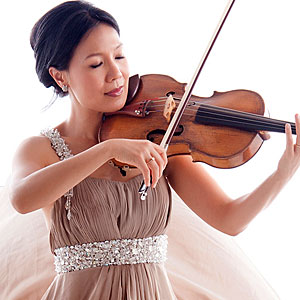
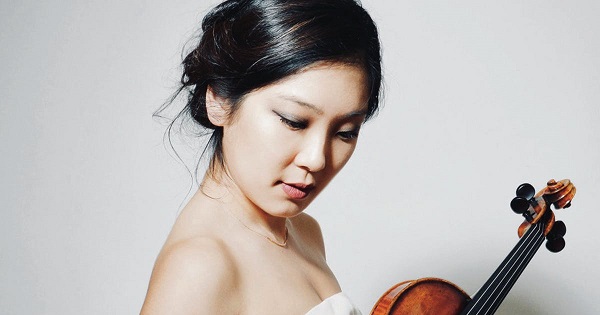
Above: violinist Kristin Lee
Tuesday January 18th, 2022 – Chamber Music Society of Lincoln Center brought together six virtuoso string players from their stellar roster for a program of music by Beethoven, Schulhoff, and Dvořák at Alice Tully Hall.
Beethoven’s Quintet in C-minor for Two Violins, Two Violas, and Cello, Op. 104, started life as a piano trio composed in 1794–95; the composer arranged the work for string quintet in 1817.
An almost waltzy feeling springs up for the opening of the Allegro con brio. The music spills forth with contrasting passages of animation and lyricism, which tonight’s five musicians graced with delicious harmonies and finely-judged dynamics. Violist Matthew Lipman’s playing (all evening) was of particular note.
A gentle flow of melody opens the Andante cantabile. Ensuing variations include a sad interlude and some boisterous passages; Mr. Lipman and cellist Keith Robinson seize on their opportunities. The irresistible magic of Beethoven abounds here. The Menuetto has a courtly feeling, but fabulous flourishes from Kristin Lee’s violin add a spicy touch. Later, some charming echo effects are heard.
Ms. Lee takes the lead in the quintet’s Finale: Prestissimo. Here I found myself deriving great joy from watching the five musicians reveling in the pleasure of playing such marvelous music. After all that has gone before, Beethoven pulls off a final magic trick: the quintet ends quietly.
Above: composer Erwin Schulhoff
The centerpiece if this evening’s program was Czech composer Erwin Schulhoff‘s Sextet for Two Violins, Two Violas, and Two Cellos, composed in the early 1920s. This evening was my first hearing of this work, and it was an engrossing, revelatory experience. My only other Schulhoff encounter was a powerful performance of the composer’s 5th symphony by the American Symphony orchestra in 2017.
Schuhoff’s Sextet opens with an Allegro risoluto, the musicians digging in and then trudging along with numerous dramatic effects. The music calms, with wisps of melody woven in; our two violists (Mssrs. Lipman and Neubauer) have much to do here, with plucking and tremolo passages. The music has hauntingly somber harmonics and brusque accents.
In the eerie Tranquillo: Andante which follows, the music is spine-tingling: unsettling yet beautiful. Mr. Neubauer and cellist Keith Robinson share an evocative exchange, and Kristin Lee spins a silky violin theme over a rocking motif. A solo from Mr. Robinson sustains the mood, and then a creepy, insectuous theme yields to a hushed atmosphere. The cello sings low, and then, with fantastic control, a final passage for viola and cello. “Wow!” I scrawled in my notes.
An agitato movement, marked Burlesca. Allegro molto con spirito brought forth fun, lively rhythms and some fiery playing from Matthew Lipman. The tempo speeds up for a propulsive unison passage at the finish.
Above: violinist Arnaud Sussmann, photographed by Carlin Ma
To close the evening, Antonin Dvořák’s Sextet in A-major for Two Violins, Two Violas, and Two Cellos, Op. 48 (1878) was gorgeously played by our six artists.
From the start, this sextet is a veritable font of melody. And the dance rhythms are indeed toe-tappingly appealing. But after a while, it all becomes so very pleasant, and I began to think back to the jarring fascination of the Schulhoff. As time goes by, I find that Dvořák’s music seldom draws a deep response from me.
Despite such quibbles, I was so glad to stand up and cheer at the end of the concert, joining my fellow music-lovers in a heartfelt homage to these six great musicians.
~ Oberon