Tag: Ben Weaver

  • CMS: Beethoven Quartet Cycle ~ Finale

    Calidore_Beethoven

    Above: the Calidore String Quartet, photo by Frank Impelluso

    ~ Author: Ben Weaver

    Sunday May 18th, 2025 – Chamber Society of Lincoln Center reached the end of its 2024-25 Beethoven String Quartets cycle, performed by the the outstanding Calidore String Quartet. For the sixth and final concert the quartet – violinists Jeffrey Meyers and Ryan Meehan, violist Jeremy Berry, and cellist Estelle Choi – performed Beethoven’s quartets Nos. 14 and 16.

    String Quartet No. 14 in C-sharp minor, Op. 131, composed in 1825-1836, and has been studied and individually praised by the likes of Richard Wagner, Robert Schumann, and Franz Schubert – who had it played for him privately a week before his death. Composed in seven movements played without a break, it opens with a somber melody on the first violin. The rest of the musicians enter one by one, the music remaining austere and calm, perhaps reflecting Beethoven’s deep faith as it resembles parts of his earlier Missa Solemnis. Wagner once wrote that this was “the saddest thing ever said in notes.” The Calidores played this beautifully, with extreme care and dedication. The music shifts to a playful dance and then back to darkness, and then back again and again. The playful Scherzo (marked Presto), with its charming melody, zooms around like a playful puppy, lovingly played by the Calidores. There’s a memorable moment towards its conclusion where all four instruments play pianissimo in their highest registers, then the volume is quickly raised, which felt like being suspended in zero gravity and then quickly falling down. The Finale is a violent march with occasional soaring melodies to break up the clouds.

    The Quartet No. 16 in F major, Op. 135 ended up being Beethoven’s almost-last composition for the string quartet. (The only thing remaining was the new final movement for Quartet No. 13, which ended up being the very last piece Beethoven ever composed.) It opens once again with a somber melody, but unlike the darkness of the earlier quartets, this one is simply mournful and lovely. The Calidores held the audience in thrall with the beauty of their playing. The second movement, Vivace, is wonderfully chaotic, as if ready to unravel at any point. The following Lento assai, cantabile e tranquillo is Beethoven at his most lyrical, full of stops and starts, like breathing of a dying man. And the Finale: Grave, ma non trope tratto, begins ominously and violently, but ends on a lighter, even triumphant, note.

    The terrific musicians of the Calidore Quartet undertook a monumental challenge, performing all sixteen of Beethoven’s String Quartets in a single season. The works themselves are the Mount Everest of the string quartet repertoire and the challenges are enormous. Beethoven wrote his string quartets in three batches of his life and career: early, middle, and late. They show a profound progress of an artist who became the leading figure of Romanticism, sturm und drang; but also a musician of frequently surprising humor. Mssrs. Meyers, Meehan, Berry, and Ms. Choi combine all the elements needed to bring these million faces of Beethoven to life.

    ~ Ben Weaver

  • BSO x 2 ~ Mostly Shostakovich

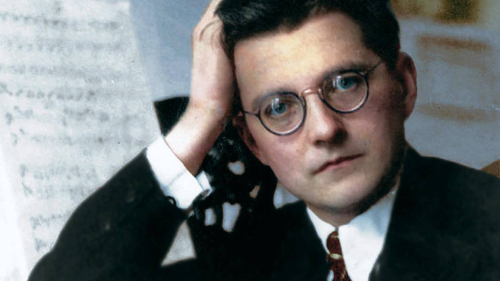
    Dimitri-Shostakovich

    Above: Dimitri Shostakovich

    ~ Author: Ben Weaver

    Wednesday April 23rd and Thursday April 24th, 2025 – Dmitri Shostakovich was the focus of Boston Symphony Orchestra’s two-concert visit to Carnegie Hall this week, under the leadership of its music director Andris Nelsons. Shostakovich’s son Maxim, dedicatee and first performer of the Second Piano Concerto, was in attendance on the second evening.

    Shostakovich died 50 years ago, and his famous struggles living and composing in a totalitarian regime, always one offense away from the gulag, sadly remain relevant today – not just in Russia, but in the United States as well. Cellist Yo-Yo Ma made a brief statement from the stage, quoting Josef Stalin’s famous line: “A single death is a tragedy, a million deaths are a statistic.” Ma pleaded that no death should ever be a statistic, and he wanted to honor anyone suffering loss of life or dignity. Ma did not name any names, but the meaning is loud and clear as our own US government is disappearing human beings into foreign gulags. For anyone who argues that artists should stay out of politics, people like Shostakovich remain an important reminder that art has launched revolutions, and if art was not political, it would never be banned.

    Ma Cello-Concerto-No.-1-Robert-Torres

    Above: Yo-Yo Ma, photo by Robert Torres

    Cello Concerto No. 1 in E-flat major, Op. 107, composed in 1959, was dedicated to Mstislav Rostropovich (as was, incidentally, the 2nd.) Yo-Yo Ma has been performing it for much of his career and his deep affection for it is clear. His warning about tyranny just before the performance was reflected in his approach to the jolly opening tune, which Ma played with a rawness that made it darker and more sinister. Irony and the grotesque are deeply ingrained in Soviet art, a tool for plausible deniability which anyone who wished to survive purges needed to master. The Playbill notes by Harlow Robinson point out that Shostakovich buried in the score a small, distorted fragment from Josef Stalin’s favorite Georgian folk song, “Suliko” – something even Rostropovich did not spot until Shostakovich finally pointed it out. (Stalin died in 1953, six years before the Concerto was composed.) As an encore Ma joined Boston Symphony’s entire cello section and they delivered a jaunty version of a traditional Yiddish tune “Moyshele,” arranged for a cello ensemble by BSO’s principal cellist Blaise Déjardin, who also contributed magnificent solo playing.

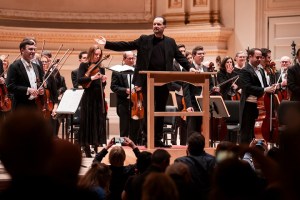
    Two late symphonies by Shostakovich received searing performances under Andris Nelson’s leadership. Over the last few years maestro Nelsons performed and recorded all of Shostakovich’s symphonies with the Boston Symphony Orchestra for Deutsche Grammophon. It is an excellent cycle (which also includes the Piano Concertos with Yuja Wang, Violin Concertos with Baiba Skride, Cello Concertos with Mr. Ma, and the opera Lady Macbeth of Mtsensk District. I have found much of these performances excellent.)
    Shosty

    Above: Maestro Nelsons, photo by Chris Lee

    Symphony No. 11 in G minor, Op. 103 (composed in 1956-57) carries the subtitle “The Year 1905.” The work depicts the failed revolution against the Russian monarchy and earned Shostakovich the Lenin prize.

    The opening movement Adagio, subtitled “The Palace Square,” is dark and gloomy, with dull strikes from the timpani foreshadowing events to come. Nelsons’s deliberate tempo set the mood well, building tension to the bloodshed to come. (I also noticed there is a section here John Williams “borrowed” for T-Rex in the score for “Jurassic Park.”) The brutal second movement (Allegro, “The 9th of January”) depicts the “Bloody Sunday” at the Winter Palace where peaceful protesters were massacred by the guard. The pounding march depicting the assault was led by BSO’s excellent percussion section. A mournful “Memory Eternal” and defiant “Tocsin” movements (a celesta taking the place of a tocsin bell) were emotionally shattering under maestro Nelson’s leadership.

    Shostakovich’s last Symphony, No. 15 in A major, Op. 141 (composed in 1970-71) was originally intended to celebrate his own 65th birthday. Several medical emergencies, including a heart attack, delayed its composition and premiere, which finally took place under his son Maxim’s direction in 1972. It’s most unusual aspect is presence of extensive unaltered quotations from Rossini’s William Tell Overture and Wagner’s Götterdämmerung and Tristan und Isolde, composers and works not immediately identified with Shostakovich. The full mystery of why he included these specific quotations remains a matter of speculation. I’ve always found the “Lone Ranger” theme to be especially jarring, but it’s important to note that Shostakovich is highly unlikely to have been familiar with that American TV series, so his point of reference to that music would have been very different from ours. Musically the choices do fit into the fabric of the symphony. The raucous opening movement – which Shostakovich ones called a “toy shop” – is a perfect place for the galloping Rossini tune. And Wagner’s music is a perfect fit for the stillness of the symphony’s latter movements. Shostakovich also quotes some of his own music. The closing percussion – like tickings of a clock – immediately remind one of the ending of the second movement of his Symphony No. 4. Andris Nelsons and his Boston forces delivered a largely superb performance, although I think maestro Nelsons’ lethargic take on the Adagio (second and fourth movements) was a misstep. They dragged and lost focus, no matter how beautifully the orchestra played. But special mention to concertmaster Nathan Cole, principal cellist Blaise Déjardin, and flautist Lorna McGhee for superb solo contributions.

    Bso uchida


    Above: Maestro Nelsons and Mitsuko Uchida take a bow; photo by Chris Lee


    Ludwig van Beethoven’s Piano Concerto No. 4 in G major, Op. 58 opened BSO’s two-night residence at Carnegie, with the always brilliant Mitsuko Uchida as soloist. The concerto has often been interpreted as Orfeo calming the furies (particularly in the magical second movement, where calmness by the soloist is interrupted by angry strings) – and so Ms. Uchida bravely faced a consumptive audience member who began proudly coughing as Ms. Uchida began to play. After a few calming chords, Ms. Uchida stopped and held up her hands in the direction of the patient. The offender took her time exiting the auditorium, coughing non-stop. We could still hear her coughing up a lung from the hallway, but that’s the most we could hope for.


    Finally the performance resumed with Ms. Uchida delivering an deeply moving performance. The work is full of conflict, but – somewhat unusual for Beethoven – if his voice its the soloist, he calms the other side instead of fighting it. Such dignified understatements were presented by Ms. Uchida with unaffected dignity and charm. That stunning second movement, with angry strings being repeatedly silenced by the soothing soloist, is among Beethoven’s most powerful and beautiful statements, and Ms. Uchida is simply second-to-none with sincerity and beauty. The rollicking Rondo: Vivace that closes the concerto is Beethoven’s victory over adversity dance, but one filled with humor. Here, too, Ms. Uchida played with unabashed, contagious joy.
     

    Uchida 2


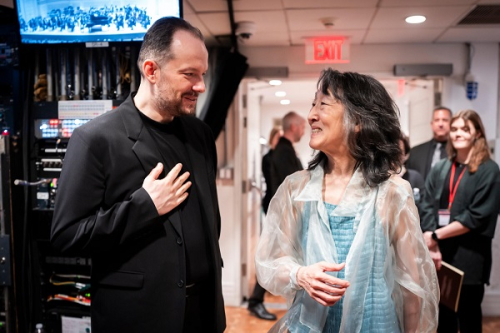
    Backstage: Maestro Nelsons and Ms. Uchida; photo by Chris Lee


    Andris Nelsons is an excellent accompanist, which I’ve had a chance to note many times. His respect for his soloists, keeping the orchestra from burying them, is an admirable trait – one I wish a few other notable conductors would also acquire.

    ~ Ben Weaver

    (Chris Lee’s performance photos courtesy of Carnegie Hall)

  • Concertgebouw: Schoenberg & Mahler

    Untitled

    Performance photo by Chris Lee

    ~ Author: Ben Weaver

    Saturday November 23rd, 2024 – The Royal Concertgebouw Orchestra gave two sold-out concerts at Carnegie Hall last week under the baton of its chief conductor designate Klaus Mäkelä. The second concert on Saturday, November 23rd featured beloved works by Arnold Schoenberg and Gustav Mahler.

    Between the two concerts, this evening’s playing of Schoenberg’s Verklärte Nacht, Op. 4 was the strongest performance of the orchestral works the Concertgebouw presented this week. Originally composed for string sextet in 1899, Schoenberg made an arrangement for a string orchestra and it’s become one of his most beloved and most frequently performed works. The string section of the Concertgebouw was on absolute peak form with its lush yet concentrated sound. Schoenberg’s score is by turns dark, ominous, romantic, and shimmering, and the orchestra reflected each emotion and turn with beautiful clarity. Maestro Mäkelä conducted it without a score, so it appears to be a work that is close to his heart. Maybe that’s why he managed to keep the tension throughout the entire composition. 

    When it comes to playing Mahler, I think the Concertgebouw’s only rival is the New York Philharmonic. These symphonies are close to their hearts and they perform them frequently. The Symphony No. 1 in D major received its Dutch premiere in 1903 under Mahler himself. This evening’s performance under the orchestra’s young incoming chief conductor was somewhat mixed.

    The first movement was something of a mess that echoed the very unfortunate performance of Rachmaninoff’s Symphony No. 2 the previous evening: while Maestro Mäkelä can build to a climax, he was unable to connect any of the climaxes together, the tension and structure of the music disintegrating every few minutes. So it was here, unfortunately. Low voltage would be one way to describe it, a flicker of color quickly draining into something dull and gray.

    Fortunately things improved as the performance continued, and Mäkelä managed to keep the symphony moving. The second movement is filled with sections of chamber music, interrupted by full orchestral blasts. There was some wonderful playing from individual sections of the Concertgebouw, the winds in particular covering themselves in glory.

    The Funeral March was the best part of the performance. The double bass solo (principal Dominic Seldis) was appropriately weary and somber. The mocking tune that interrupts it was nicely paced and delightfully almost jazzy. The Finale was largely well handled, but lacked enough frenzy to be truly satisfying until the very last moments.

    With Maestro Mäkelä taking over two of the world’s top orchestras – the Concertgebouw and the Chicago Symphony Orchestra – these performances left me concerned if he is the right person for these jobs at this time. But time will soon tell if the confidence he has inspired in others pays off.

    ~ Ben Weaver

  • Concertgebouw: Schoenberg & Mahler

    Untitled

    Performance photo by Chris Lee

    ~ Author: Ben Weaver

    Saturday November 23rd, 2024 – The Royal Concertgebouw Orchestra gave two sold-out concerts at Carnegie Hall last week under the baton of its chief conductor designate Klaus Mäkelä. The second concert on Saturday, November 23rd featured beloved works by Arnold Schoenberg and Gustav Mahler.

    Between the two concerts, this evening’s playing of Schoenberg’s Verklärte Nacht, Op. 4 was the strongest performance of the orchestral works the Concertgebouw presented this week. Originally composed for string sextet in 1899, Schoenberg made an arrangement for a string orchestra and it’s become one of his most beloved and most frequently performed works. The string section of the Concertgebouw was on absolute peak form with its lush yet concentrated sound. Schoenberg’s score is by turns dark, ominous, romantic, and shimmering, and the orchestra reflected each emotion and turn with beautiful clarity. Maestro Mäkelä conducted it without a score, so it appears to be a work that is close to his heart. Maybe that’s why he managed to keep the tension throughout the entire composition. 

    When it comes to playing Mahler, I think the Concertgebouw’s only rival is the New York Philharmonic. These symphonies are close to their hearts and they perform them frequently. The Symphony No. 1 in D major received its Dutch premiere in 1903 under Mahler himself. This evening’s performance under the orchestra’s young incoming chief conductor was somewhat mixed.

    The first movement was something of a mess that echoed the very unfortunate performance of Rachmaninoff’s Symphony No. 2 the previous evening: while Maestro Mäkelä can build to a climax, he was unable to connect any of the climaxes together, the tension and structure of the music disintegrating every few minutes. So it was here, unfortunately. Low voltage would be one way to describe it, a flicker of color quickly draining into something dull and gray.

    Fortunately things improved as the performance continued, and Mäkelä managed to keep the symphony moving. The second movement is filled with sections of chamber music, interrupted by full orchestral blasts. There was some wonderful playing from individual sections of the Concertgebouw, the winds in particular covering themselves in glory.

    The Funeral March was the best part of the performance. The double bass solo (principal Dominic Seldis) was appropriately weary and somber. The mocking tune that interrupts it was nicely paced and delightfully almost jazzy. The Finale was largely well handled, but lacked enough frenzy to be truly satisfying until the very last moments.

    With Maestro Mäkelä taking over two of the world’s top orchestras – the Concertgebouw and the Chicago Symphony Orchestra – these performances left me concerned if he is the right person for these jobs at this time. But time will soon tell if the confidence he has inspired in others pays off.

    ~ Ben Weaver

  • The Beethoven Quartets @ CMS

    Cms

    Above: the Calidore String Quartet at Alice Tully Hall; photo by Da Ping Luo

    ~ Author: Ben Weaver

    October 22nd & 27th, 2024 – Throughout the 2024-25 season, the Chamber Music Society of Lincoln Center is hosting a traversal of the complete Beethoven String Quartets at Alice Tully Hall, performed by a single ensemble: New York-based Calidore String Quartet. The ensemble is Jeffrey Meyers and Ryan Meehan on violins, Jeremy Berry on the viola, and Estelle Choi on the cello. The first two evenings of the cycle – October 22nd and 27th – included three quartets on each night.

    The 27-year-old Ludwig van Beethoven was commissioned to compose six String Quartets, alongside his former teacher Franz Joseph Haydn, who was considered the father of the string quartet. Haydn was ultimately only able to finish 2 of the 6 quartets he was supposed to compose, but Beethoven dove head-first into his first string quartets which became his Op. 18. By the time Beethoven reached the end of his life, he composed 16 string quartets, which have become the Mount Everest of the genre, arguably only equaled by Dmitri Shostakovich’s 15 String Quartets composed more than a century later.

    Commonly the Op. 18 String Quartets are called the Early String Quartets. Even though Beethoven was already exploring his more explosive and adventurous musical nature in other musical genres, most notably his piano sonatas, with these first forays into the string quartet, he harkened back to his predecessor masters of the genre, Haydn and Mozart. The Calidore Quartet are performing the works in the order they were composed, not numbered in the published score. The sequence is Nos. 3, 1, 2, 5, 4 and 6.

    By and large, these early six quartets are light in nature, with the first violin dominating the procedures. Happily, first violin Jeffrey Myers is an exceptional musician, the sweet sound of his instrument effortlessly filling the concert hall. Quartet No. 3 in D major opens with a charming melody, lovingly shaped by the Calidores, the lush and warm sound of their ensemble emphasizing the Classical and early Romantic nature of the works. (By contrast, for example, when the Danish String Quartet performed a full cycle of the Quartets at CMS in 2020, they leaned into their more modern sound, closer to Beethoven’s last quartets.) 

    Quartet No. 1 in F major also opens with a graceful, contagious melody – an obvious common thread running through all six of these works. Here, but especially in the second movement, cellist Estelle Choi, gets several key moments to stand out with a dark, glowing sound. There’s a depth to this movement that foreshadows Beethoven’s Romantic nature, one he would unleash in later compositions. He said this sorrowful movement was inspired by the ending of Shakespeare’s “Romeo and Juliet.” 

    The Calidores took most of the faster movements at a wonderfully quick pace: delirious, never chaotic. The beautiful coordination between the four partners kept them in perfect sync. This was most evident in the Quartet No. 2 in G major, the most humorous and closest in spirit to Haydn from the bunch.

    Quartet No. 5 in A major is thoughtful in its first two movements, with unexpected dramatic outbursts that bring surprising drama. Violist Jeremy Berry’s lovely solos shine in the second movement, as jagged stabs from the violins interrupt him. Second violin Ryan Meehan’s slightly sharper tone (not pitch) being a great contrast to Meyers’ sweeter sound. The third movement is a set of variations, the last of which is a tune that you can’t help but tap your toes to.

    Quartets No. 4 in C minor and No. 6 in B-flat major come closest to the Beethoven who would redefine Romanticism. Both of full drama and unexpected turns. No. 4 omits a traditional slow movement altogether, instead containing a Scherzo and Minuet in the middle. The Calidores darkened their sound for the dramatic outbursts, but kept their sense of humor for the quartet’s surprising and unexpected pizzicato close. 

    Quartet No. 6 in B-flat major, which closes this series of the Early Quartets, gives greater voice to the second violin and cello, with Meehan and Choi balancing Beethoven’s growing darkness, while the first violin soars above them. The final movement is an extraordinary piece by itself, with an extended grave “introduction” Beethoven titled “La Malinconia” (Melancholy.) It’s movement that lets us look into the future of Beethoven’s progress. The Calidores’ performance brought the full house to its feet.It should be noted that, especially on the 27th, the audience was remarkably quiet, hypnotized by these wonderful performances that made us all eagerly await the continuation of the cycle.

    The Calidore String Quartet will perform the Middle Quartets at Alice Tully Hall on January 28 and February 4, 2025. The Late Quartets, including the somewhat demented Große Fugue, will be performed on May 9 and 18, 2025. I recommend that anyone who missed these performances make sure to not miss rest of what is already an excellent cycle. 

    ~ Ben Weaver

  • Evgeny Kissin @ Carnegie Hall ~ May 2024

    Kissin 2

    Above, Yvgeny Kissin at Carnegie Hall; performance photo by Steve J Sherman

    ~ Author: Ben Weaver

    Friday May, 24th, 2024 – Evgeny Kissin is giving back-to-back concerts of the same program at Carnegie Hall this month. I attended the first one this evening, and it was a magnificent night of music, one of the best things I have heard in a concert hall this season. Kissin’s program is so popular, in fact, that not only were additional seats added on the stage (more about that later), but he will repeat this program on May 29th.

    Surprisingly this was my first time hearing Kissin live, though I have admired his many recordings over the years. He is a very unaffected performer, seemingly almost shy. His very sincere physical presence and unpretentious playing made an enormously positive impression throughout the night.

    Kissin began the program with Beethoven’s Piano Sonata No. 27 in E minor, Op. 90, composed in 1814. It reflects Kissin’s overall demeanor that he began with one of Beethoven’s least performed piano sonatas. Made up of only two movements – unusual for Beethoven – it open with a familiar Beethovenian bombast, but that falls away almost immediately and an achingly lovely melody takes over; it will return throughout the movement. The tonal contrasts throughout the the work can be hard to weave together. Kissin’s cleared those hurdles effortlessly. His playing was very clean and unfussy, each note etched like a diamond. Despite the Sonata’s Romanticism, Kissin seemed to be connecting it to Haydn and Mozart.

    Throughout the night one noticed Kissin’s very judicious use of the pedal, never letting the sound get murky and messy. This gave a great clarity to Chopin’s Nocturne in F-sharp minor, Op. 48, No. 2 and Fantasy in F minor, Op. 49 (both composed in 1841.) The long, melancholic melodies of the Nocturne – a particular specialty of Chopin’s – was played gently and without undue sentimentality. At each carefully built climax, Kissin pulled back just in time before falling into schmaltz. He launched into the Fantasy’s opening march right away. It felt like another example of Kissin not milking the crowd for affection.

    With Brahms’ Four Ballades, Op. 10 (composed in 1854) Kissin again reigned in much bombast, reminding us that Brahms, though composing at the height of Romanticism, was more of a classicist in temper. Which is not to suggest that his playing was lacking in brimstone. But Kissin’s very carefully chosen moments of when to let things blow up were fascinating to hear. The focus was always on the music and not the individual at the keyboard.

    Prokofiev’s Piano Sonata No. 2 in D-minor, Op. 14 (composed in 1912) is an early composition for the young composer (he was still a student at the St. Petersburg Conservatory), and it shows him trying out new ideas that would become trademarks in his future works. The Scherzo in particular sounds like echt Prokofiev: a playful melody played with demonic speed and attitude. Kissin’s hands were flying over the keyboard in a blur. With Prokofiev, Kissin ended the official program with the most outwardly virtuosic  piece played as dazzlingly as one can imagine.

    Kissin i

    Photo by Steve J Sherman

    The audience response was predictably wild. Kissin quickly offered 3 encores, all played superbly and all connected to the main program. A Mazurka by Chopin, March from Prokofiev’s opera “The Love for Three Oranges,” and Brahms’ gentle Waltz, Op. 39, No. 15. 

    During the opening Beethoven piece, the audience had been remarkably quiet. Perhaps making a note of this in my head jinxed the situation because what followed during the rest of the program was people repeatedly dropping things (probably their cell phones) and ringing cell phones. There is also always a risk in placing members of the audience onstage: one young girl in a white dress, sitting near the edge of the stage, was very bored and was swinging her legs the entire 1st half of the program. Thankfully her father probably took her home during intermission because they did not return. And just as Kissin launched into Prokofiev’s sonata, an elderly couple decided to exit the stage, down the steps, and out the door. Audience etiquette remains an untamable beast.

    ~ Ben Weaver

    Performance photos by Steve J Sherman courtesy of Carnegie Hall

  • Tormis/Britten/Prokofiev @ The NY Phil

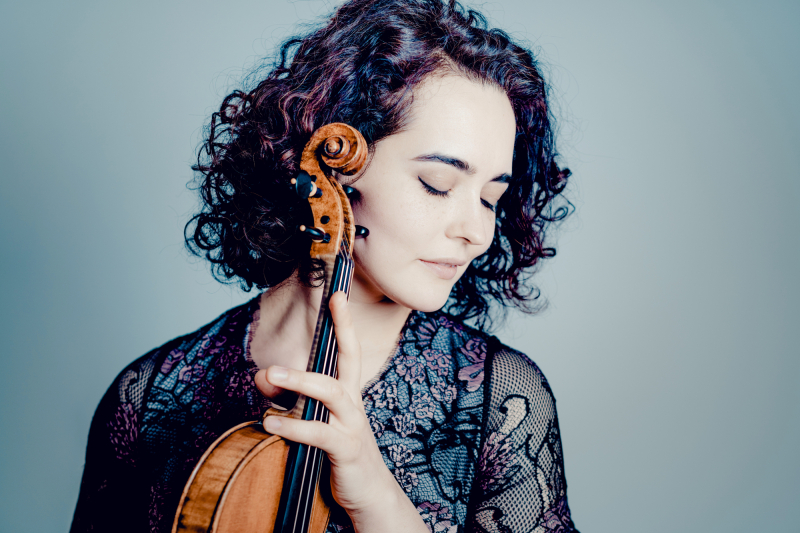
    ALENA-BAEVA-c-Andrej-Grilc

    Above: violinist Alena Baeva, photo by Andrej Grilc

    Author: Ben Weaver

    Friday November 17th, 2023 – Maestro Paavo Järvi returned to the New York Philharmonic’s David Geffen Hall for concerts featuring less familiar works by two of 20th Century’s greatest composers: Benjamin Britten and Sergei Prokofiev.

    Benjamin Britten’s Violin Concerto, Op. 15 – the only work he composed in that genre – was written in 1938-39, soon after Britten heard the world premiere performance of Alban Berg’s Violin Concerto in 1936. Indeed, the soloist who premiered Berg’s work, Antonio Brosa, would premiere Britten’s Concerto in 1940 conducted by Sir John Barbirolli, and do so with the New York Philharmonic in NYC. (In another bit of trivia, Britten composed some of the concerto while staying with Aaron Copland.) Britten revised the composition as late as 1965 (when he heard that Jascha Heifetz was considering performing it, though Heifetz would supposedly go on to declare the work “unplayable”), and it was this final edition that violinist Alena Baeva performed in these concerts. (It’s playable after all.)

    Opening with a series of timpani strokes can only evoke Beethoven’s Violin Concerto from more than a century earlier. The violin enters with a lament in the instrument’s highest registers – something Britten does often in the concerto. The second half of the first movement is taken over by a sort of a march, a persistent distant thumping, which reminded me of the villagers hunting Peter Grimes in Britten’s opera, composed a few years later.

    Ms. Baeva, in her New York Philharmonic debut, makes a rather small and tinny sound that struggled to make an impression in the concerto’s dramatic moments. To Maestro Järvi’s credit, he kept the orchestra under control, so as not to cover the soloist altogether. But in the more intimate parts, Ms. Baeva was a deeply moving narrator, which makes me want to hear her in a chamber music setting. In the extended cadenza that concludes the second movement, Ms. Baeva was mesmerizing and dazzling. The final movement is a series of variations in the form of a passacaglia, and it concludes with a lament (movement is marked Andante lento), and here Ms. Baeva’s lyrical side was wonderfully moving.

    Sergei Prokofiev’s Symphony No. 6 in E-flat minor, Op. 111 lives – unfairly – in the shadow of his more famous Fifth. Composed in 1945-47, and premiered later that year by Evgeny Mravinsky and the Leningrad Philharmonic, it is a magnificent work that never drags despite its roughly 45-minute run time.

    The Sixth’s fortunes changed over the years. Despite an acclaimed premiere in 1947, it was soon condemned by all the usual Stalinist suspects and disappeared from Soviet concert halls until the 1960s. (It was more popular in the West; Leopold Stokowski first conducted it with the NY Philharmonic in 1949). One of the complaints against the work was that it was not cheerful enough to inspire the Soviet people. Which is perhaps fair enough, but Prokofiev was not trying to cheer anyone up with this particular symphony. It opens darkly in the low strings before moving on to more lyrical themes. The second movement is the most emotional part of the symphony, woodwinds shrieking in agony. And the third movement is the most cheerful of the three, but not cheerful enough to appease Stalin.

    The Sixth sounds to me like the most mature of Prokofiev’s work. It never disintegrates into circus music, which – no matter how ironically – can on occasion be tiresome. Paavo Järvi certainly has this music in his bones and the NY Philharmonic delivered a stupendous performance. I ended up taking almost no notes as the music played because I was so hypnotized by what we heard. This is the sort of music the New York Philharmonic plays as well as anyone, and better than most. 

    Also included on the program was an unknown to most of us Overture No. 2 by the Estonian composer Veljo Tormis. Composed in 1958-59 it is a thrilling, expertly crafted work. Its highly dramatic, driven, almost cinematic opening (it would fit many movie chases beautifully), gives way to a lovely, if brief, cello solo (Patric Jee as the principal cellist in this performance). The middle section of the overture is reduced to a wonderful chamber-scale (just three violins at one point) before the breathless opening section returns. The work ends with three chords, long pauses between each one. Frequently, an audience will applaud prematurely, and certainly with an unfamiliar composition such as this, the risks were high. And yet – the silence held, Paavo Järvi controlling not just the orchestra, but, however briefly, the audience as well.

    Which brings me to a brief point about audience behavior and etiquette; we all know that both have degraded seriously over the years. At this performance, sitting just an empty seat away myself and my companion, a young woman played Candy Crush on her phone the entire evening. She was there with two friends, who seemed more interested in the music than she was…but they did not ask her to stop. I am reminded how, some years ago, the actor and playwright Wallace Shawn got in trouble at a Carnegie Hall concert for yelling at another audience member for behaving badly. Perhaps we should have been celebrating Mr. Shawn instead.

    ~ Ben Weaver

  • Philadelphia Orchestra ~ Rachmaninov/Higdon

    Rachmaninoff jpg

    Above: Sergei Rachmaninov

    ~ Author: Ben Weaver

    Tuesday October 17th, 2023 – The Philadelphia Orchestra was Sergei Rachmaninov’s favorite orchestra. He not only composed multiple works which they premiered, but it was the orchestra he chose to record his symphonies and piano concertos with. And, through the decades, the Philadelphians have played Rachmaninov as well as anyone and better than most.

    The orchestra’s current artistic director, Yannick Nézet-Séguin, has already recorded Rachmaninov’s complete symphonies and piano concertos (with Daniil Trifonov as soloist) and is continuing his presentation of the works at Carnegie Hall. (In a one-time-only mega event, pianist Yuja Wang and the combination of maestro Nézet-Séguin and Philadelphia Orchestra  performed all the piano iano Concertos and the Rhapsody on the Theme of Paganini at Carnegie Hall in a single memorable concert last season.) On October 17th Nézet-Séguin presented a marvelous evening of two of Rachmaninov’s audience favorite works: the Symphonic Dances and Symphony No. 2.

    Rachmaninov composed the Symphonic Dances in 1940 and the Philadelphia Orchestra and Eugene Ormandy premiered it in January of 1941. Apparently Ormandy was not very fond of the work, though he did perform it frequently and record it more than once. 

    The first dance opens with a three-note staccato motif, dark – even sinister – in tone, and it remains the driving rhythmic force throughout the movement. An alto saxophone plays a memorable role during the quieter moments (alas the wonderful player is not specified in the Playbill.) Rachmaninov ends the movement with a modified quote from his First Symphony, a work that had been lost 40 years earlier, so he knew nobody would have any idea what they were hearing. (The score was fortunately discovered again, but after Rachmaninov died, so he did not get an opportunity to hear it again after it’s catastrophic premiere led to his composers’ block.) Maestro Nézet-Séguin took a hard-driven, very steady, and deliberate pacing in the beginning of the work, speeding up considerably when the opening theme returned later in the movement.

    The second dance is a stilted Waltz that I always thought of a cousin to Ravel’s La Valse. The compositions share an odd limping rhythm, the wistful minor key melodies swirling like aged ballerinas remembering happier days. Perhaps Nézet-Séguin lingered a little too much occasionally here, but always recovered the pulse of the work. The final dance, with its heavy reliance on the Dies Irae (a theme Rachmaninov used in many of his works) fights against a quotation from Rachmaninov’s own All-night Vigil Vespers, as light tries to conquer darkness. It seems the heavens win (Rachmaninov even scribbled “Hallelujah” in the score.) The Philadelphia Orchestra and Nézet-Séguin dazzled all the way through.

    The Symphony No. 2 in E minor, Op. 27 is, along with his Piano Concerto No. 2, Rachmaninov’s most beloved work and oft-performed work. A gigantic, lush, deeply Romantic and melodic work was a hit from its premiere (conducted by Rachmaninov himself in St. Petersburg in 1908; the US premiere took place just one year later in – where else – Philadelphia under the composer’s baton.) Maestro Nézet-Séguin’s interpretation was magnificent, sometimes even revelatory. The tumultuous climax of the first movement, with its howling brass, for the first time reminded me of Tchaikovsky’s Pathétique Symphony. The magnificent Adagio movement – with a ravishing melody everyone recognizes – contains a tremendous extensive solo for the clarinet, played by principal clarinetist Ricardo Morales with incredible beauty and tenderness that made you lean forward. The final Allegro vivace movement was a high voltage thrill ride which the orchestra dispatched with effortless aplomb.

    I must acknowledge that the concert opened with a performance of Jennifer Higdon’s Fanfare Ritmico, a brief 1999 piece I occasionally thought may have resembled John Adams’ “Short Ride in a Fast Machine.” But the resemblances were fleeting even if they existed. My red flags went up when I looked at the list of instruments used in this 6 minute piece and it contains, as so many contemporary works do, every imaginable percussion instrument there is. Perhaps 2/3 of the instruments listed were percussive. I suppose to Higdon’s credit she does not use them all at once (something others do and never to anybody’s benefit). But she does fall into the same trap countless contemporary composers do where being unable to transition from one theme to another, the easiest path is to have somebody hit something. And so things kept getting hit. When it ended I said to my companion: “Well, whatever that was, they played it very well.”

    ~ Ben Weaver

  • Nelsons/BSO: Mozart/Adès/Sibelius @ Carnegie Hall

    CH11371830_Medium_res

    Above: Maestro Andris Nelsons; photo by Fadi Kheir

    Author: Ben Weaver

    Tuesday April 25th, 2023 – The Boston Symphony Orchestra, under the baton of their music director Andris Nelsons, returned to Carnegie Hall last week. The concert of April 25th, 2023 was a marvelous evening of music by Mozart, Adès, and Sibelius, featuring two outstanding soloist artists. 

    CH11371826_Medium_res

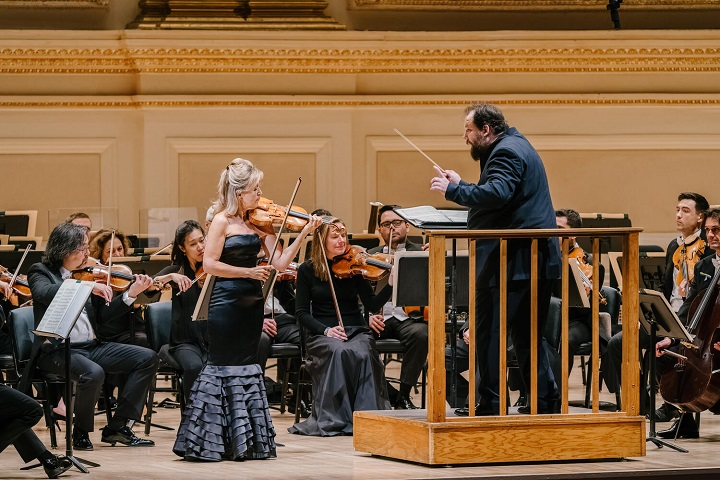
    The great Anne-Sophie Mutter (above, photo by Fadi Kheir) performed two works: Mozart’s Violin Concerto No. 1 in B-flat major, KV 207 and the New York premiere of Thomas Adès’ Air (Homage to Sibelius) for Violin and Orchestra.

    Mozart’s violin concertos have been part of Mutter’s repertoire for her entire career; it’s music she has played and internalized, and performances she has perfected, through the years. The magical performance on Tuesday night of the 1st Concerto, composed in 1773, was essentially perfect. Mutter’s golden, rich, steady tone never wavered; the soulfulness of her playing made the audience lean in. Mozart’s virtuosic writing gave Mutter no difficulties; she dispatched every run, double stop, and trill with absolute ease.

    The new composition by Adès, Air (Homage to Sibelius), is a very different work from Mozart. Composed for Ms. Mutter in 2022, it’s a single-movement, semi-minimalist work (running about 13 mins) that lets the soloist stay in the upper reaches of the instrument for almost its entire run time. While the soloist played a canon – Ms. Mutter’s perfect control and steadiness were wondrous to hear – the orchestra shifted the landscape through orchestration and rhythms. Maestro Nelsons shepherded the forces around Ms. Mutter beautifully, the BSO letting the music ebb and flow. While Mr. Adès explicitly says Air is an homage to Sibelius, I heard more Arvo Pärt and John Adams than Sibelius.

    CH11371825_Medium_res

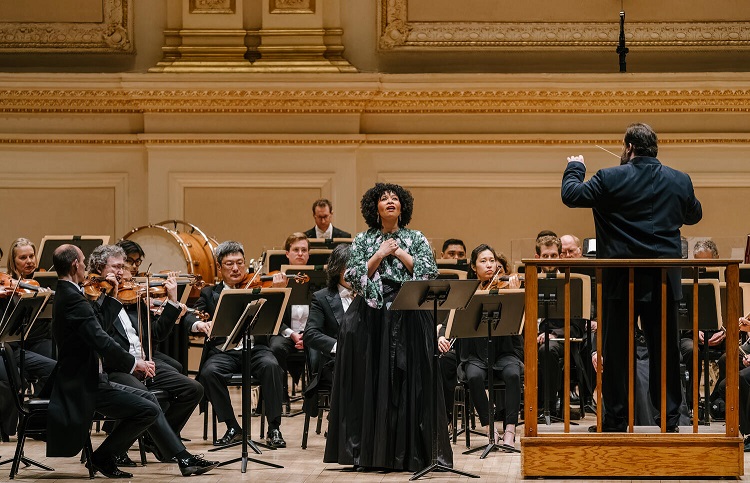
    Above: soprano Golda Schultz sings Sibelius; photo by Fad Kheir

    Two works by Sibelius book-ended the evening’s program. The vocal tone poem Luonnotar, Op. 70, is one of Sibelius’ most mystical and magical works. With text taken from the first “song” of the Finnish epic national poem Kalevala (a work that inspired several other major works from Sibelius), it tells the story of the (non-religious) Creation. The huge leaps and range of the vocal writing makes Luonnotar one of the most demanding works for a soprano, and South African soprano Golda Schultz was mesmerizing. Her rich voice is even throughout the range, even in the uppermost reaches it remains creamy and ravishing. Her breath control ensured she never ran out of air for Sibelius’ long and achingly beautiful melodies. Maestro Nelsons was sensitive to never let the orchestra drown out the singer. This is a work I wish would be performed more often.

    CH11371827_Medium_res

    Above: Maestro Nelsons and the BSO; photo by Fadi Kheir

    The concert ended with an expansive performance of Sibelius’ Symphony No. 5 in E-flat major, Op. 82. Sibelius’ sound-world is really like no other. I don’t think there is another composer who composed music of such surging coldness and brilliant light. You can feel the winds sweeping across the snow and the icy water glistening in the Sun. The episodic nature of Sibelius’ writing, in the hands of lesser conductors, can be difficult to stitch together. Maestro Nelsons managed it beautifully, and the Boston Symphony – which has a long history of playing Sibelius – responded to every nuance. The orchestra’s marvelous brass section deserves special recognition here because the very exposed writing for the horns in the first and third movements was played perfectly by the ensemble. The final movement, one of Sibelius’ most famous compositions, with the majestic tolling of the horns and sweeping melody from the strings, is one of those rare truly breathtaking glories of music. It’s interesting that this overwhelming section – supposedly inspired by a flock of swans he watched passing overhead – is only played in all its Romantic glory once. When it is repeated in the second half of the movement, it changes to a darker, almost sinister tone. And the work ends with 4 chords and 2 unisons – broken by pauses. A stark and startling conclusion.

    The Boston Symphony is second to none playing Sibelius; years ago Sir Colin Davis – one of the great exponents of the Finnish bard’s music – played and recorded his works with the BSO extensively. Andris Nelsons doesn’t miss a beat.

    Performance photos by Fadi Kheir, courtesy of Carnegie Hall

    ~ Ben Weaver

  • Bach’s Matthäus-Passion @ The NY Philharmonic

    Bach

    Author: Ben Weaver

    Saturday March 25th, 2023 – J.S. Bach’s Matthäus-Passion, composed around 1724-27 (and revised through 1742), is arguably Bach’s greatest composition. Personally, I’d place it in the top ten greatest works of Western music. The NY Philharmonic performs it infrequently; the last time was in 2008 under the baton of Kurt Masur. Running at roughly 2:45 hours, the Matthäus-Passion is a work filled with passion and drama…more drama than most church music. Anyone mocking Verdi’s Requiem as being more opera than mass perhaps should take a closer look Bach’s greatest work. Verdi was following in Bach’s mighty footsteps. I was very glad to see it on the program this year, finally! I quite literally got chills as the work started and the chorus (Musica Sacra) sang the opening words: “Kommt, ihr Töchter, helft mir klagen.” Alas, the thrills did not last; I was sadly disappointed with tonight’s performance.

    Tenor Nicholas Phan sang the very difficult part of the Evangelist, who narrates the story of Jesus’ arrest, the debate over what his fate should be, his execution, and its immediate aftermath (the Passion ends before the resurrection.) Much of the drama of the work flows through the Evangelist’s words. Mr. Phan managed the difficult music very admirably, but the part can be a trap dramatically: there are many proclamations like “And Jesus said unto him.” How does one make each one sound fresh? I don’t have a clear answer. I suppose if it was easy, anyone would be able to do it. 

    Bass-baritone Davóne Tines’ Jesus (Mr. Tines was the only person on stage wearing a costume: a white, sleeveless robe) possesses a large voice; but it’s a voice with a guttural quality, which seldom opens or blooms.

    Mezzo-soprano Tamara Mumford, a favorite at the Metropolitan Opera across the Plaza, sang nicely. “Buß und Reu” in Part I was vocally steady and clear. But in Part II, Maestro Jaap van Zweden robbed Ms. Mumford and concertmaster Frank Huang of an opportunity to give their all in “Erbarme dich”, perhaps  the Passion’s most famous aria; certainly its most emotional and devastating piece. Written for solo voice, solo violin, and orchestra, this breathtaking music has the ability to stop time. Alas, Maestro van Zweden took it at a preposterous Allegro tempo; he absolutely wrecked it by turning it into a cabaletta. If your tempo is faster than John Eliot Gardiner’s, Nikolaus Harnoncourt’s, Trevor Pinnock’s, and Gustav Leonhard’s – you may consider looking at the score again.

    Amanda forsythe

    Soprano Amanda Forsythe (above), making her Philharmonic subscription concert debut with these performances, was sublime. Her ability to float pianissimi high notes was indeed spine-tingling. The aria “Aus Liebe will mein Heiland sterben,” which also includes a flute solo by Robert Langevin, was the highlight of the evening. 

    The Philharmonic’s Principal Associate Concertmaster, Sheryl Staples, had a chance to shine in “Gebt mir meinen Jesum wieder,” with a difficult solo. Unfortunately, bass Philippe Sly, making his Philharmonic debut with these performances, had pitch difficulties which offset Ms. Staples fine playing. Tenor Paul Appleby was superb all evening, the high tessitura of the aria “Geduld” presenting no difficulties for him.

    The Choral group Musica Sacra was in excellent form all evening, from the Chorales to dramatic exchanges representing specific characters. The Brooklyn Youth Chorus sang the opening and closing choruses of Part I, but did not return for Part II. Can’t say if that was intentional or if something kept them from returning.

    I do hope the Matthäus-Passion returns to the Philharmonic again soon – under a more caring conductor.

    ~ Ben Weaver