Tag: Ben Weaver

  • Great Performers: Russian National Orchestra

    Thumbnail_Screen Shot 2019-02-22 at 3.36.48 PM

    Above: conductor Kirill Karabits; photo by Konrad Kwik

    ~ Author: Ben Weaver

    Wednesday February 20th, 2019 – The Russian National Orchestra’s highly anticipated visit to Lincoln Center’s Great Performers series with an all-Rachmaninoff concert drew a big and appreciative crowd, filled with many Russian-speakers who were buzzing about Mikhail Pletnev’s performance. Mr. Pletnev, star pianist and new conductor, was the founding conductor of the orchestra in the early 1990s after the collapse of the Soviet Union found many Soviet orchestras starved for money. Pletnev, pulling in financial backing from the West, formed the RNO and hired many leading musicians from the now former USSR’s other orchestras, creating something of an all-Star ensemble. It remains to this day Russia’s only privately-backed orchestra. Maestro Pletnev has since stepped back from full-time conducting duties and on Wednesday, February 20th appeared as soloist in Rachmaninoff’s 2nd Piano Concerto. Kirill Karabits, who has gained much attention as chief conductor of Bournemouth Symphony Orchestra, was on the podium.

    Pletnev entered to a warm welcome from the audience, dressed all in black, looking very Russian dour. The playing was anything but, however. The brief solo introduction, a series of dramatic chords before the orchestra enters with its famous first theme, showcased Pletnev’s strong, muscled tone. The muscle, however, is not lacking in musicality and lyricism. The orchestra entered with a very slow Moderato. I wondered how the choice of tempo would be able to sustain the musical line without breaking.
     
    At first both Pletnev and Karabits (via RNO) managed fine. Pletnev’s beautiful control of the piano’s dynamics, the legato of the playing, never ceding control to the orchestra, but also never showcasing himself for the sake of showboating, he seemed to be playing a concerto with piano, not just for it. This beautiful integration of sound, the marriage between the instruments, was lovely to behold. But as the movement began to build to its climax and the drama began to build, the slow tempo caught up to the proceedings. Pletnev suddenly felt muzzled, needing to take extended breaks between chords that are usually played together so that the orchestra could catch up. Pletnev seemed to desperately want to move forward and felt restrained; it created an uncomfortable pull and push between orchestra and conductor as the movement ended. The concerto’s famous Adagio sostenuto was lovely – piano and orchestra finally breathing as one, and the thrilling final Allegro showcased Pletnev’s effortlessly perfect finger work. The audience exploded with satisfaction and Pletnev gave a fascinating performance of Scarlatti’s Sonata in D minor, K.9, making it sound like ringing bells.
     
    Thumbnail_mikhail-pletnevcalexey-molchanovsky

    A
    bove: pianist Mikhail Pletnev; photo by Alexey Molchanovsky
     
    All ears were now on Kirill Karabits for Rachmaninoff’s ever-fresh Symphonic Dances, Op. 45, his final composition and one he considered his best. Written in 1941 while Rachmaninoff lived on Long Island, NY, the piece was dedicated to The Philadelphia Orchestra and Eugene Ormandy (who gave the world premiere performance in 1941) and intended to be a ballet choreographed by Mikhail Fokine. Alas, Fokine died before the project could be brought to fruition. (It has been choreographed by several leading choreographers since, including Peter Martins for New York City Ballet.) 
     
    Maestro Karabits, handsome, trim and in a perfectly fitted suit, is a fun conductor to watch, his wide, dramatic and balletic gestures helping to propel the music. The opening dance, Non allegro, was very dramatic with its driving, sharp rhythms nicely articulated; the mournful saxophone solo – and the other wind instruments – shone in the mournful sections of the movement – before the dramatic, Stravinskian rhythms return – only to dissipate like Loge’s Fire Music from Wagner’s Die Walküre, the first time I’ve made the musical connection between those two sections. The boozy, mysterious waltz of the second movement (when the Symphonic Dances were still a ballet, this was called “Midnight”), a cousin to Ravel’s La valse, sashayed nicely with its weird combination of sexiness and creepiness. The dramatic final movement, with its extensive quotations of Rachmaninoff’s favorite leitmotif, the Dies irae, was a thrilling, thundering conclusion to a perfectly paced performance. This was perhaps the most exciting performance of the Symphonic Dances I’ve heard live, so kudos to the superb Russian National Orchestra and maestro Karabits.
     
    The audience shared my enthusiasm and received 3 encores: a ravishing Rachmaninoff Vocalise, The Russian Sailors’ Dance from Glière’s The Red Poppy, and Lysenko’s Overture to Taras Bul’ba.
     
    ~ Ben Weaver

  • Weilerstein|Bychkov ~ All-Dvořák @ Carnegie Hall

    Af22462a9412c5a25af7c7678f4b1224

    Above: cellist Alisa Weilerstein

    Author: Ben Weaver

    Saturday October 27th, 2018 – The Czech Philharmonic Orchestra, under the direction of its chief conductor and music director Semyon Bychkov, rolled into Carnegie Hall on Saturday, October 27th for a two-concert visit. The first concert was an all-Dvořák program which featured two of the composer’s greatest works: the Cello Concerto (with soloist Alisa Weilerstein) and Symphony No. 7.

    Dvořák’s Cello Concerto was composed in New York City in 1894-95. Dvořák had long-held reservations about a concerto for the instrument: an early effort to write one in 1865 was left unfinished and lost until 1925; attempts by scholars to reconstruct it for performance have met with mixed results. But Dvořák was so impressed by a New York Philharmonic performance of Victor Herbert’s Cello Concerto No. 2 that he decided to try again. (Herbert, a highly successful composer of operettas in his own right, was principal cellist of the NY Philharmonic.) The resulting cello concerto by Dvořák, in the key of B minor, is arguably the greatest one of all. Brahms, for example, exclaimed: “Why on earth didn’t I know that a person could write a violoncello concerto like this? If I had only known, I would have written one long ago.”

    The opening Allegro begins with a mournful clarinet solo, a melody that reappears throughout the movement – and returns in the second half of the final movement. The cello enters playing the same melody, though in a different key. Alisa Weilerstein is one of the finest cellists in the world today and she held the audience spellbound with her passionate, emotionally generous and technically precise playing. With Maestro Bychkov, and an orchestra that has Dvořák in their bones, this was a performance from all that could not be improved. (Special recognition for the magnificent, soulful horn solo playing by, I assume from the roster, Kateřina Javůrková.) The lovely second movement, Adagio, contains Dvořák’s tribute to his dying sister-in-law Josefina (with whom he was secretly in love). He revised the finale of the concerto after returning to Prague and learning that Josefina had died. Dvořák inserted a melancholy section right before the end of the work. He wrote to the publisher: “The finale closes gradually, diminuendo – like a breath…”

    The audience greeted Ms. Weilerstein’s performance with a warm standing ovation. Weilerstein’s control of the instrument is superb. She manages to produce a million colors of sound, the rich and warm tone of her cello glows. The audience kept calling her to return, no doubt hoping for an encore. Alas, not on this night. But it’s hard to top perfection anyway.

    After the intermission the orchestra performed what many consider to be Dvořák’s finest symphony, No. 7, commissioned by the London Philharmonic Society in 1884. Dvořák himself conducted the premiere in 1885. The symphony opens with a sinister theme from the lower strings. This melody, and the dark mood, dominate the movement and haunt the rest of the symphony. No. 7 has a reputation as Dvořák’s tragic work and many conductors emphasize the darkness. But maestro Bychkov and the orchestra find more nuance here. Despite the somber mood of the opening movement there is plenty of humor too, including a lively Scherzo that could have been rejected from Dvořák’s Slavonic Dances. It is a truly great Symphony, even if has not gained the popularity of Symphonies Nos. 8 and 9.  And the Czech Philharmonic plays it better than anyone.

    The glowing strings, warm brass (no barking here), and the obvious love they have for this music are incomparable. Although most great orchestras can play everything well, there is something to be said for orchestras of a composer’s native land taking precedence in how their music can and should sound. Russians play Tchaikovsky better than anyone, Czech musicians do it with with Dvořák and Janáček, the French play French in ways most others simply don’t, an Italian voice can do things with a Verdi line that no one else can, etc. It’s not just about all the notes being played – any decent orchestra can do that – it’s about how the musicians feel about those notes. And this great orchestra clearly feels Dvořák’s music in a  singular way. It’s not just love for the music, it’s pride in the music. It is impossible to replicate anywhere else.

    You could hear and feel this uniqueness tonight, especially in the two encores: two Slavonic Dances, the lilting Starodávný (Op. 72, No. 2; surely one of Dvořák’s most memorable melodies) and the thrilling Furiant (Op. 46, No. 8). If you didn’t sway or tap along to this music, if you didn’t sing it to yourself, you weren’t doing it right.

    ~ Ben Weaver

  • An Evening With Freiburg Baroque

    Bb_freiburger-barockorchester-kristian-bezuidenhout-werke-von-haydn-mozart-und-j-chr-bach-2018_01_20170608

    ~ Author: Ben Weaver

    Saturday May 19th, 2018 – The period instrument ensemble Freiburg Baroque Orchestra (above) has been a favorite of mine on records for some time. I was glad to finally be able to hear them live – along with one of my favorite pianists, Kristian Bezuidenhout at the fortepiano. This concert of works by Haydn, J.C. Bach and Mozart was part of Lincoln Center’s Great Performers series. 

    Conducting from the keyboard in the uncomfortably warm Alice Tully Hall, Mr. Bezuidenhout launched the Freiburg Barockorchester into the opening chords of Haydn’s Symphony No. 74 (composed in 1781) with great enthusiasm. The musicians, standing around the fortepiano, all wore black and played beautifully.

    Period instruments can be an acquired taste. These instruments can go out of tune easily, and there is sometimes a nasal quality to the sound of the strings. But personally I love it, errant pitches and all. Though it should be noted that for the Freiburg Baroque musicians pitch was not an issue. Their ensemble work is flawless and the small number of players do not surrender anything in fullness and richness of sound. For this concert the orchestra was made up of 9 violinists, 3 violas, 2 cellos and 1 double-bass; with an assortment of winds and 2 horns.

    Haydn’s 74th Symphony was one of the first works he was able to publish independently and for his own profit while working for the Esterházys in Eisenstadt, Austria. It may be true that many of Haydn’s symphonies can be a bit workmanlike, but the 74th is one of his finest works, filled with lovely melodies and inventive orchestration. The second movement especially is lovely: an Adagio of muted violins playing lovely theme and variations over the cello playing a repeated motif, like a guitar accompanying a serenade. A lively Trio leads to an exciting whirlwind of the Allegro finale.

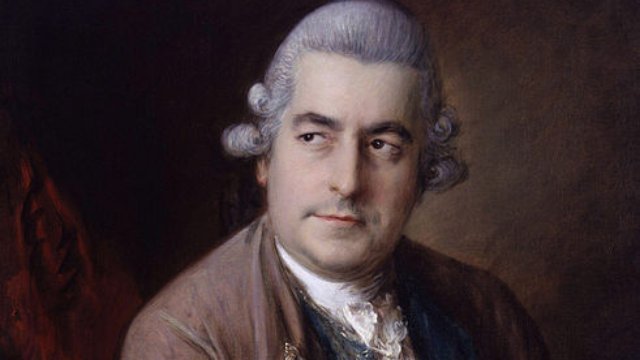
    Johann-christian-bach

    Johann Christian Bach (above) was the youngest of Johann Sebastian Bach’s sons and formed a direct link from the great Baroque master to the soon-to-be most important composer of the Classical era. When the Mozarts visited London in 1764, Wolfgang was 8 years old and J.C. Bach, recognizing talent in the young boy, played duets with him on the harpsichord and let him borrow music. Two years later, when Mozart tried his hand at composing piano concertos, he used J.C. Bach’s music as the foundation: 10 year old Mozart’s first 3 Piano Concertos are based on Johann Christian’s themes. And when Mozart heard of J.C. Bach’s death in 1782 he was in the middle of composing his 12th Piano Concerto. Mozart paid tribute to his old friend by basing the slow movement of the concerto on a melody from one of Bach’s operas, La calamità del cuore.

    While Johann Christian could never eclipse his father – a true titan – as a composer, he nonetheless became a very respectable musician in his own right. More than that, Johann Christian’s Symphony in G minor, Op. 6, No. 6 is something of a trailblazer of the symphonic repertoire. Composed some time in the 1760s, the G minor Symphony went beyond the usual sunny allegros and dances of other composers. Johann Christian offered something of a “sturm und drang” darkness in this work that would reach the peak of passion with Beethoven. The symphony opens with stormy strings and horns’ call to arms. There is an urgency to the music that an older Mozart and then Beethoven would bring over the edge. The slow movement, the Symphony’s longest movement, brings respite from urgency, but not darkness. Menacing horns return in the final Allegro molto. In this movement you can hear the winds Beethoven would one day raise in his Pastoral Symphony. But strangest of all is the Symphony’s conclusion: it simply stops, unresolved, in the middle of a thought. This is something no composer would seriously attempt until the end of the 19th century.

    Both Haydn and J.C. Bach were friends and mentors to the young Wolfgang Mozart. All 3 men composed memorable piano concertos, but Mozart’s compositions in the genre surpassed anyone who came before. Mozart’s 9th Piano Concerto, composed in Salzburg in 1777, is one of his most important compositions. It was the largest and most substantial composition of his to date, and it launched Mozart’s extraordinary development of the Piano Concerto into a centerpiece of not only his own output, but of the genre overall. The musicologist Alfred Einstein once called it “Mozart’s Eroica.”

    For many years the concerto was incorrectly called “Jeunehomme.” Nobody really knew who Jeunehomme was and it is only in 2004 that historian Michael Lorenz established that the confusion arose from the incorrect spelling of Victoire Jenamy, the highly regarded pianist and daughter of famous dancer and balletmaster Jean-Georges Noverre. The Mozarts had known the Noverres for some time, and Wolfgang gave the concerto to Ms. Jenamy as a gift of friendship between the two families when she stopped in Salzburg on her way to Paris from Vienna in 1777.

    The concerto opens with an unusual, almost instant entry of the fortepiano. Typically concertos began with extended orchestral introductions; indeed, most of Mozart’s own piano concertos do. But here Mozart wasted no time for the soloist. It’s a feature other major composers would not attempt until Beethoven’s 4th and 5th Piano Concertos a quarter century later. Composers like Grieg, Tchaikovsky and Rachmaninoff celebrated this invention with unforgettable results in their own times. The second movement, a lovely Andantino, contains magnificent writing for the piano, written almost like for a singing voice, and the final Rondo contains a surprising slow Minuet, perhaps Mozart’s nod to Ms. Jenamy’s father’s dancing career.

    The 17th Piano Concerto, written in 1784, may be from the early stages of Mozart’s maturity as a composer, but it is a fully developed and wonderful work. The orchestra begins the piece with a lively and extended introduction, like most of Mozart’s concertos. But once the pianoforte enters, Mozart displays an unerring sense of balance between the solo instrument and orchestra, the play between them, passing of melodies from one to the other – and to other solo instruments within the orchestra – was something few could do with the confidence of Mozart. The beautiful Andante is in a long line of unforgettable Mozart slow movements, at once charming and sad, with flashes of light and sudden clouds. Beautiful writing for the winds in the movement is particularly moving as well. The exuberant final movement is a reminder that Mozart often sounds easy – effortless – but, in fact, requires extraordinary virtuosity.

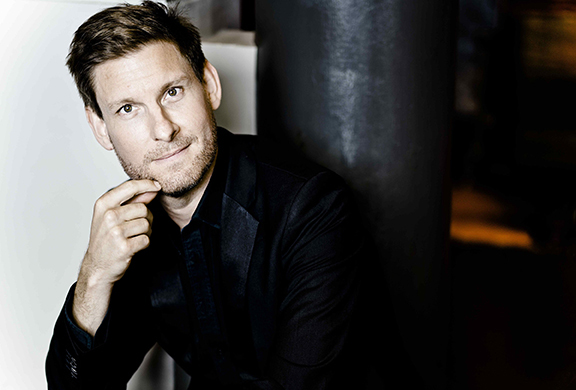
    Photos-4x

    Kristian Bezuidenhout (above, in a Marco Borggreve) portrait played these works magnificently. He played, of course, on a period fortepiano and hearing these concertos played on an instrument Mozart would have recognized is a fascinating experience. We are so used to the behemoth sound created by the modern Steinway Grand in a concert hall (accompanied by a far larger ensemble) that we forget how light and almost fragile these sounds originally were. The instrument (alas, the Playbill does not mention the specific period it replicates) has a pearly, mildly hollow sound. There are, of course, no pedals, so the sound produced is uniform and it is up to the player to truly create the effect he/she wishes to present. Mechanical trickery is not an option. Mr. Bezuidenhout is a magician in this regard. He may well be our most brilliant interpreter of Mozart’s music today. Undaunted by technical demands, he manages to conjure universes out of a small wooden box and a few strings. The rapport between him and Freiburg Baroque players is obvious; they have perfectly synced tempos and dynamics, and there were the warm glances and smiles exchanged as cues and between movements.

    The players all sat down on the risers to hear Mr. Bezuidenhout play an encore, a magical Allemande from Mozart’s unfinished Suite in C major (sounding like Papa Bach by way of Mozart).

    ~ Ben Weaver

  • Fellner|Eschenbach|NY Philharmonic

    Till-Fellner Gabriela Brandenstein

    Above: pianist Till Fellner, photographed by Gabriela Brandenstein

    ~ Author: Ben Weaver

    Saturday April 21st, 2018 – The great Austrian pianist Till Fellner made his belated NY Philharmonic debut last week with an unforgettable performance of Mozart’s Piano Concerto No. 22. Composed in 1785, while he was also composing Le Nozze di Figaro, the E-flat major concerto was following one of Mozart’s most famous works: the 21st concerto’s famous slow movement (two centuries later dubbed “Elvira Madigan” after it was used in a movie of that name.) 

    Whatever the 22nd lacks in fame, it most certainly is one of Mozart’s masterpieces. A big and extended orchestral introduction, which includes timpani and horns, leads to piano’s debut solo. There are several points in the concerto – not cadenzas – that showcase the piano playing without orchestral accompaniment. Mr. Fellner’s beautifully light and quick playing was superb. I have long been a big fan of is artistry: the clarity of his playing, the beauty of sound, perfectly controlled volume and runs, have long placed him among the best pianists of our time. In many ways he reminds me of Murray Perahia at his finest; that’s about the highest compliment I could pay a pianist. Fellner’s playing of this evening’s Mozart was as good as one could expect from anyone. Each note was like a pearl in sunlight. The depth of feeling in the leaping octaves of the slow movement were like love-sick sighs. I think this Andante may actually be Mozart’s most perfect slow movement. And the Allegro finale was thrilling, with some key contributions from flautist Robert Langevin and bassoonist Judith LeClair.

    Having a great concert pianist-cum-conductor Christoph Eschenbach on the podium was a great added bonus. Eschenbach, leading reduced forces of the NY Philharmonic, understands how to accompany the piano and showed extraordinary sensitivity, never rushing or fighting the solo instrument, allowing the piano to sing and lead. It was wonderful to finally have Mr. Fellner with the NY Phil, and I hope he will return regularly in the future.

    As an encore, Mr. Fellner played Liszt’s “Le lac de Wallenstadt” from “Album d’une voyageur“; he played it wonderfully.

    (Just as a side note: The magnificent final movement of the 22nd concerto was among works featured prominently in Miloš Forman’s film adaptation of “Amadeus.” The great Czech/American auteur, who also directed films  “One Flew Over The Cuckoo’s Nest” and “People vs. Larry Flynt,” and led the Columbia University film school for many years, passed away on April 13th.)

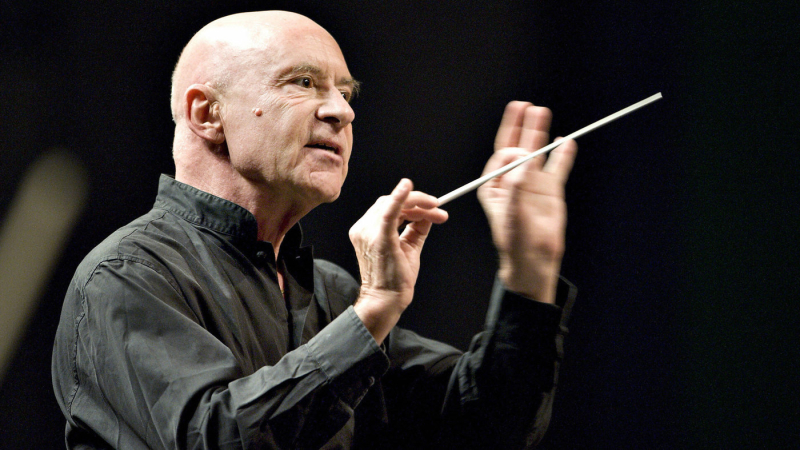
    Eschenbach

    Maestro Eschenbach (above) returned to the podium following the interval for Bruckner’s last, unfinished Symphony No. 9. In failing health for the entire composition of this work, Bruckner completed the first three movements and struggled with the finale for a year. He worked on it on the last day of his life, October 11, 1896. But he only left behind sketches (some fully scored) which were not enough for anyone to be able to legitimately piece together a full movement. (Though several have tried, none of the completions are more than curiosities.) Bruckner once suggested that his Te Deum should be performed as the finale if he did not finish the work; most people realize it was not a serious suggestion for a few reasons, one of which being that a choral finale would lead to comparisons to Beethoven’s 9th, which Bruckner would not have wanted. So the work is almost always performed in only three completed movements.

    The symphony begins with murmuring strings, interrupted by horns, like calls to battle. The brass section always gets big workouts playing Bruckner, and this evening they did not disappoint. Overall the orchestra were on spectacular form, and Maestro Eschenbach was able to corral the massive forces into a thundering wave. Bruckner had a truly unique gift for creating columns and walls of sound that sound like no one else’s. Many other composers could compose loud music, but there is something so unique and specific to Bruckner when he unleashes the full orchestra. As a listener, I often feel like I’m inside a cathedral and the walls are shaking with the voice of God. Of the great symphonists, Beethoven was able to represent musically the sounds of Earth. Sibelius is second to none to making us feel the chill of Mother Nature. Mahler could recreate the sounds of heaven. Shostakovich gave us sounds of man, in all his misery and triumph. Bruckner was a deeply religious man and I am not, but in these moments – and they exist in all of Bruckner’s works – I can imagine if God had a voice, he would sound like this.

    In the second movement, the Scherzo, the thundering march of doom is one of Bruckner’s most memorable moments. The relentless pounding of percussion and strings is stuff of nightmares. No doubt John Williams was aware of this Scherzo when he was scoring “Star Wars.” And the final Adagio is the perfect musical farewell, its conclusion sounding like a clock slowly running down.

    It is nice to have the orchestra seated on risers (a welcome change since Jaap van Zweden took over the Philharmonic as principal conductor) so one can see the various players in the back. Maestro Eschenbach also rearranged the cello and viola sections (for both Mozart and Bruckner) to have cellos on the right and violas in the middle next to the violins. Whether this was Eschenbach’s preference or a new full-time arrangement, we shall see.

    ~ Ben Weaver

  • Petrenko|Bayerisches Staatsorchester @ Carnegie Hall

    CH1375937

    Above: Kirill Petrenko on the Carnegie Hall podium; photo by Chris Lee

    ~ Author: Ben Weaver

    Wednesday March 28th, 2018 – Kirill Petrenko is finishing his term as the Generalmusikdirector of the Bavarian State Opera and in the 2019-20 season will take over as the chief conductor of the world’s most prestigious orchestra, Berlin Philharmonic. It is with the Bavarian State Opera forces (in the concert hall dubbed Bayerisches Staatsorchester) that Petrenko is making his Carnegie Hall debut this season. His only previous NYC appearances were at the Metropolitan Opera where he led a very memorable revival of Ariadne auf Naxos in 2005 and Khovanschina in 2012. For this Carnegie debut concert, Petrenko programmed two oft-forgotten works by two very famous composers: Johannes Brahms’ Double Concerto and Pyotr Tchaikovsky’s Manfred Symphony.

    Brahms composed the Concerto for Violin, Cello and Orchestra, Op. 102, in 1887. It was his last orchestral composition and it was greeted coolly even by ardent supporters like Eduard Hanslick. Soon Brahms himself was dismissing it as “folly” in letters to Clara Schumann. Neglected for many years, it certainly deserves to be heard more often; it surrenders nothing to his famed violin concerto in inspiration, melody and excitement. The writing may not seem as virtuosic as the violin concerto perhaps because Brahms composed a truly double concerto. The two instruments don’t have the kind of virtuosic writing that concertos often do. The music is more of a dialogue for violin and cello – and orchestra, too. It takes a great deal of camaraderie between the two soloists and conductor to bring the pieces together. Maybe it’s the lack of true star turns for the soloists that keeps some musicians away. But when played as superbly as it was by Julia Fischer and Daniel Müller-Schott, with Maestro Petrenko on the podium, the results are breathtaking.

    CH1375954

    Above: Julia Fischer and Daniel Müller-Schott playing the Brahms Double Concerto, with Maestro Petrenko; a Chris Lee photo

    The work begins with a dramatic and brief orchestral opening and immediately the cello launches into an extended solo. One of the few passages of this kind in the work, Müller-Schott immediately established himself as an artist. Rich and velvety notes poured from the instrument. Julia Fischer, a former child prodigy who has grown into a true artist of the violin, soon joined in for one of the concerto’s many extended conversations between the two instruments. Ms. Fischer’s sound is delicate and sweet, the notes rolling effortlessly from her bow. Fischer and Müller-Schott have collaborated many times over the years. Their discography together includes a lot of chamber music, as well as the Brahms concerto. Their musical partnership came across beautifully in the performance, whether playing in unison or handing off music back and forth, it’s the sort of relationship that takes time to develop. The hushed, pastoral-ish second movement was wondrous and the Bohemian inspired dances of the Finale were perfect. Maestro Petrenko and the superb Bayerisches Staatsorchester forces were excellent partners.

    Ms. Fischer and Mr. Müller-Schott gave an encore: an extended virtuoso piece: Passacaglia by Johann Halvorsen. It was really great!

    CH1375936

    Above: Julia Fischer and Daniel Müller-Schott, photo by Chris Lee

    Tchaikovsky’s largest orchestral work, the Manfred Symphony was composed in 1885, between his more famous 4th and 5th Symphonies. Inspired by Byron’s poem (Schumann composed a famous overture based on it as well), Tchaikovsky – already master of the large orchestral forces – outdid himself with sheer size of forces needed, including a harmonium (typically replaced by an organ in performances and recordings.) Initially Tchaikovsky considered it to be his finest composition, but after a mixed reception from critics and the public, in what was a common refrain of his life, turned on it and declared it awful; even considered destroying everything but the first movement. Fortunately his instinct to burn it did not come to pass because it is certainly one of his greatest works. And I often think it may be his greatest symphony.

    What I find astonishing about the Manfred Symphony is the sheer amount of invention – melodic and orchestration. In some ways it reminds me of Verdi’s Falstaff. Some complain that Verdi’s last opera is lacking in melody, but it might actually contain more melodies than all of his other works combined. They simply fly by and disappear so quickly that one can fail to notice. That’s my view of Tchaikovsky’s Manfred. The melodies and brilliant orchestration can be so sudden, so novel and so brief that it’s all gone and moved on to something else entirely before you realize what you just heard. It is truly a work that demands repeated hearings.

    The dark first movement depicts Manfred’s anguished wanderings in the Alps; “His life shattered…”, as the program note (by Mily Balakirev) describes. With halting phrases, Tchaikovsky depicts a peaceful pastoral one moment, Manfred’s pain the next. The explosive climax – one of Tchaikovsky’s most beautiful melodies – is hair-raising. I often hear it as a perfect musical accompaniment to the moment in Wuthering Heights where Heathcliff is found dead in Catherine’s room, thunder and lightning blaring outside. The two middle movements are, by contrast, blasts of light. The light fairy music of the Scherzo (in the program a fairy of the Alps appears to Manfred splashing in a waterfall) would have pleased Mendelssohn, I think. The slow third movement presents a portrait of a peaceful nature, something Beethoven would have recognized perhaps. And in the final movement, again a darkness descends. The music swirls and growls as Manfred visits the caves of Arimanes. And the anguished love theme from the first movement returns to signal Manfred’s death – greeted with an organ playing a hymn.

    The forces of the Bayerisches Staatsorchester played the work superbly. Kirill Petrenko led an all-around thrilling performance, goading the players to play bigger and louder (I was reminded of the famous story of Richard Strauss rehearsing Elektra and yelling to the players: “Louder, louder! I can still hear Madam Schumann-Heink!”) But effortlessly bringing volume and emotion down to a whisper when needed as well. Though Manfred has long been neglected (many complete recorded cycles of Tchaikovsky’s symphonies do not include it), over the past few years it has been heard in NYC several times. New York Philharmonic played it with Semyon Bychkov (one of Petrenko’s mentors) and Vienna Philharmonic played it at Carnegie with Valery Gergiev. Perhaps Maestro Bychkov’s performance was bigger. The NY Philharmonic’s heavier sound might account for the bigger bombast. Bayerisches Staatsorchester has a leaner, more pointed sound overall. It provided greater transparency in the more heavily orchestrated parts (and there are many.) Personal tastes will vary on the preferred sound. But no doubt Kirill Petrenko led a superb night of music-making. His future with the Berlin Philharmonic is very exciting.

    CH1375935

    Above: Kirill Petrenko and the musicians of the Bayerisches Staatsorchester acknowledge the applause at the close of this evening’s concert; photo by Chris Lee

    ~ Ben Weaver

  • American Symphony Orchestra Presents ‘Hollow Victory’

    Weinberg

    Above: composer Mieczysław Weinberg

    ~ Author: Ben Weaver 

    Sunday February 29th, 2018 – Leon Botstein and his American Symphony Orchestra always present interesting programming of rarely-performed works. On January 28th, the theme was “Jews in Soviet Russia after the World War” and was perhaps one of their finest concerts. Presented were three works by two composers: first half was dedicated to Mieczysław Weinberg and second half to Vieniamin Fleishman. Both men were close friends with Dmitri Shostakovich, whose influence can be heard in their works.

    Mieczysław Weinberg is perhaps the better-known of the two. Born in 1919 in Warsaw, Poland into an artistic family (his father was a conductor and composer of the Yiddish theater and his Ukrainian-born mother was an actress.) During the war his parents and younger sister were interned in the Lodz ghetto and died in the Trawnicki concentration camp. After the war, in the Soviet Union where he settled, Weinberg was arrested by the KGB in 1953. Shostakovich’s personal appeal to Lavrenti Beria – and Stalin’s death soon thereafter – saved Weinberg’s life. Weinberg’s vast musical output includes 22 symphonies, 17 string quartets, 9 violin sonatas, 7 operas, 40 film and animation scores (including for the Palm d’Or-winning film “The Cranes are Flying.”)

    Leon Botstein began the concert with Weinberg’s “Rhapsody on Moldavian Themes,” composed in 1949. An ancient state – forced to be one of the Soviet Union’s republics between 1940 and 1991 – Moldavia’s culture is closely related to Romania’s and it’s folk melodies sometimes will bring to mind folk melodies Brahms and Dvořák used in their famous collection of dances. Weinberg’s Rhapsody begins with a drive from the low strings and then an oboe introduces the first mournful theme. The Rhapsody moves easily between the mournful and infectious dance tunes, alternating soaring full string section and solos for individual instruments. There is a definite Klezmer dance tune near the end, which brings the work to an exciting close.

    Weinberg’s substantial Symphony No. 5, composed in 1962, without a doubt takes inspiration from Shostakovich’s Symphony No. 4, which though it was premiered in 1961 was composed 25 years earlier, and Weinberg and Shostakovich used to play a two piano arrangement of it for friends long before the premiere. The work opens with a slow “siren,” two repeated notes, from the violins. This motif returns over and over throughout the symphony like a wail of doom, sometimes picked up by other instruments. There are sudden interruptions from the timpani, bringing to mind Mahler’s 6th Symphony. There are beautiful and beautifully-played solos for various instruments, most notably the flute (Yevgeny Faniuk is listed as principal flautist) and horn (Zohar Schondorf)). The Symphony ends with a hushed march, growling trombones and a mysterious celesta.

    Veniamin Fleischman was born in 1913 and entered the Leningrad Conservatory in 1939. His teacher, Shostakovich, called Fleishman his favorite student. While a student, on Shostakovich’s suggestion, Fleishman began composing the opera “Rothschild’s Violin,” from a short story by Chekhov. (Fleishman wrote his own libretto.) When the Nazis invaded the USSR in the summer of 1941 Fleishman enlisted in the Red Army and was killed on September 14 near Leningrad. Shostakovich went to great lengths to retrieve Fleishman’s manuscript of the opera. He completed and orchestrated the work in 1943-44, and later went to great lengths to have it performed, though without much success. Its sympathetic portrayal of Jewish people no doubt did not fit comfortably with the Soviet regime. There was one concert performance in Moscow in 1960 and a staged performance did not take place until 1968. Shostakovich wrote in his memoirs: “It’s a marvelous opera – sensitive and sad. There are no cheap effects in it; it is wise and very Chekhovian. I’m sorry that theatres pass over Fleishman’s opera. It’s certainly not the fault of the music, as far as I can see.” 

    The main character, a Christian coffin maker Yakov Ivanov, undergoes a spiritual crises and something of an awakening. After Yakov’s wife Marfa informs him that she is dying, they both reminisce about their dead child, and Yakov realizes he will have to build his own wife’s coffin. “Life is all loss, only death is gain,” he says. Though Yakov quarrels with Rothschild, the young flautist in the local Jewish orchestra, at the end he leaves Rothschild his most prized possession: the violin, which Rothschild begins to play as the opera ends.

    Rothschild’s Violin” is a magnificent opera. Fleishman, editing Chekov’s story, brilliantly removed all secondary characters and stories, keeping only the story of the coffin-maker. We know nothing even about the young Jew to whom Yakov leaves his violin; nor about Yakov’s wife Marfa, who is dying. This is a story of one man, there are no loungers or pauses in the narrative. It moves quickly through monologues and dialogues, only pausing for Yakov’s final apotheosis where he comes to understand his life and losses. Though the characters, especially Marfa, feel sorry for themselves, there is no sentimentality or cheap dramatic effects. The simplicity of it is what gives the work so much power.

    220px-Mikhail_Svetlov_bass.jpg_300_(2)

    The quartet of singers assembled for the opera was perfect. Bass Mikhail Svetlov (above) was a deeply moving and beautifully sung Yakov. The only native Russian speaker in the cast, he projected the text and all its nuances in a way few can. His is a big, rich voice, with an easy top.

    Index

    Mezzo-soprano Jennifer Roderer (above) was a plum-voiced Marfa; managing to be both a nagging self-pitying wife and a woman who, perhaps on her deathbed, has obviously suffered so much. What kept flying through my head as she was singing is that Ms. Roderer’s large, beautiful and booming mezzo would make a fantastic Fricka; it is a role she sings and we can only hope she is able to sing it at the Metropolitan Opera (which is supposed to bring back its Ring cycle soon.)

    M heller

    Tenor Marc Heller (above), singing the role of the leader of the Jewish orchestra, would make a pretty good Siegfried. The huge, ringing voice flew easily over the orchestra and Maestro Botstein’s rather unforgiving volume.

    AaronBlake200

    Lyric tenor Aaron Blake (above) was a lovely and nervous young Rothschild. There is actually very little for Rothschild to sing, so Mr. Blake made up for it with pantomime acting, particularly at the end after Yakov has gifted him his fiddle (kindly loaned for the proceedings by a violinist on stage), and an extended orchestral postlude (including lovely solo violin playing by concertmaster Gabrielle Fink) summarizes not only Yakov’s sacrifice, but Rothschild’s future. Intentionally or not, there was something quite poetic and moving in the fact that a member of the orchestra gave up her violin and was not able to play the extended orchestral passage in the end, mirroring Yakov’s own losses.

    It is also worth nothing that the final orchestral passage goes from being lightly scored and transparent to having a very close resemblance to the searing final moments of Shostakovich’s 5th Symphony.

    Rothschild’s Violin” is a great opera; it deserves to be staged.

    ~ Ben Weaver

  • American Symphony Orchestra Presents ‘Hollow Victory’

    Weinberg

    Above: composer Mieczysław Weinberg

    ~ Author: Ben Weaver 

    Sunday February 29th, 2018 – Leon Botstein and his American Symphony Orchestra always present interesting programming of rarely-performed works. On January 28th, the theme was “Jews in Soviet Russia after the World War” and was perhaps one of their finest concerts. Presented were three works by two composers: first half was dedicated to Mieczysław Weinberg and second half to Vieniamin Fleishman. Both men were close friends with Dmitri Shostakovich, whose influence can be heard in their works.

    Mieczysław Weinberg is perhaps the better-known of the two. Born in 1919 in Warsaw, Poland into an artistic family (his father was a conductor and composer of the Yiddish theater and his Ukrainian-born mother was an actress.) During the war his parents and younger sister were interned in the Lodz ghetto and died in the Trawnicki concentration camp. After the war, in the Soviet Union where he settled, Weinberg was arrested by the KGB in 1953. Shostakovich’s personal appeal to Lavrenti Beria – and Stalin’s death soon thereafter – saved Weinberg’s life. Weinberg’s vast musical output includes 22 symphonies, 17 string quartets, 9 violin sonatas, 7 operas, 40 film and animation scores (including for the Palm d’Or-winning film “The Cranes are Flying.”)

    Leon Botstein began the concert with Weinberg’s “Rhapsody on Moldavian Themes,” composed in 1949. An ancient state – forced to be one of the Soviet Union’s republics between 1940 and 1991 – Moldavia’s culture is closely related to Romania’s and it’s folk melodies sometimes will bring to mind folk melodies Brahms and Dvořák used in their famous collection of dances. Weinberg’s Rhapsody begins with a drive from the low strings and then an oboe introduces the first mournful theme. The Rhapsody moves easily between the mournful and infectious dance tunes, alternating soaring full string section and solos for individual instruments. There is a definite Klezmer dance tune near the end, which brings the work to an exciting close.

    Weinberg’s substantial Symphony No. 5, composed in 1962, without a doubt takes inspiration from Shostakovich’s Symphony No. 4, which though it was premiered in 1961 was composed 25 years earlier, and Weinberg and Shostakovich used to play a two piano arrangement of it for friends long before the premiere. The work opens with a slow “siren,” two repeated notes, from the violins. This motif returns over and over throughout the symphony like a wail of doom, sometimes picked up by other instruments. There are sudden interruptions from the timpani, bringing to mind Mahler’s 6th Symphony. There are beautiful and beautifully-played solos for various instruments, most notably the flute (Yevgeny Faniuk is listed as principal flautist) and horn (Zohar Schondorf)). The Symphony ends with a hushed march, growling trombones and a mysterious celesta.

    Veniamin Fleischman was born in 1913 and entered the Leningrad Conservatory in 1939. His teacher, Shostakovich, called Fleishman his favorite student. While a student, on Shostakovich’s suggestion, Fleishman began composing the opera “Rothschild’s Violin,” from a short story by Chekhov. (Fleishman wrote his own libretto.) When the Nazis invaded the USSR in the summer of 1941 Fleishman enlisted in the Red Army and was killed on September 14 near Leningrad. Shostakovich went to great lengths to retrieve Fleishman’s manuscript of the opera. He completed and orchestrated the work in 1943-44, and later went to great lengths to have it performed, though without much success. Its sympathetic portrayal of Jewish people no doubt did not fit comfortably with the Soviet regime. There was one concert performance in Moscow in 1960 and a staged performance did not take place until 1968. Shostakovich wrote in his memoirs: “It’s a marvelous opera – sensitive and sad. There are no cheap effects in it; it is wise and very Chekhovian. I’m sorry that theatres pass over Fleishman’s opera. It’s certainly not the fault of the music, as far as I can see.” 

    The main character, a Christian coffin maker Yakov Ivanov, undergoes a spiritual crises and something of an awakening. After Yakov’s wife Marfa informs him that she is dying, they both reminisce about their dead child, and Yakov realizes he will have to build his own wife’s coffin. “Life is all loss, only death is gain,” he says. Though Yakov quarrels with Rothschild, the young flautist in the local Jewish orchestra, at the end he leaves Rothschild his most prized possession: the violin, which Rothschild begins to play as the opera ends.

    Rothschild’s Violin” is a magnificent opera. Fleishman, editing Chekov’s story, brilliantly removed all secondary characters and stories, keeping only the story of the coffin-maker. We know nothing even about the young Jew to whom Yakov leaves his violin; nor about Yakov’s wife Marfa, who is dying. This is a story of one man, there are no loungers or pauses in the narrative. It moves quickly through monologues and dialogues, only pausing for Yakov’s final apotheosis where he comes to understand his life and losses. Though the characters, especially Marfa, feel sorry for themselves, there is no sentimentality or cheap dramatic effects. The simplicity of it is what gives the work so much power.

    220px-Mikhail_Svetlov_bass.jpg_300_(2)

    The quartet of singers assembled for the opera was perfect. Bass Mikhail Svetlov (above) was a deeply moving and beautifully sung Yakov. The only native Russian speaker in the cast, he projected the text and all its nuances in a way few can. His is a big, rich voice, with an easy top.

    Index

    Mezzo-soprano Jennifer Roderer (above) was a plum-voiced Marfa; managing to be both a nagging self-pitying wife and a woman who, perhaps on her deathbed, has obviously suffered so much. What kept flying through my head as she was singing is that Ms. Roderer’s large, beautiful and booming mezzo would make a fantastic Fricka; it is a role she sings and we can only hope she is able to sing it at the Metropolitan Opera (which is supposed to bring back its Ring cycle soon.)

    M heller

    Tenor Marc Heller (above), singing the role of the leader of the Jewish orchestra, would make a pretty good Siegfried. The huge, ringing voice flew easily over the orchestra and Maestro Botstein’s rather unforgiving volume.

    AaronBlake200

    Lyric tenor Aaron Blake (above) was a lovely and nervous young Rothschild. There is actually very little for Rothschild to sing, so Mr. Blake made up for it with pantomime acting, particularly at the end after Yakov has gifted him his fiddle (kindly loaned for the proceedings by a violinist on stage), and an extended orchestral postlude (including lovely solo violin playing by concertmaster Gabrielle Fink) summarizes not only Yakov’s sacrifice, but Rothschild’s future. Intentionally or not, there was something quite poetic and moving in the fact that a member of the orchestra gave up her violin and was not able to play the extended orchestral passage in the end, mirroring Yakov’s own losses.

    It is also worth nothing that the final orchestral passage goes from being lightly scored and transparent to having a very close resemblance to the searing final moments of Shostakovich’s 5th Symphony.

    Rothschild’s Violin” is a great opera; it deserves to be staged.

    ~ Ben Weaver

  • The Orchestra Now: Penderecki & Holst

    Falletta

    Above: conductor JoAnn Falletta, photo by Cheryl Gorski

    ~ Author: Ben Weaver

    Thursday December 14th, 2017 – TŌN (The Orchestra Now) consists of musicians from leading musical conservatoires around the globe, including Julliard, Curtis and Shanghai Conservatory. I’ve heard less impressive and less cohesive playing from big name orchestras. Under the baton of JoAnn Falletta, the concert was a thrilling evening of superb music-making. And filling the entire stage of Alice Tully Hall at Lincoln Center, one was overwhelmed by the sheer impact and presence of their sound. It rather reinforced my belief that David Geffen Hall truly does have dreadful acoustics. Granted, Alice Tully is a much smaller hall, but it’s not the volume alone that impresses. NY Philharmonic can be plenty loud too. It’s feeling the sound envelop you and pins you to your seat that can be truly breathtaking. This does not happen at David Geffen Hall.

    John Adams’ “Short Ride in a Fast Machine” is about five minutes of pure adrenaline. Its percussive opening sets the tone for a repeating loop of fanfares, shrieking woodwinds, and stabbing violins. Adams once described the piece: “You know how it is when someone asks you to ride in a terrific sports car, and then you wish you hadn’t?” Composed in his trademark post-minimalist style, the work constantly shifts, turns, and twists, and the young musicians played it without fear.

    Krzysztof Penderecki is one of the giants of contemporary classical music. His “Concerto Doppio”, completed in 2012, was originally written for violin and viola, but in this TŌN concert the version for violin and cello was performed instead, with soloists Dennis Kim and Roman Mekinulov, respectively.

    Penderecki intended the solo instruments to be adapted to whatever string instruments are needed for the concert, in the style of J.S. Bach perhaps, who allowed arrangements of a lot of his music for different instruments on as-needed basis. This concerto – proving that great music is still being written – begins unusually with an extended duet for the solo instruments. In fact, the entire concerto is something of a conversation between soloists and orchestra. The music alternates from the largely (or entirely) unaccompanied solo instruments back to the orchestra, and so on. The opening minutes had something of Arvo Pärt’s instrumental chanting, and throughout one could grasp influences from Bach and Shostakovich. The concerto’s end reminded me very much of the hushed conclusion of the first movement of Shostakovich’s Symphony No. 4.

    Falletta allowed the excellent soloists, Kim and Mekinulov, to play without conducting them. As so much of their music really is an unaccompanied duet, it allowed the musicians a great deal of flexibility and freedom.

    After the intermission, the orchestra played one of the most popular of all orchestral works: Holst’s “The Planets.” It is appropriate that the concert was given on the day the new Star Wars film, “The Last Jedi,” was released. Hearing the work once again I am struck by how much composer John Williams borrowed from Holst to write the legendary film scores.

    Again, to hear such a great and inventive orchestral work for a large orchestra in a hall like Alice Tully was very exciting. Holst’s endless stream of melodies and remarkable orchestration is a war-horse for a good reason and I do not tire of hearing it. The orchestra played it superbly, relishing every note.

    No doubt many of the musicians were playing it for the first time. I am reminded of a story – perhaps a myth – about Fritz Reiner rehearsing Wagner’s “Die Meistersinger” overture, and one musician kept making a mistake. When Reiner called him out, the musician said: “I am sorry, Maestro, I am playing this for the first time.” Reiner is said to have replied: “Oh, how I envy you.”

    It is not easy to make a work as familiar as “The Planets” sound fresh, but the wonderful young TŌN Orchestra, under JoAnn Falletta’s inspired leadership, not only made it sound fresh, they did it without any noticeable mistakes.

    ~ Ben Weaver
  • The Orchestra Now: Penderecki & Holst

    Falletta

    Above: conductor JoAnn Falletta, photo by Cheryl Gorski

    ~ Author: Ben Weaver

    Thursday December 14th, 2017 – TŌN (The Orchestra Now) consists of musicians from leading musical conservatoires around the globe, including Julliard, Curtis and Shanghai Conservatory. I’ve heard less impressive and less cohesive playing from big name orchestras. Under the baton of JoAnn Falletta, the concert was a thrilling evening of superb music-making. And filling the entire stage of Alice Tully Hall at Lincoln Center, one was overwhelmed by the sheer impact and presence of their sound. It rather reinforced my belief that David Geffen Hall truly does have dreadful acoustics. Granted, Alice Tully is a much smaller hall, but it’s not the volume alone that impresses. NY Philharmonic can be plenty loud too. It’s feeling the sound envelop you and pins you to your seat that can be truly breathtaking. This does not happen at David Geffen Hall.

    John Adams’ “Short Ride in a Fast Machine” is about five minutes of pure adrenaline. Its percussive opening sets the tone for a repeating loop of fanfares, shrieking woodwinds, and stabbing violins. Adams once described the piece: “You know how it is when someone asks you to ride in a terrific sports car, and then you wish you hadn’t?” Composed in his trademark post-minimalist style, the work constantly shifts, turns, and twists, and the young musicians played it without fear.

    Krzysztof Penderecki is one of the giants of contemporary classical music. His “Concerto Doppio”, completed in 2012, was originally written for violin and viola, but in this TŌN concert the version for violin and cello was performed instead, with soloists Dennis Kim and Roman Mekinulov, respectively.

    Penderecki intended the solo instruments to be adapted to whatever string instruments are needed for the concert, in the style of J.S. Bach perhaps, who allowed arrangements of a lot of his music for different instruments on as-needed basis. This concerto – proving that great music is still being written – begins unusually with an extended duet for the solo instruments. In fact, the entire concerto is something of a conversation between soloists and orchestra. The music alternates from the largely (or entirely) unaccompanied solo instruments back to the orchestra, and so on. The opening minutes had something of Arvo Pärt’s instrumental chanting, and throughout one could grasp influences from Bach and Shostakovich. The concerto’s end reminded me very much of the hushed conclusion of the first movement of Shostakovich’s Symphony No. 4.

    Falletta allowed the excellent soloists, Kim and Mekinulov, to play without conducting them. As so much of their music really is an unaccompanied duet, it allowed the musicians a great deal of flexibility and freedom.

    After the intermission, the orchestra played one of the most popular of all orchestral works: Holst’s “The Planets.” It is appropriate that the concert was given on the day the new Star Wars film, “The Last Jedi,” was released. Hearing the work once again I am struck by how much composer John Williams borrowed from Holst to write the legendary film scores.

    Again, to hear such a great and inventive orchestral work for a large orchestra in a hall like Alice Tully was very exciting. Holst’s endless stream of melodies and remarkable orchestration is a war-horse for a good reason and I do not tire of hearing it. The orchestra played it superbly, relishing every note.

    No doubt many of the musicians were playing it for the first time. I am reminded of a story – perhaps a myth – about Fritz Reiner rehearsing Wagner’s “Die Meistersinger” overture, and one musician kept making a mistake. When Reiner called him out, the musician said: “I am sorry, Maestro, I am playing this for the first time.” Reiner is said to have replied: “Oh, how I envy you.”

    It is not easy to make a work as familiar as “The Planets” sound fresh, but the wonderful young TŌN Orchestra, under JoAnn Falletta’s inspired leadership, not only made it sound fresh, they did it without any noticeable mistakes.

    ~ Ben Weaver

  • EUGENE ONEGIN @ The Met

    Netrebko ONEGIN

    Above: Anna Netrebko as Tatiana

    Author: Ben Weaver

    Saturday April 22nd, 2017 matinee – Tchaikovsky’s operatic adaptation of Pushkin’s “Eugene Onegin” arrived this Spring at the Metropolitan Opera. Today, the season’s final performance of the opera was telecast via HD to cinemas around the world. It’s a practice that has been contributing to the hemorrhaging of live audience attendance for the house. The Met auditorium has countless empty seats more often than not, and many of those that are filled are actually papered and subsidized by donors. Today’s ONEGIN matinee was one of only two performances of the opera that actually sold out.

    Robin-Ticciati

    In the pit was the English conductor Robin Ticciati (above). He led a really magnificent reading the score, the Met Orchestra responding to Tchaikovsky’s superb orchestration with perfection. Ticciati was careful not to overwhelm the singers with sound (Tchaikovsky’s orchestral writing is often dense). There was a wonderful lightness to his interpretation, each musical strand rising magically out of the tapestry of sound. His energetic, forward moving pacing mostly worked well. Perhaps if Tatiana in her Letter Scene and Lensky in his Act II aria had been allowed to linger just a tad longer…but overall Tchaikovsky’s magical score danced and sighed superbly.

    The cast assembled for the revival of this 2013 production was first rate. At the heart of it was Anna Netrebko as Tatiana. When Netrebko first sang the role at the Met in 2013 I did not think she made a great impression. Primarily I objected to her bland reading of the text, disappointing for a native speaker. She has certainly been able to deepen her understanding of the role. This afternoon she was a living, breathing heroine. Her Letter Scene was by turns wistful and sad, excited and terrified. Fear as she awaits Onegin’s arrival, and shame at his rejection, were palpable. Haughtiness, in a crimson gown at the royal ball in Act III as she sees Onegin for the first time in many years, was delicious. And the final scene revealed verismo-ish declarations that she will not betray her husband. I suddenly remembered that Netrebko has sung Lady Macbeth and intends to sing Tosca too. These flashes of pure steel were thrilling. Vocally she was excellent. There are occasional tendencies (not new to her) to stray off pitch in her middle voice. But her top was strong and gleaming, and the aforementioned steel in the final scene brought to mind Galina Vishnevskaya. The young, impressionable Tatiana is a woman now, royalty even. She won’t let Onegin forget this.

    Mattei ONEGIN

    Peter Mattei as Onegin (above) was in stunning voice. Truly this is one of the most beautiful baritone sounds in the world. Soft and plush, but not lacking in volume. Mattei’s long-limbed figure undergoes a reverse transformation of Tatiana. Haughty and indifferent at first, he unravels as Tatiana grows in stature. While Mattei’s singing was beyond reproach, his Russian diction was quite poor. In Act 1 it was still recognizable as Russian. Alas, as the opera progressed I often wasn’t sure he was singing in Russian at all, or just making sounds intended to sound vaguely Slavic.

    Russian tenor Alexei Dolgov was a terrific Lensky. His singing is effortless. Perhaps his neurotic, bordering hysteric Lensky would not be to all tastes, but it was believable, and – again – the singing was terrific. His Act II aria was heart-wrenching; his Russian diction crystal clear. Elena Maximova, as Lensky’s fiancée Olga, did everything right dramatically and musically. Perhaps the voice is a bit too monochrome and lacks warmth, but during the Act II ball she wonderfully conveyed a flirty, young woman who only too late realizes that her behavior towards her fiancée will lead to tragedy.

    It is a great touch to have a young bass play Prince Gremin. Usually Gremin is seen as an old man, but a youthful Stefan Kocan, with the necessary low notes in full bloom, leaves no doubt why Tatiana would refuse to leave him for a now-pathetic Onegin. 

    It was wonderful to see and hear two veteran Russian mezzos as the matriarchs. Elena Zaremba as Madame Larina showed off a still gleaming, forceful mezzo, effortlessly dominating ensembles. The great Larissa Diadkova, long one of my favorite singers, was a superb Filippyevna. There is still much voice left and dramatically her fussy Nanny was by turns funny and deeply moving as she recalls her own youth. My first live Filippyevna was the legendary Irina Arkhipova making a much belated Met debut in 1997. It is the highest compliment I can pay Diadkova to say that she is in the Arkhipova stratosphere of artists. 

    There were wonderful supporting appearances by Tony Stevenson as Triquet (lovely singing of the birthday song; it’s a character that can be very grating, but Stevenson is a superb character singer/actor), Richard Bernstein as Zaretski, and David Crawford as a Captain. The chorus was in excellent form, under the leadership of Donald Palumbo. 

    The big problem with the Met’s ONEGIN, alas, is the mediocre-to-terrible production by Deborah Warner, sets by Tom Pye, costumes by Chloe Obolensky and lighting by Jean Kalman. Warner’s boring conception is old-fashioned in the worst sense of the word. I’m as fond of a “period appropriate” production as anyone, but Warner’s staging contributes nothing to the work. The previous, gorgeous production by Robert Carsen showed more depth with a simple white box and autumn leaves than Warner and team manage with stuffy period detail. The silly “when in doubt, just lay down on the stage” trope should be made illegal. All of Act I is set in the Larin country home living room. Why the family would bring their entire farming staff in there, and then allow people to throw wheat on the living room floor, is a mystery. The Duel scene is the most effective, a moody wintry landscape. But the columns in all of Act III are simply too large, sitting like titans, distracting from any and all action on the stage. 

    So it was the superb cast of singing actors, the orchestra, and thrilling conducting by Ticciati that made this ONEGIN a superb musical event.

    ~ Ben Weaver