Tag: Ken Howard

  • @ My MET Score Desk for the New AIDA/3rd of 3

    Garace jagde ken howard

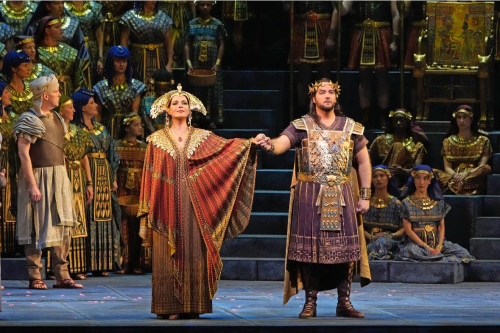
    Above: Elīna Garanča and Brian Jagde as Amneris and Radames; a Ken Howard/MET Opera photo

    ~ Author: Oberon

    Sunday April 27th, 2025 matinee – Two of the opera world’s brightest stars joined the cast today for the first of four Metropolitan Opera performances of Verdi’s AIDA, concluding this season’s run of the new production: Elīna Garanča, who had recently withdrawn from some European performances but who thankfully made it here to sing for us, was Amneris this afternoon, and the great Mongolian baritone Amartuvshin Enkhbat, whose Met debut as Germont in 2022 was truly impressive, as was his Amonasro this afternoon. Both of these singers came to worldwide recognition after participating in the Cardiff Singer of the World competition, the mezzo in 2001 and the baritone in 2015.  

    The only aspect of today’s performance that I wasn’t looking forward to was the presence on the podium of Yannick Nézet-Séguin, whose fast-and-loud, brass-happy conducting has spoiled several Met performances for me. 

    After a the opera’s expressive prelude, superbly played by the MET Orchestra, the huge voice of Morris Robinson drew us immediately into the story. As Radames, the stentorian tenor sound of Brian Jagde responded to the hint that Robinson/Ramfis had just dropped with an urgent recitative and then commenced the “Celeste Aida” which was taken a bit faster than usual; the tenor’s massive top notes immediately impressed the crowd, winning Jagde enthusiastic applause: with this man in command, the Egyptians were sure to win the coming battle.

    Ms. Garanča as Amneris enters, immediately making a lovely vocal impression as a lyrical princess; in her elegant phrasing, her every note spoke of her deep affection for Radames. A dulcet clarinet solo introduces Angel Blue’s Aida. The orchestra was sometimes too loud during the ensuing trio.

    Krzysztof Bączyk immediately made an excellent vocal impression as the King, as did the clear-toned Messenger of Yongzhao Yu. “Su del Nilo” felt a bit rushed, but Mr. Bączyk and Mr. Robinson traded bass sonorities to fine effect. Ms. Garanča chimes in…but from the pit, a N-S noise fest is developing. Angel Blue soars above the ensemble, then immediately commences “Ritorna vincitor!” in which Aida’s dilemma is introduced: she is torn between her love for Radames and love of her homeland. Some nice, chesty resonances underscore her anguish, though her topmost range seemed a bit tight. Her lyrical, prayerful ending of the aria was truly beautiful.

    As the action moves to the Temple of Vulcan, Tessa McQueen’s offstage Priestess is too far upstage to make an immediate impression but soon she is moved to a more congenial spot from which to display her attractive voice. There are lovely harmonies from the priests, and then ballet commences, only to have the music’s beautiful sense of calm (played with nice rubato touches) spoilt by someone’s coughing fit. Morris Robinson’s fabulous introduction to the consecration ritual, and Mr. Jagde’s heroic response, soon fall victim to over-playing from the N-S pit, nearly swamping the voices. 

    Bringing the house lights up a bit prior to the ensuing boudoir scene really shatters the mood; there’s a late seating, with latecomers stumbling about in the near darkness whilst people who’d arrived on time think it’s a bathroom break. Cellphones come on throughout the hall. Chatter spoils the ensuing opening harp solo as the women’s chorus seeks to restore the mood after this intrusion of reality.

    Ms. Garanča’s thrice-voiced, dreamy summoning of her beloved is so seductive. After the ballet interlude, the Egyptian princess baits her Ethiopian rival. Sparks fly as their rivalry is revealed; Amneris has the upper hand, and Ms. Garanča’s “Figlia de’ Faraino!” is blisteringly set forth. Some of Ms. Blue’s higher notes are a bit harsh, but her touching prayer at the end – Numi pieta!” – sounded gorgeous.

    The Triumphal Scene is grandly done, orchestra and chorus blazing away – interspersed with more lyrical passages – and then the ballet boys bring down the House with their bold, stomping dance. Mr. Bączyk sounds splendid as the King greets the conquering hero: Radames. The prisoners of war are brought in, among them the incognito King of Ethiopia – Aida’s father, Amonsaro – in the person of Amartuvshin Enkhbat. N-S lets loose the brass, but the baritone is unfazed, singing handsomely. Angel Blue produces a shining top-C. Now Mssrs. Robinson and Bączyk exchange bass sonorities as they debate the fate of the prisoners…of course, the priest wins. Bączyk now gives his daughter’s hand in marriage to Radames, with Ms. Garanča revelling in her triumph. The concluding ensemble was a bit messy. 

    On the banks of the Nile, Morris Robinson again impresses as he leads Amneris to a all-night prayer vigil. Angel Blue phrases the “O patria mia” poetically, her lyricism to the fore. She doesn’t float the top-C, but she makes much of the ensuing lament with a neat crescendo and then a hushed “…mai più…!” 

    Amartuvshin Enkhbat is authoritative and truly impressive as he tells his daughter what she must now do in the name of her country. His wonderful phrasing as he manipulates her leads to some very fine cantabile passages from Ms. Blue. The orchestra again overplays, but the baritone rises to the challenge with an epic “Non sei mia figlia!” Ms. Blue’s anguish is palpably voiced, and her father responds with the inspiring “Pensa che un popolo, vinto, straziato!”; here the orchestra gave truly marvelous support, making it a highlight of the performance.

    Radames now appears, and Ms. Blue treats us to a very seductive “La tra foreste vergini” as she tempts him to run away with her. The soprano’s turnings of phrase here is most inviting. But Mr. Jagde is unsure…his dolce B-flat as he ponders his choices was magical indeed. There was an intrusion by someone in distress in the audience, which killed much of the atmosphere as the duet moved to its end; Ms. Blue’s closing B-flat was short and unsteady; then the stretta was on the wild side, the soprano’s top not really assured. Amonasro’s reappearance sealed the baritone’s success, and then Mr. Jagde nailed his “Io resto a te!” with amazing power and thrust.

    Elīna Garanča now took command of the Met stage with a Judgement Scene in which every word and note counted. Her “Vorrei salvarlo…” was full of hesitant hope, and then the chilling orchestral passage, ending on a splendid clarinet low note, brought Radames before her. Simply gorgeous clarinet playing underscored Ms. Garanča’s beautifully desperate plea, to which Mr. Jagde responded with a great outpouring of tone. Garanča’s brilliant “Morire!!?” was phrased immediately into her ensuing entreating passages. Jagde silenced her with a massive B-flat. Tension reaches a boiling point, Garanča’s voice rising to two scorching B-flats as her desperation overwhelmed her.

    Radames is led away, and Ms. Garanča’s lament is hauntingly sung, her anguish over her jealously having caused Radames’s downfall marked by a pianissimo intoning of “…io stessa lo gettai!” fading to a whisper. Morris Robinson’s chilling calls of “Radames!” must still be echoing somewhere in the univese. Soft drum rolls ominously underscore the ensuing trial, with Robinson/Ramfis becoming increasingly impatient.

    Harsh accents from the orchestra underscore the death penalty prouncement, the deep brass voices terrifying. Ms. Garanča’s pleas are in vain; in her fury she curses the priests, soaring to a climatic top A. A prolonged ovation ensued, the crowd cheering the beloved mezzo in a well-deserved salute.

    The final scene opened with Mr. Jagde’s doom-ladened phrases of farewell to Aida. When she steps from the darkness of the tomb, the great farewell duet commences. Here one wished for more piano singing from Ms. Blue but overall the duetting voices were wonderfully expressive and moving. Then Ms. Garanča’s solemn invocation of peace lingered on the air as darkness fell.

    The ovation when Elīna Garanča took her first solo bow was genuinely tumultuous; a bouquet flew onto the stage, and the comely Elīna literally prostrated herself in response to the waves of love pouring across the footlights. 

    ~ Oberon
  • @ My Met Score Desk for TRAVIATA

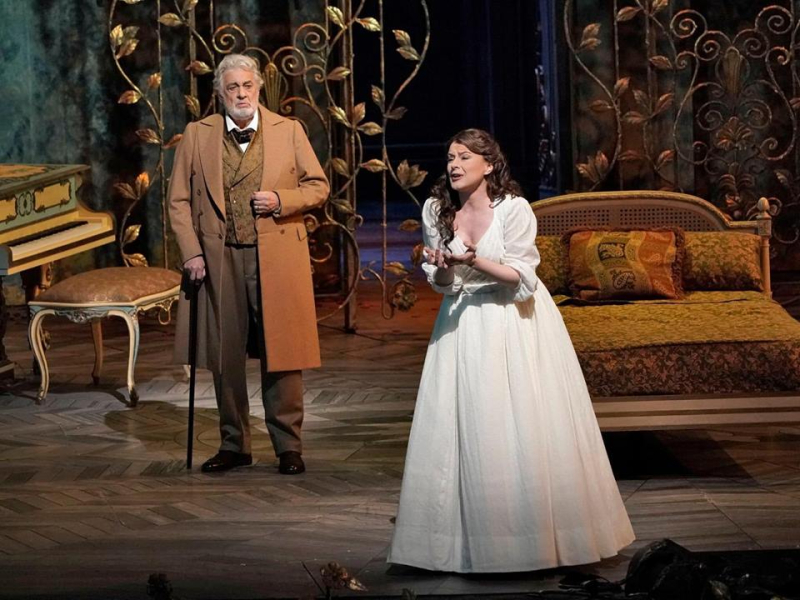
    Domingo hartig ken howard met opera

    Above: Placido Domingo and Anita Hartig in LA TRAVIATA; a Ken Howard/Met Opera photo

    ~ Author: Oberon

    Wednesday April 24th, 2019 – TRAVIATA is the opera I’ve seen more than any other. Along with Tosca and Turandot, Violetta is my idea of a test role; I’ll go to see almost anyone who tries it. From A to Z – from Licia Albanese to Teresa Zylis-Gara, from Ainhoa Arteta to Virginia Zeani – I’ve experienced every kind of Violetta: good, bad, or indifferent. Patricia Brooks, Anna Moffo, and Diana Soviero remain among the most memorable in the role; and in recent seasons, Hei-Kyung Hong and Marina Rebeka have struck gold in the part. Inexplicably, I missed seeing Tucci, Sutherland, Lorengar, Scotto, and Sills as the fragile courtesan. But as Lois Kirschenbaum always said: “You can’t go to everything!”…a notion she herself seemed to disprove.

    Knowing I’ll be seeing the Met’s current TRAVIATA (which some have described as Disneyesque) next season, when Lisette Oropesa takes on the role of Violetta at The Met, I took a score desk for tonight; my main reason for being there was to hear Anita Hartig, whose Mimi and Liu in recent season captivated me.

    Ms. Hartig’s voice, with a mixture of enticing vibrato and curiously effective straight tone, was sadly beset by pitch problems tonight (and, from comments I have read, throughout her run here as Violetta). The voice was annoyingly sharp, at times excruciatingly so. The allure of her timbre, her sense of lyricism, and her brightish upper range should have made her a fascinating Violetta; instead, it became something of a trial to listen to her.

    Stephen Costello’s Alfredo has improved considerably since I last heard him in the part, though he too showed some vagaries of pitch during the evening. I sometimes feel that Mr. Costello doesn’t sense the heartbeat of the music, but tonight he sounded like an ardent, passionate young man with reckless streak.

    Hearty applause greeted the entrance of Placido Domingo, the beloved tenor-turned-baritone, as Germont. After sorting out the voice for a bit, he settled in at “È grave il sacrifizio…” and thereafter sang quite beautifully, finding a nice emotional connection to Ms. Hartig’s Violetta in the great duet “Dite alla giovine“, which is the very heart of the opera. Some small chokes or sobs, perhaps to indicate empathy, were unnecessary; but Domingo impressed by singing the phrase “Dio mi guido…dio mi guido…” in his big aria without breaking for breath. 

    In comprimario roles, so important in the opera, the male contingent excelled: Scott Scully (Gastone), Jeongcheol Cha (D’Obigny), Paul Corona (Dr. Grenvil), the characterful singing of Dwayne Croft (Baron Douphol), and even – in the very brief role of Giuseppe – tenor Marco Antonio Jordão, each made an impression.

    Maestro Nicola Luisotti’s TRAVIATA was overall on the fast side, which is fine. He suddenly sped up the final reprise of the Brindisi, which felt exhilarating in a way, and he took “Di Provenza” at a fast clip: maybe that’s what Mr. Domingo wanted. I could have done without that aria’s cabaletta, though.

    The ballet music had gypsy charm at first, and vigor as the matador theme took over. I was recalling the many times I heard it at New York City Opera, when the incredible Esperanza Galán transformed this scene with her Flamenco flair, castanets blazing.

    Listening to Violetta’s touching reply to Alfredo’s public insult, “Alfredo, Alfredo, di questo core…”, I was yet again reminded of one of the most painful things in life: living with remorse.  

    ~ Oberon

  • PARSIFAL @ The Met

    Parsifal1213.11

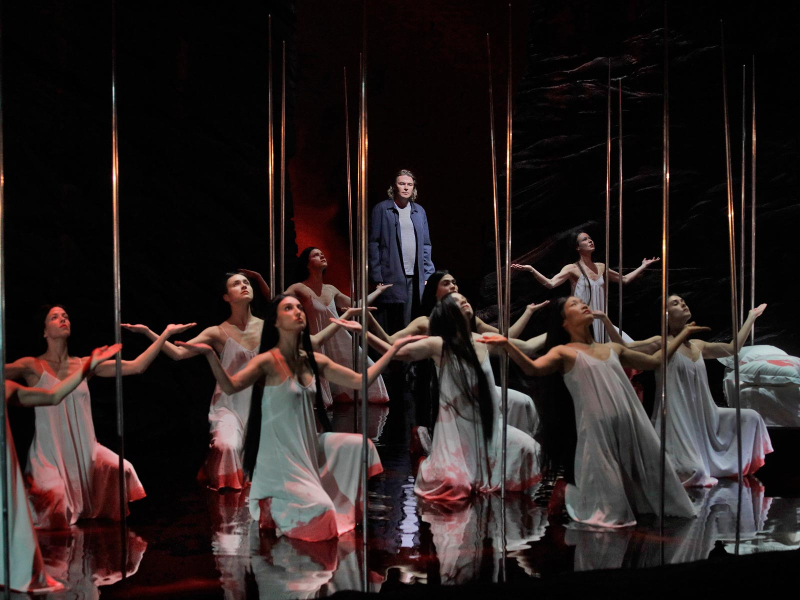
    Above: the Grail revealed: Peter Mattei as Amfortas and Rene Pape as Gurnemanz in Wagner’s PARSIFAL; a Ken Howard/Met Opera photo

    ~ Author: Oberon

    Saturday February 17th, 2018 matinee – A powerful and thoroughly absorbing matinee performance of PARSIFAL, the only Wagner in the Metropolitan Opera’s repertory this season. This dark, barren, and brooding production premiered in 2013, at which time the total absence of a Grail temple from the scenic narrative seemed truly off-putting. All of the action of the outer acts takes place out-of-doors, whilst the second act – as we were told by someone who worked on the production at the time it was new – is set inside Amfortas’s wound.

    Not everything in the production works, and the desolate landscape of the final act – with its open graves – is dreary indeed. But the devotional rites of the Grail brothers in Act I and the stylized movements of the Flowermaidens in the blood-drenched ‘magic garden’ of Act II are engrossing – especially today, where I found a personal link to both scenes.

    Musically, it was a potent performance despite a couple of random brass blips. Since the 2013 performances, I’ve been going to a lot of symphonic and chamber music concerts and this has greatly enhanced my appreciation of the orchestra’s work whenever I am at the opera. From our perch directly over the pit today, I greatly enjoyed watching the musicians of the Met Orchestra as they played their way thru this endlessly fascinating score.

    The Met’s soon-to-be music director, Yannick Nézet-Séguin, was on the podium this afternoon, and he seemed to inspire not only the orchestra, but also the principals, chorus, dancers, and supers all of whom worked devotedly to sustain the atmosphere of the long opera. While I did not feel the depth of mystery that I have experienced in past performances of this work conducted by James Levine or Daniele Gatti, in Maestro Nézet-Séguin’s interpretation the humanity of the music seemed to be to the fore. This meshes well with the physical aspects of the production, which strongly and movingly depicts the fraternity of the Grail and the desperate suffering of Amfortas. The orchestra’s poetic playing as Gurnemanz sings of the slaying of the swan was but one passage of many where I felt the music so deeply. And the transformation music of Act I was particularly thrilling to hear today.

    The singing all afternoon was at a very high level, with the unfortunate exception of the Kundry of Evelyn Herlitzius. We’d previously heard her as Marie in WOZZECK, but Kundry’s music – especially in Act II – needs singing that has more seductive beauty than Ms. Herlitzius delivered. The soprano’s one spectacular vocal  moment – “Ich sah Ihn – Ihn – und…lachte!“, where she tells how she had seen Christ on the cross and laughed – was truly thrilling, but not enough to compensate for her tremulous, throaty singing elsewhere.

    1600x1200_parsifal3

    Above: In Klingsor’s Magic Garden, tenor Klaus Florian Vogt as Parsifal; a Met Opera photo

    In 2006, Klaus Florian Vogt made an unforgettable Met debut as Lohengrin, and this afternoon as Parsifal the tenor again sang lyrically in a role that is normally sung by tenors of the more helden- type. The almost juvenile sound Vogt’s voice underscored Parsifal’s innocence; this worked especially well in Act I, and also  brought us some beautiful vocalism in Act II. As Kundry’s efforts to seduce become more urgent, Vogt’s singing took on a more passionate colour. In his struggle between steadfastness and capitulation, the tenor’s cry of “Erlöse, rette mich, aus schuldbefleckten Händen!” (‘Redeem me, rescue me from hands defiled by sin!’) pierced the heart with his dynamic mastery. 

    Kundry’s wiles fail her, and with an upraised hand, Parsifal fends off Klingsor’s spear-wielding assault. Seizing the weapon that wounded Amfortas, the young man cries out “Mit diesem Zeichen bann’ ich deinen Zauber!” (‘With this Sign I banish your magic!’); the bloody back-lighting dissolves to white and Klingsor is cast down. Turning to Kundry, Mr. Vogt’s Parsifal has the act’s final line of premonition: “Du weisst, wo du mich wiederfinden kannst!” (‘You know where you can find me again’) and he strides out into the world  to commence his long, labored journey back to the realm of the Grail. In the final act, Mr. Vogt’s expressive singing was a balm to the ear, lovingly supported by the conductor and orchestra.

    Parsifal

    Above: Rene Pape as Gurnemanz, in a Ken Howard/Met Opera photo

    Repeating the roles they created when this production premiered in 2013, Rene Pape (Gurnemanz) and Peter Mattei (Amfortas) were again superb. Mr. Pape now measures out his singing of this very long part more judiciously than he has in the past, at times allowing the orchestra to cover him rather than attempting to power thru. But in the long Act I monolog, “Titurel, der fromme Held…”, the basso’s tone flowed like honey; and later, at “Vor dem verwaisten Heiligtum, in brünst’gem Beten lag Amfortas...” (‘Before the looted sanctuary, Amfortas lay in fervent prayer’) Mr. Pape’s emotion-filled delivery struck at the heart of the matter. Throughout Act III, leading to the consecrational baptism of Parsifal, Mr. Pape was at his finest.

    Parsifal1213.40

    Peter Mattei’s Amfortas (in a Ken Howard/Met Opera photo above) is truly one of the great operatic interpretations I have ever experienced, for it is not only magnificently sung but acted with matchless physicality and commitment. The guilt and suffering Mr. Mattei conveys both with his voice and his body is almost unbearable to experience in its intensity and sense of reality.

    After a desperate show of resistance to calls for the Grail to be revealed in Act I, Amfortas – in abject anguish – performs the rite; his strength spent, he staggers offstage and as he does so, he locks eyes with Parsifal, the man who will succeed him as keeper of the Grail: one of the production’s most telling moments. And in the final act, Mr. Mattei throws himself into the open grave of his father, Titurel, as he begs for death to release him from his eternal suffering; this horrifies the assembled Grail knights. Such moments make for an unforgettable interpretation, yet in the end it’s the Mattei voice that sets his Amfortas in such a high echelon.

    P015nkzb

    Evgeny Nikitin’s Klingsor (above), creepy and thrilling in 2013, incredibly was even better in this revival. The voice was flung into the House with chilling command, and the bass-baritone’s physical domination of his bloody realm and his hapless female slaves was conveyed with grim authority. His demise was epic.

    Alfred Walker sang splendidly as the unseen Titurel, and I was very glad that he appeared onstage for the bows so I could bravo him for his wonderful outpourings of tone. Another offstage Voice, that of Karolina Pilou – who repeats the prophetic line “Durch Mitleid wissend…der reine Tor!” (‘Enlightened through compassion, the innocent fool…’) to end Act I – had beauty of tone, though the amplification was less successful here.

    The Squires ( Katherine Whyte, Sarah Larsen, Scott Scully, and Ian Koziara) were excellent, especially as they harmonized on the emblematic “Durch Mitleid wissend…” theme, and the Flowermaidens sounded lovely, led with ethereal vocal grace by Haeran Hong. Mark Schowalter and Richard Bernstein were capital Knights, and I must again mention Mr. Bernstein’s terrific voice and physical presence as a singer underutilized by the Met these days. His lines ths afternoon were few, yet always on the mark; and in Act III, helping to bear the shrouded body of his late lord Titurel to its grave, Mr. Bernstein seemed to carry the weight of the world on his shoulder.

    What gave the performance a deep personal dimension for me today was finding two dancers I have known for some time – David Gonsier and Nicole Corea – onstage in Acts I and II respectively. By focusing on them – Mr. Gonsier as a young Grail knight and Ms. Corea as a delicious Blumenmädchen – the ‘choreography’ given to these two groups became wonderfully clear and meaningful.

    I first spotted Mr. Gonsier seated in the circle of knights; my imagination was immediately seized by the rapture evident in his eyes. For long, long stretches of the first act, I could not tear my gaze away from him as his mastery of the reverential gestural language and the deep radiance of his facial expressions spoke truly of what it means to be a knight of the Holy Grail. Amazingly, out of all the men I might have zeroed in on among the brotherhood, Mr. Gonsier was the last of the knights to leave the stage as Act I drew to an end: he received a personal blessing from Gurnemanz and their eyes met ever-so-briefly. So deeply moving.

    Ms. Corea is beloved in the Gotham danceworld for her work with Lar Lubovitch; I ran into her on the Plaza before the performance today and she assured me I’d be seeing her this Spring at The Joyce as Mr. Lubovitch celebrates his 50th anniversary of making dances. Incredibly, within two seconds of the Act II curtain’s rise on the identically clad and be-wigged Flowermaidens standing in a pool of blood, I found Nicole right in my line of vision. Both in her compelling movement and her captivating face, Nicole became the icon of this band of bewitching beauties.

    Whilst hailing some of the unsung cast members of the afternoon, mention must be made of the two heroic supers who literally keep Amfortas alive and mobile, frequently taking the full weight of the ailing man as he struggles to fulfill his dreaded duties as Lord of the Grail. Great work, gentlemen!

    Much of the libretto of PARSIFAL‘s outer acts today seems like religious mumbo-jumbo. It’s the music – especially the ending of Act I – that most clearly speaks to us (and even to an old atheist like me) of the possibility of God’s existence. Perhaps He has simply given up on mankind, as His name – and his word – have been sullied in recent years by those very people who claim to revere him. Wagner may have foreseen all this, as he once wrote: “Where religion becomes artificial, it is reserved for Art to save the spirit of religion.”

    At the end of Act I of today’s PARSIFAL, I momentarily questioned my disbelief. But then the applause – which I’ve always hated to hear after such a spiritual scene – pulled me back to reality. I’d much rather have stayed there, in Montsalvat.

    Metropolitan Opera House
    Saturday February 17th, 2018 matinee

    PARSIFAL
    Richard Wagner

    Parsifal................Klaus Florian Vogt
    Kundry..................Evelyn Herlitzius
    Amfortas................Peter Mattei
    Gurnemanz...............René Pape
    Klingsor................Evgeny Nikitin
    Titurel.................Alfred Walker
    Voice...................Karolina Pilou
    First Esquire...........Katherine Whyte
    Second Esquire..........Sarah Larsen
    Third Esquire...........Scott Scully
    Fourth Esquire..........Ian Koziara
    First Knight............Mark Schowalter
    Second Knight...........Richard Bernstein
    Flower Maidens: Haeran Hong, Deanna Breiwick, Renée Tatum, Disella Lårusdóttir, Katherine Whyte, Augusta Caso

    Conductor...............Yannick Nézet-Séguin

    ~ Oberon

  • My First RING Cycle: RHEINGOLD

    Rheingold0304.08

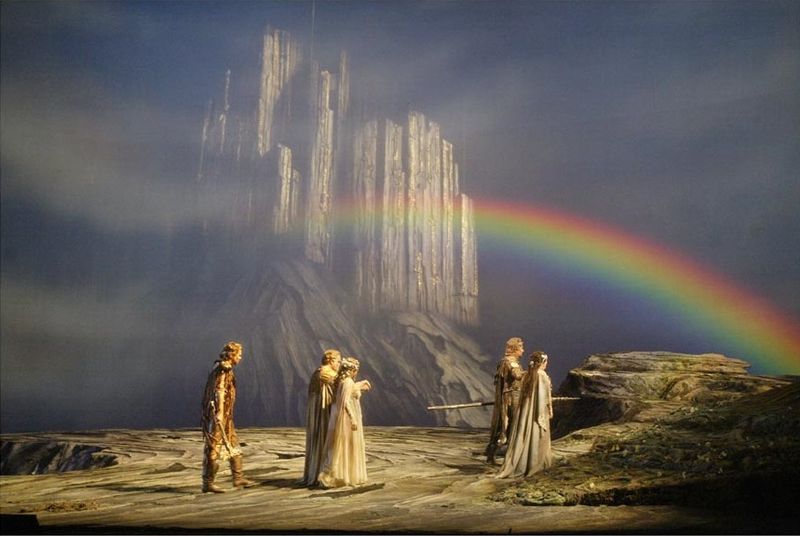
    Above: A scene from DAS RHEINGOLD, in the Met’s classic Otto Schenk production; photo by Ken Howard

    A quarter-century has passed since I first experienced a complete performance of Wagner’s RING DES NIBELUNGEN as the composer intended it to be seen: over the course of a single week. In fact, though I had seen all the RING operas previously and would see them many times again since, this 1989 Cycle has been the only time to date that I attended a “RING Week”.

    I was living in Hartford, Connecticut at that point in time, frequently spending long weekends in NYC to attend opera and ballet performances. My friend Paul Reid and I had decided to attended a Met RING Cycle at the end of the 1988-1989 season. There would be a Saturday matinee Cycle plus two week-long Cycles; we were determined to do a RING Week. So when the casting came out, we quickly decided on the ‘second cast’: we had seen the Hildegard Behrens/James Morris combination in previous performances of the individual operas and they were slated for the first weekly Cycle (as well as the Saturday matinee broadcast Cycle). The second weekly Cycle boasted not only a different Brunnhilde (Eva Marton) and Wotan (Hans Sotin) but ‘new’ and different casting of several prominent roles: William Johns (Siegfried), Franz Mazura (Alberich), Helga Dernesch (Fricka/Waltraute), Mechthild Gessendorf (Sieglinde), and Gweneth Bean (Erda). James Levine of course was conducting every Cycle.

    We ordered our tickets, and then a cast change was announced: Eva Marton had withdrawn and would be replaced by Deborah Polaski. This gave us pause, since at the time neither of us were admirers of Ms. Polaski. We fretted a bit, but it was too late to switch to another Cycle (they had all sold out very quickly). Then came another announcement: Ms. Polaski had withdrawn and the Brunnhilde would now be Dame Gwyneth Jones. We were not thrilled with this announcement either, since Dame Gwyneth had at that time something of a reputation for wobbling vocally. It wasn’t until she appeared onstage for Act II of WALKURE that our concerns were allayed: she was magnificent in every regard.

    In the days leading up to our Cycle, anticipation built and built. Concerns about leaving my young lover Kenny on his own for a week were swept aside as the idea of seeing the RING in toto was about to become reality. Paul and I had booked (separate) rooms at the Colonial House on West 22nd. I had stayed there several times in recent seasons: a very comfortable and affordable gay guest house. I was leading a promiscuous life then (despite being in a relationship) and the wonderful thing about the Colonial House was: it was hook-up heaven. There was no need to go to a bar or club: there were always men who were ready, willing and able staying at the House. The roof deck, which offered nude sun-bathing, was especially conducive to socializing.

    May 1st finally arrived; Paul and I checked in at the Colonial and geared up for our big operatic adventure.

    Here’s what I wrote about the RHEINGOLD in my diary:

    “I am finally seeing the complete RING Cycle in the course of a single week which fulfills a long-held operatic desire. The opening RHEINGOLD was a wonderful evening and set forth high expectations for the evenings to come. Levine’s skillful conducting and the excellent playing of the Met orchestra were a major factor in this magnificent Wagnerian evening. The production is visually engrossing, especially the opening scene in the murky depths of the Rhine. Casting was strong all down the line, with a very fine trio of Rhinemaidens (Diane Kesling stood out, and Kaaren Erickson and Meredith Parsons were both very good…though I did feel they gave a bit too much vibrato at times).

    Franz_Mazura

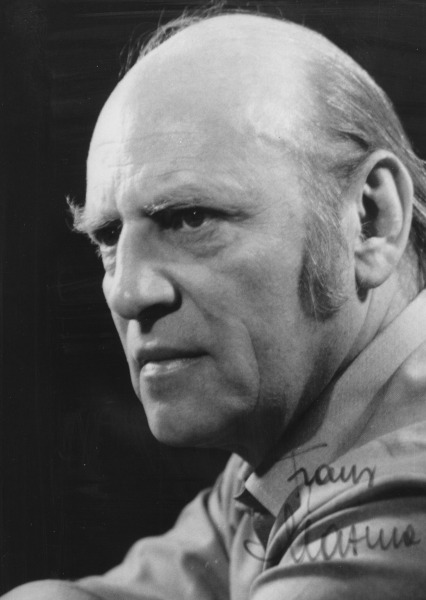
    Franz Mazura (above) as Alberich arrived on the scene and seized our imagination with his huge, thrustingly creepy voice, full of darkest intent. He was a fabulous Alberich, tireless in his vocal and dramatic commitment. Could this bizarre creature be more powerfully portrayed? Mazura’s generous artistry assured his huge success in the role: he made the character seem so real.

    Sotin_hans200x304

    Above: the Lord of This RING: Hans Sotin. He was in top form for a really impressive Wotan, immediately showing his vocal authority in his opening conversation with Fricka. His voice – large and steady and even from top notes down to the depths – created a real sense of majesty. [Sotin, as it turns out, sang his final Met Wotans in these performances].

    Dernesch_Isolde1Sa72PG

    Helga Dernesch (above): her fascinating voice and truly intense emotional involvement brought Fricka to life – incredibly powerful, with her deep lower voice and somewhat insecure top which curiously adds to her appeal.

    Her siblings were Gary Bachlund as Froh, revealing an embryonic heldentenor of some warmth; James Courtney as a sturdy Donner; and Mari-Anne Häggander, who made a great deal out of Freia’s brief role with her vulnerable appearance and full, clear lyric soprano.

    The giants were especially good: John Macurdy’s voice (Fasolt) sounded huge, and Matti Salminen (Fafner) let his oily tones roll out with great dramatic force – super!  Horst Hiestermann was a vivid Mime, but I found Graham Clark’s Loge did a bit too much prancing physically; and I guess I prefer more heldentenorish sound in the role, though Clark surely did sing musically and with clarity and good carrying power. Gweneth Bean’s large, rich voice created a really glorious impression as Erda – she just poured the tone out!

    At the end, a very enthusiastic reception for everyone – especially Bean, Dernesch, and Levine. Very exciting inaugural night of my RING! There were many moments when chills passed thru me: a sensation that is not often experienced at the opera these days. Mazura in particular thrilled me in this way with his theft of the gold and again as he placed his curse on the Ring. So exciting!”

    Metropolitan Opera House
    May 1, 1989

    DAS RHEINGOLD

    Wotan...................Hans Sotin
    Fricka..................Helga Dernesch
    Alberich................Franz Mazura
    Loge....................Graham Clark
    Erda....................Gweneth Bean
    Fasolt..................John Macurdy
    Fafner..................Matti Salminen
    Freia...................Mari-Anne Häggander
    Froh....................Gary Bachlund
    Donner..................James Courtney
    Mime....................Horst Hiestermann
    Woglinde................Kaaren Erickson
    Wellgunde...............Diane Kesling
    Flosshilde..............Meredith Parsons

    Conductor...............James Levine

  • BUTTERFLY @ The Met: First of Three

    Butterfly0607.12

    Above: dancer Hsin-Ping Chang in the Met’s production of MADAMA BUTTERFLY; photo by Ken Howard

    Monday January 20th, 2014 – Three sopranos are slated to sing Butterfly at The Met this season and I’ll be in the House for one performance by each; although I like the current BUTTERFLY production very much, as a matter of practicality I’ll be at a score desk for all three performances.

    Pierre Vallet, an assistant conductor at The Met, took over the baton tonight as the scheduled Philippe Auguin seems still to be indisposed. Vallet has worked at The Met for several seasons; tonight was only his second appearance on the podium (in 2011 he led a FAUST during which mezzo-soprano Wendy White suffered a serious onstage injury). He got BUTTERFLY off to a brisk start tonight with a nimble prelude, and although there were some moments when pit and singers were not precisely coordinated, overall he shaped a very appealing performance.

    Vocal honors tonight went to Bryan Hymel, the tenor who was a Met Auditions winner in 2000 and who returned to the House in triumph last season, replacing Marcelo Giordani in the arduous role of Aeneas in Berlioz LES TROYENS. Considering the difficulty, complexity and duration of many of the roles in Bryan’s current repertory, Pinkerton must seem like something of a ‘vacation role’ (that’s how Birgit Nilsson referred to Turandot). He sang with clear lyric thrust, with easy and sustained top notes zooming out into the House. The voice is fragrant and passionate; I had looked forward very much to hearing him in the aria and trio of the opera’s final act but in the event I didn’t end up staying that long.   

    Tonight’s Butterfly, the South African soprano Amanda Echalaz, revealed a vibrant and somewhat metallic timbre; her voice – which I would describe as ‘big lyric’ – projects well, but tonight much of the time she tended to sing sharp. This offset any pleasure I might have derived from her singing. By the end of the first act I’d decided that I’d heard enough, and I headed home after the love duet. The soprano’s bio indicates that BALLO and SALOME are in her rep; I’m wondering if she’ll wear herself out prematurely.

    Tony Stevenson was an outstanding Goro: clear and musical in his presentation, he sang the role more as a lyric than a ‘character’ tenor. The pleasing singing of Elizabeth DeShong as Suzuki was another possible reason to stay beyond the first intermission but there was no guarantee that Ms. Echalaz would overcome her sharpness, and the rest of the opera is a long haul if the Cio-Cio-San is off the mark. Scott Hendricks’  Sharpless was reasonable enough and Ryan Speedo Green was a strong Bonze.

    All the elements were here for a good BUTTERFLY except the essential one: a vocally inspiring heroine. In the coming weeks Kristine Opolais and Hui He will be taking on Butterfly at The Met and hopefully one or both of them will sustain my interest to the end of the opera. 

    Metropolitan Opera House
    January 20, 2014

    MADAMA BUTTERFLY
    Giacomo Puccini

    Cio-Cio-San.............Amanda Echalaz
    Pinkerton...............Bryan Hymel
    Suzuki..................Elizabeth DeShong
    Sharpless...............Scott Hendricks
    Goro....................Tony Stevenson
    Bonze...................Ryan Speedo Green
    Yamadori................Alexey Lavrov
    Kate Pinkerton..........Maya Lahyani
    Commissioner............Paul Corona
    Yakuside................Craig Montgomery
    Mother..................Belinda Oswald
    Aunt....................Jean Braham
    Cousin..................Patricia Steiner
    Registrar...............Juhwan Lee
    Dancer..................Hsin Ping Chang
    Dancer..................James Graber

    Conductor...............Pierre Vallet

  • Unenchanted Evening

    EnchIsla1112.21

    Monday January 30, 2012 – The Met’s Baroque pastiche ENCHANTED ISLAND made for a dismal night at the opera. Placido Domingo as Neptune, in a Ken Howard production photo above, gave the performance one of its few perk-up moments. His voice, though aged, remains a distinctive instrument and he brought a real personality to his relatively brief appearance, something no other singer in the cast was able to do.

    The Playbill featured a two-page synopsis. Drawing on two complex and brilliant Shakespeare masterpieces, THE TEMPEST and MIDSUMMER NIGHT’S DREAM, the plot is a mishmash of characters and situations that do not engage us emotionally, and rarely even theatrically. The libretto is cheesy and stilted; avoiding Shakesperian style, it has a contemporary feel at odds with the setting and the music. Forced humour abounds, and the characters are made to sing uncomfortably-structured sentences. Unable to understand much of the diction, I flipped on my Met Titles and regretted it because reading the script added to a sense of deflation as the first act progressed.

    The opera is much too long. The 90-minute first act seemed to have reached a pleasant climax with the Neptune scene, but then there was another prolonged slow aria for Prospero. Oddly, the house lights suddenly came on at full brightness during the postlude of this aria, then were dimmed and turned off again.

    Slow arias in fact abound; but that proved as well since none of the singers had the needed vocal facility to astonish us with their coloratura. The annoying voice of Danielle DeNiese as Ariel went in one ear and out the other; she made no vocal impression at all. Anthony Roth Costanzo, replacing David Daniels as Prospero, seemed over-parted in the big house; pushing for volume, his sustained notes sometimes took on a steady beat. At other times the voice vanished behind the orchestra. Joyce Di Donato was announced as indisposed but she had “graciously consented…blah, blah, blah.” Please singers: if you are unwell enough to need an announcement, don’t sing. We don’t pay Met prices to hear sick singers. At any rate, Di Donato only had one bad low note, but her voice – even in full health – lacks a distinctive colour, the sort of personal timbre that made singers like Teresa Berganza, Dame Janet Baker and Frederica von Stade so instantly identifiable. Luca Pisaroni tended to be over-emphatic in his fiorature which verged on barking at times. Lisette Oropesa sang attractively as Miranda as did Paul Appleby as as Demetrius. The libretto did them no favors, but they – and in fact everyone onstage – went at the words gamely enough, even if they felt foolish doing so.

    The idea of doing a Baroque pastische is not a bad one but it seemed to me that between the tedious libretto, too many ‘laments’, and the too-busy plot, ENCHANTED ISLAND was going nowhere. Two 45-minute acts with a 20-minute intermission should have sufficed; instead there were expendable arias, unnecessary da capos, and overdrawn recits as the first act stretched onward. We left at half-time and so, it seems, did lots of other people.