Tag: Lincoln Center

  • CMS Summer Evenings ~ 2018 – Concert 3

    Se_news

    ~ Author: Oberon

    Sunday July 15th, 2018 – The last of Chamber Music Society of Lincoln Center‘s Summer Evening concerts for 2018: perfect playing from a quintet of wonderful artists in music of Mozart, Weber, and Schubert.

    Nothing sets an evening of chamber music on its way to finer effect than Mozart: his Quartet in C-major for Flute, Violin, Viola, and Cello, K. 285b dates from the 1780s and was the last of three quartets Mozart wrote for the amateur flautist Ferdinand De Jean.

    The quartet is in two movements: the opening Allegro finds the sound of Sooyun Kim’s flute floating on the air over an elegant string accompaniment; her tone is delicious, her ruby-red gown a delight. Her colleagues – Erin Keefe (violin), Paul Neubauer (viola), and David Requiro (cello) – have a lovely feel for the pacing of the music, which occasionally veers into the minor…and back.

    The first movement comes to a pretty end, then the Andantino begins with the players harmonizing to fine effect. The music has a gentle pulse, and we can savour the velvety texture of Mr. Requiro’s cello sound. Ms. Keefe commences a theme, echoed by Mr. Neubauer’s viola and then the cello launches a fresh idea. Following a cadenza for Ms. Kim, the strings pulse gently as the flautist sends forth a sweet song which she repeats before the quartet reaches a light and charming finish.

    Carl Maria von Weber’s Trio in G-minor for Flute, Cello, and Piano, Op. 63 (composed 1818-19) – a gem of a piece – was superbly played by Ms. Kim, Mr. Requiro, and pianist Orion Weiss. von Weber is best-remembered today for the overture to his opera OBERON and for the irresistible Invitation to the Dance which inspired Fokine’s romantic ballet Le Spectre de la Rose. Weber’s music abounds in melody, and his music often seems like German bel canto.

    The opening Allegro moderato begins with a somewhat mysterious piano passage, then Mr. Requiro’s gorgeous-toned cello enters, followed by Ms. Kim’s flute, weaving together in a lovely mix. The three voices dovetail perfectly in a da capo, and the movement ends on a sustained flute tone.

    After a dramatic start, the Scherzo turns Spring-like, with the flute spinning out a tune accompanied by waltz figurations. In the Andante, entitled ‘Schäfers Klage’ (‘Shepherd’s Lament’), piano and cello seem to imitate a guitar; then each voice takes the melody in turn. Shifts from major to minor are intriguing, and – after a brief flute cadenza – comes a calm finish. Mr. Weiss commences the Finale quietly. As the pace builds, the flute takes up a tune: Ms. Kim and the pianist really sparkle here, and the music is fast and fun. After a lull, the three musicians take a da capo and sail on to a lively ending. The audience lavished them with enthusiastic applause, and deservedly so.

    Franz Schubert’s 1827 Trio No. 1 in B-flat major for Piano, Violin, and Cello, D. 898, Op. 99, filled the program’s second half. As chamber works go, it is quite long; the composer makes numerous repeats of themes throughout the four movements, and to me it seems his best ideas come in the first two. But, played as it was tonight, this trio became quite engrossing.

    The first movement, Allegro moderato, has an almost triumphant start; as the music calms, lovely nuances are brought forth by Ms. Keefe, Mssrs. Requiro and Weiss. The pianist, who was truly marvelous throughout the evening, plays a fresh melody over plucked strings. Another winning theme passes from cello to violin. In alternating passages of delicacy and melodrama, the three musicians display the agility and passion of their impeccable playing.

    The Andante has a peaceful opening, and Mr. Requiro shines yet again in a radiant melody that is then taken up by Ms. Keefe to ravishing effect. The gently animated Scherzo has a Mendelssohnian grace, but as it neared its end, a cellphone went off to disastrous effect. Yet the players were able to re-establish the mood in the charming, light, and brilliant Allegro vivace finale, much to the delight of the crowd.

    ~ Oberon

  • Bonaldo Giaiotti Has Passed Away

    Maxresdefault-752x490

    ~ Author: Oberon

    Bonaldo Giaiotti (photo above) was my favorite basso. Though he sang at a time when several wonderful bassos were to be heard at both of the houses at Lincoln Center – Tozzi, Siepi, Hines, Treigle, Ghiaurov, Raimondi, Moll, and Ramey, among others – there was something about Giaiotti’s voice that I simply loved. Even in relatively brief roles like the Commendatore in DON GIOVANNI or Monterone in RIGOLETTO, he always made a distinctive mark.

    Over a span of nearly 30 years – beginning with his Met debut as the High Priest in NABUCCO on opening night, 1960, and concluding with a performance of Don Basilio in BARBIERE DI SIVIGLIA in 1989 – Giaiotti sang more than 400 performances with the Metropolitan Opera Company in New York City and on tour.

    I first saw Giaiotti onstage in what was to become one of his signature roles – Timur in TURANDOT – at the Old Met in 1965. He performed it over 50 times with The Met, and countless times worldwide. How movingly Giaiotti conveyed the character’s heartbreak:

    Bonaldo Giaiotti as Timur in Puccini’s TURANDOT

    In 1964, Giaiotti sang a magnificent Banco in Verdi’s MACBETH on a Texaco/Met broadcast.

    Bonaldo Giaiotti – Come dal ciel precipita ~ MACBETH

    Once the New Met had opened in 1966, I saw Giaiotti often in such roles as Timur, Colline in BOHEME, Ramfis in AIDA, Raimondo in LUCIA DI LAMMERMOOR, and King Henry in LOHENGRIN. He was particularly impressive as Alvise in LA GIOCONDA where he more than held his own amidst such powerhouse co-stars as Tebaldi, Corelli or Tucker, MacNeil, and Cossotto.

    Scanned Section 18-1a

    Roles Giaiotti sang at The Met less frequently – and in which I sadly never saw him – included Mephistopheles in FAUST, Prince Gremin in EUGENE ONEGIN, Philip II in DON CARLO, and Sarastro in ZAUBERFLOETE.

    Here are more samples of Giaiotti’s singing:

    Franco Corelli & Bonaldo Giaiotti – Nume custode e vindice ~ AIDA – Rome 1966

    LOHENGRIN – King Henry’s address & finale Act I – Bonaldo Giaiotti – w Kollo – McIntyre – Lorengar – M Dunn – Met bcast 1976

    Though not of the best sound quality, this aria from BOCCANEGRA shows the basso’s ability to bring down the house:

    BOCCANEGRA aria – Bonaldo Giaiotti – NY 1968

    Would that we had an Italian basso today of Giaiotti’s caliber and versatility.

    ~ Oberon

  • Concerto Night @ CMS

    A-M McDermott

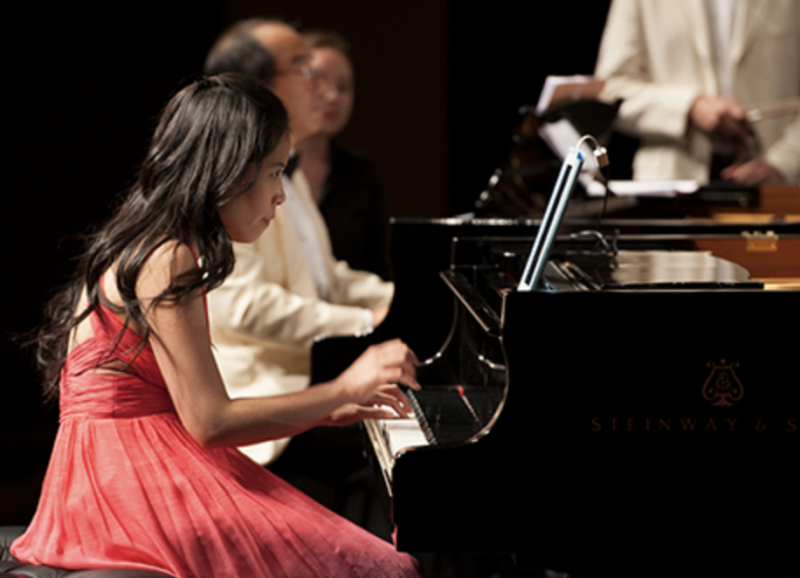
    Above: Anne-Marie McDermott at the Steinway; she delivered a phenomenal Mozart K. 466 at Chamber Music Society of Lincoln Center‘s end-of-the-season performance at Alice Tully Hall tonight.

    Author – Oberon

    Sunday May 20th, 2018 – For the final offering of their 2017-2018 season, Chamber Music Society of Lincoln Center presented five concerti, each calling for a varied ensemble of players; an impressive group of artists came together to assure yet another great CMS evening of music-making. A surprise addition to the program, in the second half, was an added treat.

    Jean-Marie Leclair’s Concerto in B-flat major for Violin, Strings, and Continuo, Op. 10, No. 1 was a wonderful program-opener, bringing forth a sterling performance from violinist Bella Hristova. This was my second Leclair encounter this Spring: in April, the composer’s Sonata for Two Violins in E-minor was played by artists from the New York Philharmonic at a Merkin Hall matinee. Today, again, Leclair’s music seemed truly fresh and vivid.

    Bella

    Ms. Hristova (above, in a Lisa-Marie Mazzucco portrait) looked gorgeous in a gunmetal grey gown, styled à la Grecque. Gilles Vonsattel was ready to play at the harpsichord and, with an ensemble of string players – Aaron Boyd, Sean Lee, Mihai Marica, Paul Neubauer, and Timothy Cobb – ranged around her, Ms. Hristova and her colleagues created a picture that somehow represented everything I love about Chamber Music Society. And then they began to play. 

    Ms. Hristova has always played beautifully, but there was some intangible quality in her artistry tonight that gave her performance a special glow. In this elegant, cordial music, she sounded splendid in both the lyrical passages and in the abounding coloratura. The poignant melody of the Andante was particularly appealing, where Mr. Cobb’s genial and rich bass also made a fine impression. In the concluding Gigue, veering between major and minor, Ms. Hristova the capped her triumph. As waves of applause swept thru the hall, Ms. Hristova strode back onto the stage for a bow, assuming that her colleagues were right behind her. But the men had held back, so that she could bask in the warm reception that she so truly deserved.

    For Mozart’s Concerto in D minor for Piano and Strings, K. 466 – composed in 1785 and played tonight in Carl Czerny’s arrangement – Anne-Marie McDermott took her place at the Steinway, joined by Tara Helen O’Connor (flute), Sean Lee and Ms. Hristova (violins), Paul Neubauer (viola), Mihai Marica (cello), and Timothy Cobb (bass). The audience, poised to hear great music-making, experienced a revelatory performance from Ms. McDermott.

    The concerto’s opening Allegro has an almost sneaky start, and then proceeds thru alternating modes of storm and calm. From the piano’s first entrance in a solo passage, it was clear we were in for exceptional playing from Ms. McDermott. The movement has a da capo with added piano roulades and an exchange of phrases between Sean Lee’s violin and Ms. O’Connor’s flute. The piano part becomes increasingly prominent. After a second da capo, Ms. McDermott trilled her way into a big cadenza; then the music again moved thru major/minor variants.

    The Romance begins with the piano in straightforward phrases which develop over a gracious pulsing motif from the strings. Ms. McDermott’s gift for nuance, and her suave turns of phrase, were abundantly pleasing to hear. In the da capo, Ms. O’Connor’s flute adds a sparkle to the harmonies; modulations, masterfully handled by Mozart, carry thru to the finish.

    Agitated bowing sets up the Rondo-finale, and as Ms. McDermott sailed thru delicious virtuoso passages with technical dazzle and amazing grace. One could sense the audience’s pent up excitement was about to burst. And burst it did. Thunderous applause filled the hall, with the pianist’s colleagues joining in and refusing to stand until she had stepped forward for a bow. The delirium continued, everyone on their feet, as Ms. McDemott and her fellow artists returned for two more bows.

    VonSattelGilles_bio

    To open the evening’s second half, Gilles Vonsattel (above) treated us to an immaculate performance of the Bach Concerto in G minor for Keyboard, BWV 975 (after Vivaldi RV 316). The oldest music on the program (dating from 1713-14), it sounded brand new: so alive and clean. In the Largo, especially, Mr. Vonsattel’s hushed pianissimi phrases and his rippling figurations played over a gentle pulse made an enchanting impression. Pianist, piano, Bach…a wonderfully intimate performance, the audience keenly attentive and appreciative.

    Paul_neubauer

    Above: violist Paul Neubauer

    Still on a high from experiencing The New York Philharmonic’s extraordinary performance of the Shostakovich 5th under Semyon Bychkov’s baton a few days ago, I was happy to hear Wu Han announce a surprise addition to the scheduled program this evening. Recently when she was in Saint Petersburg, Wu Han heard that the manuscript of a very short Shostakovich piece for viola and piano had just been discovered. Somehow she managed to bring a copy of this two-page work back to New York City with her. Paul Neubauer learned it in a day, and – with Wu Han at the piano – gave us what was most likely the first public performance (and for sure the US premiere) – of Shostakovich’s Impromptu for Viola and Piano (1931).

    This Impromptu is in two movements, a sad and very Russian melody – soft and sorrowing – which displayed Mr. Neubauer’s finely-controlled tone – and then a lively, folk-like dance kicked off by Wu Han at the piano, her bright-red shoes tapping the floor. A little musical gem, this would seem a perfect encore piece for Mr. Neubauer in future.

    Leos Janáček’s Concertino for Clarinet, Bassoon, Horn, Two Violins, Viola, and Piano (1925) is a quirky delight of a piece. As if the unusual instrumentation was not enough on its own, the full complement of musicians do not play in the first and second movements. The opening Moderato involves only the piano and horn (Ms. McDermott and burnish-toned Stewart Rose), and for the second – Più mosso – only clarinet (Tommasso Lonquich) and piano are heard, until the strings add a couple of chords at the finish.

    Mr. Lonquich had brought three clarinets to the stage, switching from one to another as the music progressed. His lively trills danced the music on to a string finish. The Concertino moves on: a rocking, swaying mode, an off-kilter march, slashing bows, dancing or jogging along, vigorous plucking, extended string trills, a misterioso piano, a fast finale.  

    Bg01

    Above: percussionist Ayano Kataoka

    The evening closed with the most recently-written work on the bill: Micro-Concerto for Solo Percussion, Flute, Clarinet, Violin, Cello, and Piano, composed 1999 by Steven Mackey. Ayano Kataoka moved from place to place on the stage where her various percussion instruments were arrayed. A superb “supporting cast” had been assembled: Tara Helen O’Connor (flute, and piccolo), Tommaso Lonquich (clarinet, and bass-clarinet), Sean Lee (violin), Mihai Marica (cello), with Gilles Vonsattel at the Steinway. The musical ensemble has their work cut out for them, as the writing seemed quite tricky and they were sometimes called upon to make unusual sound effects.

    Ms. Kataoka played several ‘legit’ percussion instruments, plus a few that she and composer John Mackey apparently found under the proverbial kitchen sink, including whistles and clickers. Often she played two or three of these at a time. A petite woman with giant talent, Ms. Kataoka had choreographed herself to always be in the right place at the right time, and the audience seemed genuinely intrigued by her every move and by all the varied sounds she produced. 

    The work opens with an extra-terrestrial quality. Tara Helen O’Connor had 2 flutes and a piccolo at her fingertips; the composer calls on her for everything from low sputtering to piccolo pipings. Two passages have special appeal: one for bass clarinet (Mr. Lonquich) and Ms. Kataoka’s vibraphone, and a second where Mihai Marica’s expert cello playing meshed with the marimba to sensuous effect.  

    The composer bounded onto the stage for a bow at the end, thanking all the players, and embracing Ms. Kataoka. The percussionist’s frock was a contemporary take on traditional Japanese dress with a shortened skirt and a fanciful obi.  

    ~ Oberon

  • An Evening With Freiburg Baroque

    Bb_freiburger-barockorchester-kristian-bezuidenhout-werke-von-haydn-mozart-und-j-chr-bach-2018_01_20170608

    ~ Author: Ben Weaver

    Saturday May 19th, 2018 – The period instrument ensemble Freiburg Baroque Orchestra (above) has been a favorite of mine on records for some time. I was glad to finally be able to hear them live – along with one of my favorite pianists, Kristian Bezuidenhout at the fortepiano. This concert of works by Haydn, J.C. Bach and Mozart was part of Lincoln Center’s Great Performers series. 

    Conducting from the keyboard in the uncomfortably warm Alice Tully Hall, Mr. Bezuidenhout launched the Freiburg Barockorchester into the opening chords of Haydn’s Symphony No. 74 (composed in 1781) with great enthusiasm. The musicians, standing around the fortepiano, all wore black and played beautifully.

    Period instruments can be an acquired taste. These instruments can go out of tune easily, and there is sometimes a nasal quality to the sound of the strings. But personally I love it, errant pitches and all. Though it should be noted that for the Freiburg Baroque musicians pitch was not an issue. Their ensemble work is flawless and the small number of players do not surrender anything in fullness and richness of sound. For this concert the orchestra was made up of 9 violinists, 3 violas, 2 cellos and 1 double-bass; with an assortment of winds and 2 horns.

    Haydn’s 74th Symphony was one of the first works he was able to publish independently and for his own profit while working for the Esterházys in Eisenstadt, Austria. It may be true that many of Haydn’s symphonies can be a bit workmanlike, but the 74th is one of his finest works, filled with lovely melodies and inventive orchestration. The second movement especially is lovely: an Adagio of muted violins playing lovely theme and variations over the cello playing a repeated motif, like a guitar accompanying a serenade. A lively Trio leads to an exciting whirlwind of the Allegro finale.

    Johann-christian-bach

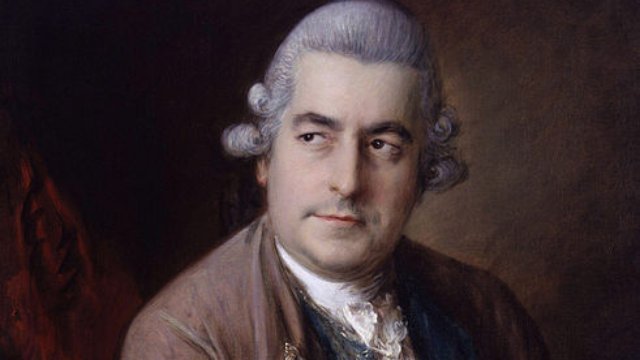
    Johann Christian Bach (above) was the youngest of Johann Sebastian Bach’s sons and formed a direct link from the great Baroque master to the soon-to-be most important composer of the Classical era. When the Mozarts visited London in 1764, Wolfgang was 8 years old and J.C. Bach, recognizing talent in the young boy, played duets with him on the harpsichord and let him borrow music. Two years later, when Mozart tried his hand at composing piano concertos, he used J.C. Bach’s music as the foundation: 10 year old Mozart’s first 3 Piano Concertos are based on Johann Christian’s themes. And when Mozart heard of J.C. Bach’s death in 1782 he was in the middle of composing his 12th Piano Concerto. Mozart paid tribute to his old friend by basing the slow movement of the concerto on a melody from one of Bach’s operas, La calamità del cuore.

    While Johann Christian could never eclipse his father – a true titan – as a composer, he nonetheless became a very respectable musician in his own right. More than that, Johann Christian’s Symphony in G minor, Op. 6, No. 6 is something of a trailblazer of the symphonic repertoire. Composed some time in the 1760s, the G minor Symphony went beyond the usual sunny allegros and dances of other composers. Johann Christian offered something of a “sturm und drang” darkness in this work that would reach the peak of passion with Beethoven. The symphony opens with stormy strings and horns’ call to arms. There is an urgency to the music that an older Mozart and then Beethoven would bring over the edge. The slow movement, the Symphony’s longest movement, brings respite from urgency, but not darkness. Menacing horns return in the final Allegro molto. In this movement you can hear the winds Beethoven would one day raise in his Pastoral Symphony. But strangest of all is the Symphony’s conclusion: it simply stops, unresolved, in the middle of a thought. This is something no composer would seriously attempt until the end of the 19th century.

    Both Haydn and J.C. Bach were friends and mentors to the young Wolfgang Mozart. All 3 men composed memorable piano concertos, but Mozart’s compositions in the genre surpassed anyone who came before. Mozart’s 9th Piano Concerto, composed in Salzburg in 1777, is one of his most important compositions. It was the largest and most substantial composition of his to date, and it launched Mozart’s extraordinary development of the Piano Concerto into a centerpiece of not only his own output, but of the genre overall. The musicologist Alfred Einstein once called it “Mozart’s Eroica.”

    For many years the concerto was incorrectly called “Jeunehomme.” Nobody really knew who Jeunehomme was and it is only in 2004 that historian Michael Lorenz established that the confusion arose from the incorrect spelling of Victoire Jenamy, the highly regarded pianist and daughter of famous dancer and balletmaster Jean-Georges Noverre. The Mozarts had known the Noverres for some time, and Wolfgang gave the concerto to Ms. Jenamy as a gift of friendship between the two families when she stopped in Salzburg on her way to Paris from Vienna in 1777.

    The concerto opens with an unusual, almost instant entry of the fortepiano. Typically concertos began with extended orchestral introductions; indeed, most of Mozart’s own piano concertos do. But here Mozart wasted no time for the soloist. It’s a feature other major composers would not attempt until Beethoven’s 4th and 5th Piano Concertos a quarter century later. Composers like Grieg, Tchaikovsky and Rachmaninoff celebrated this invention with unforgettable results in their own times. The second movement, a lovely Andantino, contains magnificent writing for the piano, written almost like for a singing voice, and the final Rondo contains a surprising slow Minuet, perhaps Mozart’s nod to Ms. Jenamy’s father’s dancing career.

    The 17th Piano Concerto, written in 1784, may be from the early stages of Mozart’s maturity as a composer, but it is a fully developed and wonderful work. The orchestra begins the piece with a lively and extended introduction, like most of Mozart’s concertos. But once the pianoforte enters, Mozart displays an unerring sense of balance between the solo instrument and orchestra, the play between them, passing of melodies from one to the other – and to other solo instruments within the orchestra – was something few could do with the confidence of Mozart. The beautiful Andante is in a long line of unforgettable Mozart slow movements, at once charming and sad, with flashes of light and sudden clouds. Beautiful writing for the winds in the movement is particularly moving as well. The exuberant final movement is a reminder that Mozart often sounds easy – effortless – but, in fact, requires extraordinary virtuosity.

    Photos-4x

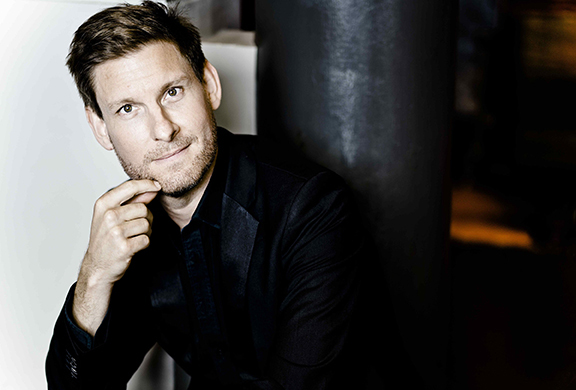
    Kristian Bezuidenhout (above, in a Marco Borggreve) portrait played these works magnificently. He played, of course, on a period fortepiano and hearing these concertos played on an instrument Mozart would have recognized is a fascinating experience. We are so used to the behemoth sound created by the modern Steinway Grand in a concert hall (accompanied by a far larger ensemble) that we forget how light and almost fragile these sounds originally were. The instrument (alas, the Playbill does not mention the specific period it replicates) has a pearly, mildly hollow sound. There are, of course, no pedals, so the sound produced is uniform and it is up to the player to truly create the effect he/she wishes to present. Mechanical trickery is not an option. Mr. Bezuidenhout is a magician in this regard. He may well be our most brilliant interpreter of Mozart’s music today. Undaunted by technical demands, he manages to conjure universes out of a small wooden box and a few strings. The rapport between him and Freiburg Baroque players is obvious; they have perfectly synced tempos and dynamics, and there were the warm glances and smiles exchanged as cues and between movements.

    The players all sat down on the risers to hear Mr. Bezuidenhout play an encore, a magical Allemande from Mozart’s unfinished Suite in C major (sounding like Papa Bach by way of Mozart).

    ~ Ben Weaver

  • New Music @ Rose Studio

    ~Author: Scoresby

    Thursday April 26 2018 – At the Chamber Music Society of Lincoln Center’s last New Music concert of the season, the Schumann Quartet and pianist Gloria Chien gave a wide-ranging performance. The first piece on the program was the last movement of Swiss composer Helena Winkelman‘s Quadriga Quartet for Strings titled “Sleipnir the eight-legged” based on the eponymous horse in Norse mythology. While only the last movement of the quartet, Ms. Winkleman is open to it being played alone. It is a rollicking piece that includes references to Bartok, jazz, metal, and Swiss folk music all in a contemporary idiom.

    The Schumann Quartet played through the virtuosic material with enthusiasm, indulging in all the fun timbres Ms. Winkleman imbeds in the score and still able to bring out the lyricism that punctuates the more cacophonous moments. In fact, violist Liisa Randalu and cellist Mark Schumann seemed to blend incredibly well as duo – matching each other to create a delicious backdrop for first violinist Erik Schumann and second violinist Ken Schumann’s lyrical melodies. Through the work, the rhythmic pulse sounds like a frenetic horse stomping through – it is a shame we only got to hear one movement of this quartet. I look forward to hearing more of Ms. Winkleman’s music soon.

    Screen Shot 2018-05-01 at 5.25.18 PM

    Above: Schumann Quartet; Photo Credit: Kaupo Kikkas

    The second work on the program was Timo Andres’s five continuous movement work Quintet for Piano, Two Violins, Viola, and Cello. The aptly named first movement Cannons and Fables, sounds like an upbeat riff on minimalist Schumann. The most interesting was the second movement, which is based on large dusty tremolos in all of the instruments. The quartet’s tight and structured sound contrasted the more rustic sounding piano part. While interesting to listen to – this doesn’t seem to Mr. Andres’s most interesting work.

    Henze’s brief “Sonatina for Violin and Piano” seemed highly structured and a completely different sound world than the earlier Andres. Second violinist Ken Schumann and Ms. Chien presented the work based off of themes from one of his operas. The Allegretto has an active piano work full of counterpoint and dissonance, with what seem to be quotes from Messiaen’s Quartet for the End of Time. Mr. K Schumann captured the almost romantic nostalgia in the second movement, his mute letting him produce a supple ghostly sound and his phrasing emphasizing the lyrical quality of the music. Ms. Chien in the last movement embraced the drama in the piano part and gave heft to the huge chords that end the piece below Mr. K Schumann’s highpitched violin.  

    After the rigidly structured world of Henze, the program moved into two selections from “Piano Etudes” by Augusta Read Thomas. The first (etude 3), titled Cathedral Waterfall – Homage to Messiaen, is a spacious work that uses the extreme reaches of the piano and heavy use of pedal to evoke a large cathedral. Ms. Chien let the piano boom in these chords, making the small space seem like an echo chamber. She managed to let the color of each chord be clear without blending into the next – thus producing a chiming sound. This effect sounded at once like Feldman’s sparse tone mixed with the large spaciousness that Crumb’s Makrosomos evoke. The second work (etude 2) called “Fire Waltz – Homage to Bartók” is a thrillingly fun Ligeti-esque work. Ms. Chien seemed to stick to its incisive rhythm and sound like a machine that kept getting interrupted. It was a fun reading that seemed to relish in Ms. Thomas’s jazzy composition style.

    Screen Shot 2018-05-01 at 5.22.19 PM

    Pianist: Gloria Chien

    The most well-known piece on the program was Arvo Pärt’s Fratres. Mr. Pärt originally composed the work in 1977 and has rearranged it over 15 times for different instrument combinations. While all share a structural chord sequence and something percussive, each one has a slightly different sound. In her speech beforehand, Ms. Randalu shared that Mr. Pärt thought of his music as existing not for a particular timbre or instrument, but in absolute forms – structural music. All four members of the quartet gave a dedicated performance. 

    Mr. K Schumann held the same note for all 10 minutes of the performance, letting everyone blend around and atop his drone. This version of Fratres is more spiritual and less earthy than other versions of the piece. They took the chords slowly, the instruments started in the high harmonics and over the course of the piece moved to the lowest notes through the chord sequence – Mr. M Schumann’s warm cello pizzicato breaking up the sequence. The lack of contrast in this version of the work, makes it much more sparse – perhaps intentional to evoke a choir. While certainly a beautiful work and given a detailed rendering here, it seemed like an odd way to end such an exciting program – perhaps it would have been better served an opener? Nonetheless, it capped another great performance in the CMS New Music Series.

  • Classical Evolution @ Chamber Music Society

    2aaf32_c2a51dd8031d4d7cab51a39159e29b1e~mv2_d_4048_3215_s_4_2

    Above: Tommaso Lonquich, photographed by Anna Grudinina

    ~ Author: Oberon

    Friday April 27th, 2018 – Chamber Music Society of Lincoln Center brought together clarinet phenomenon Tommaso Lonquich, the outstanding pianist Gilles Vonsattel, and a quartet of sterling string players for an evening of music-making that was by turns stimulating and soothing. Audience distractions were annoying, but the music prevailed.  

    According to one of his students at the time, Mozart wrote his Trio in E-flat major for Clarinet, Viola, and Piano, K. 498, “…on 10 sheets (19 pages)…” in Vienna, dating it August 5, 1786. It’s not clear how the nickname “Kegelstatt” came to be applied to this trio; the word refers to ‘a place where skittles are played’ – skittles in those days referring not to the colorful candies but rather to a nine-pins bowling game which Mozart sometimes enjoyed. At any rate, the name stuck, and thus has the trio come down to us today.

    Home music-making being all the rage in Vienna at the time, the trio was first played at a ‘house concert’ in the von Jacquin family’s residence: Anton Stadler played clarinet, Mozart the viola, and Franziska von Jacquin – a pupil of Mozart’s to whom the piece is dedicated – the piano. The clarinet at that time was only just coming into its own, so an alternate version of the trio with the clarinet part transcribed for violin was also published.

    This evening, clarinetist Tommaso Lonquich joined violist Yura Lee and pianist Gilles Vonsattel for an first-rate performance of this delightful trio. Mr. Lonquich, whose playing made a truly memorable impression when I first heard him in 2015, displayed all the same fascinating qualities of his artistry tonight: prodigious breath-control, a wonderful sense of melodic flow, and a magical finesse of the dynamic range. He and his two colleagues here were very nicely matched, for Mr. Vonsattel’s playing readily displays both verve and nuance – his tapered phrases so elegant – whilst Ms. Lee, ever a joy to encounter, aligned her tonal quality to the clarinetist’s, making their harmonizing especially attractive.

    The Menuetto was particularly enjoyable tonight; after a big start, the music simmers down and the three musicians seemed to vie with one another to see who could play the softest. Then the viola sets up an animated figuration, keeping things lively. Detail-oriented playing from all three – and their keen awareness of one another – put a smile on my face.

    In the concluding Rondeaux: Allegretto, a rolling song sets forth; clarinet and piano sing to one another. Mr. Vonsattel’s summons up sparkling sounds from the Steinway before turning more lyrical. Ms. Lee introduces a viola theme which is passed about and harmonized. Throughout, the dynamic arc keeps the ear on the alert: some glowing pianissimo motifs from the keyboard captured my imagination.

    Mr. Lonquich then took the lead in Carl Maria von Weber’s Quintet in B-flat major, Op. 34 (1811-15), with a stylish string quartet: Erin Keefe, Ida Kavafian, Yura Lee, and Nicholas Cannellakis. Like Adolphe Adam’s score for GISELLE, von Weber’s music is very operatic: one continually imagines a baritone launching a cavatina, or a soprano doling out elaborate roulades in some kind of auf Deutsch mad scene. It is perhaps this operatic connection that makes Weber’s music so appealing to me.

    After a hesitant opening of string chords, the clarinet enters very softly and takes an impressive crescendo on a single note. From here, Mr. Lonquich embarked on his astonishing performance, his tone dulcet in every register, his swift coloratura and dizzyingly accurate scales full of life and light. Cellist Nick Canellakis takes up a theme of ‘vocal’ quality; later, his gorgeous tone will be a steadying element as Mr. Lonquich continues to revel in mad bravura.

    Mr. Canellakis’s somber-sounding cello opens the Fantasia: Adagio ma non troppo, with Mr. Lonquich taking up a poignant melody; there’s heartfelt beauty in his thoughtful measuring out of the tone. Meanwhile, Mr. Canellakis continues to savour each cello passage. Clarinet scales and long, soft phrases develop, and then things come to a halt. The strings play a lament; the clarinet’s re-entry will bring us more delicate scales and whispered pianissimi before the elegant melody is resumed.

    The lively Menuetto features delightful warbling effects from Mr. Lonquich’s clarinet, along with madcap zips up to his high range; in contrast, some ultra-soft playing a bit later hung gorgeously on the air. Erin Keefe’s violin introduces a cordial interlude, followed by the clarinet resuming his fanciful warbling.

    As the concluding Rondo: Allegro giocoso commenced with the rhythm of a gentle galop, I scrawled “A treat!” across my Playbill. Mr. Lonquich sounded forth brightly, the clarinet melody drawing us forward to his spectacular scale-forays to the top before reeling off fantastic passages of fiorature in a marvelous bravura display.

    As the players sailed on their merry way thru this vastly enjoyable music, one sensed a build-up of excitement in the hall: Mr. Lonquich’s virtuosity dazzled, and the crowd’s reaction was a vociferous standing ovation, with the players called out twice as a feeling of sheer joy filled the hall.

    Main

    Following the interval, Mr.Vonsattel (above) returned to the Steinway for a perfectly polished rendering of the Brahms Quintet in F minor for Piano, Two Violins, Viola, and Cello, Op. 34 (1862), with Ms. Kavafian now in the first chair.

    At first we are lulled by a melodious start, but suddenly: drama – a big theme takes over. The string voices come alive: silky violin, mellow viola, rich cello. Mr. Vonsattel, Ms. Kavafian, and Mr. Canellakis play in unison; the piano gets rapturous before a lull, whereupon a hush sets.  Softly Mr. Vonsattel lures in a thread of sound from the violin and a warmer depth from the cello. The music builds to a mysterious dance, with glimmering piano. Intoxicated by the music and the detailed playing, I recalled a state we sometimes achieved back in the Flower-Power era: of being blissed out.

    The gentle start of the Adagio, hampered by thoughtless audience activity, nevertheless made its mark. Lovely harmonies rose, Ms. Lee and Mr. Canellakis mellifluous, with Mlles. Kavafian and Keefe duetting sweetly. The movement concludes with a tender fade-away.

    The Scherzo begins with a low cello pulse, and suddenly a big theme explodes that is both mysterious and passionate. A marziale motif takes over, a paean – to music? to life? – which subsides into a calm interlude. When things re-bound, Mr. Vonsattel at the keyboard turns sprightly as a rise in propulsion takes us to an emphatic end.

    Mr. Canellakis – shall we say here what a simply terrific cellist he is? – commences the concluding movement in a surprisingly sorrowful mood, and Mr. Vonsattel at the piano sounds richly. Now the dancing Rondo commences, veering from impetuous quietness to nervy turbulence. Themes are rewoven, and we are being borne along towards the finish when, at the worst possible moment – and with only a minute of music left to go – someone noisily began unwrapping a snack.

    ~ Oberon

  • Richard Goode @ Alice Tully

    ~Author: Scoresby

    Tuesday April 17 2018 – Oddly, I have never had the chance to hear the pianist Richard Goode before. While a seminal figure in the American piano scene, I always seemed to not be able to make his performances. Thus, I was grateful to hear him live first on Lincoln Center’s Great Performers Series in program that ran in chronological order (spare the encore) over 300 years of music history.

    The program opened with the Second and Third Pavians and Galliardes from Byrd’s My Ladye Nevells Booke of Virginal Music. While stunning music due to Mr. Goode’s pinpoint articulation – I couldn’t help but feel a layer was missing from the music by hearing it on the piano. The many trills and ornaments sound far heavier on a piano. Nonetheless Mr. Goode highlighted the harmonic progressions and layered the voicing so the audience could always hear the melody through those ornaments. In the Second Pavian, Mr. Goode let the large groupings of arpeggios having a flowing sound – he crafted melodic line to be joyous and full of energy. In the Galliarde to the Second Pavian, Mr. Goode loosened some and let the music have a more spontaneous feel, but still captured the dance form.

    The second work on the program was Bach English Suite No.6 in D minor, BWV 811. In the opening Prelude, Mr. Goode seemed to have an improvisatory feel to the music – a lot less structured than the Byrd earlier. As the prelude turned into a fugal section, Mr. Goode seemed to eschew the carefree style for rigid structured and lucidity. It was a wonderful transition that let him highlight the quiet beauty in the inner voices and left hand of this denser section. As the prelude escalated in intensity, he took advantage of the piano’s wide dynamic range to let it boom like an organ. Mr. Goode took a brisker pace for the later movements. This worked particularly well in the charming Gavotte I and II. With the speed of the trills and folk-like allure, the Bach seemed to echo the Byrd from earlier. This seemed quite intentional every part of the program seemed to be strung together with a few different ideas. In the speedy Gigue that ends the suite, Mr. Goode seemed to at once capture the rhythm and get into a more dancelike idiom. His left hand’s clarity is rare in a pianist and he used it to build the intensity in each of the scales, adding drama to this finale. Despite having a light touch to the keys, Mr. Goode seemed to be able to build a large sound without sacrificing clarity.

    Screen Shot 2018-04-23 at 4.44.32 PM

    Above: Pianist Richard Goode; photo credit: Steve Riskind

    The highlight of the program was hearing Mr. Goode’s interpretation of Beethoven Sonata No. 28 in A major, Op. 101. Mr. Goode was the first American pianist to record all 32 of Beethoven’s sonatas; his expertise in the music showed this evening. Mr. Goode’s style of playing seems to revolve around painting the exacting structure of the music, so in the Beethoven he eschewed some of the more sentimental elements of the work to do this. While I personally find it sometimes a bit cold, it is interesting to hear a fresh and insightful interpretation.  In the lyrical opening, Mr. Goode seemed to take a straightforward approach that pushed the music along. At first he kept his playing quiet and measured, but he seemed to emphasize the expansions into different registers and bell-like chords that appear littered through the work. While some pianists use these chords as a simple break, Mr. Goode made sure that each time they appeared they were a harmonic feature that drove the piece. Similarly as the first movement unfolded, he let the left hand’s drone sing clearly.

    The second movement is famous for its odd Schumann-esque march. Mr. Goode let the driving rhythmic structures take precedent, echoing the bell-like motif from the first movement. He also made sure all the jazzy riffs had spunk to them, which echoed the Debussy to come. The most fun part of the night was during the giant fugue that ends the work. Mr. Goode managed to make the exciting fugue have pristine clarity, only to be quiet in to the romantic opening of the piece. The humorous coda at the end of the work seemed to have a few audiences members smiling as he finished.

    The final work on the program (after intermission) were the Debussy Préludes, Book 2. Mr. Goode’s interpretation, while beautifully played, felt a little too monotone for my taste. Nonetheless, in the third image La puerta del vino, he managed to capture both the Spanish rhythms and bursts of different colors. The Ondine suited his style of playing well, letting each of the arpeggios ripple through with exacting phrasing. He capture the eccentricity of Hommage à S. Pickwick Esq. P.P.M.P.C., getting an earthier, Rachmaninoff- sort of sound. The tinkling of the folksy dance and humor during the contrasting section of the work harkened back to the Barqoue works earlier. It is clear that Mr. Goode manages to unify his programs by highlighting the common strands between works.

    The audience seems to love Mr. Goode, giving him a hearty ovation following the exciting Feux d’artifice. After all the applause Mr. Goode played an extended encore: Chopin Barcarolle in F-sharp major, Op. 60. While the perfect closing piece for the program (according to Mr. Goode’s remarks the Barcarolle was a favorite of Debussy’s) and a pleasurable indulgence it felt a little long-winded to add on to the end of the performance. Nonetheless, Mr. Goode’s playing was just as thoughtful and free as earlier, closing the recital on a high-note.

  • CMS Winter Festival 2018 – #3

    Shanghai-Quartet-Header

    Above: the Shanghai Quartet

    ~ Author: Oberon

    Tuesday March 27th, 2018 – The last concert of Chamber Music Society of Lincoln Center‘s Winter festival, entitled Chamber Music Vienna.

    Ignaz Schuppenzigh (1776-1830) is credited with pioneering the ‘chamber music series’. Schuppenzigh was a violinist and a friend of Beethoven who presented over a hundred chamber music concerts in Vienna between 1823 and 1828. Works of Haydn, Mozart, and Beethoven were prominently featured in the programming, and it is precisely those three composers whose music we heard this evening.

    But tonight’s concert had a deeper significance, for it duplicated exactly the program Schuppenzigh offered in Vienna on March 26th, 1827 – the very day that Beethoven passed away. In fact, it has been determined that the moving Largo con espressione from Beethoven’s Trio in G major, Op. 1, No, 2, was being played the exact time of the great man’s passing. 

    The Shanghai Quartet opened this evening’s concert with Haydn’s Quartet in G major for Strings, Hob. III:81, Op. 77, No. 1 (1799). The Shanghai have their own distinctive sound, cool and concise, suited well to both their Haydn and Mozart offerings on this program.

    The opening movement of the G major quartet, marked Allegro moderato, has a feeling of perpetual motion, somewhere between a march and a dance. There are ingratiating modulations and the writing is quite florid. By contrast, the Adagio, with its unison opening, has an almost operatic feeling. Courtly, and with gracious harmonies, the first violin sings forth and then engages in a duet with the deepening cello. Rising modulations – with the cello ever-prominent – bring a da capo which, with varying harmonics, reaches an emotional level I don’t often feel in Haydn’s music. The Shanghai made much of this movement’s sheer beauty.

    The Minuet has the genuine air of a scherzo; it’s fun, with swirls of notes carrying the violin on high. The swift, unison start of the Finale: Presto brings some very nimble playing from the Shanghai’s 1st violinist, Weigang Li; the music becomes genuinely exhilarating.

    Next came Mozart: his Quartet in D-major for Strings, K. 575, is one of the “Prussian” quartets (dating from 1789) and as such features the cello as a nod to the cello-playing king, Friedrick Wilhelm II. In the opening Allegretto, it is the cello that presents the second theme; here, and throughout the piece, the Shanghai’s Nicholas Tzavaras shone.

    While the Andante clearly showcases the cello, Mozart doesn’t shirk on opportunities for the violist – Honggang Li – or the violins, Weigang Li and Yi-Wen Jiang. Mr. Tzavaras is really in his element with the melodies, and at one point a matched phrase is passed from voice to voice. Quite inventive.

    Following the light, jesting feeling of the Menuetto (Allegretto), the concluding Allegretto‘s theme takes the cello to its high register. A decorative canon pops up before we reach the finale. 

    785535479-ludwig-van-beethoven-central-cemetery-tomb-vienna-austria

    Above: Beethoven’s tomb in Vienna’s Central Cemetary

    The evening ended with Beethoven’s Trio in G major for Piano, Violin, and Cello, Op. 1, No. 2. Pianist Gilbert Kalish, violinist Arnaud Sussmann, and cellist Paul Watkins took the stage for a first-rate performance of this work from a still-young composer.

    Following a slow introduction, in which the lovely blend of the strings and the stylish Steinway work of Mr. Kalish heralded delights to come, the first movement goes Allegro in quite a lively, sometimes folkish manner. The writing has its witty aspects, but the two women in front of us decided they’d never heard anything so hilarious, and they struck up a running conversation, laced with chuckles. Shushing was to no avail.

    Arnaud Sussmann’s absolutely gorgeous tone made a glowing impact in the Largo con espressione, inter-weaving with the bounteous beauty of Mr. Watkins’s cello to irresistible effect as refined romance bloomed from the keyboard. This Largo is considered to be Beethoven’s first great slow movement.

    Following the Scherzo, which bounces from major to minor and back, light-weight agitation marks the Finale: Presto. One violin motif seems like a pre-echo from Rossini’s GUILLAUME TELL overture. With its rhythmic vitality and breezy, devil-may-care lilt, the Presto comes to a vivacious end.

    ~ Oberon

  • CMS Winter Festival 2018 – #3

    Shanghai-Quartet-Header

    Above: the Shanghai Quartet

    ~ Author: Oberon

    Tuesday March 27th, 2018 – The last concert of Chamber Music Society of Lincoln Center‘s Winter festival, entitled Chamber Music Vienna.

    Ignaz Schuppenzigh (1776-1830) is credited with pioneering the ‘chamber music series’. Schuppenzigh was a violinist and a friend of Beethoven who presented over a hundred chamber music concerts in Vienna between 1823 and 1828. Works of Haydn, Mozart, and Beethoven were prominently featured in the programming, and it is precisely those three composers whose music we heard this evening.

    But tonight’s concert had a deeper significance, for it duplicated exactly the program Schuppenzigh offered in Vienna on March 26th, 1827 – the very day that Beethoven passed away. In fact, it has been determined that the moving Largo con espressione from Beethoven’s Trio in G major, Op. 1, No, 2, was being played the exact time of the great man’s passing. 

    The Shanghai Quartet opened this evening’s concert with Haydn’s Quartet in G major for Strings, Hob. III:81, Op. 77, No. 1 (1799). The Shanghai have their own distinctive sound, cool and concise, suited well to both their Haydn and Mozart offerings on this program.

    The opening movement of the G major quartet, marked Allegro moderato, has a feeling of perpetual motion, somewhere between a march and a dance. There are ingratiating modulations and the writing is quite florid. By contrast, the Adagio, with its unison opening, has an almost operatic feeling. Courtly, and with gracious harmonies, the first violin sings forth and then engages in a duet with the deepening cello. Rising modulations – with the cello ever-prominent – bring a da capo which, with varying harmonics, reaches an emotional level I don’t often feel in Haydn’s music. The Shanghai made much of this movement’s sheer beauty.

    The Minuet has the genuine air of a scherzo; it’s fun, with swirls of notes carrying the violin on high. The swift, unison start of the Finale: Presto brings some very nimble playing from the Shanghai’s 1st violinist, Weigang Li; the music becomes genuinely exhilarating.

    Next came Mozart: his Quartet in D-major for Strings, K. 575, is one of the “Prussian” quartets (dating from 1789) and as such features the cello as a nod to the cello-playing king, Friedrick Wilhelm II. In the opening Allegretto, it is the cello that presents the second theme; here, and throughout the piece, the Shanghai’s Nicholas Tzavaras shone.

    While the Andante clearly showcases the cello, Mozart doesn’t shirk on opportunities for the violist – Honggang Li – or the violins, Weigang Li and Yi-Wen Jiang. Mr. Tzavaras is really in his element with the melodies, and at one point a matched phrase is passed from voice to voice. Quite inventive.

    Following the light, jesting feeling of the Menuetto (Allegretto), the concluding Allegretto‘s theme takes the cello to its high register. A decorative canon pops up before we reach the finale. 

    785535479-ludwig-van-beethoven-central-cemetery-tomb-vienna-austria

    Above: Beethoven’s tomb in Vienna’s Central Cemetary

    The evening ended with Beethoven’s Trio in G major for Piano, Violin, and Cello, Op. 1, No. 2. Pianist Gilbert Kalish, violinist Arnaud Sussmann, and cellist Paul Watkins took the stage for a first-rate performance of this work from a still-young composer.

    Following a slow introduction, in which the lovely blend of the strings and the stylish Steinway work of Mr. Kalish heralded delights to come, the first movement goes Allegro in quite a lively, sometimes folkish manner. The writing has its witty aspects, but the two women in front of us decided they’d never heard anything so hilarious, and they struck up a running conversation, laced with chuckles. Shushing was to no avail.

    Arnaud Sussmann’s absolutely gorgeous tone made a glowing impact in the Largo con espressione, inter-weaving with the bounteous beauty of Mr. Watkins’s cello to irresistible effect as refined romance bloomed from the keyboard. This Largo is considered to be Beethoven’s first great slow movement.

    Following the Scherzo, which bounces from major to minor and back, light-weight agitation marks the Finale: Presto. One violin motif seems like a pre-echo from Rossini’s GUILLAUME TELL overture. With its rhythmic vitality and breezy, devil-may-care lilt, the Presto comes to a vivacious end.

    ~ Oberon

  • Brahms & Dvořák @ Chamber Music Society

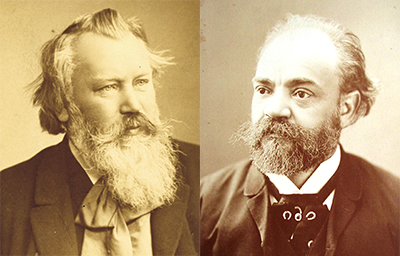
    BrahmsDvorak400px

    Above: Johannes Brahms and Antonín Dvořák

    ~ Author: Oberon

    Tuesday January 30, 2018 – This evening’s highly enjoyable program offered by Chamber Music Society of Lincoln Center brought us works by Johannes Brahms and Antonín Dvořák: music for piano 4-hands by each composer, with a piano trio from Brahms and a piano quintet from Dvořák. Six excellent musicians were on hand to delight an audience who had chosen great music over the SOTU. 

    Pianists Wu Han and Michael Brown shared the Steinway for the opening work: selections from Dvořák’s Slavonic Dances. Wu Han – clad is brilliant red – presided over the lower octaves and Mr. Brown the higher. The chosen Dances, two from opus 46 and two from opus 72, formed a perfect set.

    With the joyous opening of opus 46, #1, the cares and concerns of daily life were swept away; this Presto in C-major moves from exuberance to subtlety and back again. The players clearly enjoyed sharing the keyboard: in his program note, Mr. Brown compared playing 4-hands with playing doubles in tennis. And he further remarked that “…sharing one pedal is as strange as someone else brushing your teeth!” This duo got on like a house afire, vying in technical brilliance and relishing the more thoughtful passages. Opus 46, #2 has a darker, E-minor start, but then turns sprightly; Dvořák alternately accelerates and then pumps the brakes throughout this Allegretto scherzando.

    The dances of opus 72 are in general less extroverted and rambunctious than those of the 46. The pianists kept to E-minor with #2 which has a lyrical sadness and an emotional pull at first but later becomes sparkly and charming. They rounded off this opening Dvořák set with opus 72, #1, Molto vivace in B-major. This commences with a rocking rhythm and shows fresh vitality before it quietens with some lovely upper-range shimmers only to re-ignite as it hastens to its finish.

    For the Piano Trio in C-minor, Op. 101 of Johannes Brahms, Mr. Brown was joined by violinist Paul Huang and cellist Dmitri Atapine. This trio was composed in 1886 while the composer was summering at Hofstetten, Switzerland, and it was premiered in December of that year, with the composer at the piano, Jeno Hubay playing violin, and David Popper as cellist.

    The opening Allegro energico begins passionately, and the strings play often in unison. Following an animated passage, there comes a deep melody; the movement ends almost abruptly. 

    The trio’s second movement starts very quietly, almost hesitantly, the strings are muted and given over to almost sneaky plucking as the piano holds forth. Then violin and cello have a dialogue. The pizzicati recur, and the sotto voce atmosphere of the music is sustained.

    The Andante develops yet another conversation: this time between the duetting strings and the piano. All three musicians showed lovely dynamic gradations throughout. Mr. Brown’s dreamy and evocative playing drew sighing motifs from the violin and cello. A sudden burst of passion ends the Andante

    The rhythmic vitality of the concluding Allegro molto undergoes a mood change in an interlude where Mr. Huang’s polished tone could be savoured. Melodious exchanges lead on to a fervent finish. The three players’ sense of fraternity was evinced as they bowed to the audience’s sincere applause.

    Following the interval, our two pianists played three of Brahms’ Hungarian Dances. Wu Han and Mr. Brown had switched places on the piano bench, giving Mr. Brown the deeper registers whilst Wu Han shone in the soprano range.

    The Poco sostenuto in F-minor commences with a brooding quality, but then speeds up. A witty, almost ‘toy piano’ feeling charms in the central section before a return to the starting point. The music dances on to a fun finale. The Allegretto in A-major has a droll start and some playful hesitations: the two pianists seemed like co-conspirators here. Mr. Brown relished the low melody of the Allegro molto in G-minor whilst Wu Han’s sweetly struck higher notes felt like raindrops. The music then grows lively, with a gypsy lilt.

    A sterling performance of Dvořák’s Piano Quintet in A-major, Op. 81 (dating from 1887) made for the evening’s perfect finale, with violinists Chad Hoopes and Paul Huang, violist Matthew Lipman, and cellist Dmitri Atapine joining Wu Han.  

    Mr. Atapine sets the opening Allegro ma non tanto in motion with a nobly-played cello theme; there follows a warm tutti passage where we’re assured of a beautifully blended performance. Wu Han’s gorgeous playing (throughout) underscores the silken high range of Mr. Hoopes’ violin; then Mr. Lipman takes up a viola theme which is passed to Mr. Hoopes. Pulsing strings lead to an expansive passage; the Hoopes violin sings deliciously. We can revel in the intertwined voices for a few moments before the movement dashes to an ending.  

    The second movement, Andante con moto, was a source of true magic tonight, with Wu Han again displaying her gifts for creating atmosphere. Mr. Lipman has the melody; a tempo increase brings us duetting violins. Then comes an engrossing passage: Mr. Atapine’s cello sings deep as the violinists pluck; then Mssrs. Hoopes and Atapine sound a gentle, rolling motif in support of Wu Han’s luminous playing. Mr. Lipman takes up the main theme with rich lyricism. A sudden animation is calmed by the limpid piano, and then the ‘engrossing passage’ is repeated, with unbelievable subtlety.

    Chad Hoopes sends the Scherzo off with a light touch; Wu Han’s dazzling playing has me under a spell. The viola and cello engage us, Mr. Atapine’s attentiveness and sense of joy in his playing is inspiring to behold. Following a luminous interlude, the cellist propels the Scherzo to a lively finish.

    The Finale: Allegro starts with a petite into, and then embarks on a flowing dance. I absolutely loved watching Wu Han here, ever-alert and eyeing her colleagues with affection, she was clearly having a marvelous time of it. The mood shifts unexpectedly as Mr. Hoopes plays what seems like a hymn…or a prayer. Then the music goes on its lilting way to a jubilant close. 

    ~ Oberon