Tag: MADAMA BUTTERFLY

  • Licia’s Last Butterfly

    Albanese

    On Friday, November 26, 1965, I went to a performance of MADAMA BUTTERFLY at the Metropolitan Opera House. On the following day, I had an operatic double-header: a matinee of ELISIR D’AMORE and an evening performance of FAUST. That Saturday marked the last time I ever set foot in the Old Met. The venerable theatre had been marked for demolition, while a New Met was rising at Lincoln Center.

    The eight performances I saw at the Old House are very special memories for me. The singers I saw there had become gods and goddesses to me thru their singing on the Texaco Metropolitan Opera radio broadcasts; I was now experiencing ‘live‘ the rituals Milton Cross described each week over the airwaves: the house lights going down, the applause greeting the conductor, the great gold curtain being drawn back for the curtain calls. It was like a dream come true.

    Licia Albanese’s was one of the first operatic voices I became familiar with. She was one of the singers on the first 2-LP set of opera arias and duets that I owned. She sang Liu on a memorable Met broadcast of TURANDOT in 1962, opposite Nilsson and Corelli. And my parents had taken me to see her as Violetta (her 100th performance of the role) at the Cincinnati Zoo Opera in 1963.

    In all honesty, Albanese’s voice was never really among my favorites; it was more her expressive intensity of communication and her endearing persona that I found appealing. But I understood her importance as a singer in the grand tradition, and if her singing of the Violetta and Butterfly that I saw could turn dry and almost ghostly, I can still vividly recall her stage presence and her instinctive if Olde School acting.

    What I did not realize as I watched Licia Albanese taking her bows after that 1965 Butterfly was that it was the final time she ever sang the role. After playing Cio-Cio-San some eighty times on that stage, this was to be the last. Like many performances I have experienced, the evening became iconic over time when measured as part of the singer’s career.

    I met La Licia after the performance – I was one of a sizeable group of admirers who had waited for her – and she was of course elegantly gowned and coiffed, chattering away to her fans in Italian. She signed my program with a flourish: 

    Scanned Section 7-1

    It was a happy crowd of fans and friends, and no mention was made of it being “her last Butterfly”. She did sing one more complete role at The Met: Manon Lescaut; and the following Summer she sang Mimi in LA BOHEME with Barry Morell in a concert presented by The Met at the Newport Festival. 

    A few days after the performance, I sent her a fan letter and received this photo in return, along with her calling card:

    Scanned Section 11-1

    Licia Albanese – Ancora un passo or via ~ MADAMA BUTTERFLY

    There were two further memorable moments related to the Old Met and to MADAMA BUTTERFLY in Albanese’s extraordinary life: at the gala farewell concert that marked the closing of the Old Met on April 16th, 1966, Licia sang the aria “Un bel di” and, during the applause, she knelt to place a kiss on the stage where she had appeared so frequently since her debut in 1940:
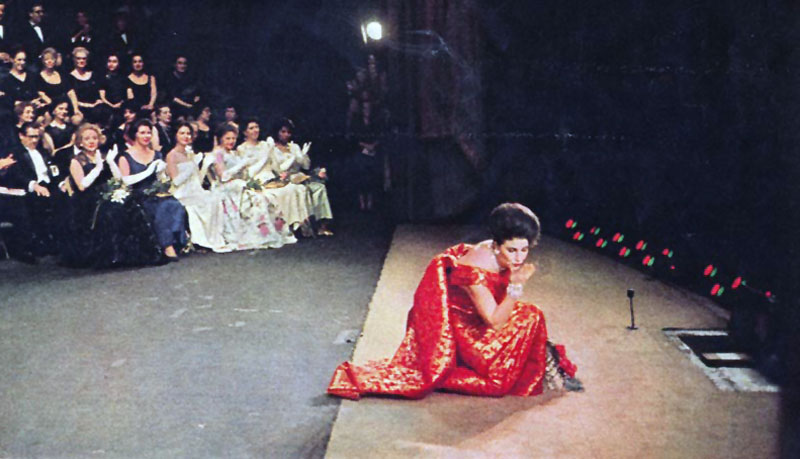
    Old met farewell

    Once the demolition of the ‘old yellow brewery’ began, Licia donned her kimono and sang “Un bel di” one last time amid the ruins.

    But my connection with the legendary diva was not over. One evening during the first season at the New Met, I saw her among the audience on the Grand Tier during intermission. She was talking with another elegantly-gown lady as I approached them hesitantly. The other woman gave me an encouraging smile, so I took Madame Albanese’s hand and awkwardly told her of having seen her Violetta and Butterfly. She thanked me quietly, but kept hold of my hand. Then she turned to her friend and said, in her charming accent: “It is so wonderful to be remembered! He’s so young, he will tell people about me many years from now.”

    Then, some thirty-five years on, I was holding down the fort in the opera room at Tower Records one dreary afternoon when Licia Albanese came in with a companion; the soprano was rather feeble by that point in time, but when I greeted her, she smiled silently. I said to her, “I saw your one hundredth Violetta at the Cincinnati Zoo Opera!” She was silent for a moment, and I thought my remark had not registered. Her friend gave me a look as if to say that Madame’s mind might not be perfectly clear.

    “The Zoo!” said the diva firmly. Then she began to roar like a lion and sing little birdcalls and make noises like chattering monkeys. Anyone who has ever attended a performance at the Cincinnati Zoo will know that these sounds were always a continuous obbligato to the opera being performed. We all laughed. And then I bade the two women goodbye, thinking to myself – as I have so often – “What a life I am living!”

    920x920

    Above: Licia Albanese at age 93; she passed away in 2014 at the age of 105. 

    ~ Oberon
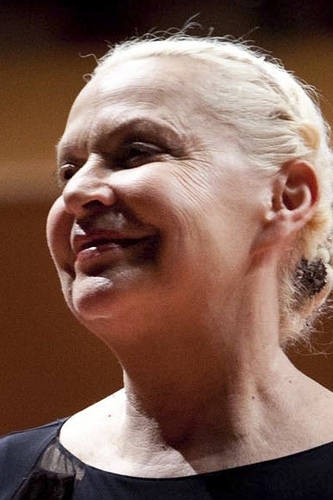
  • Elena Zilio Today

    Elena Zilio 2018

    Mezzo-soprano Elena Zilio (above) made her operatic debut in 1963 and went on to sing dozens of roles – everything from Cherubino to Dame Quickly – throughout the world.

    One of my favorite Zilio souvenirs is her passionate singing of Suzuki, Madama Butterfly’s faithful servant who, in this trio, foresees the story’s tragic ending:

    BUTTERFLY scene Zilio P Dvorsky Stilwell Chicago 1985

    Here she sings the aria of a distraught mother, Rosa Mamai, from Cilea’s L’ARLESIANA:

    Elena Zilio – Esser madre e un inferno ~ L`Arlesiana

    More recently, Elena Zilio has carved out a lovely niche for herself in character roles.

    Earlier this year, Ms. Zilio had a personal triumph as Mamma Lucia in CAVALLERIA RUSTICANA at Covent Garden. In 2019, she alternates that role and Madelon in ANDREA CHENIER in performances at Firenze, Naples, London, and Munich.

    ~ Oberon

  • BUTTERFLY @ The Met: First of Three

    Butterfly0607.12

    Above: dancer Hsin-Ping Chang in the Met’s production of MADAMA BUTTERFLY; photo by Ken Howard

    Monday January 20th, 2014 – Three sopranos are slated to sing Butterfly at The Met this season and I’ll be in the House for one performance by each; although I like the current BUTTERFLY production very much, as a matter of practicality I’ll be at a score desk for all three performances.

    Pierre Vallet, an assistant conductor at The Met, took over the baton tonight as the scheduled Philippe Auguin seems still to be indisposed. Vallet has worked at The Met for several seasons; tonight was only his second appearance on the podium (in 2011 he led a FAUST during which mezzo-soprano Wendy White suffered a serious onstage injury). He got BUTTERFLY off to a brisk start tonight with a nimble prelude, and although there were some moments when pit and singers were not precisely coordinated, overall he shaped a very appealing performance.

    Vocal honors tonight went to Bryan Hymel, the tenor who was a Met Auditions winner in 2000 and who returned to the House in triumph last season, replacing Marcelo Giordani in the arduous role of Aeneas in Berlioz LES TROYENS. Considering the difficulty, complexity and duration of many of the roles in Bryan’s current repertory, Pinkerton must seem like something of a ‘vacation role’ (that’s how Birgit Nilsson referred to Turandot). He sang with clear lyric thrust, with easy and sustained top notes zooming out into the House. The voice is fragrant and passionate; I had looked forward very much to hearing him in the aria and trio of the opera’s final act but in the event I didn’t end up staying that long.   

    Tonight’s Butterfly, the South African soprano Amanda Echalaz, revealed a vibrant and somewhat metallic timbre; her voice – which I would describe as ‘big lyric’ – projects well, but tonight much of the time she tended to sing sharp. This offset any pleasure I might have derived from her singing. By the end of the first act I’d decided that I’d heard enough, and I headed home after the love duet. The soprano’s bio indicates that BALLO and SALOME are in her rep; I’m wondering if she’ll wear herself out prematurely.

    Tony Stevenson was an outstanding Goro: clear and musical in his presentation, he sang the role more as a lyric than a ‘character’ tenor. The pleasing singing of Elizabeth DeShong as Suzuki was another possible reason to stay beyond the first intermission but there was no guarantee that Ms. Echalaz would overcome her sharpness, and the rest of the opera is a long haul if the Cio-Cio-San is off the mark. Scott Hendricks’  Sharpless was reasonable enough and Ryan Speedo Green was a strong Bonze.

    All the elements were here for a good BUTTERFLY except the essential one: a vocally inspiring heroine. In the coming weeks Kristine Opolais and Hui He will be taking on Butterfly at The Met and hopefully one or both of them will sustain my interest to the end of the opera. 

    Metropolitan Opera House
    January 20, 2014

    MADAMA BUTTERFLY
    Giacomo Puccini

    Cio-Cio-San.............Amanda Echalaz
    Pinkerton...............Bryan Hymel
    Suzuki..................Elizabeth DeShong
    Sharpless...............Scott Hendricks
    Goro....................Tony Stevenson
    Bonze...................Ryan Speedo Green
    Yamadori................Alexey Lavrov
    Kate Pinkerton..........Maya Lahyani
    Commissioner............Paul Corona
    Yakuside................Craig Montgomery
    Mother..................Belinda Oswald
    Aunt....................Jean Braham
    Cousin..................Patricia Steiner
    Registrar...............Juhwan Lee
    Dancer..................Hsin Ping Chang
    Dancer..................James Graber

    Conductor...............Pierre Vallet

  • In The Beginning

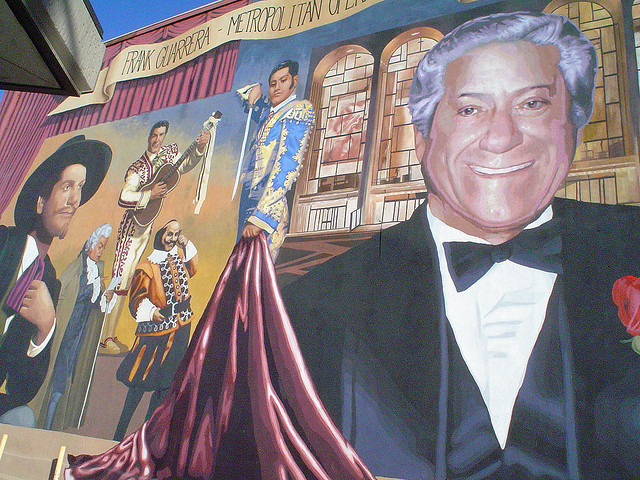
    Guarrera mural

    Above: a huge mural in Philadelphia honors that city’s native son, baritone Frank Guarrera, who sang Rigoletto in the first opera performance I ever attended.

    People have often asked me about my earliest operatic experiences and how I became engrossed in this ‘exotic and irrational’ art form. Although it all began for me in 1959 when I chanced to see Renata Tebaldi performing excerpts from MADAMA BUTTERFLY on The Bell Telephone Hour, it was actually attending a performance in the theater three years later that got me hooked. And to this day nothing – not recordings, radio broadcasts, televised performances, HD theatercasts – can compare with being in an opera house and experiencing opera in its natural habitat.

    I was a very unhappy boy, growing up in that small town and feeling totally out-of-sync with the people who lived there, and especially alienated from my peers. I had been stricken with rheumatic fever at age five, and was in a hospital bed (at home) for several weeks; I actually had to learn to walk again, and I sometimes think this had a profound effect on my development. On re-entering school, I was thououghly lacking in self-confidence, lonely and reclusive; and by the time I was ten I began to realize just how different I was from the other boys my age. 

    Watching that Tebaldi telecast was such a revelation. From the brief narration I had only the vaguest grasp of what BUTTERFLY was about; but the effect of this large, handsome woman wearing a kimono and singing in a foreign language bowled me over. I knew instinctively that life changed for me during that half-hour. But once smitten, where could I turn?

    My poor parents, how difficult it must have been for them having this weird child on their hands! My brother was a handful in his own way, though a typical late-1950s teenger: a James Dean-type who smoked, carried a switchblade, and sometimes brushed up against the local sheriff. My sister was popular, very involved in school activities, an all-American girl. But there was no instruction manual – especially in that neck of the woods – for raising an eccentric, introverted, feminine boy like me.

    Going with the flow as best they could, my parents gave me a two-LP album of Verdi and Puccini arias sung by great RCA recording artists like Milanov, Albanese, Peerce, Bjoerling, Merrill, Warren and Tozzi. I wore it out in no time. Then I discovered the Texaco Metropolitan Opera Saturday radio broadcasts (Sutherland’s 1961 LUCIA was my first) and things moved to another level. No one was allowed to disturb me during those afternoons, and I had a big old reel-to-reel deck and used a microphone to tape the operas off the air. I played the tapes over and over: that’s how I learned the repertory. I subscribed to OPERA NEWS and sent fan mail to singers I heard on the airwaves. I still have the letters and signed photos they sent me.

    So it only remained to actually attend an opera performance. Every summer at the end of June, my father would close the drug store he owned for two weeks and take us on a car trip. We went to Maine, Boston, Washington DC, Niagara Falls. My mother hated those trips: she loved sleeping in her own bed and usually found fault with the motels where we stayed. But it was my dad’s annual opportunity to get away from it all, and so – being a good wife – she obliged.

    I had found out about the Cincinnati Summer Opera festival, held at the local zoo. As my father was casting about for a place to go in July 1962, I put forth the idea of attending an opera. He thought the venue might be interesting, and that we could combine the trip with an excursion to the horse farms of Kentucky. Opera tickets were ordered by mail, and at last we were off: on July 7th, 1962, in a production of painted flats and very traditional costumes and staging, RIGOLETTO unfolded before me.

    The names and voices of the announced principals were familiar to me from hearing them on the Met broadcasts: Laurel Hurley, Barry Morell, and Frank Guarrera. A news item in the local paper had momentarily burst my bubble: Ms. Hurley was ill and would be replaced as Gilda by Nadja Witkowska. But by the time the conductor, Carlo Moresco, struck up the prelude, nothing else mattered: I was at the opera!

    I remember that Ms. Witkowska produced exciting high notes, that Mr. Morell’s voice was clear and warm, with a trace of a sob here and there; and that Mr. Guarrera sang strongly and really moved me with his “Pieta, signori!” sung prone on the stage, his face an inch or two off the floor. Irwin Densen, a basso who had a very long career and who I would see many times in years to come, was Sparafucile. And a devilish-looking tenor in a black beard and wearing black tights and tunic gave me – sub-consciously – a sexual frisson when he apeared as Borsa. That was Andrea Velis, a prominent Met comprimario. Another Met stalwart, Gene Boucher, was Count Ceprano.

    B morell

    Barry Morell (above) sang the Duke of Mantua

    After the performance I went backstage to meet the singers; oddly, I did not ask for autographs. I’ll never forget when Frank Guarrera came out to greet the fans: he had received a negative review for his prima performance, two nights earlier, from a woman named Eleanor Bell writing for the local newspaper. The crowd burst into applause and bravos when he emerged from the dressing room and as he began to sign autographs, he shouted triumphantly: “To hell with Eleanor Bell!”

    I think my parents actually had a good time: they took me back to the Zoo Opera for the next two summer vacations. We saw Licia Albanese singing her 100th Violetta (with Morell and Guarrera) and we saw Adriana Maliponte as Massenet’s Manon (with Morell and Guarrera) along with a TROVATORE starring Martina Arroyo and Irene Dalis. And my parents also took me to the Old Met, where I saw the Eugene Berman DON GIOVANNI – the first of eight performances I saw at the Old House – just days after John F. Kennedy had been assassinated.

    Finally, in late summer 1966, I was allowed to make my first solo trip to New York City to be on the first ticket line for the New Met. After that, there was no stopping me.

  • Addio fiorito asil

    Franco

    A rarity: Franco Corelli sings Pinkerton’s farewell to the little house where he and Cio-Cio-San were briefly happy together: “Addio fiorito asil” from Puccini’s MADAMA BUTTERFLY.

    “Farewell, flowery refuge
    of happiness and love!
    I shall always be tortured
    by the thought of her sweet face.
    Farewell, flowery refuge:
    here where she waited for me..
    Ah, my remorse I cannot bear.
    I must go, how I despise myself!
    Farewell…
    I must flee…I am vile…I despise myself!”