Tag: New York City Ballet

  • Joy To The World: BRANDENBURGS @ CMS

    2000px-Johann_Sebastian_Bach_signature.svg_

    Tuesday December 16th, 2014 – New York City Ballet have Balanchine’s NUTCRACKER; The Philharmonic offers the MESSIAH; and The Met’s giving holiday performances of HANSEL & GRETEL. But it’s Chamber Music Society of Lincoln Center who give us an extra-special gift every year in the run up to Christmas Eve: the complete Brandenburg concertos of Johann Sebastian Bach.

    Last year the Society scheduled two performances of this programme, both of which were sold out. This year they have added a third performance, which is the one Dmitry and I attended tonight. And on Thursday they’ll take the Brandenburgs on the road, to the Harris Theater in Chicago.

    A large crowd this evenng, with additional rows of seating near the stage. A pair of fidgety neighbors were a bit of a distraction, but at least they were silent. The concertos, played in a different order each year, unfolded magically; each has its own complement of players and the Society assembled a roster of excellent musicians who traded off ‘seatings’ from one concerto to the next. So nice to see principal artists from The New York Philharmonic (Robert Langevin, flute, and Timothy Cobb, double-bass) and The Metropolitan Opera (Julia Pilant, horn) joining CMS from their neighboring home theatres. Mr. Cobb and John Gibbons (immaculate playing at the harpsichord) performed in all six concertos. The programme looks long on paper, but actually the evening flew by with a savourable mixture of virtuosity and expressive poetry.

    The performance opened with the #1 concerto in F-major, which sounds so Handelian to me. This is the concerto with two horns and a trio of oboes. Ms. Pilant and Julie Landsman sounded the brightly-harmonized horn calls with assurance, whilst Stephen Taylor, Randall Ellis, and James Austin Smith piped up delightfully with their oboes, joined by Marc Goldberg on bassoon. Oboe, violin, bassoon and bass sound the poignant adagio, then the high horns ring out briskly in the allegro. You think it’s over, but there’s a surprise fourth movement – it veers from minuet to polonaise – in which separate choirs of winds and strings summon up the rhythms of the dance.

    In concerto #6 (B-flat major) which follows, a trio of cellos (Pauk Watkins, Eileen Moon, Timothy Eddy) bring a particular resonance to the score. The adagio – one of Bach’s most movingly melodious inventions – opens with the solo viola (Lily Francis) who passes the theme to violinist Lawrence Dutton. This is a passage that one wants to go on and on. But the closing allegro sweeps us inexorably forward.

    Violinist Benjamin Beilman took the lead in the 4th concerto (in G-major); the satiny sheen of his sustained tones and his very deft management of the coloratura passages were indeed impressive, and he is an animated, deeply involved musician. The duo flautists Sooyun Kim and Robert Langevin warbled with silvery sweetness in the fleet phrases of the outer movements and blendied serenely in the central andante.  Ben Beilman’s striking virtuosity and his elegant lyricism marked a high point in an evening loaded with superb playing.

    After the interval, in the 5th concerto (D-major), John Gibbons’ harpsichord artistry was to the fore, giving great pleasure in a long, complex and brilliantly etched ‘mega-cadenza’ at close of the first movement. The central affetuoso movement brings the sterling flute of Mr. Langevin and the poised violin phrasing of Sean Lee, mingling their ‘voices’  with the keyboard textures Mr. Gibbons so impressively evoked. Yet again, we feel Bach’s genius being transmitted to us in all its poignant clarity. The mood and pace then bounce back emphatically with a brisk final allegro.

    The 3rd concerto, in G-major, is unique in that the expected central slow movement is replaced by a mere couple of chords before going immediately into allegro overdrive. Thus the entire piece simply rushes forward in a whirlwind of animated playing. The all-strings setting (plus harpsichord, of course) features a large ensemble and much rhythmic and melodic variety whilst always sailing onward.

    The evening’s final work, the 2nd concerto (in F-major), arrived far to soon. In flourishing flights to the upper range, David Washburn’s Baroque trumpet gave the arcangel Gabriel a run for his money. Equally scintllating to the ear was Sooyun Kim’s limpid flute playing: both in agility and in sustained, luminous tone, she made a wonderful impression. In the andante, a particularly fine blend of timbres from Ms. Kim, Stephen Taylor (oboe), Lawrence Dutton (violin) and Paul Watkins (cello) made me again want to linger; but the trumpeter’s silvery calls in the final allegro assai swept us on to the evening’s celebratory conclusion.

    The young violinist Sean Lee, playing the concertos with CMS for the first time, wrote movingly of the experience in a Playbill note: “I cannot think of a more joyous, warm, celebratory set of pieces to revel to, as if gathering around a fire during these winter months.” Amen to that!   

    The participating artists:

  • Joshua Bell & The NY Philharmonic

    Joshua-bell_s345x230

    Thursday November 13, 2014 – Violinist Joshua Bell (above) plays the Glazunov violin concerto in a series of five concerts with The New York Philharmonic. Case Scaglione takes the podium for these performances, which also features Debussy’s Afternnoon of a Faun and Prokofiev’s symphony #5.

    My friend Monica and I attended the second evening of the programme; since we are both passionate ballet enthusiasts, we very much enjoyed experiencing the Debussy in a concert setting; we have often seen the Jerome Robbins setting of the work at New York City Ballet, and recently Boston Ballet brought their ‘original’ version to Lincoln Center.

    One of the composer’s most famous works, Claude Debussy’s Prélude à l’après-midi d’un faune referred to in this evening’s Playbill by its English title – premiered in 1894. The work is considered a turning point in the history of music: Pierre Boulez once said he considers the score to be ‘the beginning of modern music’. Tonight the Philharmonic gave a beautifully shaped rendering of this sensuous piece, which commences with the languid flute theme. Individual voices emerged dreamily from the overall soundscape and Debussy’s alluring colour scheme was indeed seductive. Neither Monica nor I could recall having previously heard the gentle chime of a triangle near the end of the piece; it seemed very prominent tonight. Case Scaglione rightly summoned the Philharmonic’s principal flautist, Robert Langevin, for a solo bow during the warm applause that greeted this opening work.

    Composer Alexander Glazunov (1865-1936) managed to endure ten years in Russia following the Bolshevik Revolution; he fled to Paris in 1928. His compositions from that point on are considered less impressive than his earlier works which include the richly melodic score for the ballet RAYMONDA, a suite from which was recently featured in ABT’s Autumn season at Lincoln Center.

    The violin concerto, Glazunov’s most frequently-performed work, was composed it in 1904. It is dedicated to, and was premiered by, the great Hungarian violinist Leopold Auer, the teacher of Heifetz, Milstein, and Elman, among others. Glazunov casts this concerto in an unbroken arc, with the three vari-paced movements subtly linked. A virtuosic cadenza carries us to the exuberant finale in which the soloist dazzles against a tapestry of orchestrated fireworks.

    Joshua Bell, taller than I had imagined and retaining a youthful energy of demeanor in his mid-40s, displayed the warmth of tone and the clear shimmer of upper-range diminuendo that are hallmarks of his playing. I was a bit surprised to note that he was using a score, but he handled it with casual assurance. Creating a fine rapport with conductor and musicians, Joshua drew the succession of themes in the opening movement into long, impeccably turned phrases; in the almost frantic pacing of the final allegro, he seized upon the sparkling coloratura passagework with thrilling dexterity. The crowd called him out for a well-deserved solo bow.

    After the interval, the Prokofiev: he wrote his fifth symphony during the summer of 1944, while staying at a dacha in the countryside outside Moscow. Having stored up his musical ideas over time, he wrote with speed and surety. The symphony was first performed in Moscow in January 1945 with the composer conducting.

    The first movement is dense of texture and thick with themes: there are five distinct tunes to be discerned, and the composer integrates them with skill. The movement closes on a grandiose note; I must say I wasn’t totally enamoured of this opening andante; it seemed a bit turgid and over-extended. But thereafter, the Prokofiev I have come to love was very much in evidence. The second movement in particular is a great delight with its relentless forward motion decorated by interjections of wit and melodic irony. The tempo gradually accelerates, almost to the point of veering out of control.

    The adagio conjures up the blend of unhappy romance and wistful tenderness we associate with the composer’s ROMEO AND JULIET, with a turbulent central passage. Then on to the final Allegro giocoso, where we again find Prokofiev at his most inventive, opening with an echo of the first theme of the first movement, and then a passage for the clarinet – Prokofiev at his most magical – superbly voiced by principal Anthony McGill. The symphony plunges forward to its conclusion, re-affirming the composer’s fixed positon in my constellation of favorite composers.

  • BalletCollective @ The Skirball

    Troy Schumacher, by Matthew Murphy

    Above: Troy Schumacher, photo by Matthew Murphy

    Wednesday October 29th, 2014 – The dancing tonight as Troy Schumacher’s BalletCollective opened at The Skirball was fantastic. Drawing from the roster of his resident Company, New York City Ballet, Troy presented an ensemble of dancers with spectacular technical and communicative gifts.

    The program opened with the impulse wants company (premiered in 2013), set to a score by Ellis Ludwig-Leone, and drawing inspiration from a poem by Cynthia Zarin. The music was played live (as in fact was the entire programme) the contemporary ensemble Hotel Elefant

    BALLET_COLLECTIVE, Claire Kretzschmar, by Matthew Murphy

    Above: Claire Kretzschmar, photo by Matt Murphy

    Long-limbed and with an innate sense of the dramatic, Claire Kretzschmar launched the evening in a solo passage. This distinctive NYCB ballerina really made her mark tonight, Troy’s choreography showing her off to fine effect in both the opening and closing works. (Meet Claire in this video, in which the Collective’s Taylor Stanley also appears.) She is soon joined by Ashley Laracey, Lauren King, Meagan Mann, David Prottas, Taylor Stanley, and Troy Schumacher. This dynamic group  highlighted Troy’s inventive choreography with propulsive energy mixed in with moments of pensive repose. A spectacular solo by Taylor Stanley left me feeling awestruck. 

    BC, Blackbirds, Ashley Laracey, Troy Schumacher, by Matthew Murphy

    Above: Ashley Laracey and Troy Schumacher, photo by Matt Murphy

    Following the interval, the premiere of a new duet, dear and blackbirds, was danced by Ashley Laracey and Troy Schumacher to music by Ellis Ludwig-Leone; again, a poem by Cynthia Zarin was the frame of reference. Troy had not originally planned to dance in the performance this evening, but he stepped in on short notce after a colleague sustained an injury. This pas de deux had a Jerome Robbins flavour, the couple exploring the possibilities of mutual interest, alternately hesitant and impetuous. Romantic partnering with touches of playfulness give way to the two dancers trading short phrases. Ashley Laracey displayed the lovely qualities of lyricism that have kept her shining in my dance firmament since I first saw her onstage.

    BC, ATWS, Taylor Stanley, by Matthew Murphy

    Above: Taylor Stanley, photo by Matt Murphy

    In all that we see, the addition of wind players to the strings and piano gave the sonic landscape a fresh vista. Meagan Mann, Lauren King, Claire Kretzschmar, David Prottas and Taylor Stanley all danced exceptionally well. Claire again made superb use of the space and she has a restless angularity that draws the eye. There’s a very nice duet for Lauren and Taylor, and Meagan at one point enters in a tip-toeing motif, adding a sense of mystery. David and Taylor came face to face in a dramatic moment: I thought they might punch each other…or kiss. 

    In an evening so well-danced and featuring choreography which reaches for new combinations in a familiar vocabulary, a lack of contrast in the musical settings was a minor drawback. The composer of all three works has definite skill and his music is appealing, yet a whole evening of it doesn’t quite hold up. The musicians of Hotel Elefant were excellent and warmly acknowledged by the audience.

    The Skirball stage was stripped back to the bare back wall and wings, giving the ballets an industrial look. The lighting design produced some striking moments, but at times the dancers were too heavily shadowed. The costuming had an every-day feeling in the first two works; a credit to artist David Salle for painting the clothes for all that we see piqued my curiosity but from where I was sitting I couldn’t get a feel for his work. The big projections that were a key element in the Collective’s inaugural presentations weren’t part of the current presentation, but the dancers and the dance successfully held the stage in this rather stripped-down setting. The evening drew a real New York dance crowd, laced with celebrities and keen in their attentive focus.

    All photography by the marvelous Matthew Murphy.

  • Promotion at New York City Ballet

    307993_2245998383481_1924770756_n

    Please join me in congratulating Russell Janzen on his promotion to the rank of soloist at New York City Ballet.

  • Tchaikovsky/Balanchine @ New York City Ballet

    10708211_10152712762704814_256726488_n

    Above: at a New York City Ballet rehearsal; photo by Craig Hall

    Wednesday September 24th, 2014 – An impressive line-up of favorite dancers in familiar roles, the music of Tchaikovsky, the choreography of Balanchine: what better way for me to start a new season at New York City Ballet?

    Under Clothilde Otranto’s baton, the four Tchaikovsky scores were nicely served up by the NYC Ballet‘s intrepid musicians. Tonight was probably considered an ‘easy’ night for these players: scores they have played dozens of times. They always deserve their spot-lighted ‘curtain call’ at the end of the evening, and it was good to hear a warm swelling of applause for them tonight.

    Ms. Otranto seemed to be favoring fast tempi in SERENADE tonight; the musicians assured that the emotional colours of the music came thru, and the dancers took it all in glorious stride. From curtain-rise, the corps provided an endless panorama of beautiful faces, forms, and personalities. It’s funny that I still find myself looking for people like Amanda Edge and Pauline Golbin among these ice-blue-gowned angels: and where’s Amanda Hankes tonight? Ah, well, they have danced into other phases of their lives – gone from this stage but never forgotten. 

    For present loveliness, we have a delectable quartet of demi-solistes: Faye Arthurs, Alina Dronova, Meagan Mann, and Mary Elizabeth Sell. And Gwyneth Muller always moves me as the consoling maternal figure at the end of the ballet.

    This was a blonde SERENADE: Sara Mearns, Sterling Hyltin, and Teresa Reichlen all looked sumptuous, especially when their hair came down for the final movement. Sara’s luxuriant dancing was given noble grounding by Jared Angle, ever the ideal cavalier. Sterling – her lingering balances spot-on – found just the right mixture of elegance and vivacity, catching the many musical moods in which her ‘character’ finds herself. Tess was divine lyricism personified, and Adrian Danchig-Waring seemed to have come down from Mount Olympus. The sight of Adrian and Tess crossing the stage together, raising Sara from her dream, and Tess’s marvelous slow-turning supported arabesque summed up everything that is SERENADE. The audience responded with a deeply resonant ovation; I am sure there were people in the audience seeing SERENADE for the first time, and I’m sure they will want to see it again.

    The quiet radiance of Maria Kowroski’s Preghiera in MOZARTIANA showed the great ballerina at her most communicative: the lovely passage with her hands in prayerful attitude was especially evocative tonight, as was the gentle silence of her pin-point bourrées. Later, as the ballet’s mood becomes more expansive, Maria’s swirling turns and trademark extension were woven into the music with queenly assurance. I couldn’t take my eyes off her. Tyler Angle was on fine form, his dancing marking the first of three displays of male virtuosity which had the audience cheering this evening. Maria and Tyler have formed an impressive partnership and I look forward to their future endeavors. The ever-excellent Daniel Ulbricht maintained the elegance of the ballet with his stylish dancing – his Gigue has become a signature role – and the Menuet was graciously performed by Marika Anderson, Megan Johnson, Emily Kikta, and Gwyneth Muller.

    A rousing rendition of the TCHAIKOVSKY PAS DE DEUX caused the audience to shed any trace of decorum and yell lustily as Ashley Bouder and Gonzalo Garcia traded technical fireworks in a vivid and smile-inducing performance. After a graciously musical adagio, Gonzalo gave an astonishing performance of his solo – some of the best dancing he’s ever done – nailing the myriad turns at the end before a final brilliant combination to the knee, expertly timed. The crowd went wild. Ashley then swept thru her own dazzling display of danced coloratura, tossing in spicy little pauses and teasing us with her technical savoir faire. Another roar went up as her solo’s final fantastical turns stopped on the proverbial dime. Now with the audience squarely in the palms of their hands, these two magicians of dance swept thru a blazing coda – Ashley’s deluxe fouettés yet another savorable moment – and brought down the house. 

    In the haunted ballroom setting for the Élégie of TCHAIKOVSKY SUITE #3, Rebecca Krohn and Ask LaCour brought tears to my eyes with their poetic evocation of an ideal found…and lost. Rebecca’s restless, almost feral allure was captivating to behold. And Ask is so perfect here: covering the space with questing leaps in pursuit of his elusive muse. Their performance moved me deeply, their parting and Ask’s sinking back into a reverie of heartache drawing up so many emotions.

    Abi Stafford and Justin Peck sustained a mood of mystery in the Valse Mélancolique, Justin’s innate sense of drama nearly drawing the coolly captivating Abi into his world. Yet it is she who prevails: at the end he backs away from her, completely under her spell. Abi and Justin are among my favorite dancers to watch; having them cast together here was a very nice gift.

    In the Valse, a particularly appealing trio of diverse beauties – Olivia Boisson, Lara Tong, and Claire Kretzschmar – looked fetching in one of the ballet’s many featured corps passages.

    In a bewitching performance, Erica Pereira spun marvelously thru the plentitude of pirouettes Balanchine demands of her in the Scherzo; her lustrous black hair and shimmering silver-white tulle flowing as she traced a comet-like trajectory around the stage. Antonio Carmena matched Erica’s spinning flourishes with his airy leaps; they fly off in opposite directions at the end. 

    And now we come to the grand finale: Theme and Variations. The recently refurbished costumes for this ballet seem to glow as Tiler Peck and Joaquin de Luz set forth the elegant opening Theme. Moments later, in her first solo variation, Tiler displayed her epic perfection as a classical ballerina with some truly glorious dancing. The audience showered her with a torrent of applause. The ballet progressed – with excellent suppport from the corps – as Tiler and Joaquin moved continually from one peak of perfection to another. Joaquin’s marziale variation was thrillingly executed, the devilishly handsome dancer basking in another avalanche of cheers, the iconic de Luz smile justifiably lighting up. The ballet swept forward, buoyed not only by the two spectacular principals but by a very impressive quartet of demi-solistes: Lauren King, Brittany Pollack, Mary Elizabeth Sell, and Lydia Wellington. Their cavaliers in the finale were Daniel Applebaum, Allen Peiffer, David Prottas and Andrew Scordato.

    As Ms. Otranto guided the evening to its triumphant close, the audience burst yet again into a passionate ovation: Tiler and Joaquin – and indeed the entire Company – were saluted at the end of a great evening…a great evening for dance, for Tchaikovsky, and for the enduring magnificence of Mr. B.

  • Tom Gold Dance: Images from Sofia

    10366055_10152566065832755_6100055162900197831_n

    Above: Pacific Northwest Ballet principal Seth Orza and New York City Ballet principal ballerina Maria Kowroski performing Balanchine’s APOLLO with Tom Gold Dance on their June 2014 tour to Bulgaria; photo by Ani Collier. 

    Tom Gold has sent me some of Ani Collier’s photos from his Company’s recent performances at Sofia, Bulgaria: 

    10304429_10152562878547755_3474847024320160015_n

    Seth Orza in APOLLO

    10475933_10152556875692755_6276963205773144048_n

    Maria Kowroski in Robbins’ CONCERTINO

    PZNOv3fQLxZUJB2weXRxx6extnvCOCoiSI7Q1x-mOlI

    New York City Ballet‘s Daniel Applebaum and Savannah Lowery in Twyla Tharp’s JUNK DUET

    SbNJYkN8ZcPM9aPbYP3dKjNN16Rgo_eA_H3DO9ImQBE

    The ensemble in Tom Gold’s LA PLAGE

    10449964_10152566965962755_2817086933432883500_n

    Pacific Northwest Ballet principal ballerina Carla Korbes with New York City Ballet‘s Andrew Scordato and Devin Alberda in LA PLAGE

    10430868_10152566930407755_6802768218685379841_n

    Carla Kotrbes and Seth Orza in Tom Gold’s GERSHWIN PRELUDES 

    While in Sofia with Tom’s troupe, our beloved Maria Kowroski was the subject of a photoshoot.

    In the week leading up to the tour, photographer Nir Arieli and I had stopped in at one of Tom’s rehearsals: read about it here.

  • Boston Ballet @ Lincoln Center

    10492224_10152189404857607_7335500118768821092_n

    Friday June 27th, 2014 – Boston Ballet have been celebrating their 50th season with performances at Lincoln Center this week. Tonight’s programme looked so tantalizing on paper, and it turned out to be a magnificent evening overall: Vaslav Nijinsky’s Afternoon of a Faun, George Balanchine’s Symphony in Three Movements, Jorma Elo’s Plan to B and Jiří Kylián’s Bella Figura were all superbly danced by the Boston troupe.

    When visiting companies bring Balanchine to New York, I sometimes wonder if it’s a good idea. Can’t you bring us something we don’t see all the time? But understandably, other companies are proud of their Balanchine and want to show off their abilities. Boston Ballet did a great job with The Master’s Symphony in Three Movements, even bringing their own orchestra to play the score. And Boston Ballet has strong Balanchine ties: he became Artistic Advisor to the Company in 1963, gifting them with more than seventeen of his ballets as a gesture of support.

    Curtain up, and I immediately found Shelby Elsbree in the diagonal. The ballet surges forward, with delightful performances by Misa Kuranaga and Jeffrey Curio – the high-bouncing couple – and Rie Ichikawa and Bradley Schlagheck. In the ballet’s central pas de deux, Lia Curio and Lasha Khozashvili excelled. The audience, fortified by a contigent of Bostonians, gave liberal and much-deserved applause to the dancers.

    Boston Ballet had brought their production of Vaslav Nijinsky’s Afternoon of a Faun to Fall for Dance in 2009 and I was mesmerized by it. Seeing the Leon Bakst backdrop and costumes again this evening provided a tangible link to the history of ballet and to that scandalous night over a century ago when Faun set Paris on its collective ear. Tonight, Altan Dugaraa embodied the exotic beauty of the Faun, his mystique and his longings, and Erica Cornejo was the Nymph, miming with stylized perfection. So grateful to have had another opportunity to see this production.

    In 2006, I experienced Jorma Elo’s work for the first time at the New York City Ballet’s premiere of Slice to Sharp. Slice received the longest ovation of any new work I’ve encountered at the ballet over the years: endless curtain calls and a state of euphoria among the crowd. Boston Ballet‘s performance of Mr. Elo’s Plan to B had something of the same a dynamic pungency about it. Illuminated by a large glowing screen stage right, six dancers reveled in fantastical choreographic patterns, flinging themselves into off-kilter leaps and flying across the stage, arms whirling like windmills in a tornado. Dusty Button, Whitney Jensen, Bo Busby, Jeffrey Cirio, John Law, and Sabi Varga danced thrillingly and were deservedly cheered for their jaw-dropping virtuosity.

    Alas, I am afraid Jiří Kylián’s Bella Figura was not really to my liking. Returning from the intermission, we find the dancers already onstage…warming up? Or is it a choreographed passage to start the ballet? Either way, it’s pretentious. Purgatorial and several minutes too long, the Bella Figura seemed to be more about the staging than anything else: black curtains endlessly re-arranged, a complex lighting scheme, flaming braziers bringing a taste of Hell to the stage, dancers coming and going almost randomly. The dancing was of course remarkable, and there are some very attractive passages, most especially when the topless dancers in long red skirts dance in unison. But it seemed to go on and on.

  • At NYC Ballet: Jonathan Stafford’s Farewell

    FY11 J.Stafford 10081JS_019

    Above: Jonathan Stafford, photo by Henry Leutwyler

    Sunday May 25th, 2014 matinee – Jonathan Stafford’s farewell performance at New York City Ballet turned out to be not only a royal send-off for this all-American prince, but one of the finest performances that I’ve seen the Company give in recent seasons. Everyone – musicians and dancers alike – were really on their game and the affectionate tributes at the final curtain showed the sincere esteem and friendship in which his dancing colleagues hold Jonathan. It was a very emotional but also a truly happy farewell: the fact that Jon’s not going anywhere – he stays on with us as ballet master and also continues to teach at SAB – reassures us that we’ll continue to see him around Lincoln Center from time to time. It also would not surprise me if he pops up onstage again in an acting role some day.

    When I think of Jon Stafford’s dancing, two images immediately come to mind: his beautiful air turns – in several diifferent ballets – where he could effortlessly change from left turn to right in the blink of an eye; and a truly mirthful moment in the first-season performances of Ratmansky’s CONCERTO DSCH where Jon stood in place, simply jumping up and down endlessly, keeping a straight face the whole time. These two elements – technical finesse plus an ability to transform the simplest of movements into something vivid – have always made Jon’s performances so highly enjoyable to watch.

    6a00d8341c4e3853ef0120a7fc6fe3970b

    And then there’s the partnering: Jon is a prince of a partner (above, in CORTEGE HONGROIS with Maria Kowroski in a Paul Kolnik photo). At the end of this afternoon’s performance, the principal ballerinas and then the female soloists all came out to present Jon with bouquets; their hugs seemed particularly sincere because over the years he’s helped them all to look their best onstage.

    Symphony-in-C-AStaffordJStafford

    Siblings: Jon and his sister, NYCB principal ballerina Abi Stafford, in Balanchine’s SYMPHONY IN C, photo by Paul Kolnik. Jon and Abi danced together in EMERALDS this afternoon.

    2013_01_16_01_35_1742_09_ballet

    A special memory: Jon’s performances in Balanchine’s setting of Tchaikovsky Piano Concerto #2 during the 2008 season moved me to tears in the ballet’s second movement. I saw it several times that year, when Jon danced with Ashley Bouder (Paul Kolnik photos, above and below).

    Pk_tschaikovsky_piano_concerto_2_jonathan_stafford_ashley_bouder_ppd_1000

    Today Ashley danced the ‘other’ girl in EMERALDS and gave a remarkable performance. 

    10261998_10154135166880529_3211500853438514229_n

    Above and below: Jon in DIAMONDS with Sara Mearns

    C29896-8_MearJstafDiam

    Sara danced this role with Jon this afternoon, celebrating a grand finale to his NYCB career in high style.

    Of course, ‘retirement’ performances always summon up a vast array of memories of the dancer being celebrated. Of the many evenings I have watched Jon Stafford onstage, I especially recall his perfect characterizations of several “Prince” roles: in FIREBIRD, in SLEEPING BEAUTY and in SWAN LAKE. From Balanchine, we enjoyed his LIEBESLIEDER, WESTERN SYMPHONY and NUTCRACKER cavalier, and from Robbins his IN THE NIGHT and DANCES AT A GATHERING (where he played “catch-the-ballerina” so memorably). Jon also made his mark in such diverse contemporary ballets as RUSSIAN SEASONS, VESPRO, LUCE NASCOSTA, OLTREMARE, and RIVER OF LIGHT; in the last-named Peter Martins ballet, Jon pulled off some thrilling one-armed lifts of Erica Pereira. His height and noble bearing made an outstanding impression as the venearble Father in PRODIGAL SON.

    Aside from dancing, Jon showed his organizational skills when he put together the 2008 Dancers’ Choice event, a performance I recall clearly to this day.

    6a00d8341c4e3853ef01310f1e4f4c970c

    Above: Jon with colleagues Amar Ramasar, Jared Angle, Jenifer Ringer and Abi Stafford in Robbins’ DANCES AT A GATHERING, a Paul Kolnik photo. Amar partnered Ashley Bouder in EMERALDS this afternoon and together they launched the afternoon with their elegant and truly inspired dancing.

    And so, now to the details of today’s performance. Guest conductor Koen Kessels was on the podium and as always the under-sung musicians of the NYCB orchestra played beautifully, especially in the Faure which was so moving today.

    Sometimes at a farewell, the actual performance is eclipsed by the event. Ashley Bouder and Amar Ramasar assured us immediately on curtain-rise that we were in for a super-JEWELS: save the confetti and flowers for later, we’re going to do some serious dancing! What a poetic atmosphere these two dancers created immediately, summoning up a quiet yet somehow electrifying bond between two charismatic personalities. Amar’s courtliness and Ashley’s lyric wistfulness played beautifully off one another. Complete enchantment.

    The iconic and perfumed solos which Balanchine created for the two principal ballerinas in EMERALDS were so expressively danced today by Ms. Bouder and Abi Stafford. And the gracious pas de trois was danced with lovely, refined virtuosity by Erica Pereira, Ashley Laracey, and Antonio Carmena.

    And then at last Jonathan appeared: the music here is too delicate to allow for applause for his entrance, but a murmur of excitement passed thru the House. Ever the dedicated cavalier, Jon devoted all his poetic energy to presenting his ballerina as if she were a precious jewel. Abi’s dancing, so light-filled and polished, had a calm radiance that ideally embodied the music. Together they were perfect.

    As EMERALDS moves towards its conclusion, the dancers walk slowly about the stage as the women begin to exit. In a beautiful moment, as Jon passed in front of Ashley Bouder, a subtle smile illuminated her face – a beautiful, personal homage from one dancer to another. 

    A sizzling performance of RUBIES followed: Sterling Hyltin was absolutely stunning in her virtuosity, toying with the music whilst reeling off pirouettes at improbable speed and creating a character at once elegant, provocative, and playful. She met her match in Andrew Veyette who, fresh from a triumphant guest appearance in THEME AND VARIATIONS at ABT, cut loose with some vibrantly jazzy moves to Stravinsky today. The imperial Teresa Reichlen danced a signature role in today’s RUBIES, wowing the audience with her extension and dazzling sexiness. At the close of the passage where she’s manipulated by four men into uncanny poses, Tess plunges into a deep Arabesque Pencée, eye-to-eye with Giovanni Villalobos; she holds his gaze with remarkable intensity: does she want to kiss him or kill him?  Huge applause today for the RUBIES principals and corps.

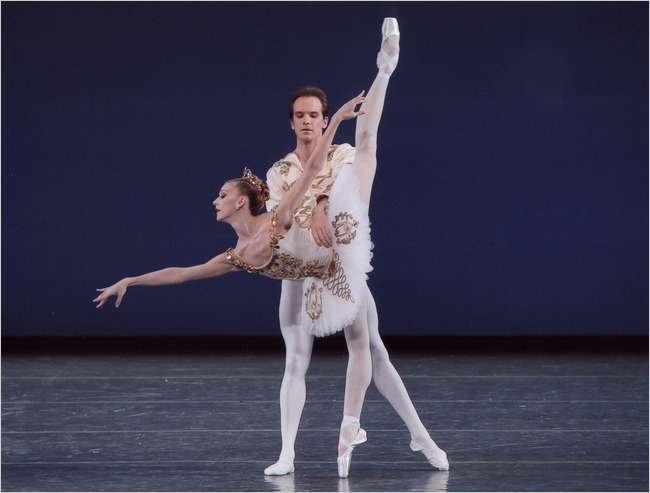
    And finally, DIAMONDS: Jon and Sara Mearns have created a special magic with their partnership in this ballet and the obvious shared joy of dancing beautifully together to beautiful music was tinged today by the knowledge that this would be the last time. Looking a bit forlorn at first, Sara was soon swept along by the gorgeous Tchaikovsky themes and the ardent support of her prince: her smile became luminous, her dancing grand and glorious.

    DIAMONDS was somewhat truncated today; eliminating the Scherzo meant that the demi-soliste women had less chance to dazzle us, but in the opening movement Gwyneth Muller and Gretchen Smith gave us some excellent dancing, their contrasting personalities drawing us in to the music.

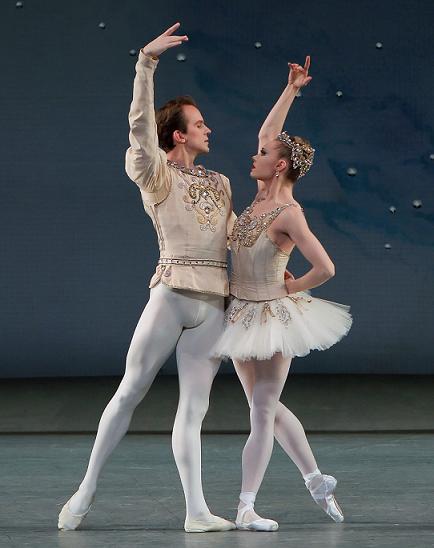
    And so, inevitably, the stage is filled with dancers in white and gold, the opera glasses momentarily zeroing in on the individual dancers of the corps de ballet who make this Company what it is, with Sara and Jonathan at the helm of Balanchine’s jewel-encrusted masterpiece.

    What an extraordinary send-off for Jon: the respect and affection of his colleagues was shown in innumerable ways during the long ovation, streamers shooting down and bouquets being flung to the stage. The afternoon ended with Jon standing by a massive heap of flowers while the Company applauded him with sincere admiration.

    Jon kept us waiting a long time at the stage door (I think secretly he just wanted to sneak out after everyone had left!); Wei met me there after his work day and we were especially happy to catch up with Faye Arthurs, and to greet so many of the dancers we admire so deeply. I’m sure they were all exhausted and just wanting to have supper, or a beer, and rest their weary bones. But they all took the time to chat us up, reflect on their association with Jon, discuss the highlights of their season, and tell us their summer plans. They are such incredible, dedicated, passionate, and amusing people and I’m so grateful to all of them, both for their dancing and just for being themselves.

    At last Jon appeared and with a lovely mix of elation and exhaustion he thanked the intrepid fans who had stayed on to greet him. I mainly wanted to wish him a happy golf game!

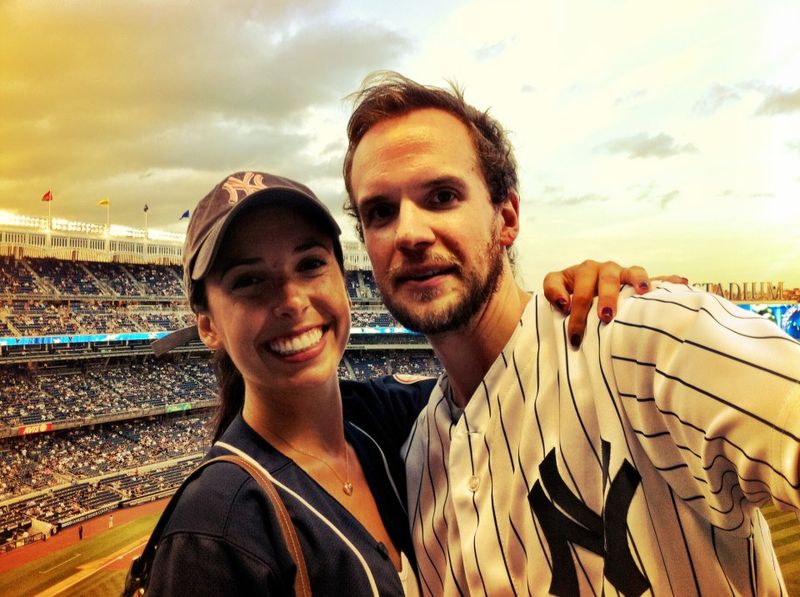
    On a personal note, Jon has his wedding to look forward to: in August he’ll be marrying New York City Ballet soloist Brittany Pollack. And here they are, at a Yankees game:

    253817_3683865459771_1041692134_n

    Best wishes, Brittany & Jon!

    703e0a8c201913cc7ebab0c7bcc60267

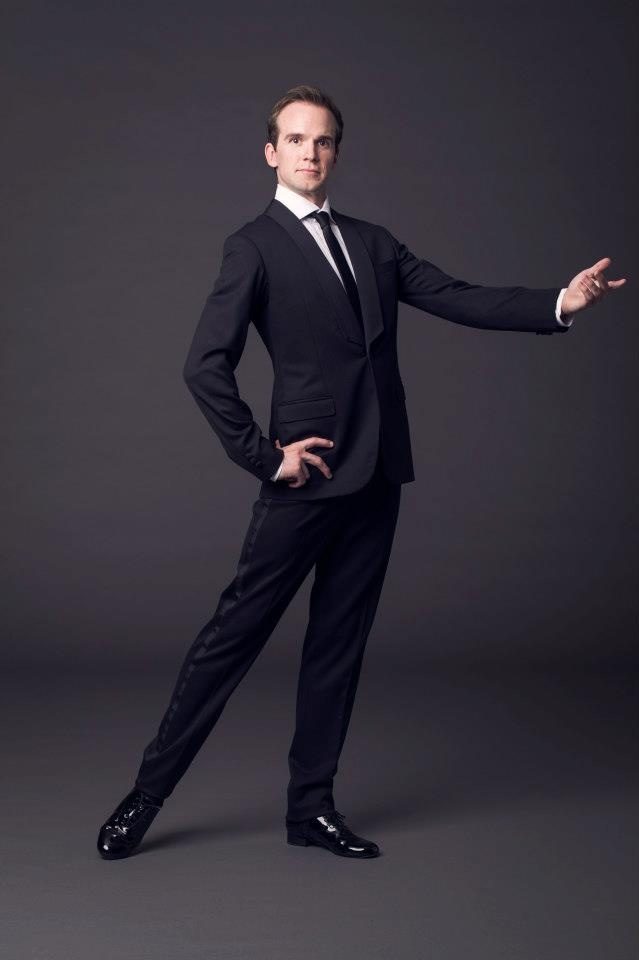
    And one more image of Jon, dressed by Valentino (above)…a class act if ever there was one. I’m sure to be seeing Jonathan around the Plaza in the months ahead, so there’s no real need to say ‘farewell’.

  • Ariel Rivka/CaitlinTrainor/Texture

    1383334044_80fb

    Above: Kaitlyn Gilliland and Caitlin Trainor is a rehearsal photo by Paul B Goode

    Thursday February 27th, 2014 – An evening of dance at Ailey Citigroup featuring three companies: Ariel Rivka Dance, Trainor Dance, and Texture Contemporary Ballet.

    Caitlin Trainor presented two works: KaitlynCaitlin (2013) a duet showcasing Ms. Trainor and former New York City ballet dancer Kaitlyn Gilliland.  This is a danced conversation between the choreographer, Caitlin, dancing barefooted, and guest artist Kaitlyn, dancing on pointe.  To music by Major Scurlock, using piano and electronics, the two girls dressed in ruby-red frocks dance in-sync and then move off on separate trajectories to explore their own vocabularies in combinations that makes great use of the space. The work reaches a peak as they come face-to-face, literally, and the movement stops for a moment.

    In the second Trainor piece, The Air Turned White, Ms. Trainor appears both in person and as a projected image, in filmwork crafted by Maria Niro. The dancer enters from the audience, wearing jeans and a halter top. To a pulsing electronic beat (the musical setting also by Ms. Niro) Caitlin begins to dance while on the huge screen above we see her folding and crawling slowly across the surface. In a miraculous ending, the filmed image shrinks to nothing.                                                                                              

    Take… Taken… Taking (world premiere) was performed by Texture Contemporary Ballet; choreographed by Alan Obuzor to music by Philip Glass. This is a pas de cinq in three movements with the girls on pointe; simple blue costumes and fine lighting set off the dancers in this well-structured ballet in which Mr. Obuzor’s choreography shows imagination and musicality throughout. In the restless opening segment, the flow of movement and stylized port de bras keep us engaged; the vivid dark-haired dancer Alexandra Tiso seems something of an outsider, and the others seek to entice or console her with lovely gestures. Then a chill descends and Mr. Obuzor commences a long solo to the adagio section; seemingly a lost soul, the dancer uses his long limbs to express isolation and fear. The solo takes on a more agitated aspect but there seems to be no escape. Three girls return for the turbulent finale, their hair down. Ms. Tiso is seen again both in solo and duet phrases with Mr. Obuzor. The ending of the work is visually pleasing but slightly inconclusive dramatically…though that in itself adds to the ballet’s mystique. Dancers:  Kelsey Bartman, Jennifer Grahnquist, Alan Obuzor, Alexandra Tiso and Brynn Vogel.

    From Ariel Rivka Dance, The Book of Esther begins with Vashti an homage to Vashti, wife of the ruler of Persia – which the Company performed last year. Set to a melodic score by David Homan for violin, cello, guitar and piano, Vashti features five women – four handmaidens and Queen Vashti – and tells the story of Vashti’s stuggle to choose between obeying her husband’s command that she dance naked before his guests or to maintain her dignity by refusing.

    Hana Ginsburg Tirosh is a poetic Vashti with an expressive face; the dancing of the five women recalls both Isadora Duncan’s works and Jerome Robbins’ Antique Epigraphs.

    Last year, Vashti stood alone; now the choreographer has extended the narrative continues with Esther. As the successor to the displaced Vashti,  Esther is in the difficult position of having to inform the King that she is Jewish. The King’s advisor, Haman, works to undermine Esther.

    Esther begins with the entry of a solo clarinetist (Moran Katz) who crosses the stage playing a wistful melody. The story the unfolds, with Claire Cholak as Esther advised by Mordechai (Kristen Licata) and by a vision of Vashti (Ms. Ginsburg Tirosh) as to how she should deal with her dilemma. Danita Shaheen dressed in red as the Good/Evil Haman brings a welcome vibrancy to the proceedings.

    By extending the dancework to incorporate the stories of both queens, the piece now seems a bit long; it might be well to pare it down just a little to maintain the dramatic flow of the narrative. But that is up to the choreographer; as it stands now The Book of Esther is both musically and visually rewarding.

    A note of praise for the excellent musicians who played the David Homan score live: Ms. Katz (clarinet), Mario Gotoh (violin), Nadav Lev (guitar), Elad Kabilio (cello) and Ben Laude (piano).

  • Preljocaj & Martins @ NYC Ballet

    Stravaganza-key

    Above: from LA STRAVAGANZA

    February 25th, 2014 – Angelin Preljocaj’s unusual 1997 ballet LA STRAVAGANZA and Peter Martins’ tango extravaganza TODO BUENOS AIRES (dating from 2000) were on the bill at New York City Ballet tonight, along with a Wheeldon pas de deux A PLACE FOR US.

    To date I’ve admired everything I’ve seen by Mr. Preljocaj, most especially his L’ANNONCIATION which has been perfomed in New York City by Cedar Lake Contemporary Ballet. I was at the NYCB premiere of LA STRAVAGANZA over a decade ago and was very taken with this dancework which revolves around a warp in the time continuum.

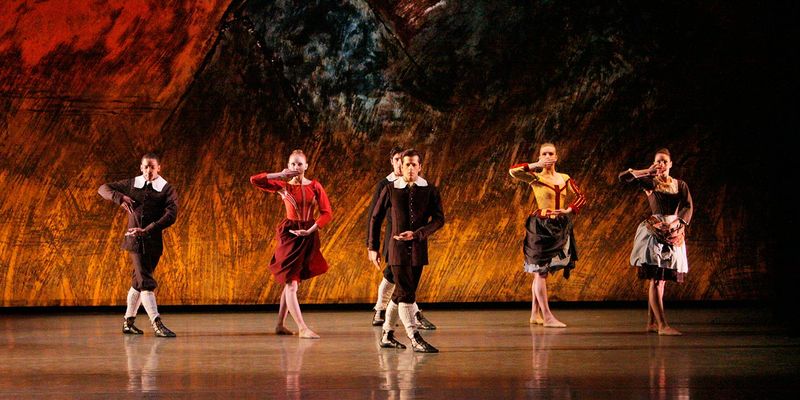
    In LA STRAVAGANZA, a sextet of young people in contemporary dress are dancing quietly in the twilight to the music of Vivaldi. At the intrusion of mechanical sounds, a black panel at the rear of the stage rises to review another sextet: three men in Puritan garb and three colourfully-dressed peasant girls. The contemporary group warily explore these aliens from another era who dance in stiff patterns with a stylized gestural language. A pas de deux ensues for one of the contemporary girls and one of he Puritans; in the end the girl is abducted and taken off to the other world. The contemporary dancers return to their original formation and the lost girl magically reappears: the story seems poised to repeat itself, endlessly. 

    In this rather odd ballet, which as I recall tended to baffle people at its premiere, Mr. Preljocaj has successfully merged the heavenly Baroque music with works of 20th century composers Evelyn Ficarra, Robert Normandeau, Serge Morand, and Ake Parmerud. Dance highlights are a duet for two of the Puritan men – Sean Suozzi and Craig Hall – moving in-sync with fast-paced gestures, and the time-spanning pas de deux danced by the ever-intriguing Gretchen Smith and Sean Suozzi.

    The contemporary boys – Devin Alberda, Joseph Gordon and Allen Peiffer – have some demanding combinations and later they stand stock still in a field of light as the girls – Ms. Smith, Brittany Pollack and Sara Adams – tentatively examine their bodies. Daniel Applebaum was the third Puritan, and a very attractive female trio – Emilie Gerrity, Claire Kretzschmar and Lydia Wellington – worked beautifully together and seemed to have stepped out of a Vermeer painting. 

    The title A PLACE FOR US made me think we were in for that cloyingly sentimental song from WEST SIDE STORY; but mercifully Chris Wheeldon turned to far more interesting – and rare – works from Andre Previn and Leonard Bernstein for this duet, the music being performed live onstage by Steven Hartman (clarinet) and Nancy McDill (piano).

    The duet, danced by NYCB‘s beloved couple Tiler Peck and Robert Fairchild, is performed in squares of light gleaming onstage. The piece has a dedication: ‘For Jerome Robbins. A thank you.’ and that choreographer’s work is indeed recalled while watching this pas de deux with its combination of romance and wit. Oddly enough, though – perhaps because of Robbie’s white tights and soft tunic – this pas de deux made me think of Balanchine’s APOLLO more than once. Needless to say, the dancers and musicians did very well by it.

    TODO BUENOS AIRES premiered in 2000 with Darci Kistler and Wendy Whelan in the principal female roles. In 2005, Peter Martins re-worked the ballet to incorporate a featured role for Julio Bocca. It’s the 2005 version we saw tonight, with our own primo bailarín Joaquin de Luz in a virtuoso performance.

    The musicians, led by concertmaster Kurt Nikkanen and featuring JP Jofre on bandoneon, are seated onstage, and two large soft drapes mark out the dance floor of a spacious after-hours club. Five Piazzolla tangos, arranged by Ron Wasserman, provide the setting for a series of duets and ensembles. Maria Kowroski – could her extension be any more heavenly? – danced with cool allure surrounded by a quartet of sexy boys: Jared Angle, Robert Fairchild, Adrian Danchig-Waring and Amar Ramasar. In a performance marked by radiant star-power, Ashley Laracey took on the role created on Wendy Whelan and made it her own. Right from her first duet with the sensuous Amar Ramasar, Ashley was thoroughly captivating; it seems to me that she is a dancer who could take on a huge variety of roles and make them all shine.

    Joaquin had the audience in the palm of his hand from the start: his speed-of-light pirouettes and spacious leaps caused the people around me to gasp in disbelief. The character’s moods range from aloof to seductive, and Joaquin seemed to be having a blast as he covered the stage with his daredevil feats, in the end basking in the adulation of the crowd and flashing his award-winning smile.