Tag: New York City Ballet

  • Ariel Rivka/CaitlinTrainor/Texture

    1383334044_80fb

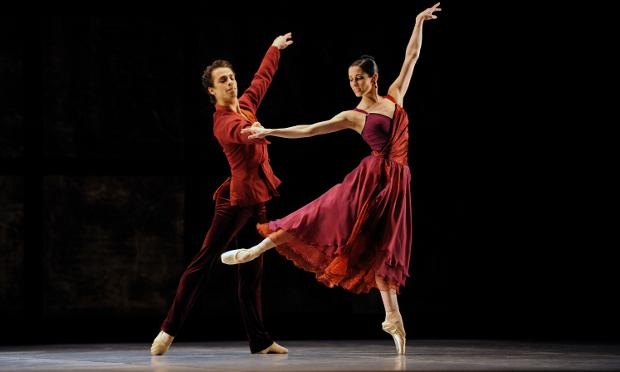
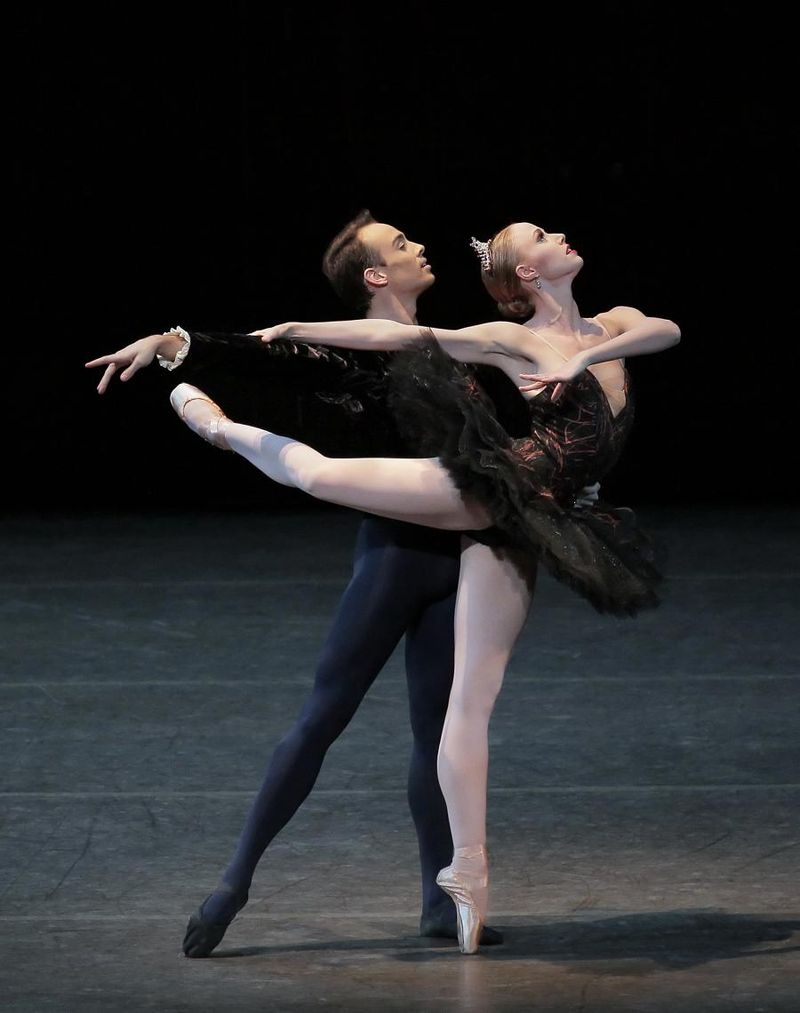
    Above: Kaitlyn Gilliland and Caitlin Trainor is a rehearsal photo by Paul B Goode

    Thursday February 27th, 2014 – An evening of dance at Ailey Citigroup featuring three companies: Ariel Rivka Dance, Trainor Dance, and Texture Contemporary Ballet.

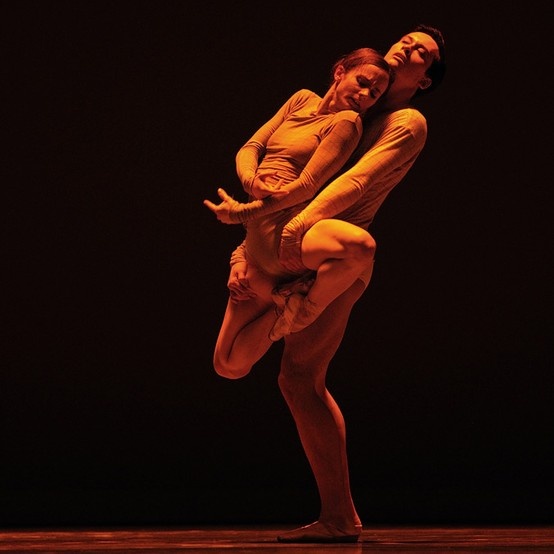
    Caitlin Trainor presented two works: KaitlynCaitlin (2013) a duet showcasing Ms. Trainor and former New York City ballet dancer Kaitlyn Gilliland.  This is a danced conversation between the choreographer, Caitlin, dancing barefooted, and guest artist Kaitlyn, dancing on pointe.  To music by Major Scurlock, using piano and electronics, the two girls dressed in ruby-red frocks dance in-sync and then move off on separate trajectories to explore their own vocabularies in combinations that makes great use of the space. The work reaches a peak as they come face-to-face, literally, and the movement stops for a moment.

    In the second Trainor piece, The Air Turned White, Ms. Trainor appears both in person and as a projected image, in filmwork crafted by Maria Niro. The dancer enters from the audience, wearing jeans and a halter top. To a pulsing electronic beat (the musical setting also by Ms. Niro) Caitlin begins to dance while on the huge screen above we see her folding and crawling slowly across the surface. In a miraculous ending, the filmed image shrinks to nothing.                                                                                              

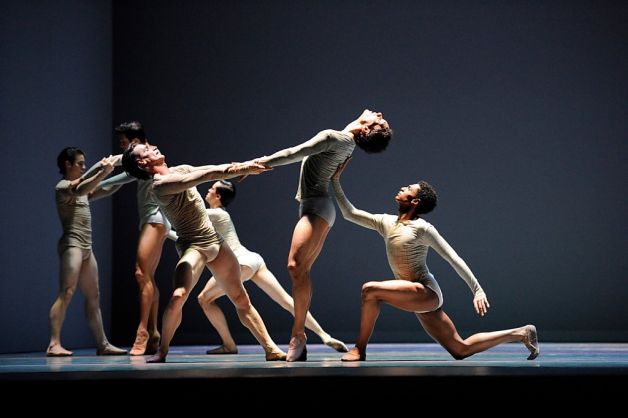
    Take… Taken… Taking (world premiere) was performed by Texture Contemporary Ballet; choreographed by Alan Obuzor to music by Philip Glass. This is a pas de cinq in three movements with the girls on pointe; simple blue costumes and fine lighting set off the dancers in this well-structured ballet in which Mr. Obuzor’s choreography shows imagination and musicality throughout. In the restless opening segment, the flow of movement and stylized port de bras keep us engaged; the vivid dark-haired dancer Alexandra Tiso seems something of an outsider, and the others seek to entice or console her with lovely gestures. Then a chill descends and Mr. Obuzor commences a long solo to the adagio section; seemingly a lost soul, the dancer uses his long limbs to express isolation and fear. The solo takes on a more agitated aspect but there seems to be no escape. Three girls return for the turbulent finale, their hair down. Ms. Tiso is seen again both in solo and duet phrases with Mr. Obuzor. The ending of the work is visually pleasing but slightly inconclusive dramatically…though that in itself adds to the ballet’s mystique. Dancers:  Kelsey Bartman, Jennifer Grahnquist, Alan Obuzor, Alexandra Tiso and Brynn Vogel.

    From Ariel Rivka Dance, The Book of Esther begins with Vashti an homage to Vashti, wife of the ruler of Persia – which the Company performed last year. Set to a melodic score by David Homan for violin, cello, guitar and piano, Vashti features five women – four handmaidens and Queen Vashti – and tells the story of Vashti’s stuggle to choose between obeying her husband’s command that she dance naked before his guests or to maintain her dignity by refusing.

    Hana Ginsburg Tirosh is a poetic Vashti with an expressive face; the dancing of the five women recalls both Isadora Duncan’s works and Jerome Robbins’ Antique Epigraphs.

    Last year, Vashti stood alone; now the choreographer has extended the narrative continues with Esther. As the successor to the displaced Vashti,  Esther is in the difficult position of having to inform the King that she is Jewish. The King’s advisor, Haman, works to undermine Esther.

    Esther begins with the entry of a solo clarinetist (Moran Katz) who crosses the stage playing a wistful melody. The story the unfolds, with Claire Cholak as Esther advised by Mordechai (Kristen Licata) and by a vision of Vashti (Ms. Ginsburg Tirosh) as to how she should deal with her dilemma. Danita Shaheen dressed in red as the Good/Evil Haman brings a welcome vibrancy to the proceedings.

    By extending the dancework to incorporate the stories of both queens, the piece now seems a bit long; it might be well to pare it down just a little to maintain the dramatic flow of the narrative. But that is up to the choreographer; as it stands now The Book of Esther is both musically and visually rewarding.

    A note of praise for the excellent musicians who played the David Homan score live: Ms. Katz (clarinet), Mario Gotoh (violin), Nadav Lev (guitar), Elad Kabilio (cello) and Ben Laude (piano).
  • Preljocaj & Martins @ NYC Ballet

    Stravaganza-key

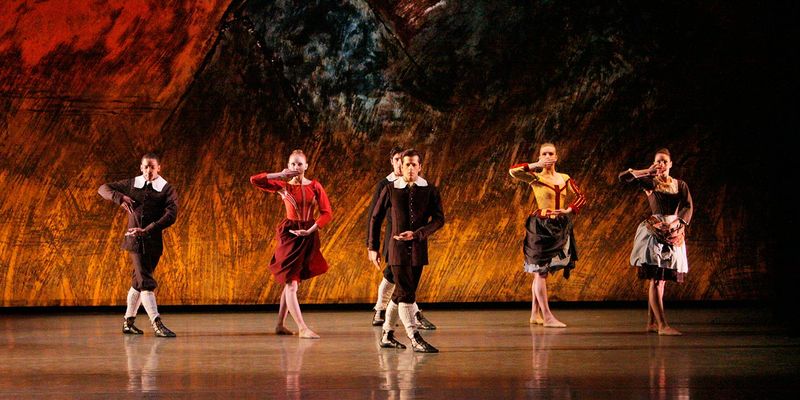
    Above: from LA STRAVAGANZA

    February 25th, 2014 – Angelin Preljocaj’s unusual 1997 ballet LA STRAVAGANZA and Peter Martins’ tango extravaganza TODO BUENOS AIRES (dating from 2000) were on the bill at New York City Ballet tonight, along with a Wheeldon pas de deux A PLACE FOR US.

    To date I’ve admired everything I’ve seen by Mr. Preljocaj, most especially his L’ANNONCIATION which has been perfomed in New York City by Cedar Lake Contemporary Ballet. I was at the NYCB premiere of LA STRAVAGANZA over a decade ago and was very taken with this dancework which revolves around a warp in the time continuum.

    In LA STRAVAGANZA, a sextet of young people in contemporary dress are dancing quietly in the twilight to the music of Vivaldi. At the intrusion of mechanical sounds, a black panel at the rear of the stage rises to review another sextet: three men in Puritan garb and three colourfully-dressed peasant girls. The contemporary group warily explore these aliens from another era who dance in stiff patterns with a stylized gestural language. A pas de deux ensues for one of the contemporary girls and one of he Puritans; in the end the girl is abducted and taken off to the other world. The contemporary dancers return to their original formation and the lost girl magically reappears: the story seems poised to repeat itself, endlessly. 

    In this rather odd ballet, which as I recall tended to baffle people at its premiere, Mr. Preljocaj has successfully merged the heavenly Baroque music with works of 20th century composers Evelyn Ficarra, Robert Normandeau, Serge Morand, and Ake Parmerud. Dance highlights are a duet for two of the Puritan men – Sean Suozzi and Craig Hall – moving in-sync with fast-paced gestures, and the time-spanning pas de deux danced by the ever-intriguing Gretchen Smith and Sean Suozzi.

    The contemporary boys – Devin Alberda, Joseph Gordon and Allen Peiffer – have some demanding combinations and later they stand stock still in a field of light as the girls – Ms. Smith, Brittany Pollack and Sara Adams – tentatively examine their bodies. Daniel Applebaum was the third Puritan, and a very attractive female trio – Emilie Gerrity, Claire Kretzschmar and Lydia Wellington – worked beautifully together and seemed to have stepped out of a Vermeer painting. 

    The title A PLACE FOR US made me think we were in for that cloyingly sentimental song from WEST SIDE STORY; but mercifully Chris Wheeldon turned to far more interesting – and rare – works from Andre Previn and Leonard Bernstein for this duet, the music being performed live onstage by Steven Hartman (clarinet) and Nancy McDill (piano).

    The duet, danced by NYCB‘s beloved couple Tiler Peck and Robert Fairchild, is performed in squares of light gleaming onstage. The piece has a dedication: ‘For Jerome Robbins. A thank you.’ and that choreographer’s work is indeed recalled while watching this pas de deux with its combination of romance and wit. Oddly enough, though – perhaps because of Robbie’s white tights and soft tunic – this pas de deux made me think of Balanchine’s APOLLO more than once. Needless to say, the dancers and musicians did very well by it.

    TODO BUENOS AIRES premiered in 2000 with Darci Kistler and Wendy Whelan in the principal female roles. In 2005, Peter Martins re-worked the ballet to incorporate a featured role for Julio Bocca. It’s the 2005 version we saw tonight, with our own primo bailarín Joaquin de Luz in a virtuoso performance.

    The musicians, led by concertmaster Kurt Nikkanen and featuring JP Jofre on bandoneon, are seated onstage, and two large soft drapes mark out the dance floor of a spacious after-hours club. Five Piazzolla tangos, arranged by Ron Wasserman, provide the setting for a series of duets and ensembles. Maria Kowroski – could her extension be any more heavenly? – danced with cool allure surrounded by a quartet of sexy boys: Jared Angle, Robert Fairchild, Adrian Danchig-Waring and Amar Ramasar. In a performance marked by radiant star-power, Ashley Laracey took on the role created on Wendy Whelan and made it her own. Right from her first duet with the sensuous Amar Ramasar, Ashley was thoroughly captivating; it seems to me that she is a dancer who could take on a huge variety of roles and make them all shine.

    Joaquin had the audience in the palm of his hand from the start: his speed-of-light pirouettes and spacious leaps caused the people around me to gasp in disbelief. The character’s moods range from aloof to seductive, and Joaquin seemed to be having a blast as he covered the stage with his daredevil feats, in the end basking in the adulation of the crowd and flashing his award-winning smile.

  • PRINCE IGOR @ The Met

    PrinceIgor-copy-2

    Above: Ildar Abdrazakov as Prince Igor at The Met

    Monday February 24th, 2014 – I fell in love with Borodin’s PRINCE IGOR back in the late 1960s when I saw several performances of it in an English-language production at New York City Opera. The staging was traditional and featured unforgettable performances by my beloved Maralin Niska (Yaroslavna) and that great singing-actor William Chapman (doubling as Khan Konchak and Prince Galitsky); much of the music became imbedded in my operatic memory, and the famed Polovtsian Dances were staged as a warriors-and-maidens extravaganza, led by the great Edward Villella who was on-loan from New York City Ballet.

    The City Opera’s production used painted drops and built set-pieces to evoke the locales, with era-appropriate costumes. It spoke to us directly of the time and place that Borodin’s music conveys. The Metropolitan Opera’s new production of PRINCE IGOR is more generalized; the women of Putivi are seen in 1940-ish dresses and coats even though the action supposedly takes place in the year 1185. 

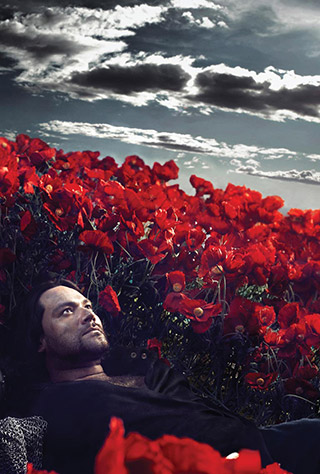
    The evening overall was a rather mixed affair: musically sound and with some interesting visual elements (the field of poppies) it does not really end up making a strong dramatic statement; this may be due in part to the episodic character of the opera itself. In this updated setting we don’t get much of a feel for exoticism. Khan Konchak for example is not seen as an Asiatic warlord with a scimitar but rather as a rather anonymous military type in a toxic-yellow uniform.

    The opening scene takes place not in a public square in Igor’s capital but rather in a great hall where the Prince’s troops assemble in preparation for going to war. This is fine, but it rather short-circuits the effect of the solar eclipse that is taken as a bad omen by the populace. Despite this warning, Prince Igor leads his troops out to fight the Khan; he is defeated and captured.

    Black-and-white films of the Prince and of his soldiers are shown during interludes; these are rather superfluous though it’s nice to see two men in a gentle embrace as they await the coming battle. The field of poppies is really very attractive and the ballet – with the dancers is gauzy cream-coloured costumes – is sensuous and flowing rather than militant and grand. I loved spotting several of my dancer-friends: Loni Landon, Michael Wright, Anthony Bocconi, Kentaro Kikuchi, Matt Van, and Bradley Shelver.

    In this production, the three scenes of Act II all take place in the same spacious great hall as the prologue; nevertheless, there are longish pauses between scenes.

    The first intermission stretched out unduly and the far-from-full house seemed bored waiting for the opera to resume. There were very short rounds of applause after the arias, which were for the most part attractively sung. A huge double explosion as the Act II curtain fell with Putivi under attack almost made me jump out of my seat.

    Gianandrea Noseda conducted with the right sense of grandeur, but also with a nice feeling for the more reflective moments. Perhaps what was missing was a Scheherazade/mystique in the Polovtsian scene. Noseda sometimes tended to overwhelm his singers; and the very open sets did not help to project the voices into the hall. The orchestra and chorus were on optimum form.

    In the title-role, Ildar Abdrazakov sang beautifully, especially in his great aria of anguish over his defeat and of his longing for his beloved Yaroslavna far away. The role, often sung by baritones, seemed to work well for Abdrazakov even though his voice is more basso-oriented. Read about Mr. Abdrazakov’s recently-issued CD of Russian arias Power Players, here. Igor’s lament is a highlight of this excellent disc.

    Stefan Kocan and Mikhail Petrenko appeared as Khan Konchak and Prince Galitsky respectively and both sang well though neither seemed as prolific of volume as I have sometimes heard them. Sergei Semishkur’s handsome tenor voice and long-floated head-tone at the end of his serenade made his Vladimir a great asset to the evening musically, though he was rather wooden onstage. The veteran basso Vladimir Ognovenko was a characterful Skula, with Andrey Popov as his sidekick Yeroshka.

    Oksana Dyka’s stunning high-C as she bade farewell to Igor in the prologue sailed impressively into the house; but later, in her Act I aria, the voice seemed unsteady and lacking in the dynamic control that made Maralin Niska’s rendering so memorable. Niska always took a flaming, sustained top note at the end of the great scene with the boyars where the palace is attacked. Dyka wisely didn’t try for it. The sultry timbre of Anita Rachvelishvili made a lush impression in the contralto-based music of Konchakovna, and it was very nice to see Barbara Dever onstage again in the brief role of Yaroslavna’s nurse: I still recall her vivid Amneris and Ulrica from several seasons ago.

    Deonarine_Kiri_046_ret4 2

    A particularly pleasing interlude came in the aria with female chorus of the Polovtsian Maiden which opens the scene at Khan Konchak’s camp. Singing from the pit, the soprano Kiri Deonarine (above) showed a voice of limpid clarity which fell so sweetly on the ear that one could have gone on listening to many more verses than Borodin provided. It was a definite vocal highlight of the evening, and also showed Mr. Noseda – and the Met’s harpist – at their senstive best.

    Metropolitan Opera House
    February 24, 2014

    PRINCE IGOR
    Alexander Borodin

    Prince Igor.............Ildar Abdrazakov
    Yaroslavna..............Oksana Dyka
    Vladimir................Sergey Semishkur
    Prince Galitzky.........Mikhail Petrenko
    Khan Konchak............Stefan Kocán
    Konchakovna.............Anita Rachvelishvili
    Skula...................Vladimir Ognovenko
    Yeroshka................Andrey Popov
    Ovlur...................Mikhail Vekua
    Nurse...................Barbara Dever
    Maiden..................Kiri Deonarine

    Conductor...............GIanandrea Noseda

  • Violin Concertos @ NYC Ballet

    318356_2232197878477_977158597_n

    Above: Russell Janzen of New York City Ballet

    Wednesday February 19th, 2014 – Ballets by Jerome Robbins, Peter Martins, and George Balanchine – each set to a great 20th century violin concerto – were on the bill at New York City Ballet this evening. To an already-great line-up of dancers there was a late addition: Russell Janzen made his debut in BARBER VIOLIN CONCERTO; Tiler Peck and Amar Ramasar were also making role debuts tonight.

    Three conductors passed the baton one to another as the evening progressed; the Company’s two concertmasters – Kurt Nikkanen and Arturo Delmoni – shared the soloist spotlight, Kurt playing the Prokofiev and Arturo playing Barber and Stravinsky. It was a programme during which really missed my beautiful seat in Fourth Ring AA where I used to watch the orchestra from on high.

    The evening opened on a high note: the curtain rose on Robert Fairchild, all in white, as the restless dreamer of Jerome Robbins’ OPUS 19/THE DREAMER – my favorite Robbins ballet. Robert danced the ballet’s opening solo with deep musicality and supple fluidity of movement. Out of the blue, his muse materializes: Tiler Peck, in this role for the first time, found a perfect balance between the classical vocabulary and the sometimes jagged expressionism the ballet requires. In the more lyrical passages, her lush pirouettes had remarkable clarity; to a role that has been gorgeously danced in recent seasons by Wendy Whelan, Jenifer Ringer, and Janie Taylor, Tiler brought her own distinctive touches. Robbins gives the corps some dreamy moves – and also some athletic ones – in OPUS 19; I very much enjoyed tonight’s collective which was made up of some of my favorite dancers.

    It took me a few hearings to figure out exactly what it is about the opening measures of the Barber violin concerto that sings to me so clearly: it’s the use of the piano, especially the opening chord. It gave me a little frisson again tonight; while I love so many violin concertos I think sometimes the Barber is my actual favorite. I remember one summer driving very fast out Route 6 with Kenny to the end of the world – Provincetown – with the Barber blasting on the car stereo. Music and memory are so often indelibly linked.

    In tonight’s performance of the Barber, Teresa Reichlen and Russell Janzen looked great together – not just because they are long-limbed and attractive, but because they share a sense of elegance that manifests itself in their bearing and the grace of their line. A chill passed thru me as Amar Ramasar entered, a fallen angel with a dangerous ‘loner’ appeal who will eventually draw Tess to the dark side. Megan Fairchild excels in the barefooted role created by Kate Johnson: it’s a far cry from the charming, pristine pointe-work that is Megan’s specialty, but she jumps right in and makes it happen.

    After their classical parterning passages in the first movement, Tess and Russell will each experience a transformation. At first seeming to console Amar, Tess falls under his spell and is borne away to an unknown fate; their duet is a psychological conflict which reaches its turning point when the subjugated woman lets her hair down. Amar’s character is not so much seductive as simply a force that cannot be withstood; Tess in her vulnerability looks ravshingly ravished. Random thought: I’d love to see Amar in the Martha Graham rep.

    In the final allegro, Russell strives to withstand the endless torment of Megan’s advances: she’s playing one of the most annoying characters in all dance. She ends up writhing on the floor as Russell backs away, covering his eyes to blot out the vision of her over-sexed frenzy. In a final attempt to get what she wants, Megan literally climbs up Russell’s back to perch on shoulder; in a last defense, he flips her over and sends her crashing to the floor. The two dancers handled this tricky finale with aplomb and in fact danced the whole third movement to perfection.

    6a00d8341c4e3853ef014e887730ac970d-800wi

    Above: Janie Taylor, in a Henry Leutwyler portrait

    Tonight’s Stravinsky had a special energy; it was in fact one of the finest performances of this ballet I’ve seen. Part of the singular excitement in the atmosphere tonight may have stemmed from the presence of Janie Taylor, the Company’s enigmatic/charismatic principal ballerina who is soon to retire. I’ve been crazy about Janie since she first stepped out, a mere slip of a girl just over from SAB, to dance the lead in LA VALSE. After building a reputation as a dancer at once fragile and fearless, a long hiatus due to a complicated injury took her away from the stage for months…years, even. Her ‘second career’ has been a real source of joy for me and so tonight it was bittersweet to think that in a few days she will be vanishing from this stage, leaving only perfumed memories. But what memories they are!

    Tonight’s performance showed off of Janie’s balletic split personality: a palpable vulnerability alinged to a steely technical resiliance: she’s simply extraordinary…and irreplacable. Ask LaCour’s partnering of this blonde enigma developed a wonderful simpatico, a sense of tenderness in what is after all an abstract and ’emotionless’ ballet. In that marvelous moment where the ballerina stands against her partner as he shows her a view of the world with a sweeping gesture of the arm, I thought I’d never seen anything so beautiful.

    Janie and Ask seemed poised to walk off with the gold tonight, but the other Stravinsky couple – Rebecca Krohn and Adrian Danchig-Waring – were so potent technically and so vivid in their presentation that the entire ballet took on a grand dynamic, abetted by the excellent corps (the quartet of leaping boys won a ‘bravo’ all their own). Rebecca Krohn has really done wonders in the leotard ballets; she looks phenomenally confident and polished, and for me she’s the equal of any ballerina I’ve seen in this rep, going way back to Suzanne and Karin. Her generous dancing found a fine match in Adrian Danchig-Waring’s vibrant physicality; together these two dancers crafted amazing shapes as they moved thru the ballet’s demanding partnering motifs, ending their pas de deux with Adrian in a finely-timed fall to the floor and Rebecca in a sweeping back-bend.

    Extra delight: Faye Arthurs in a brief partnered segment with Adrian; she danced in both the Prokofiev and the Stravinsky tonight. So nice to run into Erica Pereira and Caitlin Dieck…and Tess, after the show.

    OPUS 19/THE DREAMER: *T. Peck, R. Fairchild [Conductor: Sill, Solo Violin: Nikkanen]

    BARBER VIOLIN CONCERTO: Reichlen, *Ramasar, M. Fairchild, *Janzen [Conductor: Otranto, Solo Violin: Delmoni]

    STRAVINSKY VIOLIN CONCERTO: Taylor, la Cour, Krohn, Danchig-Waring [Conductor: Capps, Solo Violin: Delmoni]

  • San Francisco Ballet @ Lincoln Center

     86a4391427c16a88026b98851ca7d934

    Above: San Francisco Ballet‘s Vitor Luiz and Vanessa Zahorian in Helgi Tomasson’s TRIO; photo © Erik Tomasson

    Saturday October 19th, 2013 (evening) – Welcoming back to New York City one of the world’s greatest ballet companies: San Francisco Ballet!  I had hoped to attend both of the Company’s programs during their first week at Lincoln Center, but things didn’t turn out that way. When the Company were last here in 2008, I went to see everything they offered, and I fell in love with all the dancers. Fortunately tonight I was able to see many of those beautiful dancers again, though I missed some other favorites – like Lorena Feijoo and Taras Domitro. I very much admired the Company’s programming, bringing works to New York City that we’ve not seen before. 

    Triotomassonsfb

    Above: the Company in Helgi Tomasson’s TRIO; photo © Erik Tomasson

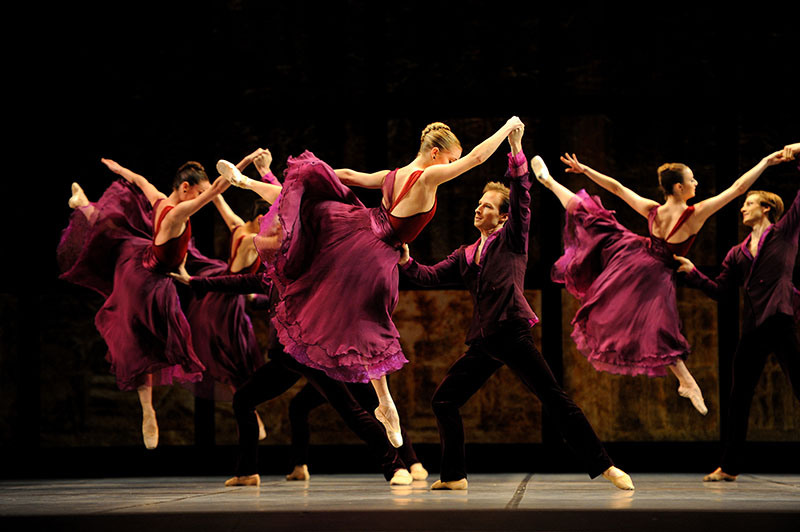
    Helgi Tomasson’s TRIO, which opened the performance, is a four-movement work in the Romantic style danced before an antique/Renaissance backdrop (by Alexander V Nichols). Mark Zappone’s costumes, in shades of wine and dusty Autumn flame, set the dancers off beautifully. Tomasson’s ballets always please the ear as well as the eye: TRIO is danced to Tchaikovsky’s richly melodic Souvenir de Florence.

    After a striking entrée where the ballerina is held aloft, the gorgeously elegant, the dark-haired Vanessa Zahorian swirls thru lovely supported pirouettes and covers the space beautifully with her joyous dance; her cavalier, Vitor Luiz, shows off some unusual flourishes in his combinations. Their duet, backed by the ensemble, is filled with demanding partnering motifs; they gave a wonderful performance, setting the tone for the entire evening.

    Et-trio-sarah-van-patten-tiit-helimets-skip_1000

    Above: Sarah Van Patten and Tiit Helimets in TRIO; photo © Erik Tomasson

    New York City has Wendy Whelan and San Francisco has Sarah Van Patten: I feel these two dancers might be sisters under the skin. Ms. Van Patten’s striking presence and passionate physicality transcend the steps and music. In the adagio of TRIO she appears first in a sensual duet with the marvelous Tiit Helimets; we are basking in their expressive perfection when the charismatic Anthony Spaulding suddenly appears, making his own claim to the ballerina. The trio’s passions and tensions ebb and flow thru their pas de trois, a finely-crafted dance drama.

    Maria Kochetkova, a petite ballerina with who radiates enormous charm and technical authority, dazzled the audience with her ebullient dancing; she and her vividly handsome partner Davit Karapetyan led the ballet’s third and fourth movements which range from classic partnering à la Russe to some stylized motifs that maintained the ballet’s freshness.

    Among the ensemble, soloist Hansuke Yamamoto made an outstanding impression. This Tomasson ballet made me crave a revival of his 2000 Beethoven work for New York City Ballet: PRISM

    Martin West
    conducted the Tchaikovsky score for TRIO and also had the baton for the evening’s second work: Christopher Wheeldon’s GHOSTS set to music by C F Kip Winger.

    Et-ghosts-yuan-yuan-tan-damian-smith_1000

    Above: Yuan Yuan Tan and Damian Smith in Wheeldon’s GHOSTS. Photo © Erik Tomasson.

    Christopher Wheeldon’s GHOSTS, which premiered in 2010, is performed by an ensemble of dancers in gossamer white beneath the pallid glow of a full moon. CF Kip Winger’s score has a cinematic feel, with passages of Romantic styling mingled with quirky, more angular effects.

    Christopher Wheeldon (who was on the Promenade this evening during the intermission) describes GHOSTS as a “mass gathering of souls … creating only atmosphere, not story.” The ballet’s marriage of music and mood evoke a dreamworld in which the dancers move with sonnambulistic grace, often falling to the floor only to rise again in a restless quest for some elusive sense of closure.

    The ravishing Yuan Yuan Tan and her superb partner Damian Smith perform an ethereal pas de deux; Seeing Yuan Yuan Tan onstage again reminded me of a very special hour Kokyat and I spent in Jessica Lang’s studio two years ago when the ballerina was rehearsing with Clifton Brown for an appearance at Fall for Dance.

    Et-ghosts-sofiane-sylve-leg-reach_1000

    Sofiane Sylve (above in a © Erik Tomasson photo) is a more restless spirit: the beauteous ballerina is still
    missed here at Lincoln Center where she danced as a principal at New
    York City Ballet from 2003 – 2007. Sylve in GHOSTS casts a spell in her pas de trois
    with Mr. Helimets and Shane Wuerthner.

    Soloist Clara Blanco, a
    particular favorite of mine during the Company’s last New York visit in
    2008, stood out among the ensemble…I couldn’t take my eyes off her.

    628x471

    Above: from Wayne MacGregor’s BORDERLANDS, photo © Erik Tomasson

    BORDERLANDS, a 2013 Wayne McGregor ballet, has a strong contemporary feel and demands great stamina and focus from a dozen of the Company’s generously talented dancers. Set in an enormous bare-walled enclosure, the stage is first bathed in steely-grey light; this will shift to Autumnal gold for the central pas de deux and then to vivid neon blue as the ballet moves to its end. The dancers wear shorts, displaying their leggy allure. They often stand or kneel around the edges of the space to observe their fellow-dancers.

    In this austere, stylized ballet the music of Joel Cadbury and Paul Stoney ranges from the kozmic and other-worldly thru a cinematic/romance to a rock-like statement and a final anthem. The dancers move with athletic intensity; the choreographic and partnering demands are strenuous and the dancers come and go throughout the work: their relationships uncharted, sometimes mechanical and always mystifying.

    The San Francisco dancers threw themselves with complusive energy into this unusual movement style: particularly excellent work from Frances Chung and Mlles. Sylve, Van Patten and Kochetkova, and from the ever-fascinating Mr. Spaulding.

    62c310f6f199abfcc0bb3adf35da96a9

    Above: Maria Kochetkova and Lonnie Weeks in McGregor’s BORDERLANDS. Photo © Erik Tomasson

    All photos in this article are copyright: Erik Tomasson.

    Repertoire and dancers: Saturday evening, October 19th, 2013:

    Trio
    Choreographer: Helgi Tomasson
    Composer: Peter Ilyich Tchaikovsky
    Conductor: Martin West

    Vanessa Zahorian, Vitor Luiz
    Sarah Van Patten, Tiit Helimets
    Anthony Spaulding
    Maria Kochetkova, Davit Karapetyan

    Ghosts
    Choreographer: Christopher Wheeldon
    Composer: C.F. Kip Winger
    Conductor: Martin West

    Yuan Yuan Tan, Damian Smith
    Sofiane Sylve, Tiit Helimets, Shane Wuerthner

    Borderlands
    Choreographer: Wayne McGregor
    Composer: Joel Cadbury and Paul Stoney
    Conductor: Martin West

    Maria Kochetkova, Jaime Garcia Castilla
    Sarah Van Patten, Pascal Molat

    Frances Chung, Carlos Quenedit
    Sofiane Sylve, Anthony Spaulding
    Koto Ishihara, Lonnie Weeks
    Elizabeth Powell, Francisco Mungamba

  • A Balanchine Evening @ NYC Ballet

    Mourka & mr b

    Above: Mr. B with Mourka

    Wednesday September 25th, 2013 – This evening’s all-Balanchine programme at New York City Ballet was a veritable parade of favorite dancers. The audience, at least in my immediate vicinity, seemed comprised of long-time NYCBers; in fact I seemed to be at the lower end of the age spectrum. It was an attentive crowd, though rather subdued in terms of expressing enthusiasm.

    Any evening that begins with Faye Arthurs onstage is off to a beautiful start; the ballerina – partnered by Zachary Catazaro – danced the opening theme of Balanchine FOUR TEMPERAMENTS. This ballet is for me the most spectacular of the Balanchine black-and-whites, not only because of its marvelous steps and structuring, but the Hindemith score seems to me a true 20th century masterpiece. 

    Lauren King and Allen Peiffer (who literally danced all night) took the second theme, crossing the stage with semaphoric gestures; the melodic sway of the third theme brought forth yet another impressive partnership: Ashley Laracey and Justin Peck. All three couples danced to perfection.

    Robert Fairchild’s Melancholic had a restless grandeur about it: what a compelling stage presence! Meagan Mann and Georgina Pazcoguin circled the handsome danseur, deploying their extensions to dramatic effect. Tyler Angle replaced his brother Jared in the Sanguinic pas de deux; I do not recall having previously seen Tyler paired with Savannah Lowery but it turned out to be an interesting match-up, with Tyler bringing a touch of classic nobility which dovetailed with Savannah’s authoritative contemporary style. In Phlegmatic, Adrian Danchig-Waring seemed to have descended from Mount Olympus: his striking physique and intense focus were engrossing. Ashley Bouder gave a stunning Choleric, her dancing – vivid and grandly secure – was marked by sustained balances and a rich feeling of commitment. In the pit, guest conductor Carolyn Kuan led this splendid score with passionate élan, and pianist Cameron Grant made a significant contrbution to the ballet’s atmosphere.

    EPISODES is basically a series of four duets, three of them performed with attendant corps dancers. Clothilde Otranto and the NYCB musicians gave clarity to the quirky Webern pieces which comprise the ballet’s score, ending with the composer’s imaginative tribute to Bach in a setting from Musical Offering.

    Abi Stafford and Sean Suozzi were finely-matched in the ballet’s opening Symphony; their articulation of the steps and their fluent work as partners made me wish to see them together in other ballets. Three couples echo the principal pair: Marika Anderson with Russell Janzen, Gwyneth Muller with Allen Peiffer and Gretchen Smith with Andrew Scordato. This entire opening movement, with the stage bathed in an unusual verdigris hue, was absorbing to watch.

    Things then take a darker turn as Teresa Reichlen and Ask LaCour appear in pools of light and dance a mysterious succession of five brief duets, their relationship physical but unfathomable. The ballet’s sense of mystery extends to the ethereal Janie Taylor’s appearance in Concerto; dancing with Sebastien Marcovici (who is just back from a hiatus), Janie retains the allure of being the Company’s most enigmatic ballerina.

    EPISODES ends with a gorgeous ritual: a corps of fourteen female acolytes weave patterns around the central couple: Maria Kowroski-  looking supremely divine – and her noble consort Jonathan Stafford. The two principal dancers, so well matched both in physique and in their ability to make expressive nuances count in these abstract ballets, were superb.   

    Principal ballerina Megan Fairchild talks about Balanchine’s DUO CONCERTANT here. When Chase Finlay sustained an injury onstage last week, forcing him to withdraw from his immediate-future performances, I wondered who might partner Ms. Fairchild in this evening’s performance. My thoughts ran to Jared Angle, who had danced DUO so perfectly at Yvonne Borree’s farewell. And sure enough: Jared it was, stepping into the ballet tonight with his signature nobility of style and peerless partnering abilities.

    Kurt Nikkanen and Cameron Grant performed this panoramic Stravinsky score – it veers from playful to deeply expressive – with impressive musicianship. The ballet is an ideal vehicle for Megan Fairchild, sweeping her from girlish impetuosity to womanly tenderness on the brilliant changing modes of the rhythms and harmonies of the instrumental voices. Jared was by turns playful, protective and poignant as he interacted with his ballerina; their partnership was a rewarding one to experience, and the audience – heretofore rather reserved in their reactions to the evening – greeted the dancers and musicians with warm applause. Now I’m wanting to see the Megan/Jared duo in other ballets.

    From its iconic opening diagonal of sleekly white-clad, pony-tailed ballerinas to the final ritualistic tableau as the dancers kneel or raise their arms (in homage to Balanchine and Stravinsky, I imagine) SYMPHONY IN THREE MOVEMENTS is one of NYCB‘s treasures. Excellent demi- and corps work in tonight’s performance, which opened with the vitality of Daniel Ulbricht’s remarkable high leaps; Ana Sophia Scheller, letting her hair down, shows us that a first-class tutu-and-tiara ballerina can also be a dynamic contemporary stylist. Rebecca Krohn looked stunning in her deep-rose leotard and danced with abandon, matched by Andrew Veyette’s speed and clarity. In the central pas de deux, one of Balanchine’s more effective, Sterling Hyltin and Amar Ramasar were at their finest. Earlier, Sterling had made a swift trajectory, circling the stagetwice in pique turns at ever-increasing speed. Amar’s charismatic presence, his commancing partnering and his generosity as a dancer make him an invaluable member of this troupe.

    As the work soared forward to its energetic conclusion, propelled by Carolyn Kuan’s baton, one felt yet again the great genius of Balanchine, and the continuing pleasure of experiencing his works, year after year.

    THE FOUR TEMPERAMENTS: Arthurs, Catazaro, King, Peiffer, Laracey, J.Peck, R. Fairchild, Lowery, T. Angle, Danchig-Waring, Bouder

    EPISODES: A. Stafford, Suozzi, Reichlen, laCour, Taylor, Marcovici, Kowroski, J.Stafford
     
    DUO CONCERTANT: M. Fairchild, J Angle
    SYMPHONY IN THREE MOVEMENTS: Hyltin, Scheller, Krohn, Ramasar, Ulbricht, Veyette

  • Images from NYC Ballet’s Balanchine Evening

    C36439-15_Duo_MFairJAng_1

    A series of Paul Kolnik’s photographs from last night’s Balanchine programme at New York City Ballet. Above: Jared Angle and Megan Fairchild in DUO CONCERTANT.

    C34660-9_Sym3_HyltinRama

    Amar Ramasar & Sterling Hyltin in SYMPHONY IN THREE MOVEMENTS.

    C36436-12_Episodes

    Janie Taylor & Sebastien Marcovici with the corps de ballet in EPISODES.

    C36429-16_4Temp

    Tyler Angle & Ashley Bouder in THE FOUR TEMPERAMENTS.

    My thanks to Mr. Kolnik and the NYCB press office for providing these photos

  • Bouder/Veyette SWAN LAKE @ NYCB

    C31750-6_Swan_BouderVeye (2)

    Above: New York City Ballet principal artists Andrew Veyette and Ashley Bouder in SWAN LAKE; photo by Paul Kolnik

    Saturday evening September 21, 2013 – When New York City Ballet announced Peter Martins’ SWAN LAKE for their Autumn 2013 season I was hoping we’d have a 2-week run with some new Swan Queens; but instead there were only six performances (all, seemingly, sold out) and the dual role of Odette/Odile remained the property of three of the Company’s top interpreters: Sara Mearns, Teresa Reichlen, and Ashley Bouder.

    Tonight was an opportunity to re-visit the Bouder traversal of this very demanding dual role. In this video, Ashley speaks of her constant work in the studio, endeavoring to bring her interpretation of Odette up to the level of her Odile. Tonight she seemed to have reached – and even surpassed – her goal.

    A key element in making tonight’s performance so enjoyable was the lack of audience distractions, which so plagued the first half of the previous evening’s SWAN LAKE. Tonight we were seated amongst well-behaved folks who seemed keenly focussed on the stage throughout the performance; even the annoying late-seating was far enough away from us to be tuned out. It makes an enormous difference in one’s appreciation of the performance when there’s nothing to infringe on the powers of concentration.

    And so from the very first notes of the prelude to the final heart-rending departure of the doomed Odette, the evening was among the most enjoyable I have spent at NYCB in recent seasons.

    Clothilde Otranto paced the music beautifully: full-speed ahead when the drama called for propulsion; tenderness and a sense of lingering when love – or the loss of it – was the theme. The powerful ending of this SWAN LAKE – from both a visual and emotional standpoint – hits home every time, and Peter Martins’ remarkable vision of the ballet’s final moments tends to make me forgive some of his lapses in other productions.

    For people like me who simply adore the NYCB dancers, this ballet affords one of the most satisfying ways of savoring so many favorites all at once: from well-established principals to the newest apprentices, SWAN LAKE is a chance to revel in the enormous variety of faces, forms and personalities who make up this phenomenal Company. And so from curtain-up to curtain calls we are immersed in NYCB on a personal level.

    The sixteen corps dancers and the flock of small children who appear in the Prince’s Act I birthday festivities have plenty to dance, and they danced up a storm. As the opera glasses wander about the scene, you can pause anywhere and watch someone like Likolani Brown or David Prottas exuding their talents – both in terms of technique and stage-craft. This is not an anonymous bunch of automatons going thru the motions, but lively individual personalities doing what they love.

    Troy Schumacher gave a dazzling virtuoso display as the Jester – a demanding role in which the character, in this production, never overstays his welcome. Antonio Carmena as Benno danced with generous spirit and space-filling bravura: his jumps and turns clear and vivid. He shared the pas de trois with two of our recently-promoted soloists: Ashley Laracey and Lauren King, both dancing with sweet assurance. Marika Anderson’s Queen was excellent: her distinctive features reacting to the dramatic situation, her height and bearing setting her apart from her subjects.

    Andrew Veyette’s Siegfried was both impressively danced and instinctively well-acted; his portrayal of the lonely boy facing a destiny that doesn’t suit him was remarkably resonant. It’s no wonder that in his magical encounter with equally unhappy Odette he seems to have found his soulmate. That his love for her is her eventual undoing is the basis of the tragedy; his unwitting duplicity, concocted by Rothbart, leaves the bereft Prince on the brink of suicide at the end of the ballet. Andrew moved thru the events of the prince’s coming-of-age – his discomfort at having to choose a bride, his joy when his beloved suddenly appears in the ballroom, his desperation when Rothbart’s ploy is revealed – with a sense of natural nobility mixed with hapless naïveté; his final collapse in a state of deepest despair was so moving. All evening Andrew’s dancing – his lithe and effortless virtuosity – was aligned to his masculine grace and skillful partnering, making for a portrayal that was thoroughly satisfying in every way,

    Ashley Bouder’s technical sorcery and her sense of theatrical vitality have always made her Odile an exciting event. Not only is she undaunted by the role’s virtuoso demands, she simply revels in them – and she even adds her own flourishes. The character – sly, enticing, peerlessly confident – has always been a triumphant Bouder realization. Meanwhile, Odette – despite Ashley’s impeccable dancing – has seemed to just slightly elude the ballerina in terms of poetry and expressive nuance. Tonight she seemed to have moved deeper into Odette’s soul and found the needed resonance there: this seems to have come about both thru hard work and thru the natural virtue of the ballerina’s maturing into womanhood. Her Odette tonight was moving, passionate, tragic. Her performance of the iconic dual role is now a complete work of art, though I feel with certainty that she’s not one to rest on her laurels: I suspect the next time we see Ms. Bouder in this ballet she will have taken things to yet another level. But for now: a triumph.      

    As I remarked earlier, the evening was a feast for devotees of the Company: the Four Cygnets were especially well-matched and accomplished tonight: Sara Adams, Alexa Maxwell, Sarah Villwock and Kristen Segin were among the finest teams I’ve ever seen in this tricky piece.

    Presenting themselves as candidates for marriage to the Prince, six ballerinas dance a lovely set-piece in which each steps forward in turn to make her mark: Faye Arthurs, Likolani Brown, Meagan Mann, Jenelle Manzi, Mary Elizabeth Sell and Lydia Wellington all looked lovely in this piece, one of my favorite passages in the production. Faye, of the lyrical extension, was also seen as the Vision of Odette.

    Megan LeCrone looked superb in the pas de quatre, with Ana Sophia Scheller and Erica Pereira completing the trio of dark-haired beauties, and the amiable partnering and handsome virtuosity of Gonzalo Garcia making me wish he’d been cast as Siegfried this season (could we not have a Scheller/Garcia SWAN LAKE next time around?) 

    Georgina Pazcoguin gave off incredible star-power in the Hungarian dance, and the handsome and rather rare Craig Hall matched her for intensity and charisma. Janie Taylor’s intoxicating presence lured my opera glasses in the Russian dance, with Ask LaCour looming over her, part predator and part slave. In the Spanish quartet, Gretchen Smith and Gwyneth Muller imbued their steps wth a flamenco flourish, their yellow fans a decorative asset; Andrew Scordato and Taylor Stanley looked dashingly sexy. Allen Peiffer, always a handsome Neapolitan lad, now has a new village lass to charm: Kristen Segin was excellent and she and Allen are a delightful match-up.

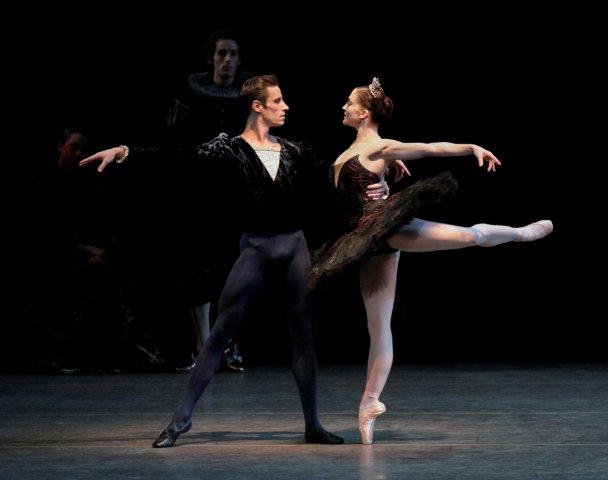
    As the Black Swan pas de deux unfolded, brilliantly danced by Bouder and Veyette, a tall newcomer to the stage, Silas Farley, showed an already keen flair for stagecraft with his manipulative, faux-courtly Rothbart.

    And so we come to the end: at the lakeside where they had met, Odette and Siegfried are now torn asunder. The power of their love has vanquished Rothbart, but his curse endures. Odette vanishes amidst the swans, and Siegfried collapses in remorseful despair.

    ODETTE/ODILE: Bouder; SIEGFRIED: Veyette; VON ROTBART: Farley; QUEEN: Anderson; JESTER: Schumacher; BENNO: Carmena; PAS DE TROIS: Laracey, King; PAS DE QUATRE: LeCrone, Scheller, Pereira, Garcia; HUNGARIAN: Pazcoguin, Hall; RUSSIAN: Taylor, laCour; SPANISH: Smith, Stanley, Muller, Scordato; NEAPOLITAN: Segin, Peiffer; PRINCESSES: Manzi, Mann, Sell, Brown, Wellington, Arthurs

  • Reichlen/T Angle SWAN LAKE @ NYCB

    6a00d8341c4e3853ef014e5f6b6b16970c-800wi

    Above: New York City Ballet principal artists Tyler Angle and Teresa Reichlen in SWAN LAKE; photo by Paul Kolnik

    Friday September 20, 2013 – I’m an admirer of the New York City Ballet‘s Peter Martins production of SWAN LAKE, even though the first time I saw it (with Kyra Nichols in her only performance of it) I found it a great eyesore. I had vowed never to see it again but of course, this Company is my Company and how could I let anything deter me from seeing such Swan Queens as Miranda Weese, Wendy Whelan, Jenifer Ringer, Maria Kowroski, Jennie Somogyi and Sara Mearns? I soon made peace with the sets and costumes (basically by simply tuning them out), and on second seeing realized that there is no more potent ending for this ballet than that which Peter has crafted.

    Non-stop dancing and just enough mime propel the ballet forward. The familiar set-pieces are there, and Peter brings especial vitality to the villager’s dance in the opening scene and (truly lovely) the would-be-brides set piece which just precedes the arrival of Odile.

    This evening’s performance had its ups and downs. There was a bit of ragged playing from the pit here and there, and it seemed to me that Daniel Capps’ tempo for the White Swan pas de deux was just a bit too fast for Teresa Reichlen and Tyler Angle to make the maximum poetic effect. But much of the first lakeside scene was nullified for me by audience distractions (whispering mother and child behind me; a woman munching on cashews from a plastic cup; someone texting). I retreated to the 5th Ring for the second half of the evening and was far better able to concentrate there.

    The opening scene, where Siegfried’s friends from the village have come to celebrate his birthday with a party of the castle terrace (they’d never be allowed inside the royal residence per se) is one long dance-a-thon and the sixteen corps dancers were a pleasure to observe thru my opera glasses: corps-watching heaven. But apparently many in the audience had never seen chidren onstage so there was a lot of ooohing and aaaahing when the small fry appear (they danced very nicely).

    BallHarrison

    Harrison Ball (above, headshot by Paul Kolnik) scored a hit as the Jester; he was one of several dancers making role-debuts tonight. Lithe and agile, Harrison moved thru the virtuoso demands of the choreography with flair. Later, at the ‘official’ birthday party of his master, I very much liked Harrison’s facial acting throughout the Black Swan pas de deux: he seemed to be the only person at court to sense that something was amiss with this Odile woman and her sinister escort.

    Amanda Hankes, a natural aristocrat, made a youthful Queen. Taylor Stanley’s handsome Benno (debut) was another feather in this dancer’s cap; watching the vivacious Lauren Lovette in the pas de trois was a treat, and I liked the touch of rubato Ashly Isaacs brought to this attractive set piece.

    As the partiers went romping off, leaving the Prince, Benno and the Jester frozen in a gesture of farewell, the stage was set for the drama to begin. At this moment, NYCB decided it was time for a round of late seating, so we had the patter of feet, the urgent whispers, the bright glare of flashlights. The mood of the ballet was successfully broken.

    Teresa Reichlen’s opening jeté seemed to proclaim that the ballet could now move into the realm of poetry, but it was at this point that the distractions all around me commenced. Restive audience members are the bane of ballet-going: if you prefer to chat with your daughter, eat, or text, why did you come to the theatre?

    So despite being aware of Tess’s lovely attitude poses and deep back bends, and of Tyler’s pale and urgently tender personification of the Prince, much of this scene went for nought. I couldn’t wait to escape; I even thought of simply going home, but it seemed so unfair – this triumph of indifference – and there were dancers coming up in the second half that I really wanted to see.

    Tess was at her grandest as Odile, wonderfully predatory as she manipulates the hapless Tyler. Coached by the ultra-tall and sinister Ask LaCour as Rothbart, Tess used the role’s faux-Odette motifs with canny skill: a mistress of deceit. Her solo was gorgeously danced and she whipped off a blazing set of fouettés, followed by the sustained balances up the diagonal. Tyler’s solo was a beautiful paragraph of polished bravura. The pledge…the shock of  betrayal…the desperate rush to the lake…

    The final scene, built on the prince’s hopeless notion the damage could be repaired, was movingly played by Tess and Tyler. Odette knows her chance has been lost; when the Prince again raises his hand in pledge, she pulls his arm down and wraps it around her torso. This will be their last moment together. But now Rothbart must be defeated: in the brilliant coup de foudre the couple make a last stand for love and Rothbart is destroyed. But the curse has not been broken. In those last heart-rending moments, Siegfried tries in vain to forestall Odette’s transformation. But she vanishes among the ranks of the swans, leaving him to contemplate his failure. In this final parting, Tess and Tyler personified the despair of shattered hope.

    Back-tracking to the ballroom, there was lots of fine dancing – commencing with Harrison Ball’s playful number with three small jesters. The prospective brides arrive: in pastel frocks, the girls weave solo passages into a very charming ensemble: Sara Adams, Likolani Brown, Megan Johnson, Jenelle Manzi, mary Elizabeth Sell and Lara Tong each took the opportunity to shine. But despite this bevy of beautiful choices, the Prince demurs.

    The pas de quatre, a virtuosic set-piece, brought forth Savannah Lowery, Rebecca Krohn and Ashley Laracey each looking lovely and with accomplished dancing. But something was amiss: Chase Finlay, after squiring the girls thru the opening segment, did not perform his variation. And in the coda, Chase seemed to be marking. If Chase had sustained an injury, let’s hope it’s quickly remedied. I was left wondering how the conductor knew to skip the male variation music. 

    In the swirling Hungarian number, Gretchen Smith threw a dash of paprika into her role-debut dancing; Justin Peck was her rather somber and very impressive beau: now that Justin is taking the choreographic world by storm, we sometimes forget what a great presence he has as a dancer. Jennie Somogyi and Adrian Danchig-Waring (another newcomer to his role) were daringly provocative and physically fearless in the steamy Russian dance. New senoritas in Spanish – Meagan Mann and Lydia Wellington – vied for our attention with their footwork and their yellow fans; Daniel Applebaum and Zachary Catazaro (debut) were the dashing toreros, In a particularly appealing match up, Lauren Lovette and Devin Alberda (his debut) were the Neapolitan dancers, displaying Lauren’s piquant charm and a touch of devilry from Devin.

    The House was full to the rafters, and Tess, Tyler and Harrison were strongly cheered. Ask’s curtain call, drawing the villain’s booing, recalled Albert Evans in the same role: a glacial staredown, and a swirl of the cape. I ran into Albert during the intermission, handsome as ever.      

    ODETTE/ODILE: Reichlen; SIEGFRIED: T. Angle; VON ROTBART: la Cour; QUEEN: *Hankes; JESTER: *Ball; BENNO: *Stanley; PAS DE TROIS: *Lovette, Isaacs; PAS DE QUATRE: Laracey, Lowery, Krohn, Finlay; HUNGARIAN: *Smith, J. Peck; RUSSIAN: Somogyi, *Danchig-Waring; SPANISH: *Wellington, Applebaum, *Mann,*Catazaro; NEAPOLITAN: Lovette, *Alberda; PRINCESSES: Manzi, Sell, Johnson, Brown, Adams, Tong

  • BalletCollective Studio Showing

    Home

    Above: BalletCollective dancer Taylor Stanley photographed by Christopher Starbody

    Thursday June 27th, 2013 – Today Troy Schumacher invited me to a special showing of his new work for BalletCollective, in preparation for the Company’s upcoming New York City performances.

    At the Ailey Citigroup Theater, friends and supporters of the Collective watched Troy working out some phrases with his exciting ensemble of dancers, all of whom are current or recent members of New York City Ballet. The work is accompanied by live music composed and conducted by Ellis Ludwig-Leone and played by ACME. During this preliminary tinkering session, lighting designer Brandon Baker tried out various effects. We were then shown a run-thru of the work-in-progress.

    The ballet, The Impulse Wants Company, takes wing on a poem by Cynthia Zarin, who was present for the showing. The music is both perfectly contemporary and beautifully melodic, with some interesting rhythmic figures; the musicians are expert.

    Ms. Zarin’s poem reflects on childhood visits to a beach, on nature, weather, on people and conversations recalled from the past. I didn’t read thru the poem until I’d seen the ballet, but the line “I was a water nymph” might have inspired the opening solo for Kaitlyn Gilliland, the tall ballerina who – with her poetic arabesque and arching back-bend – seems to conjure visions of Odette. David Prottas, a prince of a dancer, joins her. There is a trio of young women – Lauren King, Ashley Laracey and Meagan Mann – who remind me of Rhinemaidens or the nymphs on the lonely shore of Ariadne’s Naxos.

    Harrison Coll, a dynamic young dancer, joins Taylor Stanley in an off-kilter waltz, Taylor’s solo begins with him swaying like a tree in the breeze; later he travels up a diagonal in some skitteringly fast footwork before circling the space in a questing motif. 

    Troy Schumacher told us the that this ballet was created in ten days of studio time; in terms of both movement and imagination, it shows his distinctive choreographic style which uses the classic vocabulary of steps and port de bras with fresh, contemporary nuances. And he has the grest good fortune to be working with some of the best dancers in the world. 

    It was nice to see so many familiar faces from among New York City’s serious dance aficianados here supporting Troy today, and to greet the lovely former New York City Ballet ballerina Maya Collins, who now dances with Miami City Ballet.. 

    BalletCollective will be performing The Impulse Wants Company along with a re-working of their 2012 ballet Epistasis at The Joyce on August 14th and 15th. Information and tickets here.

    You can follow BalletCollective on Ashley Laracey’s blog: The Insider.