Tag: Wagner

  • Souvenirs from Cardiff ~ Part II

    6a00d8341c4e3853ef01bb09d9801f970d-800wi

    ~ Author: Oberon

    1989 was a banner year for the Cardiff Singer of the World Competition: the “Battle of the Baritones” put the competition on every opera lover’s map. Dmitri Hvorostovsky and Bryn Terfel vied for the top prize; in the end, Dima was named Singer of the Year and Sir Bryn captured the Lieder Prize. Both men went on to hugely successful international careers.

    Of course, at the time, there was no internet to speak of. You could not instantly follow the competition from afar, and even news of it was slow to reach us from the other side of The Pond. But my wonderful friend Mollie Warren diligently taped much of the proceedings directly off the BBC; then she made copies of the cassettes to send to me. So within a couple of weeks, I was listening – in Hartford CT – to the sounds of Mssrs. Hvorostovsky and Terfel: I like to think I was one of the very first people in the Western Hemisphere to hear these voices.

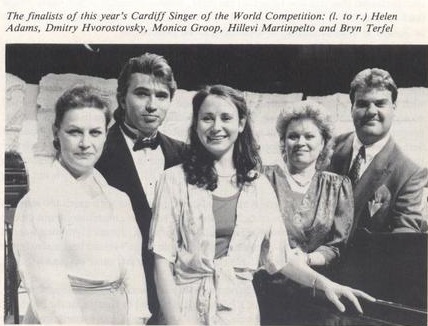
    The three other finalists in the 1989 competition were Finnish mezzo-soprano Monica Groop, Swedish soprano Hillevi Martinpelto, and the Australian soprano Helen Adams. I cannot seem to find much information regarding Helen Adams in the years following her appearance at Cardiff; she is heard here in “Depuis le jour” from LOUISE.  

    Monica Groop

    Above: Monica Groop

    Monica Groop’s extensive international career in opera, concert, and song has included a memorable portrayal of Lucretia in Britten’s RAPE OF LUCRETIA in 2003 at New York City Opera; it marked the only time I saw this wonderful singer live onstage. Her other operatic roles have ranged from Melisande to Zerlina, and she has sung and recorded a great deal of Baroque music – in which she excels – as well as lieder of Schubert and Brahms, and the complete songs of Edvard Grieg.

    Some samples of Ms. Groop’s artistry, singing in Italian, French, and German:

    Monica Groop – Stà nell’Ircana ~ ALCINA

    Monica Groop – D’amour l’ardente flamme ~ DAMNATION DE FAUST

    Monica Groop sings Schubert’s Du bist die Ruh

    Monica Groop at Cardiff, 1989:

    Monica Groop – Cardiff 1989 – CLEMENZA~WERTHER

    Hillevi Martinpelto went on from Cardiff to a very successful career, performing and recording with prominent orchestras and conductors.

    Here she is singing Weber…

    Hillevi Martinpelto – Ocean! Thou mighty monster ~ OBERON

    …and in a true rarity:

    Hillevi Martinpelto – from Karl-Magnus Fredriksson’s The Disguised God ~ Soprano & Chorus

    Here is Hillevi Martinpelto at Cardiff, 1989:

    Hillevi Martinpelto – FORZA aria – Cardiff 1989

    And finally, the winners:

    Dmitri-Hvorostovsky

    …Dima… 

    Dmitri Hvorostovsky – BALLO aria – Cardiff 1989

    Hqdefault

    …and Bryn…my original cassette of Bryn from the competition would not play, but here he is, onstage, singing Schumann…

    …and here’s a bit of Wagner, from a commercial recording:

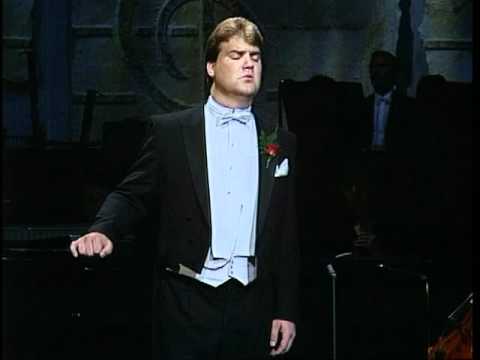
    Bryn Terfel – Song to the Evening Star – TANNHAUSER

    ~ Oberon

  • Antonín Švorc

    B2baebce2c7e431084e2cf604d2c62cf

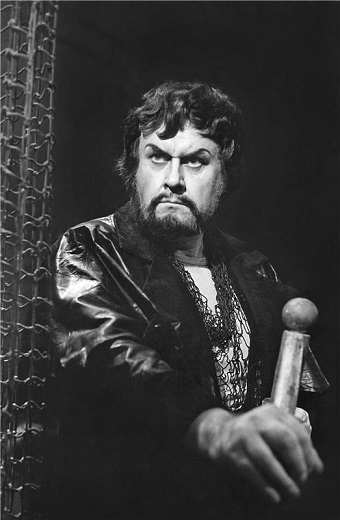
    Above: Antonín Švorc as the Flying Dutchman; photo by Oldrich Pernica

    Antonín Švorc was a Czech operatic bass-baritone. He studied at the Prague Conservatory, making his professional opera debut in 1955, and joined the roster of principal artists at the National Theatre in Prague in 1956. In 1962, Švorc debuted with the Prague State Opera where he performed for the next several decades. In 1985 he was named a People’s Artist of Czechoslovakia. After retiring from the stage, he taught at the Prague Conservatory. He passed away in 2011.

    Antonín Švorc’s repertory was vast indeed. In addition to singing in many Czech operas (including those of Dvořák and Smetana), his oles in the standard repertory included Verdi’s Amonasro, Iago, Nabucco, and Simon Boccanegra, Wagner’s Dutchman, Hans Sachs, Wotan, Kurvenal, Telramund, and Donner; Strauss’s Jochanaan, Orest, and Barak, as well as Scarpia, Alfio, Don Pizarro, Prince Igor, and Boris Godunov.

    0f0c8d9970fb434791822b37f285442a

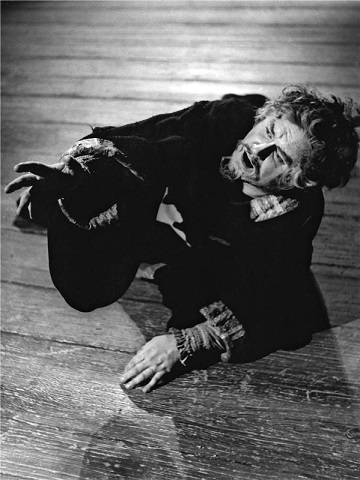
    Above: Antonín Švorc as Simon Boccanegra; photo by Jaromir Svoboda

    Czech soprano Ludmila Dvořáková joins her compatriot, Antonín Švorc, in a recording of the final scene of DIE WALKURE (sung in Czech) here.

    Švorc gives a dramatic reading of the opening portion of the Dutchman’s monolog….

    Antonín Švorc – Flying Dutchman ~ monolog

    …and in Berlin in 1967, he sang Orestes opposite Ingrid Steger’s Elektra, conducted by Otmar Suitner. Here is part I of the Recognition Scene from that performance:

    Ingrid Steger & Antonín Švorc – ELEKTRA – Recognition Scene ~ Part I – Berlin 1967

    ~ Oberon

  • Jean Cox ~ Heldentenor

    Jean Cox

    A native of Alabama, tenor Jean Cox studied with Marie Sundelius at the New England Conservatory and made his operatic debut at Spoleto as Rodolfo in LA BOHEME. In the early 1950s, Cox built his repertory and reputation at Kiel and Mannheim.

    The tenor made his Bayreuth debut in 1956 as the Steersman in FLIEGENDE HOLLANDER; he returned to the Festival as Lohengrin in 1967 and went on to sing there until 1984, taking on the Siegfrieds, Erik in HOLLANDER, Parsifal, and Walther in MEISTERSINGER.

    At other major opera houses, Cox sang Otello, Herod in SALOME, Bacchus in ARIADNE AUF NAXOS, Max in DER FREISCHUTZ, Gherman in PIQUE-DAME, and Captain Vere in BILLY BUDD. In 1976, Jean Cox made his Met debut as Walther von Stoltzing in a series of performances of DIE MEISTERSINGER in New York City and on tour. This was the sum total of his Met career.

    Jean Cox was married to the British mezzo-soprano Anna Reynolds, a noted interpreter of Bach and Wagner, and one of my very favorite singers. Following their retirement from the stage, the couple opened a vocal academy where they trained singers from all over the world. While I was working at Tower Records in the early 2000s, I met two students from this academy. I asked them to give  Ms. Reynolds a message from me; I wonder if they ever did.

    Jean Cox passed away in 2012 at Bayreuth; he was 90 years old. Ms. Reynolds died two years later.

    Enjoy this rare film clip of Jean Cox and the great basso Gottlob Frick in excerpts from Smetana’s BARTERED BRIDE and Weinberger’s SCHWANDA THE BAGPIPER.

    And here are some audio samplings of Jean Cox singing at the Bayreuth Festival.

    Jean Cox – Die Meistersinger ~ Prize Song

    Jean Cox as Parsifal – finale of the opera – Bayreuth 1973

    ~ Oberon

  • Compagnie Hervé KOUBI @ The Joyce ~ 2020

    F751b7faaa4d48cf814701ab186c45bf

    Above: Compagnie Hervé KOUBI, photo by Frédérique Calloch

    ~ Author: Oberon

    Thursday February 20th, 2020 – Celebrating their 20th anniversary season, Compagnie Hervé KOUBI returned to The Joyce with Les nuits barbares ou les premiers matins du monde. I loved this Company when they appeared at The Joyce in 2018, and when I saw that they were returning to Gotham, I knew I’d want to be there.

    Performed by an all-male cast of dancers from the countries along the shores of the of the Mediterranean – from Algeria, Morocco, France, Burkina Faso, Italy, Israel, and Palestine – the work explores the human desire for belonging: an idea that harks back to ancient times, before the birth of nations.

    B66a9f62ccd24199abcd0119aec4dba6

    Above: photo by Frédéric de Faverney

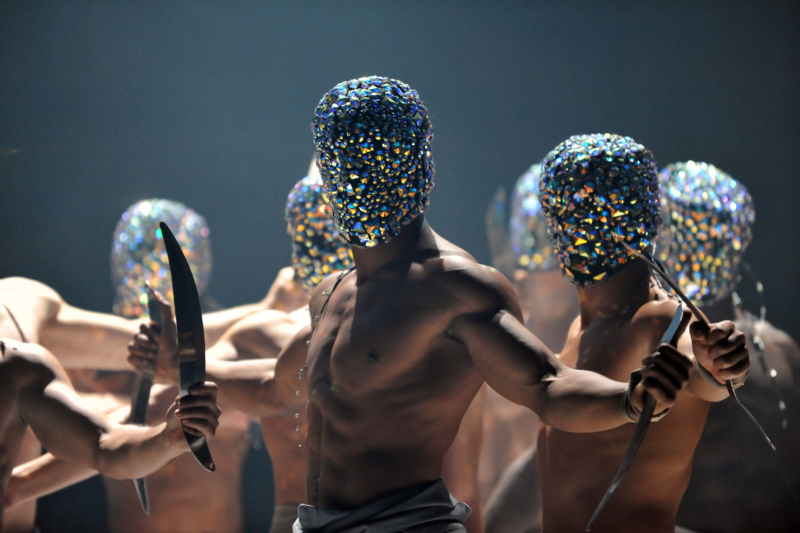
    The visually engrossing production features evocative lighting by Lionel Buzonie, and costumes by Guillaume Gabriel that include mask-like headgear adorned with Swarovski crystals which catch the light, adding to the mystique of the ballet’s darkish opening passages. The dancers appear first in long skirts, which are later shed in favor of fitted trousers. To say that these men are incredibly sexy is an understatement: they are also fearlessly committed to the work, and to the brotherhood.

    To sounds of primeval winds and waves, the dancers emerge from the shadows. They huddle together, earthbound, as the opening music of Wagner’s DAS RHEINGOLD speaks to us of beginnings. The community is restless, wary. They awaken in a brief passage of unison gestures.

    Knives are drawn, and an alarm sounds…but fades to mere tinkling sounds. There is a bathing ritual to the sounds of an antique flute, then the men take their places in a striking lineup across the rim of the stage, superbly lit.

    A tapping sound develops into vibrant drumming as the men compete in fantastic feats of tumbling, flipping, spinning on their hands or on their heads. The helmet-masks come off, the drumming gets wild. Then deep tones emerge from the sonic glow, alive with the exotic sound of finger cymbals.

    A respite, and then a whirring sound spins into a song – are the men actually singing? I was to far away to tell. Now the tribe begin tossing one another into the air; they soar with electifying bravura before being caught by their comrades. After circling in backbends, they cut loose to do more leaping and flipping: mind-boggling athleticism. The music turns metallic as the dancers again engage in uncanny break-dancing spins. Then they slowly disperse to music from the Mozart REQUIEM, only to return, engaging in ever more daring spinning and tossing.

    86734724_10218458400185321_4811273668363550720_n

    Suddenly one man is targeted and threatened with knives. Stripped of his skirt, and inverted, he performs a spectacular solo, spinning on his head as knife blades fan out from his whirling torso. The men – some on their knees like supplicants – return with metal poles; to the sound of distant voices, the poles become canes of props. Later they are tossed from man to man with amazing accuracy, and still later held aloft in cruciform.

    Now there evolves a big-beat, swirling tribal dance; the skirts have all been sheds. After more athletic feats and some spear-tossing, there is an intense run-about. To the sound of the deep chanting of Et lux perpetua, the men again line up along the edge of the stage: they seem to silently be bidding us farewell. Then they back into the shadows and begin to slowly exit – pairs or alone – heading into the unknown. As the last man vanishes from sight, one sensed the welling up of a great emotional force in the house. The audience, who have beheld this great human spectacle in awed silence, are ready to unleash a tremendous wave of applause.

    But…no: the men now return and, in a rather prolonged coda, continue to perform many of the same moves and feats we’ve already seen. As this coda brings nothing fresh to the piece, either choreographically or musically, it seemed expendable.

    At last, the packed house got their chance to hail Mssr. Koubi and his courageous dancers with waves of fervent applause and cheers.

    Efeeb7ea1079465dbd24d15aa611cea0

    Above: photo by Pierangela Flisi

    ~ Oberon

  • Franz Mazura Has Passed Away

    Mazura

    The great Austrian singing-actor Franz Mazura has passed away at the age of 96. Mazura made his operatic debut at Kassel in 1949, and went on to appear at numerous German theaters in a wide variety of roles. His career eventually took him to the great stages of Paris, Vienna, Bayreuth, and New York City.

    Mazura was a stalwart at the Bayreuth Festival for fifteen summers, beginning in 1971. His most frequent Wagnerian roles were Alberich in the RING Cycle and Klingsor in PARSIFAL, but he also sang the Wanderer and Gurnemanz at the Wagner shrine.

    Franz Mazura as Gurnemanz – Bayreuth 1973

    Cap189

    At Bayreuth, he appeared in 1976 as Gunther in the controversial Pierre Chéreau centennial production of the RING Cycle: photo above, with Dame Gwyneth Jones as Brunnhilde.

    In 1979, Mazura sang Doctor Schön and Jack the Ripper in the premiere of the completed version of Alban Berg’s LULU at the Paris Opéra, conducted by Pierre Boulez.

    After making his Metropolitan Opera debut in 1980 in the Berg double-role, Franz Mazura went on to appear on The Met stage 175 times. In 1989, he was a magnificent Alberich in the RING Cycle, my first experience of seeing the Cycle in the span of a week. Earlier, in 1987, he had stepped in as Wotan in WALKURE, a performance my friend Paul Reid attended; Paul described Mazura as “…a cantankerous god.”

    Franz Mazura’s final Met appearance was as Schigolch in LULU in 2002.

    Here is a sampling of his extraordinary portrayal of Klingsor:

    PARSIFAL – scene from Act II – Leonie Rysanek & Franz Mazura – Met bcast 1985(1)

    Among the many roles Franz Mazura sang in his long career was the Spirit Messenger in DIE FRAU OHNE SCHATTEN:

    Helga Dernesch & Franz Mazura – FRAU OHNE SCHATTEN ~ opening scene – C Perick cond – Met 1989

    He displayed his versatility in such roles as La Roche in CAPRICCO, Pizarro in FIDELIO, Scarpia in TOSCA, the Doctor in WOZZECK, Creon in OEDIPUS REX, and the Speaker in ZAUBERFLOETE. His final operatic appearance was at Berlin as Schwarz in MEISTERSINGER on April 21st, 2019…the eve of his 95th birthday.

    Franz Mazura appears in the film of Pierre Chéreau‘s 2013 production of ELEKTRA from the Aix-en-Provence Festival; he makes a touching effect as the Tutor of Orest.

    ~ Oberon

  • Met’s MAGIC FLUTE – Saturday Matinee

    Taymor Flute

    ~ Author: Oberon

    Saturday December 21st, 2019 matinee – The Met’s shortened, English-language version of Mozart’s DIE ZAUBERFLOETE may not be as musically fulfilling as hearing the original, but it does afford an opportunity to hear lots of voices – from Met veterans to newbies – in one fell swoop, and thus I am likely to go two or three times each season that it is on offer. Although the cuts are irksome, and Papageno is too much the center of attention, there’s still enough opportunities for the singers to make their mark.

    The House was full of children today, and with people who’d forgotten to turn off their cellphones. The kids were receptive during the music, but some longish stretches of dialogue prompted then to have audible monologues of their own. Is it really necessary, in a 100-minute reduction, to bring up the Seven-fold Shield of the Sun? I suppose it really doesn’t matter, since apparently this is the last season we’ll see this production. (Or might they have a new ZAUBERFLOETE, and keep this Taymor holiday season specialty around?)

    Lothar Koenigs was on the podium this afternoon; his tempi were mostly spot-on, but there were some places where stage and pit were not totally in-sync. The Three Genii were unfortunately a weak trio vocally, and at times sounded a little like The Chipmunks. The Three Ladies – Gabriella Reyes, Megan Esther Grey, and Renee Tatum – sounded good individually, but did not always mesh well; the conductor seemed at times to leave them adrift. (Is Megan Esther Grey related to the great Wagnerian soprano, Linda Esther Grey? I will try to find out.)

    Ashley Emerson’s Papagena managed to get the words across when doing her “old lady” voice: no mean feat. Once transformed, she sang brightly. Rodell Rosel was an audience favorite as the crafty Monastatos. The Priests (Christopher Job and Scott Scully) and Guards (Arseny Yakovlev and Jeremy Galyon) did well.

    Joshua Hopkins sang excellently as Papageno, and the audience loved him; his referring to the Priests as “coneheads” was priceless. David Portillo’s attractive tone and appealing lyricism made his Tamino a winning vocal presence, with a nice feeling of tenderness. In his scene with Patrick Carfizzi’s Speaker, to my mind the key to the whole opera, both singers were clear of diction and dramatic intent. Mr. Portillo’s “O endless night!” was moving; and later, his “Music is the heart’s true home…” seemed to express what this opera is all about.

    Joelle Harvey’s vocal shimmer at “Be truthful!” was engaging, as was her self-defense to Sarastro. She made a lovely, vulnerable impression in Pamina’s aria with her expressive dynamic palette and persuasive phrasing. At her “Tamino mine!” a sense of radiance was met by Mr. Portillo’s ardent response. The two sang gently and sweetly in the quartet with the Two Guards.

    Kathryn Lewek’s Queen of the Night gave the afternoon its spark; after swirling thru the coloratura of her first aria, she sustained the high-F: an exciting moment. Her “Wrath of Hell” had great accuracy and brilliance, the high-Fs slightly metallic but hitting the bullseye each time. On her final command, “Swear!”, the soprano took a soft attack and then swelled the note to white-heat. She won vociferous applause here, and again at her solo bow. She has amply proven herself in this demanding role several times; I hope now we can hear her as Lucia or Constanze. 

    Morris  r jpg

    Spectacularly anchoring the performance was Morris Robinson’s Sarastro: generous of tone, crystal clear of diction, and benevolent by nature. A grand performance from this formidable basso. Bravo!

    All afternoon, much of the spoken dialogue seemed over-wrought and campy; Papageno tended to shriek at the least provocation. David Portillo as Tamino spoke with a slight, charming accent: not amiss, as this prince has come from afar.

    ~ Oberon

  • Preislied

    Alexkim2

    Above: tenor Alex Kim

    I like this Korean tenor’s lyrical rendering of the Prize Song from Wagner’s DIE MEISTERSINGER.

  • Julia Fischer|Philippe Jordan @ The NY Phil

    Fischer_J

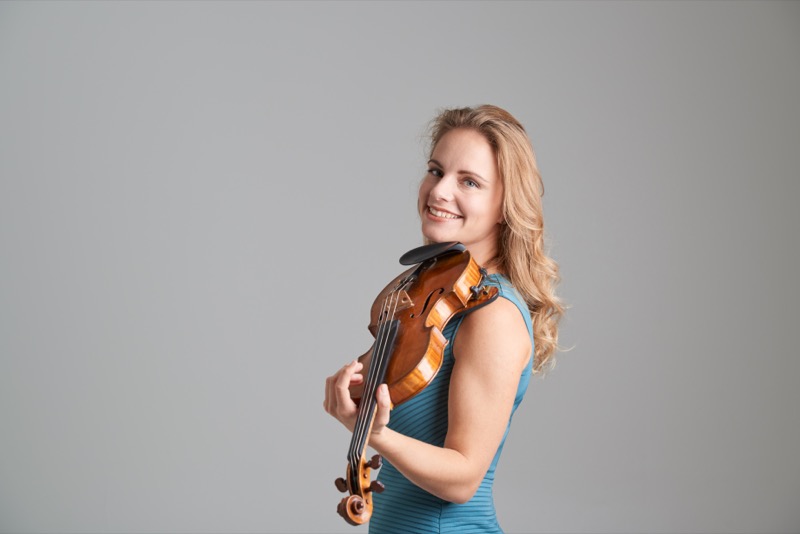
    Above: violinist Julia Fischer

    ~ Author: Oberon

    Wednesday October 30th, 2019 – Philippe Jordan was on the podium at Geffen Hall this evening as The New York Philharmonic presented their program of Prokofiev, Mendelssohn, and Beethoven: an ideal mix, in my opinion. The comely and compelling violinist Julia Fischer was the guest soloist for Mendelssohn’s violin concerto, the orchestra’s stellar woodwind soloists were all present and accounted for, and the entire evening had a special glow about it.

    Prokofiev’s Symphony No. 1, Classical, strikes me as a perfect piece of music. At a running time of just 15 minutes, the symphony is a compact delight, abounding in rhythmic variety and appealing themes. The opening Allegro con brio is in the traditional sonata form, but the composer keeps throwing us curve balls: witty bits crop up out of nowhere. Maestro Jordan and the Philharmonic artists seemed truly to enjoy playing this music, which, in the flashing leaps and zesty grace notes of the second theme made me smile to myself.

    A gentle melody on high for the violins is the key feature of the Larghetto, with pizzicati, treading basses, and colourful bassoons all part of the composer’s scheme. The Gavotte makes me think of the composer’s ROMEO AND JULIET, while the ebullient finale sounded wonderfully clear and alive. Throughout, flautist Robert Langevin, clarinetists Anthony McGill and Pascual Martínez-Forteza, oboist Sherry Sylar, bassoonist Judith LeClair, and their woodwind-section colleagues charmed the ear with their polished playing; when Maestro Jordan asked them to stand for a bow, the audience responded warmly.

    Violinist Julia Fischer then joined the orchestra for Mendelssohn’s Violin Concerto in E-minor. This was my first opportunity to hear Ms. Fischer playing live; she sounded marvelous and looked fetching is a deep grey gown shot thru with glimmering silver. There’s shining silver in her sleek tone as well.

    The first movement’s marking of Allegro molto appassionato derives from the composer’s premonition of writing “…[A concerto] in E-minor running through my head, the beginning of which gives me no peace.” With splendid support from the orchestra, Ms. Fischer displayed her expressive gifts, lovely feeling for dynamics, and exquisite control of pianissimo. In the cadenza, her soft playing in the stratosphere was remarkable; this she followed with a rocking motif as the ensemble take up the theme. The music becomes very animated as the Allegro moves to its finish.

    A sustained bassoon tone carries the music directly into the Andante wherein the glowing melody is given a tender, haunting quality as Ms. Fischer’s playing moves serenely from piano to pianissimo: simply breathtaking

    Following a brief interlude, the violinist embarks on festoons of fiorature – played with sparkling surety – in the concerto’s concluding movement. Passages of Mendessohnian ‘faerie music’ are heard, and then Ms. Fischer revels in the rapid-bowing of the effervescent finale. With the final note of the concerto still hanging on the air, the audience unleashed a tumultuous applause, and everyone stood up to cheer. Ms. Fischer and Maestro Jordan are clearly simpatico, and their performance was thrilling. The crowd clearly wanted an encore, but none was forthcoming.

    Philippe-jordan

    Above: Maestro Philippe Jordan

    The concluding work, Beethoven’s 7th symphony, was magnificently shaped by the Maestro, who dips and bends into the music, eliciting splendid playing from the orchestra. This symphony has a dance-like sense of forward momentum upon which Mssr Jordan built his interpretation. His pacing – on the fast side – was so vital, and the textures of the music so lovingly layered, with the wind soloists again producing magical effects. 

    Swept along by the music, I put away my pen and indulged myself in forty minutes of pure selfish enjoyment. One small and intriguing motif in this symphony that always captures my imagination is a seeming “preview” of six-note passage from the Grail knights’ march in Wagner’s PARSIFAL music. Did Wagner openly borrow this from Beethoven, or is it a subconscious association? Either way, it played over and over in my mind during the train ride home. 

    This has so far been a particularly impressive and satisfying season for classical music here in Gotham, and tonight’s concert was yet another edifying experience.

    ~ Oberon

  • Miró Quartet @ Weill Hall

    Miro2

    Above, the Miró Quartet: Daniel Ching and William Fedkenheuer (violins), Joshua Grindele (cello), and John Largess (viola). Photo by Naova Ikegami.

    ~ Author: Oberon

    Thursday October 25th, 2019 – For their concert at Weill Hall this evening, the Miró Quartet honored the history of string quartet performance in America by replicating a program performed by the country’s first professional touring string quartet – the Kneisel Quartet – over a hundred years ago.

    Franz Kneisel, then concertmaster of the Boston Symphony Orchestra, founded his quartet in 1885. The program offered tonight by the Miró was first performed by the Kneisel in 1910 during the Kneisel Quartet’s 25th anniversary season. The Miró Quartet are celebrating their own 25th anniversary this season, so the connection has layers of meaning.

    The first half of tonight’s concert was beset with extraneous distractions; following an over-long interval, the Miró took the chill off a hall that had become frigid due to A/C overload with their sizzling performance of Schubert’s Death and the Maiden.   

    Mozart’s “Hunt” quartet, K.458, opened the evening. The Miró’s violinists faced one another, with the cellist and violist in the middle. Right from the music’s joyous start, a wonderful vitality could be felt in the quartet’s music-making. Daniel Ching’s trill tickled the ear, and a five-note motif was passed from player to player with wit and sparkle. A gracious interlude and a paragraph in the minor key were so persuasively delivered.

    The cordial mood the Miró had established was then spoilt by late seating. It took a while for things to re-settle in the hall. There were more latecomers allowed in later. Very distracting.

    The Menuetto: Moderato profited from lovely depth of tone from each player. The ensuing Adagio has the feel of a melancholy bel canto aria, with a tender melody sung first by the violin and then taken up by the cello. As the movement continued, with exquisite playing from Mr. Ching, the sound of quiet snoring crept into our collective consciousness. I could not tell if the players could hear it or not. At any rate, they carried on with the sprightly start of the final  Allegro assai, the cellist reveling in his rich tone, everything lively and appealing.  

    The Kneisel Quartet were advocates for contemporary works of their day; thus music by Reinhold Glière and César Franck was on the program; it felt odd to hear only parts of string quartets by these two composers, but it seems that the idea of playing individual movements of works was not frowned upon in 1910.
     
    Each of the three remaining works on the program’s first half was prefaced by a spoken introduction from one of the players. As there was a very thorough program note about the content of the concert, the talking seemed unnecessary. 
     
    The Glière Andante (his Opus 1, #2) and the Franck Scherzo were delightfully played. The Glière is a ‘theme-and-variations’ affair, launched by the viola and cello playing pizzicati under sustained tones from the violins. A gently rocking feeling takes over, with decorative fiorature from the violin; then the music turns fast and furious, with the brisk, deep cello bringing a sense of urgency. Ethereal sounds from the violin next lend a pensive air – very subtle playing here – and then a dance springs up, with plucking lower voices and shivering violins. 
     
    The Franck Scherzo, the shortest movement of his lengthy D-major Quartet, brought forth mutes for the violins, lending the charming piece a magical lightness akin to Mendelssohn’s faerie music.  
     
    S Ho
     
    Above: pianist Stephanie Ho, photographed by Masataka Suemitsu
     
    In another departure from ‘normal’ string quartet programming, the unusual inclusion of a work for cello and piano on tonight’s program points up yet again how things were sometimes done back in the day. Pianist Stephanie Ho joined the Miró’s cellist Joshua Gindele tonight for Adrien-François Servais’ Fantasie sur deux air Russes.
     
    The cellist and pianist are long-time friends and colleagues, so their playing was beautifully meshed and simpatico. Ms. Ho commenced the work with a solemn opening piano statement. The first cello melody, oddly familiar, was lushly played. And then, with a delicious trill from Mr. Gindele, a dance strikes up, and it soon turning into a gallop. The cello goes very high, and then very low. Following some hesitations, a sad waltz develops.  This leads to a virtuoso competition between cello and piano…great fun! After a few small detours, comes the brilliant finish. The two musicians embraced as the audience warmly applauded their expert performance.
     
    Returning after the prolonged interval, the Miró Quartet swept aside any and all distractions or concerns with a thrilling rendering of Schubert’s immortal Death and the Maiden.

    The opening Allegro drew vibrant playing from the Miró. The individuality of the players’ respective timbres achieves a surprisingly coherent, compelling blend: they make this familiar music sound fresh – and what more can we ask? Their rhythmic surety and variety of dynamics make their playing irresistible.

    The sublime Andante con moto, which introduces the doleful “Death” theme, moved me deeply with its air of hushed lamenting. The emotional ebb and flow of this movement seemed to well up from Mr. Gindele’s richly resonant cello, suffusing the whole with a spiritual glow.

    The Scherzo is quite brief; we don’t know if Wagner intentionally lifted one rhythmic motif here to serve as a leitmotif for Nibelheim in his opera DAS RHEINGOLD, but it always gives me a smile.

    Now the finale is reached, with Mr. Ching festooning the music with precise filigree over the passion and drive of his colleagues’ playing. A high-velocity rush suddenly shifts into hyper-gear as the music careens almost recklessly to its end. 

    Playing at the peak of their powers, the dazzling Miró artists turned the concluding Presto into the crowning glory of this outstanding musical experience. Though “death’ is in the work’s title, the word I  kept scrawling in my notes about the Miró’s playing was: “…alive..!”

    ~ Oberon
  • New Bayreuth

    Scanned Section 4-1

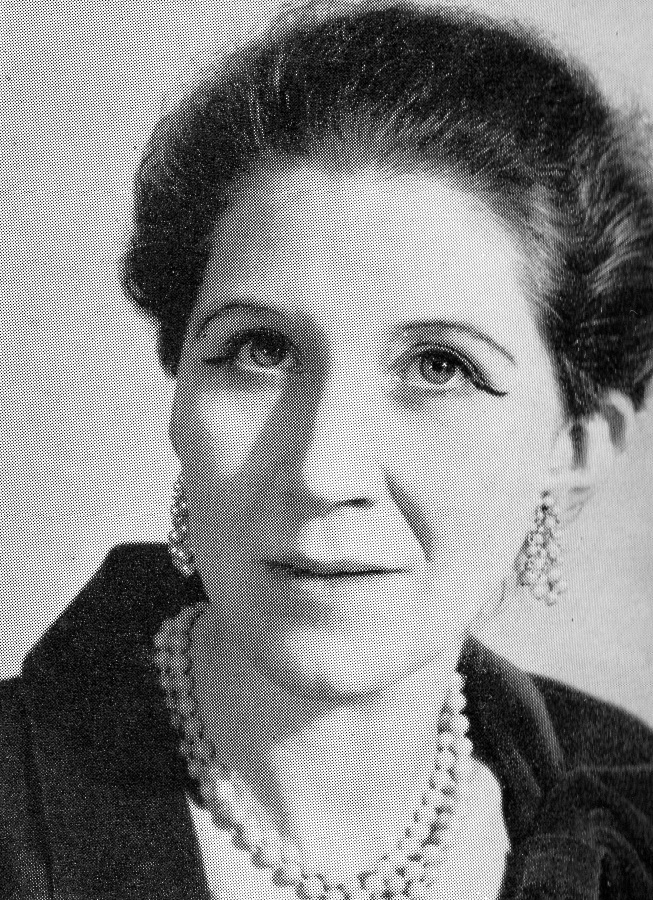
    Penelope Turing (above) was an Englishwoman who attended the second post-war Bayreuth Festival in 1952, returning to the Green Hill for many seasons thereafter. She continued to attend performances thru the Summer of 2009, and she passed away in 2010.

    Turing’s book, New Bayreuth, was first published in 1969. It is full of detailed writing about both the scenic and the musical aspects of the productions she saw there over her first seventeen years of attending the Festival, commencing – in 1952 – with DAS RHEINGOLD, in Wieland Wagner’s ground-breaking production which had premiered the Summer before.

    Turing’s writing about the voices and characterizations of the eminent singers who appeared in those first post-war festivals is fascinating to read.  

    Her descriptions are so evocative. Of curtain-rise for the Wieland Wagner PARSIFAL, which had been introduced in 1951, Turing writes: “According to the score, the scene is a glade in a solemn, shady forest in the domain of the Grail. In what we saw, however, there was no forest definable, nor even a tree. We felt the forest rather than saw it: a legendary forest that was of no time and no place, and one, moreover, over which mystery and sorrow and pain seemed to have brooded long.”

    After reading that, on page 6, I was hooked on Turing’s book, and have been barely able to put it down. Turing’s writing is free of ‘intellectual’ blather, theories, and nit-picking. She writes about what she saw and what she heard, and how she felt about it all. 

    Md30327760771

    The book contains many black-and-white photos from those years: of the iconic productions, and of the fabled singers who appeared in them; of the Festspielhaus, and of the town of Bayreuth. These produce a feeling of nostalgia for a place I’ve – unfortunately – never been.

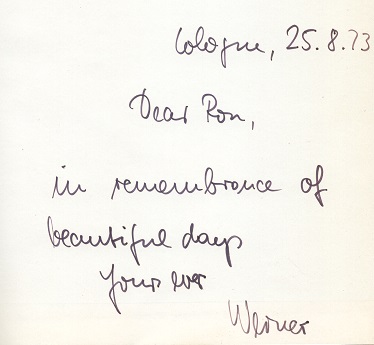
    But there’s another reason I’m so captivated by the book. As I so often do, I bought New Bayreuth in a used, hardcover edition via Alibris. Used books invariably have a life of their own, and, opening it for the first time, I found this inscription:

    Scanned Section 2-1

    Who were Ron and Werner? Were they lovers? Had they gone to Bayreuth together, or did they perhaps meet one another there? Are they still alive? My guess would be: probably not.

    But now their book has come down to me, and it is intriguing in so many ways.

    ~ Oberon