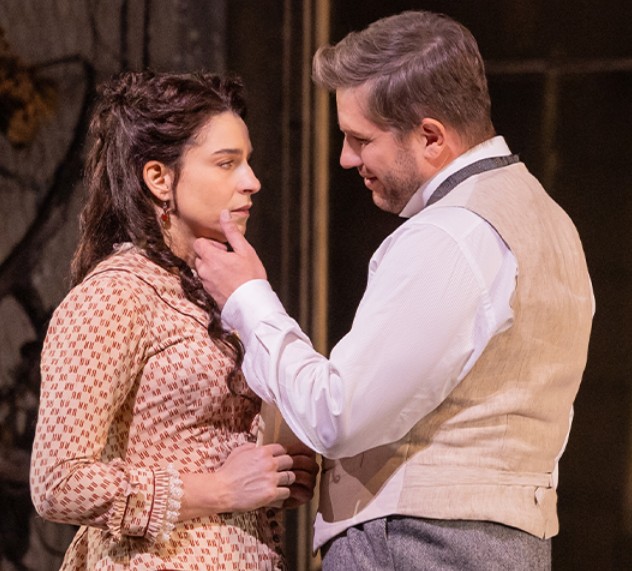
Above: Asmik Grigorian and Iurri Samoilov as Tatiana and Onegin; a MET Opera photo
~ Author: Oberon
Saturday May 2nd, 2026 matinee – The Met put together an impressive cast for their revival of Tchaikovsky’s EUGENE ONEGIN this season. The Russian conductor Timur Zangiev was making his Met debut with these performances, and he and the orchestra forged this into the outstanding sonic experience of the season – one in which the singing onstage was never swamped by the sounds emerging from the pit.
Over the years, I have been fortunate to see a number of sopranos in the role of Tatyana, starting with Raina Kabaivanksa at The Met in 1979 (opposite Yuri Mazurok’s Onegin). Since then, my Tatyanas have been Teresa Zylis-Gara, Ileana Cotrubas, Kay Griffel, Edith Davis (in the opening production of the Glimmerglass Opera House), Mirella Freni, Lyubov Kazarnovskaya, Solveig Kringelborn, Hanan Alattar (especially lovely…at Juilliard), Tatiana Pavlovskaya, and Anna Netrebko. Each has been special in her own way. This afternoon, Asmik Grigorian joined the list.
I remember well first hearing the voice of Iurri Samoilov when he was a finalist at the 2017 BBC Cardiff Singer of the World. His only previous Met role has been Schaunard back in 2022. Joining in the cast’s principals were French tenor Stanislas de Barbeyrac as Lenski, the monumental voice of Alexander Tsymbalyuk as Prince Gremin, and the comely Russian mezzo Maria Barakova as Olga.
The pensive prelude (with a jangling cellphone distraction) immediately assured us that the opera was in good hands with Maestro Zangiev in charge . Mlles. Grigorian and Barakova sang their folk-song dreamily, whilst Elena Zaremba as Madame Larina and the remarkable Larissa Diadkova traded chesty resonances as they recalled days gone by. (Ms. Diadkova had joined the cast after Stephanie Blythe withdrew.). The field workers sang their exhilarating folk song, and Ms. Barakova made a lovely impression with Olga’s aria, her expressive, velvety mezzo very forward and well placed, and finishing off with a gorgeous low line, laced with a sultry nuances.
We now meet Olga’s lover, Lenski, and his friend Onegin. Mr. de Barbeyrac displayed beautiful softness of tone in his song to his beloved, leading to a passionate declaration of love…his voice and Ms. Barakova’s blend poetically. Onegin’s little arietta was superbly sung by Mr. Samoilov, with Ms. Diadkova keeping a watchful eye on these young people. We hear, for the first time, the heart-throbbing melody that will soon open the famous Letter Scene.
Alone with her Nurse, Tatyana is uncharacteristically nervous. Ms. Diadkova tries to calm the girl with a touching narrative from her own past; the nurse leaves, and the passionate theme bursts forth from the celloes. The soprano’s voice bursts into an almost demented excitement, leading to a stunningly-sustained A-flat. As her monolog commences, winds, harp, and horn weaving restless underlying themes. Ms. Grigorian’s voice moved splendidly between lyricism and power; she has so many colours in her palette, making emotions ebb and flow with astonishing control. After her great outpouring, shimmering top notes sink into probing depths of tone. The orchestra plays sensationally as Tatyana hastily scribbles out the end of her letter. Her aria’s final lines are thrillingly voiced. The show then came to a halt as a hearty, porlonged ovation embraced the soprano.
Then the dawn music heralds the nurse’s return; the Grigorian voice is aglow with anticipation. Ms. Diadkova (bless her heart) gets very chesty as the two banter. The letter is sent; torn between hope and fear, Tatyana now awaits her fate. The orchestra and conducting have been sensational during this memorable scene. And Asmik has been spectacular.
In the next scene, the prelude and maidens’ chorus are wunderbar. Tatyana’s hopes are dashed by Onegin’s heartless response to her “juvenile” letter. Mr. Samoilov’s condescending – and eventually cruel – lecture is handsomely sung, taking the written ending to fine affecting.
After a long intermission, Maestro Zangiev is very warmly greeted as he returns to the podium. So far, he and the marvelous Met musicians been magnificent, and every note and nuance from the singers has been heard…and savoured. This is a very welcome change from the usual “fast and loud” atmosphere generated by most Met conductors these days. The Act II prelude is grandly played, with a special nod to the flautist. The beloved waltz commences, orchestra and chorus vivid at every moment. A bravo! from me to Ben Brady, who made the most of the Captain’s brief lines.
At his ball, Lensky and Olga argue…they do not know that their fate will soon be determined. Mr. de Barbeyrac’s plea is so touching, with a gorgeous diminuendo especially impressive. Tony Stevenson now takes the stage as Monsieur Triquet; in the past I have often thought that this vignette is tedious and delays the unfolding drama, but Tony made a masterpiece of it with his lyrical singing, avoiding character-tenor “nuances” and maintaining a melodious approach… Bravo!
The exchange between the friends Lenski and Onegin gets prickly. Mssr. de Barbeyrac as Lenski pours out his memories of the many happy hours he has spent at Madame Larina’s house with his beloved Olga; his singing is incredibly touching, with achingly beautiful piani effects and tender phrasing. In the big finale, the orchestra is loud, but the Maestro makes sure the singers are always heard. Madness takes over, with the tenor’s desperate farewell wrenchingly uttered. Kudos to all – and especially for the conductor – for such a thrilling scene.
It’s always great to have Richard Bernstein is the cast of any of the operas in his extensive repertoire; today he was Zaretsky, who presides over the fatal duel between Onegin and Lensky. Playing of deep richness came from clarinet and cello in the scene’s prelude. Then Mr. Bernstein took up his duties, annoyed at Onegin’s casual lateness. Mr. de Barbeyrac then gave us Lenski’s tragic aria, his singing full of sorrow and regret. As one beautiful, tormented phrase after another rose up, the bassoon offered its own poetic commentary. Lenski the poet was at his most poetic in what is to be his farewell to life. Ravishing sound, so engrossing…such hushed pianissimi that brought tears to my eyes. The uncanny fading away of the final phrase elicited a heartfelt applause from the crowded house, who had listened intently to such poignant singing. An agonizing duet of fate is voiced by the friends, now estranged beyond redemption. The orchestra plays frantically; the gunshot is fired. “Dead?” asks Onegin…”Dead!” is Zaretsky’s numbing reply.
Years have passed; Onegin has wandered the world restlessly. Back in St. Petersburg, with nothing better to do, he attends a ball hosted by an old comrade, Prince Gremin. After a simply brilliant polonaise, played gloriously by the Met musicians, Onegin sings – with undercurrents of regret – of his loss of interest in all things worldly. Following a sort of ‘encore’ by the orchestra (a brisk Allegro vivace), Onegin – to his amazement – then spots Tatiana, now the elegant Princess Gremina, across the ballroom. The prince greets his long-lost friend and tells him, in a splendid aria, of his happiness and contentment with his young wife. Alexander Tsymbalyuk, a bass with a voice of gold, simply pours out this magnificent piece with sustained gorgeousness. A more introverted repeat of the aria’s initial phrases creates a feeling of great tenderness; in his penultimate measures, Mr. Tsymbaluk descends to a solemn low note, which some in the audience mistook for the ending. Applause and bravos broke out. When they finally died down, the maestro and basso took up where they had left off, giving the the aria’s concluding low note its full grandeur. After speaking briefly to Tatiana, who politely withdraws, Mr. Samoilov sings excitedly of newfound hope before he rushes away.
Against her better judgement, Tatiana agrees to meet Onegin. The prelude to this scene found the orchestra at their very finest. Mr. Grigorian voiced Tatiana’s mixture of torment and rapture with marvelous vocal colours. The princess explains that this is to be their last meeting, but Onegin cannot accept her rejection. Things get intense, with Onegin fighting for his life, but Tatiana stands firm. With a sublime floated note, Ms. Grigorian again attempts to dismiss him (and her own feelings). They harmonize, each filled with desire, and at last Tatiana admits she still loves him. But, just as hope fills Onegin’s heart, Tatiana breaks away and, with a searing high note, she rushes off. After what felt like an eternity of silent despair, Mr. Samoilov thrillingly ended the opera with heart-rending cry of anguish.
At the stage door, I met Ms. Grigorian, Mr. Tsymbalyuk, Richard Bernstein, and Maestro Zangiev. The conductor seemed surprised when I told him that his had been best conducting I’d heard at The Met all season. It was not meant as an idle compliment, and I assured him it was true. His respect, not just for the music, but for the singers singing it, was so meaningful to me.
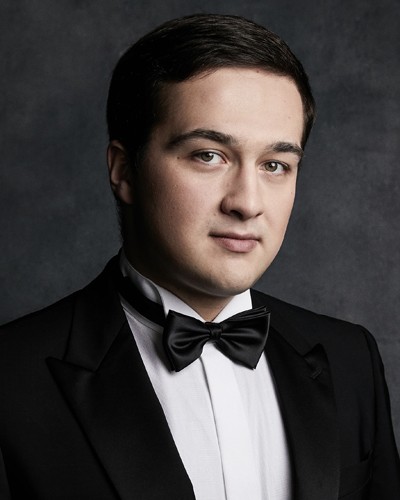
Above: Maestro Timur Zangiev
~ Oberon
 Oberon's Glade