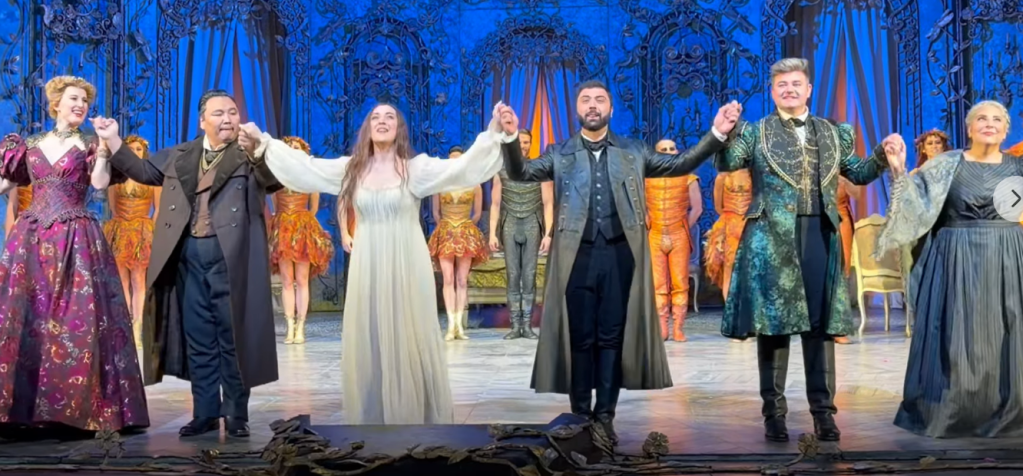
Above, curtain call: Lindsay Martin, Amartuvshin Enkhbat, Rosa Feola, Liparit Avetisyan, Ben Reisinger, and Eve Gigliotti.
~ Author: Oberon
Sunday May 3rd, 2026 matinee – Soprano Rosa Feola enjoyed a personal triumph as Violetta in Verdi’s LA TRAVIATA at The Met this afternoon. Sharing the stage with debuting tenor Liparit Avetisyan and the great Mongolian baritone Amartuvshin Enkhbat, the performance benefited from conductor Marco Armiliato being on his best behavior, fully supportive of the singers.
For me, Ms. Feola was the first Italian Violetta to make such a mark on the role since Scotto and Freni sang it back in their heyday. All afternoon, Ms. Feola kept my emotional temperature at the boiling point: I cried, got breathless, and had chills running thru me as she delivered one marvelous moment after another.
I ran “Italian sopranos who sang TRAVIATA from 1950 on” thru AI and was surprised to find that Anna Moffo, Maria Callas, and Virginia Zeani were all Italian! Who knew??! Anita Cerquetti is listed, though she never sang the role. Licia Albanese, who was my first-ever Violetta at the Cincinnati Zoo Opera in 1963 (and who recorded the opera with Toscanini) is not named, nor is the first Violetta I ever heard (on a MET broadcast): Gabriella Tucci. Adriana Maliponte and Elena Mauti-Nunziata (who I saw singing Violetta in Hartford in 1985) are likewise ignored by AI.
What is the point of all this? Well, simply that somehow, when the Violetta is Italian-born, it adds an inexplicable dimension to the story of the famous French courtesan, Marie Duplessis, on whose brief life the Verdi opera is based. Example: Italian sopranos such as Tebaldi, Tucci, and Renata Scotto have stopped the show with their “Amami Alfredo…!” in Act II (Tebaldi was even known to encore the passage…).
Oddly, I hadn’t even thought about any of this until I was at my score desk; I had come simply to hear Ms. Feola again after enjoying her performances in RIGOLETTO and FEDORA. The presence of Mr. Enkhbat in the cast was another attraction.
Settling in, it looked like the House might end up half-empty, but by the time the conductor entered the pit, there was a substantial crowd. The prelude was hauntingly played; when the singing began, I was afraid Maestro Armiliato might be in his “loud-and-fast” mode. Perhaps because his Violetta was a compatriot, he was more thoughtful in his approach today. In the end, it was probably the most pleasing conducting I’ve ever heard from him.
The singing started. From her first lines, it was evident that Ms. Feola had something special to offer. Tenor Ben Reisinger as Gaston introduces Alfredo (Mr. Avetisyan) to Violetta. I have no doubt that – soon – Mr. Reisinger will be singing Alfredo; he cetainly has everything a tenor needs for the role…and for many other roles. Meanwhile, Lindsay Martin, Christopher Job, Brian Major, and Richard Bernstein are all making their marks as party guests. Mr. Avetisyan leads off the Brindisi, his lyrical voice Italianate in sound, with stylish turns of phrase, and an endearing trace of a sob here and there. Ms. Feola immediately established herself with her full lyric sound, her natural flow of the text, and her wonderful feel for subtleties in the music that will make her all the more riveting as the opera moves forward. Her B-flat to end the drinking song rang beautifully into the big hall.
The tenderness of Mr. Avetisyan’s lines after Violetta has experienced a coughing fit led him on to his persuasively voiced “Un di felice...” sung with ardor. Ms. Feola replied with deft coloratura phrases, and a moment of rubato that made me fall in love with her.
Left alone, Ms. Feola commences the great scena that Verdi constructed to end the act: a gift that every soprano who has taken on the role of Violetta has unwrapped in her own unique way. What a pleasure to hear the Italian language so gorgeously rendered by Ms. Feola. Everything is clear and clean: her lingering higher notes enticing, and a marvelous crescendo carrying her into “Ah, qual amor…”. The audience seems entranced: the silence in the Hall is palpable. We are hanging onto every note and word. The ensuing recit takes her into the dazzling “Sempre libera…” with bright top Cs and words filled with magical colourings. After hearing Alfredo’s ardent serenade, Ms. Feola launches the second verse more introspectively, but is soon relishing the flowing scale passages before soaring up to a house-filling E-flat. The crowd went wild; if – as in days of yore – the soprano had taken a solo bow at this point, the ceiling might have collapsed.
A long interval (not an intermission) with the house lights at the half mark caused people to flock to the restrooms only to be told by the ushers “This is not an intermission!” When the opera started up again, the audience remained unsettled for a minute or two, spoiling the intro to Alfredo’s aria. This Mr. Avetisyan sang beautifully, with a tenderly expressive recit and a seductive flair in the aria proper. Armiliato chose a fairly rapid tempo, but the tenor used it to advantage, letting the long phrases meld into one another: very poetic. We briefly meet Annina, Violetta’s faithful servant, in the person of Eve Gigliotti. After her revealing of the facts of Violetta’s finances to the love-struck Alfredo, he sings the cabaletta “O mio rimorso…” (hardly ever heard in my first decade or two of opera-going) with assured coloratura and fluent diction before rushing off to set things right.
We come now to the heart of the opera: the meeting between Violetta and her lover’s father. This scene has always moved me deeply, ever since Ms. Tucci and Robert Merrill captivated me with it on that Texaco broadcast – which now seems like a lifetime ago. Today, Mr. Enkhbat’s incredibly powerful voice made Germont’s angry first lines truly threatening. The baritone, sounding better than ever, is taken aback when Violetta stands up to him. Every line that Ms. Feola sings in this in this scene (well, all afternoon actually…) turns to gold. Her “Piu non esiste…” and “Era felice troppo…” are deeply felt. Taking on a less combative stance, Mr. Enkhbat attempts to explain his family’s situation; with “Pura siccome un angelo...”, so gorgeously sung, so legato, and full of subtleties, he begins to wear down Violetta’s defense. Shattered by Germont’s demands, Ms. Feola brings some anguished chest tones into play. Her “Cosi alla misera…” is heart-breaking, and then comes the turning point of the opera, from which there is no going back: Violetta’s “Dite alla giovine...” was another Feola treasure, answered by the baritone’s attempt to console her with “Piangi, piangi…” The whole duet was so engrossing…so real. Germont has won. Ms. Feola sings the parting line “Non ci vedrem piu forse...” but suddenly voices from the lighting bay at the top of the hall break the mood.
Violetta sends Annina off to accept Flora’s invitation, Ms. Feola dismissing Ms. Gigliotti severely. The haunting clarinet solo as Violetta writes a farewell letter to Alfredo is broken by his sudden return. Ms. Feola sings a moving “Amami, Alfredo…” which Mr. Armiliato underscores with deep, rumbling timpani.
Mr. Enkhbat’s “Di Provenza…” is spectacularly sung, his mellifluous tone filling the hall, with hushed piano effects etched in. In the second verse, so vibrant, touches of anger emerge, filling out the portrait of a father burdened with a wayward son and a beloved daughter. Mr. Enkhbat sings then sings the cabaletta, which I have never liked. TRAVIATA survived for decades without this piece, which delays the flow of the story. Enkhbat sang it sumptuously, though Armiliato drowned out the singer’s final line.
The intermission felt endless, but Flora’s party finally kicked off with a briskly-paced ballet…I’ll never forget the NY City Opera’s production wherein the Galán sisters took turns dancing the lead, castanets blazing away. At her party, Lindsay Martin’s Flora gets a chance to shine, as do Mssrs. Reisinger, Job, Major, and Bernstein. After the ballet, Alfredo arrives, followed shortly by Violetta on the arm of her former protector. Agitato music underscores the drama as Violetta’s two lovers gamble whilst subtly insulting one another. Armiliato takes this scene super-fast; the tension is palpable.
Violetta begs Alfredo to leave as she fears the Baron might assault him. Furious at being spurned and seeing her with the Baron again,. Alfredo flings his winnings at her: Mr. Avetisyan is fiery here. The chorus upbraids him loudly for his treatment of their beloved friend, Violetta; all is silenced by the arrval of Germont. Mr. Enkhbat scolds his son powerfully and then Ms. Feola, in one of the opera’s most poignant passages, attempts to console Alfredo, who has no idea that it’s his own father who has caused Violetta to break with him. The Feola voice sails over the big ensemble, whilst Mr. Enkhbat’s voluminous sound effortlessly rings thru the finale.
Another long pause went on and on; it might as well have been an intermission. At last, the sorrowful prelude to the final scene commences; here Armiliato and his players are at their most expressive. Two of my favorite humans – Eve Gigliotti and Richard Bernstein – are there to ease Violetta’s final hours. Left alone, Ms. Feola reads Germont’s letter rather quickly and quietly, but ends with an anguished cry of “È tardi”. The soprano’s sung recitative is beautifully thought out, and “Addio del passato…” is colored in heartbreak…a gossamer top-A is strikingly beautiful. Usually, I do not think a second verse of the aria is essential, but today Ms. Feola persuaded me otherwise. The applause that followed was long and loud.
Soprano and tenor found a heavenly blend in “Parigi, o cara…“, with Ms. Feola’s delicate piano at “…tutto il futuro…” especially fine. The soprano’s desperation at “…ma se tornando…” as she faces the inevitable was harrowing. Of all the moments for another intrusion from the lighting bay, the voice of a man talking about his doctor’s appointment was clearly audible during the silence before the funereal “Prendi: quest’è l’immagine…” This was inexcusable. Ms. Feola’s “Se una pudica vergine...” was sheer heaven.
The opera ended; after a few moments of total darkness, the curtain rose again and Ms. Feola came forward to a tidal wave of applause and bravas.
~ Oberon
 Oberon's Glade