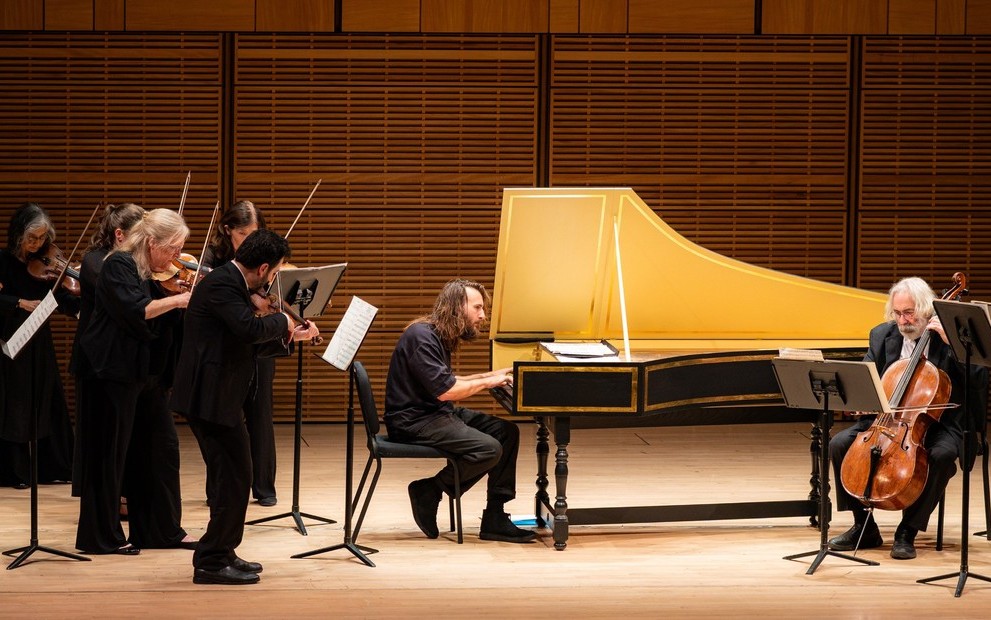
Above performance photo by Nicholas V. Hall
~ Author: Lane Raffadini Rubin
Tuesday June 23rd, 2026 – The Orchestra of St. Luke’s wrapped up its annual Bach Festival in Zankel Hall on Tuesday with works by four members of the Bach family. Jean Rondeau, the world’s most remarkable harpsichordist, led a program largely drawn from his 2017 album Dynastie.
Rondeau waited forbearingly at the keyboard until the rustling in the hall subsided before gesturing the start of the first piece. Rondeau typically appears on stage and camera in a disheveled state (unshaven, with long unwashed hair and baggy T-shirts) but this moment of pause revealed the genuine, rarified conscientiousness that he brings to his playing despite his appearance.
The ten OSL string players who joined Rondeau were excellent partners in the evening’s musicmaking, constantly attuned to the shape of his melodic lines and his coaxings for bursts of energy.
The program began with Rondeau’s transcription of Johann Christoph Bach’s chorale Wer Gott vertraut, hat wohl gebaut. The strings provided a sedate, organlike backdrop over which Rondeau’s first entrance blossomed into technicolor.
After the music of Johann Christoph (Johann Sebastian’s older cousin), the remainder of the program traced a reverse-chronological path through Johann Sebastian’s sons (Johann Christian, the youngest, and Carl Philipp Emanuel, the second oldest) back to the definitive Bach at the center of this dynasty.
The evening’s highlight came early with Johann Christian’s Concerto No. 6 in F minor, in particular its moody and sublimely contoured second movement. Between statements of the ritornello the soloist is given searching, quasi-Romantic material akin to the journey of the orphic soloist in the second movement of Beethoven’s fourth piano concerto. At each return of the ritornello the OSL players brought a new character, from questioning to yearning to resolute.
Rondeau wove together the brilliant extended cadenza of the third movement with the Andante con tenerezza from Carl Philipp Emanuel’s Sonata in A-Major. It was a compelling programmatic trick, a bridge between the two half-brothers working across decades in different corners of Europe. The cadenza-sonata was characterized by harmonic richness and deceptive twists and turns. Rondeau’s playing was often lyrical and always technically flawless. He drew out a range of the froggy, lacey, and stately sounds that are the hallmark of his instrument.
Carl Philipp Emanuel’s Concerto in D-minor followed, revealing a composer caught between the idiom of his father and the nascent streamlined, classical textures of Haydn and Mozart. If Johann Christian’s concerto demonstrated brooding expressivity, Carl Philipp Emanuel’s showed elegance and propulsion.
The first movement of the latter concerto often relied on repetitive pulses and unison moments of arrival. Intervening sections of virtuosic passagework garnered audible hums of approval from the audience. The second movement, strikingly, featured many melodic traces of Johan Sebastian while the third movement revived Italianate pyrotechnic displays common in an earlier generation of concertos.
All the music thus far was performed without pause. In a charming moment, Rondeau began an improvisatory interlude which turned out to be no more than the tuning pitch for the OSL players.
The program concluded with Johann Sebastian’s Concerto in D- minor, BWV 1052, a very popular piece whose appeal I have never understood. But presenting it as a source for the remaining music on the program was a fascinating perspective that threw its spiky contrapuntal texture and dialogic relationship between soloist and orchestra into sharp focus.
The second movement presaged Johann Christian Bach’s and brought Beethoven’s orphic meanderings back to mind as well. Rondeau and the OSL players brought precise articulation and perfect lyric consensus to this movement’s underwordly melodic refrain.
Throughout the evening Rondeau showed a level of physical restraint that would come as a surprise to those who have watched the many production videos available online of his recording sessions, which can border on the wacky. Is he growing out of his wild-boy schtick? The hair and T-shirt suggest that we might find him during a moment of transition. But his playing, still filled with the kind of vibrant energy that tests the agility of the humble harpsichord, continues to mature and revealed itself tonight in the blazingly effective ways he was able to bring the OSL players along for the ride through multiple generations of Bach keyboard works.
~ Lane Raffaldini Rubin
 Oberon's Glade