Author: Philip Gardner

  • Raphaël Pichon and the Orchestra of St. Luke’s find a new path toward Beethoven’s Ninth

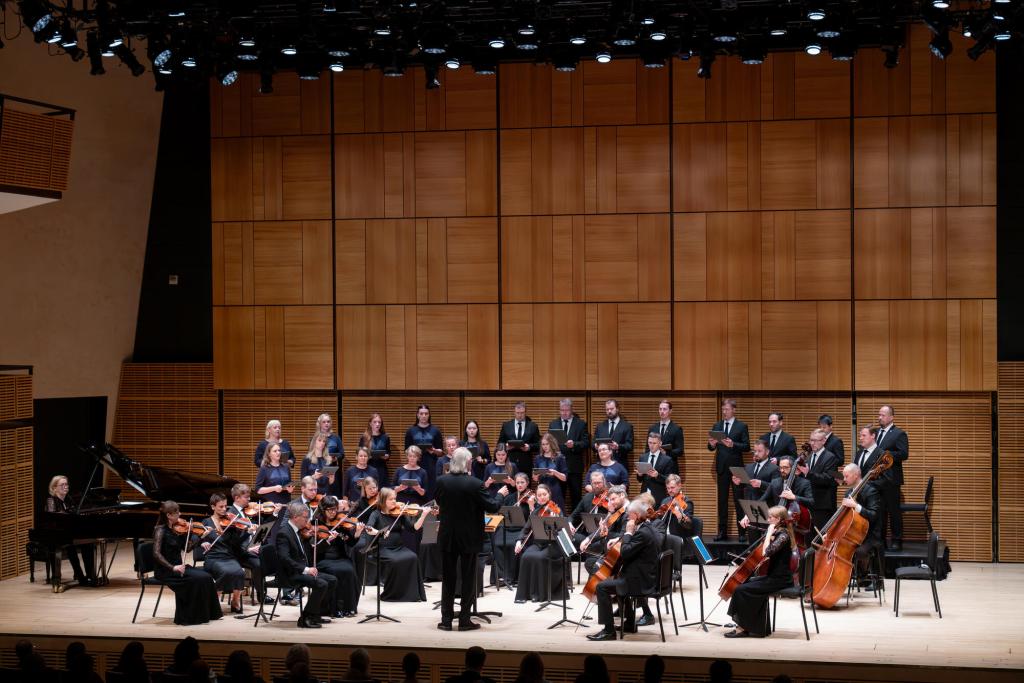
    Above: Maestro Pichon and the Orchestra of St. Luke’s; photo by Fadi Kheir

    Author: Lane Raffaldini Rubin

    Thursday November 6th, 2025 – As the OSL strings played the soft opening chords of the Geistlicher Marsch from Beethoven’s König Stephan, members of the Clarion Choir marched toward the stage in slow motion from the wings and the rear of the hall. The enveloping, uncanny feeling of this assembly was heightened when Alex Rosen, in his booming profound bass, recited passages from Walt Whitman’s “Song of Myself”:

    Do I contradict myself?

    Very well then I contradict myself,

    (I am large, I contain multitudes.)

    The audience, who came to hear Beethoven’s Symphony No. 9, were confronted head-on (in English) by Beethoven’s and Whitman’s inner questioning: How does the self relate to the collective? How might my ego find its place in the world? These questions remain as vital today as they were for Beethoven’s revolutionary-enlightenment deism and Whitman’s rugged American individualism.

    In Whitman’s multitudes we hear a prefiguration of Beethoven’s (andSchiller’s) Millionen (“millions”). But if Millionen merely suggests sheer number, then multitudes shows us the integration of the self and the collective: the multitudes within each of us, the multitudes in which we are each just one voice.

    The evening’s program, played without breaks or applause, wove together the march from Beethoven’s König Stephan incidental music, Friedrich Silcher’s Persischer Nachtgesang based on the Allegretto from Beethoven’s Symphony No. 7, selections of Beethoven’s incidental music from the play Leonore Prohaska, and his Symphony No. 9.

    Overlaid on an orchestral excerpt from Leonore Prohaska were excerpts from Maya Angelou’s “The Caged Bird”:

    The caged bird sings  

    with a fearful trill  

    of things unknown  

    but longed for still  

    and his tune is heard  

    on the distant hill  

    for the caged bird  

    sings of freedom.

    Angelou’s lines do not map as neatly onto Beethoven’s music and philosophy as Whitman’s do, but they evoke a similar struggle of an individual toward a lofty goal, whether it be joy, freedom, or confraternity. And they invoke music—singing, in particular—as a vehicle for this struggle. Leonore Prohaska, a play about a real war orphan who enlisted to defend Prussian freedom against Napoleonic despotism, was a fitting substrate for the recitation of Angelou’s poem of freedom, read in an impressive Scottish brogue by mezzo-soprano Beth Taylor.

    This is how Pichon chose to preface Beethoven’s Symphony No. 9: by preemptively reframing our notion of what Schiller’s and Beethoven’s Ode to Joy is really about. By constructing a ground above which Beethoven’s finale might nobly soar.

    When Pichon moved seamlessly into the Symphony’s first movement, I came to a new understanding, steeped in all this prefatory music and language, of this sometimes vacuous movement. My understanding came from another near-contemporary of Beethoven, Søren Kierkegaard, who said that “anxiety is the dizziness of freedom.” As the singers resumed their slow-motion procession onto the stage, the Orchestra launched crisply into the first movement’s buzzing and abstract terrain. This music bursts at the seams but never seems to go anywhere. It is not until the Scherzo begins that we find an outlet for this pent-up energy. Pichon and the Orchestra brought out this intensity but could have lent more contrast to the first movement’s few peaks and valleys.

    The alternating Scherzo and Trio sections of the second movement illustrate the dual nature of Beethoven’s cosmology. On the one hand, the Scherzo music is a Newtonian clockwork, an ideal machine of intricate contrapuntal parts. The Trio music, on the other hand, takes us outside on one of Beethoven’s sylvan walks. This movement presents both of Beethoven’s paradigms of nature in miniature: one concerning its logical internal structure, the other its sublime, unpredictable, earthly manifestations. The Orchestra occasionally sacrificed clarity for the sake of Beethoven’s fast tempos. The woodwinds and horns struggled to keep up, while the strings grew muddy in more difficult passages.

    The third movement inhabits the sublime realm of B-flat major. The violins take up a prayer-like melody (reminiscent of the ascending theme from the slow movement of the Pathétique piano sonata) that gets reworked into ever-more florid variations—as a religious follower might search for more and more effusive ways to profess devotion. The first violins effortlessly tossed off the fast runs of these variations and the clarinet solo near the middle of the movement was an oasis of transparent simplicity. Amidst these high points, the prominent horn solo was disappointingly labored and out of tune.
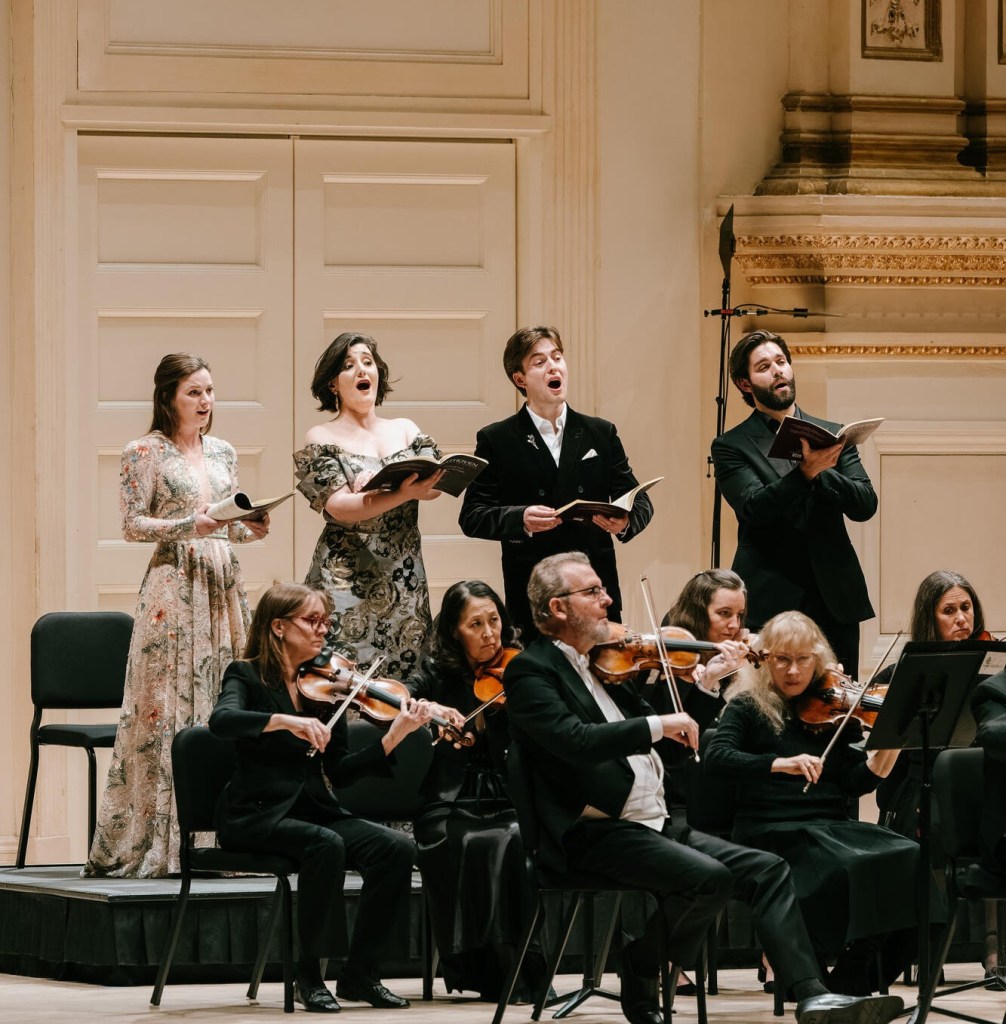
    Above, the evening’s vocal soloists: Liv Redpath, Beth Taylor, Laurence Kilsby, and Alex Risen. Photo by Fadi Kheir.

    The fourth movement, an entire symphony unto itself, begins by mixing music from each prior movement with cacophonous fanfare and a recitative-style prefiguring in the low strings of the statement later enunciated by the baritone. The low strings were unfortunately ponderous and clumsy, while the themes from the earlier movements all sounded even better in their recapitulations than they did in context. Pichon took an extended pause before the first full statement of the Ode to Joy theme, a shame because it detached this music from the lines that constructed it.

    When Alex Rosen stood to deliver “O Freunde, nicht diese Töne! (Oh friends, not these sounds!)”—a moment that never fails to produce frisson—he seemed to embody Whitman, shaking the score in his hands and elbowing his sound into every corner of Beethoven’s line. The chorus and soloists worked through variations on the Ode to gloriously full-throated effect, arriving at a massive and harmonically remote chord. When the fog of that chord clears, Beethoven pieces together a Turkish military march and tops it off with a tenor solo (Froh, wie seine Sonnen fliegen), sung with brassy heroism by Laurence Kilsby.

    By this point Beethoven has abandoned the traditional form of the symphony (to say nothing of his use of choral forces and cantata-like text) in favor of the narrative journey of Schiller’s poem. At one moment a chorale suits the narrative best, in others a chant-like recitative, in another an interlude of fugal variations in the strings.

    All this music in the service of Beethoven’s existential goal—a brotherhood of man, “Seid umschlungen, Millionen! (Be embraced, ye millions!)”—tonight, however, understood to mean not only confraternity but also freedom and the enactment of oneself.
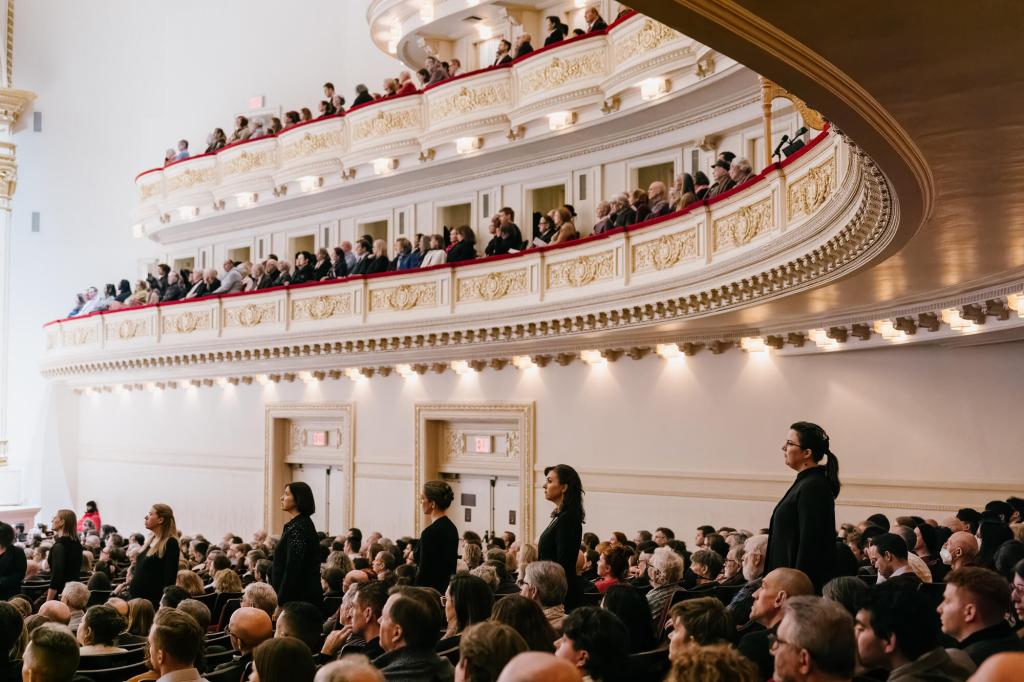
    Orchestra of St. Luke’s, 11/6/2025

    At the coda, some members of the audience stood (photo above by Fadi Kheir), scores in hand, and joined in singing the final verses. It was a gesture that borders on pandering and gimmickry, but it showed the ever-expanding potential for the idea of a universal brotherhood. The Orchestra’s playing did not always rise to meet this lofty aim, but Pichon’s program may have finally given the Symphony No. 9 a full-enough arc to warrant so norm-shattering and monumental a finale as the one that Beethoven gave us.

    ~ Lane Raffaldini Rubin

    Performance photos by Fadi Kheir, courtesy of Carnegie Hall
  • Paul Taylor @ Lincoln Center 2025 ~ 1st of 3

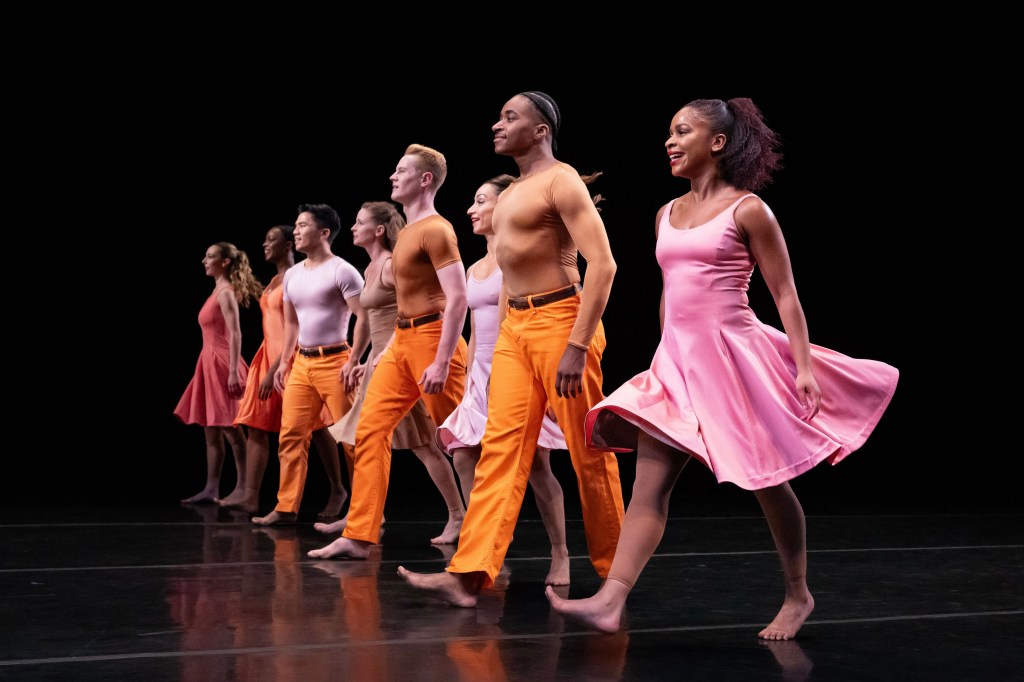
    Above: from Paul Taylor’s ESPLANADE, photo by Steven Pisano

    Wednesday November 5th, 2025 –  The Paul Taylor Dance Company are back at Lincoln Center for a 3-week season; I’ll be going on three consecutive Wednesdays. This evening’s program looked short on paper but was stretched by an unnecessary second intermission. 

    On a day after we had our first glimmer of hope in many dreary months, the program opened with the rather desolate, unfathomable SCUDORAMA; this 1963 dancework is set to a score by Clarence Jackson. It is music of wide rhythmic variety, by turns eerie, clever, and vibrant. The Orchestra of St. Luke’s, under the baton of David LaMarche, gave a superb rendering of the score, which features some jarring whistle-blowing.

    The setting, by Alex Katz, shows stylized dark clouds hovering in a toxic yellow sky. Seemingly homeless, people huddle under discarded blankets. A quintet of women – Jessica Ferretti, Emmy Wildermuth, Elizabeth Chapa, Lisa Borres Casey, and Gabrielle Barnes – have many comings and goings. Tall and alluring, Kenny Corrigan made an outstanding impression. The centerpiece of the work is a duet for Kristin Draucker and Devon Louis; Ms. Draucker’s solo, in a red gown, was stunningly danced, and she was vociferously applauded when she took her bow at the end of the ballet. 

    Paul Taylor’s TROILUS AND CRESSIDA (reduced vesion) uses music by Amilcare Ponchielli, whose LA GIOCONDA is one of my favorite operas. The Dance of the Hours became famous – and familiar to millions – via the Disney film FANTASIA. Paul Taylor has spoofed the classical nature of the ballet with a fanciful back-drop and trios of Cupids (Mlles. Draucker, Borres Casey, and Payton Primer) and invading Greek soldiers (Mr. Corrigan, Caleb Mansor, and Patrick Gamble) while Madelyn Ho and Alex Clayton are brilliant as the principals who cannot seem to do anything right. At one point, the danseur even loses his trousers. 

    Choreographer Robert Battle’s very brief TAKADEME dates from 1999; it is set to a score by Sheila Chandra which features rhythmic vocalizations of the Indian Kathak dance style. In a tour de force performance, Devon Louis captured all the facets of footwork and gesture that the solo calls for. Taking his bow to a cheering audience, the dancer summoned Mr. Battle to join him onstage.

    Paul Taylor’s iconic masterpiece, ESPLANADE, closed the evening. St. Luke’s violinists Krista Bennion Feeney and Alex U Fortes beautifully played the Bach score, and the cast of nine – Mlles. Draucker, Borres Casey, Ferretti, Barnes, and Chapa joined by the ever-delightful Jada Pearman; and Mr. Clayton with his colleagues Lee Duveneck and John Harnage, revevelled in the Taylor choerography. The three duets were danced by Ms. Barnes with Mr. Duveneck, Ms. Borres Casey with Mr. Clayton, and Ms. Draucker with Mr. Harnage.

    The lighting for ESPLANADE tonight seemed terribly “pinkish” and tended to wash out the dancers. And someone near us was loudly humming along – somewhat off-pitch – to the Largo

    As the Bach drew to its end, I was again thinking that I much prefer seeing Taylor at venues like Jacob’s Pillow (where I first discovered them back in the 1970s) and The Joyce. In the House of Mr. B, the dancers seem far away…and their personalities less distinctive. My companion – a dancer and choreographer – agreed with me, and suggested City Center as an alternative: a place which used to be the Taylor company’s Gotham home.

    ~ Oberon

  • Jean Madeira’s Monumental Erda

    The great American contralto Jean Madeira sings Erda’s Warning from Wagner’s DAS RHEINGOLD from a performance at the 1956 Bayreuth Festival. Hans Hotter is Wotan, and Hans Knappertsbusch conducts.

    Listen here.

  • Eike Wilm Schulte Has Passed Away

    The extraordinary German baritone Eike Wilm Schulte has passed away at the age of 86.

    Mr. Schulte studied with the great German baritone Josef Metternich; he made his operatic debut in 1966 as Sid in ALBERT HERRING at the Deutsche Oper am Rhein. For many years a mainstay at Wiesbaden, and later at the Bavarian State Opera, Schulte developed a repertoire of over 100 roles. He sang at the Bayreuth Festival, and he appeared in the world premieres of several operas.

    Among Mr. Schulte’s many roles were Papageno, Guglielmo in COSI FAN TUTTE, Hamlet, William Tell, and the four Villains in TALES OF HOFFMANN.

    He made his debut at The Metropolitan Opera in 1991 as the Speaker in ZAUBERFLOETE; in the ensuing years, he sang Kurwenal, Beckmesser, Faninal, the Herald in LOHENGRIN, and the Spirit Messenger in FRAU OHNE SCHATTEN here in New York City,for a total of 65 Met performances. I saw him in all six of his Met roles: a compelling voice and a powerful presence. 

    Listen to Eike Wilm Schulte sing Dappertutto’s Diamond Aria here, and singing Alberich’s Curse from RHEINGOLD here.

  • Anna Steiger sings Chausson’s “Poème de l’amour et de la mer”

    Anna Steiger sings Ernest Chausson’s “Poème de l’amour et de la mer” from a BBC broadcast in 1985. Norman del Mar is the conductor.

  • Seoul Philharmonic Orchestra @ Carnegie Hall

    Above: Jaap van Zweden

    ~ Author: Mark Anthony Martinez II

    Monday October 27, 2025 – The Seoul Philharmonic Orchestra came to perform at Carnegie Hall tonight under the baton of their conductor and music director, Jaap van Zweden. This was a sort of return home for van Zweden, as he was the music director of the New York Philharmonic from 2018 to 2024.

    I love Carnegie’s series this year, “International Festival of Orchestras II,” because you really get to see how each orchestra operates and performs. Even when playing the same classics, it is fascinating to see how different cultures approach music and performance.

    On this particular night, there was a strong contingent of Koreans in the audience, which would make sense because of the orchestra, but it was also the U.S. premiere of South Korean composer Jung Jae-il’s new piece.

    Right when the concert started, the entire orchestra stood up to greet their maestro as he made his way to the stand. The large orchestra, all in concert black, cut an imposing figure as they all waited for van Zweden to arrive at the podium before sitting down. As someone who grew up in Korea, it reminded me of students standing for a teacher when they entered the classroom. This was one of those interesting cultural moments that was on display beyond just the music itself.

    Above: composer Jung Jae-il

    The orchestra went directly into their first piece, Inferno, by Jung. Jung is not a classical composer by training, but has had some amazing merits to his name already. Jung composed the music for not only the Korean movie Parasite, which steamrolled the Oscars several years ago, but also Squid Game, which took the world by storm in 2020 and this past year as the series concluded.

    I was curious as to how the music would sound coming from a primarily film composer. I had some expectations because I always thought that if someone like Mozart were alive today, he would be writing for Hollywood and Broadway instead of just the symphony.

    The piece started off cacophonous, in a similar soundscape to his television work. I might have been biased because I am a fan of the Squid Game series, but the violence of the sound felt very much in that world. The music itself felt more like tone painting than the more cerebral or academic sort of modern music that I’ve heard more frequently. I quite enjoyed the music, even though I have a penchant for more melodic or tonal pieces.

    It was interesting that there wasn’t much of a melody in the work. It really felt like a film score in that sense, where the music was describing a mood. There were several distinct sections to the piece that didn’t have too much relation to each other, sort of like a movement. Unlike some other classic examples of tone paintings, which have their own movements, these sections were demarcated by distinct moments of silence between each other. This is almost assuredly a product of being a film or television composer instead of a classical one. Where, say, in La Mer, there are distinct sections within the movement that blend into one another, here it felt more like track 2 of a movie soundtrack, which then moved on to track 3 right afterward. This is not a detraction from the piece itself, though! It is just a note on how the world of music is adapting to how it’s used. I’m sure when Monteverdi first wrote Orfeo, people noticed how differently the music was used since it was a work for the stage instead of just the court.

    There were moments where the percussion actually had the main role, which was very interesting because I feel like that doesn’t happen too often. And if it is used by composers like Rachmaninoff as the focal point (who would come later on in the program), those instruments are the more melodic kind, such as the glockenspiel.

    After the piece ended, the composer came up from the audience and embraced van Zweden. He took several bows in every direction of the audience. I’m sure it was a wonderful moment for him.

    After the composer and maestro left the stage, the orchestra set itself up for a diametrically different piece. Bomsori Kim (photo above) came out to the much-reduced orchestra in a beautiful yellow dress and took center stage.

    The Mendelssohn Violin Concerto is such a beautiful gem, and it was a great bridge to move back into an earlier sonic world. The piece was well played by Kim as the soloist. As such an iconic piece, there is little room for error, but it was executed very well. The first movement felt a bit uninspired in the beginning, but by the end, Kim was fully involved in the piece and really giving a show.

    After the concerto ended, Kim received a very spirited ovation and, after a couple of curtain calls, played a Kreisler solo violin piece marvelously.

    After the intermission, the orchestra increased in size again and was ready to play the behemoth that is Rachmaninoff’s Second Symphony. The symphony was longer than the entire first half of the concert and quite technically demanding. To be able to navigate a modern piece, an early Romantic, and a late Romantic piece in one concert showed the ability of the orchestra as well as the conductor.

    The Rachmaninoff was sublimely played. Most of the time, I was lost in the soundscape that was so reminiscent of other Rachmaninoff pieces in the most pleasant ways. You can hear shades of his piano concertos in his symphonic writing.

    After the symphony drew to a close, I thought the concert must surely be over, but there was an encore! It was the Slavonic Dance No. 8 by Dvořák. I could only imagine how tired the orchestra was after such a long night of demanding music, but I left a happy concertgoer.

    ~ Mark Anthony Martinez II

  • Marion Dry, contralto

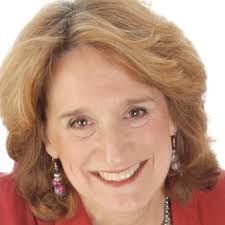
    Contralto Marion Dry has appeared with the Cleveland Orchestra, Boston Pops Orchestra, National Symphony of Panama, National Symphony of Ukraine, Boston Modern Orchestra Project, and at Tanglewood. She sang with the opera companies of Houston, Seattle, Boston Lyric Opera, at the Kennedy Center, Blossom Music Festival, Netherlands Opera, and at the Edinburgh Festival. She has recorded for Nonesuch, Koch, CRI, and Virgin Classics.

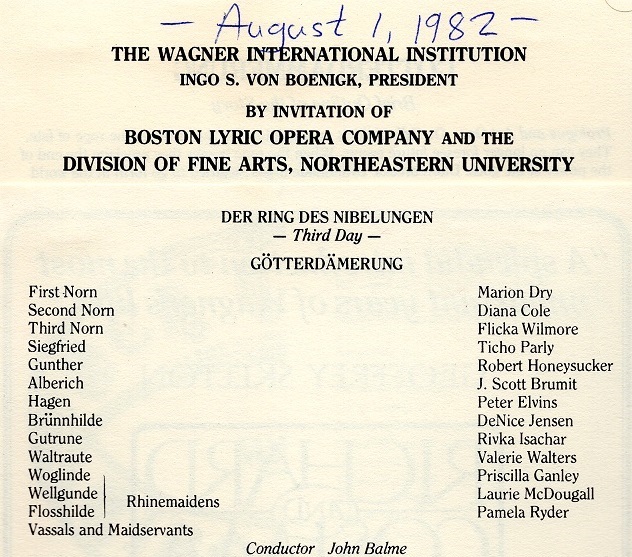
    In the Summer of 1982, the Wagner International Institution presented Boston Lyric Opera in Wagner’s RING Cycle in a concert setting at North Eastern Unversity. My friend Paul Reid and I trekked up to Boston on July 18th and August 1st to hear two of the four operas. Marion Dry sang Schwertleite in WALKURE and the 1st Norn GOTTERDAMMERUNG, as part of a particularly fine trio alongside Diana Cole and Flicka Wilmore; John Balme was the conductor.

    Listen to Marion Dry in the aria “You Have Learned to Bewitch” from Lukas Foss’s GRIFFELKIN here.

    Ms. Dry later became Director of the Music Performance Department at Wellesley College, and co-founded ClassACT HR73

  • The Miró String Quartet’s 30th Anniversary Concert @ Alice Tully Hall

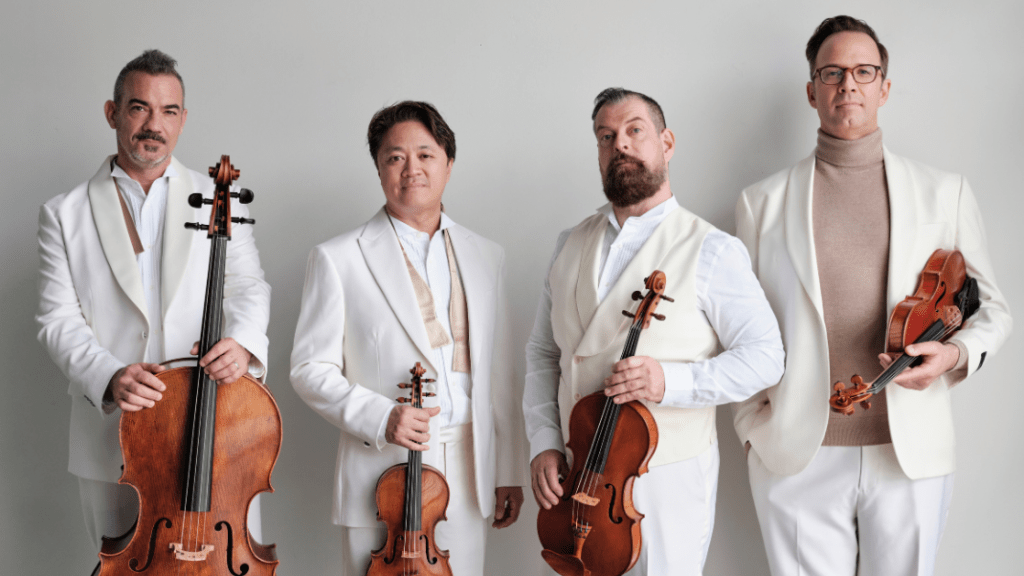
    Above, the artists of the Miró String Quartet: Joshua Gindele, Daniel Ching, John Largess, and William Fedkenheuer. Photo from the Quartet’s website.

     Tuesday October 28th, 2025 – The Miró String Quartet, celebrating their 30th-anniversary, gave a terrific program at Chamber Music Society of Lincoln Center tonight. 

    The evening opened with Haydn: his Quartet for Strings in D-major, Hob. III:70, Op. 71, No. 2, penned in 1793. Like many Haydn quartets, this one starts off with a slow introduction, lovingly harmonized; then the Allegro comes alive. This very inventive music seemed so fresh and clear, and was played with youthful joy. The movement ends with a jolly dance.  

    The ensuing Adagio commences with a poignant violin melody from Daniel Ching, his colleagues joining with gorgeous harmonies underpinned by Joshua Gindele’s rich cello tones. Violinist William Fedkenheuer and violist are well-represented by Haydn here. After a silent pause, the theme resumes.  

    In the Minuet that follows, Haydn favors a more lively feeling than the usual genteel elegance of the dance. It is music lovingly played by the Mirós; there is a rather pensive interlude before the minuet resumes…and reaches a sudden end. 

    The finale begins gently; it is laced with rhythmic and dynamic variety, then going into minor mode before moving on to a vigorous finish. 

    Music of Alberto Ginastera came next. The composer’s Quartet No. 2 for Strings, Op. 26, dates from 1958. Its 5-movement form covers a vast range of tempi, and of colour. The agitated bowing and emphatic rhythm of the opening Allegro rustico turns thoughtful, and then insistent, with a dazzling urgency. Things simmer down for a bit before a concluding burst of energy. 

    Mr. Largess’s viola launches the Adagio angoscioso; his wandering melody draws comments from the other voices, with drowsy sighs from the Gindele cello. Mssrs Ching and Fedkenheuer offer ethereal duetting, and complex harmonies emerge. A sudden agitato springs up before calm is restored by the cello. Bizarre chords are heard. 

    The Presto magico is worthy of its name: from an insectuous start, pings, slurs, purring effects, and shimmering sounds constantly lure the ear. The fourth movement, Libero e rapsodico, brings skittering motifs in a violin solo, which is passed on to the cello. Slashing strokes of violin and viola, a restless cello passage, Mr. Fedkenheuer shines, and a wide-ranging theme from the Largess viola: all these carry the movement to its somber ending.

    Buzzing sounds announce the final Furioso: a fast and fun movement, brilliantly played. Throughout the Ginastera, I often found myself on the edge of my seat, bedazzled by the music…and by the musicians’ playing of it. Ending the concert’s first half, this work drew a big response from the audience. 

    A delicious treat came after the interval in the form of César Franck’s “Scherzo: Vivace” from his 1889 Quartet in D-major for Strings, a work which seems to have inspired the evening’s final work: Claude Debussy’s Quartet in G minor for Strings, Op. 10, which was composed five years after the Franck. The Franck “Sherzo: Vivace” lasts less than six minutes. Its start honors Mendelssohn, king of the scherzo. A more reflective interlude brings lovely playing from Mr. Gendele’s cello. 

    The gentlemen of the Miró then commenced the Debussy. The quartet has a restless start, then a range of harmonies offer a perfect Miró sonic blend. The music turns urgent, but is then becalmed, offering some truly beautiful passages.

    Plucking from the violins – and later from all four players – is an ear-teasing motif of the second movement. Later, some trills embellish the effect. Mr. Fedkenheuer opens the Andantino, with Mr. Largess picking up the theme, which draws a slow rise of tenderness. As the music moves expressively onward, the violist returns for a lonely melody. The Gindele cello sounds velvety and Mr. Ching’s violin soars. A feeling of peace settles over the hall.

    The cello opens the finale, then the violin takes up the theme. A rhythmic pattern springs up; mood swings and witty instrumental comments lead to an increase of speed…and a fine finish.

    Above performance photo by Cherylynn Tsushima.

    A full-house standing ovation greeted the players, honoring the quartet’s thirty-year anniversary. I’m so happy I was there to join in the celebration.

    ~ Oberon 

  • A Celebration of Arvo Pärt at Carnegie Hall

    ~ Author: Lane Raffaldini Rubin​

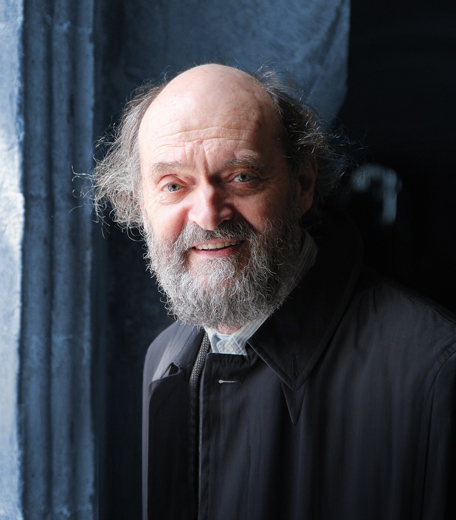
    Thursday and Friday October23rd and 24th, 2025 – Why is the music of Arvo Pärt (above) so beloved around the world? Perhaps it has to do with our penchant for metaphor. Pärt’s music, through the richness it creates out of modest ingredients, conjures other—higher—things. Its representational power makes it mystical to some, mysterious to others, and glorious to others still.

    Carnegie Hall is celebrating Arvo Pärt’s 90th birthday this season by giving him its annual Debs Composer’s Chair and holding a series of performances featuring his works. It all kicked off on Thursday and Friday with back-to-back all-Pärt programs. In Thursday’s mainstage performance the Estonian Festival Orchestra (led by its founder Paavo Järvi) presented a survey of Pärt’s greatest hits. Friday’s performance, in Zankel Hall, featured the Estonian Philharmonic Chamber Choir and Tallinn Chamber Orchestra in an array of lesser-known works.

    The program on Thursday night was comprised of pieces written between 1963 and 2013—a full fifty years—representing the many modes of Pärt’s output, from early twelve-tone writing to the fully formed tintinnabuli style that he invented and became famous for.

    The 1977 Cantus in memoriam Benjamin Britten opened the concert with the singular toll of a bell. From silence, the strings slowly grow into a glimmering churn that layers into a thick slab of sound before eventually sifting into pure unison.

    Perpetuum Mobile, written in 1963, has an similarly imperceptible start that settles into a patter of staccato syncopated notes in the winds. A ceaseless repetitive rhythm lends this piece perpetual time, if not perpetual motion per se. Rumbling drums undergird a glacial crescendo toward a monumental peak. From there, the music follows its long arc back to nothing, finishing where it began, in silence.

    In contrast, La Sindone (The Shroud) of 2005, which opens with aching diminished chords in the strings, seemed melodramatic and overly figured. The texture does thin itself out in later passages and weaves together brief linear threads of notes, but the piece never sheds the unusual quasi-cinematic sound that makes it uncharacteristic of Pärt’s work.

    The Estonian Philharmonic Chamber Choir joined the orchestra for the 2009 Adam’s Lament, a setting of a prose text about the desolation and abject grief of Adam. Chantlike introductory statements in the choir grow into glorious major chords, which Pärt—and audiences—savor in inhabiting. Much of this piece is derived from simple stepwise motion built around these tectonic triads.

    In works like this, Pärt achieves textures and colors reminiscent of the sacred music of Tallis, Josquin, and other renaissance composers of music for the Church. Pärt permits himself the use of a narrow set of compositional tools, which he deploys with precise control. The result is a varied bounty that belies the severe economy of means of its component parts.

    In this way, Pärt offers musical instantiation to Giorgio Agamben’s concept of altissima povertà (“highest poverty”), the ascetic notion often associated with St. Francis of renouncing earthly excess in favor of rule-based forms of life comprising only the most basic elements.

    Above: Hans Christian Aavik and Midori playing the Tabula Rasa; photo by Fadi Kheir

    The second half of Thursday’s program featured two of Pärt’s best works, Tabula Rasa and Fratres, both written in 1977. The young Estonian violinist Hans Christian Aavik and the veteran star Midori joined the Orchestra as soloists in Tabula Rasa. (Nico Muhly also joined on the prepared piano, seated unceremoniously near the back of the stage)

    Midori and Aavik were perfect partners in the intricate interplay of the first movement (Ludus).The kaleidoscopic, fractal sound of the two violins wended between moments of Vivaldian rationality, cosmic splendor, and demonic fiddling.

    The second movement is entitled Silentium, the word inscribed on monastic refectory walls to instruct brothers to eat in silence and listen mindfully to the recitation of prayer. Here the music in the orchestra provides a slow temporal fabric above which the violins float in cloudlike, vaporous suspension, passing simple figures between them that act like ribbons of smoke steadily rising from votive tapers.

    In Fratres, presented here in its version for strings and percussion—a slightly disappointing fact given that two able violinists were on hand to play the version for violin and orchestra—the music takes as much time and space as it needs to, unfurling its series of changing pitches like necessary steps in a penitential ritual. The piece opens with gossamer high strings shining over a sustained bass ground like the first rays of light in a sunrise.

    Compare that to Swansong (2013), a fully leavened, meaty pastorale that Sibelius might have written. Pärt uses the orchestra to paint traditional colors in this piece (including the facile association of the oboe’s sound with the swan), which even swells into a Romantic, cymbal-crashing climax. The result could not be more different from the austere sublimity of Fratres.

    Muhly and the Choir returned to the stage for Credo (1968), one of Pärt’s most impressively strange works. Credo features passages of J.S. Bach’s Prelude in C Major from the Well-Tempered Clavier, which are meant to represent elemental “good” in the face of darker forces. They come off, however, as almost juvenile when pitted against Pärt’s mammoth depictions of evil, including passages that evoke Haydn’s “representation of chaos” with ululating screams from the choir.

    Järvi acted as a humble, devoted shepherd of the evening’s music, treating his role on the podium not only as timekeeper, but also as manager of coherent timbres across the orchestra and guide through the creeping pace of the broad arcs that span each piece.

    Photo above by Jennifer Taylor

    On Friday the singers of the Estonian Philharmonic Chamber Choir joined the Tallinn Chamber Orchestra in Zankel Hall for a more intimate set of Pärt’s works. While the orchestral and choral forces were reduced, the evening featured lengthy settings of liturgical texts including Stabat Mater, Magnificat, and Te Deum, as well as L’Abbé Agathon, a French setting of part of the fifth century Sayings of the Desert Fathers.

    Pärt’s Magnificat (1989) and Te Deum (1985), which were played together and made up the second half of Friday’s program, were the evening’s highlights. Magnificat begins with women’s voices high up in the metaphorical rafters. This is Pärt’s take on stile antico homophonic writing, in which all the a cappella vocal parts move with the same rhythm.

    Te Deum constructs a towering cathedral of sound around this core. Pärt lays out a complex dramatic topography that navigates between sober moments of plainchant, impressively grand crests (as at “Tu Rex gloriae, Christe”), and the rumbling piling-up of tension in between (as at “Fiat misericordia tua”).

    The listener enters a kind of trance in Pärt’s music—one that demands patience and rewards it with the glory and richness of simple things. But it is a fragile hypnosis and its precarity was tested time and again on Thursday and Friday nights with the overactive mundanity of squeaky chairs, cellphone chimes, and coughing. In Zankel Hall, the N, Q, R, and W trains run mere feet away from the subterranean stage. Their periodic rumblings were quite distracting at first, but as the Te Deum faded away (“Amen. Sanctus, Sanctus, Sanctus”), the sounds of the subway tethered the ethereal to the terrestrial, the lofty to the earthly, and these rumblings became part of the music too.

    ~ Lane Raffaldini Rubin

  • NY Pops @ Carnegie Hall

    ~ Author: Mark Anthony Martinez II 

    Above: conductor Steven Reineke

    Friday October 24th, 2025 – The NY Pops opened their 43rd season at Carnegie Hall on October 24th with a phenomenal concert of music rooted in Broadway and cinema classics. The theme itself was explained more clearly by the conductor, Steven Reineke: the music from the program was picked from shows that either became movies or movies that became musicals. Normally, this distinction doesn’t make too much of a difference, but in some instances, the movie score for, say, The Sound of Music was played instead of the music composed for the Broadway performance.

    It was my first time going to a Pops concert, and I was very excited but also curious as to what it would be like. It was quite a mix of ages in the audience, which was nice to see. The stage wall was awash in subtle changing colors when the conductor walked out.

    Maestro Reineke cut a charismatic figure as the orchestra jumped into the Overture from Bernstein’s classic West Side Story. The music was fantastic and reminded me that this show really is an American classic. The orchestra also played deftly and enthusiastically. I remembered reading that orchestras had a very difficult time playing the swing rhythms when Bernstein first composed the piece, but the Pops orchestra was certainly at home and had none of those issues.

    As the overture progressed through the different numbers from the show, the lights projected onto the stage changed, seemingly to match the mood of the numbers. When the overture got to the famous “Mambo!” number, the musicians all shouted “Mambo!” at the appropriate time when the dancers would have in the show, a very rousing way to start the concert.

    After the first number closed, Reineke took to a microphone and explained the concept of the show and introduced the first guest performer of the night. Elizabeth Stanley, a veteran performer, walked onto the stage to what turned out to be the opening music of “Diamonds Are a Girl’s Best Friend” from Gentlemen Prefer Blondes.

    I originally thought it was walk-on music, but her perfectly accentuated hip pops to the music and the vocals that ensued afterward proved otherwise. The song was a perfect number to start the vocal portion of the show. The song had three verses, each one making it seem as if the song had ended. What was so wonderful about this, though, is that it got the audience excited from the get-go, with applause after each verse ended. When the song itself actually ended, the audience was ecstatic and energized.

    Stanley’s first number was one of my favorites of the night. She had a perfect combination of vocal prowess and performance ability that really made a song from 1949 stand out. I actually found that her voice shone best in older numbers like the aforementioned and later ones in the show, like the classic “The Sound of Music” by Rodgers and Hammerstein, popularized by the legendary Julie Andrews.

    After Ms. Stanley’s exciting number, Broadway legend Hugh Panaro walked out onto the stage and introduced his first song. Mr. Panaro originated the role of Marius in Les Misérables on Broadway and also played the Phantom in the Broadway run of the show over 2,500 times.

    Panaro started off by singing “The Impossible Dream” from Man of La Mancha, and much of the audience fell in love with his tone and delivery. I heard murmurs of approval from behind me. His big number in the first half of the performance was when he sang “Bring Him Home” from Les Misérables, where his emotional pianos enraptured the audience, which bolted into a standing ovation afterward.

    Panaro and Stanley peppered almost all of their numbers with anecdotes, like how Panaro lost out on playing the Hunchback in the Broadway version of The Hunchback of Notre Dame to the performer Meat Loaf, or Stanley’s parents’ church congregation coming to her performance of The Bridges of Madison County while she performed as an adulterous Italian woman. It was these anecdotes that made each number come alive and not just be another song in a concert.

    The excitement from the crowd was one of the more noticeable aspects of the show. Classical music audiences tend to know the decorum of when to clap or stand, but that can cause performances to seem stuffy at times. What I loved was the general enthusiasm the audience had for the performers and the music. Two young concertgoers in front of me were having the best time cheering after numbers they loved (and sometimes in between). And that really is what makes music so wonderful—when people can’t help themselves and simply enjoy the performance.

    The second half of the show was stacked with crowd favorites and showstoppers. It started with the Overture and the song “Oh, What a Beautiful Mornin’,” sung by Panaro from the classic show Oklahoma! The overture actually came from the movie version instead of the stage show.

    Stanley sang huge numbers like the previously mentioned “The Sound of Music,” followed right after by the dauntingly difficult “Don’t Rain on My Parade” from the musical Funny Girl. Panaro sang favorites like “Johanna” from Sondheim’s classic Sweeney Todd, and for his final solo number, the breathlessly anticipated “The Music of the Night” from The Phantom of the Opera, which he had performed so many times before on Broadway. The Phantom number received the most raucous applause and standing ovations from the audience.

    The concert closed with a duet of the classic show tune “Suddenly Seymour” from Little Shop of Horrors. I had a hunch, though, that this wouldn’t be the last number, and as I expected, the duo performed a beautiful rendition of “Somewhere” from West Side Story, providing a perfect Berstein bookend to close the concert.

    ~ Mark Anthony Martinez II