Author: Philip Gardner

  • Rehearsal: Cherylyn Lavagnino’s Monsters of Grace

    IMG_7835a

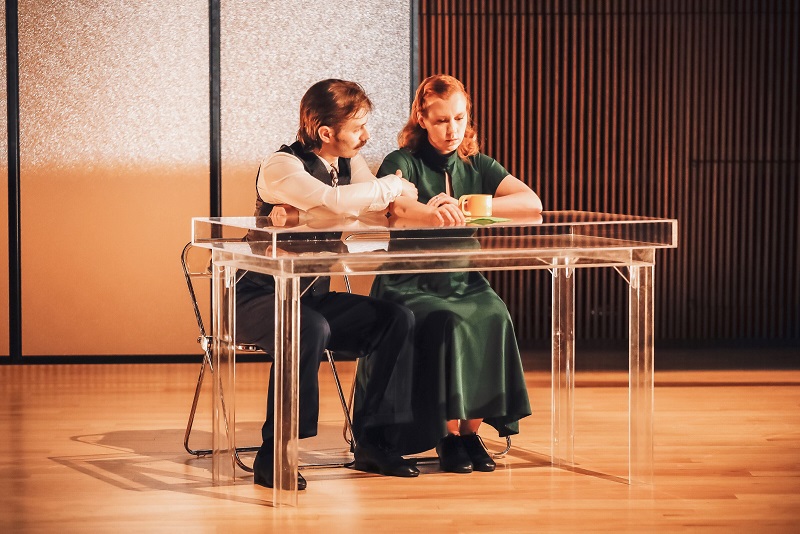
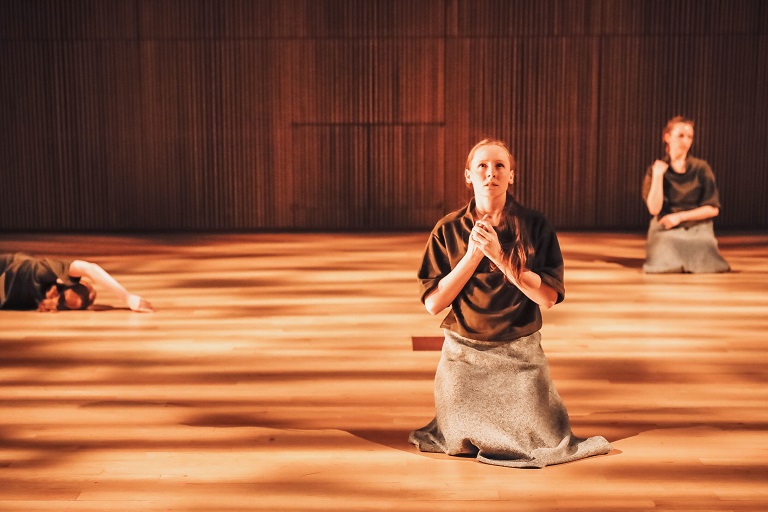
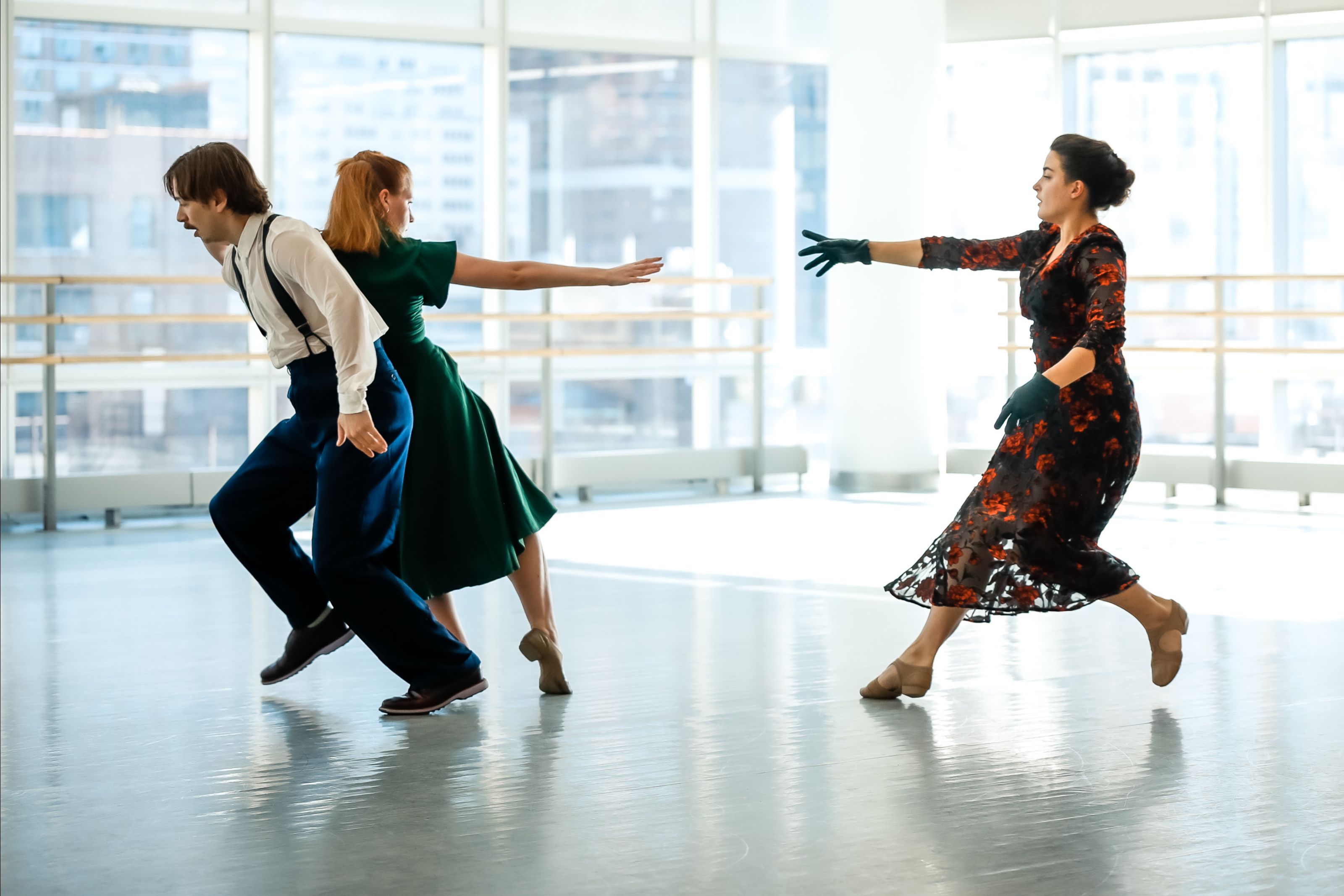
    Above: Dorrie Garland and Dervia Carey-Jones of Cherylyn Lavagnino Dance

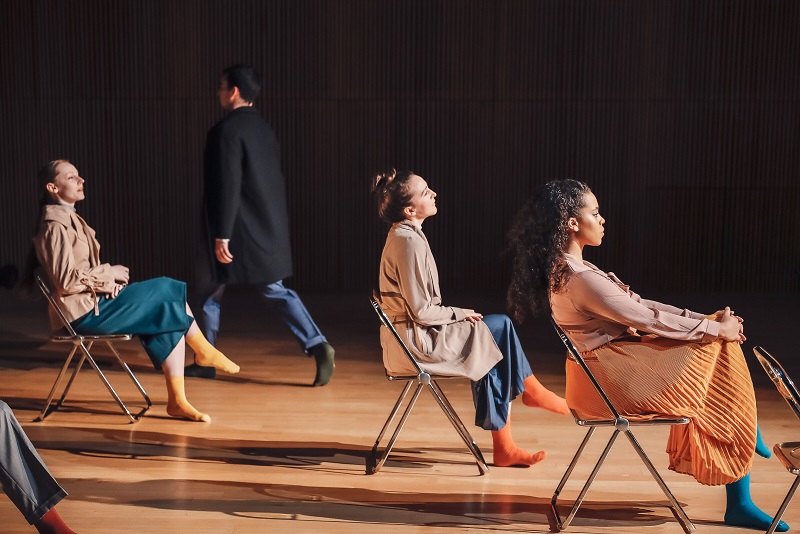
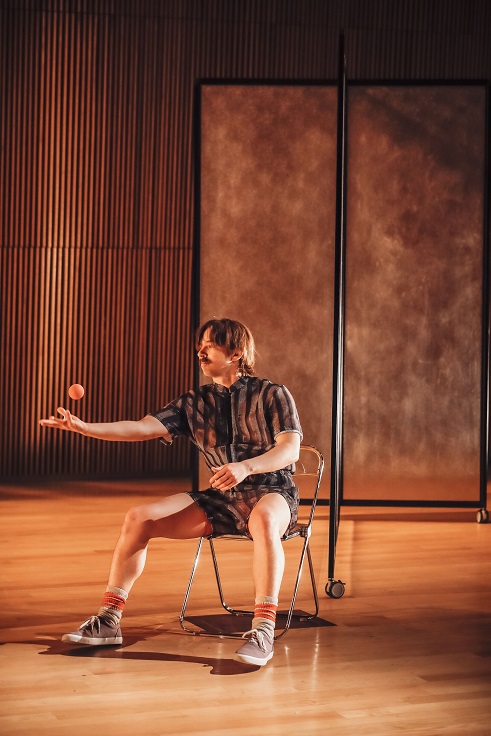
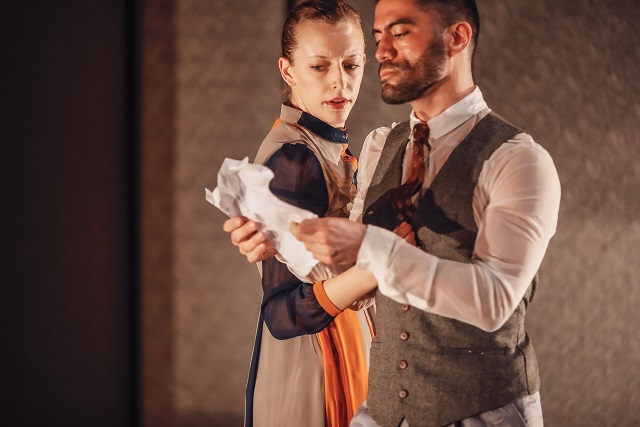
    Monday November 26th, 2019 ~ In the early afternoon, I went down to the NYU/Tisch studios where Cherylyn Lavagnino was running a rehearsal of her latest creation, Monsters of Grace, set to the aria “In The Arc of Your Mallet” from the almost-forgotten Philip Glass opera Monsters of Grace.

    Here is the text of the aria, drawn from the writings of the Persian poet and scholar Rumi (1207-1273):

    “Don’t go anywhere without me.
    Let nothing happen in the sky apart from me,
    or on the ground, in this world or that world,
    without my being in its happening.
    Vision, see nothing I don’t see.
    Language, say nothing.
    The way the night knows itself with the moon,
    be that with me. Be the rose
    nearest to the thorn that I am.
    I want to feel myself in you when you taste food,
    in the arc of your mallet when you work,
    when you visit friends, when you go
    up on the roof by yourself at night.
    There’s nothing worse than to walk out along the street
    without you. I don’t know where I’m going.
    You’re the road, and the knower of roads,
    more than maps, more than love.”

    It seems very…contemporary, doesn’t it?

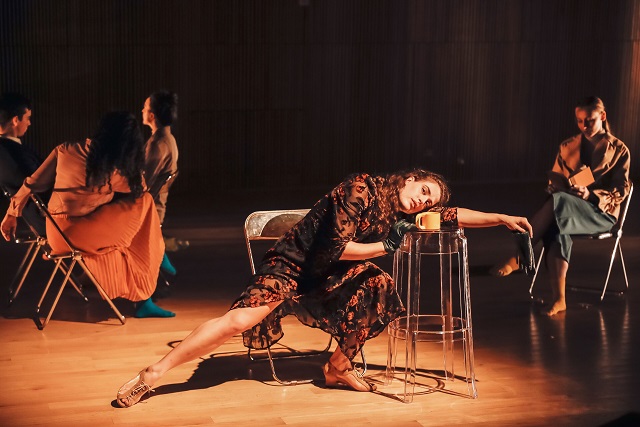
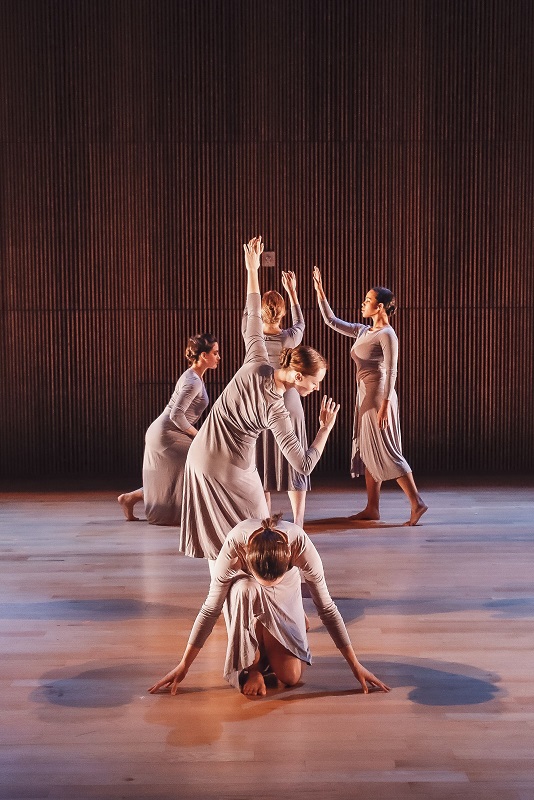
    And here are some photos from the rehearsal, courtesy of Cherylyn Lavagnino Dance:

    IMG_7826

    Dervia Carey-Jones, Dorrie Garland, Kaitlyn Yiu, and Lila Simmons

    IMG_7837

    Corinne Hart and Dervia Carey-Jones

    IMG_7853

    Kaitlyn Yiu and Dorrie Garland

    IMG_7854

    Kaitlyn and Dorrie

    Cherylyn’s choreography strikes me as ideally suited to the music; the ballet has the feeling of ritual…a feeling I love.

    My thanks to Cherylyn and her beautiful and generous dancers Dervia Carey-Jones, Dorrie Garland, Corinne Hart, Lila Simmons, and Kaitlyn Yiu for this engaging studio experience.

    ~ Oberon

  • The Soldier’s Tale @ Chamber Music Society

    McDermott_1600x660

    Above: pianist Anne Marie McDermott

    ~ Author: Oberon

    Sunday November 24th, 2019 – A thoughtfully-devised program this evening at Chamber Music Society of Lincoln Center gave prominence to the inspired – and inspiring – pianist Anne-Marie McDermott. Ms. McDermott has given me some of my happiest times at CMS, most memorably with her playing of Mozart’s K. 466 in May 2018: a performance which drew a vociferous ovation.

    Tonight, the pianist played in every work on the program, commencing with Beethoven’s Trio in B-flat major for Clarinet, Cello, and Piano, Op. 11 (1797) for which she was joined by the Spanish clarinetist Jose Franch-Ballester, and cellist Gary Hoffman, whose leap to prominence followed his 1986 win of the Rostropovich International Competition in Paris. Together, the three musicians filled Beethoven’s score with vibrant musicality.

    The timbres of the three ‘voices’ aligned perfectly, and rhythmic clarity was a hallmark of their performance. Dramatic accents cropped up in the opening Allegro con brio, to which a pensive interlude brings contrast.

    A waltz-like motif for the cello is taken up by the clarinet in the Adagio: a fine opportunity to savor the coloristic gifts of Mssrs. Franch-Ballester and Hoffman. Ms. McDermott brought gentley nuances to the mix, and, after a slightly darker passage, her delicacy of touch underscored Mr. Hoffman’s graciously expressive softness of melody.

    The trio’s finale is a theme-and-variations affair which gets off to a perky start. The first variation brings some elaborate piano passages, the second a cello/clarinet duo, and the third is fast and fun. After veering into minor mode for the fourth variation, the music proceeds to a passing about of the theme, a petite marche, some tickling trills from the keyboard, and a witty finish. 

    The concert’s centerpiece was a vivid performance of Igor Stravinsky’s L’Histoire du soldat (The Soldier’s Tale), in the trio version for violin, clarinet, and piano (1918, arranged 1919), Mr. Franch-Ballester brought two clarinets to the stage for this work, which commences with The Soldier’s March, filled with jaunty swagger and relentless piano. A bouncing piano figuration introduces The Soldier’s Violin, wherein Ida Kavafian’s bow dances across the strings, and the clarinet provides a sense of jollity. The music seems about to fade away until it hits a punctuating chord.

    A Little Concert brings swirls of notes, the piano rhythm pulsing along. The music has an ironic feeling, and turns insistent before its sudden end. A dance triptych (Tango, Waltz, Ragtime) finds Ms. Kavafian’s violin in waltzing mode, with rhythmic piano and commenting clarinet. The final movement of his colourful suite, The Devil’s Dance, has a wild streak. The three musicians seemed truly to enjoy playing this miniature masterpiece, which clocks in at a mere fifteen minutes but covers a lot of musical territory in its course.

    Following the interval, Ms. McDermott had the stage all to herself with some marvelous Mendelssohn: selections from Lieder ohne Worte (Songs Without Words). She chose numbers 1, 2, and 3 from the cycle which made for a nicely contrasted segment of the program. Her playing was both elegant and passionate, and her mastery of dynamics was very much to the fore.

    Bedřich Smetana’s Trio in G-minor for Piano, Violin, and Cello, Op. 15 (1855, revised in 1857) was written in memory of the composer’s four-year-old daughter Gabriela, who succumbed to scarlet fever in 1854.

    Thus, the work begins with Ida Kavafian’s playing of a violin solo of yearning tenderness, with a rise in passion which subsides to a cello theme and an ascending phrase for the violin. Suddenly, a forward impetus springs up, and the music gathers steam to a grand outburst. Following a brief violin cadenza, the string players introduce a buzzy agitato, over which Ms. McDermott plays some sparkling piano passages. The music grows rhapsodic, and grand passions burst forth before Mr. Hoffman’s lyrical cello and Ms. Kavafian’s shining violin conspire to play on our emotions. The Moderato assai comes to an emphatic, passionate conclusion.

    Bustling, almost furtive strings lend a scherzo-like feeling to the start of the second movement. Melodic motifs sing forth, building to grandeur before finding a quiet place to conclude. The three musicians dig in for the final Presto, for which Ms. McDermott sets a fast pace. In a reflective mood, Ms. Kavafian and Mr. Hoffman have appealing solo passages, and the pianist a thoughtful interlude.

    Now some fast plucking takes over, and the music dances along for a bit. But a calmer mood returns, with the music going deep. The trio ends grandly, with an affirmative air of hope springing from the ashes of tragedy.

    ~ Oberon
  • All-Beethoven @ Lincoln Center’s Great Performers

    66153624_23843479431240714_7828252017846910976_n.png

    ~ Author: Ben Weaver

    Wednesday November 20th, 2019 – Violinist Isabelle Faust and pianist Alexander Melnikov – long time musical partners – joined the celebrations of Beethoven’s 250th birthday as part of the Lincoln Center’s Great Performers series with an all-Beethoven recital at Alice Tully Hall. The 70-minute, no-intermission, program featured Beethoven’s last three violin sonatas.

    Composed in 1801-02 and dedicated to Tsar Alexander I of Russia, the three sonatas of his Op. 30 were Beethoven’s final word on the genre, even though he was only 31 years old. (In total, he composed 8 violin sonatas.) At this stage Beethoven had not yet written his Eroica Symphony (that would come 2 years later), changing the trajectory of the symphony and his own musical development

    Beethoven’s violin sonatas, like so much of his “early” music, look back on Mozart’s contributions to the genre, while at the same time developing new languages. Whereas Mozart’s violin sonatas were focused on the violin – with the piano as an accompaniment – Beethoven forced the piano into the spotlight, with a more prominent voice and bigger, more “symphonic” writing. In the sonata No. 6’s opening movement the violin seems to be playing catch-up with the piano in introducing the melodies. In the final movement, a theme and set of variations, the piano again dominates.

    While the following two sonatas give the violin a much bigger role, as performed by Isabelle Faust and Alexander Melnikov, the piano’s dominance was clear throughout the evening. Ms. Faust’s playing, quiet and brittle at times, with an edge to the tone, required the listener to lean in. She rarely demanded attention for her instrument or her playing; she is certainly not a “showboat” performer. Mr. Melnikov, a more aggressive player by nature, was the dominant force on the stage almost by default. The relaxed tempos set by the duo made clear this was not heaven-storming Beethoven.

    Sadly, as the evening progressed, the quiet playing by Faust, which I initially attributed to a “lean-in” personality, started to grow flat and dull. Whether drama or joy, one could hardly tell the difference. I almost got the sense that Faust was sight-reading the music, as if she’d hardly ever seen these notes before. (That’s clearly not the case: she and Melnikov recorded the complete sonatas for Harmonia Mundi some years ago and did so very well.) How unfortunate then that on this evening she was unable to gather enough spirit to help launch New York’s Beethoven year celebration.

    ~ Ben Weaver

  • All-Beethoven @ Lincoln Center’s Great Performers

    66153624_23843479431240714_7828252017846910976_n.png

    ~ Author: Ben Weaver

    Wednesday November 20th, 2019 – Violinist Isabelle Faust and pianist Alexander Melnikov – long time musical partners – joined the celebrations of Beethoven’s 250th birthday as part of the Lincoln Center’s Great Performers series with an all-Beethoven recital at Alice Tully Hall. The 70-minute, no-intermission, program featured Beethoven’s last three violin sonatas.

    Composed in 1801-02 and dedicated to Tsar Alexander I of Russia, the three sonatas of his Op. 30 were Beethoven’s final word on the genre, even though he was only 31 years old. (In total, he composed 8 violin sonatas.) At this stage Beethoven had not yet written his Eroica Symphony (that would come 2 years later), changing the trajectory of the symphony and his own musical development

    Beethoven’s violin sonatas, like so much of his “early” music, look back on Mozart’s contributions to the genre, while at the same time developing new languages. Whereas Mozart’s violin sonatas were focused on the violin – with the piano as an accompaniment – Beethoven forced the piano into the spotlight, with a more prominent voice and bigger, more “symphonic” writing. In the sonata No. 6’s opening movement the violin seems to be playing catch-up with the piano in introducing the melodies. In the final movement, a theme and set of variations, the piano again dominates.

    While the following two sonatas give the violin a much bigger role, as performed by Isabelle Faust and Alexander Melnikov, the piano’s dominance was clear throughout the evening. Ms. Faust’s playing, quiet and brittle at times, with an edge to the tone, required the listener to lean in. She rarely demanded attention for her instrument or her playing; she is certainly not a “showboat” performer. Mr. Melnikov, a more aggressive player by nature, was the dominant force on the stage almost by default. The relaxed tempos set by the duo made clear this was not heaven-storming Beethoven.

    Sadly, as the evening progressed, the quiet playing by Faust, which I initially attributed to a “lean-in” personality, started to grow flat and dull. Whether drama or joy, one could hardly tell the difference. I almost got the sense that Faust was sight-reading the music, as if she’d hardly ever seen these notes before. (That’s clearly not the case: she and Melnikov recorded the complete sonatas for Harmonia Mundi some years ago and did so very well.) How unfortunate then that on this evening she was unable to gather enough spirit to help launch New York’s Beethoven year celebration.

    ~ Ben Weaver

  • NCB Farewells ~ Gallery

    004_SM_2019_11_23_NCB_15TH-ed

    Above: pianist Melody Fader and dancers Elizabeth Brown and Sarah Atkins in Miro Magloire’s Klavierstück

    Photographer Arnaud Falchier provides these images from the Saturday November 23rd, 2019, performance at Miro Magloire’s New Chamber Ballet. The evening marked the farewell performances of two longtime Company dancers: Elizabeth Brown and Sarah Atkins. Read about the performance here.

    022_SM_2019_11_23_NCB_15TH-

    Sarah Atkins in the solo For Another Day, created for her by Miro

    030_SM_2019_11_23_NCB_15TH-ed

    Sarah Atkins in For Another Day

    083_SM_2019_11_23_NCB_15TH-

    Miro’s gift to founding Company dancer Elizabeth Brown: the solo Morning Song

    092_SM_2019_11_23_NCB_15TH-

    Elizabeth Brown in her solo Morning Song

    102_SM_2019_11_23_NCB_15TH-

    Former members gather to celebrate the community that is New Chamber Ballet in As One

    111_SM_2019_11_23_NCB_15TH-

    Alumni and current NCB dancers in As One

    118_SM_2019_11_23_NCB_15TH-

    Elizabeth Brown and Sarah Atkins taking their final New Chamber Ballet bows

    All photos by Arnaud Falchier

    ~ Oberon

  • Farewells @ New Chamber Ballet

    6a00d8341c4e3853ef016767bb8206970b-800wi

    Above: Elizabeth Brown and Sarah Atkins of New Chamber Ballet, photo by Kokyat

    ~ Author: Oberon

    Saturday November 23rd, 2019 – While I felt happy to be part of New Chamber Ballet’s 15th anniversary season, tonight felt bittersweet as two dancers long associated with Miro Magloire’s company were giving their farewell performances: Elizabeth Brown (a founding member) and Sarah Atkins.

    Over the years since I began following Miro’s work, his Company has undergone many changes in roster. Inevitably, with smaller dance troupes, one forms an attachment to individual dancers, and this is especially true of New Chamber Ballet as Miro has frequently invited to me rehearsals over the years, so that I’ve often felt like I’m a non-dancing member of the family. Watching Elizabeth and Sarah tonight brought back so many memories, not only of their own performances but of all the other women they have danced with thru the years. This kind of nostalgia is lovely in its way, but it also means we’re all getting older.

    The evening’s program opened with Klavierstück, to solo piano music by Karlheinz Stockhausen. The grand piano had been rolled into the center of the space, where pianist Melody Fader deftly took in stride the composer’s demands. Danced by the evenings two honorees – Elizabeth Brown and Sarah Atkins – it’s a work in which the piano becomes an altar or shrine. 

    6a00d8341c4e3853ef0168e695be97970c

    Above: Sarah Atkins, photo by Kokyat

    Next came a solo, For Another Day, created by Miro specially for Sarah Atkins. With the piano now back in its usual place at the point of the seating diamond, Melody Fader played the sixth of Franz Schubert’s Moments musicaux to which Ms. Atkins danced with a deep sense of the music’s lyrical flow. Circling the space, the dancer made eye contact with audience members: a beautiful expression of leave-taking. To dance this gorgeously at one’s farewell speaks volumes for Sarah’s technique and artistry. As the solo ended, a tidal wave of vociferous applause cheers was unleashed; everyone stood up to salute the dancer, who had to bow many times. 

    For an excerpt from Miro’s full-length work Phantom, music of Wolfgang Rihm, which veers from dreamlike to dramatic, was marvelously played by Ms. Fader and the enormously talented violinist Doori Na. Here we must pause to praise the technical assurance of the fearlessly adventurous Melody and Doori, who tackle any score Miro sets before them with flair. Over the years, they – as much as the choreography and dancing – have made New Chamber Ballet so distinctive. A chance to peer over Doori’s shoulder at his illuminated score for the Rihm was a highlight of my evening.

    The dancers – Amber Neff, Rachele Perla and NCB newcomers Anabel Alpert and Megan Foley – coped well with the choreography, which is often floor-oriented and includes demanding passages of the same-sex partnering that Miro has been developing in recent works. Tonight, in this gala setting, it seemed earthbound and over-long. Matters were not helped by the audience seating configuration, which feels like a airport boarding lounge when the flights have been delayed. 

    6a00d8341c4e3853ef01b7c90150ea970b

    Above: Elizabeth Brown rehearsing Morning Star with violinist Doori Na, photo by Nir Arieli

    This was my third viewing of Morning Song, the solo Miro made in 2017 for Elizabeth Brown to John Cage’s violin piece “Cheap Imitation”. A new costume for this ballet tonight was less to my liking than the original, but that became irrelevant during this sensational performance by Ms. Brown and Mr. Na.

    Morning Star is one of Miro’s greatest creations, and my favorite among all his works.  Elizabeth Brown is the inspirational force behind the solo’s success, with its feeling of timeless ritual and quiet ecstasy. It is a portrait of feminine power and mystique, and Ms. Brown dances it divinely. It ends as the dancer circles the space in hypnotically slow turns, finishing with an Isadora-like greeting of the dawn, arms upraised.

    As a founding member of New Chamber Ballet, Elizabeth has been an superlative muse for Miro, and an inspiration for dance-lovers; her technical prowess, unique persona, and deep devotion to the art merit the highest praise.

    During the mammoth applause that greeted her after Morning Song this evening, Elizabeth and Doori bowed deeply to one another, underscoring the intrinsic connection between music and dance that is Miro’s trademark.

    To conclude the program, Miro offered a pièce d’occasion entitled As One. Set to Antonín Dvořák’s Romance for violin and piano – played with impeccable verve, charm, and joy by Melody Fader and Doori Na – the work is Miro’s hymn to all the dancers who have performed for him thru New Chamber Ballet’s 15-year history.

    As such, and in a celebratory move that seemed to take Elizabeth and Sarah by surprise, a bevy of former NCB dancers who had been seated randomly among the crowd suddenly rose and stepped into the dance space, performing an homage to the two departing stars whilst also celebrating the continuum of Miro’s tireless work, in which the dancers and the dance are one.

    6a00d8341c4e3853ef01b8d1a3507e970c

    Above: Elizabeth and Sarah. Thanks for the memories, ladies…and please: keep on dancing!

    ~ Oberon

  • Preislied

    Alexkim2

    Above: tenor Alex Kim

    I like this Korean tenor’s lyrical rendering of the Prize Song from Wagner’s DIE MEISTERSINGER.

  • Les Grecs ont disparu!

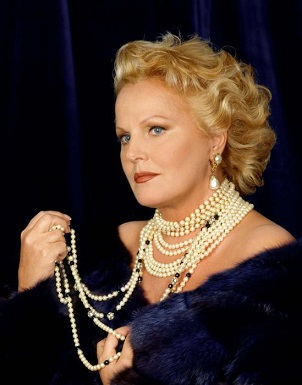
    Pollet2

    Françoise Pollet (above) and Dwayne Croft are Cassandre and Chorèbe in this dramatic scene from Hector Berlioz’s LA PRISE DE TROIE:

    Françoise Pollet & Dwayne Croft – PRISE DE TROIE scene – Levine cond – Met bcast 1994

  • Julia Fischer|Philippe Jordan @ The NY Phil

    Fischer_J

    Above: violinist Julia Fischer

    ~ Author: Oberon

    Wednesday October 30th, 2019 – Philippe Jordan was on the podium at Geffen Hall this evening as The New York Philharmonic presented their program of Prokofiev, Mendelssohn, and Beethoven: an ideal mix, in my opinion. The comely and compelling violinist Julia Fischer was the guest soloist for Mendelssohn’s violin concerto, the orchestra’s stellar woodwind soloists were all present and accounted for, and the entire evening had a special glow about it.

    Prokofiev’s Symphony No. 1, Classical, strikes me as a perfect piece of music. At a running time of just 15 minutes, the symphony is a compact delight, abounding in rhythmic variety and appealing themes. The opening Allegro con brio is in the traditional sonata form, but the composer keeps throwing us curve balls: witty bits crop up out of nowhere. Maestro Jordan and the Philharmonic artists seemed truly to enjoy playing this music, which, in the flashing leaps and zesty grace notes of the second theme made me smile to myself.

    A gentle melody on high for the violins is the key feature of the Larghetto, with pizzicati, treading basses, and colourful bassoons all part of the composer’s scheme. The Gavotte makes me think of the composer’s ROMEO AND JULIET, while the ebullient finale sounded wonderfully clear and alive. Throughout, flautist Robert Langevin, clarinetists Anthony McGill and Pascual Martínez-Forteza, oboist Sherry Sylar, bassoonist Judith LeClair, and their woodwind-section colleagues charmed the ear with their polished playing; when Maestro Jordan asked them to stand for a bow, the audience responded warmly.

    Violinist Julia Fischer then joined the orchestra for Mendelssohn’s Violin Concerto in E-minor. This was my first opportunity to hear Ms. Fischer playing live; she sounded marvelous and looked fetching is a deep grey gown shot thru with glimmering silver. There’s shining silver in her sleek tone as well.

    The first movement’s marking of Allegro molto appassionato derives from the composer’s premonition of writing “…[A concerto] in E-minor running through my head, the beginning of which gives me no peace.” With splendid support from the orchestra, Ms. Fischer displayed her expressive gifts, lovely feeling for dynamics, and exquisite control of pianissimo. In the cadenza, her soft playing in the stratosphere was remarkable; this she followed with a rocking motif as the ensemble take up the theme. The music becomes very animated as the Allegro moves to its finish.

    A sustained bassoon tone carries the music directly into the Andante wherein the glowing melody is given a tender, haunting quality as Ms. Fischer’s playing moves serenely from piano to pianissimo: simply breathtaking

    Following a brief interlude, the violinist embarks on festoons of fiorature – played with sparkling surety – in the concerto’s concluding movement. Passages of Mendessohnian ‘faerie music’ are heard, and then Ms. Fischer revels in the rapid-bowing of the effervescent finale. With the final note of the concerto still hanging on the air, the audience unleashed a tumultuous applause, and everyone stood up to cheer. Ms. Fischer and Maestro Jordan are clearly simpatico, and their performance was thrilling. The crowd clearly wanted an encore, but none was forthcoming.

    Philippe-jordan

    Above: Maestro Philippe Jordan

    The concluding work, Beethoven’s 7th symphony, was magnificently shaped by the Maestro, who dips and bends into the music, eliciting splendid playing from the orchestra. This symphony has a dance-like sense of forward momentum upon which Mssr Jordan built his interpretation. His pacing – on the fast side – was so vital, and the textures of the music so lovingly layered, with the wind soloists again producing magical effects. 

    Swept along by the music, I put away my pen and indulged myself in forty minutes of pure selfish enjoyment. One small and intriguing motif in this symphony that always captures my imagination is a seeming “preview” of six-note passage from the Grail knights’ march in Wagner’s PARSIFAL music. Did Wagner openly borrow this from Beethoven, or is it a subconscious association? Either way, it played over and over in my mind during the train ride home. 

    This has so far been a particularly impressive and satisfying season for classical music here in Gotham, and tonight’s concert was yet another edifying experience.

    ~ Oberon

  • Ah! Lève-Toi, Soleil!

    Franco_corelli-thumb-250x290-30666

    From a live performance nearly 50 years ago, Franco Corelli sings Romeo’s great aria from Gounod’s ROMEO ET JULIETTE.

    ~ Franco Corelli – Ah! lève-toi soleil! ~ ROMEO ET JULIETTE – 3~16~70