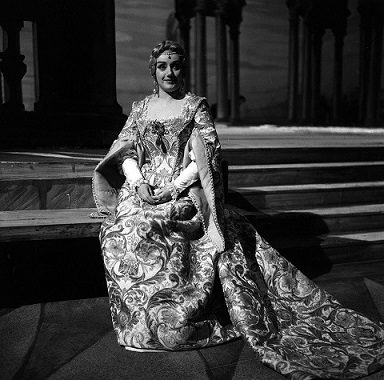
Gabriella Tucci sings the Ave Maria from Verdi’s OTELLO from a 1967 performance given by The Met on tour in Atlanta. Zubin Mehta is the conductor.
Listen here.
Gabriella Tucci sings the Ave Maria from Verdi’s OTELLO from a 1967 performance given by The Met on tour in Atlanta. Zubin Mehta is the conductor.
Listen here.
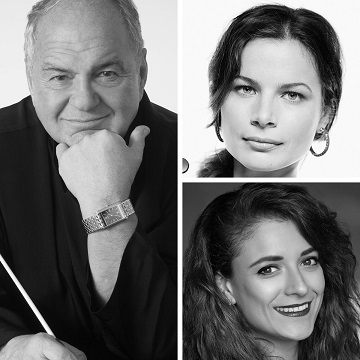
Above: Jaime Laredo, Bella Hristova, and Milena Pajaro-van de Stadt
~ Author: Oberon
Sunday December 24th, 2023 – The New York String Orchestra’s Christmas Eve concert at Carnegie Hall this year was an all-Mozart program which featured soloists Bella Hristova (violin) and violist Milena Pajaro–van de Stadt (viola) with Jaime Laredo on the podium. I invited my long-time friend Rob Scott to join me; Rob was one of the very first people I met on moving to NYC twenty-five years ago. Later, he became Lisette Oropesa’s first manager, helping her to launch her brilliant career.
I learned the overture to The Marriage of Figaro long before I heard the complete opera: we played a transcription of it in my high-school band (we also played the prelude to Lohengrin Act III!). Tonight, the young players of the New York String Orchestra gave a lively and immaculately-played rendering of the Figaro, immediately setting the mood of the evening. There were many young children among the audience tonight, and this brisk music seemed to draw them in.
A wonderful sense of attentive silence was sustained in the hall throughout the playing of the Sinfonia concertante in E-flat Major, K. 364, which I was – incredibly enough – hearing “live” for the first time. Dating from 1779, this is simply a great piece of music. The two soloists chose striking gowns that brought a glamorous touch to the evening: Ms Hristova in an elegant, one-shoulder forest green frock, and Ms. Pajaro–van de Stadt in shimmering gold and silver.
In the Sinfonia‘s opening Allegro maestoso, duetting motifs for two horns are picked up by two oboes, with the orchestra’s basses sound velvety. Now the soloists join, their timbres ideally matched as they exchange phrases; displaying their fluent techniques; the two seem to converse whilst gracious horn harmonies are heard. In Mozart’s day, cadenzas were usually improvised by the performers, but in the Sinfonia Concertante’s first and second movements, the composer specifically wrote out the cadenzas. And what magical cadenzas they are, played tonight with great finesse and charm.
The ensuing Andante takes on a feeling of mournful lyricism, with Ms. Hristova’s beautifully sustained tone singing a lament that is then taken up by the duskier colours of Ms. Pajaro–van de Stadt’s viola. A sense of exquisite sadness slowly gives way to tender harmonies A rich tutti passage leads to the cadenza of the entwining solo voices, underscored by sustained horn tones. Bella’s enchanting trills take us to a sublimely poignant finish.
Maestro Laredo let the hushed atmosphere linger by keeping his arms poised before delving into the concluding Presto wherein the horns and oboes are again welcome, with the basses sounding so appealing to my ear. In a spirit of friendly competition, Mlles. Hristova and Pajaro–van de Stadt regaled us with their virtuosity, clearly savoring every phrase that Mozart offered them. A roar of applause rang out as the final note hung on the air, and our gracious soloists embraced one another. For this precious half-hour, the woes of the world had been forgotten.
The familiar Symphony No. 35, “Haffner“, made for a perfect end to the evening; despite the fact that some of the children in the crowd became a bit restive, the power of Mozart’s spirit prevailed. The young musicians handled all of the music’s demands with assurance, and I especially loved hearing the timpani lending an air of nobility to the concluding Presto.
~ Oberon

Tenor Eduardo Villa, a native of Santa Barbara, California, has passed away at the age of 70. Originally interested in musicals, he appeared in productions of Oliver!, West Side Story, and Paint Your Wagon before deciding to develop his voice further by studying at the University of Southern California, where his teachers included such luminaries as Martial Singher and Margaret Harshaw.
Upon winning the Metropolitan Opera Auditions in 1982, alongside Hei-Kyung Hong, Sylvia McNair, and Nancy Gustafson, Villa departed for Switzerland, where sang with Basel Opera Theater between 1983 and 1987. In 1986, he made his debut at the Paris Opéra as Verdi’s Don Carlo, and from 1987 to 1991 he appeared at the Munich State Opera.
When Villa began getting offers in the USA and Canada, he left Munich. Among his many contracts were appearances with Connecticut Opera at The Bushnell in Hartford, where I first heard his warm, passionate singing in BALLO IN MASCHERA, and later as an ardent suitor to Mary Dunleavy’s captivating Lucia di Lammermoor.
In 1992, Eduardo sang Jacopo in a concert performance of Verdi’s I DUE FOSCARI given by Eve Queler’s Opera Orchestra of New York. It was a very exciting evening, with soprano Martile Rowland and baritone Vladimir Chernov sharing enthusiastic ovations with the tenor.
Mr. Villa joined the Metropolitan Opera in 2002, debuting as Don Carlo and going on to make two dozen Met appearances (thru 2008) as Pinkerton, Don Jose, Calaf, Turiddu, Rodolfo in LUISA MILLER, Cavaradossi, Enzo Grimaldi, and Ernani.
I saw him at The Met as Radames in 2002 opposite Michelle Crider, and he was really impressive: a Met-sized voice with a nice Italianate ring to the tone. In my diary, I praised his vocal generosity, his ability to cut thru ensembles, and his sustained “Sacerdote! Io resto a te!!” at the end of the Nile Scene.
There is not a lot of Eduardo Villa’s singing on YouTube but there is an OTELLO duet with baritone Mark Rucker that gives a you a good idea of what kind of singer Mr. Villa was…watch and listen here.
~ Oberon

Gabriella Tucci and Franco Corelli sing the final duet from Giordano’s ANDREA CHENIER from a 1971 performance at The Met; Cornell MacNeil is Carlo Gerard, and Fausto Cleva conducts.
Listen here.

Above: pianist Maki Namekawa, photo by Steven Pisano
~ Author: Oberon
Tuesday November 28th, 2023 – The long-awaited opening of Dancing With Glass at The Joyce: a program wherein several of Philip Glass’s études were performed by pianist Maki Namekawa; five of the études had been choreographed by prominent artists in the danceworld: Lucinda Childs, Chanon Judson of Urban Bush Women, Justin Peck of the New York City Ballet, Brazilian tap artist Leonardo Sandoval, and Los Angeles-based choreographers Bobbi Jene Smith and Or Schraiber.
A packed house, which included some luminaries of the NYC dance scene, seemed mesmerized both by the music and the dancing. Ms. Namekawa is a pianist with a special affinity for the works of contemporary composers; she played eleven of the études in the course of the evening, commencing with the spellbinding Etude #1. Her playing was remarkably clear, committed, and soul-filling.

The dancing commenced with a fabulous tap-dance setting of the 7th étude, choreographed by Leonardo Sandoval, who was tapping along with his mates Ana Tomioshi, Orlando Hernandez, and Lucas Santana (photo above by Steven Pisano). Noé Kains was onstage with the quartet, and he was dancing along when suddenly he stepped to the edge of the stage and eased his way down to the pit where he took over the keyboard and played the 7th étude to perfection. Meanwhile, his fellow tapsters – such gorgeous humans – continued to dance in sync, with brilliant solo moves etched into the choreography. An exhilarating start to the evening’s dancing.

Above: Bobbi Jene Smith, photo by Steven Pisano
Bobbi Jene Smith (co-choreographer of the memorable DEO for the Martha Graham Dance Company in 2019) and her husband Or Schraiber both choreographed and performed the familiar Etude #8. On a dusky, hazy stage, an anxious man and a moody woman take us thru various states of a romantic relationship. Each dressed all in black, with Ms. Smith’s luxuriant hair playing its own role, the dancers are hypnotic movers and shapers of phrase. Passion underscores everything: the wounded man is rejected, but – true to life – within seconds the couple are kissing again. Touches of humor are subtly woven in…and at the end, aggression turns to peace in the twinkling of an eye. The piece, marvelous in every way, made me think of so many evenings spent at home with my partner.

Tall, lithe, and elegant in a sky-blue Josie Natori frock, Chanon Judson of Urban Bush Women (above, photo by Steven Pisano) took the stage for Etude #11. John Torres’ lighting – a major contribution to the evening’s pleasures – was especially perfect here. Ms. Judson danced with compelling authority and grace to the vividly dramatic music. Veering from madness to repose, this long-limbed goddess filled the space with her magnetic presence and riveting moves. Overcome by trembling, she is finally becalmed as the pulsating music fades to silence.

Justin Peck’s setting of Etude #6 brought a stunning performance from Patricia Delgado (above, photo by Steven Pisano); I had only seen Ms. Delgado once previously, when she appeared in a 2009 gala here in New York featuring many alumni from the School of American Ballet. In her Glass solo tonight, she was fascinating to watch. Clad in a black trouser outfit, she is seated in a chair at curtain-rise. The music’s fast staccati underscore her restlessness. She at times ventures a few steps from her chair, but always returns to this safe haven. As the music turns grand, her mental instability becomes palpable. Ms. Delgado is both a gorgeous mover and a subtle actress. At the end, unable to cope, the woman seeks to hide herself from the world under her chair.

Clad in white and looking like angels, dancers Caitlin Scranton and Kyle Gerry (above, photo by Steven Pisano) reveled in the flow of Lucinda Childs’ luminous choreography in Etude #18. Sometimes dancing side-by-side and at other times moving about the space with a sense of other-worldly beauty, the dancers perfectly embodied the lyricism of this particular Glass piece.
Bringing the evening full circle, Ms. Namekawa played the last of the études: #20. This rather long work gave us a chance to reflect on the evening, whilst savouring the pianist’s poised musicality. As the applause commenced, all of the dancers appeared onstage to receive the audience’s wholehearted accolades. Ms. Namekawa then drew Philip Glass from his seat to the side of the piano, while the standing crowd hailed him with a joyous ovation.
All photos by Steven Pisano.
~ Oberon

Frederica von Stade (above) and a host of other stars gathered to celebrate the 75th anniversary of San Francisco Opera with a televised gala in 1997.
Watch and listen to highlights from the concert here.
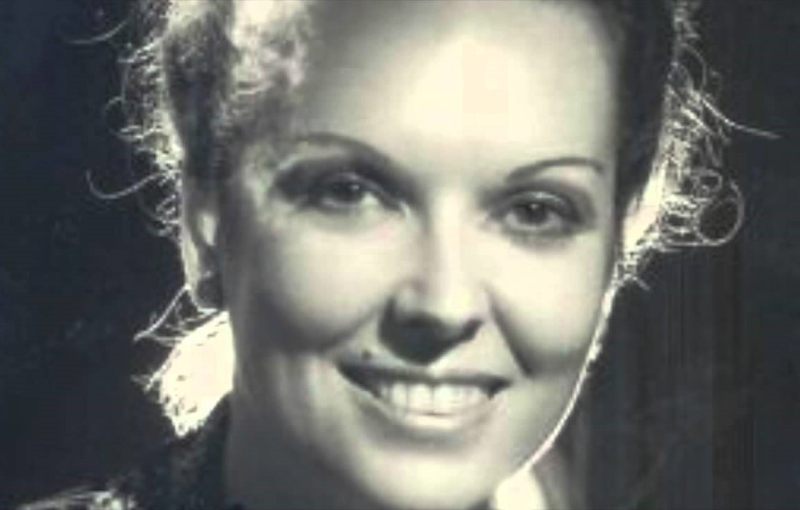
Biancamaria Casoni sings Dalila’s seduction aria from SAMSON & DALILA in Italian. Ms. Casoni was my first-ever Cherubino in NOZZE DI FIGARO when the Rome Opera came to the (then) New Met in 1968.
I love the subtleties in Ms. Casoni’s interpretation; she makes Dalila’s aria intimately persuasive. Her phrasing and the softness of her timbre are alluring, and her long line and vocal control are impressive…especially as it’s a live performance.
Listen here.

Above: Michael Miles and Laura DiOrio in CHAPTERS; photo by Steven Pisano
A gallery of performance photos by Steven Pisano from Lydia Johnson Dance‘s November 12th, 2023 matinee at Westbeth. Read about the afternoon here.
The following photos are from FOR ELI, a ballet dedicated to the memory of a young pianist:
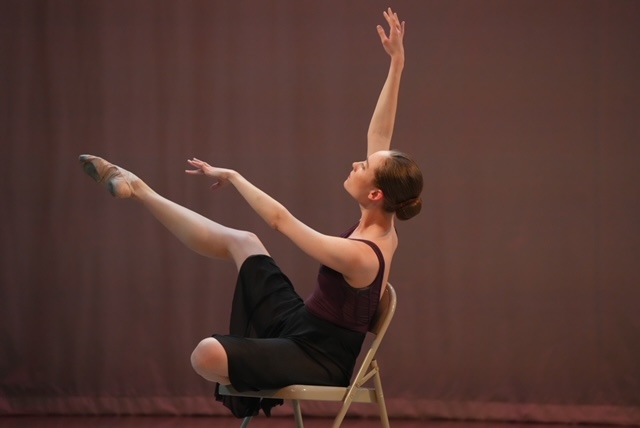
Catherine Gurr

MaliQ Williams and Michael Miles

MaliQ and Michael

Michael and MaliQ

Emily Sarkissian and MaliQ Williams
The following images are from Lydia Johnson’s newest work, CHAPTERS, having its premiere performances:

Laura DiOrio and Michael Miles
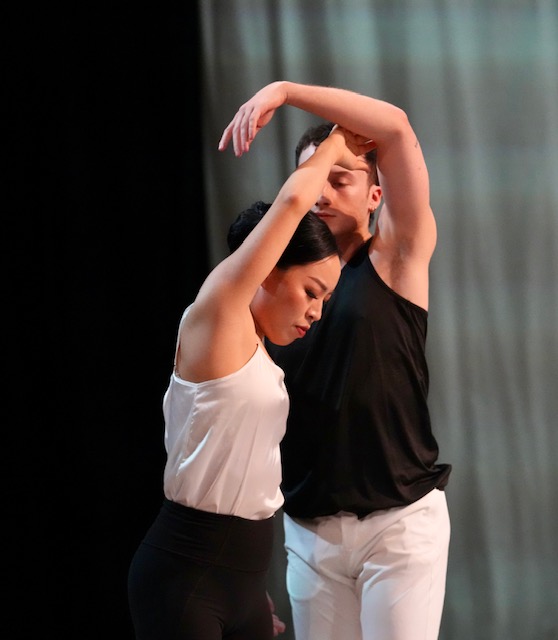
MinSeon Kim and Arieh Bates Vinueza

Cara McManus and MaliQ Williams

Michael Miles and Arieh Bates-Vinueza

Cara McManus and MaliQ Williams
The program ended with a revival of Lydia’s NIGHT OF THE FLYING HORSES (premiered in 2013):
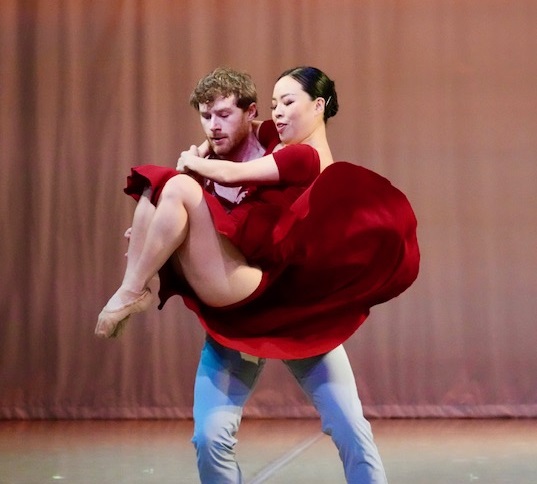
MinSeon Kim and Quinton Guthier
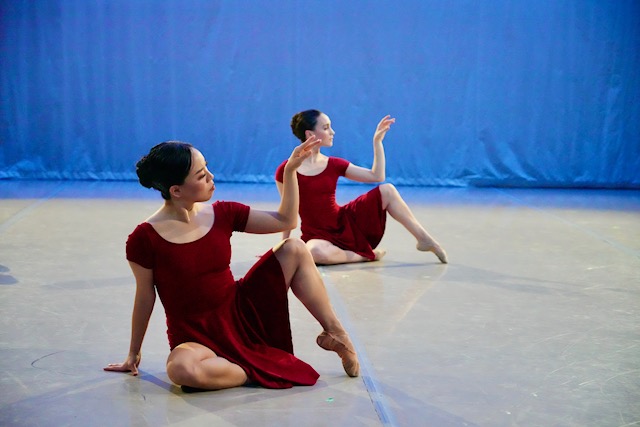
MinSeon Kim and Cara McManus
~ All photos by Steven Pisano

Montserrat Caballé vocalizes to an arrangement of The Swan, from Camille Saint-Saëns’ Carnival of the Animals.
Watch and listen here.

Ángeles Gulín and Carlo Bergonzi sing “Vicino a te“, the final duet from Giordano’s ANDREA CHENIER, from a performance given at London in 1970. Anton Guadagno conducts.
Listen here.
 Oberon's Glade