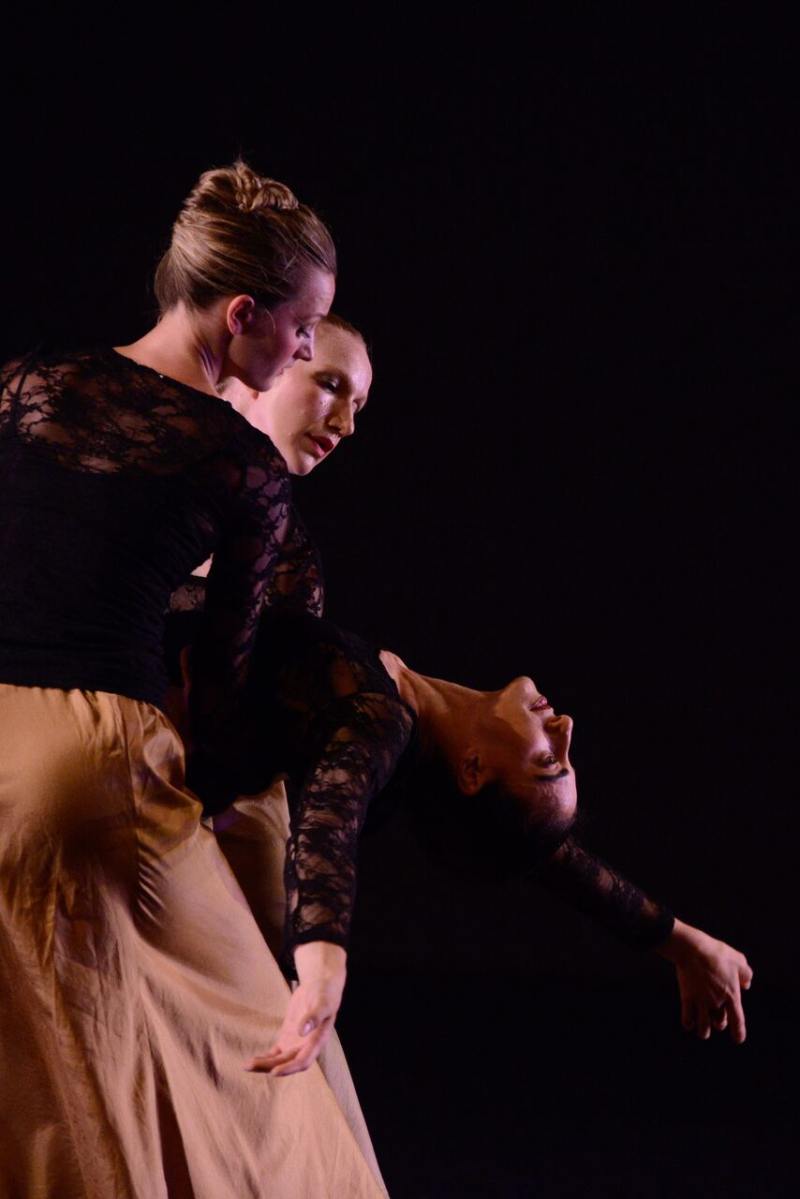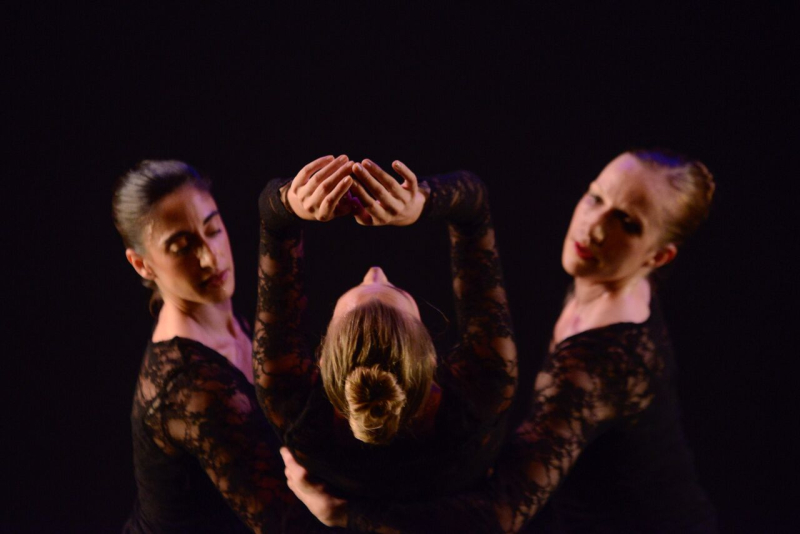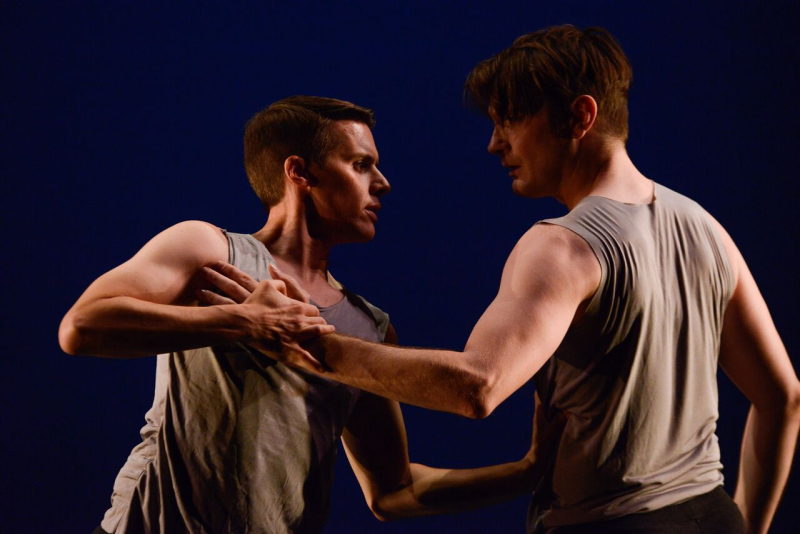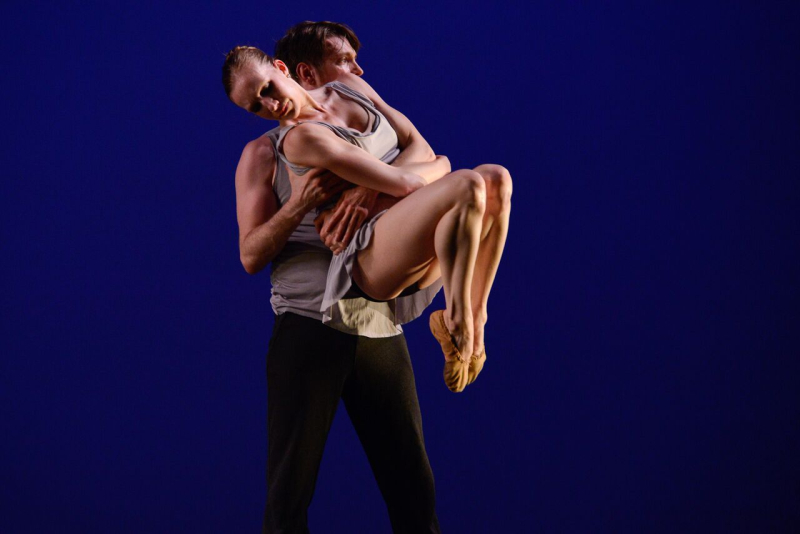
Category: Dance

  • AnA Collaborations: SEASONED

    2017-Seasoned

    We never remember days, only moments.” ~ Cesare Pavese

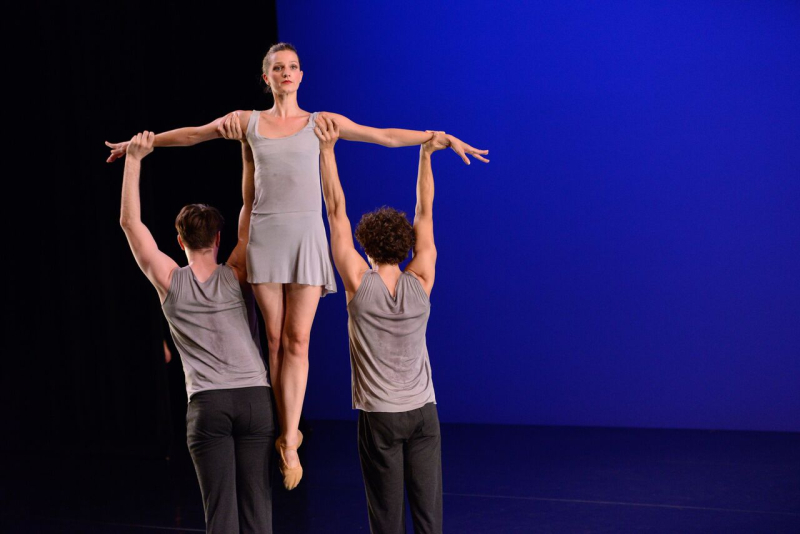
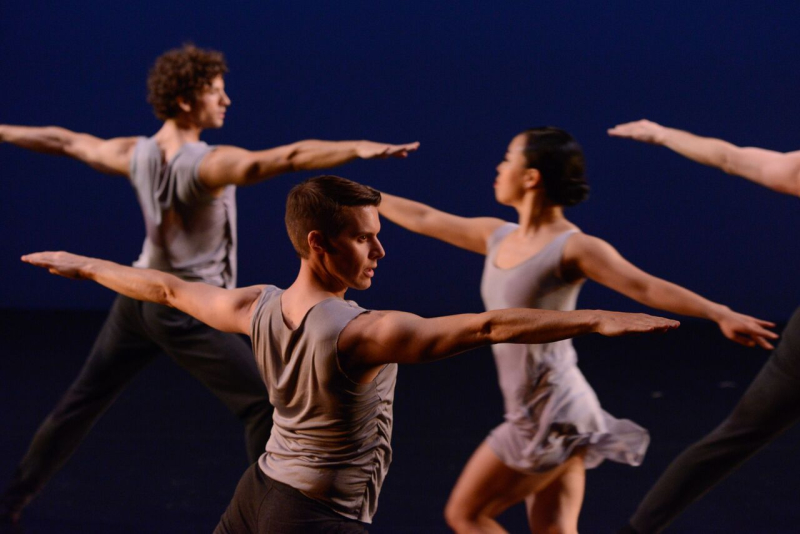
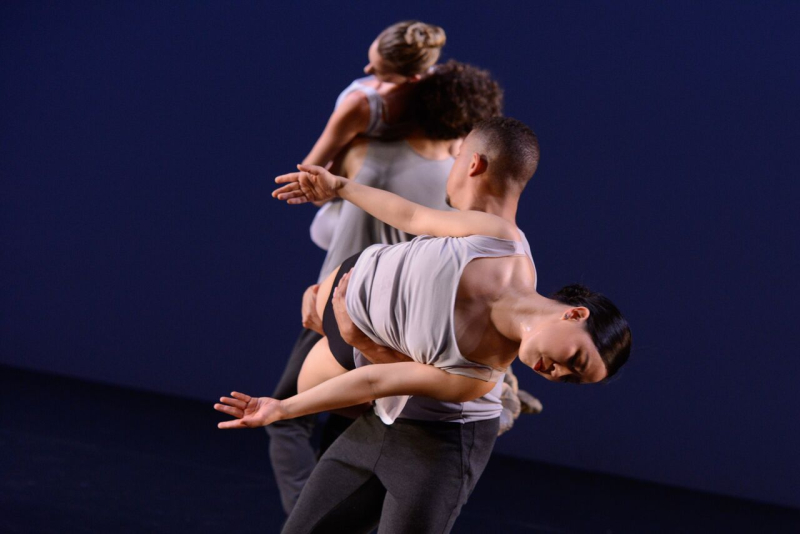
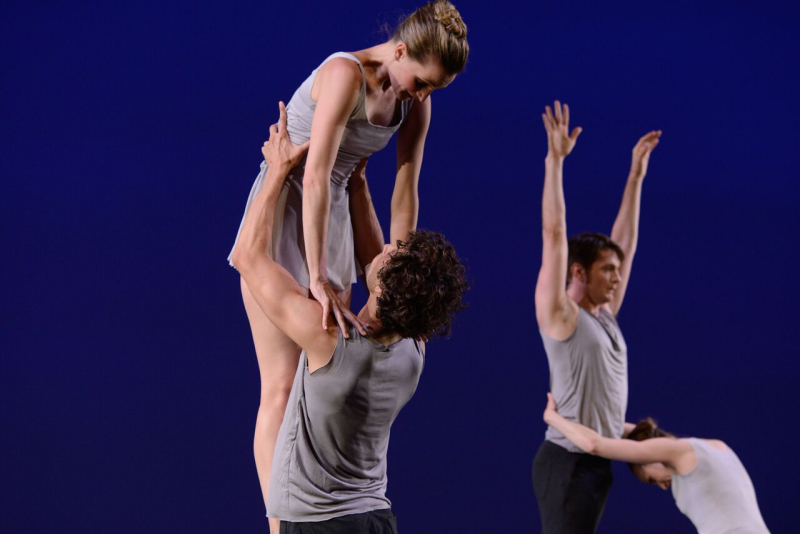
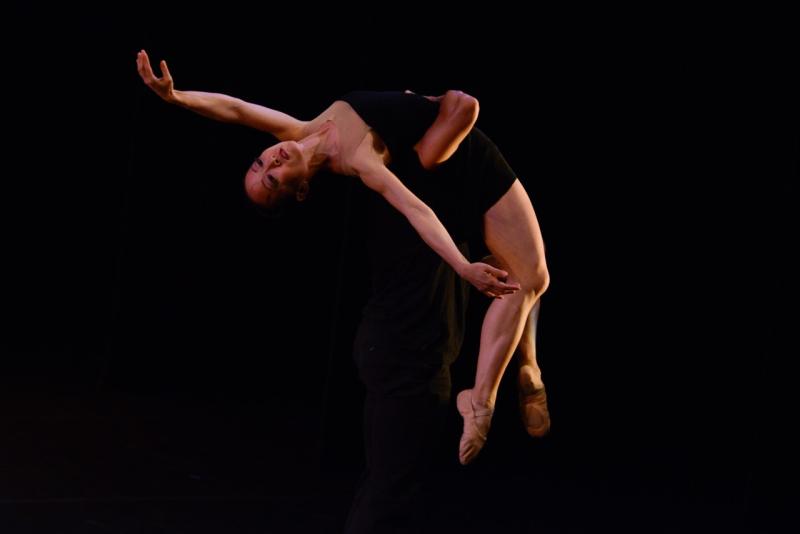
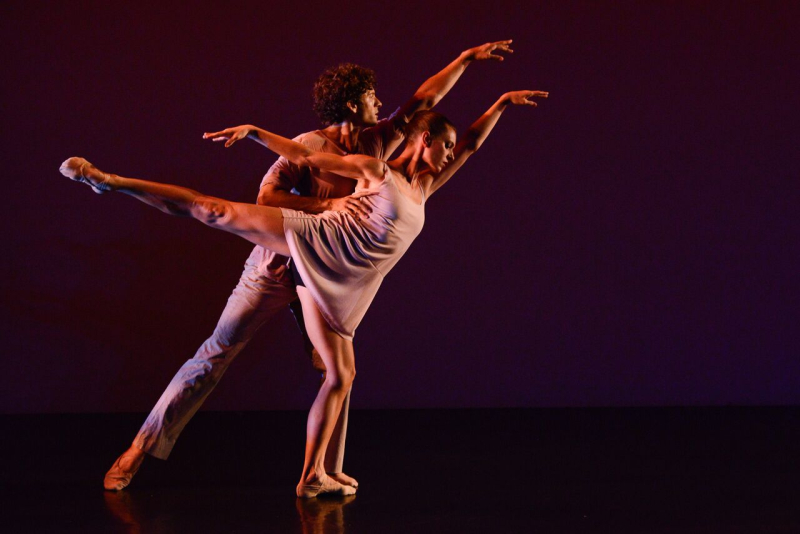
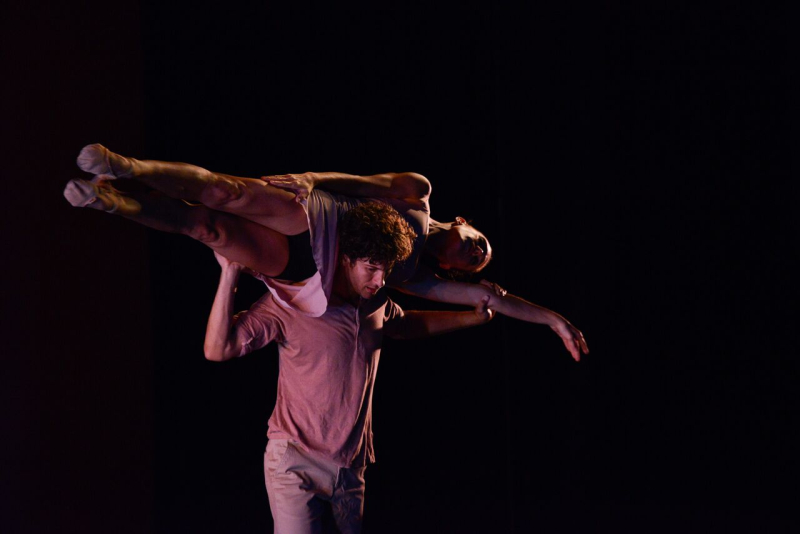
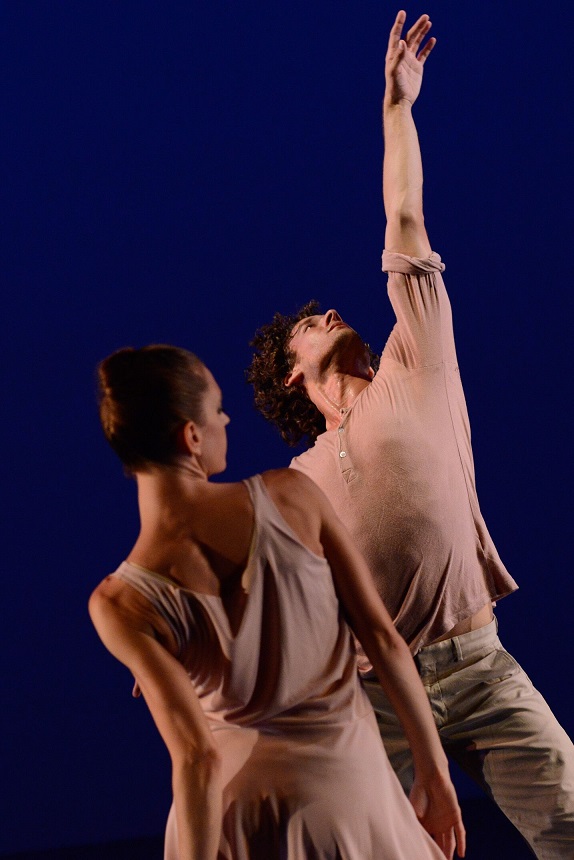
    AnA Collaborations (dancer/choreographers Alex Jenkins and Audrey Rachelle) have created a film entitled SEASONED. The film premiered in late July 2017 down at The Wild Project. At that time, I was still in the recovery phase of my hip arthritis ordeal; but the collaborators have very kindly sent me a Vimeo of the entire film to view at home. I’ve finally found time this afternoon to watch it, and it’s a finely-crafted film that resonates deeply.

    Alex Jenkins is the central figure in SEASONED: her distinctive and quite mesmerizing screen presence alone is enough to sustain our interest in watching the 20-minute film. Cinematographer Blake Horn has wisely let nothing intrude on Ms. Jenkins’ charismatic persona; rather, he enhances it at every turn.

    The four seasons are evoked in this reflective work; in each of its four segments, Ms. Jenkins shares the screen with an equally compelling lover or partner in her journey. 

    Autumn is handsomely filmed against a backdrop of yellow leaves; Ms. Jenkins finds herself in this woodland glade with Jon Ole Olstad. Their intimacy is easy, loving, and joyous, and their pas de deux is at once earthbound and dreamy. Everything about this scene is perfectly natural and spontaneous, even to the point of feeling that’s it’s been shot in one take.

    In Winter, the cinematographer dazzles us with chiaroscuro effects. We are in a dark, unfurnished, rustic cabin but thru the windows the reflected glare of a snow-covered landscape makes for brilliant contrast. Here, Ms. Jenkins’ partner is Cameron McKinney, whose alluring sculpted torso is ideally displayed in the contrasted light. Perhaps suffering from cabin fever, this couple’s love is rougher, with an unkind edge. Their choreography is gestural and more angular, and occasionally there are cutbacks to Ms. Jenkins’ happier times in Autumn. Desperate to escape, Mr. McKinney leaps out of a window and races away into forest. Ms. Jenkins pursues him.

    The Winter lovers are never re-united. Instead, in Spring, Ms. Jenkins – after running and seeking – encounters a contemporary wood-nymph, played by Ms. Rachelle. They bask in a mud bath and communicate on a primeval level.

    81847432f9ff625c46f8e3c1dc712ef1_original

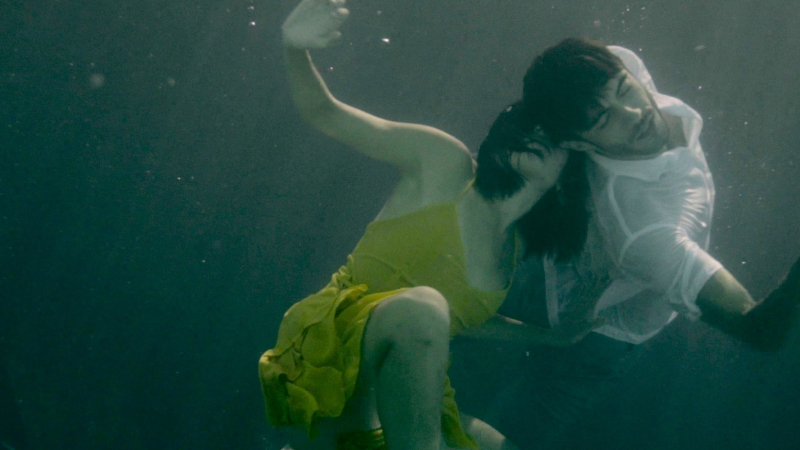
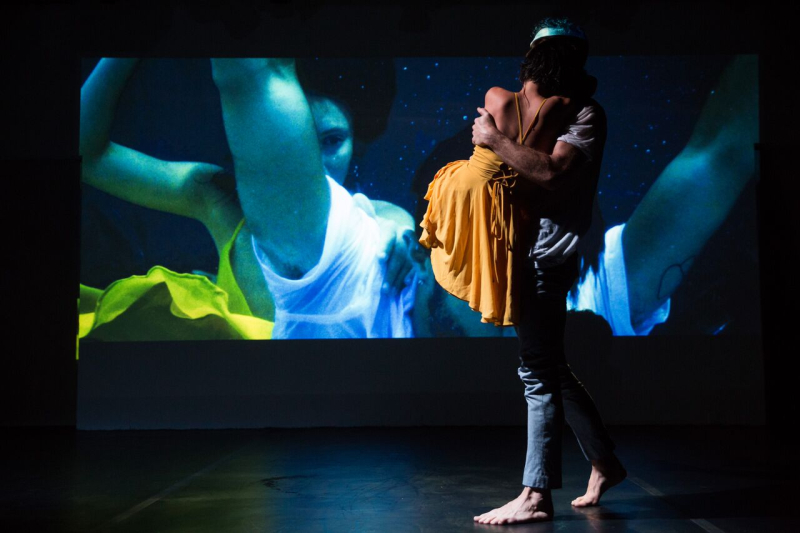
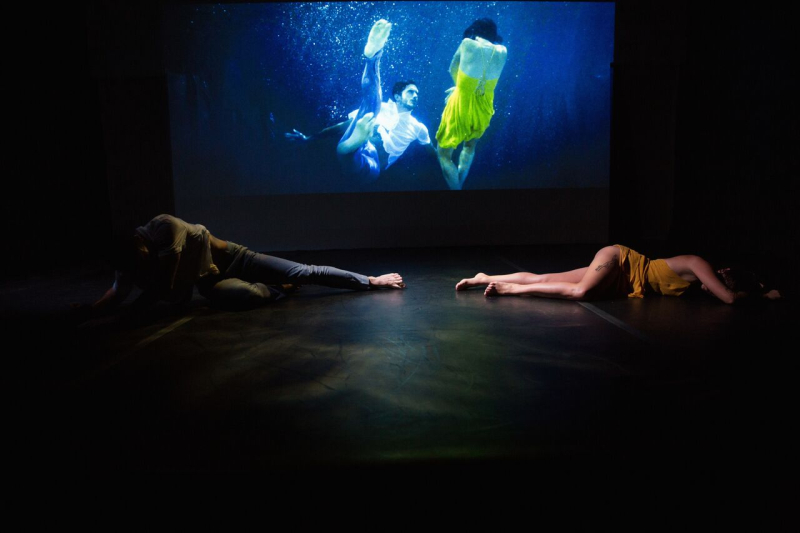
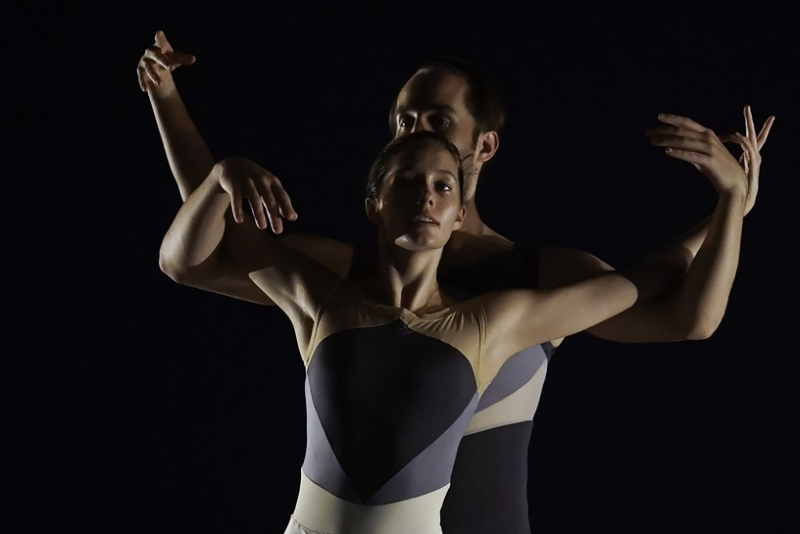
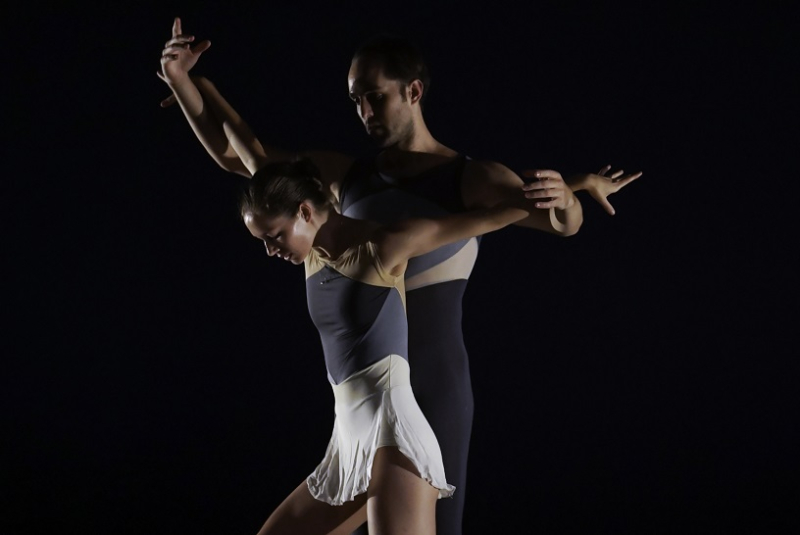
    Finally, in Summer, we experience a beautifully-framed underwater pas de deux, with Ms. Jenkins and Nick Korkos floating weightlessly across the screen, their bodies alternately entwining and drifting apart. Their hypnotic duet has a sense of quiet ecstasy, and of time standing still. 

    072217-AnACollaborations-Seasoned-byScottShaw-146

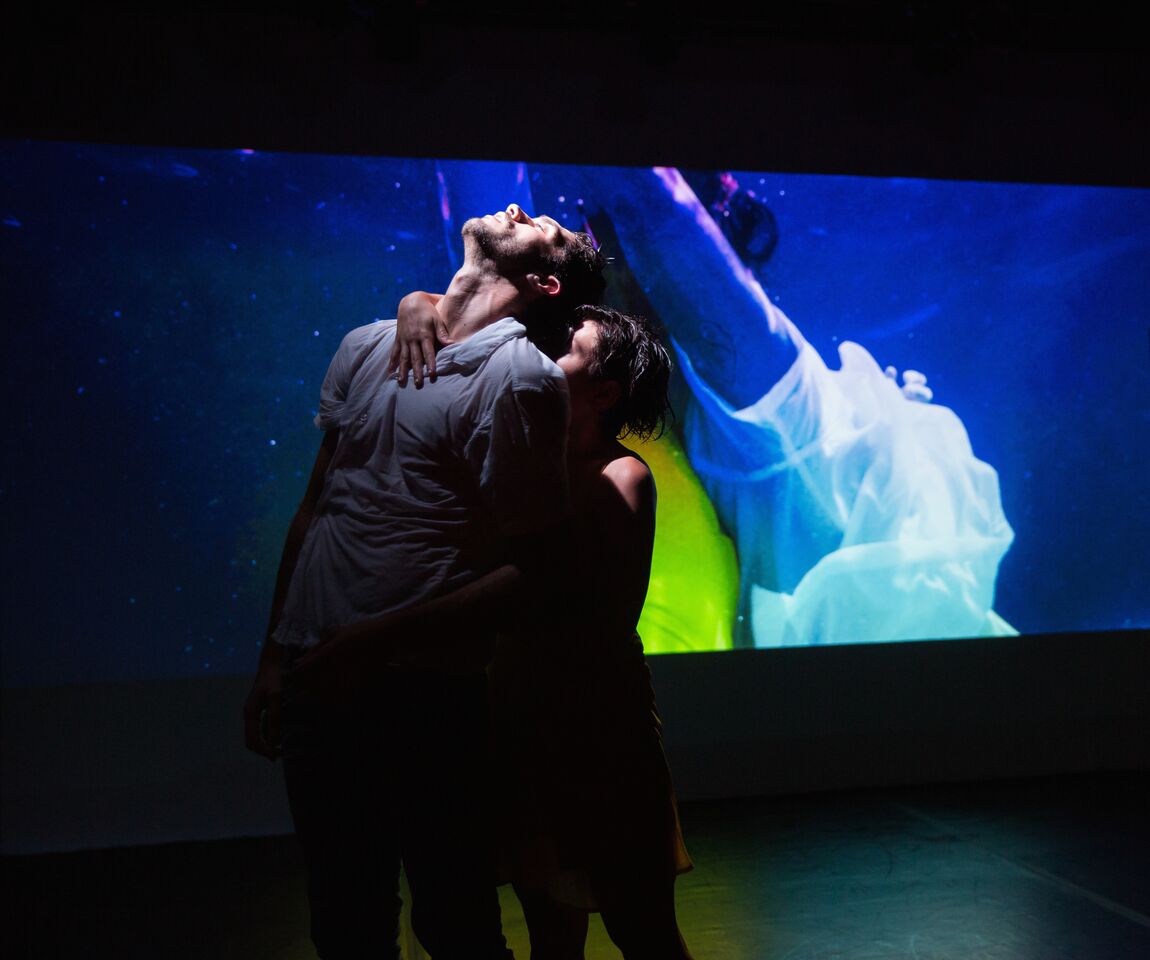
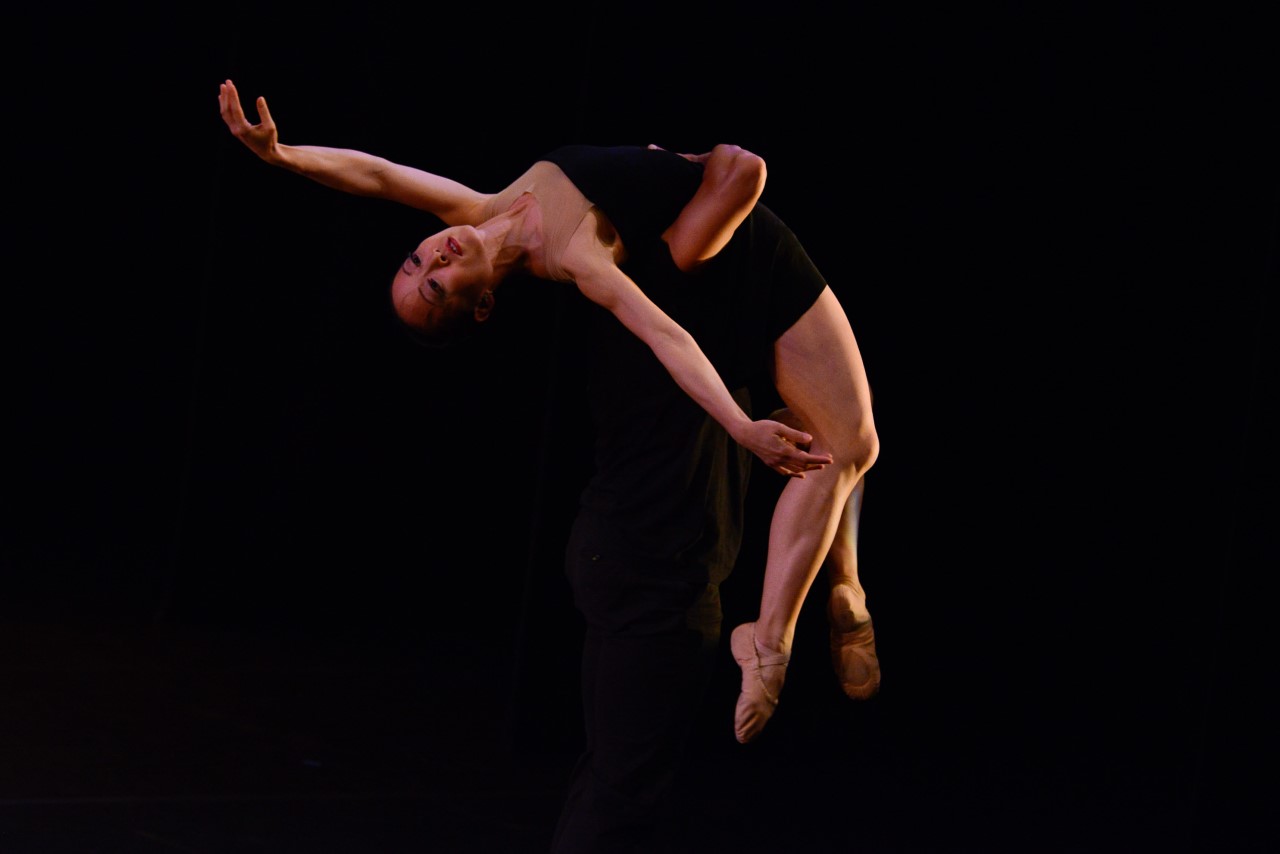
    At the Wild Project premiere of SEASONED, while this aquatic duet is being shown, Ms. Jenkins and Mr. Korkos (above, in a Scott Shaw photo) appeared live onstage, dancing together in a duet of passion, tenderness, and supplication. While perfectly dovetailed to the filmed sequence, this live duet has a distinct power of its own as a viable, free-standing dancework.

    More of Scott Shaw’s images:

    072217-AnACollaborations-Seasoned-byScottShaw-226

    072217-AnACollaborations-Seasoned-byScottShaw-222

    Watch the SEASONED trailer here.

  • Round 2 @ The US Open Qualifiers ~ 2017

    L1870214

    Author: Oberon

    Thursday August 24th, 2017 – Less humidity but still scorching sun today at the US Open as the second round matches of the Qualifying Tournament were played. Lots of distractions – mainly from people gabbing courtside during play (‘straight’ men are by far the worst chatterboxes) – and unpleasant encounters with staff made me wonder why I continue to trek out there year after year. Well, I love tennis, that’s why.

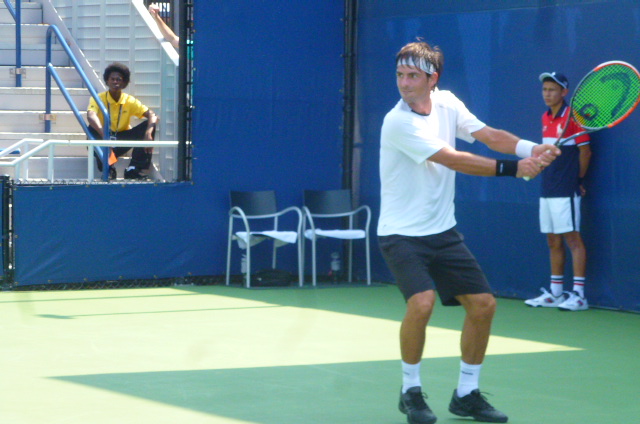
    Today my first match was between Vincent Millot and Tatsuma Ito. As on Tuesday, Ito began rather sluggishly but today he was unable to turn things around, and Millot won in straight sets.

    L1870100

    I then went to have a look at a Women’s match: former world #2 Vera Zvonareva (above) was playing American Jamie Loeb. Zvonareva was trying for a comeback after a career beset by injuries and which included time off to have a baby. Today she looked to be in great shape and played with rugged determination and fine skill. Each player took a set – the scores were really close – and in the third, Zvonareva saved a couple of match points before Loeb was able to prevail. The crowd was overwhelmingly favoring the American; in fact I am not sure that many of them even knew who Zvonareva was, nor her history. It was great seeing her play again, and I hope she sticks with it. 

    L1870104

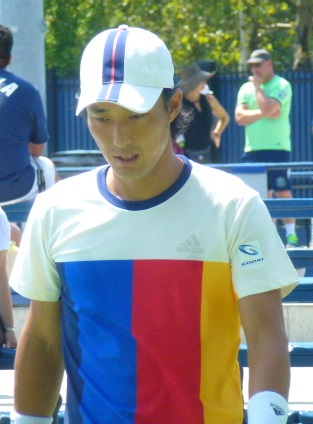
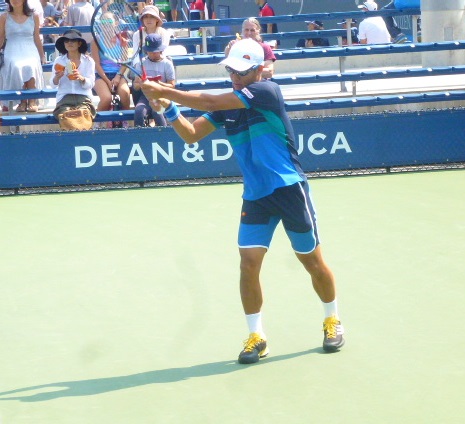
    The best time I had this week at the Open was watching the match between Go Soeda (above) and Marco Chiudinelli. I found a seat all by my lonesome high up in the gallery where a refreshing breeze periodically swept over me. Go was on fire and played the best tennis I have ever seen from him.

    Go Soeda’s matches have been some of my happiest memories of past US Opens; win or lose, he always plays a beautiful game. He is among the players who, over the years, have made me see the excitement of the Qualifying matches and who have drawn me there annually, choosing the Qualies over the far more crowded and expensive main draw.  

    Today, Go allowed Marco Chuiudinelli very little room for error. The Swiss player could not get his foot in the door against his Japanese opponent’s good serving and well-placed shots. The match flew by and Go, cheered on by the crowd, was soon basking in his victory.

    More photos of Go Soeda from today:

    L1870137

    L1870132

    L1870134

    L1870140

    Above: Go signing autographs…

    L1870149

    …and meeting his fans.  

    L1870192

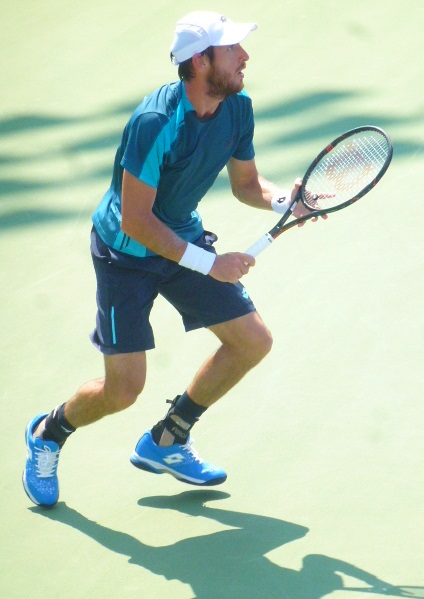
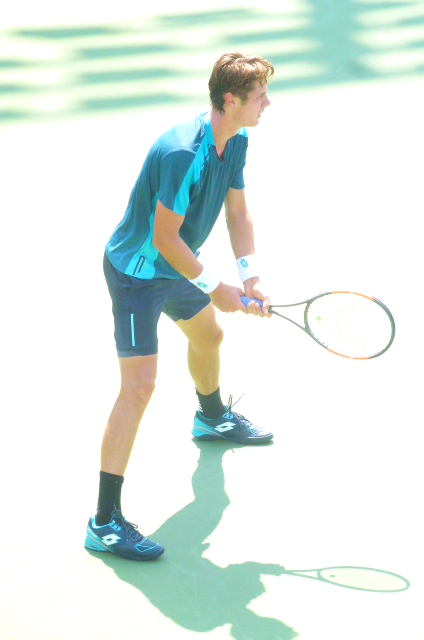
    Nicolas Mahut (above), a mainstay on the international tennis stage since turning pro in 2000, was today facing up-and-comer Ramakumar Ramanathan of India. Like Leonardo Mayer, who played a great match here on Tuesday, Mahut has slipped down the rankings just far enough that he has to qualify this time around.

    Mahut had vociferous support from the crowd and, although Ramamathan pulled off some impressive shots – and took the second set in a tie-breaker – the Frenchman held on for the win.

    L1870156

    Mahut’s young son was courtside for the match and kept calling out “Allez, papa!”. It was charming, at least for the first one hundred times. 

    I was just heading towards the exit to catch the train when a beautiful breeze kicked up. I stopped randomly at the nearest court and watched a bit of the match between Frank Dancevic and Stephane Robert.

    I recalled an incident from 2 or 3 years ago when Dancevic had an on-court meltdown over what he thought was a bad line-call. It happened again today – though as a less hysterical level – just during the few minutes I was watching. Chill, man. Everyone gets bad calls. Marco Chiudinelli thought he’d been deprived of a legitimate point during his match with Go Soeda earlier today and held up play as he unloaded on the chair umpire. What good did it do?  Just keep playing and try to win, instead of whining.

    My plan had been to stay on til the last matches of the day; I wanted to see Lukas Lacko and Duckhee Lee in action. But you’ve heard the phrase “twice-baked potato”…and that was how I was beginning to feel.

    L1870210

    Heading home.

    ~ Oberon

  • @ The US Open Qualifiers ~ 2017

    L1870022

    Author: Oberon

    Tuesday August 22nd, 2017 – As many readers of this blog will know, starting in early March of this year, I developed severe hip arthritis – or maybe bursitis: the exact diagnosis remains unclear. I was literally homebound until, after six weeks of physical therapy, things began to improve…very slowly. Aside from the pain, I also suffered from a literal terror of going outdoors. This hindered my progress considerably. But by the end of May, I began setting goals to commence re-connecting with my world of music, dance, and…tennis.

    My improvement stalled more than once; but, encouraged by my physical therapist and by friends who had been thru similar interruptions in their lives (thank you especially, Ask LaCour and Lydia Johnson!), I stuck to my course and one by one achieved my goals. The final one was set for today: to attend the first session of the US Open Qualifying Tournament. This has been an annual event for me for several years and I was determined to be there, come Hell or high water.

    Just two weeks ago, the last level of recovery I had hoped for was attained: I was essentially 95% pain-free and weaned off the meds. But then, going to the US Open is not the same as going to a concert or a dance event: it’s an all-day experience that includes a very long subway ride from Inwood, lots of walking and standing about, and plenty of stair-climbing. Just as I was leaving my apartment to catch the train, I thought: “Should I pop some Aleve just to be safe?” Nope. Fuck it.

    I won’t complain at length about the many inconveniences and distractions of going to the Open; I guess you have to shut up and put up with things like tantrum-throwing toddlers (small children don’t belong at the Open, especially on blisteringly hot days); badged employees – there are hundreds of ’em – who seem to have nothing else to do but congregate courtside and gab with one another or on their walkie-talkies during play; and staff members barking at you for one reason or another. And it’s all become so terribly commercialized.

    But…on to the tennis:

    L1860857

    Seventeen-year old Félix Auger-Aliassime (above) of Canada prevailed…

    L1860855

    …over Japan’s Hiroki Moriya (above). Hiroki’s a good player and he made some nice shots, but he didn’t have the replies for what Félix was sending him from the opposite end of the court.

    One court over, a huge throng had gathered to watch another Canadian teenager, Denis Shapovalov, who is building a reputation as a giant-killer. Today he defeated Denis Kudla; I had no energy to fight the crowds to get even a glimpse of the Battle of the Two Denises. Another bright young player on the ascent, Noah Rubin, succumbed to Germany’s Tobias Kamke in two sets; Rubin was treated for a shoulder or neck issue during the match, which undoubtedly affected his chances.

    L1860885

    I stopped by to watch part of a match between two gentlemen from Portugal: Gastao Elias (above) and Goncalo Oliveira. Each player took a set, and it seemed to me that Oliveira had gathered steam in the second and might outlast Elias in the third, but instead Goncalo seemed to wilt and Gastao claimed the win. One fun aside: Goncalo Oliveira has a unique service preparation: it’s something you really have to see.

    The only match I watched in its entirety today was between…

    L1860916

    …Argentina’s Leonard Mayer (above)…

    L1860939

    …and the Frenchman Maxime Janvier. Both men are tall, and both are big hitters: the Wilson balls took a real pummeling during their match. Mayer, seeded #1 in the Qualifying draw, made one exquisite drop-shot and had a bit of luck as one of his returns caught the tape and then dropped into Janvier’s end of the court. Despite his height, Mayer is an agile mover and was great fun to watch. It took just one break in each of the two sets for the Argentine to secure the victory.

    More images of Leonardo Mayer from today’s match:

    L1860924

    The serve…

    L1860921

    …on guard…

    L1860910

    …liftoff…

    L1860995

    …signing autographs…

    L1870003

    Leonardo turned pensive as well-wishers surrounded him after his win.

    The predicted cloud-cover had dissipated into a haze and the sun was baking the courts. The match I had most wanted to see today, between Japan’s Go Soeda and India’s Yuki Bhambri, was scheduled for Court 10 but when I went to see if they’d started, the match preceding theirs was just getting underway.

    L1870027

    I went to watch Japan’s Tatsumo Ito (above) playing against the Frenchman Kenny de Schepper but it was during their first set that I began feeling ‘the burn’. Ito is often a slow starter, and de Schepper took the opening set. When I got home, I checked the website to find that Ito had turned things around and scored a win. 

    I swung by Court 10 again to see if the Soeda/Bhambri match was anywhere near ready to go but that was not the case. It would have been one of those matches that’s hard for me to watch, as I like both players; in fact, they are my only tennis-playing Facebook Friends. I later found that Go had prevailed in a 3-setter.

    On the women’s side, one name piqued my curiosity: Vera Zvonareva. In 2010, Zvonareva was a finalist both at Wimbledon and the US Open and reached a career-high ranking of #2. Injuries, marriage, and motherhood subsequently took her away from tennis. She is now making a comeback. I wish I had seen her play today; I didn’t notice her name in the listings until her match was over. Maybe I’ll catch her on Thursday, when I plan to go back to the Open.  

    So, In the end, my day turned out very well. The only pain involved was the sunburn I acquired, and that will fade in a day or two. 

    Leaving the tennis center, I couldn’t resist photographing this poster which reminded me so much of my Brix:

    L1870048

    ~ Oberon

  • dell’Arte Opera Ensemble: LA CALISTO

    CAVALLI

    ~ Author: Oberon

    Sunday August 20th, 2017 matinee – Francesco Cavalli (above) wrote about 30 operas, and of them LA CALISTO has become a favorite with contemporary audiences. Premiered in 1651, the opera’s brief and richly-varied musical numbers – and its sensuous, lusty characters – seem wonderfully fresh and relevant to us today, especially in a performance such as was offered this afternoon by the enterprising dell’Arte Opera Ensemble down at the La MaMa Theater.

    A brief synopsis of the opera will help sort out the twists of plot and the infatuations and motivations of the various characters:

    THE PROLOGUE
    Nature and Eternity celebrate those mortals who have climbed the path to immortality. Destiny insists that the name of Calisto be added to the list.

    THE OPERA
    A thunderbolt hurled by Giove has gone awry and decimated a portion of the valley of Arcadia. The god comes down with his sidekick Mercurio to inspect the damage They find the nymph Calisto, desperately seeking water. Giove causes a stream to gush up. He then attempts to seduce Calisto, who is a follower of Diana – the goddess of the hunt – and a staunch virgin. She rejects Giove’s advances, but later succumbs when he disguises himself as Diana. Meanwhile, the real Diana, because of her vow of chastity, cannot return the love of the handsome shepherd boy Endimione. Diana relies on the help of her attendant nymph, Linfea, who desires a husband but spurns the advances of a young satyr.

    On Mount Lycaeus, Endimione sings to the moon, the symbol of Diana. As he sleeps, Diana covers him with kisses. He awakes and they sing of their love. Jove’s infidelity is discovered by his wife Juno, while Diana’s secret is found out by Pane, the god of the forest, who has long desired her. Endimione is persecuted by Pane and his satyrs.

    The Furies turn Calisto into a bear at the command of the indignant Juno. Giove sadly confesses all to Calisto: she must live the rest of her life as a bear, but eventually he will raise her to the stars. Diana rescues Endmione and they agree that, while their kissing-fest was enjoyable, they will leave it at that. Giove and Mercurio celebrate Calisto’s ascension to her heavenly home in the constellation Ursa Major

    ~~~~~~~~~~~~~~~~~~~~~~~~~~~~~~~~~~~~~~~~~~~~~~~~~~~~~~~~~~~~~~~~~~~~~~~

    Sung in the original Italian, with English surtitles, the dell’Arte production is directed with wit and affection by Brittany Goodwin, who let the bawdiness of certain scenes play out without lapsing into vulgarity. The costumes by Claire Townsend mix modern-day wear with fantasy elements. The scenic design is by You-Shin Chen, and the atmospheric lighting by Dante Olivia Smith.

    The score was played by an expert period-instrument ensemble led by Charles Weaver, with Mr. Weaver and Adam Cockerham playing lutes, violinists Dongmyung Ahn and Sarah Kenner, cellist Matt Zucker, and Jeffrey Grossman at the harpsichord. Their unfailing grace and perceptive dramatic accents brought Cavalli’s music into our time in all its glory.  

    20768180_10107878883186965_3866968242292011471_n

    Vocally, the afternoon got off to a splendid start as Allison Gish (above, in a backstage portrait) intoned the lines of La Natura with a voice that evoked thoughts of the great contraltos of bygone days.

    In a scene which anticipates Wagner’s GOTTERDAMMERUNG Norns (even down to having a contralto sing first), Ms. Gish’s La Natura is joined by Elyse Kakacek as L’Eternità and Jungje Xu as Il Destino. Ms. Kakacek looked striking as she sang from the mezzanine; the voice is full and wide-ranging, pinging out into the theater space. Jungje Xu’s voice is lyrical, and she sang very well as she pleaded Destiny’s case for giving Calisto a place in the heavens. When these three singers blended voices, the effect was superb. Later in the opera, they portrayed the stream which sprang up to quench Calisto’s thirst, and – later still – were Furies, minions of the goddess Juno, who revel in a scene where they torment Calisto.

    20747980_10154800303580777_7132399321096474619_o

    Above: Emily Hughes as Calisto, with her fellow archers of Diana’s entourage, in a Brian Long photo. Ms. Hughes was the lovely focal-point of the story; with her clear, appealing timbre and a charming streak of vulnerability in her personification of the role, the young soprano made Jupiter’s infatuation entirely understandable. Her long aria in the opera’s second half was particularly pleasing.  

    Mason Jarboe as Giove (Jupiter) – handsome in appearance and authoritative of voice – was an ideal matching of singer to role. My only wish was that he’d had more to sing. The same might be said of tenor Brady DelVecchio as Mercurio; his characterful singing, easy stage demeanor, and pimp-like persona were much appreciated. Both gentlemen savoured their every moment onstage.

    EmilyHughes_AdriaCaffaro

    Above: Emily Hughes as Calisto with Adria Caffaro, who appears both as Diana and as Giove disguised as Diana. Ms. Caffaro was able to subtly differentiate vocally between her two roles; the voice is warm, sizable and pliant, with a touch of earthiness. And she exuded goddess-like confidence. After an episode of heated kissing between Calisto and Giove in his Diana guise, Ms. Caffaro returns as ‘Diana herself’ and is amused – and then annoyed – by Calisto’s description of ‘their’ smooching session and the implication that Diana might have same-sex desires: Ms. Caffaro here turned fiery, making the scene one of the highlights of the afternoon. 

    PadraicCostello

    Above: Padraic Costello as Endimione. Mr. Costello’s honeyed counter-tenor and gift for persuasive phrasing fell graciously on the ear. His portrayal of the shepherd, infatuated with Diana, was as expressive as his singing. As the most human character in the story, and the one for whom love is truly all, Mr. Costello was as moving in his sincerity as in the beauty of sound he produced.   

    JoyceLin

    Above: Joyce Yin as Linfea, one of Diana’s handmaidens who is torn between preserving her chastity and losing it. Satirino, a lusty satyr, offers to solve Linfea’s dilemma for her, but she fends him off. Ms. Yin’s voice is clear and assertive, pealing forth to express her excitement. Stage-wise, she was a bundle of energy, and very amusing when she ‘remembered’ to strike the required archer’s poses.

    RaymondStorms

    Above: Raymond Storms as Pane. This is the opera’s second counter-tenor role and Mr. Storms excelled in the music, which veered from passionate declaration to soft, sweet turns of phrase. His acting was spot-on as yet another frustrated lover of Diana (she’s so popular!).

    Pane’s pals are Shawn Palmer as Satirino (the satyr who tried to have his way with Linfea earlier) and Angky Budiardjono as Silvano. This trio’s scenes recall the rustics in MIDSUMMER NIGHT’S DREAM…and all three are actors who can sing.

    Ms. Palmer looked androgynous with her lithe, long-legged figure and glossy blue bob-wig. Her cantering walk and occasional pawing of the ground revealed her animal nature. Her rather long dramatic aria showed a deeper side to the character, and she sang it so well.

    Mr. Budiardjono’s singing was wide-ranging and ample-toned, a very pleasing sound to be sure. In Part II of the opera, Mssrs. Storms and Budiardjono have a duet that really showed off their talents; Ms. Palmer then joined them in a trio that was sheer fun to see and hear.

    Sophie Delphis as the goddess Giunone, wife of Jove, did not descend from the heavens until the start of Part II. Clad in an elaborate haute couture dress, spike heels, and a flame-red hat, Ms. Delphis’ appearance was as striking as her singing and acting. A complete immersion into the character made her every note, word, and movement vivid. In a vindictive rage upon learning her husband has been unfaithful, Ms. Delphis unleashed her anger like a sylvan Santuzza. The voice has a real bite to it.

    Diana’s archers also served as stagehands, quickly maneuvering floor platforms into different configurations and nimbly transforming swaths of long, hanging sheer-white fabric into clouds, canopies, or pillars.

    The afternoon flew by; all too soon we were hearing what seemed to be a choral finale with all the characters mingling voices as Giove showed Calisto the firmament…her future home. But the voices fade away and the opera ends on a parlando passage from Giove.

    Production photos by Brian Long.

    ~ Oberon

  • Shaham|Langrée @ Mostly Mozart

    Gil-left-1

    Above: Violinist Gil Shaham

    ~ Author: Scoresby

    Friday August 18th, 2017 – After a month of recovering from an illness, I was happy to be able hear live music performed by the Mostly Mozart Festival Orchestra in David Geffen Hall led by its music director Louis Langrée with guest violinist Gil Shaham. A month is the longest I’ve gone without hearing live music in years, so it felt like the ultimate psychological panacea to attend. While I have regularly attended the chamber music performances, A Little Night Music, and contemporary music concerts, I hadn’t heard the Festival Orchestra since 2014.  I was glad to be able to attend the penultimate Festival Orchestra concert of the season.

    Louis-Langrée

    Above: Louis Langrée 

    The first piece on the program was the bubbly Prokofiev Symphony No. 1 in D major (“Classical”). The only other time I have heard this piece played live was, coincidentally, also the last time I heard the Festival Orchestra. This evening Mr. Langrée led a taut, lean performance. During the dance-like opening movement, the strings sounded bouncy and light. The low woodwinds provided a warm sheen, even in the most ominous undercurrents of the piece. Mr. Langrée’s sense of balance allowed the bassoon’s counterpoint to easily pop. While certainly an energetic account, none of the structural detailing was missed.

    During the Larghetto, the bassoons and clarinets took the spotlight, providing entertainment combined with artistry. For those who haven’t been to Mostly Mozart before, the stage of David Geffen is modified to allow riser seating in the back of the orchestra by moving up the stage to what would be the first few rows of the hall. This pushes the orchestra significantly closer to audience and creates a much more intimate environment.

    Mr. Langrée takes full advantage of this intimacy by using far quieter dynamics than could ever be used during the normal season’s setup – it feels as if the orchestra is thrust into the audience. The orchestral detailing in the second movement was superb through even the quietest of moments. While this makes the music sound more nuanced and detailed, it feels as if the noises from the crowd are too. Throughout the performance I heard many more pings of hearing aids, coughs, and wrappers of food than I hear during the regular season. However, I am happy to take that trade-off if it makes the music-making substantially more interesting as it did here. In the third and fourth movements, the orchestra kept its momentum and finished to a crowd that roared, obviously excited over the energy of the musicians.

    The second piece on the program was Mozart Symphony No. 25 G minor, K. 183 (one of few Mozart symphonies in the minor key). I’ve never been the biggest fan of the piece, but it was still a pleasure to hear it live in such an intimate space. While at times I felt the orchestra sounded a little muddy through the first movement, every time there was a canonic section Mr. Langrée confidently led transparent and thoughtful introductions for each instrument.

    These structured sections sounded just as buoyant as the Prokofiev. While a welcome change in dynamics, some of the rhythms and accents in the Andante felt over-accentuated to my ear.  Nonetheless, one could hear every instrument clearly singing its line. The trio of the third movement brought another warm passage with the bright woodwinds followed by an incisive final movement.

    After the intermission, the crowd seemed to be buzzing to hear the final piece on the program: the Tchaikovsky Violin Concerto in D major played by violinist Gil Shaham. I’ve never been a fan of this piece, but here it was played in a refreshing way that would make want to listen again. Mr. Shaham took an understated approach to the first movement (at least as much as is possible for a virtuosic warhorse), languishing in the phrasing of lines.

    Again, because of the setup of the lean orchestra and intimacy of the venue, there was no need to play loud. Thus he was able to bring a supple legato phrasing that never sounded harsh. After a measured performance of the cadenza by Mr. Shaham, the principal flautist Jasmine Choi gave one of the clearest and mellowest solos I’ve heard for that section of the piece. Mr. Shaham seemed more effective in the second movement, managing to illicit a rounder, ghostly tone during the introduction. The orchestra responded, with the clarinet’s extensive accompaniment matching the misty mood.

    Throughout the piece Mr. Shaham seemed to play for the musicians rather than for the audience – the whole experience seemed have more of a chamber music feel than that of a virtuosic concerto. The orchestral musicians and Mr. Langrée were smiling from start to finish and it was a joy to watch them exchange phrases with Mr. Shaham. While perhaps not the most technical or dazzling performance of this piece, witnessing and feeling that rare warmth between the artists is something that can only be experienced in a live performance.

    During the final movement, Mr. Shaham dispatched the technical sections with ease and the crowd gave him a roaring ovation. He played as an encore the third movement of the third E-major Bach Partita. While charming, to me the highlight of the concert was witnessing intimate collaborative music-making that is rare to see in an orchestra.

    ~ Scoresby

  • Claudia Schreier & Company: Gallery

    AniCollier_DSC04839

    Above: Wendy Whelan and Da’Von Doane in Claudia Schreier’s VIGIL; photo by Ani Collier. VIGIL is danced to a cappella choral music, performed onstage by Tapestry

    Here are some images from photographer Ani Collier of Claudia Schreier & Company‘s recent program at The Joyce. Read about the performance here.

    AniCollier_DSC04761

    Wendy Whelan with Da’Von Doane (of Dance Theatre of Harlem) in VIGIL

    AniCollier_DSC04954

    Wendy and Da’Von: VIGIL

    AniCollier_DSC04987

    New York City Ballet’s Cameron Dieck and Jared Angle, with Da’Von Doane and NYCB soloist Unity Phelan in SOLITAIRE

    AniCollier_DSC05017

    Unity Phelan and Da’Von Doane: SOLITAIRE

    AniCollier_DSC05055

    New York City Ballet stars Unity Phelan and Jared Angle: SOLITAIRE

    AniCollier_DSC05060

    Unity & Jared in SOLITAIRE

    AniCollier_DSC05062

    Unity & Jared in SOLITAIRE

    AniCollier_DSC05243

    Elizabeth Claire Walker (soloist, Los Angeles Ballet) and Jared Angle in TRANQUIL NIGHT, BRIGHT AND INFINITE

    AniCollier_DSC05329

    Elizabeth Claire Walker and Jared Angle in TRANQUIL NIGHT, BRIGHT AND INFINITE

    AniCollier-DSC05825

    Elizabeth Claire Walker in CHARGE; Ms. Walker was recently (and aptly) described by the L.A. Times as “impossibly glamorous” when she danced the Siren in Balanchine’s PRODIGAL SON at Los Angeles Ballet.

    AniCollier-DSC05868

    Tiffany Mangulabnan with Elizabeth Claire Walker in CHARGE.

    And finally, a series of Ani Collier’s images of Wendy Whelan in the mysterious and marvel-filled solo created on her by Claudia Schreier, and danced to music by Marc Mellits: THE TRILLING WIRE.

    AniCollier_DSC05508

    AniCollier_DSC05525

    AniCollier_DSC05560

    AniCollier_DSC05587

    AniCollier-DSC05593

    AniCollier_DSC05650

    All choreography by Claudia Schreier; all photography by Ani Collier.

  • Claudia Schreier & Company @ The Joyce

    6Q5A0441

    Above: Da’Von Doane (of Dance Theater of Harlem) and Elizabeth Claire Walker (from Los Angeles Ballet) in Claudia Schreier’s TRANQUIL NIGHT, BRIGHT AND INFINITE @ The Joyce; photo by Travis Magee

    Author: Oberon

    Friday July 21st, 2017 – Tonight’s performance by Claudia Schreier & Company at The Joyce was something I had been looking forward to ever since the choreographer confided to me last Fall the news that she had been invited to show a full evening of her work at the iconic dance venue. Having put together an impressive program of her ballets which explore a range of moods and musical styles, Ms. Schreier assembled a simply gorgeous troupe of dancers and also summoned a choir, a pianist, a clarinet virtuoso, and a string quartet to make the performance one of the most impressive and satisfying in many a Gotham moon.

    I first became aware of Claudia Schreier’s choreography thru her creations for Columbia Ballet Collaborative; those elements in dance-making that should be fundamentals (but so often aren’t) – musicality, structural integrity, showing off dancers in the best possible light, and an underlying sense of passionate commitment – are givens when it comes to Ms. Schreier’s work. 

    It was one particular piece – her 2013 ballet HARMONIC set to a dazzling score by the Dutch composer Douwe Eisenga – that heralded a great leap to prominence for the choreographer. After its premiere at Columbia, the ballet was taken up by Craig Salstein’s Intermezzo Dance Company for performances at Vassar.

    And then, in 2014, HARMONIC won Claudia Schreier the top prize in the Breaking Glass Competition for Female Choreographers. The shouts of joy from the crowd as HARMONIC ended that night signaled the emergence of a major force in the dance world, and things have rolled on with a sense of inevitability since then. A year after winning their Competition, Breaking Glass presented a full evening of Schreier choreography at the Ailey Citigroup Theatre which was a smashing success. Claudia then became the second woman to hold the Virginia B Toulmin Fellowship for Female Choreographers at New York University’s Center for Ballet and Arts. A ‘big ballet’ (CHARGE) for Ballet Academy East, and an intimate quartet (SOLITAIRE) for the Vail International Dance Festival (2016) have shown Ms. Schreier’s range. Commissions and future projects will keep her busy for months to come.

    And so this evening’s Joyce program provided a welcome vision of what Claudia Schreier has accomplished to date, where she stands at the moment, and where it all may lead her in the future.

    ~~~~~~~~~~~~~~~~~~~~~~~~~~~~~~~~~~~~~~~~~~~~~~~~~~~~~~~~~~~~~~~~~~~~~~~~~~~~~~~~~~~~~~~~~~~~

    On Valentine’s Day, 2016, Claudia and I attended a concert which was part of the New York Philharmonic Ensembles series at Merkin Hall. A stellar group of NY Phil players opened their program with the Piano Quintet – composed in 2010 – of Ellen Taafe Zwilich. After the quintet’s striking first movement, I whispered to Claudia: “That’s your next ballet!” and she whispered back, “I was thinking the exact same thing!” And…voilà!…a year and a half later, we have WORDPLAY.

    6Q5A0170

    WORDPLAY is an impeccably-crafted duet, danced by New York City Ballet’s Unity Phelan and Jared Angle (above, photo by Travis Magee). Clad in sleek red-and-black body tights from designer Martha Chamberlain, the dancers mirror the changing moods of the Zwilich score in a pairing that shifts from intimate to gently ironic. Jared Angle, always my ideal as a danseur noble, looked thoroughly at home in the supple Schreier choreography, and his partnering skills are to die for. Ms. Phelan’s technical authority is vivid, yet I can’t quite get a sense of the woman inside the dancer.

    6Q5A0193

    Above: Wendy Whelan, Da’Von Doane, and members of Tapestry in Claudia Schreier’s VIGIL; photo by Travis Magee 

    VIGIL is set to choral works by Tomás Luis de Victoria and Sergei Rachmaninoff which were performed live tonight by the choral group Tapestry. Their achingly beautiful harmonies evoked such feelings of peace: an escape to a realm of purity and truth from an ever-darkening world. Danceworks which can move us to the very depths of our souls come along but rarely; VIGIL is in that rarefied echelon. 

    6Q5A0240

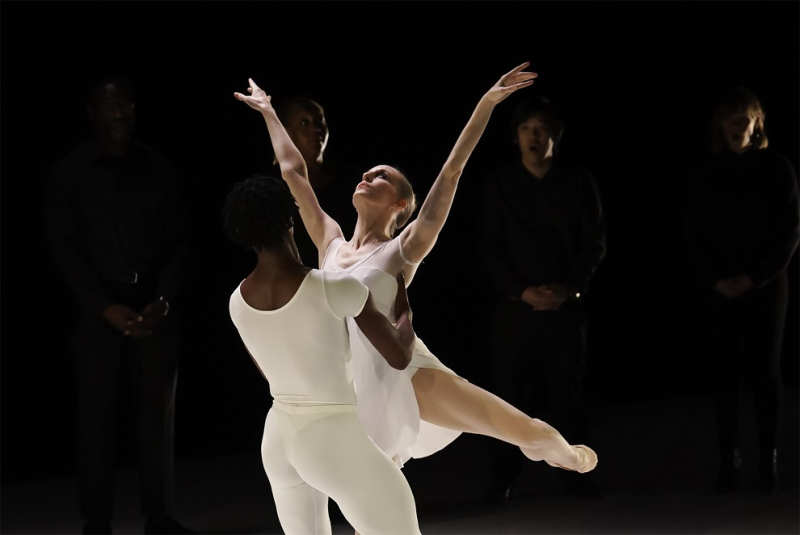
    With the singers of Tapestry, clad in black, ranged in a semi-circle onstage, the stage lights came up on the heavenly sight of Wendy Whelan poised aloft, borne up on the strong arms of Da’Von Doane. Together they moved thru the choreography, which somehow manages to be both elegant and soulful, in a state of grace. As Da’Von manipulated his gossamer-light ballerina with consummate skill thru lifts and sustained poses, they seemed like angels on Earth. Wendy’s other-worldly beauty and serenity as she floated weightlessly in her partner’s hands was something to behold.   

    6Q5A0300

    As the lights began to fade on the final moments of VIGIL, I wanted so desperately to remain in that beautiful place with Wendy, Da’Von , and the singers of Tapestry. I was put in mind of the ecstatic words of the Dyer’s Wife in Act II of Richard Strauss’s DIE FRAU OHNE SCHATTEN; upon being shown a vision of the life she has always desired, she cries out: “O Welt in der Welt! O Traum im Wachen!” (“O world within the world! O waking dream!”)… 

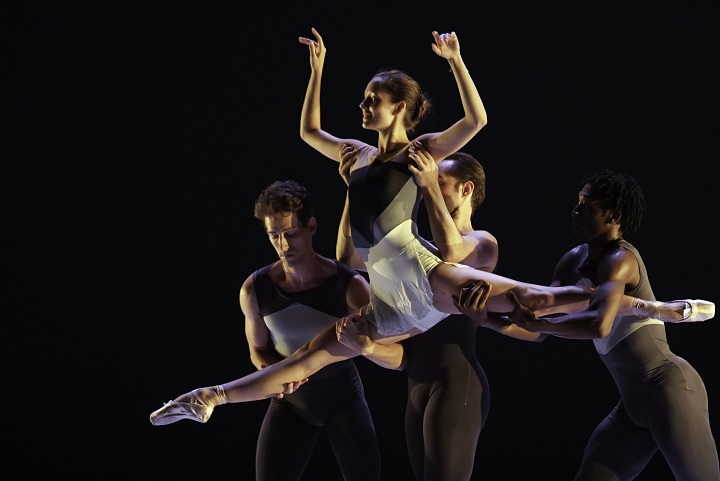
    But if we cannot linger long in paradise, then let it be Shostakovich who calls to us: the gentle opening of his Piano Quintet, Opus 57, played by pianist Emily Wong, opens Claudia Schreier’s SOLITAIRE, which was first seen at last summer’s Vail Festival. Unity Phelan leads off the ballet alone to that pensive piano solo; she is soon joined by three men: Jared Angle, Da’Von Doane, and Cameron Dieck, as the strings take up a chorale-like passage.

    The Shostakovich section ends with the first of two sensational lifts of Ms. Phelan by Jared Angle. The moderato pastorale from Alfred Schnittke’s Piano Quintet is the setting for their ensuing duet, which reaches a striking climax with a powerful, very exposed overhead lift. 

    6Q5A0356

    Let us now praise the superb musicians (above) who so beautifully played the Shostakovich/Schnittke scores used in SOLITAIRE: Emily Wong (piano), Lily Holgate and Kenneth Trotter (violins), Drew Ford (viola), and Julia Henderson (cello).

    Here are some of Travis Magee’s images from SOLITAIRE:

    6Q5A0366

    Da’Von Dane and Unity Phelan

    6Q5A0374

    Unity Phelan and Jared Angle

    6Q5A0389

    Unity Phelan and Jared Angle

    During the intermission, everyone was abuzz about the choreography, the music, and the dancing. It was wonderful to find so many dance-world luminaries among the crowd: Deborah Wingert Arkin and her daughter Ava; Christina Lynch Markham and Madelyn Ho from Paul Taylor; Miro Magloire, Brian Brooks, Vincent Paradiso, Richard Isaac, Jere Hunt…

    6Q5A0409

    Live music set the evening’s second half on its way with a brilliant performance of Leonard Bernstein’s Sonata for Clarinet and Piano (1942). Above: Ms. Wong was again delightfully at the keyboard with Weixiong Wang delivering a performance of the clarinet part with delicious tone, fluent technique, vastly appealing subtle moments, and a lively personality to boot. This ballet, with the intriguing title TRANQUIL NIGHT, BRIGHT AND INFINITE, opens with the five dancers in silhouette.

    6Q5A0453

    As the lights come up, Martha Chamberlain’s tourquoise/sea-green/black costumes catch the eye – above, Jared Angle, Unity Phelan, Elizabeth Claire Walker, and Dameron Dieck; photo by Travis Magee. The choreography is agile, sometimes stylized, with comings and going and brisk partnering trade-offs. Joined by Da’Von Doane, the dancers follow the music into a lyrical state…

    6Q5A0522

    …as Ms. Walker and Mr. Angle dance a pas de deux while their colleagues eavesdrop. The ballet ends with an upbeat feeling.

    More images from TRANQUIL NIGHT, BRIGHT AND INFINITE courtesy of Travis Magee:  

    6Q5A0545

    Unity Phelan and Da’Von Doane

    6Q5A0565

    Unity Phelan and Cameron Dieck

    Solo danceworks for women loom large in my memory-book: seeing Peggy Lyman dance The Incense at Jacob’s Pillow; Kaitlyn Gilliland debuting at New York City Ballet in Eliot Feld’s Étoile Polaire; Ioanna Toumpakari enrapturing me with Andonis Foniadakis’ Rite of Spring; a whole evening of solos from the magical Miki Orihara at La MaMa…the list goes on and on. Tonight, Claudia Schreier’s THE TRILLING WIRE, danced by Wendy Whelan, wrote a whole new chapter in my dance diary: an unforgettable piece performed by Terpsichore’s favoured handmaiden.

    The choreography for THE TRILLING WIRE is different from all other Schreier choreography I have seen. And I’m sure it posed challenges for the dancer; but Wendy Whelan has risen to every challenge that’s ever come her way and thus she turned this unusual work into a full-fledged triumph.

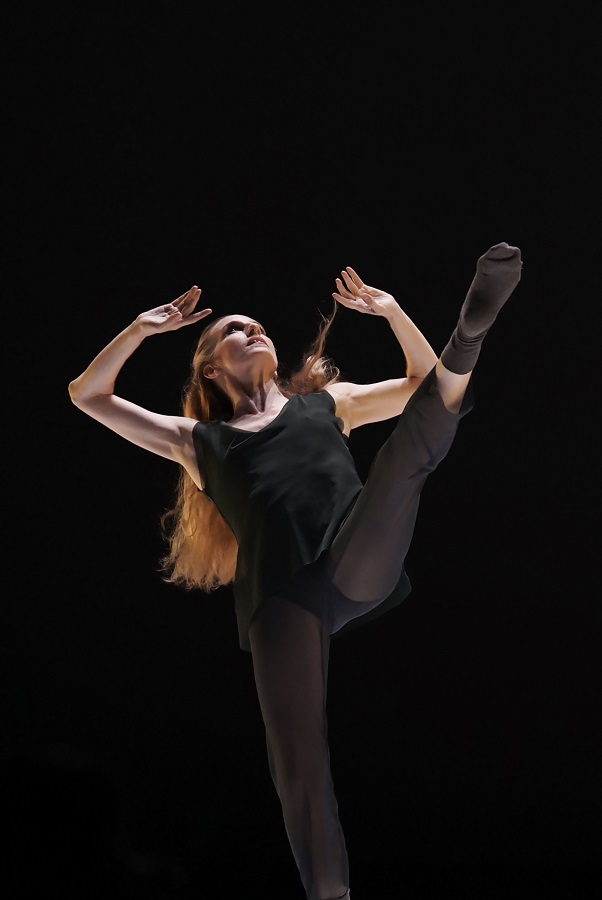
    With the string players back in the pit to play movements of three Marc Mellits string quartets, the ballet opens with Wendy – hair down, in a casual outfit and wearing socks – facing upstage. She begins to move, and within about three seconds we are totally under her spell: her most subtle gestures lure the viewer in. A flow of dance commences, with a searching air and marked by pauses as if she was examining the terrain along which her quest carries her. Mesmerizing at every single moment, Wendy transforms a prayerful gesture into an act of wonderment. 

    As the musical pace steps up, the gorgeous movement quality becomes light and airy. Wendy’s arms and hands are hypnotic, and even her hair is dancing. As the strings stutter, the classic notion of “dancing like no one is watching” comes to mind.

    Then out of the blue comes a walkabout: Wendy simply circles the stage. But even this simple act has such resonance. To pulsing music, fabulous movement ensues; veering from lyrical to stylized, turns and gentle leaps propel the dancer as the pace quickens. A sort of coda seems to indicate the solo is about to end, but suddenly Wendy stops, only to embark on a slowish passage with animated gestures. She has made the music, the choreography, and the very space itself her own. The audience erupted in a tumult of cheers and applause after having savoured this unparalleled dance experience. Graciously sharing the acclaim with the musicians, Wendy was engulfed in a flood of love.

    Here’s a gallery of Travis Magee’s images of Wendy Whelan in Claudia Schreier’s THE TRILLING WIRE:

    6Q5A0594

    6Q5A0603

    6Q5A0633

    6Q5A0678

    6Q5A0682

    6Q5A0706

    6Q5A0720

    I simply cannot get over the power and the glory of Wendy’s performance!

    6Q5A0951

    Above: the final moment of CHARGE with Tiffany Mangulabnan is a spectacular lift by Gilbert Bolden III    

    The evening ended thrillingly with CHARGE. Douwe Eisenga’s Piano Concerto, Movement III is the musical font from which this choreographed blessing flows. It is a work for large ensemble, and every dancer in that ensemble matters. There’s no standing about or idle promenading: this is a ballet that is meticulously structured yet seemingly bursting with spontaneity. The eye is constantly allured from one heavenly body to another as Claudia’s bevy of ballerinas and their handsome cavaliers flash thru the combinations and partnering motifs with élan.

    The driven pace of the music – with fleeting moments of sparkle – propels various smaller ensemble sub-divisions into a vast tapestry of dance. Visual polyphony has seldom been so appealing: with endless comings and goings, one hardly knows where to settle one’s gaze next.

    Travis Magee caught these moments from CHARGE:

    6Q5A0757

    Craig Wasserman and Holly Curran

    6Q5A0816

    Ramona Kelley and Gabriel Hyman

    6Q5A0940

    For me, this ballet was especially gratifying to watch thanks to the presence in the cast of a number of ballerinas who I count as wonderful friends: thus, thru every moment of CHARGE, I was feeling a very personal connection to what was happening onstage: thanks…and roses…to Holly Curran (who opens CHARGE alone onstage, luminous in the light), Amber Neff, Elinor Hitt, Ramona Kelley, Cassidy Hall, and Tiffany Mangulabnan. New to me were Evelyn Kocak, Jasmine Perry, and Jordan Miller. Beauties, all!

    Da’Von Doane, having danced passionately all evening, looked wonderfully fresh and vital here: he and the other men have so much to do in CHARGE, from whirlwind combinations to tricky partnering motifs. Great work from all: Samuel Akins, Michael Breeden, Gabriel Hyman, Francis Lawrence, Craig Wasserman, and Gilbert Bolden III. Mr. Bolden, who I believe is about to join NYC Ballet, is a tall and powerful presence: he effortlessly put Tiffany Mangulabnan into an overhead lift to mark the end of this spectacular ballet.

    6Q5A0897

    As if we had not had enough thrills all evening, watching Elizabeth Claire Walker (above) toss off a series of demi-turns while sending her extension skyward was the frosting on the cake. This combination, which made me think of Gamzatti’s coda in Bayadere, just delighted me thoroughly. We don’t get to see Liz nearly often enough here in New York City.

    The curtain fell, then rose again as the packed house went wild for the dancers. Wendy, Unity, Jared, and Cameron – already in street clothes – joined the cast of CHARGE onstage. Finally, Cameron brought Claudia Schreier out onto the stage; the entire audience stood up and literally screamed at the top of their lungs. It seemed actually that the roof might cave it. Such delirium, and so well-deserved.

    Many thanks to Travis Magee for producing the images for this article.

    Oberon

  • Prelude: Claudia Schreier & Co

    6Q5A0113

    Claudia Schreier & Co will be at The Joyce on July 21st and 22nd, 2017, as part of the theatre’s two-week ballet festival. The performances are sold out.

    On Wednesday evening, July 19th, photographer Travis Magee and I stopped in at the Barnard College studios where rehearsals have been taking place. The dancers were running thru CHARGE, Claudia’s large-scale ballet set to a vibrant score by the Dutch composer Douwe Eisenga. For this ensemble work, Claudia has gathered together an outstanding group of dancers; although it’s an ad hoc ensemble, they’ve already developed the feeling of a Company.

    Here are more of Travis’s images from CHARGE:

    6Q5A0203

    Elinor Hitt and Craig Wasserman

    6Q5A0319

    Elizabeth Claire Walker

    6Q5A0396

    Claudia & Company

    While the dancers caught their breath after two runs of CHARGE, members of the choral group Tapestry filed into the studio and arranged themselves in a semi-circle to sing the music of Tomás Luis de Victoria and Sergei Rachmaninoff which comprise the setting of Claudia’s breathtaking pas de deux, VIGIL.

    6Q5A0482

    VIGIL is danced by guest artist Wendy Whelan and Dance Theater of Harlem’s Da’Von Doane. Working together for the first time, Wendy and Da’Von have formed a partnership based on resonant technique and spiritual affinity. Their dancing is borne up by the heartfelt, resplendent harmonies of Tapestry, making this is a dance experience sans pareil.

    More of Travis Magee’s photos from VIGIL

    6Q5A0506

    6Q5A0523

    6Q5A0558

    The Joyce performances by Claudia Schreier & Co will further feature ballets set to music of Leonard Bernstein, Marc Mellits, Dmitri Shostakovich, Alfred Schnittke, and Ellen Taafe Zwilich. Unity Phelan, Jared Angle, and Cameron Dieck – all from New York City Ballet – will appear in prominent roles.

    All photos by Travis Magee.

  • CMS ~ Summer Evenings 2017 ~ Concert 3

    Efe

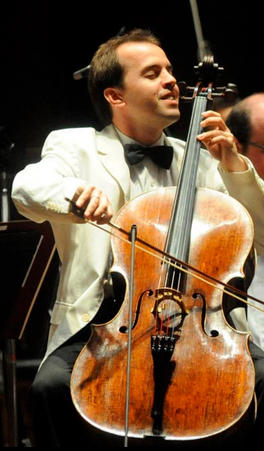
    Above: cellist Efe Baltacigil

    Author: Oberon

    Sunday July 16th, 2017 – All too soon, Chamber Music Society of Lincoln Center‘s Summer Evenings series for 2017 has come to an end. Over the course of the three concerts, we heard magnificent music, played to perfection. Each summer I find myself hoping that a fourth concert might be added to the series: the packed houses indicate how successful these summertime concerts are. But perhaps it’s just a question of timing, as so many musicians are making appearances at the various summer festivals. Also, the Society is about to commence a run of concerts at Saratoga Springs. So, we can feel grateful for what we have heard this summer, whilst looking forward to the 2017-2018 CMS season

    Anticipation ran high as Alice Tully Hall was again filled to the rafters with Gotham’s music-lovers, thirsting for the classics as the doldrums of the summer lazed along. A cordial greeting to Mr. Baltacigil and his colleagues…

    Keefe-erin

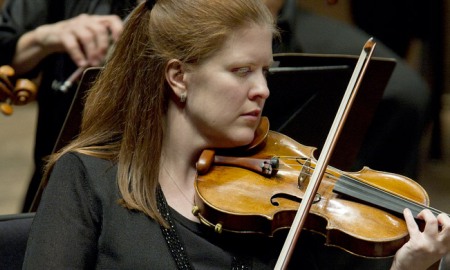
    …violinist Erin Keefe (above)…

    Fullsizephoto372849

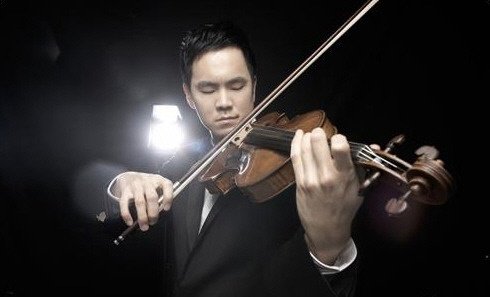
    …and violist Richard O’Neill (above), as they appeared onstage for the opening Beethoven.

    The D-major Trio opens serenely, but things soon become quite lively. It was quickly evident that our three musicians were well-matched, and as the shifting themes unfolded their playing was marked by a fine mixture of impetus and elegance.

    As is so often the case, it is in the second movement, marked Andante quasi allegretto, that we get to the heart of the matter. A nostalgic feeling pervades here, though the textures remain translucent. Mr. Baltacigil’s cello enhances the lyrical aspects of the music, and some gracious plucking maintains an active feeling so that things don’t turn dolorous. A beautiful viola passage receives loving attention from Mr. O’Neill, and Ms. Keefe’s relishing of the Andante‘s most subtle moments is a distinctive asset.

    Delicate playing in the Menuetto dances us along with courtly charm. Then, after a longish pause, the concluding Rondo is quite jolly, with the cello prominent, the viola harmonizing, and the three voices eventually in finely-timed exchanges. A passing lull into lyricism again brings subtle mastery from our expert trio before the piece reaches its happy ending.

    Kristin Lee

    A brilliant performance of the Prokofiev Violin sonata in D-major followed. While I have enjoyed the playing of Kristin Lee (above, in an Arthur Moeller potrait) on many CMS evenings in the past, I can’t recall having heard her in a sonata performance. Her Prokofiev was, in a word, spectacular. And, with their usual knack for matching up musicians of like quality, Michael Brown at the Steinway played with thrilling verve and clarity.

    Brown-Michael_credit_Jeanette_Beckman

    Above: Michael Brown, photographed by Jeanette Beckman

    Originally a flute sonata, this piece was re-worked by Prokofiev for violin as several violinists – notably David Oistrakh – took an interest in it. In the opening Moderato, the violin floats in a lyrical dream. An almost fanfare-like passage leads to some scurrying before resuming its more song-like aspect, with some piercing highs; a pensiveness evolves and a short coda concludes the movement.

    The ensuing Scherzo begins as a jig, with dance-like swirls from both violin and piano. A more tranquil interlude temporarily lulls us, but things again speed up to a big dance.

    The Andante features a soaring, romantic theme for the violin: Ms. Lee was at her most poetic here before passing the melody along to Mr. Brown, who takes it up at the piano. The music aches the heart until a quiet restlessness steals in; the violin goes high and sounds on the verge of spacing out.

    The Allegro con brio finale opens with a rollicking passage and then jogs along for a bit until Mr. Brown’s pianistic passion takes over. Things simmer down and become quite delicate; then a song wells up and a triumphant feeling builds. A increase in velocity carries the sonata to the finish line.

    Kristin Lee, a beauty in black, was so impressive in her technical command, with Mr. Brown an ideal colleague in both the passion and precision of his playing. As the duo embraced at the end of their superb performance, the audience lavished well-deserved cheers upon them.

    Yuralee1586color_608x265

    Violist Yura Lee (above) joined the ensemble after the intermission for a richly rewarding performance of Antonin Dvorák’s String Quintet in E-flat major, Opus 97.

    “Spillville is an ideal place; I would like to spend the rest of my days there,” wrote the homesick Dvorák of the Iowa town where he had gone (in 1893) to mingle with the local Bohemian community. But while he was there, something else happened: a road-show of Native American entertainments and crafts came to Spillville for two weeks. Dvorák was intrigued by the rhythms and harmonies he heard in the group’s presentations and worked some of these elements into his E-flat major Quintet.

    One of the most delightful aspects of this work is in the composer’s assigning of equal prominence to the “1st” and “2nd” violins and violas; this division of labor gives everyone a chance to shine. And underlying the melodious marvels produced by his colleagues, Mr. Baltacigil’s honey-toned cello playing gave the ensemble a pleasing depth of feeling: for both rhythmically and melodically, Mr. Baltacigil is first class.

    Dvorák himself was a viola player, and it is to that instrument that the composer gives the quintet’s opening statement, played from the heart by Richard O’Neill. Chamber Music Society is like a paradise for lovers of the viola sound (count me in!) where one is likely on a given evening to hear the likes of Paul Neubauer, Matthew Lipman, or Pierre Lapointe. In tonight’s Dvorák, Yura Lee shared the viola spotlight with Mr. O’Neill: her rich, pliant tone is always so inviting. Likewise, on the violin side, Mlles. Keefe and Kristin Lee were each heard to advantage.

    In the quintet’s first movement, Ms. Keefe’s lambent tone was particularly enhancing. As ribbons of melody pass from player to player, we can savor the unique sound of each voice as well as their combined appeal when they sang in unison in a passage with an unusual drawling quality. The two violists were having a heyday, unwrapping each phrase the composer has given them and relishing it for us to enjoy.

    For the second Allegro movement, Mr. O’Neill again takes the lead. Ms. Keefe and Yura Lee trade passages and then, to the genial plucking of her colleagues, Yura takes up a gorgeous theme which explains why she wanted to be “1st”;  Ms. Keefe, playing high and sweet, makes the same case for being “1st” violin.

    The Larghetto offers a set of variations, shifting between major and minor. Here a sad melody is given out by the lower voices with a hymn-like quality. More magic from Yura Lee, and then Ms. Keefe plays a sinuous obbligato over the choir; the opposite effect is created when Mr. Baltacigil’s animated cello is overlain by the harmonizing violins and violas. The cellist then sings forth while the higher voices take a tremelo stance. Amazing delicacy is achieved in a plucked interlude, the audience breathlessly charmed by the effect. Following a dynamic outburst, calm is restored and Kristin Lee carries the Larghetto to a fade out.

    Erin Keefe leads a dance to start the Finale: Allegro giusto. Plucking again; then Kristin Lee, Mr. Baltacigil, and Yura Lee each have their say before a broad flow of melody ensues. Ms. Keefe takes up a ‘Native’ theme and then Yura Lee has a final viola gesture which leads to a rush to the finish: an exhilarating end to a great evening of music.

    ~ Oberon

  • Lydia Johnson Dance @ NYLA

    _NA09058

    Above: Nir Arieli’s image of Dona Wiley, Sara Spangler, and Blair Reavis-Tyler in Lydia Johnson’s This, and my heart beside…

    Author: Oberon

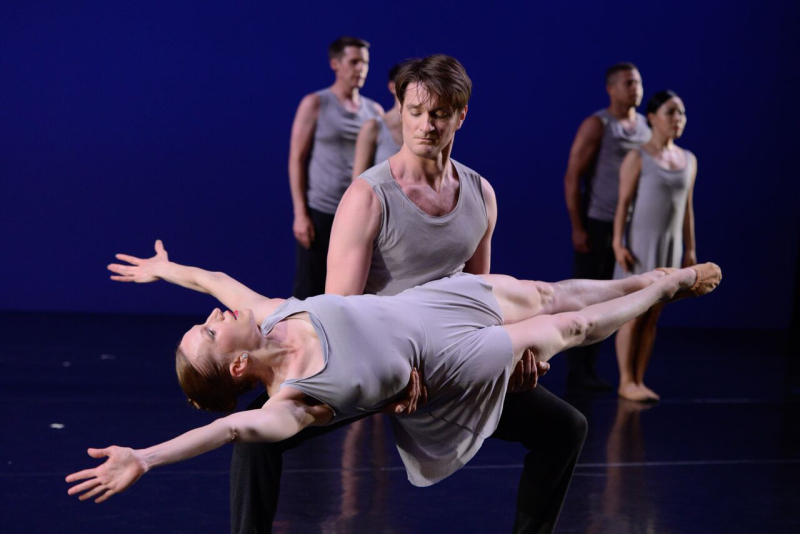
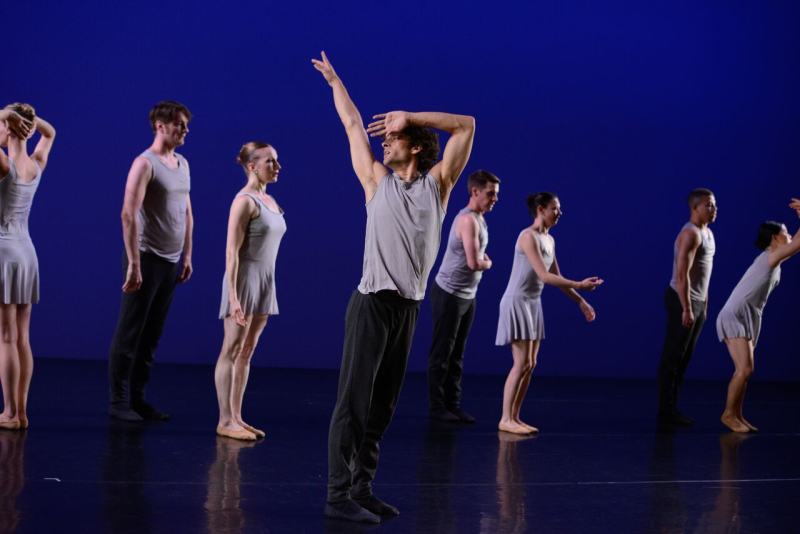
    Wednesday June 21st, 2017 – Lydia Johnson Dance‘s annual New York season opened tonight at New York Live Arts in Chelsea. Performing in two new works, as well as the revival of a Johnson classic from 2012, and the repeat of a darkish ensemble work held over from last season, the Company dancers displayed the strength, technical accomplishment, emotional commitment, and ever-appealing individuality of face and form that sets them in a unique place on the Gotham dancescape. For Lydia Johnson’s work, rooted as it is classical ballet technique, is alive with dramatic nuances that paradoxically seem both contemporary and curiously evocative of ancient modes of dance. 

    Among current choreographers, Lydia’s work bristles and blooms with a poignant sense of humanity. There’s nary a trace of theatricality in her dances; rather, she uses the music as a canvas on which emotions – both the deep and the subtle – are painted. Expressions of tenderness (so lacking in our lives today), hope, remorse, uncertainty, and the frailty of the human heart well up on the music, sometimes unexpectedly. How often, watching Lydia’s troupe in rehearsal, have I fought back tears or felt pangs of regret as I connect memories from my own life with things she is depicting in dance.

    To Lydia’s good fortune, her work has always attracted dancers with an intrinsic gift for colouring their performances with expressive hues, drawing on their own recollections and experiences to captivate the viewer with their commitment, energy, and passion.

    This season, a particularly striking ensemble has gathered together to offer up Lydia’s ballets: from Company mainstays Laura DiOrio, Katie Martin-Lohiya, MinSeon Kim, Brynt Beitman, and Chazz Fenner- McBride to newcomers Daniel Pigliavento, Dona Wiley, Lauren Treat, Blair Reavis-Tyler, and Hope K Ruth, everyone shone: each in his or her own way. Debuting with the Company, a marvelous ballet-duo, Mary Beth Hansohn and Peter Chusin, left me hoping that tonight marks the start of their ongoing involvement with Lydia’s troupe.

    Of special joy was the re-appearance at Lydia Johnson Dance of a pair of beloved dancers, Sarah Pon and Blake Hennessy-York; they had moved to the West Coast last year, and have graciously flown in to reprise their roles in Giving Way. And we also welcomed back Lisa Iannacito McBride, a key dancer during her seasons with Lydia Johnson Dance. Lisa has come back to perform a role made on her in 2012 in Crossings by River; in the intervening years, Lisa has been raising her son and dancing in her current neighborhood, up the Hudson River. This was not a sentimental return, but rather a vibrant and supremely assured performance from a dancer who always lights up the stage. 

    As we sat waiting for the performance to start, I was reflecting on all that has happened since the Company last danced in New York City. I felt quite certain, having seen some rehearsals, that this would be a strong program. As the evening flowed onward, I found the impact of the music, the choreography, and the dancing exceeded expectations in every regard.
    _NA07564

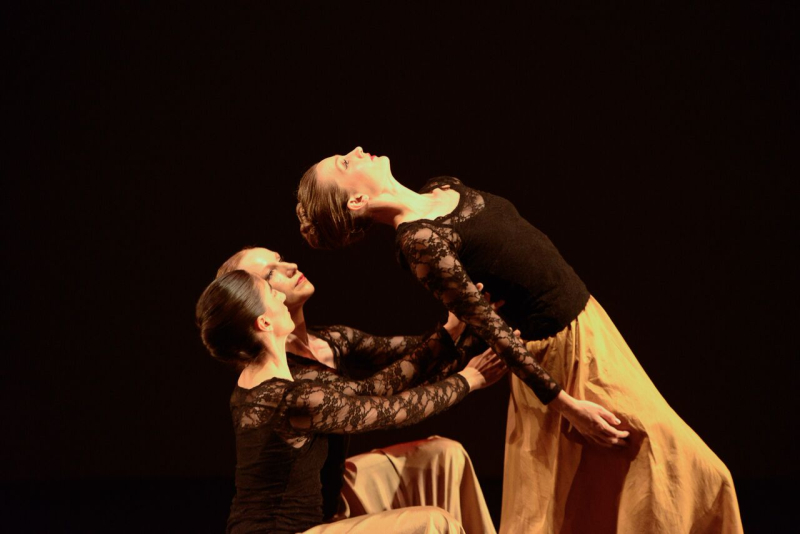
    Above: Lisa Iannacito McBride, Laura DiOrio, and Katie Martin-Lohiya in Crossings by River; photo by Nir Arieli

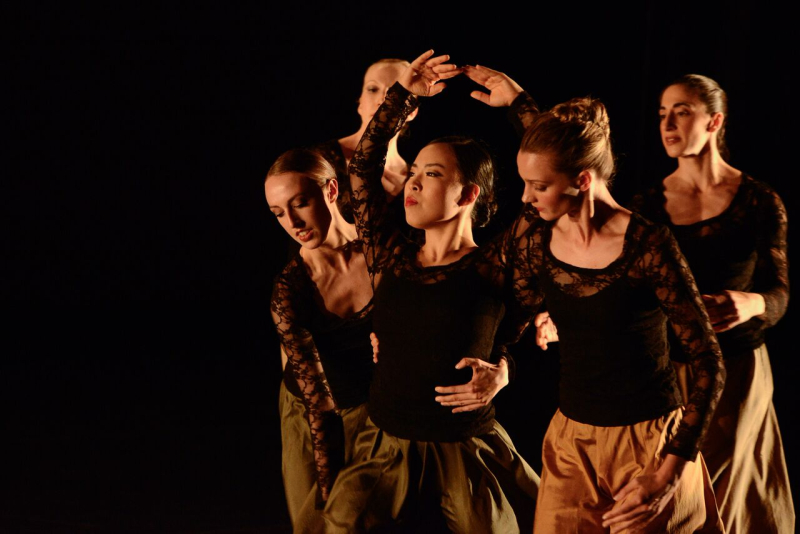
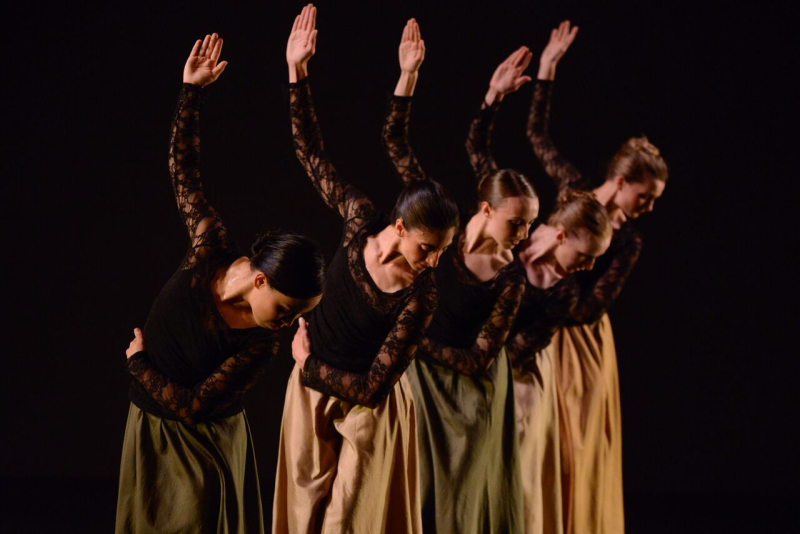
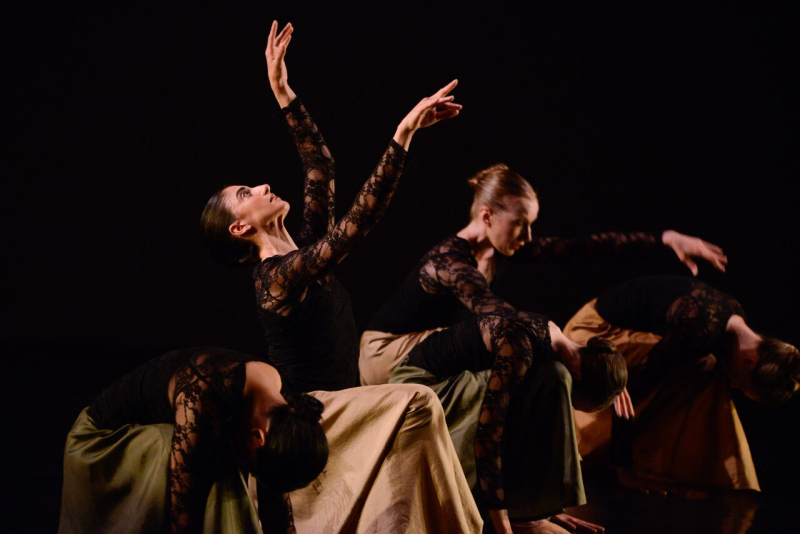
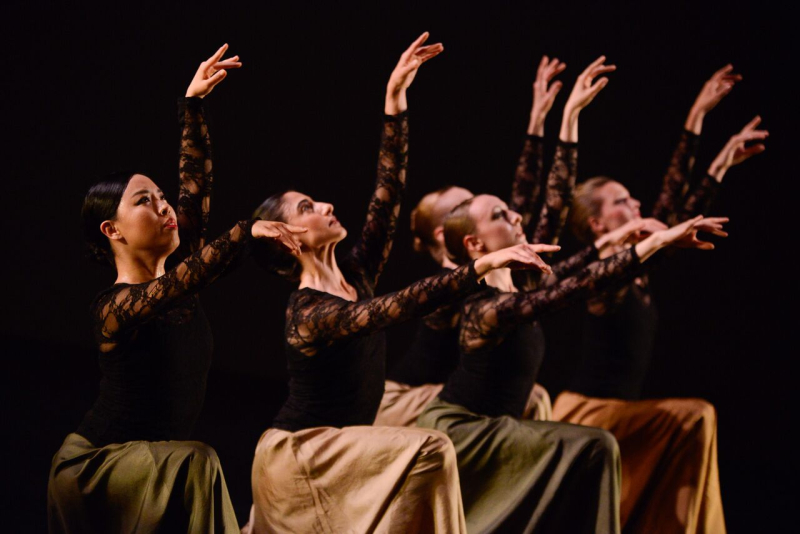
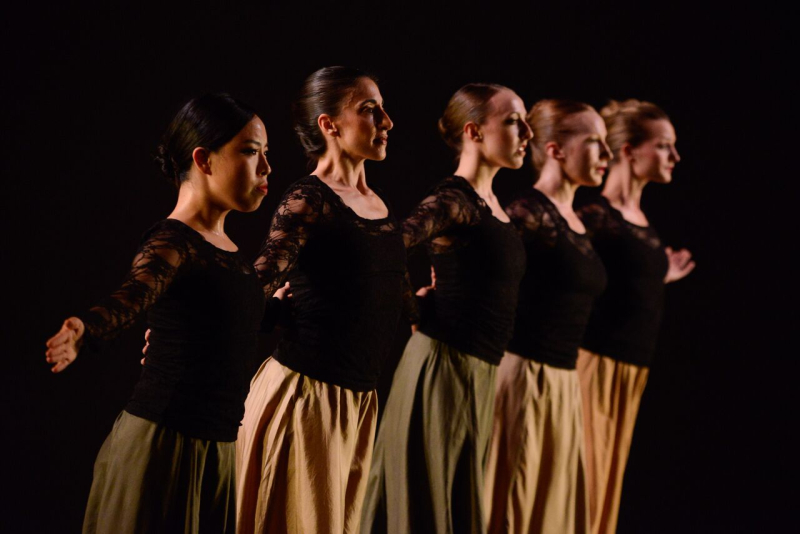
    In Crossings by River, music of Osvaldo Golijov is the ideal setting for a dancework depicting the quiet rituals of a group of five women. Their flowing golden skirts and black lace bodices lend a Spanish flavour to the proceedings and, from the rooted, gestural elements at the start thru to spacious circlings laced with solo passages, and on to the consoling, rocking motifs of the sisterhood, Lydia Johnson’s choreography takes the Balanchinian stance of letting us see the music.

    The five women gave an exceptionally well-integrated performance; two members of the original cast for Crossings were re-visiting their roles today: Lisa Iannacito McBride and Laura DiOrio. Their confident, expressive dancing resonates from the depths of their feminine spirits. Since the creation of this ballet, both Lisa and Laura have become mothers; this added an intangible layer of richness to their portrayals. 

    Katie Martin-Lohiya, who has become a paragon of the Lydia Johnson style, radiated assurance and grace, and MinSeon Kim stepped into one of Lydia’s most intriguing solos – the dancer subtly changes directions as she moves about the space – and made it her own. Dona Wiley, in her first performances with Lydia Johnson Dance, was an elegant presence and danced beautifully in this finely-integrated ensemble work.

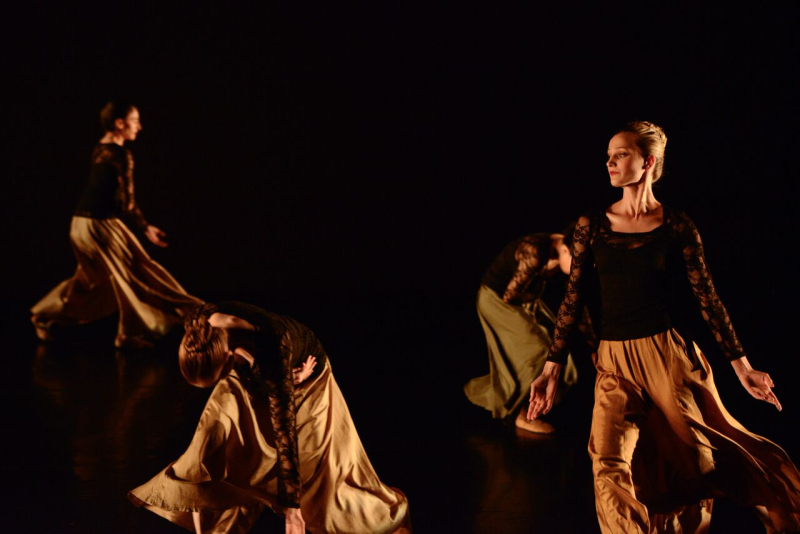
    Here are some of Nir Arieli’s images from Crossings by River:
    _NA07582

    Katie Martin-Lohiya

    _NA07630

    Dona Wiley, Min SeonKim, Katie Martin-Lohiya
    _NA07782

    Min, Lisa, Dona, Laura, Katie

    _NA07785

    _NA07789

    Lisa Iannacito McBride

    _NA07794

    _NA07817

    Katie, Laura, and Lisa

    _NA07878

    Katie, gently rocked by Lisa and Laura

    Giving Way is being presented for the third consecutive season; I must say it seemed even more vital this year than previously, though I cannot put my finger on the reason. A sense of urgency was in full flourish among the dancers, whilst the more lyrical passages were hauntingly evocative.

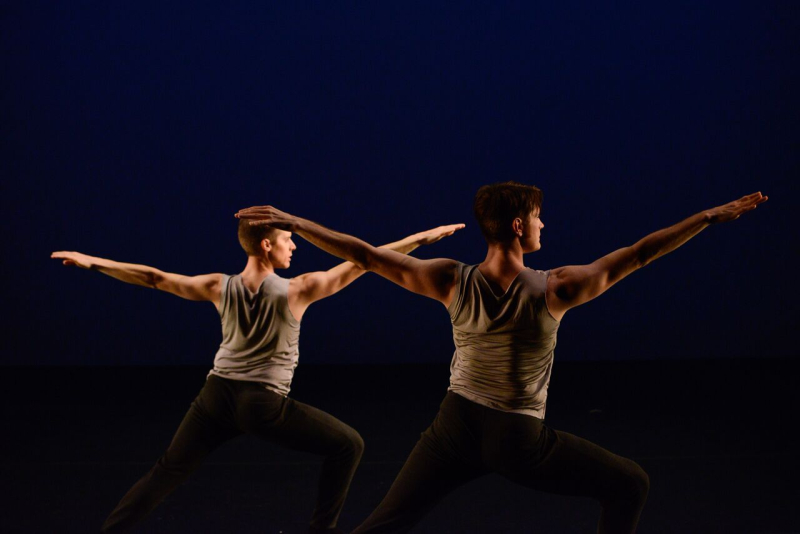
    Following a dynamic opening in which opposing quartets of men and women advance and retreat, Lydia Johnson brings forth an intensely personal duet for two boys: Blake Hennessy-York and Brynt Beitman. Their performance was a highlight of the evening, as Nir’s images attest:
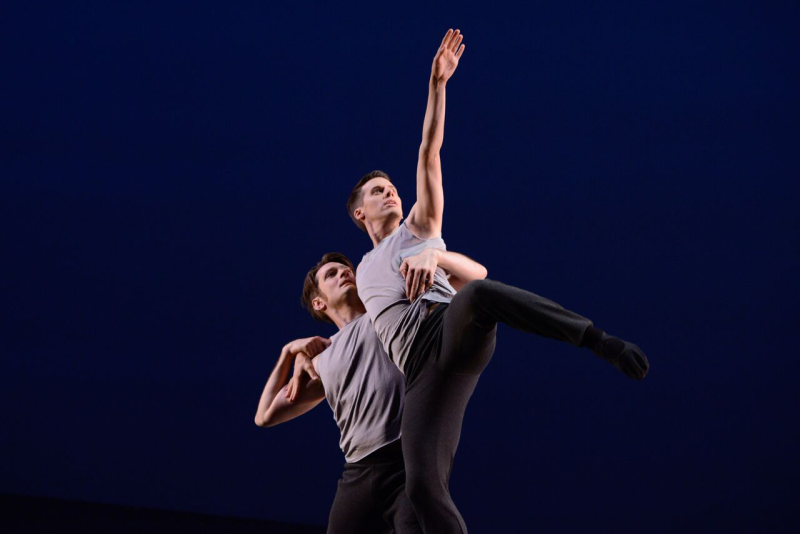
    _NA07968

    _NA07979

    _NA07985

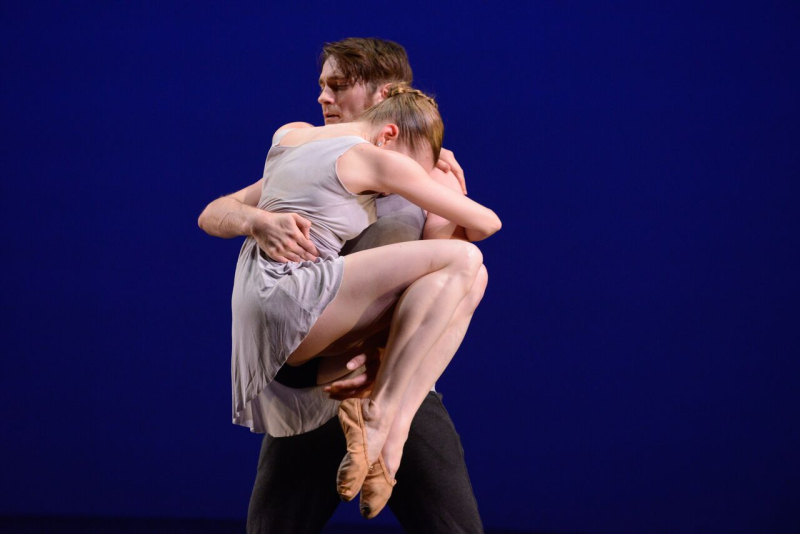
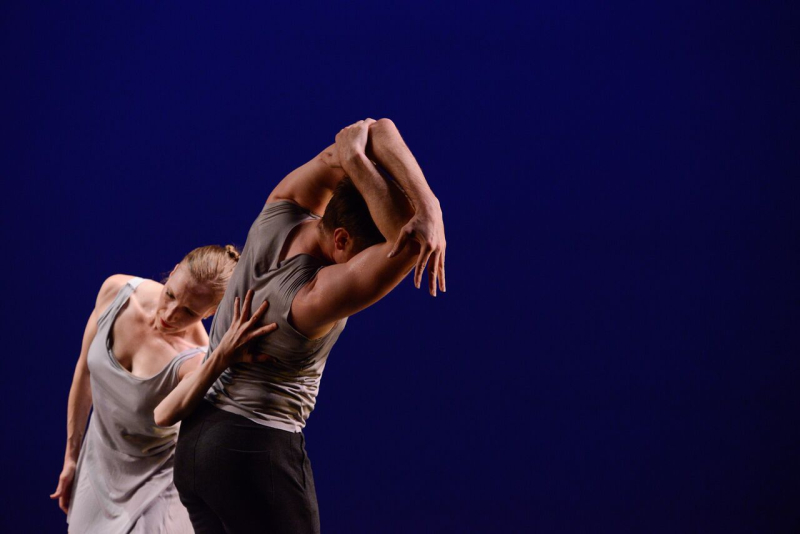
    A men’s quartet – swaying at first and then more animated – leads on the the heart of the ballet, set to a gorgeously mystical music for marimba and cello. A folkish cello passage for the men evolves to a memorable pas de deux danced by Laura Di Orio and Brynt Beitman:
    _NA08306

    _NA08316

    _NA08319

    _NA08327

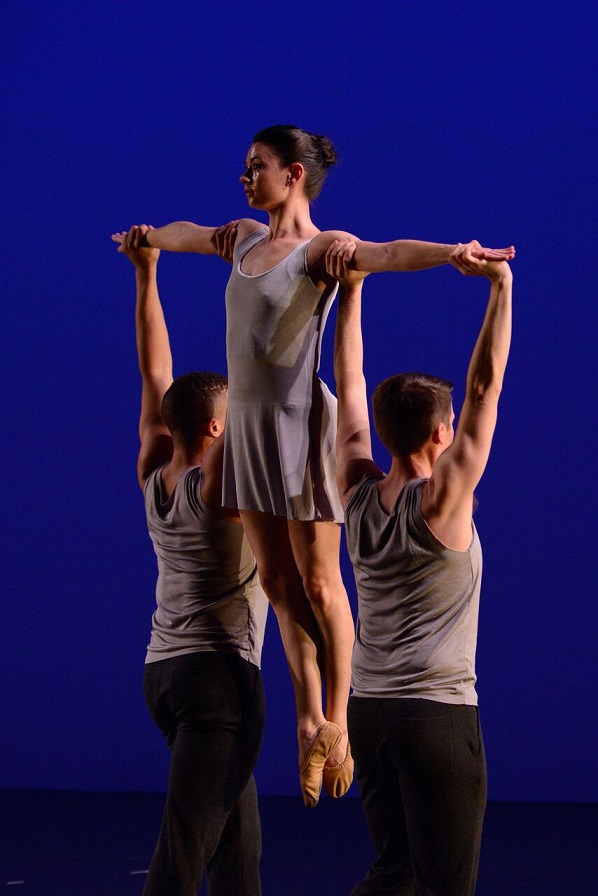
    In a unique passage, girls are lifted by pairs of men:
    _NA08262
    Sarah Pon

    _NA08270

    Katie Martin-Lohiya

    Spectacular solo dancing from Chazz Fenner-McBride in Giving Way brought another outstanding performance from this incredibly gifted and vividly communicative dancer. I have been following Chazz over the past few seasons, dancing first for Robin Becker and now for Lydia Johnson. He just gets better and better: fearless, powerful, but always lyrical at heart: such a perpetual pleasure to watch him.

    Giving Way ends with the dancers undulating in a wave-like passage as the light fades. 

    Here are more of Nir images from Giving Way:

    _NA07902

    Peter Chursin, Blake Hennessy-York

    _NA07999

    Blake Hennessy-York

    _NA08017

    Chazz Fenner-McBride & MinSeon Kim

    _NA08114

    Katie Martin-Lohiya, Peter Chursin

    _NA08140

    Brynt Beitman, Laura DiOrio

    _NA08149

    Peter Chursin

    The music of Georg Friedrich Handel cries out: “Dance to me!” The contrasts between the lively allegros and the lyrical andantes set up a perfect opportunity for choreographers to show off both their dancers’ technical proficiency and their emotive qualities.
    _NA08468

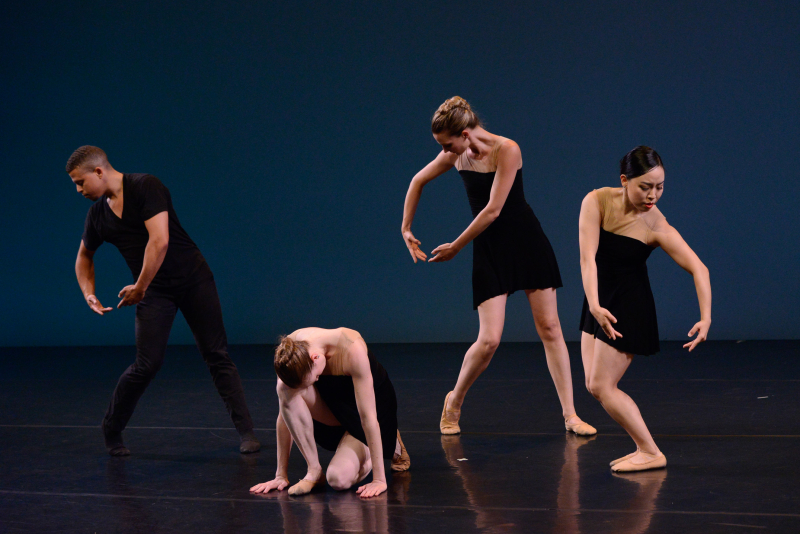
    In the premiere of her new Handel ballet, Trio Sonatas, Lydia Johnson shows her usual structural deftness and musicality. The dancers strike off-kilter, stylized poses (above) before things turn more animated, with small leaps in place and the girls flinging themselves dramatically into Chazz’s arms.

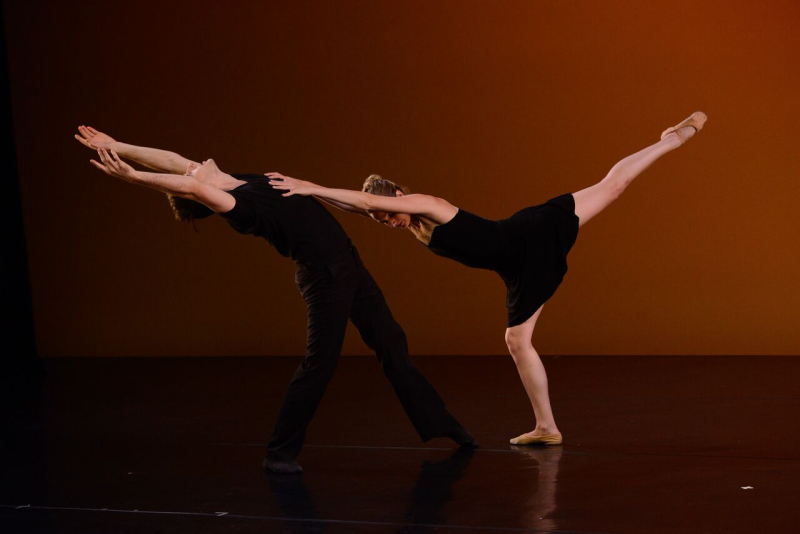
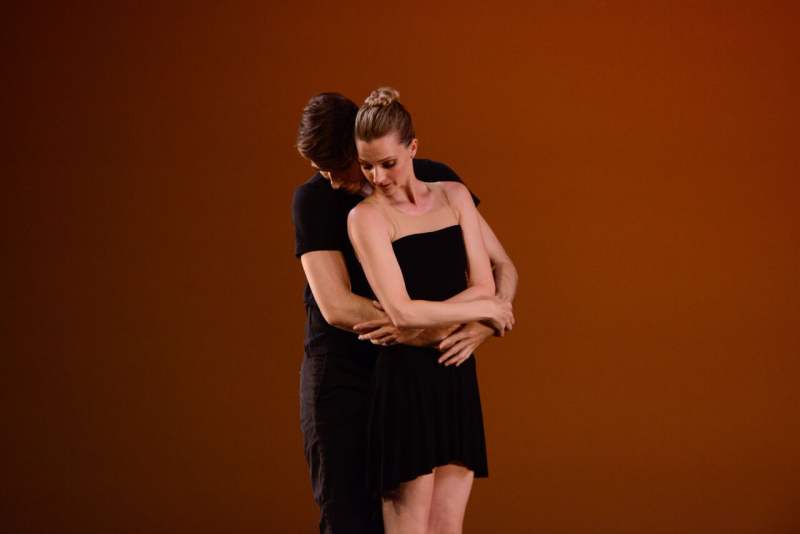
    Duet motifs, and a walking ensemble ensue: the Company’s newest members have opportunities to shine. Daniel Pigliavento dances with Katie Martin-Lohiya – their long limbs and tender sense of lyricism shaping the movement persuasively:
    _NA08575

    _NA08579

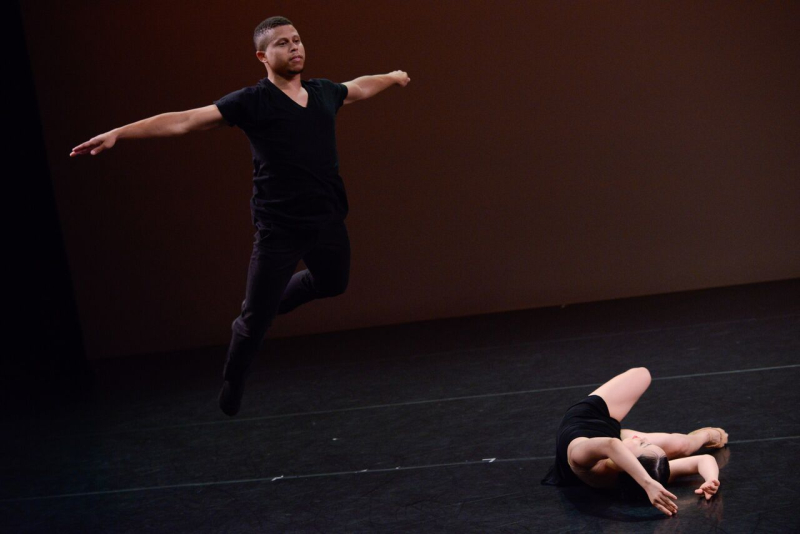
    Lydia’s newest ladies – Dona Wiley, Lauren Treat, Blair Reavis-Tyler, and Hope K Ruth – are seen to advantage in the Handel work. A sprightly finale strikes up, with the dancers doing swift lay-downs before springing back to action. Chazz Fenner-McBride’s daring catches of the petite and charming Hope K Ruth drew appreciative murmurs from the crowd. A female ensemble with decorative gestures, another bit of brightness from Ms. Ruth, and a duo passage for Chazz and Blair Reavis-Tyler draw Trio Sonatas to its close. 

    Trio Sonatas images from Nir Arieli:
    _NA08408

    Chazz fenner-McBride and MinSeon Kim

    _NA08435

    Laura DiOrio and Katie Martin-Lohiya

    _NA08451

    Chazz Fenner-McBride and MinSeon Kim

    _NA08591

    Chazz Fenner-McBride and Dona Wiley

    Thumbnail_Hope in Trio Sonatas

    Hope K Ruth

    This, and my heart beside… is Lydia Johnson’s very newest work, and let’s say it flat-out: it’s a masterpiece. The title of the ballet is drawn from this Emily Dickinson poem:

    “It’s all I have to bring today—
    This, and my heart beside—
    This, and my heart, and all the fields—
    And all the meadows wide—
    Be sure you count—should I forget
    Some one the sum could tell—
    This, and my heart, and all the Bees
    Which in the Clover dwell.” 

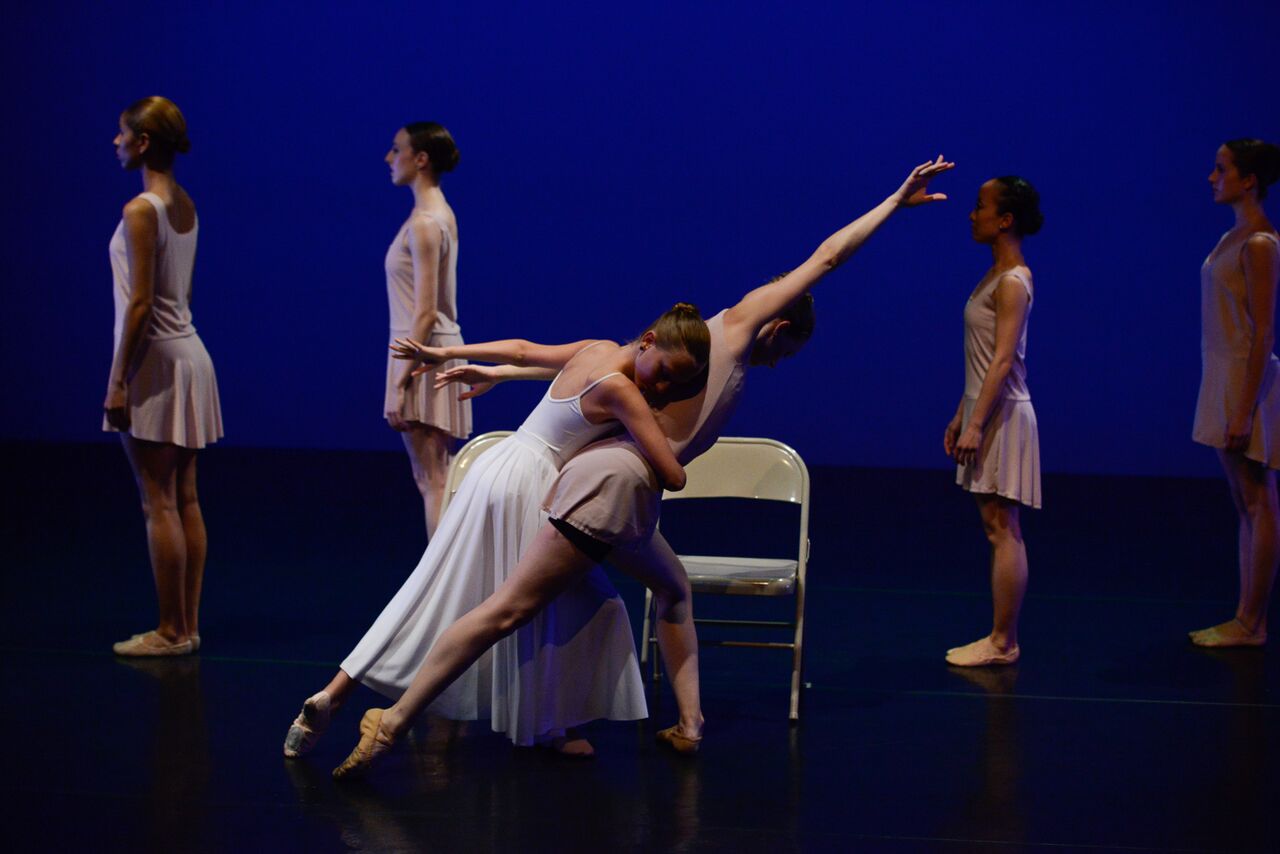
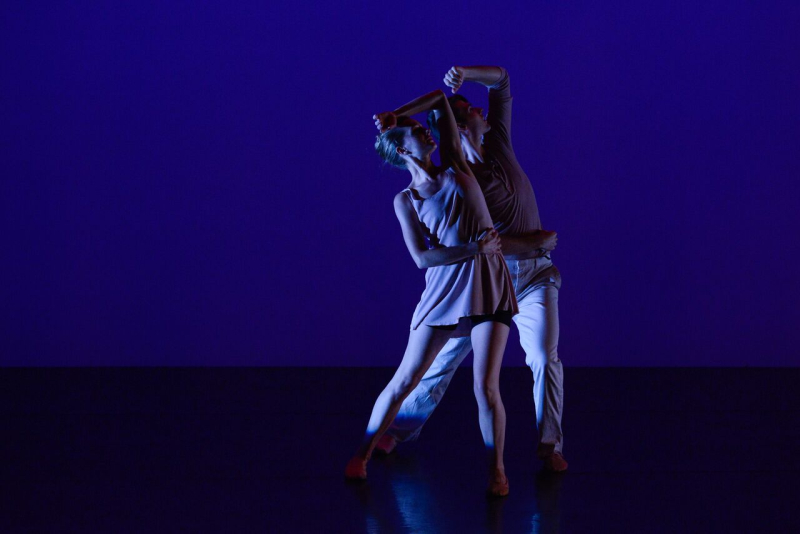
    To music by Marc Mellits and Philip Glass, the choreographer has deployed her large cast in an inspired manner; the ballet features the appearance of a young girl, Sara Spangler, and centers on three couples: Mary Beth Hansohn and Peter Chursin, MinSeon Kim and Chazz Fenner-McBride, and Katie Martin-Lohiya dancing with Daniel Pigliavento.

    One aspect of this work that is most intriguing is that its narrative qualities seem to loom up along a fluid timeline; rather than linear storytelling, the dancers seem to slip from the here-and-now into memories from the past and dreams of things to come. Philip Glass’s music amplifies this sense of layers of time, just as it did in Lydia Johnson’s earlier work Summer House, also danced to Glass.
    _NA08770

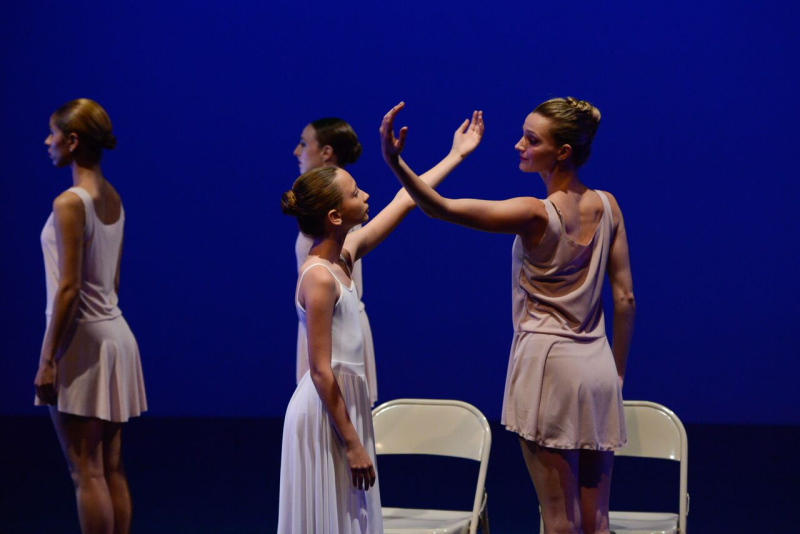
    The Marc Mellitts segment of This, and my heart beside… has the feeling of a prologue. Sara Spangler’s perfection in the role of The Child (above, with Katie Martin-Lohiya) removed the risk of any inadvertent scene-stealing on her part: she was a calm, natural, lovely presence throughout.
    _NA08776

    Sara Spangler and Katie Martin-Lohiya

    Once the Philip Glass music commences, we are drawn deeper into the drama. In a dancework rife with emotion, the exact inter-relationships of the characters become a matter of what the individual viewer chooses to focus on. There is much going on; the ballet will require additional viewings before one can draw any definitive conclusions – though, on the other hand, definitive conclusions may not be possible in this case.

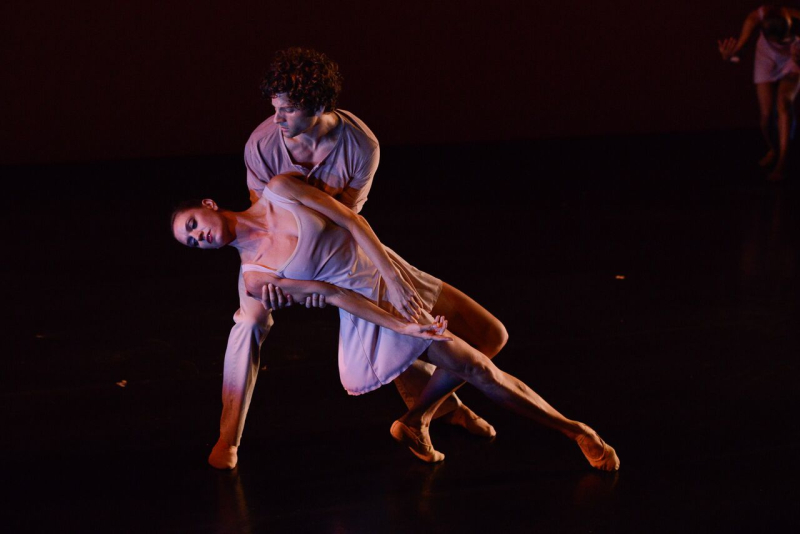
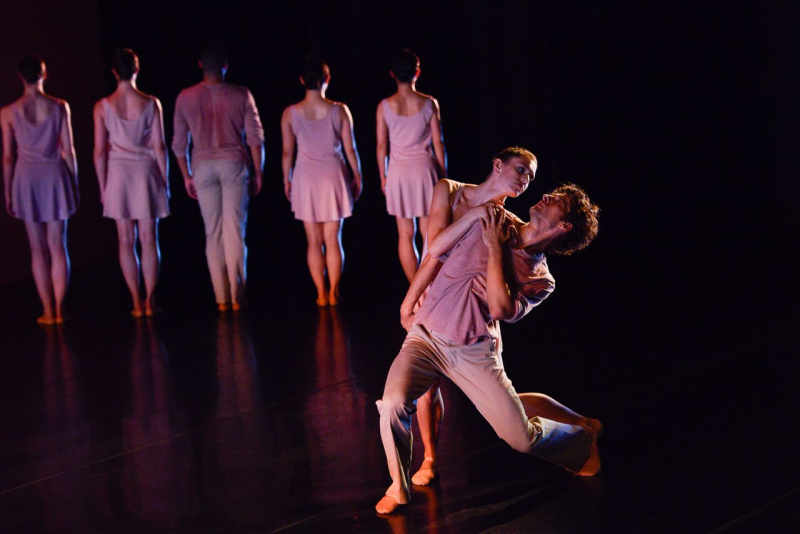
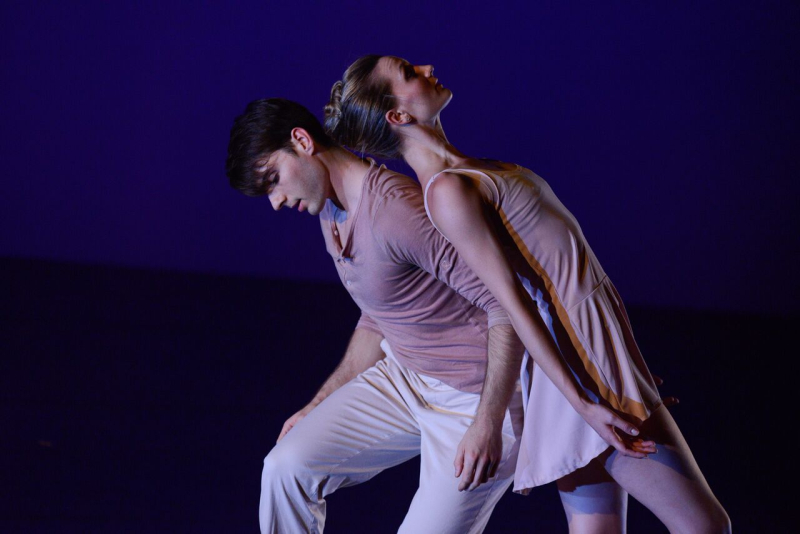
    In a striking partnership, Mary Beth Hansohn and Peter Chursin delved into both the passion and the problems inherent in a long-time love affair. Resistance and surrender vie for the upper hand, and it is all so true-to-life. Here are some of Nir’s images of this charismatic pair of dancers:
    _NA08844

    _NA08867

    _NA08957

    _NA08970

    _NA09121 - Copy

    One memorable moment in the Hansohn/Chursin relationship came when they seemed to express opposing viewpoints in flashes of pirouettes.
    _NA08871

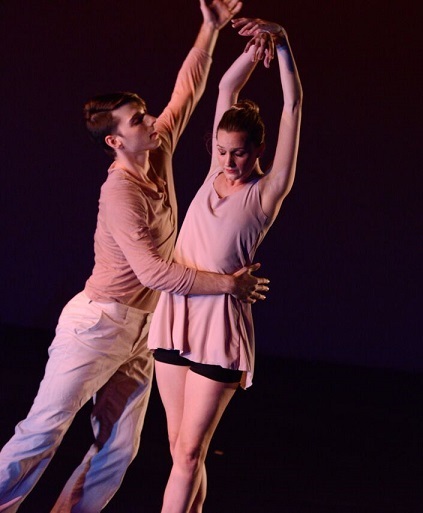
    The second couple, Katie Martin-Lohiya and Daniel Pigliavento (above), seem more steadfast in their love. It is they, in the end, who have charge of the young girl.
    _NA08890

    _NA08935 - Copy

    Thumbnail_Min and Chazz in This....

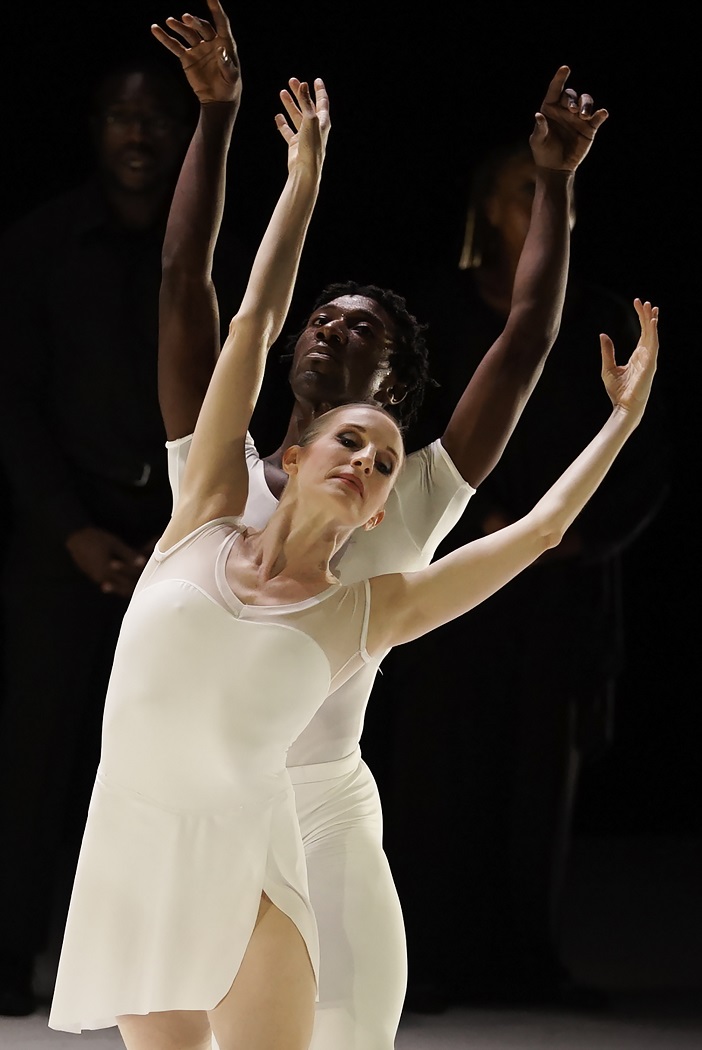
    MinSeon Kim and Chazz Fenner-McBride (above) are a youthful couple, alternately joyous and a bit scrappy; all seems well between them until – as the ballet nears its end – Chazz becomes intrigued with Mary Beth. This sets up a brief and subtle but tension-filled encounter for Chazz and Peter. The situation remains unresolved, as does the music. As the light fades, Peter and MinSeon are on their own, with Mary Beth in Chazz’s encircling arms. The child, for whom all that has gone before may be a vision of the future, is safe in the protective love of Katie and Daniel.
    Others will have seen variable narratives in this complex but wonderfully absorbing work; and over time, I may change my opinion of what has happened in the course of This, and my heart beside…

    But I won’t change my mind about the work itself: it’s something to treasure.

    ~ Oberon