
Tatiana Troyanos and Placido Domingo sing the Pollione/Adalgisa duet from Act I of Bellini’s NORMA at a 1982 gala concert at The Met. James Levine conducts.
Watch and listen here.
Tatiana Troyanos and Placido Domingo sing the Pollione/Adalgisa duet from Act I of Bellini’s NORMA at a 1982 gala concert at The Met. James Levine conducts.
Watch and listen here.
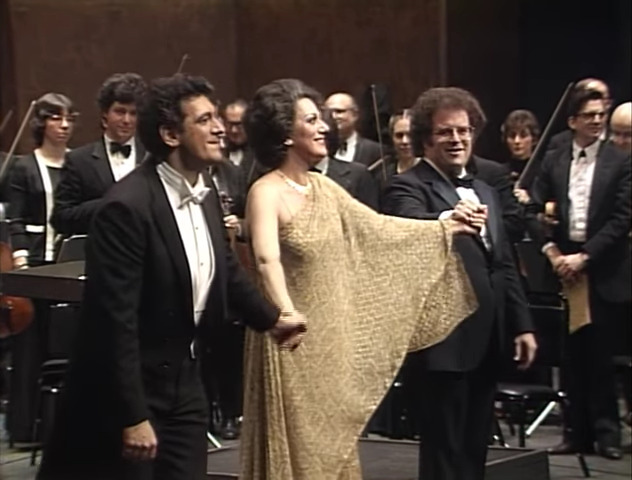
Tatiana Troyanos and Placido Domingo sing the Pollione/Adalgisa duet from Act I of Bellini’s NORMA at a 1982 gala concert at The Met. James Levine conducts.
Watch and listen here.
Above: Anna Larsson (Erda) gives a wonderfully subtle interpretation in this concert performance of Wagner’s DAS RHEINGOLD at Baden-Baden, 2004. Sir Simon Rattle conducts a very impressive cast.
Watch and listen here.
You’ll want to block the annoying ads.
CAST:
Sir Willard White – Wotan
Oleg Bryjak – Alberich
Kim Begley – Loge
Yvonne Naef – Fricka
Robbin Leggate – Mime
Geraldine McGreevy – Freia
Anna Larsson – Erda
James Rutherford – Donner
Timothy Robinson – Froh
Peter Rose – Fasolt
Robert Lloyd – Fafner
Kate Royal – Woglinde
Karen England – Wellgunde
Christine Rice – Flosshilde
Orchestra of the Age of Enlightenment
Sir Simon Rattle
Baden-Baden, 2004
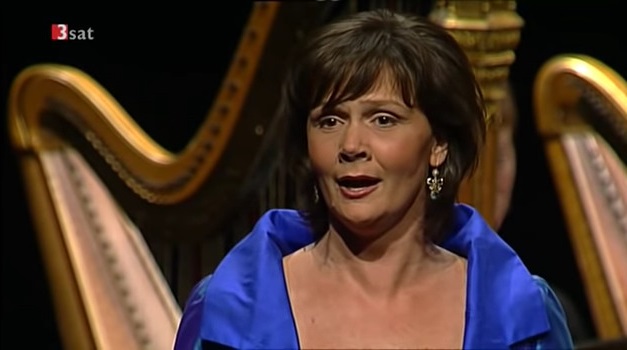
Above: Anna Larsson (Erda) gives a wonderfully subtle interpretation in this concert performance of Wagner’s DAS RHEINGOLD at Baden-Baden, 2004. Sir Simon Rattle conducts a very impressive cast.
Watch and listen here.
You’ll want to block the annoying ads.
CAST:
Sir Willard White – Wotan
Oleg Bryjak – Alberich
Kim Begley – Loge
Yvonne Naef – Fricka
Robbin Leggate – Mime
Geraldine McGreevy – Freia
Anna Larsson – Erda
James Rutherford – Donner
Timothy Robinson – Froh
Peter Rose – Fasolt
Robert Lloyd – Fafner
Kate Royal – Woglinde
Karen England – Wellgunde
Christine Rice – Flosshilde
Orchestra of the Age of Enlightenment
Sir Simon Rattle
Baden-Baden, 2004

Doori Na plays Jessie Montgomery’s Rhapsody #1 in an at-home performance during the pandemic. Watch and listen here.
Doori is the resident violinist of Miro Magloire’s New Chamber Ballet. During this period of isolation, Doori has been producing a series of Laid Bach Concerts: watch them here.
Read about composer Jessie Montgomery here.
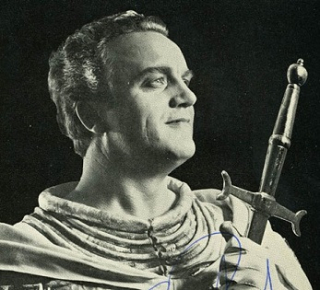
Ticho Parly (above, as Lohengrin) would have been my first-ever Tristan if I’d been able to secure a ticket for one of his 1966 Met performances of the role, opposite Ludmila Dvořáková. But every performance at the Met in that opening season was sold out well in advance, and so it was not until 1982 that I had the unexpected pleasure of hearing this estimable helden-tenor.
Born in Denmark, Ticho Parly went from being a treble to being a bass-baritone. It was while studying with Charles Paddock (the teacher of Anthony Laciura and Greer Grimsley) in New Orleans that Parly settled in as a tenor. He made his operatic debut with New Orleans Opera as Pong in Turandot.
Returning to Europe, the tenor sang at Aachen, Brussels, Wuppertal, Lisbon, Kassel, Amsterdam, and Vienna. He made his Bayreuth debut in 1963 as Walther von Stoltzing in Meistersinger, and returned to the Festival to sing Siegmund and Siegfried in 1966.
1966 was also the year of his Met debut, in the afore-mentioned Tristan und Isolde. Parly’s other Met roles were Erik in Fliegende Hollander and Aegisth in Elektra.
Ticho Parly’s career kept him shuttling between Europe and the Americas: he sang at Covent Garden, La Scala, Paris, Covent Garden, San Francisco, Mexico City, and at the Teatro Colón. His roles included Tannhauser, Parsifal, Loge, the Drum Major in Wozzeck, Herod in Salome, the Emperor in Frau ohne Schatten, Florestan, Bacchus, and Peter Grimes. He was active thru 1988, when he sang Otello in Denmark, and passed away in 1998 in Seattle where he had been teaching.
Here’s the story of my one opportunity to hear Ticho Parly live:
An enterprising organization called The Wagner International Institution offered the complete Ring Cycle in concert form at Northeastern University on Boston. The operas were given on four consecutive Sunday afternoons. My friend Paul and I decided to give the Walkure a try, prompted mainly by the fact that Roger Roloff was singing Wotan. We enjoyed it thoroughly, and immediately obtained tickets for the Götterdämmerung, scheduled for two weeks later.

Ticho Parly was not the announced Siegfried in the pre-publicity for this Ring, but on performance day, there he was onstage. He’d had a long career and I was unsure of what to expect from him, but here’s what I wrote the day after:
“Ticho Parly was a surprise Siegfried. He sang commandingly and sustained the long, often cruelly demanding part impressively. He had ample vocal heft, and the tone is still quite pleasant; his diction so clear, and his feeling for the music so sure. His third act was especially fine: a huge and sustained high-C on “Hoi-ho!” (greeting the hunting party) and a firm rendition of his long narrative. His final apostrophe to Brünnhilde was tenderly sung, and moving. In sum: an excellent performance!”
Mr. Parly recorded Siegfried’s farewell to Brünnhilde: here.
Mr. Parly and Gladys Kuchta sing the final duet from Siegfried from a 1966 NY Philharmonic concert conducted by Lukas Foss. Ms. Kuchta never quite makes it up the the concluding high-C but otherwise it’s a very interesting performance. Listen here.
~ Oberon

American soprano Judith Raskin (above) began taking voice lessons while attending Smith College. She began concertizing, and in 1957 sang Sister Constance in a televised performance of Poulenc’s DIALOGUES OF THE CARMELITES. She made her New York City Opera debut as Despina in 1959, and enjoyed a personal success there in the title-role of Douglas Moore’s BALLAD OF BABY DOE.
Ms. Raskin made her Metropolitan Opera debut in 1962 as Susanna in NOZZE DI FIGARO and went on to give more than a hundred performances with the Met company over the next decade. Her roles included Marzelline, Nanetta, Sophie in ROSENKAVALIER, Zerlina, Pamina, and Micaela.

I first saw Judith Raskin onstage as Pamina in the Marc Chagall production of THE MAGIC FLUTE. She made such a beautiful impression in Mozart’s sublime music. Later I saw her in her signature role as Susanna in NOZZE DI FIGARO. Her last Met performance was as Marzelline in 1972.
Judith Raskin sang with the opera companies of Chicago and San Francisco, and appeared as Pamina at the Glyndebourne Festival, She also performed frequently in concerts, most notably with the Cleveland Orchestra under George Szell. And she once said, ““In my heart of hearts, I have always been a recitalist.”
After retiring from the stage, Judith Raskin taught at the Manhattan School of Music. She passed away in 1984.
Judith Raskin sings Samuel Barber’s Knoxville: Summer of 1915 here.
~ Oberon

I heard soprano Ángeles Gulín (above) as Valentine in a concert performance of LES HUGUENOTS at Carnegie Hall in 1969, singing Valentine opposite Beverly Sills and Tony Poncet. Ms. Gulín had one of the biggest voices I ever encountered.
There are not many souvenirs of her career. This TABARRO, though not in great quality, is enjoyable.
Watch and listen here.
CAST: Luigi: Placido Domingo; Giorgietta: Ángeles Gulín; Michele: Sylvano Carrolli; Frugola: Isabel Rivas; Tinca: Jose Manzaneda; Talpa: Jose Luis Alcalde. Conductor: Olivero di Fabritiis
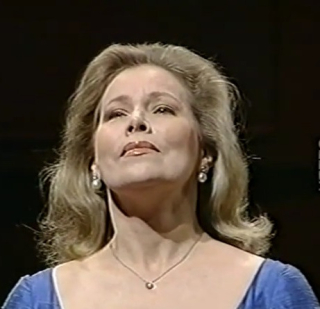
Julia Varady sings Strauss’s Vier Letze Lieder in a 1992 concert with the Gewandhaus Orchestra conducted by Kurt Masur. Watch and listen here.

Erin Wall, a native of Calgary, Canada, was a finalist at the 2003 Cardiff Singer of the World competition. She had made her international debut the previous year singing Britten’s War Requiem in London. She spent three seasons building repertoire at Lyric Opera of Chicago, and made her Met debut in 2009 as Donna Anna. In 2014, I had the pleasure of hearing her as Strauss’s Arabella at The Met.
Erin Wall’s repertoire includes Freia, the 3rd Norn, Strauss’s Daphne, Marguerite in Faust, Ellen Orford, Chrysothemis, Helena in Britten’s Midsummer Night’s Dream, Thais, and Mozart’s Contessa Almaviva. She does a lot of concert work, most notably the Mahler symphonies 2, 4, and 8, and Strauss’s Vier Letze Lieder.
Erin Wall – Vier letzte Lieder ~ Frühling

Counter-tenor Matthias Rexroth was born in Nuremberg and made his debut in Purcell’s King Arthur at Stuttgart in 1999. Having won major voice competitions at Barcelona and Vienna, Mr. Rexroth was soon performing Bach and Baroque works all over Europe, and he represented Germany at the 2003 Cardiff Competition. He sang often with conductor Nikolaus Harnoncourt, and also with Riccardo Muti and Rafael Frühbeck de Burgos. His operatic repertory covers numerous Handel roles and ranges from Monteverdi to Britten.
Watch Mr. Rexroth singing at the the 37th Concurso Francisco Viñas in Barcelona here.
Since 2014, Mr. Rexroth has been professor of voice at the Opera Academy of Warsaw; he also gives masterclasses internationally.
Parts of Ms. Wall’s and Mr. Rexroth’s 2003 Cardiff performances are heard here:
Cardiff 2003 – Matthias Rexroth – Erin Wall
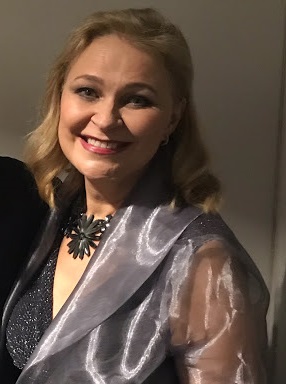
Bucharest-born Ruxandra Donose came to prominence following an impressive showing at a voice competition at Munich in 1990. She soon joined the opera company at Basel, and – thereafter – the Vienna State Opera. Her international career has since continued apace, and lately she has taken on roles like Kundry and Sieglinde.

Above: Ruxandra Donose as Nicklausse in Contes d’Hoffmann; a Marty Sohl/Met Opera photo
I met Ruxandra in 2004 while I was working at Tower Records; she was singing Nicklausse at The Met and she stopped by at the opera room. We had a lovely chat.
Here’s Ruxandra at the 1993 Cardiff competition:
Ruxandra Donose – Allerseelen – Cardiff 1993
And Roger Vignoles is the pianist for Ruxandra’s lovely singing of Dalila’s seduction aria from a 2014 London recital here.
~ Oberon

 Oberon's Glade