Category: Music

  • van Zweden’s Bruckner 8th @ The NY Phil

    JaapVanZweden

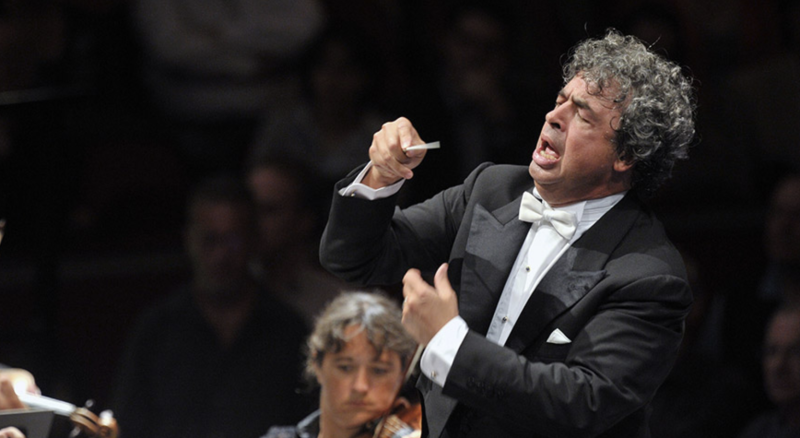
    Above: Jaap van Zweden, Musical Director of The New York Philharmonic

    ~ Author: Oberon

    Friday September 28th, 2018 – This evening was our first opportunity to hear Jaap van Zweden lead The New York Philharmonic since he officially took up the position of Musical Director. My friend Ben Weaver and I splurged and bought tickets to this concert because Bruckner is always on our must-hear list. In 2014, I had my first live encounter with the composer’s 8th in this very hall, under Alan Gilbert’s baton. It was a revelation.

    Tonight, Jaap van Zweden offered Conrad Tao’s Everything Must Go as a prelude to the Bruckner 8th. Does this massive symphony need a prelude? No. As with many ‘new’ works we’ve encountered over the past few seasons, Everything Must Go is expertly crafted but it sounds like so much else: by turns spare and noisy, with frequent percussive bangs and pops, this eleven-minute piece (it felt longer) passed by without providing any sense of the composer’s individual voice. Perhaps hearing more of Mr. Tao’s work – music not yoked to an existing masterpiece that employs the same orchestral forces – will lead us to discover who he is.

    Since there was no pause between the Tao and the Bruckner, the audience’s response to Everything Must Go could not be gauged. I wonder if the young composer took a bow at the end; we had headed out as the applause commenced.

    For the first two movements of the Bruckner, I was enthralled. The orchestra sounded truly superb, and Maestro van Zweden held sway with a perfect sense of the music’s architecture. It was a tremendous relief and balm to emerge from the day’s madness (the Kavanaugh hearings) into Bruckner’s vibrant world.

    The Philharmonic musicians offered rich tone and marvelous colours, the brass sounding grand and the violins singing lyrically in their big theme. The music has a Wagnerian sense of the monumental, and a ceaseless melodic flow. Among the solo moments, Sherry Sylar’s oboe stood out. At one point there’s an almost direct quote from Tchaikovsky’s SLEEPING BEAUTY. During a respite/interlude, softer themes mingle before a splendid onslaught from the brass turns grandiose. The movement ends on a murmur.

    The Scherzo has as its main and oft-repeated theme a churning 5-note figure that has worked its way into the soundtrack for GAME OF THRONES. As the movement progresses, the harp makes a lovely effect, as do the entwining voices of solo woodwinds. Textures modify seamlessly, sustaining our pleasure.

    A deep sense of longing suffuses the opening of the Adagio, with its rising passion. Again the harp glimmers magically. The rise and fall of great waves of sound bring passages of almost unbearable beauty; there’s a spectacular build-up to music of searing passion which evaporates into soft halo of solo winds. As the music re-builds, a Tchaikovskian glory permeates. It seems, though, that Bruckner cannot quite decide how to end this epic movement.

    Pulsing, march-like, and majestic, the Finale leads us onward. A big swaying rhythm from the timpani leads into a huge tsunami of sound. The work began to feel like a series of climaxes, though, and traces of brass fatigue started to crop up. The Maestro and the musicians were engulfed by gales of applause and cheers at the end. 

    I’m probably in a minority in feeling that Alan Gilbert’s 2014 rendering of the Bruckner 8th with the Philharmonic reached me on a deeper level, as well as being more exhilarating. “Well, it was faster!”, Ben Weaver would say. À chacun son goût…

    ~ Oberon

  • Wagnerian Voices

    Eileen farrell

    Above: Eileen Farrell

    This recording of Eileen Farrell singing the Immolation Scene from GOTTERDAMMERUNG is quite a rarity. I first received it back in the 1970s when I was exchanging reel-to-reel tapes with contacts in the USA and Europe. Later, I copied it to cassette, and of course it was a priority in my two-year project of creating MP3 before discarding my cassette collection.

    Eileen Farrell – Immolation Scene – Ozawa – Ravinia 1970

    George London as Wotan

    Above: George London as Wotan

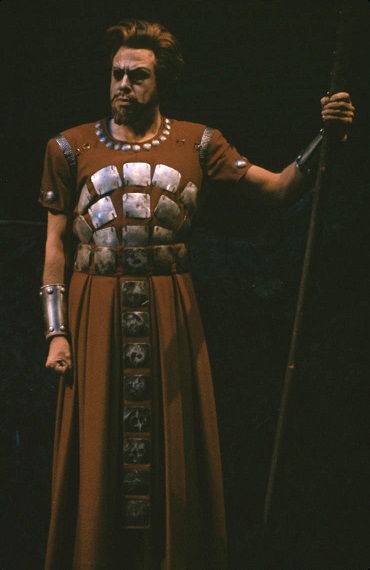
    During his years at The Met, I was not a great admirer of George London’s voice. The tragic early termination of his career is a very sad chapter in the annals of opera. Just recently, I have come to think highly of him.

    George London – Abendlich strahlt die Sonne Auge ~ RHEINGOLD

    Boese Bayreuth 1965

    Above: Ursula Boese at the Bayreuth Festival, 1965

    Ursula Boese made her Bayreuth debut in 1958 as Flosshilde, following successes on the concert platform. Her international career extended into the 1990s and included such roles as Cornelia in GIULIO CESARE, Jocasta in OEDIPUS REX, Ulrica, Dalila, and Klytemnestra. Here is her doom-ladened rendering of Erda’s Warning:

    Ursula Boese – Das Rheingold ~ Weiche Wotan weiche – with Polke – Hesse

    Peter Hofmann

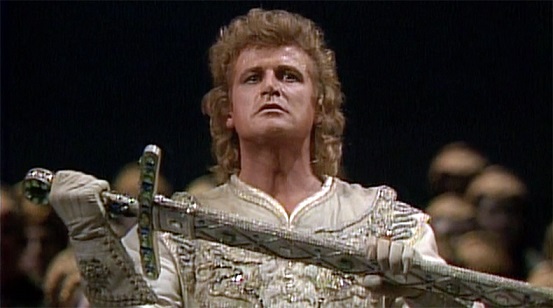
    Above: Peter Hofmann as Lohengrin

    Peter Hofmann was perhaps better-admired for his stage presence than his actual singing, though he did give some perfectly fine performances. He is best-remembered for his Siegmund in the internationally televised Chéreau RING Cycle from Bayreuth in 1976. I saw him at The Met as Lohengrin, twice as Siegmund, and singing with Leonie Rysanek at her 25th Anniversary gala. Hofmann was slated to take on the Siegfrieds at The Met, but he wisely withdrew. After leaving the opera stage, he gave rock concerts, and appeared in over three hundred performances of Phantom of the Opera in Hamburg, Germany. He passed away in 2010 at the age of 66 from complications of Parkinson’s Disease.

    Peter Hofmann ~ LOHENGRIN Narrative – Bayreuth 1982

    C ludwig

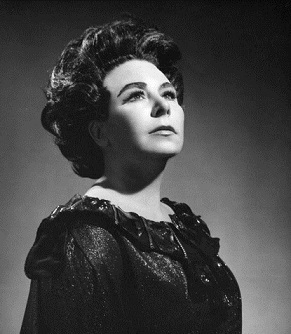
    Above: Christa Ludwig as Fricka in a Louis Melançon photo

    I think, all things considered, Christa Ludwig ranks as my all-time favorite singer. She gave me so many wonderful evenings, and so many hours of enjoyment thru her recordings. She was my first Octavian, first Dyer’s Wife, first Berlioz Dido. You never forget such firsts. In 1988, on the first night of the ‘Levine’ GOTTERDAMMERUNG, Christa sang Waltraute; she walked out unassumingly for a solo bow after the first act and the house literally exploded in an epic ovation. She seemed genuinely moved.

    Christa Ludwig never sang Isolde onstage, but her recording of the Liebestod is among the finest.

    Christa Ludwig – Liebestod ~ TRISTAN UND ISOLDE

    ~ Oberon

  • Leonie Rysanek as Sieglinde

    Scanned Section 6-1

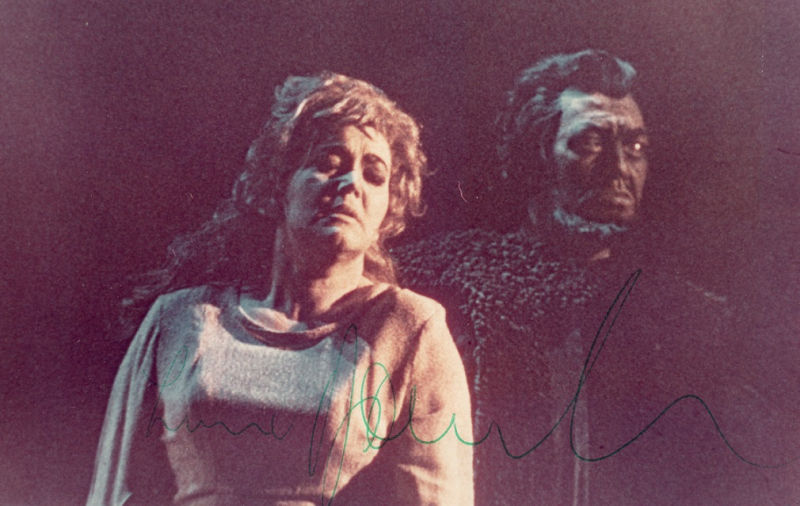
    I brought this photo of Leonie Rysanek with me for her to autograph after a performance of FRAU OHNE SCHATTEN at The Met in 1971. Why she was signing photos with a green pen I am not sure…her signature is barely legible; but she loved the photo. With her in the picture is basso David Ward, as Hunding.

    I did not see Rysanek as Sieglinde until 1988, in a matinee performance that marked the last time she sang this signature role of hers at The Met. Hildegard Behrens, to whom Rysanek later left the Lotte Lehmann Ring, was Brünnhilde. The two divas took many bows together after the performance, to the delight of the huge crowd.

    Walkure6465.01

    Among the great tenors who sang Siegmund to Rysanek’s Sieglinde was Jon Vickers (Met Opera Guild photo, above).

    In 1985, Rysanek sang Sieglinde in the first act of WALKURE as part of her 25th anniversary gala celebration at The Met; Peter Hofmann was her Siegmund that afternoon. My friend Paul Reid and I were there. Rysanek had become famous for her scream at the moment Siegmund pulls the sword from the tree; this was apparently Wieland Wagner’s idea, and it became a signature moment whenever the soprano sang Sieglinde anywhere in the world. 

    As the 1985 gala was a concert performance, with the orchestra onstage and the singers in gown and tux, there was some speculation as to whether Rysanek would include the scream. “It would break the frame of the concert,” said the woman sitting behind us. “She won’t scream.” She screamed.

    As a sampling of Rysanek in the role of Sieglinde, here she is – in fabulous voice – at Bayreuth in 1967, opposite James King:

    Leonie Rysanek – Der Männer Sippe ~ WALKURE – with James King – Böhm cond – Live @ Bayreuth 1967

  • The Search for a Symphony @ Merkin Hall

    Brahms

    Above: Johannes Brahms

    ~ Author: Oberon

    Tuesday June 19th, 2018 – The last concert the St Luke’s Chamber Ensemble‘s series, Facets of Brahms, at Merkin Hall brought us Andy Stein’s octet-arrangement of the Beethoven Symphony No. 2 in D Major, Op. 36, and Alan Boustead’s nonet-reconstruction of Johannes Brahms’s Serenade No. 1 in D Major, Op. 11, which – in its orchestrated form – might have been designated as the composer’s first symphony.

    Brahms seems to have been hesitant to attempt composing a symphony in large part because he could hear “the footsteps of a giant” – Beethoven – walking behind him. Brahms’s anxiety meant that it wasn’t until 1876 that his 1st symphony premiered, some 14 years after he’d made preliminary sketches.

    This evening, the St. Luke’s Chamber Ensemble opened with Beethoven 2nd Symphony in an octet realization conceived by Andy Stein. Two violins, one viola, a cello, a bass, and clarinet, bassoon, and horn made up the ensemble. Their full, rich playing did not give a feeling of a ‘reduction’ in any sense of the word. Instead, it was a very pleasing, absorbing experience; and Mr. Klein was called to the stage for a bow, warmly greeted by the crowd.  

    The 2nd opens with a slow introduction which in a flash turns into a lively Allegro; this is ‘glad music’, rich in melodies. In the Larghetto, Beethoven churns out cordial, lyrical themes. The music summons up thoughts of Springtime, flowering meadows, and blue skies. The Scherzo shows the composer’s sense of humour, which to me seems even more evident in the witty opening of the final Allegro molto, which seems to have a touch of sarcasm.

    248630_web_Jon-Manasse

    Above: Jon Manasse

    In tonight’s ensemble, Jon Manasse’s clarinet playing made a superb impression: I have heard him play often in recent seasons and he makes the music so alive, with his fragrant tone and attention to dynamic detail. His subtle playing in the final movement gave me a smile.  Of equal note was the sound of Marc Goldberg’s mellow bassoon. Violinist Krista Bennion Feeney, so fine in last week’s concert, impressed again, as did bassist John Feeney.

    The Brahms 1st Serenade is in six movements. The composer noted it as a ‘Sinfonie-Serenade‘, later enlarging it for full orchestra at the urging of Clara Schumann. Alan Boustead gives the music back to its chamber roots in his excellent rendering.

    Jesse Mills was the principal violinist in this work tonight, with Ms. Bennion Feeney, violist David Cerutti, cellist Daire FitzGerald along with Mr. Feeney’s bass filling out the string contingent. Joseph Anderer provided warm-toned horn-playing, and clarinetist Dean LeBlanc joined Mr. Manasse. Elizabeth Mann’s flute sang forth with serene, appealing tone.

    The first three movements of this Serenade each felt a bit long tonight, as if the composer wanted to keep presenting his admittedly lovely themes to us again and again. By the fourth movement, a double Menuetto featuring the winds, Brahms was showing more economy. Ms. Fitzgerald and Mr. Anderer made the most of the ‘hunting call’ motif of the Scherzo, whilst Ms. Mann’s playing in the Rondo~Allegro was very pretty indeed. And throughout, Mr. Manasse continued to display the artistry that makes him such a valuable player on the Gotham scene. 

    ~ Oberon

  • Marta Fuchs

    39235935a63d757910b3525bd1f52d09

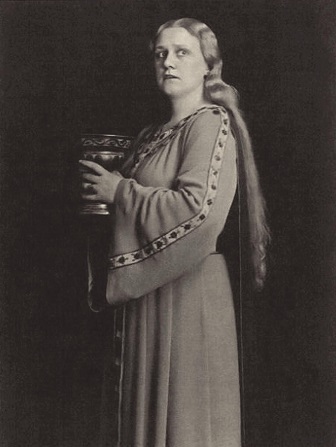
    Above: Marta Fuchs as Kundry

    Marta Fuchs began her career as a contralto in 1923; for the first five years, she sang only concerts. In 1928, at Aachen, she began singing such operatic roles as Gluck’s Orfeo, Verdi’s Azucena, and Carmen. Then, in 1930, Fuchs made the switch to dramatic soprano, though she retained parts of her old repertoire. At the Dresden Oper, she sang the world premieres of several now-forgotten operas.

    In 1931, she debuted at the Deutschen Opernhaus, Berlin, as Octavian in Der Rosenkavalier; she had a great success. From 1935, she was associated with both Dresden Oper and Berlin’s Staatsoper. Marta Fuchs became one of her generation’s foremost interpreters of the great Wagner roles. From 1933 to 1942, at Bayreuth, she was a celebrated Isolde (1938), Kundry (1933-1937), and Brünnhilde (1938-1942).

    In 1936 she appeared as a guest with the ensemble of the Dresden State Opera at the Covent Garden Opera in London as Donna Anna in Don Giovanni, as Marschallin in Rosenkavalier, and as Ariadne in Ariadne auf Naxos; and in 1938, she sang Isolde at the Théâtre des Champs-Élysées in Paris. 1942 brought successful guest appearances at the Maggio Musicale, Florence (as Leonore in Fidelio), and the Vienna State Opera, where she continued to appear until 1944.

    An ardent Christian, Fuchs steered clear of the rising tide of National Socialism. Because Adolf Hitler was an ardent lover of Wagner, he had met Fuchs. In 1936, the soprano told Hitler: “Mr Hitler, you are going to make war!” After Hitler’s protestation, she replied, “I don’t trust you.” In May 1939 Hitler greeted her asking, “Now, have I made war?” Fuchs replied, “I still don’t trust you.”

    Marta Fuchs fled the destruction of Dresden, eventually settling in Stuttgart and appearing with the opera company there. She retired from singing in 1954, and passed away some twenty years later.

    Many years ago I had heard the Fuchs voice during a time when I was exploring singers of the past. But recently, I came back to her, and am much taken with the beauty and expressiveness of her singing in Brünnhilde’s pleading of her case to Wotan from Act III of Walkure:

    Marta Fuchs – War es so schmählich ~ WALKURE

    And here is her wonderful Liebestod from Tristan und Isolde:

    Ef7c73fe9cb47a77997a845a90adf7e1

    Marta Fuchs – Liebestod ~ Tristan und Isolde

    ~ Oberon

  • Brahms & The Schumanns @ Merkin Hall

    214053_750

    Above: pianist Pedja Mužijević, photographed by Jacob Blickenstaff

    ~ Author: Oberon

    Tuesday June 12th, 2018 – Works by Johannes Brahms, Robert Schumann, and Clara Schumann were on offer as musicians from the Orchestra of St Luke’s joined pianist Pedja Mužijević in this concert at Merkin Hall which is part of a series entitled Facets of Brahms.

    Johannes Brahms, Clara Schumann, and Robert Schumann were close friends and confidantes. Schumann had pronounced Brahms the heir of Beethoven, marking him out as third of the Three Bs. Following Schumann’s mental deterioration and his eventual death in an asylum, Brahms and Clara continued a flirtatious friendship that endured for many years.

    Johannes Brahms’ Scherzo from the Sonatensatz in C-Minor was the composer’s share in an 1863  collaborative musical gift for the violinist Joseph Joachim; Robert Schumann and Albert Hermann Dietrich each contributed movements of their own.

    In this evening’s performance, violinist Krista Bennion Feeney joined Mr. Mužijević. We were seated very close to the stage, and at the Scherzo‘s animated start, the sound of the piano seemed often to overwhelm the violin. Ms. Bennion Feeney is a subtle artist, and it took a few moments for the balance between the two instruments to be achieved. Thereafter, the performance became distinctive, with alternating currents of passion and lyricism. Ms. Bennion Feeney’s arching tonal glow in the central violin theme was most appealing; the piece then moves on to a big finish. 

    Returning with cellist Myron Lutzke – whose playing with the St Luke’s orchestra has often endeared itself to me – the violinst and pianist gave a wonderfully simpatico rendering of the Schumann Piano Trio No.1, Op. 63. Mr. Lutzke’s dusky timbre and his Olde World cordiality of style seemed beautifully matched to Ms. Bennion Feeney’s superb control of dynamics whilst Mr. Mužijević at the Steinway reveled in the many marvelous piano passages Schumann has provided.  

    The opening movement is marked, “Mit Energie und Leidenschaft” (‘With energy and passion’). Throughout the first movement, achingly expressive passages from the violin over piano arpeggios alternate with dramatic outbursts. The cello’s incursions are relatively brief but telling. A change of mood near the end builds slowly to a kind of grandeur. Deep tones from the cello then have a calming effect, before another build-up leads to a return to the first theme, now altered and lovingly styled by Ms. Bennion Feeney. The music flows on to a rather unusual minor-key finish. 

    The second movement has a lively, scherzo-like quality. Its repeated rising theme and sense of rhythmic drive have a wonderfully familiar feeling. The rising motif returns in the Trio section, although here it is slower and more thoughtful. Violin and cello sing up and down the scale, then we zoom back to the original ascending theme, to a sudden ending.

    Marked “Langsam, mit inniger Empfindungen” (‘Slowly, with inner feeling’), the third movement ravishes with a poignant violin melody, the cello providing a tender harmony. Things grow more animated; the violin hands over the melody to the cello and their voices entwine. This music drew me in deeply as it lingered sadly, with sustained low cello notes. The movement ends softly, and the three musicians went directly into the Finale, with its joyous song. An exhilarating rush to the finish brought warm applause for the three players.

    As the audience members returned to their seats after the interval, it was apparent that our neighbors had stepped out for a cigarette: the smell was dense and unpleasant. We made a quick dash to the balcony where the usher was welcoming. We found a quiet – though chilly – spot from which to enjoy the concert’s second half.

    Ms. Bennion Feeney and Mr. Mužijević’s radiant performance of Clara Schumann’s Romances for Violin, Op. 22, assured that Frau Schumann’s music more than held its own when set amidst that of her more celebrated husband and the masterful Brahms.

    From its lovely start, the first Andante molto has a sense of yearning, the violinist bringing both depth of tone and gentle subtlety. Lightness of mood marks the Allegretto, with its passing shifts to minor, decorative trills, and a wry ending. A lilting feeling commences the final movement, melodious and – again – modulating between major and minor passages. The piano takes up the melody, and all too soon the Romances have ended.

    Ms. Bennion Feeney and Mr. Mužijević rounded out their busy evening with the Brahms Horn Trio, Op. 40, joined by Stewart Rose. Mr. Rose’s tone can be robust or refined, depending on the musical mood of the moment. A few passing fluffed notes go with the territory: as a frustrated horn-player, I know it all too well.

    I did find myself wishing that the violinist and horn player had been seated during this piece; I think it makes for a more intimate mix with the piano. The music veers from the pastoral to the poignant, from rich lyricism to sparkling liveliness, and the ‘hunting horn’ motifs in the final Allegro con brio always give me a smile. The three players made this quintessential Brahms work the crowning finale of a very pleasing evening.

    ~ Oberon

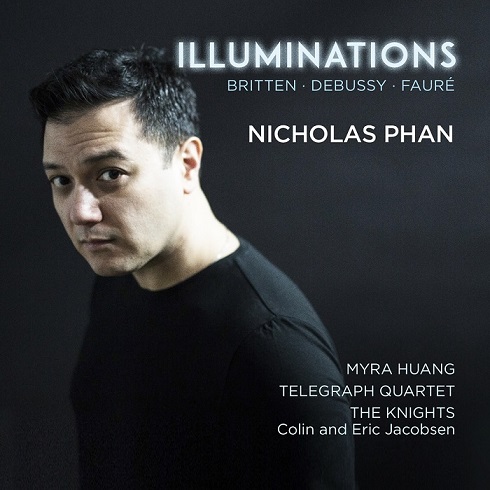
  • Nicholas Phan: ILLUMINATIONS

    822252238228-cover-zoom

    ~ Author: Oberon

    A new disc from tenor Nicholas Phan has come my way. Entitled ILLUMINATIONS, the CD features works by Britten, Debussy, and Fauré. During the classical music season, I don’t listen to a lot of music at home; I’m so busy attending and writing about live performances that I need downtime during the day so that everything stays fresh. But Mr. Phan’s voice being a particular favorite of mine, and the repertory on ILLUMINATIONS being extremely enticing, I soon found time to listen.

    Having Myra Huang at the keyboard is an added attraction: she and Mr. Phan gave a memorable recital at the Caspary Auditorium in 2009, and their work together on ILLUMINATIONS confirms the appeal of their partnership.

    While the three composers represented on the disc are all high on my list of favorites, Gabriel Fauré‘s La Bonne Chanson is the least-familiar to me of the pieces Mr. Phan has programmed. These songs were composed mainly in the summers of 1892 and 1893, when the composer had fallen in love with the soprano Emma Bardac, a married woman. Fauré chose poems by Paul Verlaine that reflected his romantic exultation; the cycle – for voice, piano, and string quartet – is dedicated to Mme. Bardac, who later married Claude Debussy.

    Even before we hear the voice of Mr. Phan on the recording, the briefest opening phrase from the Telegraph Quartet establishes the mood. The tenor then begins to sing – “Une Sainte en son aureole” – and his expressive gifts are immediately evident, the words coloured by a sense of romance that is at once calm and urgent. Ms. Huang’s rippling piano motif sets the mood for “Puisque l’aube grandit“, the singing filled with desire which becomes quietly rhapsodic.

    To a gently rolling accompaniment, “La Lune blanche luit dans les bois” evokes moonlight; the words themselves are picturesque, and on the final phrase – ‘C’est l’heure exquise!’ – Mr. Phan rises to a delicately perfumed finish. “J’allais par des chemins perfides” brims with the glow of reassuring love and companionship, wherein the tenor paints with delicious vocal colours. At first expressing a fear of loving too much – too deeply – “J’ai presque peur, en verite” settles into steadfastness, the lover prepared to face any potential setbacks to his infatuation.

    Whispering piano and poignant strings open “Avant que tu ne t’en ailles“; the music takes on a fluttery feel as the poet sings of birds in flight and breezes on the meadow. In this song, Mr. Phan ideally captures a sense of wonderment before powerfully summoning his beloved from slumber to greet the sunrise Following on, “Donc, ce sera par un clair jour d’ete” is all light and joy until the final verse becomes a hymn to married love. 

    The tenor brings poetic nuances, supported by tender strings, to “N’est-ce pas?” This song is dreamy at first, becoming more passionate. A silken violin passage sustains the romantic atmosphere: the lovers will face the future with hope: ‘Our love is unalloyed…isn’t that so?’ Animated piano figurations announce the end of Winter in “L’hiver a cesse“; straightforward lyricism from the singer greets the Spring, confident of his future. The song’s final reflective phrases tell of his assured delight in their love.

    I can’t recall ever having heard Debussy’s Ariettes oubliées sung by male voice before. The six poems by Paul Verlaine that make up the set Debussy published in 1903 were revisions of originals the composer had written between 1885 and 1887. The dedication of the 1903 edition is to Mary Garden, ‘an unforgettable Mélisande’, though they were not necessarily meant for her particular voice. Mr. Phan and Ms. Huang make magic with them.

    C’est l’extase langoureuse” is sung and played with dreamy softness. Sounds of nature are evoked before passion briefly rouses itself. The song fades to a whisper.

    Il pleure dans mon coeur” is pervaded with an air of gentle sadness. The piano murmurs quietly in a raindrop motif. The tenderness in Mr. Phan’s voice  at “Il pleure sans raison” (“To weep without reason”) is ravishing; Ms. Huang’s playing has a haunting sense of fragility. The two artists maintain their sense of the poetic in the quiet despair of “L’ombre des arbres“, Mr. Phan’s final phrases here can only be described as exquisite.

    The mood brightens considerably in “Chevaux de bois“, a song about the wooden horses on a merry-go-round. The amusing text pours out over lively piano motifs. At nightfall, the music calms, and the final verse is very gently sung. The carousel runs down.

    Green” finds the poet bringing flowers and fronds to his beloved, suggesting that they nap together  – though he probably has something else in mind. The rippling piano speaks of his restlessness before calming to a hushed state of day-dreaming.

    The final song, Spleen, has a simple start from the piano. It’s a song about lost love, and of recalling happier times when one is in despair. Mr. Phan’s final sigh of “…hélas…” signals his resignation.

    It was through Elisabeth Söderström‘s intriguing recording that I became familiar with Benjamin Britten’s Les Illuminations. These settings of poems by Arthur Rimbaud, begun in Suffolk in March 1939 and completed a few months later in the USA, were originally written for soprano Sophie Wyss. The songs are often performed by a tenor: Britten’s longtime lover and muse Peter Pears sang them frequently in recitals, starting in 1941.

    Rimbaud (1854-1891) wrote all of his poetry in a three-year period from 1872-1875. His writing career, often under the influence of hashish, was marked by disappointment, restlessness, and scandals involving  Rimbaud and his fellow poet Paul Verlaine. The poems of Les Illuminations were probably his last creative efforts.

    Britten chose a sentence from one of the poems as a sort of emblem for the cycle: “J’ai seul la clef de cette parade sauvage” (“I alone have the key to this savage parade”). This phrase is sung three times in the course of the songs.

    The songs might be thought of as a series of dreams. That’s how I felt listening to them in Mr. Phan’s rendering, wherein he forms a marvelous collaboration with the orchestral collective The Knights.

    Opening with instrumental shivers of anticipation and heraldry, Fanfare brings the first declaration of “I alone have the key to this savage parade!”, the song’s only text. A poignant violin solo follows. Pulsing strings and urgency of expression – excitement, in fact – from the singer fill Villes: descriptions of the rush and clamour of cities. The music accelerates to a gallop before calming again, letting the strings sputter out.

    Phrase is eerie, high, quietly ecstaticand brief. Mr. Phan’s evocative final phrase, “Et je danse…” is dreamy indeed. Antique, which follows immediately, is plaintive and erotically tinged. Over delicately strummed strings, the singer’s soft singing delights again, as does a lingering violin. Royaute is a vivid, strutting salute to self-proclaimed royalty; in Marine, the tenor sings the words on isolated notes, with a downward swoop at the end. Interlude brings a repeat of the emblematic ‘key’ phrase.

    Being Beauteous, the longest song of the cycle, has a sweetly langourous feel, and Mr. Phan sings it like a vocal caress. The music becomes more animated, but then reclines again. The violin ascends, and the tenor offers some of the disc’s most beautifully expressive singing here. The end of the song strikes me as ironic, with its gentle string flurry.

    Parade sings of the great sideshow of life, its feeling droll and swaggering. The singer again reminds us that he alone holds the key to these visions. The music is march-like, trilling itself away. For the final Départ, the poet anticipates moving on to new loves, new views, new sensations. But it ends on a darkish note.

    ~ Oberon

  • Berio Sinfonia@NY Phil

    Author: ~Scoresby

    Thursday May 24 2018 – “The unexpected is always upon us. Well, I must have said this before since I say it now” says Berio’s sprawling five movement work for orchestra and microphoned vocal octet: Sinfonia2018 marks the 50th anniversary of Berio’s opus magnum. It was commissioned by the NY Philharmonic for its 125th anniversary (Berio delivered the score a year late) and the work, more than most, feels like a stamp of its time. Written for Leonard Bernstein and the jazzy pop group the Swingle Singers originally, the music has a wide range references, from Mahler to Boulez. The text draws from Beckett, Lévi-Strauss, and Berio’s own writings. Some of the words are purposely difficult to hear, moving in and out of focus at Berio’s will. With music that is both funny and saturated with anxiety of events of 1968, the meaning of this piece is purposely obscured. 

    Screen Shot 2018-05-30 at 2.15.20 PM

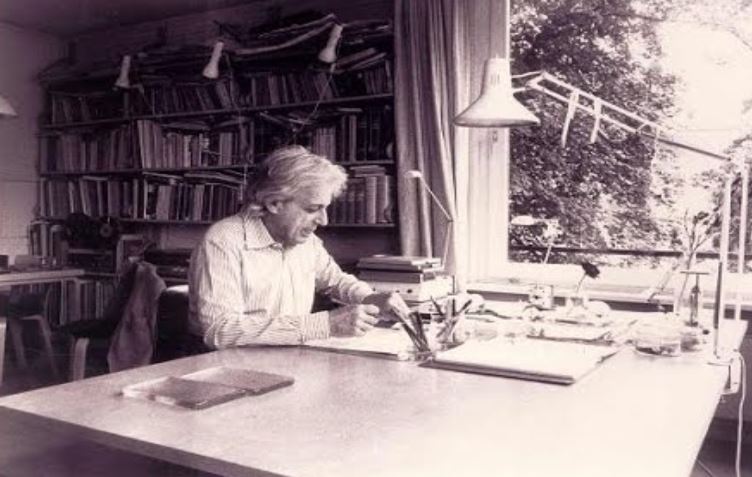
    From the Archives: Composer Luciano Berio

    It is a commentary both in a universal sense and a musical sense (the performers even narrate the music in real time, almost like a sports commentator in the third movement). 50 years later, it feels both relevant and a glimpse into a specific period. Philosopher Walter Benjamin wrote in his Thesis on the Philosophy of History: 

              This is how one pictures the angel of history. His face is turned toward the past . . . The storm irresistibly propels him into the future to which his back is turned, while the pile of debris before him grows skyward.  

    I never thought I’d hear a musical representation of Benjamin’s words, but Berio is able to so in this piece.

    Each of the first four movements (the fifth was added a few years later) has its own feel and exists in a completely different sound world then the others. The fifth ties the disparate entities together in a sort of amalgam of the movements. This evening, the New York Philharmonic presented the work with Seymon Bychkov conducting his second week in a row and the young new music ensemble Roomful of Teeth in its New York Philharmonic debut. It should be said, because this work has such a textual importance it was surprising that the NY Philharmonic opted to not use either supertitles or issue a libretto – particularly for the third movement of the piece. While in English, Berio’s tricky text is important and purposely difficult to hear at times. 

    In the mysterious opening of first movement, Mr. Bychkov managed to guide the orchestra with an incisive sound while blending with the organ-like Roomful of Teeth. Speech is incredibly important to Berio, in his works he always mimics it. Here, the Philharmonic took this to heart. As a singer would finish a line, the instrumentalists would pick up the melody imitating the singer’s timbre and speech pattern. It was an impressive transformation from speech to music and vice versa, making the weaving textures of the piece wonderful to hear. This magical effect reminded me a lot of Boulez’s Répons, composed nearly twelve years later. This is the only performance of the work I’ve heard where I could clearly hear all of the singers – the Philharmonic’s sensitive accompaniment surely the reason. The second movement comprises of a memorial to Martin Luther King Jr. The precise and pouncing brass/percussion outbursts balanced the more Gregorian chant-like singing texture that sits below – at once given the impression of being static and lurching forward. Mr. Bychkov drew a wide range of color from the orchestra, balancing the many textures while still making the outbursts sound percussive. The music briefly devolves into a march near the end before dissipating and here the orchestra seemed to blend into quietness of the hall.

    Screen Shot 2018-05-30 at 2.17.19 PM
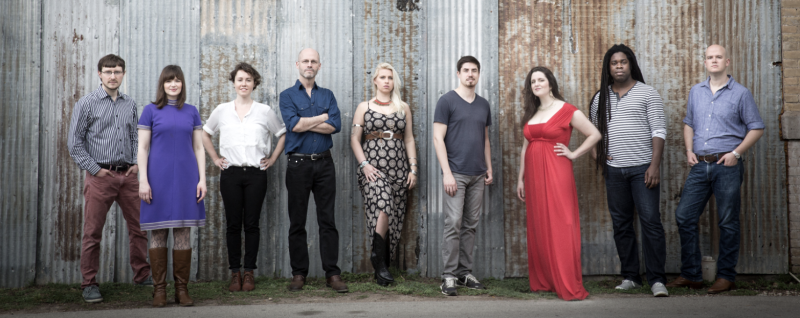
    Above: Some of the members of vocal group Roomful of Teeth; Photo Credit: Bonica Ayala of BONICA AYALA PHOTOGRAPHY

    The third movement is the most experimental music Berio wrote. It has the third movement of Mahler’s Symphony No. 2 underlying it (which is in itself a setting of Mahler’s St. Anthony’s Sermon to the Fish from Das Knaben Wunderhorn) with many additions. Berio makes sure that the Mahler is never lost through the entire movement, but it comes in out of focus while the singers do everything from congratulating the conductor to singing about the anxiety of the role of art in politics. Mr. Bychkov managed to untangle the chaos of the music by making each texture transparent and audible, even in the most cacophonous sections. Whether through melody or rhythm, the Mahler was easily heard as were the slew of extra-musical references. Roomful of Teeth for their part, made the movement at once entertaining and somber, even getting laughs from some audience members. During the serious moments, such as questioning the point of art, they took a dedicated tone. This is incredibly difficult music to perform, but I can’t imagine it being rendered better. 

    In the fourth movement which has many short outbursts and feels comparatively sparse and calm, Mr. Bychkov’s precise conducting and the orchestra’s sharp sound provided a respite. The fifth movement’s recollections brought in bits of each of the other movements, almost like a summary of the entire work. It was wonderful to hear because it felt like a retrospective that tied everything together. The much younger looking crowd than usual (many hipster looking men in their late 20’s/early 30’s, likely do to Roomful of Teeth’s dedicated following) gave a well-deserved enthusiastic applause. Mr. Bychkov, Roomful of Teeth, and the NY Philharmonic couldn’t have performed the piece better, showing why at 50 this remains one of the most important symphonic works composed.

    Returning from intermission, the New York Philharmonic did its annual Milestones speeches, honoring members of the New York Philharmonic who are retiring and who have been a part of the orchestra for a certain number of years. This year, they honored the 25th anniversaries of Oboist Robert Botti, Principal Violist Cynthia Phelps, violist Robert Rinehart, and horn player R. Allen Spanjer. They also retiring members Mark Schmoockler (44 years), Vladimir Tsypin (35 years), and Archivist Barbara Haws (34 years). Ms. Haws gave a stirring speech about the importance of history and the connections that occur from a true institution like the New York Philharmonic. Her speech dovetailed perfectly with the Sinfonia, “The present honors the past. 100 years ago, seems like today.” 

    Screen Shot 2018-05-30 at 2.20.50 PM
    Above: Conductor Semyon Bychkov; Photo credit: Chris Christodoulou

    After, the group performed Strauss’s last tone poem: An Alpine Symphony. The pairing of these two seemingly unrelated works comes from a line in the Sinfonia when the main narrator in the third movement makes a sarcastic jibe about the Alpine Symphony, saying something the effect of maybe a grand work like the Alpine Symphony will grow flowers (while discussing the lack of political potency music has). Mr. Bychkov and the Philharmonic were in top form. While this is personally my least favorite Strauss piece, Mr. Bychkov gave one of the best interpretations one could want. He made the strings sound vigorous, the brass warm, and the music layered. The orchestra crafted a round, gentle, and rolling sound – which contrasted the first half’s incisiveness well. During the exciting stormy sections, it was fun watching the percussionist get up to play the Thunder Sheet for its brief appearance. It was clear after this performance that Mr. Bychkov can get this orchestra to sound its best – I look forward to hearing him again soon.

  • Immortal Longings

    A + C

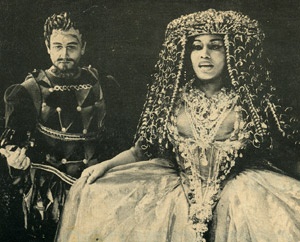
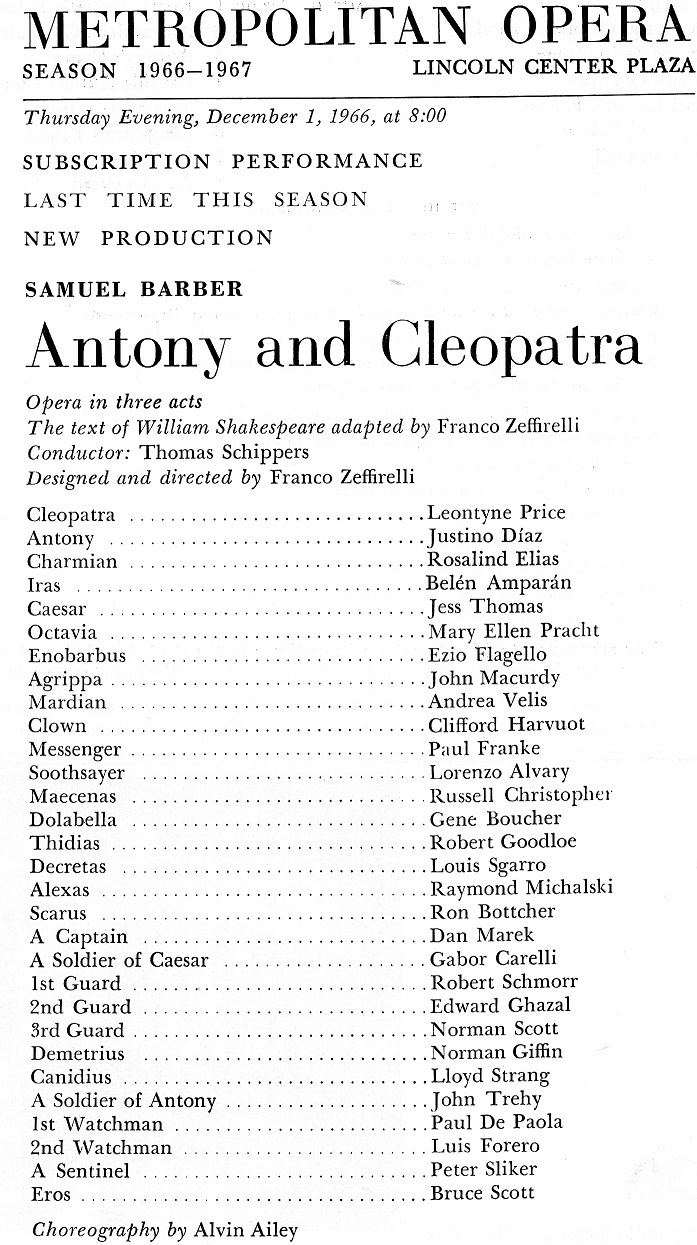
    Above: Justino Diaz and Leontyne Price in Samuel Barber’s ANTONY & CLEOPATRA at The Met, 1966

    ~ Author: Oberon

    By chance, I came upon this film of Leontyne Price singing Cleopatra’s final aria from Barber’s ANTONY & CLEOPATRA at a 1984 concert at Juilliard, conducted by Jorge Mester. Ms. Price’s singing here shows some of the vocal idiosyncrasies that crept into her performances as the 1970s progressed into the 1980s. But the sheer sound is glorious, the upper notes sustained, steady, and thrilling. What I love most about her in this brief video is her stillness – she doesn’t flail her arms about melodramatically; it’s all contained in the music – and her great sense of personal dignity.

    Scanned Section 18-1

    Barber wrote Cleopatra’s music specifically with Leontyne Price’s voice in mind. After the run of performances that opened the New Met in 1966 – of which I attended the last – the opera vanished from the Met repertoire. The composer devised a concert ending for the great final aria so that Ms. Price, and others to follow, might include it in their appearances with symphony orchestras. 

    A revised version of ANTONY & CLEOPATRA was given at Juilliard in 1975, a performance of which I attended:

    Scanned Section 8-1

    The European premiere of the opera (in concert form) took place at the Théâtre des Champs Elysées, Paris, in 1980. Chicago Lyric Opera gave the opera in 1991 with Richard Cowan and Catherine Malfitano in the title-roles. There was a telecast, which I watched – really impressive – and which you can watch here and here!

    In 2009, New York City Opera gave the opera in concert form at Carnegie Hall with Teddy Tahu Rhodes and Lauren Flanigan as Antony and Cleopatra. I was there, and the cumulative effect of the opera was powerful.

    Writing about this opera gives me an opportunity to bring forth one of the great rarities from my collection: a performance of the final aria of Cleopatra by mezzo-soprano Beverly Wolff from a concert at Cincinnati in 1971. Martina Arroyo was to have been the vocal soloist that evening, but she was taken ill and Ms. Wolff stepped in on very short notice; musical revisions were made to accommodate the switch from soprano to mezzo-soprano.

    Beverly Wolff ANTONY & CLEOPATRA aria Cincinnati 1971

    ~ Oberon

  • Wang @ Carnegie

    ~ Author: Scoresby

    Thursday May 17th, 2018 – It is truly a rare occasion to see Carnegie Hall‘s Stern Auditorium completely sold out. It is even rarer to see this happen with stage seating too as was the case with pianist Yuja Wang‘s recital last week. Only Ms. Wang could do so with an unrelenting program like the one she played, with dark, not necessarily crowd pleasing works by Rachmaninoff, Scriabin, Ligeti, and Prokofiev. I haven’t enjoyed Ms. Wang’s solo performances as much in the past, but this felt like a completely different atmosphere than her usual fair. For one, the repertoire was much more intellectual and music lover oriented than her usual programs. For another, this program really seemed to be a statement. If it was any indication of how Ms. Wang’s Perspectives series will be at Carnegie Hall next season, I look forward to being able to attend the many events. 

    Capture
    Above: Pianist Yuja Wang; Photo Credit: Kirk Edwards

    Ms. Wang began the performance with a series of seven Rachmaninoff’s smaller works, all in minor keys and repeated keys back to back (except for the opening g minor prelude). Despite clapping from the audience in-between the works, it was obvious Ms. Wang wanted to play them as one giant set. These set up the rest of the concert incredibly well – she drew in the crowd with a sense of mystery, making Rachmaninoff’s writing sound much more modern than it typically is treated. Emphasizing dissonances and unstable textures, Ms. Wang’s Étude-tableau in C minor, Op. 39 No. 1 sounded like a torrent in the right hand with crisply articulated left hand percussion. But here the blurs and ripples took control – while the notes were clear, Ms. Wang managed to make the voicing fade behind the accompaniment making the piece more modernist.

    In the Prelude in B Minor, Op. 32 No. 10, Ms. Wang’s sensitive dynamic range and languid playing made the romantic climax seem less important than the surrounding, Debussy-like material. The best part of the evening was the Étude-tableau in E-flat Minor, Op. 39 No. 5 which ended the set. Here Ms. Wang had an unparalleled light touch which managed to let the melody sing through the storm of darker undercurrent. This was the opposite of virtuoso playing – many pianists hammer this etude out without much subtlety. Instead, Ms. Wang let the music’s storminess speak for itself, which led perfectly into the Scriabin that came next.

    The next work on the program was Scriabin Sonata No. 10, Op. 70. This is one of Scriabin last five pieces written for piano and has his characteristic mystical sound world in the extreme. While work is in much stricter sonata form than the other late piano sonatas, it still has a mysterious, almost ghostly atmosphere. Ms. Wang wove through the dense textures with ease, making both the structure clear and letting the ambiguous atmosphere seem full of color. Her notes never sounded crisp or grounded; they instead were washed with an ethereal sheen. Just as the magical trills that appear before the work launches into its second theme began to be played, someone’s cellphone ringer featuring a trilling bird went off.

    Capture
    From the Archive: Alexander Scriabin

    While admirably Ms. Wang continued to play, it was a funny indication of the music. The trills begin to take over the more melodic portions of the piece before the climactic recapitulation where tremolos and trills rule in all registers – as Scriabin put it “a blinding light”. Ms. Wang’s glossy playing made this piece seem remote in the best way possible – someone taking you into their isolated world. Adding to this effect was the stage seating. In order to accommodate everyone on the stage without disrupting the performance, Carnegie lowered the lights so there was just a small circle of light around Ms. Wang – making her seem in that same realm as Scriabin.

    ​To finish the first half of the program, Ms. Wang performed three short, but difficult Ligeti Etudes: No. 3 Touches bloquées, No. 9 Vertige, and No. 1 Désordre. To be clear, the Ligeti Etudes are some of the hardest pieces for piano ever written, but each one is also a musical world into itself. After the otherworldly Scriabin piece, Touches bloquées offered a different kind of isolation: that of machinery. The work sounds like a giant machine jerking around – Ligeti gets this odd rhythmic effect by having the pianist strike some keys silently in order to build in a particular rhythm to the piece.

    Ms. Wang gave a committed performance that captured all of this convulsive sound. Vertige is modeled after a falling Shepard’s Tone with many chromatic notes lined up and falling forever. Ms. Wang player her way through this exhausting etude with verve – plucking out each of punchy chords in-between the falling. Finally, the first half ended with the jazzy and punchy disorder, a funny musical joke by Ms. Wang after such a dark/intellectual first half. 

    Capture

    From the Archives: Composer Györg Ligeti

    After what seemed more like a 30 or so minute intermission, the final work on the program was Piano Sonata No. 8 in B-flat Major, Op. 84. Despite the program notes saying that this was Prokofiev’s most optimistic of the war-time sonatas – the sprawling first movement of this piece a moody, wandering work. Ms. Wang’s performance captured the eccentric melody lines and temperamental well. She used a similar remote style of playing that she used in the Rachmaninoff and Scriabin here, but with well timed percussive outbursts in the bass that gave a contrasting mood.

    In the Allegro moderato sections of the first movement Ms. Wang’s rapid fire style of playing was thrilling to watch, bringing the movement to a climax. More impressive though was Ms. Wang’s sense of space and silence at the end of the movement. In the romantic second movement, Ms. Wang seemed at her warmest of the night in the lighthearted theme before plunging into the electric final movement. Here, Ms. Wang plucked out precise articulation with a lithe sound, speeding through the virtuosic sections. The highlight was the mysterious coda-esque moment before the last outburst. Here Ms. Wang seemed relish in the atmosphere before the crashing ending (which had all the tight control of the rest of the performance).

    While a thrilling recital from start to finish, I do wonder if her diverse crowd found it as satisfying. In many ways this was her at her most introspective – no crowd pleasing works like her usual programs and while certainly virtuosic playing, emphasizing the ephemeral instead of flash. Ms. Wang has a history of extensive encores, as such the crowd didn’t seem surprised when she brought out five of her favorite show-stopper type pieces. The crowd seemed enthused with these – much more so than the pieces on the actual program. While Ms. Wang wasn’t indifferent to her crowd, she certainly seemed all-business this evening with brusque bows and a sense of pushing forward. As a final gesture she played Liszt’s transcription of Schubert’s Gretchen am Spinnrade, going back to that dark place of the rest of the concert and seemingly shunning the audience there to hear her – it was like magic.

    ~ Scoresby