Category: Music

  • Fantastic Finckel

    1200x1200-75

    It’s during the months of High Summer that I find time to listen to music at home. The rest of the year is taken up with live music, and with writing (and reading!) about it. But on these long, hot August afternoons, I am in my cool cavern of a room with CDs playing.

    I have a huge stack of music yet to be listened to – and even larger stacks of un-read books – but one disc that I’d been really looking to hearing was my focus yesterday: a recording by cellist David Finckel of Antonín Dvořák’s cello concerto, paired with Augusta Read Thomas’s 1999 work, Ritual Incantations, and featuring the Taipei Symphony Orchestra conducted by Felix Chiu-Sen Chen. The disc – on the Artist Led label – may be purchased here.

    The familiar Dvořák is – needless to say – beautifully played, and the concerto sounded wonderfully fresh to me. It’s the Thomas that I am savouring now, being of a type of music that is particularly appealing to me. David Finckel premiered Ritual Incantations at Aspen in 1999.

    In March 2015, Augusta Read Thomas was the subject of one of The Miller Theatre’s Composer Portraits. My friend Monica and I were drawn into Ms. Thomas’s musical world, as well as much taken with her as a personality.

    Ritual Incantations opens with solo cello in a fanfare-like summons, followed by a mystical, plaintive passage which Mr. Finckel plays gorgeously. Bells of varying textures are heard in an animated section before the cello takes up a soulful solo; incantatory chimes summon us as to prayer, and the harp lends a feeling of enchantment. Wind voices and cello converse, taking Mr. Finckel’s voice to the depths.

    The music turns lively, urgent and emphatic. There are jabs and sudden bursts from various instruments, and then again the cello sings longingly, rising upwards. A glassy shimmer ends the work abruptly. The other-worldly aspects of the music evoke uncharted distances whilst the passionate beauty of the cello writing wraps itself around the soul. I can’t stop listening to it.

  • Britten’s Endgame

    9007000059671_1

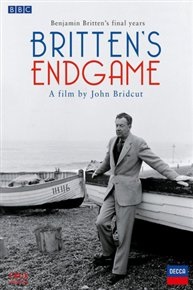
    Tuesday July 19th, 2016 – I pulled this John Bridcut/BBC film off the shelf at the Performing Arts Library at Lincoln Center today, played it immediately on getting home, and found it thoroughly engrossing. The documentary focuses of the final years of the great composer’s life when – despite failing health – he churned out such masterworks as DEATH IN VENICE, the cantata PHAEDRA, and the 3rd String Quartet.

    Archival footage of Britten – conducting, playing the piano, chatting and performing with his life-companion Peter Pears, and greeting Queen Elizabeth II at the Aldeburgh Festival – is interspersed with interviews with both music-world luminaries (Dame Janet Baker, Steuart Bedford, Sir Charles Mackerras, Mark-Anthony Turnage) and people who knew the composer personally or were care-givers (David Hemmings, Sue Phipps, Rosamund Strode, his surgeon Dr. Michael Petch, and the tirelessly dedicated Rita Thomson). Thru their words and the reading of intimate letters, the film gives us a vividly personal portrait of Britten in the last three years of his life. 

    Then there are the superb musical excerpts, seemingly staged in the studio specially for this DVD. Absolutely splendid choral work from the Schola Cantorum of Oxford, including parts of Hymn to the Virgin, written when Britten was 16 years old. Tenor John Graham-Hall is most impressive as Aschenbach in scenes from DEATH IN VENICE; another tenor, Allan Clayton, joins horn player Michael Thompson in some gorgeous passages from the Serenade for Tenor, Horn, and Strings; the Fitzwilliam String Quartet’s ravishing playing of portions of the String Quartet #3 makes us doubly regretful that it was Britten’s last substantial work.

    In a magnificent performance, mezzo-soprano Sarah Connolly is a thrilling Phaedra; her singing is juxtaposed with Dame Janet Baker’s spoken recollections of collaborating with Britten on the cantata’s creation.

    Uk1.31.4

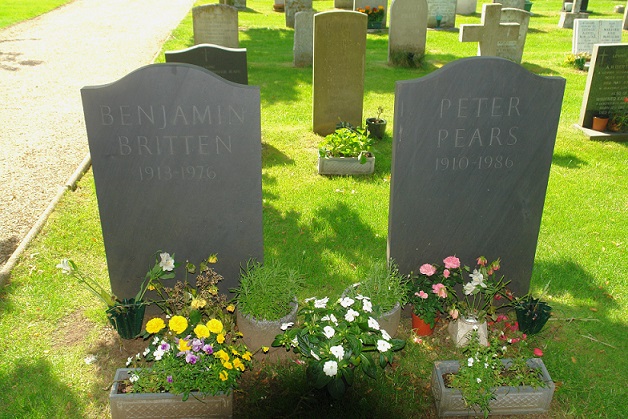
    Britten died of heart disease in 1976 at the age of 63, five years younger than I am now. He is buried next to Peter Pears in the Parish Churchyard, Aldeburgh.

  • NY Phil: THE PLANETS + Williams’ Tuba Concerto

    PJ-BW140_FIXBAG_DV_20140723162140

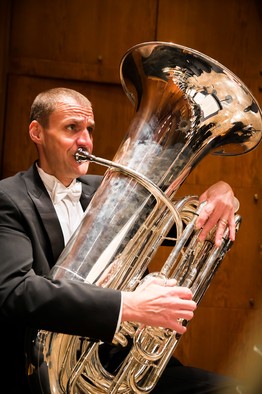
    Above: Alan Baer of The New York Philharmonic in a Chris Lee photo

    Saturday May 28th, 2016 – Aside from Mars, I am not really a fan of the famous Gustav Holst work The Planets (composed in 1914-1916). I remember many years ago tuning in to a radio broadcast of the piece and finding my interest diminishing steadily once the spaceship left Mars for Venus; I never made it back to Earth.

    Tonight, a chance to hear The Planets in concert at Geffen Hall provided an opportunity to test my earlier reaction. Under the baton of David Robertson, The New York Philharmonic‘s performance of this sprawling epic was nothing short of marvelous. But the music itself just doesn’t reach me, beyond a surface appeal – and despite the composer’s obvious skill in orchestration. And so – yet again – upon departing Mars, I felt lost in space. 

    The remaining six movements do have their very appealing passages, of course, but also their longueurs. The only time I truly connected with any of the music was when the theme of the hymn ‘I Vow To Thee My Country strikes up as Jupiter looms in the sonic heaven. The stay on Uranus seemed endless: not much going on there. I simply couldn’t wait for this trip thru the solar system to end. Maestro Robertson had the huge forces doing his bidding to fine effect, and making a splendid sound; featured violin solos from Sheryl Staples were saving graces on this journey to nowhere. 

    But enough grumbling, lest I be mistaken for Bernie Sanders; the first half of the program was indeed thoroughly enjoyable.  

    Edward Elgar’s Introduction and Allegro (composed in 1905) opened the evening; it’s a beautiful piece and would make a great ballet score (maybe it’s been done?). The composer gives a prominent role to a string quartet, setting them before the full string contingent of the orchestra. As this quartet consisted of Sheryl Staples, Lisa Kim, Cynthia Phelps, and Carter Brey, the playing was remarkable – I especially was entranced by a solo from the viola of Ms. Phelps. When the Philharmonic strings played en masse, the richness of sound was truly savorable.

    The tall and slender Alan Baer then appeared with his silver tuba for John Williams’ Tuba Concerto. This rather brief work (just over 15 minutes in length) was very pleasing from start to finish, for Mr. Baer’s sound has a warm glow and a toothsome dark-chocolate richness in the lower range.

    The opening passages made me think of a sea shanty: good-natured, a bit brusque, with fog-horn low notes along the way. Later the tuba converses with the French horn, and in the concerto’s second movement, the tuba sounds deep phrases over a horn chorale before embarking on a polished cadenza.

    The violins strike up. The oboe has a theme that is passed to the flute, and then the flute and tuba talk to one another. After another – briefer – tuba cadenza, fanfares sound and there is a cabaletta of sorts, with trumpets giving propulsion and the tuba singing some skittish coloratura. Harp and timpani have a part to play: another inventive mix on the composer’s part. Swift-rising scales for the tuba herald a jovial conclusion.

    Philharmonic audiences love it when artists from the orchestra step forward in featured roles; there was lovely enthusiasm for the string quartet after the Elgar, and Mr. Baer received hearty cheers from the crowd, as well as the admiring applause of his colleagues.

  • NY Phil: THE PLANETS + Williams’ Tuba Concerto

    PJ-BW140_FIXBAG_DV_20140723162140

    Above: Alan Baer of The New York Philharmonic in a Chris Lee photo

    Saturday May 28th, 2016 – Aside from Mars, I am not really a fan of the famous Gustav Holst work The Planets (composed in 1914-1916). I remember many years ago tuning in to a radio broadcast of the piece and finding my interest diminishing steadily once the spaceship left Mars for Venus; I never made it back to Earth.

    Tonight, a chance to hear The Planets in concert at Geffen Hall provided an opportunity to test my earlier reaction. Under the baton of David Robertson, The New York Philharmonic‘s performance of this sprawling epic was nothing short of marvelous. But the music itself just doesn’t reach me, beyond a surface appeal – and despite the composer’s obvious skill in orchestration. And so – yet again – upon departing Mars, I felt lost in space. 

    The remaining six movements do have their very appealing passages, of course, but also their longueurs. The only time I truly connected with any of the music was when the theme of the hymn ‘I Vow To Thee My Country strikes up as Jupiter looms in the sonic heaven. The stay on Uranus seemed endless: not much going on there. I simply couldn’t wait for this trip thru the solar system to end. Maestro Robertson had the huge forces doing his bidding to fine effect, and making a splendid sound; featured violin solos from Sheryl Staples were saving graces on this journey to nowhere. 

    But enough grumbling, lest I be mistaken for Bernie Sanders; the first half of the program was indeed thoroughly enjoyable.  

    Edward Elgar’s Introduction and Allegro (composed in 1905) opened the evening; it’s a beautiful piece and would make a great ballet score (maybe it’s been done?). The composer gives a prominent role to a string quartet, setting them before the full string contingent of the orchestra. As this quartet consisted of Sheryl Staples, Lisa Kim, Cynthia Phelps, and Carter Brey, the playing was remarkable – I especially was entranced by a solo from the viola of Ms. Phelps. When the Philharmonic strings played en masse, the richness of sound was truly savorable.

    The tall and slender Alan Baer then appeared with his silver tuba for John Williams’ Tuba Concerto. This rather brief work (just over 15 minutes in length) was very pleasing from start to finish, for Mr. Baer’s sound has a warm glow and a toothsome dark-chocolate richness in the lower range.

    The opening passages made me think of a sea shanty: good-natured, a bit brusque, with fog-horn low notes along the way. Later the tuba converses with the French horn, and in the concerto’s second movement, the tuba sounds deep phrases over a horn chorale before embarking on a polished cadenza.

    The violins strike up. The oboe has a theme that is passed to the flute, and then the flute and tuba talk to one another. After another – briefer – tuba cadenza, fanfares sound and there is a cabaletta of sorts, with trumpets giving propulsion and the tuba singing some skittish coloratura. Harp and timpani have a part to play: another inventive mix on the composer’s part. Swift-rising scales for the tuba herald a jovial conclusion.

    Philharmonic audiences love it when artists from the orchestra step forward in featured roles; there was lovely enthusiasm for the string quartet after the Elgar, and Mr. Baer received hearty cheers from the crowd, as well as the admiring applause of his colleagues.

  • The Last Song of Richard Strauss

    Jeritza strauss

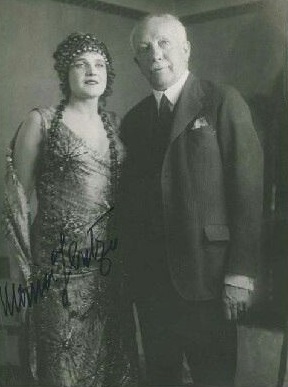
    Above: Maria Jeritza, in costume for The Egyptian Helen, with Richard Strauss

    Richard Strauss’s Vier letze lieder were for many years thought to have been the composer’s last completed work. But in November of 1948, the composer wrote a song entitled Malven (“Mallows”); he dedicated it to soprano Maria Jeritza and sent her the only known copy.

    The manuscript turned up Mme. Jeritza’s papers following her death in 1982. Read an article about the discovery of the Malven here

    The world premiere of Malven was given at a New York Philharmonic concert (that I attended) in 1985. Dame Kiri Te Kanawa was the first to sing the song in public; as Malven had never been orchestrated, Dame Kiri was accompanied by pianist Martin Katz. The program further included the soprano’s sterling performance of the Vier letze lieder, conducted by Zubin Mehta.

  • Great Performers: Matthias Goerne

    M Goerne

    Above: Matthias Goerne

    Wednesday April 20th, 2016 – Baritone Matthias Goerne offered a program of songs by Eisler, Schumann, and Wolf, with Alexander Schmalcz at the Steinway. The recital was part our Great Performers at Lincoln Center subscription series.

    In the congenial setting of Alice Tully Hall, we experienced a lieder recital like no other I have ever attended. Rather than singing neat sets of songs by each composer and walking offstage after each group, only to return in a couple of minutes for another segment, Mssrs. Goerne and Schmalcz remained onstage throughout each half of the program. At the end of each group of songs by one of the evening’s composers, applause was forestalled by silent signals from the singer and by the pianist keeping his hands poised over the keyboard. Thus each half of the program flowed seamlessly, coughing and quiet chatter between sets was avoided, and the focus on the music itself, without the distractions of the recitalist’s comings and goings, made for an intense and amply rewarding listening experience. The individual songs became part of a vast sonic canvas of myriad colours. 

    This innovative presentation created an opportunity to experience the Goerne voice and artistry in two long arcs of song. And what a voice it is: in over five decades of listening to singing in the realms of opera and classic song, only two or three voices have been so captivating just as sound. Mr. Goerne is blessed with an enormous vocal range, from the depths of basso-darkness to a secure, blooming, and captivating upper register. His mastery of dynamics is nothing less than awesome: thunderous, hall-shaking phrases can be succeeded by the most delicate of sustained piano effects, whilst at mid-volume, the sound with it’s magically manipulated vibrato is almost unbearably beautiful. 

    Mr. Goerne is a singer who gets physically involved in his songs: gestures and indeed full-body moves seem to flow with utter naturalness from his deep emotional commitment to what’s being sung. Thoroughly lacking in pretense, he allows us into his private world where we can commune with the composers thru the singer’s personal involvement. Goerne’s generosity both of voice and of spirit makes him an artist you want to experience time and again.

    With the Goerne voice ideally partnered by Mr. Schmalcz’s lyrical attentiveness at the piano, the music-making was so totally pleasing that it hardly mattered what was being sung, or that the numerous (and short) Eisler songs are less involving musically than those of Schumann or Wolf. It was just such an immersive pleasure to bask in the heart-healing tone and exquisite expressiveness that filled the blessèd space.

    When it was announced that songs by Wolf would be on the program, I hoped to see that composer’s timelessly touching Anakreons Grab listed – alas, it wasn’t included in the printed program. But it made for a gorgeous encore, sung and played so poetically:

    "Here, where the roses bloom, and the ivy embraces the laurel,
    Where the turtledove murmurs, and the cricket sings -
    What grave is this, that the gods 
    Have so kindly graced with vines and flowers?
    It is Anacreon's resting-place. Spring, Summer, and Autumn did that poet enjoy; And now from Winter, at last, this mound protects him."  

  • American Visions @ CMS

    Randall-Scarlata

    Above: baritone Randall Scarlata

    Tuesday May 19th, 2016 –  Chamber Music Society of Lincoln Center offering a diverse program of ‘Americana’. On entering the auditorium at Alice Tully Hall tonight, we found the stage filled with a vast array of percussion instruments; these were set up in four “territories”, each to be managed by a specific musician in the program’s second half: a spectacular performance of a fascinating work by George Crumb. 

    In the midst of all the chimes, gongs, and other percussive paraphernalia, the sleek Steinway was parked. Pianist Michael Brown took the driver’s seat and set the evening on its way with Louis Moreau Gottschalk’s The Union, Concert Paraphrase on National Airs for Piano. Composed in 1862 by the wildly popular Gottschalk, this 9-minute fantasia weaves together arrangements of Hail Columbia, Yankee Doodle Dandy, and The Star-Spangled Banner. The work’s virtuoso demands were a stroll in the park for Mr. Brown, who simply rippled off the composer’s flourishing flights and furbelows with sprightly brilliance. This patriotic little gem sparkled on New York’s Primary Day.

    Mr. Brown returned immediately to perform Antonin Dvorak’s Sonatina in G-major with violinist Chad Hoopes. Written (swiftly) in New York City in 1893, this attractive piece was the composer’s opus 100, and he chose to mark that milestone by writing a work for his two children: Otilie (a 15-year-old pianist) and young Antonin (aged 10, and already a capable violinist); the sonatina was first performed at Dvorak’s home on East 17th Street, right here in Gotham.

    Mssrs. Hoopes and Brown found this Dvorak work most congenial; their performance was finely coordinated and together they gave us a savorable rendering of the folkish elements which are so typically Dvorakian. In the work’s four movements, both lyricism and dexterity are called for, and the two musicians polished off the music with style and flair.

    A group of songs by Charles Ives were then performed by baritoneRandall Scarlata and Gilbert Kalish. These two expert artists have worked together frequently and their rapport is a delight to witness. Randy Scarlata’s wide-ranging voice, his fluency of language, and his natural gift for making it seem like he is singing just to you have always given his performances a special appeal – starting back in his Juilliard days, when I first met him and we began a friendship that has been sustained over the years.

    The six Ives songs Randy programmed tonight showed the many felicities of his vocal and interpretive style, and Mr. Kalish was the ideal collaborator. The soft ending of “The Things Our Father’s Loved” was haunting; the ironic sense of triumph of “In Flanders Field” showed vocal expressiveness at its finest. A music hall feeling is evoked in the narrative “Charlie Rutlage” which covers many moods and at one point erupts in a huge tumult; “The Indians” veers from the dramatic to the pensive. A particularly masterful rendering of “The Housatonic at Stockbridge” opened with Mr. Kalish’s atmospheric piano introduction; the music is then taken up by Randy with finely-inflected phrasing and spine-tingling dynamic control. “The Circus Band”, a jolly tongue-in-cheek affair, calls for a baritone who is also an actor, and it ended the evening’s first half vividly.

    So lovely and pleasant to simply sit in the hall during the interval, watching the percussionists as they made sure everything was in place for the work about to be performed: George Crumb’s American Songbook II: A Journey Beyond Time.

    I can hardly begin to describe the effect of this ingenious and truly splendid work. The composer, with his ever-rich musical imagination, has taken some of the best-beloved spirituals and spun them into a sound tapestry that is nothing less than magical. The work calls for four top-flight percussionists, a pianist of consummate skill who is willing to extend his range beyond the keyboard, and a great communicator as vocal soloist. CMS brought together just such a remarkable ensemble tonight, and the result was both aurally dazzling and rich in spiritual reward.

    Each of the four percussion players – Christopher Froh, Ayano Kataoka, Eduardo Leandro, and Ian David Rosenbaum – had his or her own island kingdom of instruments to preside over. An open-topped piano awaited Gil Kalish, with a pair of small mallets and an odd conch-like horn set out for him: things most pianists have no use for. At the center of it all, Randy Scarlata, ready to pour his heart and soul into the eight timeslessly powerful songs that Mr. Crumb had arranged for this epic work.

    Otherworldly sounds transport us immediately; as the work progresses, the textures developed by the percussion orchestra will chill, delight, and fascinate us. The baritone voice emerges from this soundscape in the haunting melody of “Swing Low, Sweet Chariot” – Randy Scarlata at his expressive best. Mr. Kalish must reach into the piano to pluck the strings, and meanwhile the percussionists are setting up echo effects and rich reverberations. The chimes of midnight sound, uncanny deep resonances glow and fade, ghostly shimmers hang in the air. Randy’s control of finely-honed piano demi-tints gave me goosebumps as the ‘sweet chariot’ vanished into the mists.

    Bizarre rhythms and noisy cacophony signal ‘the walls come tumbling down’ in “Joshua Fit de Battle ob Jerico”; Mr. Kalish’s horn bleats desperately, Randy Scarlata’s voice rages and exhorts. Things fade away before a big bang of an ending. Tremendous!

    Soft chimes lend an air of mystery to Randy’s poignant singing of “Steal Away”. This is followed by the impulsive rhythms of “Rock My Soul” in which Randy sings, speaks, and whispers in turn. An instrumental interlude (“The pregnant earth : a Psalm for Noontide”) brings forth delicate effects. Here Mr. Kalish alternately plays and plucks the strings of the Steinway while the four percussionists seem to vie in a contest to see who can play most quietly. Kozmic softness!

    Marimba and rattles set the rhythmics of “Sit down, Sister!”, in which the pianist also has a say. Randy sings “I just got to heaven and I want to look around!”; the song then teases forward until he shouts “Sit down!” This is punctuated by a sonic boom.

    Soggy chimes make us think of weeping; “Nobody Knows the Trouble I See” laments, with Randy’s voice low and mournful. The stage lights inexplicably dimmed to darkness by mistake midway thru this song; the music halted but light was soon restored and the musicians picked up where they’d left off. Eerie echoes are heard.

    A deep growl…a thudding drum…a welter of gongs and chimes: “Let My people Go!” This is “Go Down, Moses”, robustly declaimed by Randy Scarlata, and it is big singing indeed. The music is ominous but fades to a long, reverberant end.

    Gongs and chimes, chirps, and the sound of tinkling broken glass create a halo of mystery around Randy’s plaintive singing of “Sometimes I feel like a Motherless Child”. After a last percussive power burst, Mr. Kalish brings forth some extremely delicate playing, and some eerie tapping. The singer turns to parlando with “Motherless children have a hard time…a long way from home”: eventually Randy hums wordlessly as the music fades sway into thin air.

    The audience seemed spellbound by the Crumb work; it is not easy music, but instead unsettling, thought-provoking, and richly rewarding in its own way. I was so grateful for this opportunity to experience it, and in such a thoroughly impressive and moving performance.

    The Repertory: 

    The Participating Artists:

  • Kavakos Plays Sibelius @ The NY Phil

    Kavakos-Leonidas-21

    Above: violinist Leonidas Kavakos

    Saturday March 19th, 2016 – Feeling under the weather today, I was nevertheless determined to hear Leonidas Kavakos play the Sibelius violin concerto with The New York Philharmonic. I’d looked forward to this red-letter evening since the season was announced, and even though I feel strongly that people who are sick are better off staying home, I was determined to go.

    In an unusual programming move, the concerto was the opening work tonight.

    Mr. Kavakos, very tall and with the air of a mythic sorcerer, launched his inspired rendering of the concerto with a magical glow: the spine-tingling opening passage – coolly sensual – immediately drew us in. Maestro Alan Gilbert and Mr. Kavakos have formed a rich rapport over time, and the conductor and his players were at their shining best as the violinist shaped the opening movement with alternating currents of broad-toned lyricism and spiky bravura. Few violinists today can match Kavakos for power – both sonic and emotional – and his playing as the concerto unfolded continually sent chills up and down my spine.

    In the central Adagio, with its heart-fillingly gorgeous main theme, violinist and orchestra were in a particular state of grace. One of the most winning aspects of Mr. Kavakos’ playing is his marvelously sustained phrasing; Maestro Gilbert and the orchestra provided the soloist with perfect support as passage after passage fell gratifyingly in the ear, everything lovingly dove-tailed and with an acute awareness of dynamic nuance. This performance of the Adagio was a high point in a season that has been rich in musical magic. 

    Mr. Kavakos then dug into the opening dance of the concluding Allegro with gusto, and the orchestra sounded simply magnificent in the big tutti passages. Give and take between soloist and ensemble produced some dazzling effects, and the lovely ‘wandering’ passage for violin when the music briefly slows down was particularly appealing. Following an energetic rush to the finish, Mr. Kavakos enjoyed a prolonged ovation, filled with shouts of joy from his listeners. The Philharmonic players seem clearly to revel in performing with this violin-magician, and his warm greeting of concert-master Frank Huang and a lovely embrace for Sheryl Staples indicated a deeper personal connection with his colleagues than we sometimes see between soloist and orchestra. 

    After several bows, Mr. Kavakos granted us a rather long solo encore which showed a more intimate side of his artistry. And now, here’s some excellent news: Mr. Kavakos will be with us more frequently next season as he has been designated the Philharmonic’s 2016-2017 Mary and James G Wallach Artist-in-Residence. In addition to programs featuring him as soloist, he will make his NY Phil conducting debut. Find out more about this residency here

    Much as I wanted to hear the Shostakovich’s The Age of Gold Suite, I knew it was time to go home, take Advil, and rest. I now have some rare downtime: an opportunity to re-charge before this busy season continues. I have lots of wonderful music to listen to, including Mr. Kavakos’s Sony double-disc of Mendelssohn’s concerto and the piano trios, which I highly recommend; find it here.

  • Freiburg Baroque @ Alice Tully Hall

    Mozart

    Thursday February 25th, 2016 – This all-Mozart concert, performed by Freiburg Baroque at Alice Tully Hall tonight, was part of our Great Performers at Lincoln Center subscription series. Arias from the da Ponte/Mozart operas, the clarinet concerto, and the “Linz” symphony were scheduled. We were of course expecting the usual program order: the arias first, then the clarinet concerto, an intermission, and the symphony coming last. 

    Instead, in an attempt to re-create a type of concert popular in Mozart’s time, the movements of the symphony were played on the first half of the program, interspersed with arias. This may have seemed intriguing on paper, but in the event it lessened the effect of the symphony – which now seemed more like incidental music (great incidental music!) – while the arias seemed rather randomly chosen, two of them in fact being simply passages from ensembles.

    Given all this, and despite some very fine playing, the first half of the evening seemed a bit of a jumble. Gottfried von der Goltz, the ensemble’s principal violinist and director, had an ideally light touch, and he set propulsive tempi for the symphonic movements. He and the singer, Christian Gerhaher, formed a very simpatico bond: Mr. Gerhaher’s very confident stage-presence, wide-ranging voice, and winningly characterful interpretations were finely supported by conductor and ensemble. 

    Prior to playing the concerto, soloist Lorenzo Coppola introduced us to the clarinet d’amour – an unusual instrument that is longer than a standard clarinet and with a flared bell at the end. Once the concerto was underway, Mr. Coppola played with sure technique, exploring the instrument’s wide range with plenty of body language and almost comic accentuation of the lowest notes. His performance took on a more serious tone for the haunting Adagio, one of Mozart’s most sublime creations. For all Mr. Coppola’s skill and artistry, there were times when the instrument itself seemed in control.

    Mr. Gerharer then re-appeared for three of Mozart’s greatest arias for male voice: Leporello’s Catalogo, and one showpiece each from the opposing protagonists of NOZZE DI FIGARO: the valet’s “Non piu andrai” and Count Almaviva’s blazing “Hai gia vinto la causa!” In these three solos, Mr. Gerharer further displayed his impressive grasp of vocal characterization: in the Almaviva aria especially, he seemed to bring the drama most vividly to life.

    Between the two NOZZE arias, the orchestra chimed in with a brief Contredanse (K. 610) subtitled “Les filles malicieuses“, a brief charmer of a piece. Who were these “malicious girls” and what did Mozart want with them?  We’ll never know, any more than we’ll know whose cellphone went off at just the wrong moment tonight.

    The Participating Artists:

    Freiburg Baroque/Gottfried von der Goltz, violin and director

    Christian Gerhaher, baritone

    Lorenzo Coppola, clarinet d’amour

    The Repertory:

    Arias from Mozart’s Don Giovanni, Così fan tutte, and Le Nozze di Figaro

    Mozart: Clarinet Concerto

    Mozart: Symphony # 36 (“Linz”)