Blog

  • Martha Graham’s ‘Hérodiade’

    Miki herodiade

    Above: Miki Orihara in Graham’s Hérodiade

    Wednesday November 20, 2013 – Two of today’s foremost interpreters of the works of Martha Graham – Miki Orihara and Katherine Crockett – appeared tonight in a studio showing of the great choreographer’s 1944 work Hérodiade. As a splendid prelude, Ms. Crockett also danced Spectre-1914. It was an evening that resonated for me in so many different ways.

    Martha Graham Dance Company‘s artistic director Janet Eilber welcomed an overflow crowd to this second of three presentations of this programme. The Company’s spacious studio/theater on the eleventh floor of the Westbeth complex had been hung with black drapes, and after Ms. Eilber’s brief remarks, the majestic Katherine Crockett appeared to dance Spectre-1914, the opening solo from Martha Graham’s Chronicle.

    6a00d8341c4e3853ef0168eb764f31970c-800wi

    Above: Katherine Crockett, photographed by Matt Murphy

    Chronicle, dating from 1936, is Graham’s powerful statement on the devastation and futility of war; it is a great masterwork for female ensemble and it opens with a magnificent solo in which the dancer manipulates a voluminous skirt lined in red fabric to evoke both the bloodshed and the flames of war.

    Spectre-1914 had all but passed from memory until 1994 when it was researched and reconstructed by Terese Capucilli and Carol Fried, using film clips and still photos by Barbara Morgan. May Terpsichore bless these women for their efforts, for Spectre-1914 is as powerful a dancework as may be found, and it was danced tonight with marvelous amplitude and a deep sense of consecration by the marvelous Katherine Crockett. The audience beheld the dance in an awed state of pin-drop silence.

    Noguchi herodiade set

    Above: the Isamu Noguchi set pieces for Martha Graham’s Hérodiade

    After the Noguchi setting had been swiftly installed in the space, we watched a full performance of Graham’s ballet Hérodiade. Set to music by Paul Hindemith and commissioned by Elizabeth Sprague Coolidge for the Library of Congress, the ballet was originally called Mirror Before Me, and was first seen on October 30, 1944, at the Elizabeth Sprague Coolidge Auditorium, Library of Congress, Washington, D.C. Writing of that performance for the New York Times (November 1, 1944), critic John Martin said: “Miss Graham has created a powerful study of a woman awaiting a ‘mysterious destiny’ of which she has no knowledge…into it she has poured a somber tension that is relentless and altogether gripping. The music is rich and dark in color and the action on the stage meets it magnificently on its own terms.”

    That music, scored for chamber orchestra, was written by Paul Hindemith, a composer perhaps best-loved in the dance world for his superb Four Temperaments, choreographed by Balanchine.

    When I received the announcement that Hérodiade would be performed this evening, I suppose my natural reaction as an opera-lover was that it would be a dance about the Biblical princess Herodias and her daughter Salome and their conspiracy to have the prophet John the Baptist executed. But that is not the case: there are no allusions to either the Strauss or Massenet operas, nor to the Bible, nor to Oscar Wilde who penned the famous play Salome – Salome does not figure in the Graham work at all.

    Martha Graham had been interested in the poem Hérodiade by Stephane Mallarmé and in creating her ballet, the choreographer eschewed a specific narrative and instead turned to an abstraction of the character. Herodias is never named; she is simply referred to as ‘A Woman’. In Graham’s description, we see “a glimpse into the mirror of one’s being,” and she refers to this Woman as ‘doom-eager’, going forth with resolve to embrace her destiny.

    The Hindemith score is in eleven short movements, and we watch with intense interest as the radiant Miki Orihara, as the Woman in a deep violet gown, and the more austere Ms. Cockett, her Attendant in simple grey, move about the space. The choreography is restless and urgent, the Woman clearly obsessed with whatever fate awaits her while the Attendant seeks to comfort or forestall her mistress. The two dancers were simply engrossing to behold: Miki often in rapid, complex combinations moving swiftly about the stage while Katherine deployed her uncanny extension with mind-boggling expressiveness.

    In the end, Miki steps out of her rich gown and is revealed in virginal white; the Attendant withdraws and the Woman, taking up a black veil, contemplates her destiny. Mysterious, and all the more powerful for the unanswered questions it raises, Hérodiade is breath-taking.

  • The Virtuoso Clarinetist @ CMS

    David_shifrin

    Above: clarinet virtuoso David Shifrin

    Tuesday November 19th, 2013 – A delightful programme of music celebrating the clarinet was featured at Chamber Music Society of Lincoln Center. The Society gathered a distinctive ensemble of artists tonight, among them one of my favorite singers, mezzo-soprano Sasha Cooke. This week I have the pleasure of experiencing Sasha’s artistry twice, for she follows up tonight’s chamber evening with performances of Britten’s Spring Symphony with the New York Philharmonic. 

    The Society’s Wu Han greeted us with irrepressible, energetic charm; she explained that she had left the evening’s programming up to Mr. Shifrin and then turned the stage over to the musicians. A packed house seemed eager to hear everything that was offered: again, CMS is the place to be for serious music-lovers.

    The evening commenced with an unusual Mozart adagio for two clarinets and three basset horns (K. 411) which the composer purportedly arranged as a sort of entree for the members of the Masonic lodge which he had joined in 1784. The piece is brief, with organ-like sonorities.   

    Sasha_Cooke_-_profile_-_credit_Rikki_Cooke

    Above: Sasha Cooke, photo by Rikki Cooke 

    In the splendid aria “Parto, parto…” from Mozart’s penultimate opera, LA CLEMENZA DI TITO, Sasha Cooke’s timbre seems to have taken on an added richness since I last heard her. The singer’s expressive qualities were, as ever, to the fore, and the power and beauty of her interpretation made me long to hear her at The Met again where lesser artists hold forth in roles that would suit Ms. Cooke to perfection. Be that as it may, her singing of the aria tonight, graced by Mr. Shifrin’s polished roulades, was a thoroughly engrossing musico-dramatic experience.  The Opus One Piano Quartet’s first-rate playing of this chamber arrangement was an ideal compliment to the singer and clarinetist. 

    Leaping forward from the 18th century to the 21st, Sasha Cooke displayed her versatility in the New York premiere performance of Lowell Liebermann‘s Four Seasons. In setting poems by Edna St. Vincent Millay, the composer seems to me to have crafted a contemporary masterpiece: his highly evocative, coloristic writing summons visions of the changing seasons with spine-tingling textures. There are several remarkable passages – the transition from Spring to Summer was especially marvelous – and the composer set The Death of Autumn twice, with the singer’s poetic response to the text varying in mood between the two. A chilly misterioso motif depicts swirls of snowflakes at the singer intones the beautiful ‘What lips my lips have kissed’ and the work closes with the poignant recollection of lost love: ‘But you were something more than young and sweet and fair – and the long year remenbers you’.

    Sasha Cooke, with her gift for communicating not just words but emotions, gave a sublime performance of this fascinating new work; Mr. Shifrin and the musicians of Opus One – Anne-Marie McDermott, Ida Kavafian, Steven Tenenbom and Peter Wiley – produced a glowing soundscape in which the voice was heard in all its affecting radiance.

    Following the intermission, Stravinsky’s Berceuses du chat were performed by Ms. Cooke and three clarinetists: Mr. Shifrin, Romie De Guise-Langlois, and Ashley William Smith. These wryly charming  lullabies were sung with soulful ‘Russian’ tone by the delightful Sasha.

    The evening’s second New York premiere, Christopher TheofanidisQuasi una fantasia is dedicated to Mr. Shifrin and was performed by him and fellow-clarinetist Chad Burrow, with the Opus One Quartet. Facing one another, the two clarinets engage in a musical conversation and sometimes blend in duet; the ensemble provide commentary and pulsing rhythmic motifs. 

    Sasha Cooke’s lovely rendering of four contrasting Mendelssohn lieder – accompanied by Ms. McDermott – was followed by the composer’s melodious Concertpiece No. #1 which was lovingly played by Mr. Shifrin with Mlles. De Guise-Langlois (on Basset horn) and McDermott at the Steinway.

    A rarity, Ponchielli’s Il Convegno (The Meeting), which featured Mr. Shifrin and Miss De Guise-Langlois in a gentle virtuoso dialogue backed by the ensemble, ended the evening. All was well – and beautifully played, of course – though I did feel that the Mendelssohn and Ponchielli were too similar in mood to be played back-to-back. I think interjecting the Stravinsky songs after the Mendelssohn Concertpiece might have set the two ensemble pieces in higher relief. 

    The Program:

    • Mozart Adagio in B-flat major for Two Clarinets and Three Basset Horns, K. 411 (1782)
    • Mozart “Parto! Ma tu ben mio” from La clemenza di Tito, K. 621 for Mezzo-Soprano, Clarinet, and Piano Quartet (1791)
    • Liebermann Four Seasons for Mezzo-Soprano, Clarinet, and Piano Quartet (2013) (New York Premiere)
    • Stravinsky Berceuses du chat (Cat’s Cradle Songs) for Voice and Three Clarinets (1915)
    • Theofanidis Quasi Una Fantasia for Two Clarinets and String Quartet (2013) (New York Premiere)
    • Mendelssohn Concertpiece No. 1 in F minor for Clarinet, Basset Horn, and Piano, Op. 113 (1832)
    • Mendelssohn Selected Songs for Mezzo-Soprano and Piano
    • Ponchielli Il Convegno (The Meeting), Divertimento for Two Clarinets and Strings (1868)

    The Artists:

  • MADboots Prepare for ACADEMY

    MADboots_rehearsal-9

    Tuesday November 12, 2013 – Photographer Matt Murphy and I dropped in at New York Live Arts today to watch the MADboyz of MADboots working on their latest creation, ACADEMY.

    Jonathan Campbell and Austin Diaz, the founders of MADboots, were joined last season by Eli Bauer; and now the trio have embraced another new dancer, Garth Johnson, and also have a guest artist for this work: David Norsworthy. ACADEMY will be presented at the 92nd Street Y on December 7th and 8th, 2013. Information here.

    ACADEMY will stand as a counterpoise to the boys’ most recent previous creation, blue, which will be sharing the bill at the 92nd Street Y. Whereas blue is lyrical and intimate, ACADEMY is dynamic, intense and madly physical.

    My first thought when I heard that the MADboys were creating ACADEMY was that it would be about life at a prep school or first-year college – like something out of Maurice or Another Country – where young men would be experiencing both academic and athletic competition whilst at the same time grappling (sometimes literally) with their awakening sexuality and forming their first relationships. But in fact, it’s more like a military academy or a police training program: rigorous, sweaty, boisterously masculine, and highly competitive. 

    Calisthenics and running dominate the action, laced with poignant or disturbing moments of physical contact in which a transient glimmer of tenderness can be followed by almost violent abuse. The five dancers gave a full-tilt run-thru of the piece for me and Matt, and their generosity was much appreciated.

    Here are some of Matt’s images from the studio:

    MADboots_rehearsal-5

    David, Austin and Eli

    MADboots_rehearsal-11

    Jonathan

    MADboots_rehearsal-12

    MADboots_rehearsal-3

    Austin, David

    MADboots_rehearsal-4

    Garth

    MADboots_rehearsal-13

    Jonathan

    MADboots_rehearsal-15

    MADboots_rehearsal-14

    Garth

    MADboots_rehearsal-7

    David, Austin, Eli

    MADboots_rehearsal-17

    MADboots_rehearsal-18

    David, Eli

    MADboots_rehearsal-16

    David

    MADboots_rehearsal-8

    Garth (foreground)

    My thanks to Austin and Jonathan for giving me a preview of ACADEMY, and to Matt Murphy who managed to find a free hour in his madly busy schedule to come and photograph this rehearsal.

  • Score Desk for NORMA @ The Met

    Mistletoe

    “Il sacro vischio a mietere Norma verrà?”

    Monday October 28th, 2012 – Angela Meade is one of the most talked-about sopranos in New York City these days. Having not – to date – been really impressed by the performances of her’s that I have seen, I was still curious to hear (though not to see) her Norma, so a score desk was the place for me tonight.

    In a Met ERNANI, I felt Meade’s voice un-sorted and a bit shy of the needed power (she had no help from the conductor in that regard); in Rossini’s MOISE ER PHARAON at Carnegie Hall she sang quite beautifully. As Leonora in a Met TROVATORE, the soprano had some lovely turns of phrase and vocal effects, but was dramatically nil, especially when she got down on the floor in the duet with di Luna and floundered around, provoking titters from those around me. Her Bellini Beatrice di Tenda at Carnegie was mostly attractively sung – though somewhat tremulous of tone and a bit under-powered in places – but a breach of stage etiquette near the end of the first half dissolved any atmosphere that had been created, and we headed for the exit as soon as the act ended, while a woman seated behind us hauled out her cellphone to tell someone: “This Angela Meade is sensational, she’s so much better than Joan Sutherland!”

    So we come to Norma, a daunting role under any circumstances; having just seen Sondra Radvanovsky give a very impressive performance of the role, I approached this evening with mixed expectations, hoping Ms. Meade would come thru with flying colours. 

    Meade commenced with an authoritative rendering of Norma’s opening recitative “Sediziose voci…”; the voice was ample, and her pacing and use of words marked a fine start to this arduous role. But in the “Casta diva” the innate flutter in Meade’s tone began to intrude on my enjoyment of her singing. This is simply the nature of her voice, not really a technical flaw, and you are either going to like it or not. For me, it became increasingly irritating as the first act of the opera progressed.

    Aside from some smudgy fiorature here and there, Meade had all the notes well in hand. Her use of pianissimo in the high register is so frequent that it’s predictable, however attractive the effect might be. In the scene and duet with Adalgisa, Meade had many lovely passages but the flutter (there is no other word for it) in her voice undid any pleasure I was deriving from the evening. As the act surged towards its conclusion, the cognoscenti were expecting a high-D from the soprano; when it didn’t materilaize, at least one famous fan showed his disappointment by gesticulating wildly. I could almost hear him saying ‘Phooey!’

    Jamie Barton’s been in the news lately as winner of both the opera and lieder prizes at this year’s Cardiff Singer of the World competition. It’s a fine instrument, clear and warm and even, though as yet not a truly individual sound; one might be tempted to say it’s a baby-Horne voice. She sang very well and was clearly the audience favorite tonight; we’ll see how she develops in terms of distinctiveness. I sense a bit of tension in her upper register but otherwise the instrument seems very well-placed. The news that she’s going to sing Fricka feels a bit premature (RHEINGOLD, fine; WALKURE, probably not a great idea at this point) but hopefully she’ll stay on a steady course: it should be a long and interesting career.

    Aleksandrs Antonenko seemed in better voice than in the earlier performance I saw (with Radvanovsky) and he tackled and sustained the written high-C in his aria, not prettily but emphatically. James Morris was a bit below his current best form but still held up his corner of the vocal quartet well enough. The orchestra and chorus seemed to thrive under Maestro Frizza, who was very supportive of his principal singers.

    I left at intermission, knowing now that there’s no real need for me to attend future Angela Meade performances, unless she just happens to be singing on a night I am going. She has plenty of admirers to sustain her, come what may.   

    Metropolitan Opera
    October 28, 2013

    NORMA
    Vincenzo Bellini

    Norma...................Angela Meade
    Pollione................Aleksandrs Antonenko
    Adalgisa................Jamie Barton
    Oroveso.................James Morris
    Flavio..................Eduardo Valdes
    Clotilde................Siân Davies

    Conductor...............Riccardo Frizza

  • Joshua Beamish @ Ailey Citigroup Theater

    Joshua Beamish in PIERCED by MOVE the company 2

    Above: choreographer Joshua Beamish

    Saturday October 26, 2013 – The planned New York City premiere presentation of Joshua Beamish’s PIERCED at Ailey Citigroup had to be abandoned on very short notice due to extenuating circumstances. A combination of dancer injuries and a delay in obtaining visas (a result of the recent US government shutdown) caused the Canadian choreographer to assemble a new programme, literally on the spur of the moment. The evening proved rewarding in its own right, thanks to Joshua’s charismatic personality, his gifts as both choreographer and dancer, and the assistance of two of Gotham’s loveliest ladies: Deborah Wingert and Cathy Eilers.

    Cathy introduced the evening, describing how she fell under Joshua’s spell right from her first meeting with him at Joyce SoHo a few years ago. A film of a pas de deux from PIERCED was then shown, performed by Harrison James (National Ballet of Canada) and Jo-Ann Sundermeier (Smuin Ballet). The music is by David Lang, and the title PIERCED refers to Cupid’s arrow.

    Live dancing started with a solo that followed: Joshua – as the self-described ‘guardian of love’ – danced with hypnotic fluidity: his clarity of movement and caressive port de bras enhance his god-given handsomeness, creating a distinctive self-portrait.

    In an interview that followed, Deborah Wingert posed just the right questions so that we got to know Joshua – his process and his way of thinking – without compromising his personal mystique. Many dance interviews fall flat, but Deborah’s thorough understanding of dance from the inside out – as dancer, teacher, choreographer, stager and coach – assured an articulate and meaningful dialogue with Joshua, one coloured by honest emotion.

    For now we must put PIERCED on our wish-list and hope that a future opportunity will bring Joshua’s MOVE: the company to New York City in full force.

    Tonight’s performance continued with Jacklyn Wheatley of The Ailey School performing a new Beamish solo, Some is Lost, to music by Hauschka. The movement here is a feminine counter-poise to the solo Joshua danced earlier in the evening.

    Music from Bach’s cello suite #1 set the stage for Joshua’s expressive dancing of a solo from his 2011 work Allemande. Sticking with the music of the great masters, Vivaldi was then summoned for a particularly satisfying performamce of an extended excerpt from This Black Vale which premiered earlier this year. Davon Rainey, totally at home in Joshua Beamish’s flowing movement style, danced a solo and then a duet in which Joshua kept coming and going, their relationship a mystery. Davon’s second solo was a more animated piece, and then, as the music seemed to fracture, Joshua re-appeared for the evening’s final solo.

    Joshua Beamish will be dancing a duet he choreographed for Wendy Whelan and himself at The Joyce as part of Wendy’s production Restless Creature April 1st – 6th, 2014. Further details will be forthcoming.

  • Robin Becker’s INTO SUNLIGHT

    War-memorial dc

    Above: the Vietnam War Memorial in Washington DC

    Friday October 25th, 2013 – My association with Robin Becker’s dancework INTO SUNLIGHT, set during the Vietnam War era, stretches back to November 2010 when my dancer/friend Paul (Oisin) Monaghan suggested that Kokyat and I drop in to one of Robin’s rehearsals. I was immediately drawn to Robin’s movement style and to the theme of the work.

    Inspired by Pulitzer prize-winning author David Maraniss’s book THEY MARCHED INTO SUNLIGHT,
    Robin Becker has crafted an hour-long dancework with a musical score by Chris
    Lastovicka. While the events depicted –
    the ambush of a batallion of American soldiers in the Vietnam jungle and
    the protest against Dow Chemical at the University of Wisconsin – took
    place on two consecutive days in October of 1967, INTO SUNLIGHT
    resonates far beyond those specific incidents, and will continue to
    resonate as long as mankind resorts to warfare as a way of settling
    religious and idelogical differences – differences which will never be settled anyway.

    INTO SUNLIGHT was shown in June 2011 at the 92nd Street Y; now it has come to
    the Florence Gould Theater. For the most part, the leading dancers have
    retained their roles from the original cast: Nicole Sclafani, Yoko Sagimoto-Ikezawa, Lisa Clementi, Oisin Monaghan, Chazz Fenner-McBride and Edwardo Brito.  Sarah Parker is new to the Company and makes a beautiful impression.

    Over the two years since I saw this dancework, the original dancers have matured: in physique, technique and stagecraft, they now give the work more nuance and complexity while maintaining their individual appeal as personalities. This developmental process has given INTO SUNLIGHT a more polished and compelling look, without sacrificing freshness. The Company are supplemented by an ensemble of nine young dancers who bring their own faces and forms into play.

    Among the most vivid moments of INTO SUNLIGHT are
    two duets: in one, Nicole Sclafani and Paul Monaghan depict the dream a
    young woman had of her brother’s horrific death from a massive abdominal
    wound – a dream which came true. Later – in the work’s most poignant passage – Yoko Sugimoto-Ikezawa visits
    the grave of her beloved (the ensemble dancer Ricky Wenthen) where she seeks to
    connect with his spirit.

    There is also an animated trio for three soldiers – Oisin Monaghan, Chazz
    Fenner-McBride and Edwardo Brito – recalling the innocent rough-housing of their younger days while dealing with the realities of serving in a war in a far-away land and watching their buddies being killed or maimed. Chazz also has a physically demanding solo depicting the moment that West Point football hero Don
    Holleder rushed heedlessly onto the battleground towards his vanquished
    comrades only to be gunned down. The three boys are distinctive stage personalities: Oisin, pale and enigmatic; Edwardo with his easy moves, handsome torso and expressive face; and Chazz, who has lost his puppy-dog boyishness and is now a muscularized young man, moving with compelling energy.

    The work shifts between solemn rites and more animated emsemble passages; only near the end does the balance go off somewhat: the final two movements are perfomed mostly in slow-motion, the dancers re-arranging themselves in structures which then dissolve and re-form. As lovely as this is to watch, after a while it can’t sustain us visually and our focus begins to falter. Some compression here would make for a more powerful experience as the work moves to its pensive conclusion.

    But despite this concern, INTO SUNLIGHT is beautifully performed: it’s a dancework that is thought-provoking and meaningful, even as civilization continues to blunder thru war after war. I congratulate Robin Becker, Chris Lastovicka, and everyone involved in bringing this work to the stage.

  • BalaSole: VISAGES

    15e2018e5ce2bdce869516f22d3dddb1_goeb_qqsw

    Thursday October 24th, 2013 – Roberto Villanueva’s BalaSole Dance Company presenting VISAGES, a programme of solo danceworks, mostly self-choreographed, which was given at Ailey Citigroup Theater. Roberto provides a rare opportunity for dancers to perform solo works in professionally-staged productions before sizeable audiences of dance-lovers. His ever-changing roster of dancers is marked by diversity of race, body-type, age, style and individual expression.

    L1270409

    Christa Hines (above) performed the opening solo entitled Falling Together, Falling Apart which was choreographed by Teal Darkenwald. Wearing a soft white belted tunic and heavy black boots, the dancer began in silence, moving haltingly about the space and periodically collapsing to the floor. The plaintive voice of Mimerose Beaubron seeps into our senses as the dancer continues her struggle against unseen forces. Ms. Hines, with an appealing quality between vulnerability and hope, signaled the start of a programme which was especially strong in its musical offerings.

    L1270525

    Janina Clark performed the solo Sining (Art) to the delicate sounds of the koto. In a black tunic with a ruby-red sash, the dancer moved gracefully across the space, evoking images of a young geisha dancing alone in her own private world.

    L1270535

    Steven Brown’s solo Revealed was set to a haunting rendition (in Italian) of Nadir’s aria from Bizet’s The Pearl Fishers sung by the late tenor Salvatore Licitra. I had never heard this particular version before, and it was quite moving. Mr. Brown’s performance – he remained stationary throughout, communicating with his expressive arm and hands – had a reverential and introspective quality, and he sustained the mood beautifully. 

    L1270833

    Ursula Verduzco, the tall and stately ballerina, let her hair down for the solo Nothing To Hide, danced to the contemporary lyricism of Yann Tiersen. Eminently at home on the stage, and using the space with expressive assurance, the dancer’s sense of urgency moves inevitably to a silent scream. This solo was a cohesive blend of music, movement and personal commitment. 

    L1270403

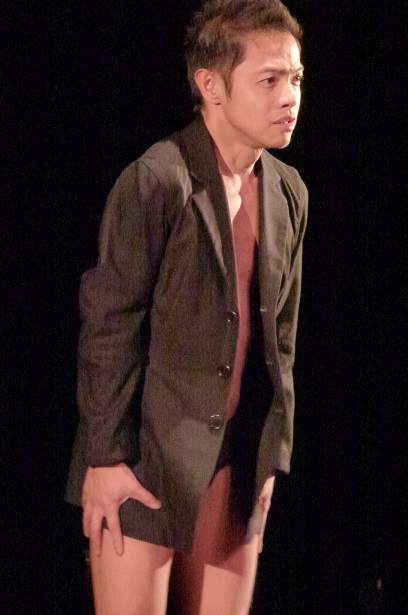
    Jason Garcia Ignacio, a compact and muscular dancer from the Philippines, used harpsichord music by Louis Couperin to excellent advantage for his handsomely-danced solo My Brother’s Keeper. Jason’s supple body, finely lit to delineate his sculpted torso, showed compelling flexiblity in some deep backbends (that’s Jason in the costume-photo at the top of this article).

    L1270673

    The evening’s most unusual work, Go To The Limits Of Your Longing, was created and performed by Anna Brown Massey (above).

    L1270617

    Ms. Massey’s solo opens with vocalist Julia Patinella seated onstage, clapping a rhythmic phrase. As dancer enters (above photo), Ms. Patinella bursts into song: her is voice rich, earthy and powerful. The dancer takes a seat across the stage and her entire solo is performed from this seated position, with Ms. Massey using her arms, hands, shoulders and neck to convey an interior monolog. The voice of Ms. Patinella filled the hall with passionate clarity.

    L1270684

    Looking striking with her long hair and vivid make-up, dancer Katherine Alvarado showed a strong dramatic flair in her solo Distancia; the music, by Max Richter, seems Glassian at first but then evolves into expansive, full-blown lyricism. Ms. Alvarado, in a backless black outfit, used her entire body as a communicative vessel.

    L1270757

    A strong house beat set Delphina Parentiv (above) in restless motion for her solo Body Rebellion. A vivid gestural language and space-covering combinations marked the dancer’s high-energy performance which drew an enthusiastic reaction from the audience.

    L1270794

    Roberto Villanueva’ s solo Seconds Remain The Same showed this magnetic dancer’s presence and his flexibility of physique as he moved across the stage in a contemplative state, seemingly lured by some far-off vision. Eventually the dancer is seen in silhouette as he retreats from us into the distance.

    L1270432

    The BalaSole tradition of opening and closing their programmes with ensemble works created in a brief rehearsal period was particularly rewarding tonight as the dancers introduced themselves (and bade us good-night) to the music of Franz Joseph Haydn, marked by celebratory getures and a series of pas de trois in which individual personalities emerged. The evening’s performers were joined by emerging artist Ashley Peters who – it seemed to me – deserved a solo shot. Maybe in the next BalaSole show? 

    I apologize for the darkness and lack of focus in some of these photos from the dress rehearsal: I am still trying to capture motion, but I have a long way to go…

    L1270402

    …though I can do well enough when dancers stand still (Jason and Christa, above).

  • Intermezzo Dance Company/Update

    _G1A0851

    Above: Carlos Lopez and Kurt Froman in the ‘drunken duet’ from Raymond Lukens’ ballet VEILS from Intermezzo Dance Company‘s debut performance at the 92nd Street Y; photo by Sarah Sterner

    Mary Cargill writes about the Intermezzo performance here, and Deborah Wingert covers it here.

    _G1A0918

    Above: Aran Bell and Kurt Froman in VEILS; photo by Sarah Sterner

    _G1A1002

    Above: Intermezzo ballerinas Kaitlyn Gilliland and Rina Barrantes; photo by Sarah Sterner

    IMG_3939

    After the show: Craig Salstein (center) with the Intermezzo dancers and the members of the Wyrick String Quartet.

  • Great Piano Quartets @ Chamber Music Society

    Gilbertkalish_large

    Above: pianist Gilbert Kalish of the Chamber Music Society of Lincoln Center

    Tuesday October 22nd, 2013 – Piano quartets from three centuries were on the bill today at this Chamber Music Society of Lincoln Center performance. As I walked down the corridor to enter the auditorium at Alice Tully Hall, I experienced the odd sensation of being in church; these CMS concerts are not only completely satisfying musically, but they are so spiritually uplifting in their ability to carry us out of the everyday world to something more pure and elevated. 

    I had an incredible seat, second row center, looking up at the musicians at close range. The lines of communication – between player and player, and between musicians and audience – were so direct and intimate; I don’t exaggerate when I say it was a transportive experience.

    O weiss

    Above: pianist Orion Weiss

    Mozart first: the ill-fated genius composed two piano quartets, a relatively rare genre during the Viennese
    Classical period. The E-flat major quartet K. 493 is the second of these, and dates from 1786. It is thought to be the piece that Mozart himself played at Count Joseph Thun’s palace when the composer journeyed to Prague in 1787 to witness the overwhelming success there of his opera LE NOZZE DI FIGARO. This quartet is considered among the peaks of Mozart’s chamber music, and it certainly seemed so today in a performance of remarkable musical clarity and emotional immediacy.

    Orion Weiss was at the Steinway, with Nicolas Dautricourt (violin), Paul Neubauer (viola) and Keith Robinson (cello) center-stage. Their playing was impeccable, and I so deeply enjoyed watching the communication between them: a silent language of the eyes and a tilt of the head. Mr. Neubauer, as expressive of face as in his musicianship, seemed the conduit linking the four players emotionally. The music flowed freely as melody and embellishment passed from one player to another. An atmosphere of quiet intensity filled the hall, the audience breathing in the sustaining beauty of Mozart’s perfection.

    A complete change of mood as we were transported forward to 1931 and the intoxicating rhythms and alluring turns of phrase of the Spanish composer Joaquin Turina’s A-minor quartet, opus 67. Here the players were out to seduce the ear, led by Yura Lee (violin) with Messrs. Neubauer, Robinson and Weiss.

    Turina composed this piano quartet in 1931; its flavour of
    Spanish folk music, with gypsy and Andalusian nuances, is characteristic of the composer’s work, which was influenced by his predecessors Manuel de Falla and Isaac Albeniz. Veering effortlessly from the fiery rhythms to the more sustained song-like motifs, Ms. Lee and her colleagues reveled in sensuous glow of the music; Mr. Weiss fulfilled the demanding piano writing with élan, and again I greatly enjoyed the the silent sense of conspiracy among the players as they wound their way thru the subtle turns of the music.

    Yura Lee switched gracefully from violin to viola for the evening’s concluding work, the Brahms Quartet #2, Opus 26. For this long (50 minutes) and demanding work, keyboard master Gilbert Kalish was at the Steinway, Nicolas Dautricourt returned with his violin, and the superb Mr. Robinson polished off his evening perfectly – the only player involved in all three works tonight. 

    Johannes Brahms himself played the piano part at this work’s premiere in 1863; Robert Schumann had already hailed Brahms as Beethoven’s heir apparent, and the piano quartet was one of the works that propelled the composer into his position as one of the immortal Three Bs – Bach, Beethoven and Brahms – in the pantheon of classical music.

    Tonight this masterpiece unfolded in all its glory. In a touching tribute in the playbill, Mr. Dautricourt spoke of being mentored by Mr. Kalish at Ravinia in 2002 when the Frenchman had first arrived in the United States. It must have been a great experience for them to perform together this evening.

    Mr. Dautricourt’s playing is so passionate and expressive; I found myself drawn to this tall and charismatic musician, who is apparently equally at home in both jazz and the classics. Mr. Kalish’s playing was resonant and sublime, with Ms. Lee and Mr. Robinson yet again as pleasing to watch as to hear. The cumulative effect of their performance drew a sustained applause from the attentive and dedicated audience of music-lovers.

    The anticipation I felt going into the concert was amply rewarded: I had expected the best that music can offer, but – intangibly – it was even better than that.

    The participating artists tonight were:

  • Ballet Next: New Works-in-Progress

    L1270067

    Above: Michele Wiles of Ballet Next

    Monday October 21st, 2013 – Ballet Next had a huge turn-out (intentional pun!) for their choreographic exhibition at Ailey tonight. Three works being created for the Company’s upcoming season at New York Live Arts were shown, all performed to live music under the direction of cellist Elad Kabilio.

    The dates for the Ballet Next performances at New York Live Arts are January 13th – 18th, 2014; further information will be forthcoming.


    L1260983

    Above: violinist Mario Gotoh played the Chaconne from the ‘Partita #2′  for the pas de deux entitled Bach 260, choreographed by Robert Sher-Machernndl, and danced by Michele Wiles and Mr. Machernndl (photo below).


    L1270057

    This duet, anchored in the classic vocabulary, takes a contemporary overlay with elements of pursuit and capture carrying the dancers about the space in movement that both sustains and sometimes counter-acts the Bach score, which Ms. Gotoh played so beautifully.


    L1270122

    All the Drops of Water
    is a duet choreographed by Michele Wiles and danced by Tiffany Mangulabnan and Ms Wiles (above). The music, a lyrical quintet by Max Richter, was performed by Hajnal Karman Pivnik and Ms. Gotoh (violins), Caroline Gilbert (viola), Mr. Kabilio (cello) and Ben Laude (piano). The musicians were seated literally inches away from me – in fact, I could read Hajnal’s score – while the two dancers in deep blue with their hair down seemed like contemporary nymphs. The choreography has a restless quality, inter-laced with moments of repose and tenderness.


    L1270222

    Surmisable Units is an ensemble work with choreography by Brian Reeder. The dancers (above) are Tiffany Mangulabanan, Michele Wiles, Steven Melendez, Kaitlyn Gilliland, and Brittany Cioce. The score, Steve Reich’s tricky and repetitive ‘Piano Phase‘, was played by Peter Dugan and Ben Laude.

    The choreography utilizes the space in quirky ways, with the dancers sometimes standing behind the two pianos (which are center-stage) and executing semaphoric arm gestures. At times the dancers wear metallic-silver face masks, making them anonymous. Solo dancing is woven in, and the combinations echo the speed and articulation of the relentless musical pulse.


    L1270157

    Above: Kaitlyn Gilliland and Michele Wiles in Surmisible Units.

    The large crowd of Company friends and supporters seemed very taken with the dancing and the music; I look forward to seeing these works in their staged settings at NYLA in the new year.