Blog

  • US Open Qualifying Tournament 2013 #1

    L1190872

    Above: Robby Ginepri

    Monday August 20th, 2013 – Robby Ginepri hit a career high in 2005 when he finished the season ranked #15 in the world. Thereafter he remained a force on the tour but never equalled his 2005 record. A biking accident in 2010 side-lined him for almost a year. To be honest, I’d sort of forgotten about him and I guess I assumed that he’d retired. He’ll turn 31 this year, and when I saw his name among the players listed for the US Open qualifying tournament this week, it was a bit like a blast from the past.

    Last summer I’d almost given up on the Open; the constant use of cellphones during play is so distracing, as are the large of small children who have no clue as to what tennis is all about and invariably get cranky very quickly (“I’d rather go to the playground!” whined one tiny girl being dragged around by her mother today); food and beverages are absurdly expensive ($5 for a normal sized bottle of Coke), and off-duty linesmen and ball-kids love to congregate around the courts during matches and chatter away: “Did you see ELYSIUM yet? Awesome…blah blah blah”. But today it was not overly crowded and for the most part I was able to concentrate on the actual playing.

    The seats at the outer courts of the Tennis Center can be exceptionally uncomfortable: hard, bare metal that heats up like a stovetop in the summer sun. Invariably people taking seats during a match find their butts getting baked: first contact can really be alarming. Thus I normally prefer to stand (it’s also easier for taking pictures). But this summer they’ve extended the 3-row metal seating bleachers almost the full length of the court so you can’t stand by the court-rail any more and get all into the match. Since hardly anyone watches a complete set these days, there’s a lot of coming and going, and clambering over other people.

    The tall, lanky Israeli player Amir Weintraub is being hosted in NYC by the building manager of our apartment complex. Augie asked me to check out Amir’s match and since it was the first match of the day, I started there. Amir was playing the American Noah Rubin; Rubin was heavily favored by the large and fairly attentive crowd. Amir took the first set and seemed destined to win in two sets; but Noah fought back hard, delivering some great shots. After Noah won the second set, I needed to head over to Court 7; but I ran into Augie later and he told me that Amir – deservedly – had prevailed.

    L1190828

    On Court 7, the Indian player Somdev Devvarman (above) was facing Brazil’s Fabiano De Paula. I’d seen Somdev at the US Open in 2009 and I was really impressed, but today was the first time I’ve seen him since. I went up high into the bleachers and found a solitary vantage point. I enjoyed the match tremendously because I could really concentrate; and up above court-level a gentle summer breeze and passing fluffy clouds made for a perfect tennis-watching experience. 

    L1190807

    Somdev for the most part dominated the action; his serve is breakable but when it’s on it’s really on. His shots go deep and his sense of placement is keen, and despite some frustration with questionabe line calls he moved steadily onward to a straight-set win. Mr. De Paula had some fine moments but Somdev’s victory seemed inevitable. 

    L1190855

    Somdev, after the match.

    L1190859

    Then I ran over to Court 17, the new ‘stadium-style’ court, where Robby Ginepri and Giovanni Lapentti (of Ecuador) were already into the second set. Robby had taken the first set but Giovanni wasn’t about to give in. The crowd was lopsidedly pro-Robby, understandably, and the American clearly didn’t want to disappoint. A hoped-for win at 5-4 didn’t materialize, and the set went to a tie-breaker in which Robby eventually secured victory.

    L1190880

    Robby Ginepri

    L1190884

    Lapentti and Ginepri after the match.

  • ABARUKAS + vivake @ MMAC

    1069802_10151735363464933_471183311_n

    Sunday August 18, 2013 – One of my few opportunities to try a new dance company, since their performance happened to fall on one of my rare free days: Abarakus Contemporary Dance Company gave two performances at MMAC this weekend where they were joined by the hip-hop company vivake.

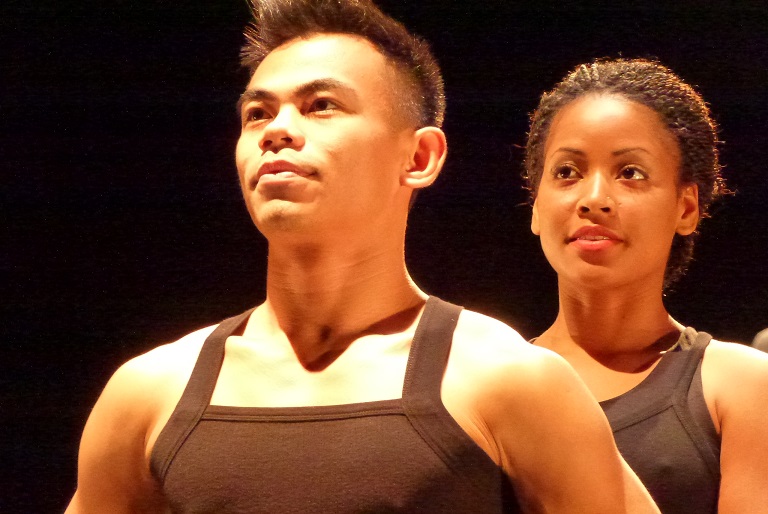
    vivake opened the show, dancing Scar. The Company, led by Vivake Khamsingsavath, is made up of sexy boys and beautful girls, and they danced up a sultry summer storm in this darkly alluring piece. All clad in black, and illuminated by the fine lighting design by David Opara, the dancers exuded sensuous energy. Vivake himself is an ultra-charismatic personage, a dancer who put me very much in mind of such super-smooth Gotham movers as Bennyroyce Royon and Norbert de la Cruz. I look forward to seeing this dynamic group again.

    I loved looking at the cast listings this evening and finding familiar names: Lizzy Zevallos dancing with vivake and Guang-Lei Hui dancing with ABARUKAS. I really enjoyed seeing both of them again.

    ABARUKAS offered Yoshito Sakuraba’s “Lullaby to Mr. Adam“; this note from the choreographer had me expectng a narrative dancework:

    Lullaby
    to Mr. Adam
    emerges from from an idea of a complete separation from
    reality, imagining myself returning to the past.   I imagine myself
    walking to my home where I lived and loved when I was little.   The
    moment I start imagining that, I continue to recall a letter from the
    first girl I fell in love with, the barbershop I used to go to, streets
    where I’d bicycle to school, a sky where there were fireworks in the
    summer, friends I played basketball with, and my grandma, whom I loved
    but never expressed that to her.  I’ve lived through everything and
    everyone’s memory.   And they lived through mine.   I still have the
    letters from the girl.”

    But the choreographer is not a literalist; the piece is abstract and opens with a ritualistic passage in which we meet the dancers one by one. As with vivake, ABARUKAS is a Company loaded with talent. As individuals and as an ensemble, they danced with vivid commitment. Plenty of solo opportunities were afforded as the dancework unfolded. The choreography is gestural, scupltural, and – again – excellently lit by Mr. Opara. 

    Adan Jiminez Aguillar, a tall and stage-commanding presence, had a central role in the piece commencing with a passage in which he shoots – and then revives – his fellow dancers. He’s cast as a rather tyrannical type, though in the end he manages somehow to redeem himself. Guang-Lei Hui is a very fluid mover and a strong partner, and Shawn Rawls showed some remarkable break-dancing skills in his solo. Adan has a sustained, powerfully lyrical solo danced to the evening’s most poignant musical theme. The women – Caitlin Cantrell, Erin Dillon, Rebecca Quintrell, and Tsai-Hsi Hung – danced beautifully and allowed their individual personalities to emerge as the work surged forward.

    The denouement of the piece comes as each dancer steps forward to slap Adan’s face – he endures this, and expects the same from Guang-Lei who instead gently lays his hand on Adan’s shoulder. A perfect final image as the light fades.

    But no – there’s more to come. Another ensemble passages melds into a spacious duet for the striking Erin Dillon and Adan which ends with yet another ideal final tableau. But no – the work continues on. It’s all well-crafted and very finely executed, but after two false endings things seem to be stretching on a bit too long; a judicious paring down and some re-arranging of the various segments could produce a more cohesive and impressive overall effect. Nevertheless, the performances of the dancers overcame any slight misgivings about the structure of the piece.

  • Jessica Lang Dance @ The Joyce

    6a00d8341c4e3853ef016761100c9b970b-800wi

    Above: dancers Clifton Brown and Kana Kimura of Jessica Lang Dance; photo by Kokyat

    Friday August 16th, 2013 – The Joyce’s Ballet V6.0 festival draws to a close with performances by Jessica Lang Dance making their Joyce debut with in a visually rich and musically inspired programme. Jessica Lang’s
    choreography has been on my A-list since I saw her Astor Piazzolla ballet Oblivion danced by the ABT Studio Company a few years ago. Jessica comes to The Joyce fresh from her operatic-directing debut at Glimmerglass (Pergolesi’s STABAT MATER) and a sold-out run for her Company at Jacob’s Pillow. Tonight’s performance at The Joyce was also a sell-out.

    The evening commenced on a high note and soared onward from there. To music of Antonio Vivaldi, Jessica’s 2010 A Solo in Nine Parts seemed to immediately captivate the audience. Her excellent company of dancers came on, all clad in summer-white, and danced their hearts out in this ballet which drew to mind Paul Taylor’s most joyous works.

    Performed against a sea-green back-panel, Jessica’s choreography looked clean and clear. and she has ideally visualized the Vivaldi score. Woven thru the ensemble passages are solos for each of the nine dancers. The central slow movement is a pas de quatre for Julie Fiorenza, Laura Mead, Kirk Henning and Milan Misko. Each dancer in the ensemble made his or her mark: Sarah Haarmann, Claudia MacPherson, Kana Kimura, Todd Burnsed, and Clifton Brown. Clifton in particular danced superbly in three of the four works shown tonight; he’s one of the most fluent and charismatic dancers of our time.

    Clifton Brown’s partnership with Kana Kimura, a striking dancer with a mystical presence, was the highlight of the second work, i.n.k. In this ballet which fuses music, dance and film to hypnotic effect, Kana and Clifton perform a remarkable adagio which ends with a thrilling slow backbend from Kana, supported in Clifton’s arms. The audience seemd to hold their collective breath as the dancers executed this unusual passage with complete control.

    i.n.k. overall is enthralling. The black-clad ensemble move before a glaring white back-panel, sometimes dancing with their shadows. Meanwhile drops or waves of dark ink splash across the screen. The crystalline score by Jakub Ciupinski, the costuming of Elena Comendador, Nicole Pearce’s lighting, and the captivating film elements (KUSHO by Shinichi Maruyama, edited by Tetsushi Wakasugi) all combine to make this poetic dancework a 21st century jewel: imaginative and beautifully executed.

    The evening’s second half kicked off excitingly with Aria, a quartet set to Zenobia’s tragic/frantic aria “Son contenta di morire” from Handel’s RADAMISTO. In this world premiere performance, three boys (Todd Burnsed, Kirk Henning and Milan Misko) in grey tights and bright red shirts sail thru the strongly musical choreography with the delicious Laura Mead the object of their attention. Laura, in a flame-red frock and dancing on pointe, gave a vivid and impetuous performance. Mr. Burnsed is her primary partner, though she often seems to want to evade contact altogether. My only slight concern here was that the singer on the chosen recording sometimes seemed slightly below pitch.

    Pianist Taka Kigawa took the keyboard to play Schumann live for the evening’s concluding work, From Foreign Lands and People; Taka’s playing was refined and beautifully supportive of the dancing. Like everything else on the programme tonight, this ballet was visually impressive. The midnight-blue-clad dancers move on, over, and under glossy black architectural pieces which they skillfully manipulate and re-arrange throughout the ballet. Pools of white light enhance the shifting landscape as the dancers clamber onto, slide down, and even partner the oblong boxes. The mood of the piece veers from playful to poetic, dictated by Taka’s playing.

    Milan Misko, a long-limbed dancer I have seen performing with TAKE Dance and the Lubovitch company, seems to have found an ideal dance-home in Jessica Lang’s style.  And Clifton Brown’s dancing – all evening – was a marvel: his solo in the concluding work was astonishing in its clarity and expressiveness. If Mlles. Mead and Kimura stood out among the other dancers by virtue of their featured roles, the entire ensemble deserve bouquets for their impressive performances in this vastly pleasing evening of dance.

  • At Home With Wagner III

    Wagner

    Above: Richard Wagner

    Having taken a break from listening to Wagner at home while I was wrapped up with attending the RING operas at The Met, I picked up where I’d left off in playing CDs that my friend Dmitry has graciously made for me. These live recordings all come from a valuable source, Opera Depot, and this latest round of Wagnerian adventures kicks off with a 1966 performance of FLIEGENDE HOLLANDER from Covent Garden.

    HOLLANDER was not the first Wagner opera I ever experienced in the theatre, but my first encounter with it (in 1968) was a memorable event with Leonie Rysanek (singing despite a high fever) magnificent as Senta, and Walter Cassel, James King and Giorgio Tozzi as the male principals.

    Jones

    Above: Dame Gwyneth Jones

    For this 1966 performance from London, Sir Georg Solti is on the podium, stirring up a vivid performance that comes across excitingly in this recording which is in pretty good broadcast sound, with the voices prominent.

    David Ward is a bass-oriented Dutchman and his singing is moving in its passion and despair, fierce in anger and with a touching human quality in the more reflective passages. He and his Senta, Dame Gwyneth Jones, manage the strenuous demands of their long duet very well: both the tessitura and the emotional weight of this duet test the greatest of singers and if there are slight signs of effort here and there in this recording, the overall effect is powerful.

    Dame Gwyneth, just two years after her break-through performance at The Garden in TROVATORE casts out the powerful top notes before her final sacrificial leap thrillingly; earlier, in the Ballad she is engrossing in her use of piano singing and creates a haunting picture of the obsessed girl. The soprano’s well-known tendency to approach notes with a rather woozy attack before stabilizing the tone is sometimes in evidence; I find it endearing.

    The great basso Gottlob Frick is a wonderful Daland, and tenor Vilem Pribyl holds up well in the demanding role of Erik; his third act aria – which recalls Bellini in its melodic flow – is passionately sung. Elizabeth Bainbridge and Kenneth MacDonald give sturdy performances as Mary and the Steersman.

    ~~~~~~~~~~~~~~~~~~~~~~~~~~~~~~~~~~~~~~~~~~~~~~~~~~~~~~~~~~~~~~~~~~~~~~~~~~~~~~~~~~~~~~~~~~~~

    1024px-Horst_Stein

    A WALKURE Act I from Bayreuth 1971 finds conductor Horst Stein (above) giving a great sense of urgency to the opening ‘chase’ music. Helge Brilioth, probably better known for his Tristan and Siegfried, sounds a bit rough-hewn at first as Siegmund but summons up some poetry later in the act. Dame Gwyneth Jones as Sieglinde shows both contemplative lyricism and the power of a future Brunnhilde; her singing is emotional without breaking the musical frame. Karl Ridderbusch is a darkly voluminous Hunding; despite a few moments of sharpness here and there, he makes a strong impression.

    ~~~~~~~~~~~~~~~~~~~~~~~~~~~~~~~~~~~~~~~~~~~~~~~~~~~~~~~~~~~~~~~~~~~~~~~~~~~~~~~~~~~~~~~~~“

    540752_10151474196683142_112317311_n

    The Swedish singer Berit Lindholm (above) was one of a group of sopranos – Rita Hunter, Ingrid Bjoner, Caterina Ligendza and Dame Gwyneth Jones were some of the others – who increasingly tackled the great Wagnerian roles as Birgit Nilsson’s career wound down. In 1976 Lindholm sang Brunnhilde in a performance of GOTTERDAMMERUNG at Covent Garden conducted by Sir Colin Davis, and she does quite well by the role, bringing a more feminine and vulnerable quality to her interpretation than Nilsson did. Lindholm reaches a fine peak as Act I moves toward its inexorable climax with the meeting between Brunnhilde and Waltraute, followed by the false Gunther’s rape of the ring.

    Interestingly, though both the recording and the Covent Garden website list Yvonne Minton as Waltraute in this performance, there is some question that she might have been replaced last-minute by Gillian Knight; in fact, some listings for this recording on other releases do show Knight singing Waltraute. A delicious mystery, since whichever mezzo it is is impressive indeed. (I’ve left an inquiry on the Opera Depot listing, perhaps someone can shed further light…)

    Jean Cox certainly has an authentic Wagnerian voice though at times in Act I his singing falls a shade below pitch. The wonderful basso Bengt Rundgren sounds fine as Hagen in Act I, and his half-siblings are Siegmund Nimsgern – later a Bayreuth Wotan – as Gunther, and Hanna Lisowska as Gutrune, a role she repeated at the Met when the ‘Levine’ Cycle was filmed for posterity.

    As an admirer of the Norn scene, I’m very pleased with the three women who sing this fantastic music here: Patricia Payne, Elizabeth Connell and Pauline Tinsley. Ms. Payne is steady and sure of voice and what a delight to hear a future Isolde (Ms. Connell) and Kundry (Ms. Tinsley) in these roles; Ms. Tinsley dips impressively into her chest voice at one point, an unusual and exciting effect.

    Sir Colin Davis builds the great span of the prologue/Act I persuasively; a few minor orchestral blips here and there are barely worth mentioning. Once Waltraute arrives at Brunnhilde’s Rock the conductor attains a heightened level of dramatic intensity and the act ends excitingly.

    Act II opens with the mysterious conversation between Alberich and his slumbering son, Hagen. Zoltán Kelemen, who was Karajan’s Alberich when the conductor inaugurated his RING Cycle at The Met (a project from which the maestro withdrew after the first two operas) makes a fine effect, and Mr. Rundgren maintains his sturdily sung Hagen throughout this act. Jean Cox is very authoritative as he declaims his oath on Hagen’s spear; any misgivings about him from Act I are swept away here. Berit Lindholm may lack the trumpeting, fearlessly sustained high notes of the more famous Nilsson, but her Brunnhilde is exciting in its own right, with her anguished cries of ‘Verrat! Verrat!’ (“Betrayed!”) a particularly strong moment.   

    Whether she is the Waltraute or not, Gillian Knight is definitely one of the Rhinemaidens, joined in melodious harmonies by Valerie Masterson and Eiddwen Harrhy for the opening scene of Act III. There’s some vividly silly giggling from this trio, and Ms. Masterson in particular sounds lovely – an augury of her eventual status as a fabulous Cleopatra.

    Mr. Cox has impressive reserves to carry him thru Siegfried’s taxing narrative – he’s at his best here – and if Ms. Lindholm’s voice doesn’t totally dominate the Immolation Scene, she’s very persuasive in the more reflective passages of Brunnhilde’s great concluding aria. Sir Colin Davis had built the opera steadily and with a sure sense of the music’s architecture; he saves a brilliant stroke for the end of the opera when he does not take the ‘traditional’ pause before the reprise of the ‘redemption thru love’ theme but instead sails forth into it with impetuous fervor.

    There were times while listening to this performance when I wondered if this was a broadcast performance or was recorded in-house. The voices do not always have the prominence we associate with broadcast sound, but perhaps the micorphones were oddly placed. At any rate, GOTTERDAMMERUNG has again made its mark as the culmination of the great drama of The RING.

  • JANUSPHERE at the IATI Theater

    Janusphere

    Photo: Rachel Neville

    Sunday July 28, 2013 – JANUSPHERE at the IATI Theater down on East 4th Street. I met my friend Roberto Villanueva (of BalaSole Dance Company) there on an overcast afternoon.

    Aqura Lacey, Dora Kovac, Grace Song, Jason Jordan, Luke Manley and Matt Van appeared in KinderPlatz (Children’s
    Place
    ) which is set to a darkish, at times almost ominous score by Adyo and Deepbass. Despite its title, there’s nothing juvenile about this work. The dancers,
    clad in soft creamy outfits, perform a series of trios and duets, often changing partners and configurations. They run and slide across the smooth floor, or stand still waving their arms in
    unison windmill patterns; in these motifs the illusions of children’s
    games are expresssed, but the mood remains distinctly ‘adult’.

    A geodesic dome serves as a jungle gym, a cage, a bowl. At one point Ms Lacey climbs up onto the shoulders of the men, as if trying to escape thru the ceiling.  

    KinderPlatz is accompanied by original video projections created by visual artist Aleksandar
    Cosic, featuring elements of architecture and shifting perspectives. What makes the work appealing though is the movement quality and the clarity of personal expression of the six indivdual dancers.

    A Dancer’s Life opens with the diverse group of Janusphere
    dancers appearing one-by-one in practice clothes, telling their stories of “why I became a dancer”. A solemn narrator calls the group to order and they start doing classroom pliés and
    tendus, and working on partnering.

    Then the competitive spirit takes over: to the ‘Lone Ranger’ theme from Rossini’s WILLIAM TELL overture, the dancers race about the space, bumping one another off in an effort to get ahead of the pack. In an audition scene, the dancers vie
    fiercely for available work…and then comes the anguish of waiting for
    a callback. When all but one dancer are called,
    there’s relief and rejoicing, as well as a defensive narrative from the unchosen one. The work ends with the start of another day, another class.

    In A Dancer’s Life, the cast of KinderPlatz are joined by Misei Daimaru, Stephanie van Doreen, and Ashley Whitson. In the theater’s intimate space, the personalities and individual attractiveness of the dancers gave the performance a sense of direct communication.

  • Emery LeCrone for Works & Process

    6a00d8341c4e3853ef0168ea8b64a8970c-800wi

    Above: Emery LeCrone, photo by Kokyat

    Thursday July 25th, 2013 – Choreographer Emery LeCrone has a new and unusual commission from the Guggenheim’s Works & Process series. In the past, Works & Process have invited two choreographers to create works to the same piece of music and present them on the same programme. Emery’s current commission gives this concept a new twist: she has been asked to create two ballets to the same piece of music, using different dancers in each. Today at the Guggenheim, friends of the choreographer were invited to watch a working rehearsal for this project.

    The music is – blessedly – Bach, specifically the partita #2 in C minor. When we arrived, Emery was working out some partnering details with dancers Kaitlyn Gilliland and Alfredo Solivan. A second couple – Sarah Atkins and Richard Isaac – then rehearsed on a passage where they dance in unison, employing a fast-paced gestural language. As the hour drew to a close, the four dancers appeared together and ran thru the segment, dancing to the music which has now become visual.

    Specific dates for the Works & Process perfomances of Emery’s Bach double-bill have not yet been set, but it will most likely be seen in March 2014. Further details will be forthcoming.

  • Installation: Cedar Lake

    L1180461

    Wednesday July 24th, 2013 – Cedar Lake Contemporary Ballet‘s interim artistic director Alexandra Damiani conceived and directed this evening’s expansive and stimulating installation which was presented at my favorite New York dance venue: Cedar Lake‘s home space on West 26th Street.

    Thirty-two young dancers who had participated in this year’s Cedar Lake 360° summer intensive culminated their experience by joining Company members in a panoramic dance presentation featuring Clifton Taylor’s imaginative lighting, and sexy costuming by Cedar Lake‘s Matthew Rich. Company members Jason Kittelberger & Acacia Schachte, Jon Bond, Rachelle
    Scott and Ebony Williams each had a hand in the choreography, their work blended into a seamless montage of movement along with repertory excerpts from Sidi Larbi Cherkaoui and Andonis Foniadakis. All of this took place to the accompaniment of a sweepingly propulsive sound collage developed by (and including  original music by) Jasper Gahunia.

    Cedar Lake’s installations are both fascinating and frustrating: as an audience member you get to wander the space, sometimes actually coming into contact with the dancers. There are always three or four dance elements going on simultaneously in different areas of the space and that’s what leads to a bit of frustration: while watching one module of movement your eye is caught by something happening across the crowded room. After the first ten minutes I was thinking that even if I could attend all four showings of the installation I would still not be able to take it all in.

    The student dancers were super; many intriguing dance personalities are developing here and I feel certain several of them will become familiar to us as their careers develop. Of course it was exciting to see the Company members, some of them dancing and others on the side-lines.

    L1180428

    Photography is encouraged during Cedar Lake installations but I’m not skilled enough to take advantage of the situation, given the speed of the movement and the ever-shifting light. Only when a dancer is momentarily still (Company member Billy Bell, above) was my camera of any use to me. So for the most part I simply watched the event unfold, trusting that there will be images forthcoming from more seasoned photograhers.

  • Pergolesi’s STABAT MATER at Glimmerglass

    JamieKraus_StabatMaterFinal_548

    Above photo by Jamie Kraus

    Images from the Glimmerglass Festival production of Pergolesi’s STABAT MATER; part of a double bill (with David Lang’s little match girl passion), the Pergolesi was staged by choreographer Jessica Lang.

    The following photos are by Karli Cadel:

    KarliCadel-Stabat-5627

    Above: Sarah Parnicky and Danny Lindgren

    KarliCadel-StabatGeneral-9739

    Ensemble

    KarliCadel-StabatStageOrch-7397

    Above: Andrea Beasom and Danny Lindgren

    Click on each image to enlarge.

    Glimmerglass Festival‘s Artistic & General Director Francesca
    Zambello said: “Dance is a rich part of the operatic tradition, and I’m always
    interested in finding new ways to incorporate contemporary dance into
    our season at Glimmerglass. The way Jessica
    has integrated dance into this piece expresses Pergolesi’s timeless
    narrative in a truly modern vernacular. She has helped us provide a much
    richer Festival experience by bringing this beautiful, emotive
    choreography to our stage.”

    Jessica Lang Dance will be at The Joyce August 16th and 17th, 2013. Information here.

  • Amanda Selwyn’s Green Afternoon

    Impr 176 copy

    On June 13th, 2013 Amanda Selwyn Dance Theatre offered a summer evening of dance at a private function in East Hampton. Photographer Nir Arieli produced these images of Amanda’s dancers from this outdoor event.

    Click on each photo to enlarge.

    Impr 052 copy

    Jenny Gillan

    Impr 037 copy

    Emily Pacilio

    Impr 115 copy

    Torrey McAnena

    Impr 098 copy

    Randall Anthony Smith

    Prmnc 016 copy

    Emily Pacilio

    Impr 016 copy

    Sarah Buscaino

    Impr 062 copy

    Jenny Gillan

    Amanda Selwyn Dance Theatre recently performed IT’S A GAME at Manhattan’s New York Live Arts; an article about the performance may be found here.